
Semester VI DSC-18 India’s Foreign Policy: Challenges and Strategies
Unit I · 21 min read · Updated 24 Nov 2026
As per the University of Delhi (DU) BA (Hons) Political Science syllabus
Contents
- 1.1 Sources of India’s Foreign Policy
- 1.2 Theorising India’s Foreign Policy
- 1.3 Dimensions of India’s Foreign Policy: Domestic and International
- 1.4 From Non-Alignment to Strategic Engagements in a Multipolar World
- 1.5 Important Questions
- Discuss the sources of India’s foreign policy.
- How has India’s foreign policy been theorised? Discuss the main approaches.
- Discuss the domestic and international determinants of India’s foreign policy.
- Trace the evolution of India’s foreign policy from non-alignment to strategic engagements in a multipolar world.
- Short Notes
हम जहाँ तक संभव हो, एक-दूसरे के विरुद्ध खड़े गुटों की शक्ति-राजनीति से दूर रहना चाहते हैं, जिसने अतीत में विश्व युद्धों को जन्म दिया है।
We propose, as far as possible, to keep away from the power politics of groups, aligned against one another, which have led in the past to world wars.
— Jawaharlal Nehru, radio broadcast (7 September 1946)
INDIA began its life as an independent state in 1947 after two centuries of colonial rule. Its foreign policy was shaped by this postcolonial experience: a determination to protect its hard-won independence, to oppose colonialism and racism, to develop its economy and to keep out of the Cold War blocs through non-alignment. Over seven decades, India has moved from non-alignment to strategic engagements with many powers in a multipolar world. This unit studies the sources of India’s foreign policy, the ways scholars have theorised it, its domestic and international dimensions, and its evolution from non-alignment to strategic engagement, drawing on Deepshikha Shahi, Swarna Rajagopalan, Kanti Bajpai, Vineet Thakur, J. Bandyopadhyaya, P.S. Raghavan and Harsh V. Pant.
1.1 Sources of India’s Foreign Policy
India’s foreign policy draws on several sources. Geography gives India a central position in South Asia and the Indian Ocean, with long and disputed land borders. History, especially the experience of colonialism and Partition, made independence, sovereignty and anti-colonialism central values. Civilisational traditions offer ideas about statecraft: Deepshikha Shahi reads Kautilya’s Arthashastra as more than a realist manual, and Swarna Rajagopalan finds grand strategic thought in the Ramayana and Mahabharata. Economic needs, domestic politics, leaders and the international system also shape policy.
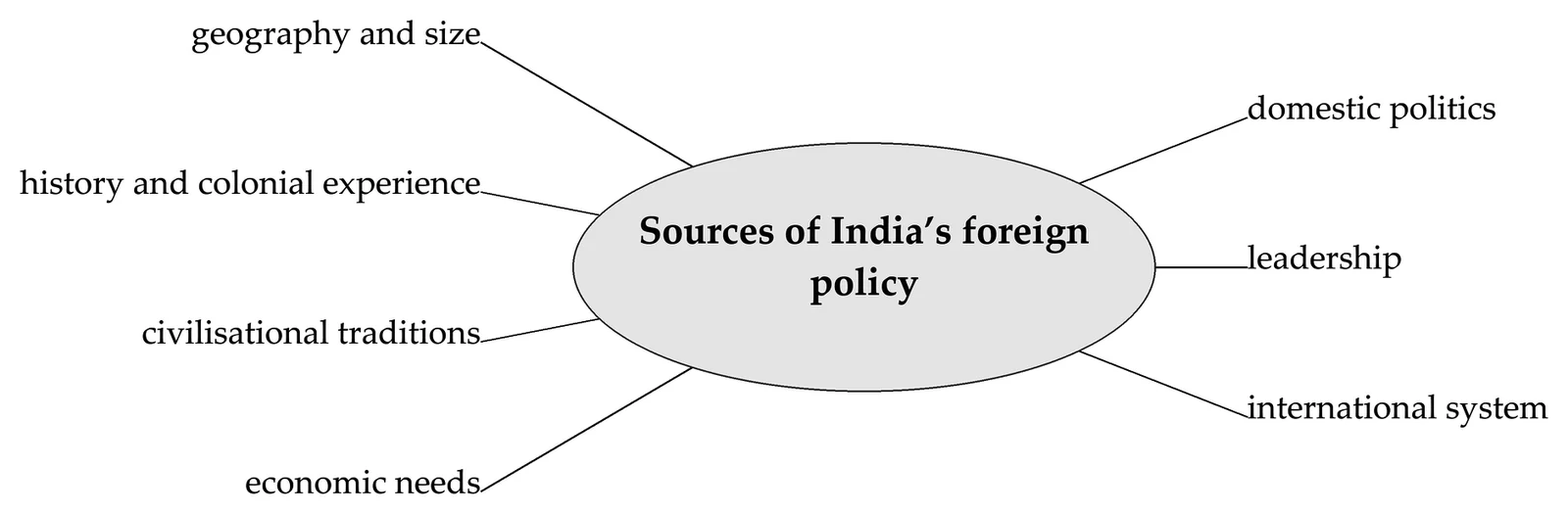
External Affairs Minister S. Jaishankar, in The India Way (2020), draws on the Mahabharata to describe India’s choices in an uncertain world, while Amrita and Aruna Narlikar use the epic to explain India’s bargaining style. Diplomats such as J.N. Dixit and Shivshankar Menon emphasise the role of geography, history and national interest. Together these sources explain both continuity and change in Indian foreign policy.
1.2 Theorising India’s Foreign Policy
For a long time, studies of Indian foreign policy were mainly historical and descriptive. Vineet Thakur argues that they lacked theory and relied on Western categories. Kanti Bajpai surveys the main approaches, from historical and policy accounts to explanations based on realism, which stresses power and security; liberalism, which stresses economic interdependence and institutions; and constructivism, which stresses identity and ideas. Priya Chacko shows that India’s foreign policy has been shaped by its postcolonial identity and its ambition to be a moral, ethical power. Siddharth Mallavarapu calls for theories grounded in Indian experience.

Bajpai also identifies schools of grand strategic thought in India: Nehruvians, who favour diplomacy, cooperation and restraint; neoliberals, who prioritise economic growth and interdependence; and hyperrealists, who emphasise military power, along with Hindu nationalist, Marxist and Gandhian views. Different governments have drawn on these traditions in different proportions.
1.3 Dimensions of India’s Foreign Policy: Domestic and International
Foreign policy is shaped by both domestic and international forces. Domestically, J. Bandyopadhyaya and A. Appadorai point to geography, economic development, political traditions, parties, Parliament, public opinion and leadership. India’s democracy, federal structure and coalition politics influence policy, as border states such as West Bengal and Tamil Nadu affect relations with Bangladesh and Sri Lanka. P.S. Raghavan stresses national security as a central determinant, given threats from Pakistan, China and terrorism.
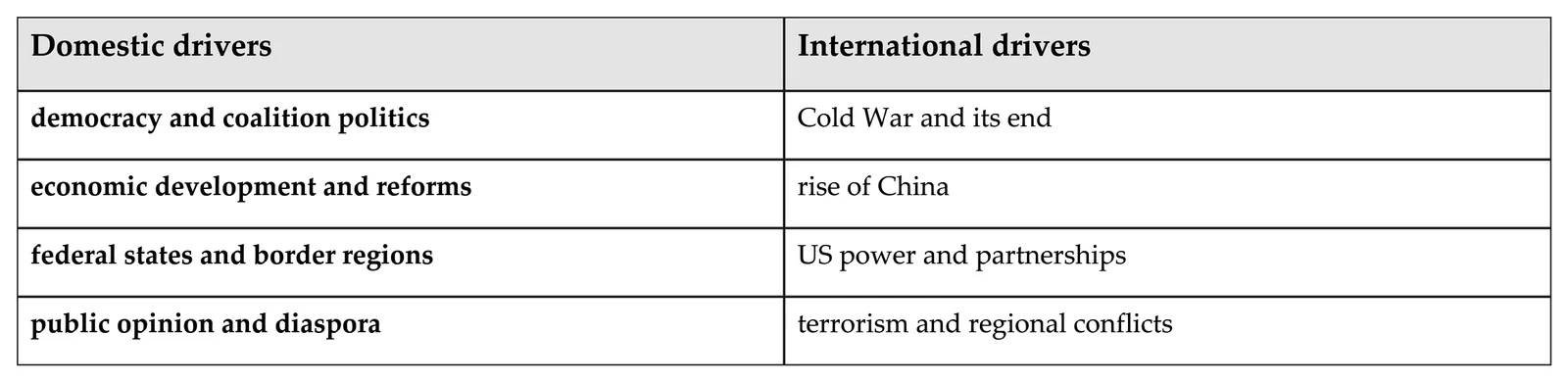
Internationally, the Cold War shaped India’s non-alignment and its friendship with the Soviet Union; the end of the Cold War, globalisation and economic reforms in 1991 led India to engage the United States, East Asia and the world economy; and the rise of China has become the most important strategic challenge. Varun Sahni identifies these domestic and external drivers as the keys to understanding India’s changing foreign policy.
1.4 From Non-Alignment to Strategic Engagements in a Multipolar World
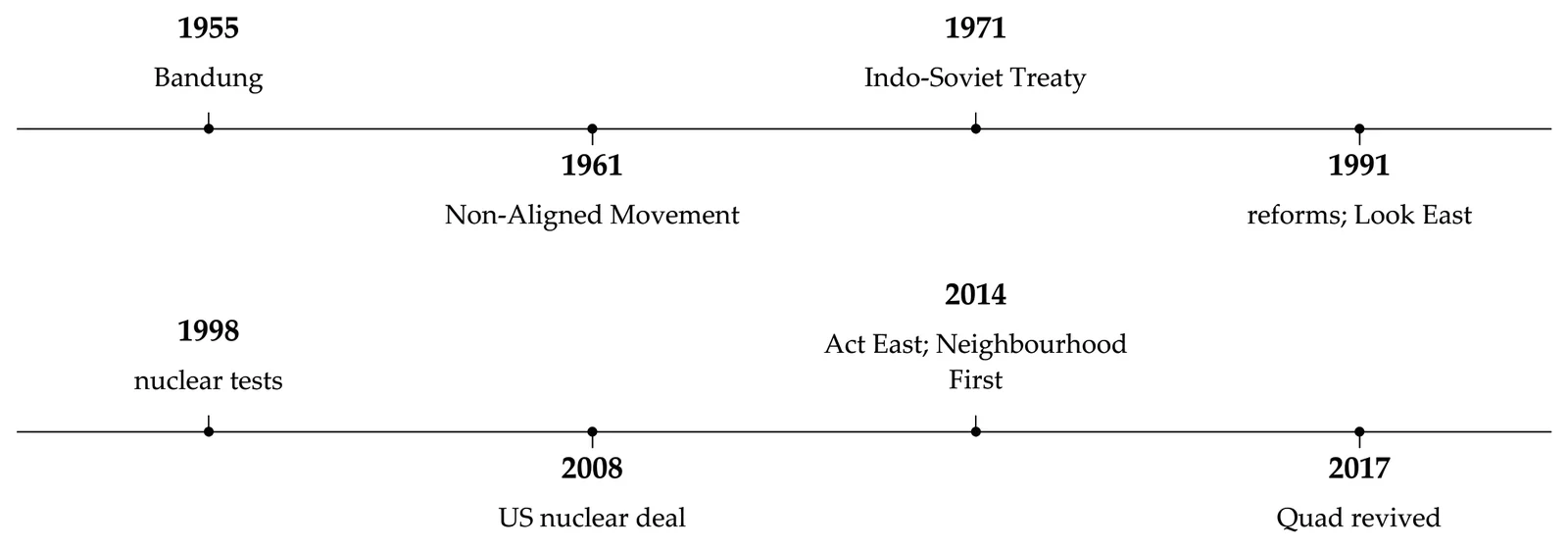
Non-alignment, developed by Nehru, meant not joining either Cold War bloc, keeping freedom of judgement on each issue and promoting peace and decolonisation. K.P. Mishra stressed that it was not neutrality but an active, independent policy. India helped found the Non-Aligned Movement in 1961, though it signed a treaty of friendship with the Soviet Union in 1971. After 1991, India adopted the Look East policy, engaged the United States and pursued economic diplomacy.
Today India speaks of strategic autonomy and multi-alignment: building partnerships with many powers without formal alliances. Harsh V. Pant and Julie Super argue that non-alignment is a twentieth-century policy unsuited to a changing world. Ian Hall shows how Narendra Modi reinvented Indian foreign policy through energetic diplomacy, the diaspora and new initiatives such as Neighbourhood First, Act East, the Indo-Pacific vision and the Quad with the US, Japan and Australia, while also deepening ties with Russia and the Global South.
1.5 Important Questions
- Question 1 Discuss the sources of India’s foreign policy.
- Question 2 How has India’s foreign policy been theorised? Discuss the main approaches.
- Question 3 Discuss the domestic and international determinants of India’s foreign policy.
- Question 4 Trace the evolution of India’s foreign policy from non-alignment to strategic engagements in a multipolar world.
DU asks the same idea in different words. So learn one broad answer for each question below; the same answer works for every question joined by OR.
Important Question 1
Discuss the sources of India’s foreign policy.
OR
Examine the role of India’s civilisational traditions in its foreign policy thinking.
OR
How do geography and history shape India’s foreign policy? Discuss.
Model Answer
“The king who is situated anywhere immediately on the circumference of the conqueror’s territory is termed the enemy.”
— Kautilya, Arthashastra, Book VI (translated by R. Shamasastry)
Introduction. A country’s foreign policy grows out of its geography, history, culture, economy and political system, as well as the international environment. India’s foreign policy, as a large postcolonial state with an ancient civilisation, draws on a particularly rich set of sources. Scholars such as Shahi and Rajagopalan highlight civilisational traditions, while diplomats emphasise geography and national interest.
1. Geography
India occupies a central position in South Asia, with the Himalayas to the north and the Indian Ocean to the south. It shares long land borders with Pakistan, China, Nepal, Bhutan, Bangladesh and Myanmar, many of them disputed, and sits astride major sea lanes. Geography makes the neighbourhood and the Indian Ocean central to its security.
2. Size and Resources
India’s large population, territory and economy give it the potential to be a major power, but also responsibilities for development and the welfare of a vast, diverse population. Energy needs make access to oil, gas and new technologies important.
3. Colonial Experience
Two centuries of colonial rule made Indians deeply committed to sovereignty, independence of action and opposition to colonialism and racism. This experience shaped non-alignment and India’s support for liberation movements in Asia and Africa.
4. Partition
Partition in 1947, with mass violence and the creation of Pakistan, left a legacy of hostility, the Kashmir dispute and concerns about internal security that continue to shape India’s relations in South Asia.
5. Kautilya’s Arthashastra
Kautilya’s Arthashastra set out the mandala theory, in which a neighbour is a natural enemy and the neighbour’s neighbour a natural friend, and a six-fold policy of peace, war, neutrality, marching, alliance and dual policy. Deepshikha Shahi argues that it should not be read only as realism, since it also contains a holistic, non-Western understanding of order.
6. The Epics
Swarna Rajagopalan finds ideas of grand strategy in the Ramayana and Mahabharata: the importance of dharma, the search for allies, attempts at negotiation before war, and the four means of statecraft, conciliation, gifts, division and force. Krishna’s peace mission before the Mahabharata war illustrates diplomacy as a first resort.
7. Modern Readings of the Mahabharata
S. Jaishankar uses Mahabharata episodes to explain India’s choices in a competitive world, and Amrita and Aruna Narlikar draw lessons from it for India’s negotiating style, suggesting that flexibility and pragmatism can coexist with principle.
8. National Movement and Nehru’s Ideas
The national movement developed a foreign policy outlook opposing imperialism and supporting world peace. Nehru’s ideas of non-alignment, Asian solidarity and Panchsheel drew on Gandhian non-violence and liberal internationalism.
9. Economic Needs
Development has always been a key goal. In the Nehru era, India sought aid and technology from both blocs; after 1991, trade, investment, energy and technology became central to foreign policy, reflected in economic diplomacy.
10. Domestic Politics
Parties, public opinion, Parliament, federal states and the diaspora influence foreign policy. Coalition governments and state concerns have sometimes limited agreements, as with the Teesta water treaty with Bangladesh.
11. Leadership
Leaders have shaped foreign policy significantly: Nehru’s non-alignment, Indira Gandhi’s realism in 1971, Narasimha Rao’s economic opening, Vajpayee’s nuclear tests and outreach to the US, Manmohan Singh’s nuclear deal and Modi’s energetic diplomacy.
12. International System
The structure of the international system, bipolar in the Cold War, unipolar after it, and increasingly multipolar today, sets the options available to India. The rise of China is now the most important external factor.
13. Constitutional Principles
Article 51 of the Constitution directs the state to promote international peace and security, maintain just and honourable relations between nations, respect international law and encourage the settlement of disputes by arbitration.
14. Evaluation
India’s foreign policy draws on geography, history, civilisational ideas, economic needs, domestic politics, leadership and the international system. Their interaction explains both the continuity of values such as autonomy and the changes in strategy over time.
Conclusion. Thus, the sources of India’s foreign policy include its geography, colonial history and Partition, civilisational traditions such as Kautilya and the epics, the ideas of the national movement, economic needs, domestic politics, leadership and the changing international system.
Important Question 2
How has India’s foreign policy been theorised? Discuss the main approaches.
OR
Examine the realist, liberal and constructivist approaches to India’s foreign policy.
OR
Discuss Kanti Bajpai’s schools of Indian grand strategy.
Model Answer
“We have no eternal allies, and we have no perpetual enemies. Our interests are eternal and perpetual, and those interests it is our duty to follow.”
— Lord Palmerston, House of Commons (1848)
Introduction. Indian foreign policy has often been studied through history and policy analysis rather than theory. In recent decades, scholars have applied and developed theoretical approaches to explain it. Kanti Bajpai, Vineet Thakur, Priya Chacko and Siddharth Mallavarapu show how realist, liberal, constructivist and postcolonial approaches illuminate different aspects of India’s behaviour.
1. The Need for Theory
Theory helps explain why India acts as it does, identify patterns and compare India with other states. Without theory, accounts of foreign policy become a list of events and decisions.
2. The Descriptive Tradition
Vineet Thakur argues that early writing on Indian foreign policy was largely descriptive, written by diplomats and area specialists, focused on policy, and borrowed Western concepts without developing Indian theory.
3. Bajpai’s Survey
Kanti Bajpai surveys the approaches used to study Indian foreign policy, including historical accounts, studies of leaders and decision-making, analyses of domestic politics, and theory-driven explanations based on systemic and ideational factors.
4. Realism
Realists explain India’s policy by power and security in an anarchic system. They see the 1971 treaty with the Soviet Union, the nuclear tests of 1998 and the balancing of China through partnerships with the US and Japan as rational responses to threats.
5. Liberalism
Liberals emphasise economic interdependence, institutions and democracy. They explain India’s engagement with the world economy after 1991, its participation in multilateral bodies and its democratic partnerships as driven by economic interests and shared values.
6. Constructivism
Constructivists argue that identity, norms and ideas shape foreign policy. Priya Chacko shows that India’s postcolonial identity, its self-image as a moral and civilisational power and its memory of colonialism shaped non-alignment and its approach to nuclear weapons.
7. Postcolonial Approaches
Postcolonial scholars emphasise how colonialism shaped India’s borders, institutions and worldview, and how India resists hierarchies in international order, such as the nuclear non-proliferation regime it called nuclear apartheid.
8. Nehruvianism
Bajpai identifies Nehruvianism as a major school of grand strategy. Nehruvians believe that international politics can be moderated through diplomacy, cooperation and institutions, and that India should use force with restraint while building its strength.
9. Neoliberalism
Neoliberals in Bajpai’s scheme argue that economic strength is the foundation of national power. India should prioritise growth, trade and investment, and economic interdependence can reduce conflict.
10. Hyperrealism
Hyperrealists see international politics as a struggle in which only military power ensures security. They favour strong armed forces, nuclear weapons and firm responses to Pakistan and China.
11. Other Schools
Bajpai also identifies Hindu nationalist, Marxist and Gandhian schools. Hindu nationalists emphasise civilisational strength and national pride; Marxists criticise imperialism and capitalism; Gandhians emphasise non-violence and moral example.
12. Mallavarapu on Theorising
Siddharth Mallavarapu argues for theorising India’s foreign relations using Indian experiences and concepts, engaging critically with Western theory rather than simply applying it.
13. Combining Approaches
No single approach explains everything. Realism explains security behaviour, liberalism economic diplomacy, and constructivism the role of identity and values. Indian policy often combines all three.
14. Perspectives from the Global South
Scholars such as Bhupinder Chimni and Siddharth Mallavarapu have promoted perspectives for the Global South, which examine how international law, institutions and the world economy reproduce inequalities between rich and poor countries. From this viewpoint, India’s demands for reform of the UN, the IMF and trade rules, and its claims to speak for developing countries, are central features of its foreign policy rather than rhetoric.
15. Evaluation
Theorising has enriched the study of Indian foreign policy, moving it beyond description. Combining mainstream theories with postcolonial and Indian perspectives offers the fullest understanding.
Conclusion. Thus, India’s foreign policy has been theorised through realism, liberalism, constructivism and postcolonial approaches, and through Bajpai’s schools of Nehruvianism, neoliberalism and hyperrealism. As Thakur and Mallavarapu argue, theory grounded in Indian experience is needed.
Important Question 3
Discuss the domestic and international determinants of India’s foreign policy.
OR
Examine the role of national security in India’s foreign policy.
OR
How do domestic factors influence India’s foreign policy? Discuss.
Model Answer
“The State shall endeavour to promote international peace and security; maintain just and honourable relations between nations.”
— Constitution of India, Article 51
Introduction. Foreign policy lies at the meeting point of domestic and international politics. India’s policy has been shaped by its domestic political system, economy and security needs, as well as by the changing international environment. J. Bandyopadhyaya, A. Appadorai, P.S. Raghavan and Varun Sahni analyse these determinants.
1. Bandyopadhyaya’s Determinants
J. Bandyopadhyaya’s classic study, The Making of India’s Foreign Policy, identifies determinants such as geography, economic development, political traditions, the domestic and international milieu and military strength, and examines the institutions through which foreign policy is made.
2. Appadorai’s Domestic Roots
A. Appadorai showed in The Domestic Roots of India’s Foreign Policy that national interest, as interpreted by leaders, parties, Parliament, the press and public opinion, shaped Indian foreign policy in its first decades.
3. Institutions
Foreign policy is made mainly by the Prime Minister, the Ministry of External Affairs, the National Security Council and its adviser, and the Cabinet Committee on Security. Parliament debates foreign policy but has limited formal control over treaties.
4. Democracy and Coalitions
India’s democracy gives parties and public opinion a voice. During coalition governments, allies influenced policy, as when the Left parties opposed the Indo-US nuclear deal in 2008.
5. Federalism and Border States
States bordering neighbours influence foreign policy. Shyam Saran notes the role of border states: West Bengal’s opposition delayed the Teesta water agreement with Bangladesh, and Tamil Nadu’s concerns shaped policy towards Sri Lanka.
6. Economy
Economic needs shape policy. Liberalisation in 1991 led India to seek investment, technology and markets, while energy security drives relations with the Gulf, Russia and others.
7. National Security
P.S. Raghavan argues that national security is a central determinant. India faces threats from two nuclear-armed neighbours, cross-border terrorism, insurgencies and maritime challenges, which shape its defence partnerships and diplomacy.
8. Diaspora and Public Opinion
India’s large diaspora has become both a resource and a constituency, influencing relations with countries such as the US, UK and the Gulf states. Media and public opinion affect responses to crises with Pakistan and China.
9. The Cold War
Internationally, the Cold War shaped India’s non-alignment. American support for Pakistan and Soviet support for India on Kashmir drew India closer to Moscow, culminating in the 1971 treaty.
10. End of the Cold War
The collapse of the Soviet Union in 1991 removed India’s main partner and coincided with an economic crisis. India responded by opening its economy, engaging the US, East Asia and Israel, and adopting the Look East policy.
11. Globalisation
Globalisation increased the importance of trade, investment, technology and the diaspora, and drew India into multilateral negotiations on trade, climate and security.
12. The Rise of China
China’s rise, its border pressure, its partnership with Pakistan and its influence in South Asia and the Indian Ocean have become the most important external factors shaping Indian strategy.
13. Sahni’s Drivers
Varun Sahni identifies key drivers of India’s foreign policy in the interaction of domestic factors, such as economic growth and democratic politics, with the regional and global strategic environment.
14. Diplomats and Think Tanks
India’s diplomatic service is small for a country of its size, with fewer than a thousand Indian Foreign Service officers, which limits its capacity. In recent years, think tanks such as the Indian Council of World Affairs, the Manohar Parrikar Institute for Defence Studies and Analyses, the Observer Research Foundation and Carnegie India have increasingly contributed ideas and debate to foreign policy-making.
15. Evaluation
Indian foreign policy reflects the interaction of domestic politics, economic needs and security concerns with a changing international system. Neither domestic nor international factors alone can explain it.
Conclusion. Thus, India’s foreign policy is shaped by domestic determinants such as institutions, democracy, federalism, economy, security and the diaspora, and by international determinants such as the Cold War, its end, globalisation and the rise of China, as Bandyopadhyaya, Appadorai and Raghavan show.
Important Question 4
Trace the evolution of India’s foreign policy from non-alignment to strategic engagements in a multipolar world.
OR
Is non-alignment still relevant for India? Discuss.
OR
Examine the idea of strategic autonomy in India’s foreign policy.
Model Answer
“This is a time for us to engage America, manage China, cultivate Europe, reassure Russia, bring Japan into play.”
— S. Jaishankar, The India Way (2020)
Introduction. Non-alignment was the defining feature of Indian foreign policy for decades. Since the end of the Cold War, India has moved towards strategic partnerships with many powers, described as strategic autonomy or multi-alignment. K.P. Mishra, Harsh V. Pant and Julie Super, and Ian Hall examine this evolution.
1. Meaning of Non-alignment
Non-alignment meant refusing to join either Cold War military bloc and judging each issue on its merits. K.P. Mishra emphasised that it was not neutrality or isolation, but an active policy of independence, peace and opposition to colonialism.
2. Reasons for Non-alignment
India chose non-alignment to protect its newly won independence, avoid being drawn into great-power conflicts, obtain aid from both blocs, focus on development and lead other newly independent states.
3. The Non-Aligned Movement
Building on the Bandung Conference (1955), Nehru, Tito, Nasser, Sukarno and Nkrumah founded the Non-Aligned Movement at Belgrade in 1961. It became a forum for developing countries, demanding decolonisation, disarmament and a fairer economic order.
4. Tests of Non-alignment
The 1962 war with China led India to seek Western help, and in 1971 India signed the Treaty of Peace, Friendship and Cooperation with the Soviet Union before the Bangladesh war. Critics argued that India tilted towards Moscow.
5. After the Cold War
The end of the Cold War and the economic crisis of 1991 led India to rethink its policy. It liberalised its economy, launched the Look East policy, established full diplomatic relations with Israel in 1992 and began engaging the United States.
6. Nuclear Tests and Partnership with the US
India’s nuclear tests in 1998 led to sanctions, but also to a strategic dialogue with the US. The civil nuclear agreement of 2005–08 transformed India–US relations and India’s place in the nuclear order.
7. Strategic Autonomy
Strategic autonomy means preserving India’s freedom to make its own choices, without alliances that would constrain it, while building partnerships with many powers. The NonAlignment 2.0 report of 2012 argued that this remained India’s core principle.
8. Pant and Super’s Critique
Harsh V. Pant and Julie Super argue that non-alignment is a twentieth-century policy unsuited to a world shaped by China’s rise, and that India needs closer strategic partnerships rather than old slogans.
9. Multi-alignment
India now pursues multi-alignment: working with the US, Japan and Australia in the Quad, maintaining ties with Russia, joining BRICS and the Shanghai Cooperation Organisation, and leading the Global South.
10. Act East and Indo-Pacific
The Look East policy became Act East in 2014, deepening ties with ASEAN, Japan and Australia. In 2018 Prime Minister Modi set out a vision of a free, open and inclusive Indo-Pacific.
11. Plurilateralism
Shyam Saran describes India’s contemporary plurilateralism, its participation in smaller groupings such as BRICS, IBSA, BASIC, the G20 and the Quad, which allow it to pursue different interests with different partners.
12. Modi’s Reinvention
Ian Hall argues that Narendra Modi reinvented Indian foreign policy through energetic personal diplomacy, outreach to the diaspora, the Neighbourhood First policy and a new emphasis on India’s civilisational identity, while largely continuing earlier strategic directions.
13. Continuity and Change
The underlying goal of autonomy has remained constant, while the means have changed from non-alignment between two blocs to engagement with many powers in a multipolar world.
14. Evaluation
India’s evolution from non-alignment to multi-alignment reflects changes in the international system and in India’s own capabilities, while preserving the postcolonial commitment to independent judgement.
Conclusion. Thus, India moved from non-alignment during the Cold War to strategic autonomy and multi-alignment in a multipolar world, engaging the US, Russia, Japan, Europe and the Global South through partnerships such as the Quad, BRICS and Act East, while preserving its independence of choice.
Short Notes
(a) Non-alignment
India’s Cold War policy, developed by Nehru, of not joining either the US-led or Soviet-led bloc and deciding each issue on its merits. It was not neutrality but an active, independent policy that supported decolonisation and peace, and it became the basis of the Non-Aligned Movement founded in 1961.
(b) Strategic autonomy
The principle that India should keep its freedom to make foreign policy choices in its own interest, without binding alliances. It is seen as the modern successor of non-alignment and guides India’s partnerships with competing powers.
(c) Mandala theory
Kautilya’s theory of interstate relations in the Arthashastra, describing circles of states around a king seeking expansion: the neighbour is a natural enemy and the neighbour’s neighbour a natural ally. It is often cited as an Indian source of realist thinking.
(d) Act East policy
India’s policy, launched in 2014 as an upgrade of the Look East policy of the early 1990s, to deepen economic, strategic and cultural ties with Southeast and East Asia, including ASEAN, Japan, South Korea and Australia, and to connect India’s northeast to the region.
More notes: DSC-18 India’s Foreign Policy: Challenges and Strategies
These notes are prepared by PADHO TO AISE for study help. They are not an official University of Delhi publication.