
Semester IV DSE-2b India's National Security
Unit IV (4.1) · 25 min read · Updated 24 Nov 2026
As per the University of Delhi (DU) BA (Hons) Political Science syllabus
Contents
- 4.1 India’s Neighbourhood: Terrorism and Securitised Borders
- Muni: Problem Areas in India’s Neighbourhood Policy
- Cross-Border Terrorism
- Securitised Borders: Pakistan
- Securitised Borders: China
- Other Borders
- 4.2 Water-Sharing Conflicts and Nuclearization
- Water as a Security Issue
- Nuclearization of the Neighbourhood
- 4.3 Maritime Security
- Why the Sea Matters
- Jaishankar: The Pacific Indian
- Rajagopalan: India’s Maritime Strategy
- Maritime Threats
- India’s Responses
- 4.4 Important Questions
- Discuss the security challenges in India’s neighbourhood with reference to cross-border terrorism and securitised borders.
- Discuss water-sharing conflicts as a challenge to India’s national security.
- Discuss nuclearization as a challenge to India’s national security.
- Discuss the importance of maritime security for India.
- Short Notes
दोनों देश अपने मतभेदों को द्विपक्षीय बातचीत से या आपस में तय किसी अन्य शांतिपूर्ण तरीके से सुलझाने के लिए संकल्पित हैं।
The two countries are resolved to settle their differences by peaceful means through bilateral negotiations or by any other peaceful means mutually agreed upon between them.
— Simla Agreement between India and Pakistan, 2 July 1972
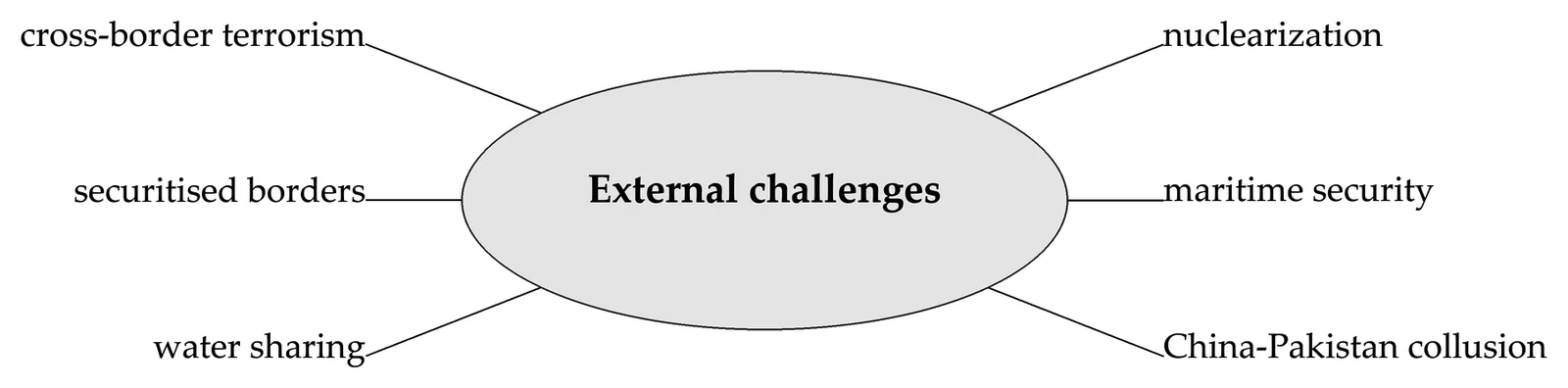
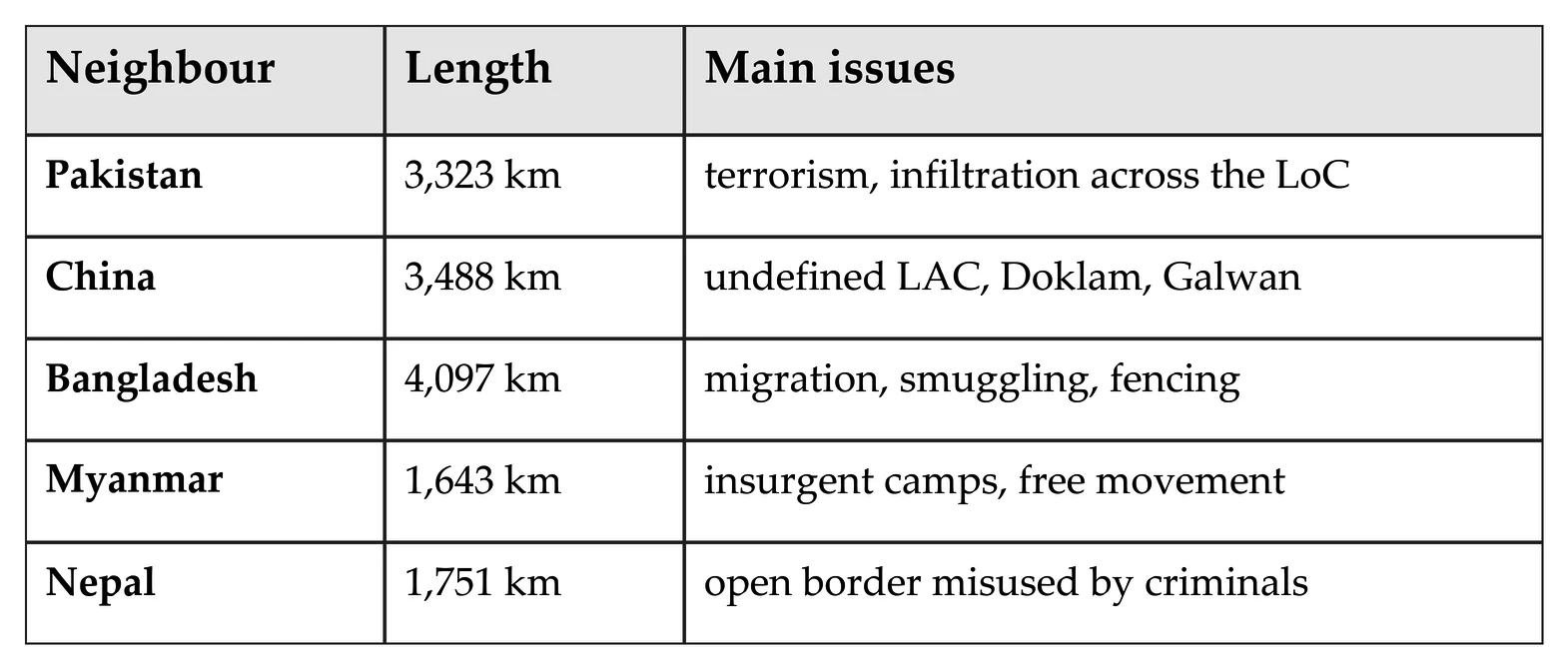
IINDIA shares land borders of more than 15,000 km with its neighbours and has a coastline that opens onto one of the world’s busiest oceans. Two of its neighbours, Pakistan and China, are nuclear-armed and have fought wars with India, and both dispute parts of its territory. This chapter studies the external challenges to India’s national security set out in Unit IV of the syllabus: problems in India’s neighbourhood, namely cross-border terrorism, securitised borders, water-sharing conflicts and nuclearization, and the growing importance of maritime security in the Indian Ocean. Internal challenges (Unit IV, 4.2) follow in Chapter 5.
4.1 India’s Neighbourhood: Terrorism and Securitised Borders
Muni: Problem Areas in India’s Neighbourhood Policy
S. D. Muni, in Problem Areas in India’s Neighbourhood Policy (2003), explains why India’s relations with its South Asian neighbours remain troubled. India is far larger than all its neighbours put together and is the only country that borders almost all of them, while they rarely border each other. This asymmetry creates fear of Indian domination among the smaller states, who often seek support from outside powers such as China or the United States to balance India. India, in turn, tends to view their domestic politics and their links with outside powers through a security lens. Muni identifies further problem areas: the Pakistan factor, which blocks regional cooperation; ethnic and religious ties that spill across borders, such as the Tamil question in Sri Lanka or the Madhesi question in Nepal; India’s preference for bilateralism; and the slow progress of economic integration through SAARC. He argues for a more generous and sensitive approach, in the spirit of the Gujral Doctrine (1996), under which India would not ask for reciprocity from its smaller neighbours.
Cross-Border Terrorism
Cross-border terrorism means terrorist violence planned, trained, financed or launched from across a state’s borders, often with the support of another state. For India, the main source has been Pakistan, where groups such as Lashkar-e-Taiba, Jaish-e-Mohammed and Hizbul Mujahideen have operated. Sanjeev Kumar H. M., in The India-Pakistan Sub-conventional War (2022), describes the conflict as a sub-conventional war, i.e. a war fought below the level of open conventional war, through proxies, infiltration and terrorism. After both states became nuclear powers in 1998, Pakistan could use terrorism while relying on its nuclear weapons to deter a large Indian response. K. Santhanam (2003) traced the sources of terror in India to Pakistan-sponsored groups, insurgencies in the Northeast and left-wing extremism, and S. D. Muni, in Responding to Terrorism in South Asia (2006), showed that terrorism in the region is tied to unresolved conflicts, weak states and the use of militant groups as instruments of policy.
- 1989 onwards. Insurgency in Kashmir, supported from across the Line of Control.
- 1993. Serial bomb blasts in Bombay killed 257 people.
- December 1999. Hijacking of Indian Airlines flight IC-814 to Kandahar; three militants were released, including Masood Azhar, who then founded Jaish-e-Mohammed.
- December 2001. Attack on Parliament, followed by Operation Parakram, a ten-month military mobilisation.
- November 2008. The Mumbai attacks, launched from the sea by Lashkar-e-Taiba.
- 2016 and 2019. The Uri attack (September 2016) and the Pulwama attack (February 2019) led to the surgical strikes and the Balakot air strike.
- April–May 2025. The Pahalgam attack on tourists (22 April 2025) was followed by Operation Sindoor, Indian strikes on terrorist infrastructure in Pakistan and Pakistan-occupied Kashmir.
Securitised Borders: Pakistan
India’s border with Pakistan includes the international border, the Line of Control in Jammu and Kashmir and the Actual Ground Position Line at the Siachen glacier, which India has held since 1984. Most of the international border and the Line of Control is now fenced, floodlit and watched by the Border Security Force and the Army. A ceasefire on the Line of Control was agreed in November 2003 and renewed in February 2021, though violations recur. Shyam Saran, in The Pakistan Puzzle (2017), explains that Pakistan’s army dominates its politics and that its national identity has been defined in opposition to India, which makes normal relations difficult. Saran argues that India should combine firmness against terrorism with engagement where possible, since Pakistan’s instability itself is a danger to India.
Securitised Borders: China
The boundary with China has never been agreed. China occupies Aksai Chin in the western sector and claims almost all of Arunachal Pradesh in the eastern sector, while the two sides patrol up to their own perceptions of the Line of Actual Control. After the war of 1962, the two countries signed agreements on peace and tranquillity (1993), confidence-building measures (1996), political parameters for a settlement (2005) and border defence cooperation (2013). Yet standoffs at Depsang (2013), Chumar (2014) and Doklam (2017) were followed by the deadly clash at Galwan in June 2020 and a long military standoff in eastern Ladakh, eased by a disengagement agreement in October 2024. Alka Acharya (2013) describes India-China relations as a mix of cooperation and rivalry, shaped by the boundary, Tibet, China’s close partnership with Pakistan and a growing trade imbalance. Shivshankar Menon (2021) and Shyam Saran show how China’s rise has made the boundary the most serious military challenge India faces.
Other Borders
- Bangladesh. The Land Boundary Agreement of 2015 exchanged enclaves and settled the boundary, but illegal migration, cattle smuggling and fencing remain sensitive issues.
- Myanmar. Insurgent groups of the Northeast have used camps across the border; India decided in 2024 to fence the border and end the Free Movement Regime.
- Nepal and Bhutan. Open borders under friendship treaties (1950 and 1949, revised in 2007) bring people closer but can be misused by criminals and militants.
4.2 Water-Sharing Conflicts and Nuclearization
Water as a Security Issue
Rivers cross borders in South Asia, and water is increasingly treated as a security issue as populations grow, farming depends on irrigation and climate change affects glaciers. India is downstream of China on the Brahmaputra and Sutlej, but upstream of Pakistan on the Indus system and of Bangladesh on the Ganga and Teesta. Brahma Chellaney, in Water: Asia’s New Battleground (2011), calls water the latest India-Pakistan battle line and warns that China, as the upstream power on Tibet’s rivers, holds a riparian advantage that it can use without sharing data or agreeing to treaties.
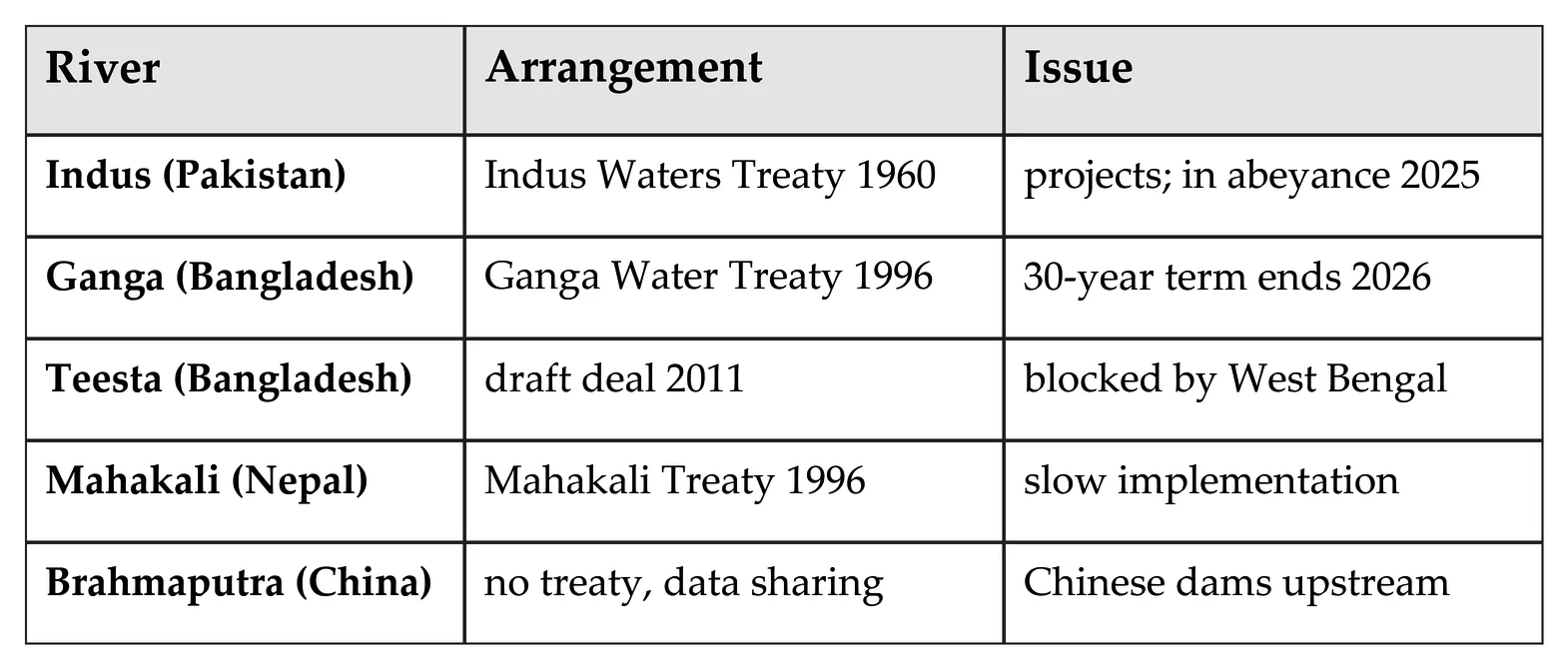
- Indus Waters Treaty (1960). Brokered by the World Bank, it gave the eastern rivers (Ravi, Beas, Sutlej) to India and the western rivers (Indus, Jhelum, Chenab) to Pakistan, with limited Indian use of the western rivers, including run-of-river hydropower.
- Disputes over projects. Pakistan objected to India’s Baglihar and Kishenganga projects; a neutral expert ruled on Baglihar in 2007 and a Court of Arbitration on Kishenganga in 2013.
- Treaty in abeyance. India sought to modify the treaty in 2023 and placed it in abeyance after the Pahalgam attack in April 2025.
- Ganga Water Treaty (1996). A 30-year treaty with Bangladesh on sharing the Ganga at Farakka, due for renewal in 2026.
- Teesta. An agreement with Bangladesh was ready in 2011 but blocked by objections from West Bengal.
- Brahmaputra. India and China have no water treaty, only an Expert Level Mechanism (2006) and agreements on sharing flood-season data; China’s dams on the Yarlung Tsangpo, including a very large project in its lower reaches, worry India and Bangladesh.
Medha Bisht, in From the edges of borders (2019), argues that water diplomacy in South Asia has been dominated by a narrow, state-centric and technical view that treats water as a zero-sum resource. She calls for a basin-wide approach that includes local communities and ecological concerns. Jonathan Holslag (2011) argues that fears of large-scale Chinese diversion of the Brahmaputra are often exaggerated, but that the lack of transparency and trust turns water into one more element of the wider Sino-Indian rivalry. K. Warikoo (2001) presents the Indus Waters Treaty as a rare success of India-Pakistan cooperation that survived several wars.
Nuclearization of the Neighbourhood
China tested its first nuclear weapon in 1964, two years after defeating India. India conducted a peaceful nuclear explosion in 1974 and, after the tests of 11 and 13 May 1998, declared itself a nuclear weapon state; Pakistan tested on 28 and 30 May 1998. South Asia thus has three nuclear-armed states with disputed borders. Ashley Tellis, in India’s Emerging Nuclear Doctrine (2001), argued that India’s doctrine exemplified the lessons of the nuclear revolution: nuclear weapons are useful for deterrence, not for fighting wars, so India needed only a small, dispersed force-in-being capable of assured retaliation, rather than a large, ready-to-launch arsenal.
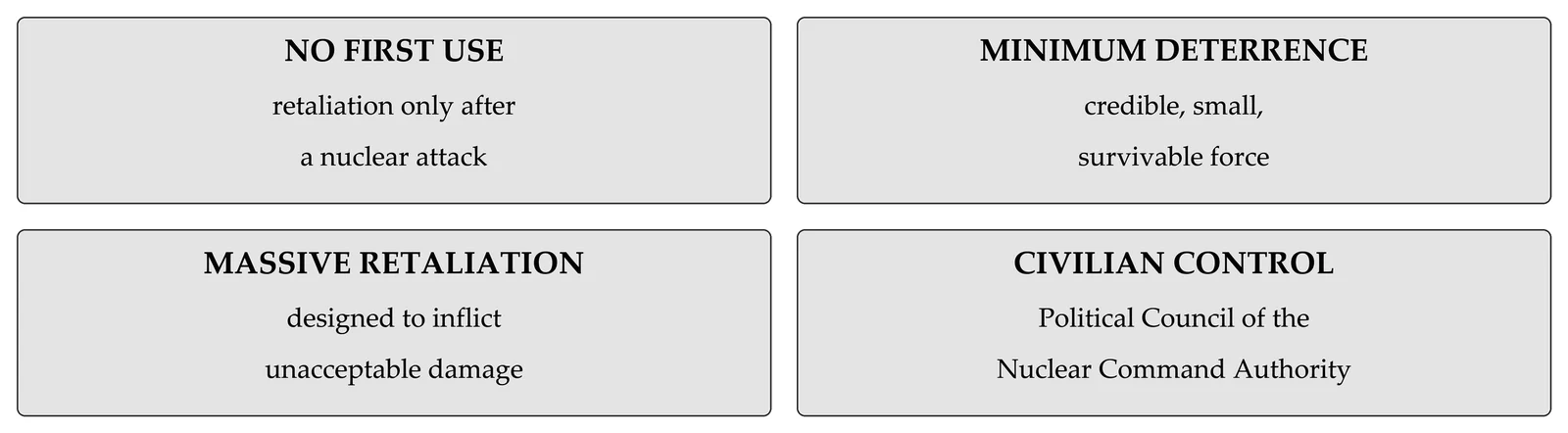
- The 2003 doctrine. Credible minimum deterrence; no first use; retaliation to a first strike will be massive and designed to inflict unacceptable damage; no use against non-nuclear states; civilian control through the Nuclear Command Authority.
- The triad. Land-based Agni missiles, aircraft, and the submarine INS Arihant, which completed its first deterrence patrol in 2018; Agni-V was tested with multiple warheads in 2024.
- Pakistan’s posture. Pakistan rejects no first use and has developed short-range tactical nuclear weapons such as the Nasr to deter Indian conventional operations, a posture it calls full-spectrum deterrence.
- China’s arsenal. China also has a no first use policy, but its arsenal is much larger and growing quickly.
K. Sundaram and M. V. Ramana (2018) examine India’s no first use policy and note that some officials have questioned it, for example in 2016 and 2019, when ministers suggested that it depends on circumstances. They argue that no first use reduces the risk of nuclear war and should be strengthened rather than diluted. Rajesh Basrur (2019) describes India-China nuclear relations as a managed rivalry, relatively stable because both have no first use policies and do not plan for nuclear war-fighting, though the growing Chinese arsenal creates pressure. Vipin Narang, in Seeking the Bomb (2022), places India among states that pursued the bomb through a long, hedging strategy before testing.
4.3 Maritime Security
Why the Sea Matters
India has a long coastline, more than 1,300 islands and an Exclusive Economic Zone of over two million square kilometres. About 95 per cent of its trade by volume moves by sea, and most of its oil imports cross the Indian Ocean. K. M. Panikkar, in India and the Indian Ocean (1945), argued that India lost its independence when it lost control of the sea to European powers, and that its future security depended on the ocean. For decades after 1947, however, India’s attention was mainly continental, focused on the land borders with Pakistan and China.
Jaishankar: The Pacific Indian
S. Jaishankar, in the chapter The Pacific Indian: A Re-Emerging Maritime Outlook of The India Way (2020), argues that India is recovering an older maritime identity, seen in historic trade links with South-East Asia. He supports the Indo-Pacific concept, which joins the Indian and Pacific Oceans into one strategic space, and explains India’s growing ties with Japan, Australia, ASEAN and the United States, including the Quad. In 2015, Prime Minister Modi announced SAGAR (Security and Growth for All in the Region) in Mauritius, and in 2025 India extended it into the broader MAHASAGAR vision for the Global South.
Rajagopalan: India’s Maritime Strategy
Rajeswari Pillai Rajagopalan (2016) traces how the Navy articulated a maritime strategy through documents such as the Indian Maritime Doctrine (2004), Freedom to Use the Seas (2007) and Ensuring Secure Seas (2015). She argues that India has moved from a narrow coastal defence role towards being a net security provider in the Indian Ocean, while facing limits of budget, shipbuilding capacity and coordination between agencies.
Maritime Threats
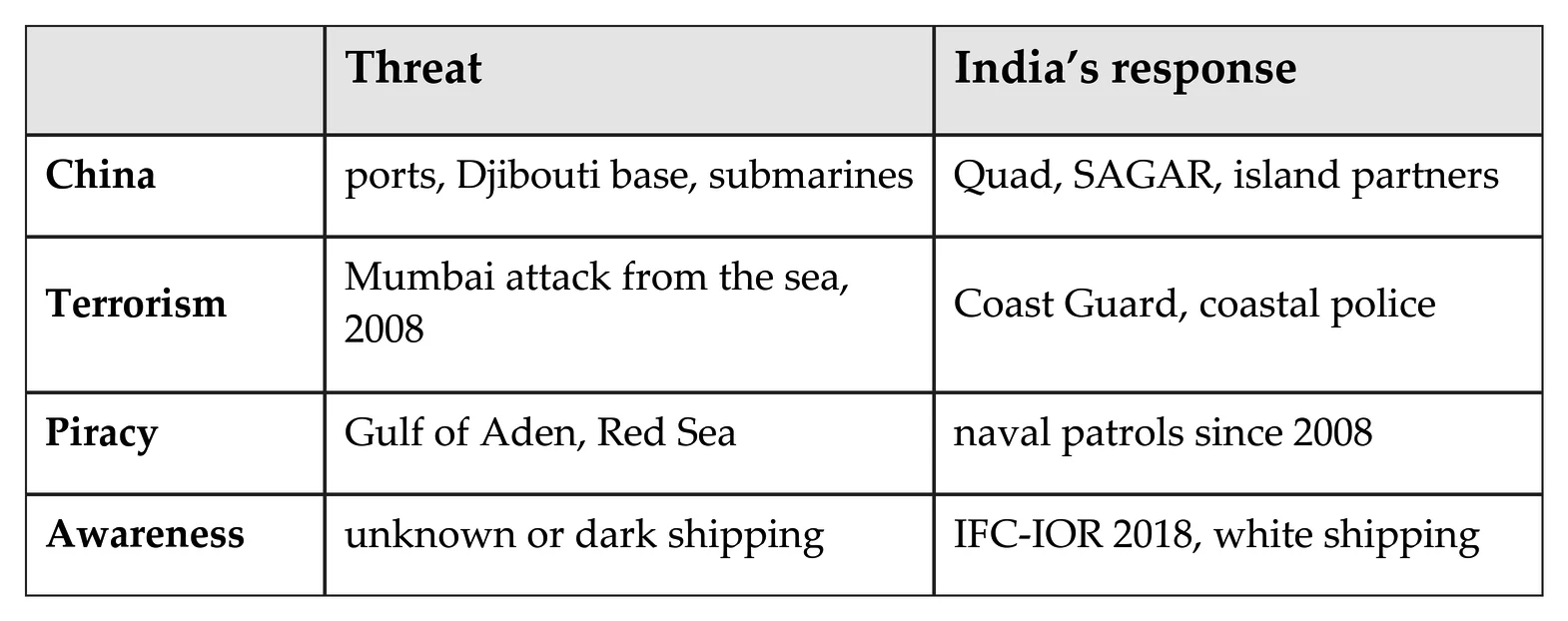
- China’s presence. Chinese port projects at Gwadar (Pakistan) and Hambantota (Sri Lanka, leased for 99 years in 2017), its first overseas base at Djibouti (2017) and submarine visits create fears of encirclement, often called the string of pearls.
- Maritime terrorism. The 2008 Mumbai attackers came by sea, exposing gaps in coastal security.
- Piracy. Somali piracy led the Indian Navy to begin anti-piracy patrols in the Gulf of Aden in 2008; attacks on shipping in the Red Sea in 2023–24 brought new deployments.
- Non-traditional threats. Illegal fishing, drug and arms smuggling, cyclones and tsunamis, and rising sea levels.
India’s Responses
- Coastal security reform after 2008. The Coast Guard was made responsible for coastal security, coastal police stations and radar chains were set up, and the National Command Control Communication and Intelligence network was created.
- Information sharing. The Information Fusion Centre for the Indian Ocean Region opened in Gurugram in 2018.
- Partnerships. The Indian Ocean Naval Symposium (2008), the Malabar exercise, coastal surveillance radars in Mauritius, Seychelles, Maldives and Sri Lanka, and white-shipping agreements.
- Humanitarian role. India was the first responder after the 2004 tsunami and in many later disasters, building goodwill as a net security provider.
4.4 Important Questions
- Question 1 Discuss the security challenges in India’s neighbourhood with reference to cross-border terrorism and securitised borders.
- Question 2 Discuss water-sharing conflicts as a challenge to India’s national security.
- Question 3 Discuss nuclearization as a challenge to India’s national security.
- Question 4 Discuss the importance of maritime security for India.
DU asks the same idea in different words. So learn one broad answer for each question below; the same answer works for every question joined by OR.
Important Question 1
Discuss the security challenges in India’s neighbourhood with reference to cross-border terrorism and securitised borders.
OR
Discuss cross-border terrorism as a challenge to India’s national security.
OR
Examine the security challenges arising from India’s borders with Pakistan and China.
Model Answer
“Decides also that all States shall: (a) Refrain from providing any form of support, active or passive, to entities or persons involved in terrorist acts.”
— UN Security Council Resolution 1373 (28 September 2001), paragraph 2
Introduction. India’s neighbourhood is one of the most difficult in the world. Its two largest neighbours, Pakistan and China, are nuclear-armed and dispute Indian territory, and Pakistan has long used terrorism as an instrument against India. As S. D. Muni shows, the asymmetry between India and its smaller neighbours adds further problems. Cross-border terrorism and securitised borders are therefore central challenges to India’s national security.
1. Muni’s Problem Areas
S. D. Muni argues that India’s size and centrality create fear among smaller neighbours, who seek outside support, while India views their politics through a security lens.
2. Meaning of Cross-Border Terrorism
Cross-border terrorism means violence planned, trained or launched from another country, often with the support of its state agencies.
3. Pakistan as the Main Source
Groups such as Lashkar-e-Taiba and Jaish-e-Mohammed have operated from Pakistan, carrying out attacks in Kashmir and Indian cities.
4. Sub-Conventional War
Sanjeev Kumar H. M. describes India-Pakistan conflict as a sub-conventional war, fought through proxies and terrorism below the threshold of open war.
5. The Nuclear Shield
After 1998, Pakistan relied on its nuclear weapons to deter large Indian retaliation, which made terrorism a low-cost option.
6. Major Attacks
The 2001 Parliament attack, the 2008 Mumbai attacks, Uri in 2016, Pulwama in 2019 and Pahalgam in 2025 show the scale of the challenge.
7. India’s Responses to Terror
India has moved from restraint and diplomacy to calibrated force, as in the surgical strikes of 2016, Balakot in 2019 and Operation Sindoor in 2025.
8. International Pressure
India has used diplomacy, the UN sanctions list and the Financial Action Task Force, which placed Pakistan on its grey list from 2018 to 2022.
9. The Line of Control
The Line of Control is fenced and heavily guarded; ceasefire agreements in 2003 and 2021 reduced, but did not end, firing and infiltration.
10. Saran on Pakistan
Shyam Saran explains that Pakistan’s army-dominated politics and anti-India identity make normal relations difficult, so India must combine firmness with engagement.
11. The China Boundary
China occupies Aksai Chin and claims Arunachal Pradesh; the undefined Line of Actual Control allows each side to patrol up to its own claims.
12. Standoffs and Galwan
Standoffs at Depsang, Chumar and Doklam led to the Galwan clash of 2020, the first deadly border clash in decades, and a long standoff in Ladakh.
13. China-Pakistan Collusion
China’s close partnership with Pakistan, including the economic corridor through Pakistan-occupied Kashmir, raises the danger of a two-front threat.
14. Other Borders
Borders with Bangladesh, Myanmar and Nepal involve migration, smuggling and insurgent camps, requiring fencing and cooperation with neighbours.
15. Securitisation and Its Costs
Heavily securitised borders protect territory but divide communities, slow trade and can harm the people living in border areas.
16. Terror Financing and Narcotics
Terrorism is sustained by money from front charities, fake currency, hawala channels and drug trafficking, especially across the Punjab border. India has strengthened the NIA, tightened financial monitoring and deployed anti-drone systems against weapons and drugs dropped from across the border.
17. Afghanistan and the Wider Region
The return of the Taliban to power in Kabul in August 2021 raised fears that Afghan territory could again shelter groups hostile to India, showing that cross-border terrorism is a regional problem that extends beyond India’s immediate borders.
18. Evaluation
Cross-border terrorism and disputed borders are linked challenges that require military strength, diplomacy and regional cooperation together.
Conclusion. Thus, India faces cross-border terrorism from Pakistan, waged as a sub-conventional war under a nuclear shield, and a disputed, militarised boundary with China. Resolution 1373 requires states not to support terrorists, and India’s response has combined calibrated force, diplomacy and border management, while Muni’s call for generosity towards smaller neighbours remains relevant.
Important Question 2
Discuss water-sharing conflicts as a challenge to India’s national security.
OR
Examine the Indus Waters Treaty and water disputes between India and Pakistan.
OR
Discuss the Sino-Indian water dispute over the Brahmaputra.
Model Answer
“Blood and water cannot flow together.”
— Narendra Modi, at a review of the Indus Waters Treaty (September 2016), as reported
Introduction. Rivers flow across borders in South Asia, so water has become a matter of security as well as development. India is upstream of Pakistan and Bangladesh but downstream of China. Brahma Chellaney calls water Asia’s new battleground, while scholars such as Medha Bisht call for cooperative, basin-level water diplomacy.
1. Water as Security
Growing populations, irrigation, hydropower and climate change make water scarce, turning river sharing into a security issue.
2. India’s Dual Position
India is upstream on the Indus and Ganga but downstream on the Brahmaputra, so it must balance the rights of upstream and downstream states.
3. The Indus Waters Treaty
The World Bank-brokered treaty of 1960 gave the eastern rivers to India and the western rivers to Pakistan, with limited Indian use of the western rivers.
4. Survival through Wars
K. Warikoo shows that the treaty survived the wars of 1965, 1971 and 1999, making it a rare example of India-Pakistan cooperation.
5. Project Disputes
Pakistan objected to the Baglihar and Kishenganga projects; a neutral expert and a Court of Arbitration ruled on them in 2007 and 2013.
6. Chellaney’s Battle Line
Brahma Chellaney calls water the latest India-Pakistan battle line, as Pakistan accuses India of controlling its lifeline and militants use the issue.
7. The Treaty in Abeyance
After Uri, India reviewed the treaty; it sought modification in 2023 and placed the treaty in abeyance after the Pahalgam attack in 2025.
8. The Brahmaputra
China controls the upper Brahmaputra, the Yarlung Tsangpo, and is building dams, including a very large project in its lower reaches near India.
9. China’s Riparian Advantage
Chellaney warns that China uses its upstream position without treaties, sharing only flood-season data through limited agreements.
10. Holslag’s Assessment
Jonathan Holslag argues that fears of large-scale diversion are often exaggerated, but mistrust makes water part of the wider India-China rivalry.
11. Bangladesh and the Ganga
The Ganga Water Treaty of 1996 settled sharing at Farakka for 30 years, but the Teesta agreement remains blocked by domestic politics.
12. Nepal and Bhutan
The Mahakali Treaty (1996) with Nepal and hydropower cooperation with Bhutan show the potential of water as a source of shared energy.
13. Bisht’s Water Diplomacy
Medha Bisht argues that South Asian water diplomacy is too state-centric and technical, and calls for a basin-wide, people-centred approach.
14. Climate Change
Melting Himalayan glaciers and erratic monsoons will change river flows, increasing the risk of floods, droughts and disputes.
15. Domestic Dimensions
Water sharing also involves states within India, as the Teesta case shows, so federal politics shapes India’s external water diplomacy.
16. Hydropower in Jammu and Kashmir
India has sped up projects such as Pakal Dul, Kiru and Ratle on the Chenab to use its share under the treaty more fully, while Pakistan sees these projects as a threat to its water security, which keeps the dispute alive.
17. Data and Transparency
Sharing river-flow data is the simplest form of cooperation. Agreements with China cover only flood-season data, and India’s own data sharing with downstream neighbours has also been criticised, so trust-building must begin with transparency.
18. Evaluation
Water disputes rarely cause wars, but they deepen mistrust and can be used as levers in wider conflicts, so cooperation is vital.
Conclusion. Thus, water sharing is a growing security challenge for India, as upstream power on the Indus and downstream state on the Brahmaputra. The remark that blood and water cannot flow together shows how water became linked to terrorism, while Bisht and Warikoo show that cooperative, basin-level diplomacy remains the better long-term path.
Important Question 3
Discuss nuclearization as a challenge to India’s national security.
OR
Examine the main features of India’s nuclear doctrine.
OR
Critically examine India’s policy of no first use of nuclear weapons.
Model Answer
“We have an overt nuclear weapon state on our borders, a state which committed armed aggression against India in 1962.”
— Atal Bihari Vajpayee, letter to President Bill Clinton (May 1998)
Introduction. South Asia has three nuclear-armed states, China, India and Pakistan, two of which have disputed borders with India. India tested nuclear weapons in May 1998, citing the threat from China, and Pakistan followed within weeks. Since then India’s doctrine of credible minimum deterrence and no first use has sought to make nuclear weapons a means of deterrence rather than war.
1. China’s Bomb
China’s nuclear test of 1964, soon after the 1962 war, was the starting point of India’s nuclear concern.
2. India’s Path
India conducted a peaceful nuclear explosion in 1974, kept its options open for decades and tested weapons in May 1998.
3. Vajpayee’s Justification
Vajpayee justified the tests by pointing to an overt nuclear weapon state on India’s borders and covert help to Pakistan.
4. Pakistan’s Tests
Pakistan tested on 28 and 30 May 1998, creating a nuclear rivalry between two states with an active territorial dispute.
5. The 2003 Doctrine
India’s doctrine rests on credible minimum deterrence, no first use and massive retaliation designed to inflict unacceptable damage.
6. Civilian Control
The Nuclear Command Authority has a Political Council chaired by the Prime Minister, which alone can authorise nuclear retaliation.
7. Tellis on the Nuclear Revolution
Ashley Tellis argued that India’s doctrine reflects the lesson that nuclear weapons deter but cannot win wars, so a small force-in-being is enough.
8. The Triad
India has built land, air and sea-based delivery systems, including INS Arihant and Agni-V, to make its retaliation survivable.
9. Pakistan’s Full-Spectrum Deterrence
Pakistan rejects no first use and has tactical nuclear weapons such as the Nasr to deter Indian conventional operations.
10. The Stability-Instability Paradox
Nuclear deterrence prevents full-scale war but may encourage lower-level conflict, as Kargil and repeated terror attacks suggest.
11. Debate on No First Use
Some officials suggested in 2016 and 2019 that no first use depends on circumstances, raising questions about its future.
12. Sundaram and Ramana
Sundaram and Ramana argue that no first use reduces the risk of nuclear war and should be strengthened, not diluted.
13. China and Managed Rivalry
Rajesh Basrur calls India-China nuclear relations a managed rivalry, stable because both follow no first use, though China’s arsenal is growing.
14. Karnad’s Critique
Bharat Karnad argues that India’s arsenal is too small and too cautious, and calls for a larger thermonuclear deterrent.
15. Global Nuclear Order
India stays outside the NPT but secured the India-US nuclear deal and a waiver from the Nuclear Suppliers Group in 2008.
16. Nuclear Terrorism
The danger that nuclear materials could fall into the hands of terrorists in an unstable neighbourhood adds another layer of risk, which India addresses through strict export controls and its participation in the Nuclear Security Summits of 2010 to 2016.
17. Confidence-Building Measures
India and Pakistan exchange lists of their nuclear installations every 1 January under a 1988 agreement not to attack them, and notify each other of ballistic missile tests under a 2005 agreement, small but valuable steps to reduce risk.
18. Evaluation
Nuclearization has made large wars unlikely but has not ended conflict; India’s restraint has helped its credibility as a responsible power.
Conclusion. Thus, nuclearization of the neighbourhood, which Vajpayee cited in 1998, is a lasting challenge. India’s doctrine of credible minimum deterrence and no first use, explained by Tellis as a lesson of the nuclear revolution, has kept deterrence stable, but Pakistan’s tactical weapons and China’s growing arsenal demand constant attention.
Important Question 4
Discuss the importance of maritime security for India.
OR
Examine India’s maritime strategy in the Indian Ocean.
OR
Discuss the challenges to India’s maritime security and India’s responses.
Model Answer
“While to other countries, the Indian Ocean is only one of the important oceanic areas, to India it is a vital sea.”
— K. M. Panikkar, India and the Indian Ocean (1945)
Introduction. India sits at the centre of the Indian Ocean, through which most of its trade and energy flows. For long its security thinking was continental, but the rise of China’s naval presence, maritime terrorism and new economic interests have made the sea central. S. Jaishankar speaks of a re-emerging maritime outlook, and Rajeswari Pillai Rajagopalan traces India’s evolving maritime strategy.
1. Geography
India has a long coastline, more than 1,300 islands and an Exclusive Economic Zone of over two million square kilometres.
2. Economic Stakes
About 95 per cent of India’s trade by volume and most of its oil imports move by sea, making sea lanes vital.
3. Panikkar’s Insight
K. M. Panikkar argued that India lost its freedom when it lost control of the sea, so its security depends on the Indian Ocean.
4. Continental Neglect
After 1947, threats from Pakistan and China kept attention on land borders, and the Navy received a small share of resources.
5. Jaishankar’s Pacific Indian
Jaishankar argues that India is recovering an older maritime identity and should act as a Pacific as well as an Indian Ocean power.
6. The Indo-Pacific
India supports a free and open Indo-Pacific and works with Japan, Australia, ASEAN and the United States, including through the Quad.
7. SAGAR and MAHASAGAR
SAGAR (2015) offered security and growth for all in the region; MAHASAGAR (2025) extended this vision to the Global South.
8. Rajagopalan’s Analysis
Rajagopalan shows how naval doctrines of 2004, 2007 and 2015 moved India towards the role of a net security provider.
9. China’s Naval Presence
Chinese ports at Gwadar and Hambantota, the Djibouti base and submarine visits raise fears of a string of pearls around India.
10. Maritime Terrorism
The 2008 Mumbai attack came by sea, leading to major coastal security reforms led by the Coast Guard.
11. Piracy and Shipping
India has run anti-piracy patrols since 2008 and deployed ships to protect shipping during Red Sea attacks in 2023–24.
12. Non-Traditional Threats
Illegal fishing, smuggling, natural disasters and climate change are also maritime security concerns.
13. Information Sharing
The Information Fusion Centre in Gurugram and white-shipping agreements improve awareness of activity at sea.
14. Partnerships and Capacity Building
Coastal radars in island states, joint exercises such as Malabar and the Indian Ocean Naval Symposium build cooperation.
15. Limits
Budget constraints, slow shipbuilding and weak coordination among agencies limit India’s ability to match China’s navy.
16. Andaman and Nicobar Command
India’s only tri-service command, set up at Port Blair in 2001, guards the approaches to the Malacca Strait, through which much of China’s trade and oil passes, giving India an advantage at a key maritime choke point.
17. The Blue Economy
Maritime security also protects the blue economy, i.e. fisheries, offshore oil and gas, deep-sea minerals and ports. The Sagarmala programme (2015) and the Deep Ocean Mission (2021) link maritime security with economic growth.
18. Evaluation
Maritime security has become central to India’s national security, and India is moving from continental to balanced continental-maritime thinking.
Conclusion. Thus, Panikkar’s view that the Indian Ocean is India’s vital sea has gained new force. Through SAGAR, the Indo-Pacific vision, coastal security reforms and partnerships, India seeks to be a net security provider, though capacity gaps and China’s naval rise remain serious challenges.
Short Notes
(a) Sub-conventional war
Conflict waged below the level of open conventional war, through proxies, infiltration and terrorism, as in Pakistan’s support to militant groups against India after both states became nuclear powers.
(b) Indus Waters Treaty
The 1960 treaty brokered by the World Bank that divided the Indus rivers between India and Pakistan; India placed it in abeyance in April 2025 after the Pahalgam attack.
(c) SAGAR
Security and Growth for All in the Region, India’s Indian Ocean vision announced in Mauritius in 2015, extended as MAHASAGAR in 2025.
More notes: DSE-2b India's National Security
These notes are prepared by PADHO TO AISE for study help. They are not an official University of Delhi publication.