
Semester V DSE-3a International Political Economy
Unit III · 23 min read · Updated 24 Nov 2026
As per the University of Delhi (DU) BA (Hons) Political Science syllabus
Contents
- 4.1 The Politics of International Trade
- O’Brien and Williams: Trade in the Global Political Economy
- Krasner: State Power and the Structure of Trade
- From GATT to the WTO
- 4.2 Multinational Corporations
- Meaning and Growth
- Hirst, Thompson and Bromley: National Firms Abroad
- Balaam and Dillman: The Governance of Foreign Investment
- Gilpin and Fieldhouse: Three Views and a New Imperialism
- 4.3 Perspectives from the Global South and the Indian Story
- Uneven and Combined Development
- Commerce and State Power in Pre-Colonial India
- The Drain of Wealth
- Mukherjee: How Colonial India Made Modern Britain
- Debates on Development
- 4.4 Important Questions
- Discuss the politics of international trade with reference to Stephen Krasner’s theory of state power and trade.
- Discuss the role of multinational corporations in the global political economy.
- Discuss the idea of uneven and combined development and its relevance for the Global South.
- Discuss the colonial drain of wealth from India and its place in the global political economy.
- Short Notes
व्यापार और आर्थिक प्रयास के क्षेत्र में उनके संबंध जीवन स्तर को ऊपर उठाने, पूर्ण रोज़गार सुनिश्चित करने तथा वास्तविक आय और प्रभावी माँग की बड़ी और निरंतर बढ़ती मात्रा को ध्यान में रखकर संचालित होने चाहिए।
Recognizing that their relations in the field of trade and economic endeavour should be conducted with a view to raising standards of living, ensuring full employment and a large and steadily growing volume of real income and effective demand.
— Marrakesh Agreement Establishing the World Trade Organization, Preamble (1994)
TTRADE has been called an engine of growth, but it has also been a tool of empire. Who makes the rules of world trade, and who benefits from them? Are multinational corporations agents of development or of domination? Why did some countries industrialise early while others, such as India, were turned into suppliers of raw materials? This chapter studies Unit III of the syllabus: the politics of international trade, from GATT to the WTO; multinational corporations and their relations with states; and perspectives from the Global South, including the idea of uneven and combined development and the Indian story of colonial trade, the drain of wealth and late industrialisation.

4.1 The Politics of International Trade
O’Brien and Williams: Trade in the Global Political Economy
Robert O’Brien and Marc Williams, in Global Political Economy (2016), explain that trade is never only an economic exchange. It involves questions of power (who sets the rules), distribution (who gains and who loses within and between countries) and ideas (whether free trade or protection is seen as legitimate). They trace the history of trade from mercantilist empires to British free trade in the nineteenth century, the collapse of trade in the 1930s, the post-war GATT system and the WTO. They also show the rise of global value chains, in which goods are made in stages across many countries, so that a large share of trade now happens within or between firms.
Krasner: State Power and the Structure of Trade
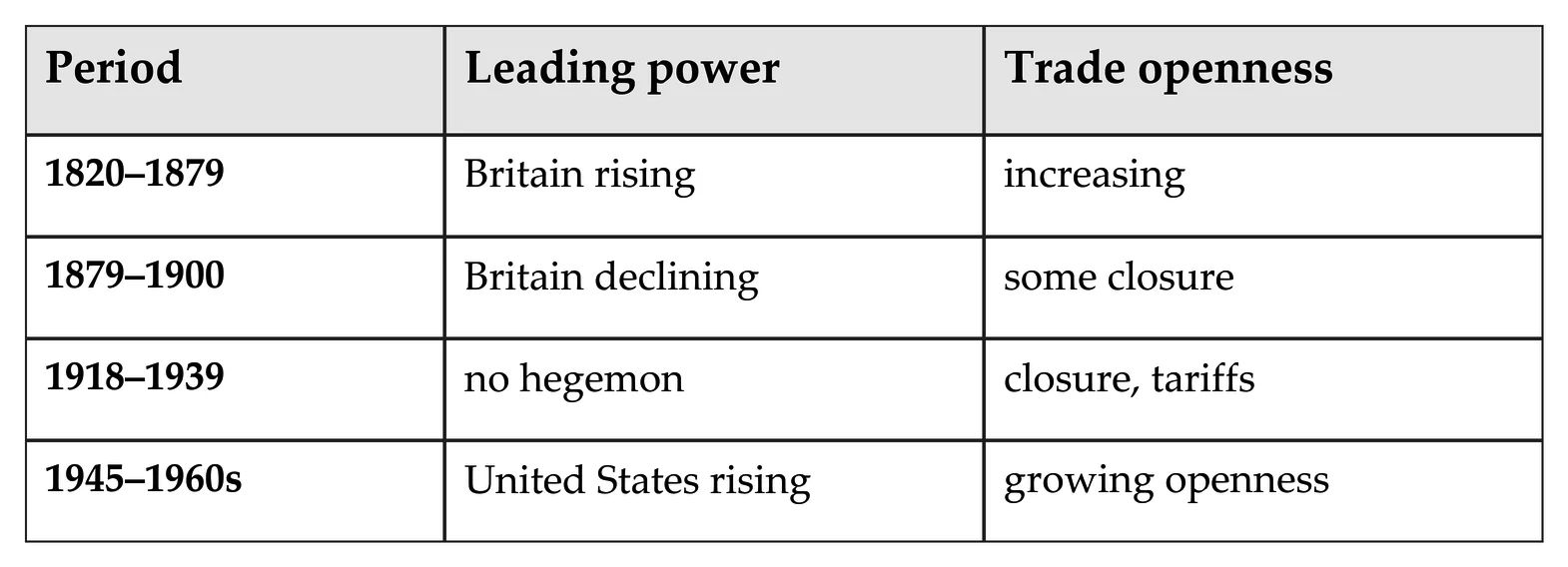
Stephen Krasner, in State Power and the Structure of International Trade (1976), offers a state-centred explanation of why the world trading system is sometimes open and sometimes closed. States, he argues, have four interests in trade: aggregate national income, social stability, political power and economic growth. Their preferences depend on their size and level of development. Large, advanced states benefit most from openness, while small or backward states may fear dependence. Krasner concludes that an open trading structure is most likely when a hegemonic state, much larger and more advanced than others, is on the rise, as Britain was in the mid-nineteenth century and the United States after 1945. When the hegemon declines, the system tends to close. This argument became known as hegemonic stability theory.
From GATT to the WTO
John Ruggie (1982) described the post-war trade order as embedded liberalism: GATT lowered tariffs gradually through negotiating rounds but allowed states to protect agriculture, use safeguards and maintain welfare policies. Developing countries, including India, pressed for special treatment through UNCTAD (1964), led by Raúl Prebisch, and won the Generalised System of Preferences. The Uruguay Round (1986–94) brought agriculture, services, intellectual property (TRIPS) and investment measures under rules, and created the WTO with a binding dispute settlement system.
- Doha deadlock. Braz Baracuhy (2012) argues that the Doha Round stalled because power was shifting: rising powers such as Brazil, India and China, organised in coalitions like the G-20 of developing countries at Cancún in 2003, could block deals but the old powers would not accept their demands, especially on agriculture.
- Crisis of the institution. Aseema Sinha (2021) shows that the WTO faces a crisis of its core functions: negotiation has stalled, the Appellate Body has been paralysed since 2019, and major powers increasingly act outside its rules.
- Rise of regionalism. Mega-regional agreements such as the CPTPP and RCEP (which India chose not to join in 2019) and bilateral free trade agreements have grown.
- Fair trade. Candace Archer and Stefan Fritsch (2010) argue that the global fair trade movement reintroduces ethical questions into IPE by connecting consumers with producers and seeking fair prices and conditions.
4.2 Multinational Corporations
Meaning and Growth
A multinational or transnational corporation (MNC or TNC) owns or controls production in more than one country, usually through foreign direct investment (FDI). MNCs grew rapidly after 1945, first from the United States, then from Europe and Japan, and more recently from China, India and other emerging economies. They organise global value chains, control much of world trade, technology and brands, and some have revenues larger than the economies of many countries.
Hirst, Thompson and Bromley: National Firms Abroad
Hirst, Thompson and Bromley (2009) challenge the idea that MNCs have become footloose global firms without national roots. Their evidence shows that most large companies still have their headquarters, ownership, top management, research and much of their assets and sales concentrated in their home country or region. They are best described as national companies operating internationally. This matters politically, because it means home governments can still regulate and influence them.
Balaam and Dillman: The Governance of Foreign Investment
Balaam and Dillman (2014) explain the main debates about TNCs. Liberals see them as carriers of capital, technology, management skills and jobs. Critics argue that they shift profits to tax havens, exploit cheap labour and weak environmental rules, and use their power to influence governments. The relationship between TNCs and host states is a bargain: states offer market access and incentives, and firms offer investment. Raymond Vernon described an obsolescing bargain: once a firm has invested, its bargaining power declines and the host state can demand more. Since there is no comprehensive global treaty on investment, governance relies on national laws, bilateral investment treaties and voluntary codes such as the UN Global Compact (2000).
Gilpin and Fieldhouse: Three Views and a New Imperialism
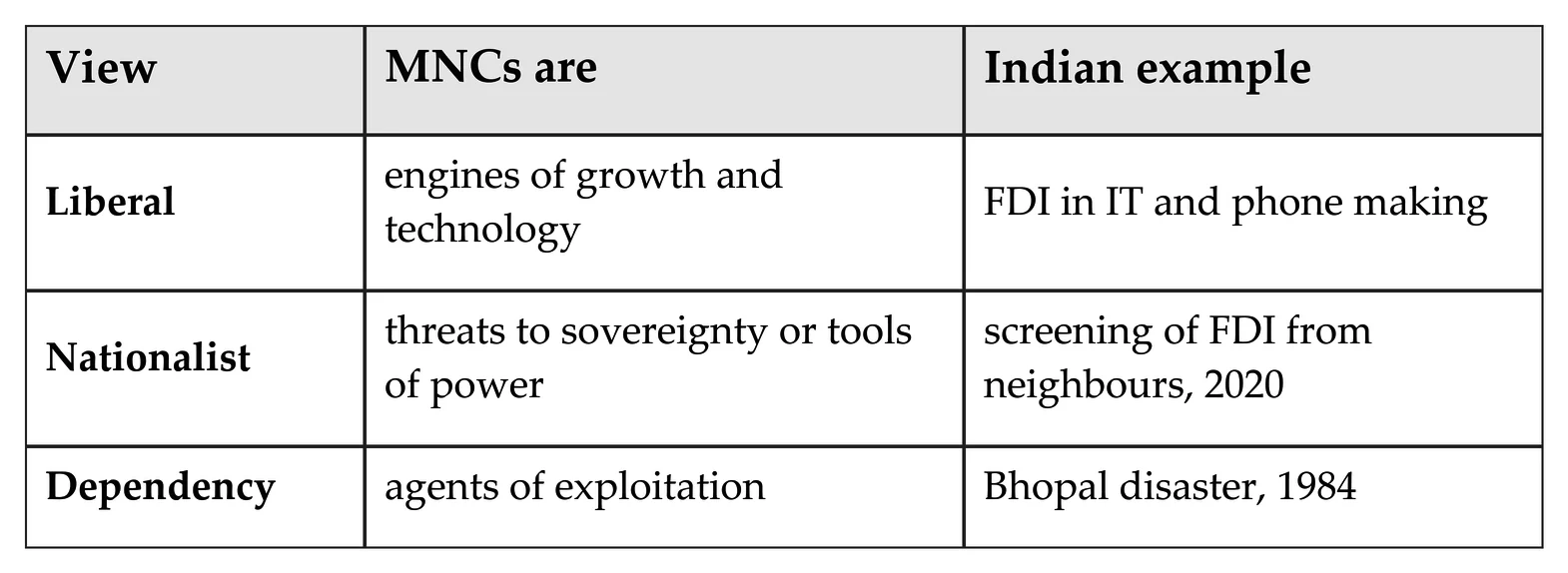
Gilpin (1987) shows how the three ideologies view MNCs: liberals see them as engines of efficiency and growth; nationalists see them as threats to sovereignty or as instruments of their home states’ power; and dependency theorists see them as agents of exploitation that drain profits from the periphery. David Fieldhouse, in A New Imperial System? The Role of the Multinational Corporations Reconsidered, examined the claim that MNCs were a new form of imperialism. He found that the evidence was mixed: MNCs could exploit weak states, but host governments, especially after decolonisation, also gained power to regulate, nationalise and bargain, so MNCs were not simply a new imperial system.
- FERA, 1973. India’s Foreign Exchange Regulation Act limited foreign ownership; Coca-Cola and IBM left India in 1977 rather than reduce their stakes.
- Bhopal, 1984. The gas leak at the Union Carbide plant killed thousands and became a symbol of the risks of weak regulation of MNCs.
- Liberalisation. After 1991, India opened to FDI; the Foreign Exchange Management Act (1999) replaced FERA.
- Screening. In April 2020, India required government approval for FDI from countries sharing a land border, mainly aimed at China.
- Manufacturing shift. Firms such as Apple’s suppliers have expanded production in India as companies diversify away from China.
4.3 Perspectives from the Global South and the Indian Story
Uneven and Combined Development
The idea of uneven and combined development (UCD) comes from Leon Trotsky, who argued that societies develop at different speeds (unevenness) and that late developers do not repeat the path of early ones but combine advanced technologies and forms with older social structures (combination). Barry Buzan and George Lawson (2016) link UCD to the global transformation of the nineteenth century, when industrialisation, the rational state and ideologies of progress gave a few Western societies enormous power. This created a sharp core-periphery world, but also forced every other society to respond, producing combined forms of development, from Meiji Japan to colonial India. David Blaney and Naeem Inayatullah (2016) discuss what is at stake in UCD: it helps explain the interconnected making of the world, but they warn that it can still treat Western development as the norm and the rest as backward, and they ask how it can take seriously the different values and ways of life of non-Western societies.

Commerce and State Power in Pre-Colonial India
Sanjay Subrahmanyam, in Commerce and State Power in Eighteenth-Century India (1988), challenges the view that the eighteenth century was a dark age of decline before British rule. He shows that Indian states were closely tied to merchants and bankers, often called portfolio capitalists, who combined trade, revenue farming, banking and military finance. Commerce and state power reinforced each other, and regional states such as Mysore, Hyderabad and the Marathas were dynamic. This history shows that India was an active participant in the early modern world economy, a major exporter of textiles, before colonialism reshaped it.
The Drain of Wealth
Dadabhai Naoroji, in Poverty and Un-British Rule in India (1901), argued that Britain drained India’s wealth through the home charges (salaries and pensions of British officials, interest on debt and military costs paid in Britain), the profits of British firms and the remittances of Europeans. India had a regular export surplus, yet it received little in return, because the surplus was used to make these payments. R. C. Dutt, in The Economic History of India (1902), showed how colonial trade and tariff policies ruined Indian handicrafts and turned India into an exporter of raw materials. K. N. Chaudhuri (1983) analysed India’s foreign trade and balance of payments from 1757 to 1947, showing the structural role of the export surplus in paying for the home charges.
Mukherjee: How Colonial India Made Modern Britain
Aditya Mukherjee, in Empire: How Colonial India Made Modern Britain (2010), argues that India was central to Britain’s economic power. India’s export surplus with the rest of the world helped Britain settle its own trade deficits, especially before 1914, and India’s revenues paid for British wars and armies across Asia and Africa. Colonial India thus underwrote British capitalism and the international payments system, while Indian per capita income stagnated. This supports Bhambra’s argument that the colonial global economy must be the starting point of political economy.

Debates on Development
- Acemoglu and Robinson. In Why Nations Fail (2012), they argue that inclusive institutions create prosperity while extractive institutions create poverty; colonialism imposed extractive institutions in many places, causing a reversal of fortune.
- Vivek Chibber. In Locked in Place (2003), he argues that India’s developmental state after 1947 failed to discipline its capitalists, unlike South Korea, because Indian business resisted planning and benefited from protected domestic markets.
- Anwar Shaikh. In Globalization and the Myths of Free Trade (2006), he argues that free trade favours advanced economies and that developing countries need policy space.
- India after 1991. Liberalisation brought rapid growth led by services, while manufacturing lagged, leading to policies such as Make in India (2014).
4.4 Important Questions
- Question 1 Discuss the politics of international trade with reference to Stephen Krasner’s theory of state power and trade.
- Question 2 Discuss the role of multinational corporations in the global political economy.
- Question 3 Discuss the idea of uneven and combined development and its relevance for the Global South.
- Question 4 Discuss the colonial drain of wealth from India and its place in the global political economy.
DU asks the same idea in different words. So learn one broad answer for each question below; the same answer works for every question joined by OR.
Important Question 1
Discuss the politics of international trade with reference to Stephen Krasner’s theory of state power and trade.
OR
Examine the evolution of the multilateral trading system from GATT to the WTO.
OR
Discuss the reasons for the crisis of the World Trade Organization.
Model Answer
“Unhampered trade dovetailed with peace; high tariffs, trade barriers, and unfair economic competition, with war.”
— Cordell Hull, The Memoirs of Cordell Hull (1948)
Introduction. International trade is shaped by power, distribution and ideas as much as by economics. Stephen Krasner argues that the openness of the trading system depends on the distribution of state power, especially the presence of a rising hegemon. The post-war system, from GATT to the WTO, reflected American leadership, but shifts in power have produced deadlock and crisis.
1. Trade and Power
O’Brien and Williams show that trade involves power over rules, the distribution of gains and ideas about legitimacy.
2. Hull’s Liberal Vision
American leaders such as Cordell Hull believed open trade promoted peace, shaping the post-war order.
3. Krasner’s State Interests
Krasner identifies four state interests in trade: national income, social stability, political power and economic growth.
4. Size and Development
Large, advanced states gain most from openness, while small or backward states fear dependence and instability.
5. Hegemonic Stability
An open trading system is most likely when a rising hegemon is far larger and more advanced than other states.
6. Historical Evidence
Openness grew with British dominance in the nineteenth century and with American dominance after 1945, while the interwar years saw closure.
7. GATT and Embedded Liberalism
GATT (1947) lowered tariffs gradually while allowing protection of agriculture and welfare, which Ruggie called embedded liberalism.
8. Developing Countries and UNCTAD
Developing countries, including India, used UNCTAD (1964) to demand special treatment and preferences.
9. The Uruguay Round
The Uruguay Round extended rules to agriculture, services and intellectual property and created the WTO in 1995.
10. Dispute Settlement
The WTO introduced binding dispute settlement, giving even small states a legal route against powerful ones.
11. The Doha Deadlock
Baracuhy argues that the Doha Round stalled because rising powers could block deals the old powers would not accept.
12. India’s Role
India has defended food security and farmers, as at Bali in 2013, often leading coalitions of developing countries.
13. Sinha on the Crisis
Aseema Sinha shows that negotiation has stalled, the Appellate Body has been paralysed since 2019 and powers act outside the rules.
14. Trade Wars
The US-China trade war from 2018 and the use of tariffs for security reasons reflect declining faith in multilateral rules.
15. Regionalism
Mega-regional deals such as CPTPP and RCEP, and bilateral FTAs, have grown as the WTO has weakened.
16. Criticism of Krasner
Critics note that openness survived America’s relative decline after the 1970s, suggesting that institutions and interests also matter.
17. Non-Tariff Barriers
As tariffs fell, trade politics shifted to non-tariff barriers such as quotas, subsidies, health and safety standards and, more recently, carbon border taxes such as the EU’s Carbon Border Adjustment Mechanism, which India has criticised.
18. Trade and Security
States increasingly justify trade restrictions on national security grounds, using exceptions such as GATT Article XXI, which blurs the line between economic and security policy.
19. Evaluation
Trade politics reflects both power and institutions; the WTO’s crisis mirrors the shift in power towards emerging economies.
Conclusion. Thus, Krasner shows that the openness of world trade depends on state power and hegemony. Hull’s belief that unhampered trade supports peace shaped GATT and the WTO, but shifting power has produced the Doha deadlock and the WTO’s crisis.
Important Question 2
Discuss the role of multinational corporations in the global political economy.
OR
Discuss whether multinational corporations form a new imperial system.
OR
Examine the relationship between multinational corporations and host states.
Model Answer
“Suddenly, it seems, the sovereign states are feeling naked.”
— Raymond Vernon, Sovereignty at Bay (1971)
Introduction. Multinational corporations own or control production in many countries and dominate world trade, technology and investment. Liberals see them as engines of growth, nationalists as threats or instruments of state power, and dependency theorists as agents of exploitation. Scholars such as Hirst, Thompson and Bromley and David Fieldhouse question both the hype and the fear surrounding MNCs.
1. Meaning of MNCs
An MNC owns or controls production in more than one country, mainly through foreign direct investment.
2. Growth of MNCs
MNCs grew from the US after 1945, then from Europe and Japan, and now also from China and India.
3. Vernon’s Sovereignty at Bay
Raymond Vernon argued in 1971 that MNCs challenged the sovereignty of states, which suddenly felt naked.
4. Global Value Chains
MNCs organise production in stages across many countries, controlling much of world trade.
5. Liberal View
Liberals see MNCs as carriers of capital, technology, skills and jobs that promote development.
6. Nationalist View
Nationalists see MNCs as threats to sovereignty or as tools of their home states’ power.
7. Dependency View
Dependency theorists see MNCs as agents of exploitation that drain profits from the periphery.
8. National Firms Abroad
Hirst, Thompson and Bromley show that most MNCs remain rooted in their home countries, so they are national firms operating internationally.
9. The Bargaining Relationship
Balaam and Dillman describe a bargain: host states offer access and incentives, while firms offer capital and technology.
10. The Obsolescing Bargain
Once a firm has invested, its bargaining power declines, allowing host states to demand more.
11. Fieldhouse’s Reassessment
Fieldhouse found that MNCs could exploit weak states but that host governments also gained power, so they were not simply a new imperialism.
12. Costs of MNC Power
Profit shifting to tax havens, exploitation of cheap labour and disasters such as Bhopal (1984) show the risks.
13. India’s Changing Policy
India moved from FERA (1973), which pushed out Coca-Cola and IBM, to opening FDI after 1991 and FEMA (1999).
14. Screening and Security
India’s 2020 rule requiring approval for FDI from neighbouring countries shows renewed state control over investment.
15. Global Governance
With no global investment treaty, governance relies on national laws, investment treaties, the OECD global minimum tax deal and voluntary codes.
16. Emerging Market MNCs
Firms such as Tata, Infosys and Chinese giants show that MNCs now come from the Global South as well.
17. Tech Giants
Digital firms such as Google, Amazon and Meta hold great power over data and markets, and states including India and the EU have used competition law and data rules to regulate them.
18. Corporate Social Responsibility
India’s Companies Act, 2013 made it the first country to require large companies to spend two per cent of profits on corporate social responsibility, a response to concerns about corporate power.
19. Evaluation
MNCs are powerful, but states retain significant ability to bargain with and regulate them.
Conclusion. Thus, MNCs shape trade, technology and investment, and Vernon warned that states felt naked before them. Yet Hirst and Fieldhouse show that MNCs remain national firms operating internationally and that host states can bargain, so the relationship is one of mutual dependence rather than simple domination.
Important Question 3
Discuss the idea of uneven and combined development and its relevance for the Global South.
OR
Examine Buzan and Lawson’s view of the global transformation of the nineteenth century.
OR
Discuss the debate on why some nations developed and others did not.
Model Answer
“Unevenness, the most general law of the historic process, reveals itself most sharply and complexly in the destiny of the backward countries.”
— Leon Trotsky, The History of the Russian Revolution (1930)
Introduction. Why did a few Western countries industrialise first while most of the world was colonised or left behind? Leon Trotsky’s idea of uneven and combined development, revived by scholars such as Barry Buzan and George Lawson, explains development as an interconnected global process. Perspectives from the Global South also stress the role of colonialism and the struggles of late developers.
1. Trotsky’s Idea
Trotsky argued that societies develop unevenly and that late developers combine advanced and older forms rather than repeating earlier paths.
2. Unevenness
Societies develop at different speeds, creating differences in wealth, technology and power.
3. Combination
Late developers borrow advanced technologies and institutions while retaining older social structures, producing hybrid forms.
4. Interconnected Development
UCD treats development as international, since every society develops in relation to others.
5. Buzan and Lawson’s Global Transformation
Buzan and Lawson argue that industrialisation, the rational state and ideologies of progress transformed the world in the nineteenth century.
6. Core and Periphery
This transformation gave a few Western states huge power and created a sharp core-periphery world order.
7. Responses of Late Developers
Every other society had to respond, as Meiji Japan modernised rapidly while colonial India was subordinated.
8. Blaney and Inayatullah’s Caution
They warn that UCD can still treat Western development as the norm and ask how it can respect different non-Western values.
9. Subrahmanyam on Pre-Colonial India
Sanjay Subrahmanyam shows that eighteenth-century Indian states and merchants were dynamic, not stagnant, before colonial rule.
10. Colonialism and Divergence
Colonial rule turned India from a major textile exporter into a supplier of raw materials, deepening unevenness.
11. Acemoglu and Robinson
They argue that inclusive institutions create prosperity, while colonial extractive institutions caused a reversal of fortune.
12. Chibber on Late Development
Vivek Chibber argues that India’s developmental state failed to discipline capitalists, unlike South Korea, limiting industrialisation.
13. Shaikh on Free Trade
Anwar Shaikh argues that free trade favours advanced economies, so late developers need policy space.
14. East Asian Success
South Korea, Taiwan and China show that late developers can catch up through state-led industrialisation and exports.
15. India’s Path
India combined planning, then liberalisation, and grew through services, a combined path different from East Asia.
16. Criticism
Critics argue that UCD is too broad to test and that it may underplay culture and agency in non-Western societies.
17. The Great Divergence
Kenneth Pomeranz, in The Great Divergence (2000), argued that advanced parts of China and Europe were similar until about 1800, and that coal and colonies explain Europe’s later lead, supporting a global view of development.
18. Catch-Up Today
The rise of China and India has reduced the gap between the core and parts of the periphery, though much of Africa remains far behind.
19. UCD and Dependency Compared
Unlike dependency theory, which sees the periphery as trapped, UCD allows for catch-up through combination, since late developers can leap ahead by adopting the newest technologies, as Japan and later China did.
20. Evaluation
UCD and Global South perspectives show that development is shaped by global connections, power and colonial history.
Conclusion. Thus, Trotsky’s insight that unevenness reveals itself most sharply in the destiny of backward countries helps explain the global transformation described by Buzan and Lawson. Perspectives from the Global South add colonialism and state capacity to explain why some nations developed and others did not.
Important Question 4
Discuss the colonial drain of wealth from India and its place in the global political economy.
OR
Examine Aditya Mukherjee’s argument that colonial India made modern Britain.
OR
Discuss Dadabhai Naoroji’s theory of the drain of wealth.
Model Answer
“The government of an exclusive company of merchants is, perhaps, the worst of all governments for any country whatever.”
— Adam Smith, The Wealth of Nations (1776)
Introduction. The Indian story is central to understanding the colonial global economy. Before British rule, India was a major manufacturing and trading economy. Under colonialism, it was turned into an exporter of raw materials and a source of tribute. Dadabhai Naoroji called this the drain of wealth, and Aditya Mukherjee argues that colonial India helped make modern Britain.
1. Pre-Colonial India
India was a leading producer and exporter of textiles, and Subrahmanyam shows close links between commerce and state power.
2. The East India Company
Adam Smith criticised rule by an exclusive company of merchants, which governed India from the 1757 victory at Plassey.
3. Naoroji’s Drain Theory
Naoroji argued in Poverty and Un-British Rule in India that Britain drained India’s wealth without return.
4. The Home Charges
Salaries, pensions, interest and military costs paid in Britain formed the core of the drain.
5. The Export Surplus
India earned a regular export surplus, but it was used to make these payments instead of financing imports or investment.
6. Dutt on Deindustrialisation
R. C. Dutt showed how colonial policies ruined Indian handicrafts and made India dependent on agriculture.
7. Chaudhuri on the Balance of Payments
K. N. Chaudhuri showed that India’s export surplus played a structural role in paying for the home charges.
8. Mukherjee’s Argument
Aditya Mukherjee argues that India was central to Britain’s economic power, not a marginal possession.
9. Settling Britain’s Deficits
India’s surplus with the rest of the world helped Britain settle its own trade deficits, especially before 1914.
10. Paying for Empire
Indian revenues paid for British armies and wars across Asia and Africa.
11. Stagnation in India
While Britain prospered, Indian per capita income stagnated and famines recurred.
12. Nationalist Economic Critique
The drain theory became the economic foundation of Indian nationalism and the demand for swadeshi.
13. Bhambra’s Reorientation
Bhambra argues that such colonial transfers must be placed at the centre of political economy.
14. Estimates of the Drain
Scholars such as Utsa Patnaik have produced large estimates of the wealth transferred, though the figures are debated.
15. Counter-Arguments
Some historians argue that railways, irrigation and law under British rule brought benefits, though critics say these mainly served colonial interests.
16. Legacy after 1947
Memories of the drain shaped India’s choice of self-reliance, import substitution and suspicion of foreign capital.
17. Famines and Exports
During famines such as those of 1876–78 and 1896–97, grain continued to be exported from India, which nationalists cited as evidence that colonial policy put revenue and trade before Indian lives.
18. Tariff Policy
Britain kept Indian tariffs low to favour Lancashire textiles, and imposed excise duties on Indian cloth in the 1890s, showing how trade policy served British interests.
19. Railways and Guaranteed Returns
British investors in Indian railways were guaranteed a return of about five per cent, paid from Indian revenues whether or not the lines made profits, another channel through which wealth flowed to Britain.
20. Naoroji’s Method
Naoroji used official statistics to estimate India’s income per head and showed that it was below the cost of bare subsistence, turning economic data into a powerful political argument against colonial rule.
21. Indian Enterprise under Constraints
Despite colonial limits, Indian entrepreneurs built modern industries, such as the Tata Iron and Steel Company founded in 1907, and nationalists demanded tariff protection for them.
22. Evaluation
The drain shows that colonialism was a system of extraction that shaped both Indian poverty and British wealth.
Conclusion. Thus, the Indian story shows how colonialism built the global economy. Smith warned against rule by a company of merchants, Naoroji exposed the drain, and Mukherjee shows how colonial India made modern Britain, lessons that shaped India’s economic nationalism after independence.
Short Notes
(a) Hegemonic stability theory
The theory, associated with Kindleberger, Krasner and Gilpin, that an open world economy is most likely when a single dominant power is willing and able to maintain its rules.
(b) Obsolescing bargain
Raymond Vernon’s idea that a multinational’s bargaining power declines after it has invested, allowing the host state to demand better terms.
(c) Home charges
Payments made by colonial India to Britain, including salaries and pensions of officials, interest on debt and military costs, central to the drain theory.
More notes: DSE-3a International Political Economy
These notes are prepared by PADHO TO AISE for study help. They are not an official University of Delhi publication.