
Semester V DSE-3a International Political Economy
Unit II (a) · 22 min read · Updated 24 Nov 2026
As per the University of Delhi (DU) BA (Hons) Political Science syllabus
Contents
- 2.1 Gilpin’s Three Ideologies of Political Economy
- 2.2 Economic Nationalism and Liberalism
- Mercantilism and Economic Nationalism
- Economic Liberalism
- Strange: States, Firms and Diplomacy
- Critiques of Liberalism
- 2.3 Structuralism: Imperialism, Dependency and World-Systems
- Marx and Lenin
- Dependency Theory
- Wallerstein’s World-Systems Theory
- Critiques of Structuralism
- 2.4 Important Questions
- Compare the three ideologies of political economy described by Robert Gilpin.
- Discuss economic nationalism or mercantilism as a perspective in International Political Economy.
- Discuss economic liberalism as a perspective in International Political Economy.
- Discuss the structuralist perspective in International Political Economy with reference to dependency and world-systems theory.
- Short Notes
अर्थशास्त्रियों और राजनीतिक दार्शनिकों के विचार, चाहे वे सही हों या गलत, आमतौर पर समझे जाने से कहीं अधिक शक्तिशाली होते हैं। वास्तव में दुनिया पर लगभग इन्हीं का शासन है।
The ideas of economists and political philosophers, both when they are right and when they are wrong, are more powerful than is commonly understood. Indeed the world is ruled by little else.
— John Maynard Keynes, The General Theory of Employment, Interest and Money (1936)
SSHOULD a country protect its industries or open them to foreign competition? Does trade make everyone richer, or does it keep poor countries poor? Is the world economy a field of cooperation or of exploitation? Three classic perspectives give different answers. Economic nationalism (or mercantilism) sees the economy as a tool of state power. Liberalism sees markets as the best way to create wealth for all. Structuralism, drawing on Marx, sees the world economy as a structure of exploitation between classes and between rich and poor countries. This chapter studies these three perspectives, the first part of Unit II of the syllabus, through Robert Gilpin, Balaam and Dillman, Susan Strange, and the dependency and world-systems theorists.
2.1 Gilpin’s Three Ideologies of Political Economy
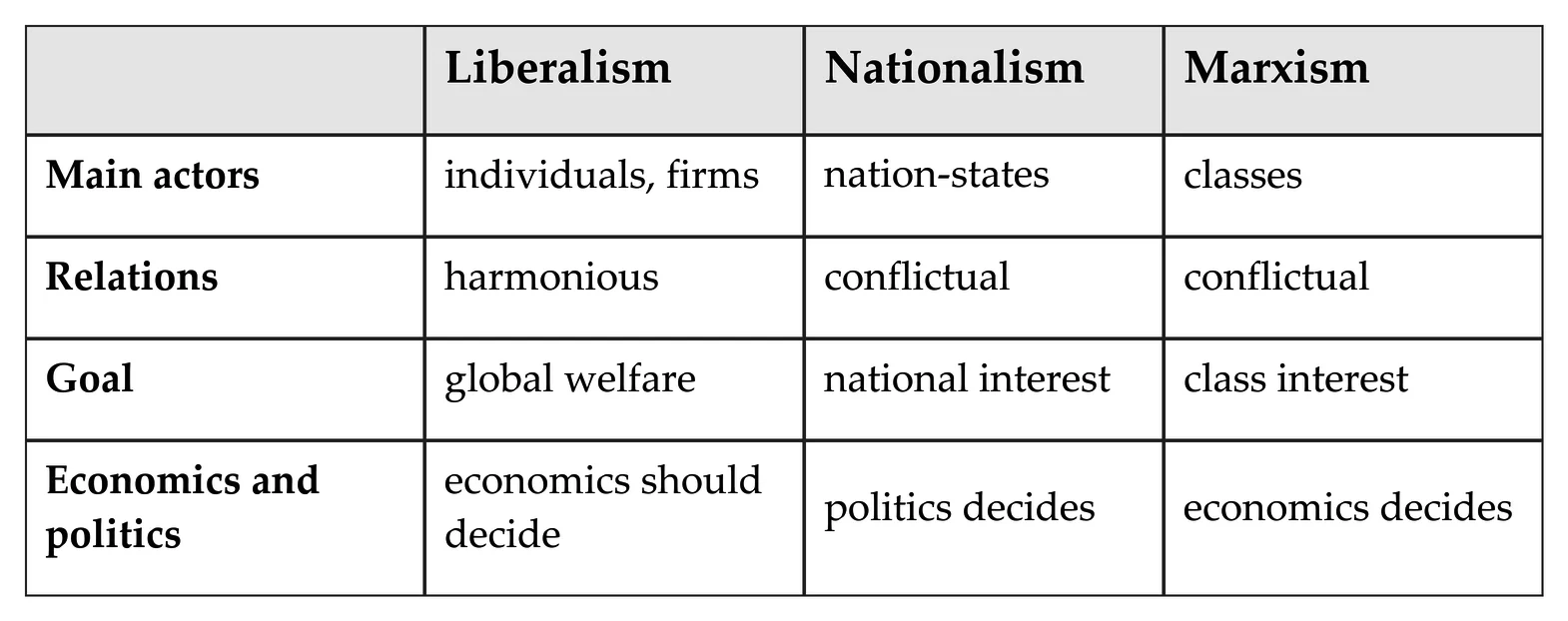
Robert Gilpin, in The Political Economy of International Relations (1987), describes three ideologies of political economy, i.e. systems of belief about how the economy works and how it should work: liberalism, nationalism and Marxism. He calls them ideologies rather than theories because each combines scientific claims with values and cannot be fully proved or disproved. They differ on five questions: who the main actors are, whether economic relations are harmonious or conflictual, what the goal of economic activity is, how economics and politics are related, and how change happens.
- Liberalism. Actors are individuals and firms; relations are harmonious, since exchange benefits all; the goal is to maximise global welfare; economics should decide politics; change comes gradually through growth and markets.
- Nationalism. Actors are nation-states; relations are conflictual, since wealth is a source of power; the goal is national interest; politics decides economics; change comes from shifts in the distribution of power.
- Marxism. Actors are economic classes; relations are conflictual, based on exploitation; the goal is class interest; economics decides politics; change comes through the crises and contradictions of capitalism.
Gilpin himself, a realist, believed that each ideology captured part of the truth: liberalism explains how markets work, nationalism explains why states care about the distribution of gains, and Marxism highlights inequality and crisis. Balaam and Dillman (2014) call these the three traditional perspectives of IPE, labelled economic liberalism, mercantilism and structuralism. Robert O’Brien and Marc Williams (2016) add that newer theories, such as constructivism, feminism and green theory, now challenge all three.
2.2 Economic Nationalism and Liberalism
Mercantilism and Economic Nationalism
Mercantilism was the dominant economic philosophy of European states from the sixteenth to the eighteenth century. Mercantilists such as Thomas Mun in England and Jean-Baptiste Colbert, finance minister of Louis XIV of France, believed that national wealth meant gold and silver, that a country should export more than it imports, and that colonies should supply raw materials and buy manufactures. Wealth and power were two sides of the same coin: wealth paid for armies and navies, and power protected trade. Balaam and Dillman, in Wealth and Power: The Mercantilist Perspective, show that this outlook survives as economic nationalism, i.e. the belief that economic activity should serve the interests of the nation-state.
- Alexander Hamilton. His Report on Manufactures (1791) urged the young United States to protect and subsidise its industries.
- Friedrich List. In The National System of Political Economy (1841), he argued for protecting infant industries until they could compete, accusing Britain of preaching free trade after growing rich through protection, i.e. kicking away the ladder.
- Developmental states. Japan’s Ministry of International Trade and Industry, studied by Chalmers Johnson in MITI and the Japanese Miracle (1982), and later South Korea and Taiwan, used state guidance, credit and protection to build export industries.
- Neo-mercantilism today. China’s state-led capitalism, the US-China tariff war from 2018, export controls on technology, and policies such as India’s Atmanirbhar Bharat and Production Linked Incentive schemes (2020) show the return of economic nationalism.
Economic nationalists, like realists, care about relative gains: even if trade makes both sides richer, the side that gains more may become more powerful. They stress economic security, i.e. control over strategic goods such as food, energy, semiconductors and critical minerals. Critics argue that protection breeds inefficiency, invites retaliation and can lead to conflict, as the tariff wars of the 1930s did.

Economic Liberalism
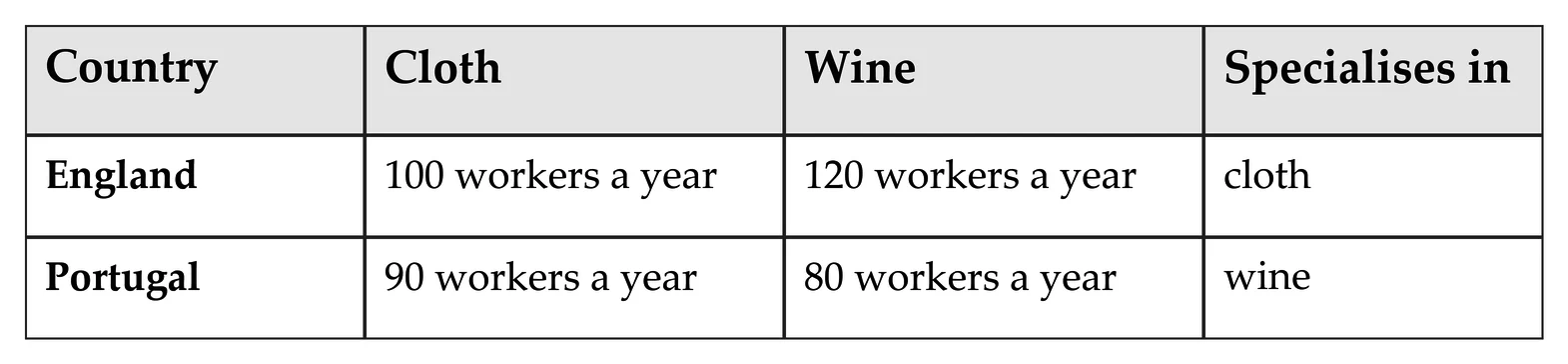
Adam Smith, in The Wealth of Nations (1776), attacked mercantilism. He argued that wealth lies in production, not gold; that the division of labour raises productivity; and that individuals pursuing their own interest in free markets are led as if by an invisible hand to promote the good of society. David Ricardo (1817) added the theory of comparative advantage: even if one country is better at producing everything, both gain if each specialises in what it produces relatively most efficiently and trades. His example was England and Portugal: Portugal was more efficient in both cloth and wine, but both gained when England made cloth and Portugal made wine.
- Classical liberalism. Smith and Ricardo favoured laissez-faire, i.e. minimal state interference, and free trade.
- Keynesian or interventionist liberalism. After the Great Depression, John Maynard Keynes (1936) argued that governments must manage demand to prevent unemployment, which shaped the post-1945 order of embedded liberalism.
- Neoliberalism. From the late 1970s, thinkers such as Friedrich Hayek and Milton Friedman and governments led by Thatcher and Reagan revived free-market ideas; the Washington Consensus (John Williamson, 1989) prescribed liberalisation, privatisation and fiscal discipline to developing countries.
- Liberal institutionalism. Scholars such as Robert Keohane argue that international institutions help states cooperate for mutual gain.
Strange: States, Firms and Diplomacy
Susan Strange, in States, Firms, and Diplomacy (1992), argues that the old picture of states as the only actors no longer holds. States now compete to attract and keep the investment of global firms, and firms compete for market shares across the world. Diplomacy has therefore become triangular: state-state, firm-firm and state-firm bargaining. This view combines liberal recognition of markets with a realist concern for power, and shows that firms have become political actors in their own right.
Critiques of Liberalism
Anwar Shaikh, in The Economic Mythology of Neoliberalism (2005), argues that the neoliberal belief that free markets lead to balanced, mutually beneficial outcomes rests on unrealistic assumptions of perfect competition. In real capitalism, competition is driven by absolute cost advantages, so free trade tends to benefit stronger economies and leave weaker ones with persistent deficits and debts. Others note that today’s rich countries, as List argued, mostly developed through protection and state support before preaching free trade.
2.3 Structuralism: Imperialism, Dependency and World-Systems
Marx and Lenin
Structuralists see the world economy as a structure that systematically benefits some and exploits others. Karl Marx argued that capitalism rests on the exploitation of workers by capitalists, who extract surplus value, and that capitalism expands across the world in search of markets and profit. V. I. Lenin, in Imperialism, the Highest Stage of Capitalism (1916), argued that by the late nineteenth century capitalism had become dominated by monopolies and finance capital. Faced with falling profits at home, capitalists turned to the export of capital to colonies and backward countries, where profits were high, and the great powers divided the world among themselves. Imperialism, for Lenin, was therefore a special stage of capitalism, and rivalry among imperialist powers caused the First World War.
Dependency Theory
After 1945, Latin American economists led by Raúl Prebisch at the UN Economic Commission for Latin America argued that the prices of primary exports tended to fall relative to manufactured imports, so the periphery’s terms of trade worsened. John Martinussen, in Society, State and Market (1997), surveys the neo-Marxist theories of underdevelopment and dependency that followed: Paul Baran, Andre Gunder Frank, Samir Amin, and Fernando Henrique Cardoso and Enzo Faletto, who spoke of dependent development.
Andre Gunder Frank, in The Development of Underdevelopment (1966), rejected the modernisation view that poor countries were simply at an earlier stage of development. He argued that underdevelopment is not an original condition but was produced by the same historical process that developed the rich countries. The world is linked by chains of metropolis-satellite relations through which surplus flows from the satellites to the metropolis. Satellites developed most when their ties to the metropolis were weakest, for example during world wars and the Depression. Frank concluded that development required breaking these ties.
Wallerstein’s World-Systems Theory
Immanuel Wallerstein, in The Rise and Future Demise of the World-Capitalist System (1974) and The Modern World-System (1974), argued that the proper unit of analysis is not the nation-state but the capitalist world-economy, which emerged in Europe in the sixteenth century and spread to cover the globe. It has a single division of labour but many states. It is divided into the core, with high-skill, capital-intensive production and strong states; the periphery, with low-wage, labour-intensive production of raw materials and weak states; and the semi-periphery, which mixes both and acts as a buffer that stabilises the system. Countries can move between zones, as Japan or South Korea moved upward, but the hierarchy itself persists. Wallerstein predicted that the system’s contradictions would eventually lead to its demise.

Critiques of Structuralism
Critics argue that dependency theory could not explain the rise of East Asian economies, which grew rapidly through trade with the core, or India’s and China’s growth after opening up. Some say it neglects domestic factors such as governance, education and institutions. Defenders reply that global inequality remains vast, that commodity exporters still suffer from price swings and debt, and that the structure of the world economy still limits the choices of poor countries.
2.4 Important Questions
- Question 1 Compare the three ideologies of political economy described by Robert Gilpin.
- Question 2 Discuss economic nationalism or mercantilism as a perspective in International Political Economy.
- Question 3 Discuss economic liberalism as a perspective in International Political Economy.
- Question 4 Discuss the structuralist perspective in International Political Economy with reference to dependency and world-systems theory.
DU asks the same idea in different words. So learn one broad answer for each question below; the same answer works for every question joined by OR.
Important Question 1
Compare the three ideologies of political economy described by Robert Gilpin.
OR
Examine the relationship between politics and economics in the liberal, nationalist and Marxist perspectives.
OR
Discuss the main theoretical perspectives in International Political Economy.
Model Answer
“Theory is always for someone and for some purpose.”
— Robert W. Cox, Social Forces, States and World Orders (1981)
Introduction. Robert Gilpin identified three ideologies of political economy: liberalism, nationalism and Marxism. Each offers a different view of the actors, the nature of economic relations, the goals of economic activity and the relationship between economics and politics. Balaam and Dillman call them economic liberalism, mercantilism and structuralism. Comparing them helps us understand debates on trade, development and globalisation.
1. Meaning of Ideology
Gilpin calls them ideologies because each combines claims about how the economy works with values about how it should work.
2. Cox on Theory
Robert Cox reminds us that every theory serves some interest, so each perspective reflects a particular standpoint.
3. Liberalism: Actors
Liberalism focuses on individuals and firms as rational actors seeking to maximise their welfare in markets.
4. Liberalism: Harmony
Liberals believe exchange benefits all parties, so economic relations are harmonious and positive-sum.
5. Liberalism: Economics and Politics
Liberals argue that economics should be separate from politics and that markets should decide the allocation of resources.
6. Nationalism: Actors
Economic nationalism treats nation-states as the main actors and the economy as a means of building national power.
7. Nationalism: Conflict
Nationalists see economic relations as conflictual, since relative gains in wealth translate into relative gains in power.
8. Nationalism: Politics First
For nationalists, politics decides economics: states shape markets to serve security and national interest.
9. Marxism: Classes
Marxism sees classes as the main actors, with capitalists exploiting workers and rich countries exploiting poor ones.
10. Marxism: Economics First
For Marxists, the economic base shapes politics, so the state largely serves the interests of the dominant class.
11. Theories of Change
Liberals see gradual growth, nationalists see shifts in power, and Marxists see crises and contradictions of capitalism as drivers of change.
12. Strengths of Liberalism
Liberalism explains the efficiency gains of markets and trade, seen in the growth of open economies.
13. Strengths of Nationalism
Nationalism explains why states protect strategic industries and care about who gains more, as in US-China rivalry.
14. Strengths of Marxism
Marxism highlights inequality, exploitation and crises, which liberal theory often neglects.
15. Gilpin’s Synthesis
Gilpin argued that each ideology captures part of the truth, and that a realistic IPE must combine their insights.
16. Ideologies and Policy Choices
Governments rarely follow one ideology fully. India after 1991 combined liberal trade reforms with nationalist protection of agriculture and strategic sectors, and with welfare policies shaped by concerns about inequality.
17. Newer Challenges
Constructivists argue that economic interests are shaped by ideas and identities, feminists show the gendered nature of work, and green theorists question endless growth, so the three classic ideologies are no longer the whole of IPE.
18. Gilpin’s Own Position
Gilpin wrote as a realist, believing that the world economy rests on a political foundation provided by a dominant power, which is why he paid special attention to nationalism and to the rise and decline of hegemons.
19. Evaluation
No single perspective explains everything, and newer theories such as feminism and postcolonialism challenge all three.
Conclusion. Thus, Gilpin’s three ideologies differ on actors, relations, goals and the link between politics and economics. As Cox reminds us, theory is always for someone and for some purpose, so each perspective reveals some aspects of the world economy and hides others.
Important Question 2
Discuss economic nationalism or mercantilism as a perspective in International Political Economy.
OR
Examine Friedrich List’s argument for the protection of infant industries.
OR
Discuss the relevance of neo-mercantilism in the contemporary world economy.
Model Answer
“It is a very common clever device that when anyone has attained the summit of greatness, he kicks away the ladder by which he has climbed up, in order to deprive others of the means of climbing up after him.”
— Friedrich List, The National System of Political Economy (1841)
Introduction. Economic nationalism holds that economic activity should serve the power and interests of the nation-state. It began as mercantilism in early modern Europe, was developed by Alexander Hamilton and Friedrich List, and survives in developmental states and today’s neo-mercantilism. Balaam and Dillman describe it as the perspective that links wealth and power.
1. Classical Mercantilism
Mercantilists such as Thomas Mun and Colbert believed national wealth meant gold and silver, earned through trade surpluses and colonies.
2. Wealth and Power
Wealth paid for armies and navies, and power protected trade, so the two were inseparable.
3. Zero-Sum View
Mercantilists saw trade as a zero-sum contest in which one country’s gain was another’s loss.
4. Hamilton’s Report
Alexander Hamilton’s Report on Manufactures (1791) urged the United States to protect and subsidise its young industries.
5. List’s Infant Industries
Friedrich List argued that new industries need protection until they can compete with established foreign rivals.
6. Kicking Away the Ladder
List accused Britain of preaching free trade after growing rich through protection, kicking away the ladder from others.
7. Productive Powers
List valued the nation’s productive powers, i.e. skills, industries and institutions, more than present consumption.
8. Link with Realism
Like realists, economic nationalists care about relative gains and national security in an anarchic world.
9. Developmental States
Japan’s MITI, South Korea and Taiwan used state guidance, credit and protection to build competitive export industries.
10. China’s State Capitalism
China combines markets with strong state control over finance, strategic firms and technology, a form of neo-mercantilism.
11. Economic Security
States now seek control over semiconductors, critical minerals and energy, using export controls and subsidies.
12. Trade Wars
The US-China tariff war from 2018 and rising protectionism show the revival of economic nationalism in leading economies.
13. India’s Experience
India’s import substitution after 1947 and Atmanirbhar Bharat with Production Linked Incentives since 2020 reflect nationalist ideas.
14. Criticism
Liberals argue that protection breeds inefficiency, raises prices and invites retaliation, as in the tariff wars of the 1930s.
15. Defence
Supporters reply that almost all rich countries developed behind protection, so poor countries need policy space.
16. Hegemonic Stability
Realist scholars such as Robert Gilpin and Stephen Krasner argue that an open world economy needs a dominant power willing to enforce its rules, as Britain did before 1914 and the United States after 1945.
17. Weaponised Interdependence
States increasingly use their control over networks of finance, energy and technology as weapons, as in sanctions on Russia and Iran; Henry Farrell and Abraham Newman (2019) call this weaponised interdependence.
18. Mercantilism and Colonialism
Mercantilist policies justified colonies as sources of raw materials and captive markets; Britain’s Navigation Acts, first passed in 1651, required colonial trade to be carried in English ships, protecting English shipping and power.
19. Evaluation
Economic nationalism remains powerful because states care about security and power, not only about efficiency.
Conclusion. Thus, economic nationalism links wealth and power and treats the economy as a tool of the state. List’s charge that rich countries kick away the ladder remains influential, and the return of tariffs, subsidies and export controls shows that this perspective is very much alive.
Important Question 3
Discuss economic liberalism as a perspective in International Political Economy.
OR
Explain the theory of comparative advantage and its critics.
OR
Examine the neoliberal perspective and its critique.
Model Answer
“Under a system of perfectly free commerce, each country naturally devotes its capital and labour to such employments as are most beneficial to each.”
— David Ricardo, On the Principles of Political Economy and Taxation (1817)
Introduction. Economic liberalism holds that free markets and free trade are the best way to create wealth and that economic relations are positive-sum. It began with Adam Smith and David Ricardo, was modified by Keynes, and was revived as neoliberalism from the 1970s. It remains the dominant perspective in mainstream economics and international economic institutions.
1. Smith against Mercantilism
Adam Smith argued that wealth lies in production, not gold, and that free trade benefits all nations.
2. Division of Labour
Smith showed that specialisation and the division of labour raise productivity, as in his famous pin factory example.
3. The Invisible Hand
Individuals pursuing their own interest in markets are led, as if by an invisible hand, to promote the good of society.
4. Ricardo’s Comparative Advantage
Ricardo showed that both countries gain if each specialises in what it produces relatively most efficiently and trades.
5. England and Portugal
Portugal was more efficient in both cloth and wine, yet both gained when England made cloth and Portugal made wine.
6. Harmony of Interests
Liberals believe trade creates mutual gains and interdependence, which also reduces the likelihood of war.
7. Keynesian Liberalism
After the Depression, Keynes argued that governments must manage demand, shaping the welfare states of the post-war era.
8. Embedded Liberalism
The post-1945 order combined open trade through GATT with domestic welfare and full employment.
9. Neoliberalism
Hayek and Friedman revived free-market ideas, adopted by Thatcher and Reagan, stressing deregulation and privatisation.
10. Washington Consensus
The Washington Consensus prescribed liberalisation, privatisation and fiscal discipline to developing countries in the 1980s and 1990s.
11. Liberal Institutionalism
Keohane and others argue that institutions such as the WTO help states cooperate for mutual benefit.
12. Strange’s Triangular Diplomacy
Strange shows that states now bargain with firms for investment, so markets and firms shape state policy.
13. Shaikh’s Critique
Anwar Shaikh argues that real competition is based on absolute advantage, so free trade favours strong economies.
14. Inequality and Crises
Critics link neoliberal policies to rising inequality and financial crises such as those of 1997 and 2008.
15. Indian Experience
India’s liberalisation after 1991 brought faster growth and services exports, but also debates about jobs and inequality.
16. Gains from Trade in Practice
Supporters point to the rapid fall in global poverty since the 1990s, especially in China and India, as evidence that open trade and markets can raise living standards on a large scale.
17. Winners and Losers
Even liberal economists accept that trade creates losers: the Stolper-Samuelson theorem (1941) shows that trade raises the income of abundant factors and lowers that of scarce ones, which explains political opposition to free trade.
18. The WTO and Liberal Rules
The WTO, created in 1995, embodies liberal principles such as non-discrimination through most-favoured-nation treatment and national treatment, backed by a dispute settlement system to enforce the rules.
19. Evaluation
Liberalism explains the gains from trade and markets but underplays power, distribution and the role of the state.
Conclusion. Thus, economic liberalism, from Smith’s invisible hand to Ricardo’s comparative advantage and today’s neoliberalism, holds that free markets benefit all. Ricardo’s claim that free commerce leads each country to its most beneficial employment remains powerful, but critics such as Shaikh show that trade can also reproduce inequality.
Important Question 4
Discuss the structuralist perspective in International Political Economy with reference to dependency and world-systems theory.
OR
Examine Andre Gunder Frank’s idea of the development of underdevelopment.
OR
Explain Immanuel Wallerstein’s world-systems theory.
Model Answer
“Contemporary underdevelopment is in large part the historical product of past and continuing economic and other relations between the satellite underdeveloped and the now developed metropolitan countries.”
— Andre Gunder Frank, The Development of Underdevelopment (1966)
Introduction. Structuralism sees the world economy as a structure of exploitation between classes and between rich and poor countries. Rooted in Marx and Lenin, it was developed by Latin American dependency theorists such as Andre Gunder Frank and by Immanuel Wallerstein’s world-systems theory. It challenges the liberal claim that trade and investment benefit all.
1. Marx on Capitalism
Marx argued that capitalism rests on the exploitation of workers and expands across the world in search of profit.
2. Lenin on Imperialism
Lenin argued that monopoly and finance capital led to the export of capital and the division of the world among imperial powers.
3. Prebisch and Terms of Trade
Raúl Prebisch argued that primary export prices fall relative to manufactures, worsening the periphery’s terms of trade.
4. Against Modernisation Theory
Dependency theorists rejected the view that poor countries were simply at an earlier stage of the same path of development.
5. Frank’s Underdevelopment
Frank argued that underdevelopment was produced by the same process that developed the rich countries.
6. Metropolis and Satellite
Chains of metropolis-satellite relations drain surplus from the satellites to the metropolis at every level.
7. Weak Ties Help
Frank noted that satellites developed most when their ties to the metropolis were weakest, as during wars and depression.
8. Martinussen’s Survey
Martinussen shows the variety of dependency theories, from Baran and Amin to Cardoso and Faletto’s dependent development.
9. Wallerstein’s World-Economy
Wallerstein made the capitalist world-economy, emerging in sixteenth-century Europe, the unit of analysis.
10. Core, Periphery, Semi-Periphery
The core has high-skill production and strong states, the periphery low-wage production and weak states, and the semi-periphery a mix.
11. Role of the Semi-Periphery
The semi-periphery acts as a buffer that reduces polarisation and stabilises the system.
12. Mobility within the System
Countries can move between zones, as Japan and South Korea rose, but the hierarchy itself persists.
13. India and Dependency
Colonial drain and India’s role as a raw material exporter illustrate dependency, while its later growth complicates the picture.
14. Criticism
Critics say the theory cannot explain East Asia’s rise through trade and neglects domestic institutions and policies.
15. Continuing Relevance
Persistent global inequality, commodity dependence and debt crises keep structuralist ideas relevant.
16. Unequal Exchange
Arghiri Emmanuel and Samir Amin argued that trade between high-wage and low-wage countries involves unequal exchange, transferring value from the periphery to the core even when prices appear fair.
17. Dependency and Policy
Dependency ideas encouraged import-substitution policies in Latin America and elsewhere, which built industries but later suffered from debt and inefficiency in the debt crisis of the 1980s.
18. Hegemonic Cycles
Wallerstein argued that the world-system has seen successive hegemonic powers, the Dutch in the seventeenth century, Britain in the nineteenth and the United States in the twentieth, each rising and declining within the same capitalist world-economy.
19. Evaluation
Structuralism reveals the inequalities of the world economy, though it underestimates the possibility of development.
Conclusion. Thus, structuralism, from Lenin to Frank and Wallerstein, sees underdevelopment as the historical product of unequal relations between satellite and metropolis. Despite its failure to predict East Asia’s rise, it remains a powerful critique of global inequality.
Short Notes
(a) Comparative advantage
Ricardo’s theory (1817) that countries gain by specialising in goods they produce relatively most efficiently, even if another country is better at producing everything.
(b) Infant industry
List’s argument that new industries need temporary protection from foreign competition until they become strong enough to compete.
(c) Semi-periphery
In Wallerstein’s world-systems theory, the intermediate zone between core and periphery that mixes both types of production and stabilises the system.
More notes: DSE-3a International Political Economy
These notes are prepared by PADHO TO AISE for study help. They are not an official University of Delhi publication.