
Semester V DSE-3a International Political Economy
Unit I · 23 min read · Updated 24 Nov 2026
As per the University of Delhi (DU) BA (Hons) Political Science syllabus
Contents
- 1.1 The Nature of Political Economy
- From Political Economy to Economics and Back
- Gilpin: State and Market
- Balaam and Dillman: What Is IPE
- 1.2 IPE as a Field: Strange and the End of Mutual Neglect
- Strange: A Case of Mutual Neglect
- Strange’s Structural Power
- Schools of IPE
- 1.3 The History of the International Economy and Global and Domestic Interactions
- Hirst, Thompson and Bromley: Globalization in Question
- Gilpin: The Second Great Age of Capitalism
- Frieden and Martin: Global and Domestic Interactions
- The Indian Story in Brief
- 1.4 Important Questions
- Explain the nature of International Political Economy and the relationship between politics and economics.
- Discuss Susan Strange’s argument about the mutual neglect of international economics and international relations.
- Discuss the history of the international economy with reference to the debate on globalisation.
- Discuss the interaction between global and domestic politics in International Political Economy.
- Short Notes
आधुनिक विश्व में राज्य और बाज़ार का साथ-साथ अस्तित्व और उनकी परस्पर क्रिया ही राजनीतिक अर्थव्यवस्था को जन्म देती है।
The parallel existence and mutual interaction of state and market in the modern world create political economy.
— Robert Gilpin, The Political Economy of International Relations (1987)
WWHY did India face a crisis in 1991 that forced it to pledge its gold and open its economy? Why do countries fight over tariffs, oil prices and the rules of the World Trade Organization? Such questions cannot be answered by economics alone or by politics alone. International Political Economy (IPE) studies how politics and economics interact in the world: how states use economic tools to gain power, how markets limit what states can do, and how social groups win or lose from global economic change. This chapter introduces the nature of political economy, the relationship between state, market and society, Susan Strange’s call to end the mutual neglect of economics and international relations, the history of the international economy, and the links between global and domestic politics.

1.1 The Nature of Political Economy
From Political Economy to Economics and Back
The term political economy is older than economics. Thinkers such as Adam Smith (1776), David Ricardo (1817), Friedrich List (1841) and Karl Marx (1867) studied production, trade and wealth together with the state, classes and power. In the late nineteenth century, economics became a separate science that studied markets with mathematical models and assumed rational individuals, while political science studied the state, government and power. In international relations, realists after 1945 focused on war and security, the high politics, and treated trade and money as low politics. International Political Economy emerged in the 1970s to bring these divided fields back together.
Gilpin: State and Market
Robert Gilpin, in The Political Economy of International Relations (1987) and Global Political Economy (2001), explains that political economy arises from the coexistence of two forms of organisation: the state, which is based on territory, authority and the pursuit of power and security, and the market, which is based on exchange, prices and the pursuit of efficiency and wealth. The state’s logic is to control and to protect, while the market’s logic is to expand wherever profit can be made, regardless of borders. IPE studies the tension between these logics. In simple words, states shape markets through laws, taxes, currencies and trade rules, and markets shape states by creating wealth, distributing it unequally and limiting what governments can do. Gilpin describes the nature of political economy as the study of how the pursuit of wealth and the pursuit of power interact.
- How politics shapes economics. Governments set tariffs, regulate firms, manage money and decide whether to join trade agreements.
- How economics shapes politics. Economic growth gives states the resources for military power; crises can bring down governments; interest groups lobby for policies.
- Distribution. Every economic arrangement creates winners and losers, so the central political question is who gets what.
- Power. Rich states can use trade, aid, sanctions and finance as instruments of power, a practice often called economic statecraft.
Balaam and Dillman: What Is IPE
David Balaam and Bradford Dillman, in Introduction to International Political Economy (6th edition, 2014), define IPE as the study of the tensions and interactions among states, markets and societies. They add society to Gilpin’s state and market, because individuals, classes, firms, social movements and non-governmental groups also shape the global economy. They explain IPE through three classic perspectives, economic liberalism, mercantilism and structuralism, and through alternative perspectives such as constructivism and feminism. They also adopt Susan Strange’s four structures of the global political economy, i.e. security, production, finance and knowledge, to analyse who has power over outcomes. For them, IPE is interdisciplinary, drawing on economics, political science, sociology, history and philosophy, and it asks normative questions about fairness as well as factual questions about how the world works.
1.2 IPE as a Field: Strange and the End of Mutual Neglect
Strange: A Case of Mutual Neglect
Susan Strange, a British scholar, argued in International Economics and International Relations: A Case of Mutual Neglect (1970) that economists ignored politics and international relations scholars ignored economics, even though the real world was being transformed by trade, multinational firms and international money. Economists assumed a stable political framework, and IR scholars assumed that economics was a technical matter. Strange warned that this neglect left both disciplines unable to explain events such as the troubles of the pound sterling or the growth of the Eurodollar market. Her article is often seen as a founding text of British IPE. Events soon proved her right: in August 1971, President Nixon ended the convertibility of the dollar into gold, and in 1973 the oil price shock showed how economic power could be used politically.
Strange’s Structural Power
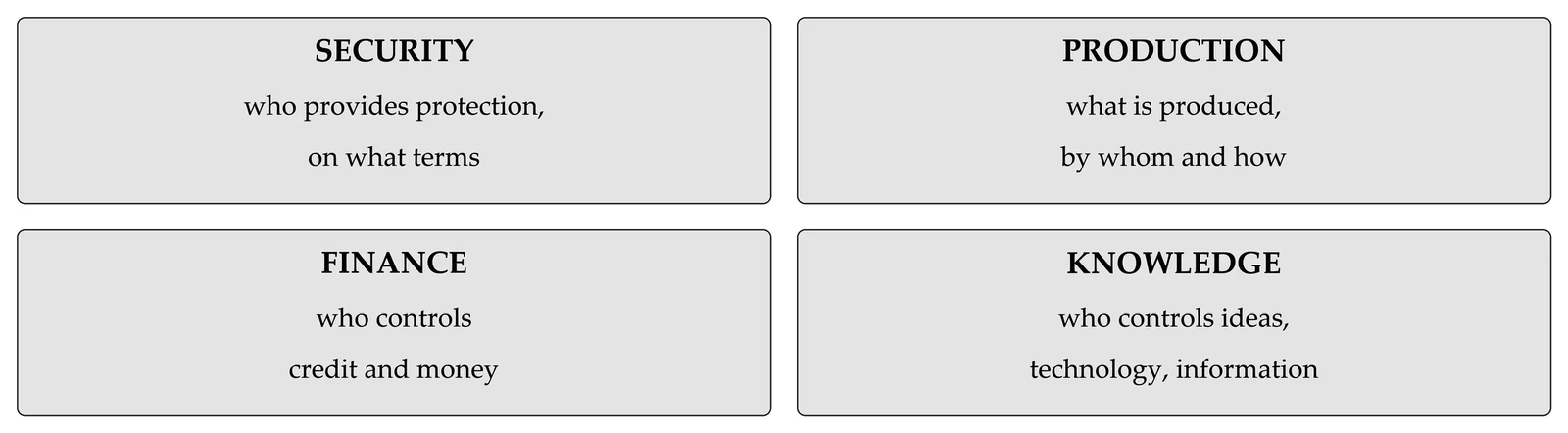
In States and Markets (1988; second edition 1994), Strange distinguished relational power, i.e. the power of A to make B do something, from structural power, i.e. the power to shape the frameworks within which others must act. She identified four primary structures of the world economy:
- Security structure. Who provides protection against violence, and on what terms.
- Production structure. What is produced, by whom, by what methods and for whose benefit.
- Finance structure. Who controls credit and money, and so who can spend now and pay later.
- Knowledge structure. Who creates, controls and communicates knowledge, ideas, technology and beliefs.
Strange argued that the United States retained great structural power even when it seemed to be in decline, because it dominated all four structures. In The Retreat of the State (1996), she argued that markets, firms and other non-state actors had gained power at the expense of states, so IPE must study authority wherever it lies.
Schools of IPE
Benjamin Cohen, in International Political Economy: An Intellectual History (2008), distinguishes an American school, which uses positivist, often quantitative methods and focuses on states and institutions (associated with Robert Keohane, Joseph Nye, Stephen Krasner and Peter Katzenstein), from a British school, which is more historical, normative and critical (associated with Susan Strange and Robert Cox). Keohane and Nye’s Power and Interdependence (1977) introduced the idea of complex interdependence, in which multiple channels link societies and military force is less useful. Robert Cox (1981) argued that theory is always for someone and for some purpose, opening the way to critical IPE.
1.3 The History of the International Economy and Global and Domestic Interactions
Hirst, Thompson and Bromley: Globalization in Question
Paul Hirst, Grahame Thompson and Simon Bromley, in Globalization in Question (third edition, 2009), challenge the claim that today’s globalisation is new and has made states powerless. Their history of the international economy shows that the period 1870–1914 was in some ways as open as today: trade and capital flows were very high relative to output, the gold standard linked currencies, and mass migration moved millions of people across oceans. This open economy collapsed with the First World War, the Great Depression and protectionism in the 1930s, and was rebuilt after 1945 under American leadership. They argue that the world economy is better described as international than truly global, because most trade and investment remain concentrated among a few regions, most multinational companies remain rooted in a home country, and states retain significant capacity to govern their economies, especially when they cooperate.
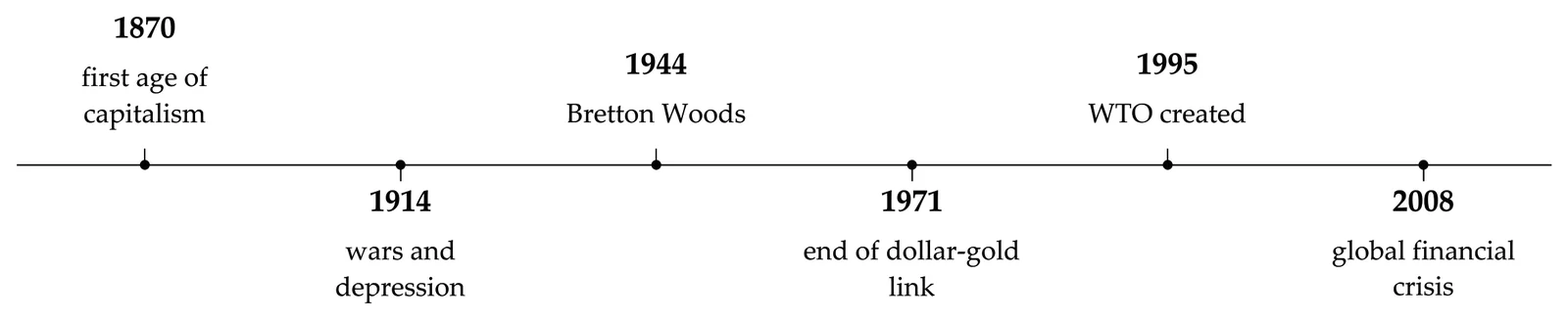
- 1870–1914. Gold standard, free trade led by Britain, large capital exports and migration.
- 1914–1945. World wars, the Great Depression, collapse of the gold standard, tariffs and competitive devaluations.
- 1944–1971. The Bretton Woods system of fixed exchange rates tied to the dollar, the IMF, the World Bank and the GATT (1947).
- 1971–1990s. Floating exchange rates, oil shocks, the debt crisis of developing countries and the rise of neoliberal policies.
- 1995 onwards. The WTO, rapid growth of China and India, global value chains, and recurring financial crises, notably 1997 and 2008.
Gilpin: The Second Great Age of Capitalism
In The Challenge of Global Capitalism (2000), Gilpin calls the period after the Cold War the second great age of capitalism, the first being the era before 1914. He argues that the post-1945 order was built on American leadership, the Cold War alliance among capitalist states and a compromise that allowed governments to pursue full employment and welfare at home while opening trade abroad. With the end of the Cold War, this political foundation weakened. He described the global economy as fragile, threatened by financial instability, economic nationalism and regional blocs, and warned that the first great age had ended in war and depression because its political foundations collapsed.
Frieden and Martin: Global and Domestic Interactions
Jeffry Frieden and Lisa Martin, in International Political Economy: Global and Domestic Interactions (2002), survey how the field explains foreign economic policies and international outcomes. They argue that IPE must study the interaction between domestic and international levels. Domestic interests (such as exporters, import-competing industries, workers and farmers) and domestic institutions (such as electoral systems and central banks) shape a country’s trade and monetary policies. In turn, the international economy changes domestic interests and politics, an idea Peter Gourevitch called the second image reversed (1978). International institutions such as the WTO and IMF affect states by providing information, reducing transaction costs and making commitments credible. Robert Putnam’s idea of two-level games (1988) shows that leaders negotiate simultaneously with foreign governments and with domestic groups whose approval they need.
The Indian Story in Brief
India’s experience illustrates these ideas. After independence, India chose import-substituting industrialisation and a large public sector, a choice shaped by memories of colonial economic exploitation. In 1991, a balance of payments crisis forced India to take an IMF loan and begin liberalisation, privatisation and globalisation. Since then India has become a major exporter of services and a key voice of developing countries in the WTO and G20, while domestic groups such as farmers continue to shape its positions in trade negotiations.
1.4 Important Questions
- Question 1 Explain the nature of International Political Economy and the relationship between politics and economics.
- Question 2 Discuss Susan Strange’s argument about the mutual neglect of international economics and international relations.
- Question 3 Discuss the history of the international economy with reference to the debate on globalisation.
- Question 4 Discuss the interaction between global and domestic politics in International Political Economy.
DU asks the same idea in different words. So learn one broad answer for each question below; the same answer works for every question joined by OR.
Important Question 1
Explain the nature of International Political Economy and the relationship between politics and economics.
OR
Discuss Robert Gilpin’s view of the relationship between state and market.
OR
Examine the meaning and scope of International Political Economy.
Model Answer
“It is not from the benevolence of the butcher, the brewer, or the baker that we expect our dinner, but from their regard to their own interest.”
— Adam Smith, The Wealth of Nations (1776)
Introduction. International Political Economy studies the interaction of politics and economics in world affairs. Robert Gilpin describes it as the study of the relationship between the state, driven by power, and the market, driven by wealth. Balaam and Dillman add society as a third element. IPE grew in the 1970s to overcome the separation of economics and international relations.
1. Classical Political Economy
Adam Smith, Ricardo, List and Marx studied wealth, trade and production together with the state and classes, as political economy.
2. Separation of Disciplines
Later, economics became a separate science of markets, while political science and IR focused on the state and security.
3. Rise of IPE
The end of the dollar-gold link in 1971, the oil shock of 1973 and the debt crisis showed that economics and politics could not be separated.
4. Gilpin’s State and Market
Gilpin explains that the state seeks power and security within borders, while the market seeks efficiency and profit across borders.
5. Tension between Logics
The state’s logic is control and protection, while the market’s is expansion, creating constant tension and bargaining between them.
6. Politics Shapes Economics
Governments set tariffs, regulate firms, manage money and decide whether to join trade agreements, shaping how markets work.
7. Economics Shapes Politics
Economic growth funds military power, crises can topple governments, and interest groups lobby states for favourable policies.
8. Smith and Self-Interest
Adam Smith argued that individuals pursuing self-interest in markets create wealth, an idea at the heart of economic liberalism.
9. Balaam and Dillman’s Society
Balaam and Dillman add society, i.e. classes, firms, social movements and NGOs, to state and market, since these also shape outcomes.
10. Distribution
Every economic arrangement creates winners and losers, so IPE asks who gets what, when and how.
11. Power and Economic Statecraft
States use trade, aid, sanctions and finance as instruments of power, as in sanctions on Iran or Russia.
12. Strange’s Four Structures
Susan Strange’s structures of security, production, finance and knowledge help identify who has power in the world economy.
13. Three Classic Perspectives
Liberalism, mercantilism and structuralism offer different views of the relationship between state and market.
14. Interdisciplinary Nature
IPE draws on economics, political science, sociology, history and philosophy, and asks normative questions about fairness.
15. Indian Example
India’s 1991 crisis, IMF loan and liberalisation show how economic pressures and political choices interact.
16. Economic Statecraft in Practice
Recent examples include American export controls on advanced semiconductors to China from 2022 and Western sanctions on Russia after its invasion of Ukraine, which froze much of Russia’s central bank reserves. They show how economic tools serve political ends.
17. Positive and Normative Questions
IPE asks positive questions about how the world economy works and normative questions about what is fair, such as whether trade rules favour rich countries or whether global finance should be more tightly regulated.
18. Evaluation
IPE provides a fuller understanding of world affairs than economics or politics alone, since power and wealth are inseparable.
Conclusion. Thus, IPE studies the interaction of state, market and society. Smith showed how self-interest drives markets, while Gilpin showed that markets operate within states that pursue power. Understanding this intersection is essential to explain trade wars, financial crises and the rise of new economic powers such as India and China.
Important Question 2
Discuss Susan Strange’s argument about the mutual neglect of international economics and international relations.
OR
Explain Susan Strange’s idea of structural power and the four structures of the world economy.
OR
Discuss the emergence of International Political Economy as a field of study.
Model Answer
“Structural power … is the power to shape and determine the structures of the global political economy within which other states, their political institutions, their economic enterprises and (not least) their scientists and other professional people have to operate.”
— Susan Strange, States and Markets (1988)
Introduction. Susan Strange was one of the founders of International Political Economy. In 1970 she argued that international economics and international relations neglected each other, leaving both unable to understand a world transformed by trade, finance and multinational firms. Her later idea of structural power showed how power in the world economy works through the frameworks that shape choices.
1. The Context of 1970
By 1970, trade, multinational firms and international money were growing fast, but the disciplines studying them remained separate.
2. Economists’ Neglect
Economists assumed a stable political framework and treated the world economy as a technical system of markets.
3. IR Scholars’ Neglect
Realist IR scholars focused on war and security as high politics and treated trade and money as low politics.
4. Consequences
Strange argued that this neglect left scholars unable to explain events such as the troubles of sterling and the Eurodollar market.
5. Events Proved Her Right
The end of the dollar-gold link in 1971 and the oil shock of 1973 showed how economic and political power were intertwined.
6. Relational and Structural Power
Strange distinguished relational power, making others act, from structural power, shaping the frameworks within which others act.
7. Security Structure
The security structure concerns who provides protection and on what terms, as the US does for its allies.
8. Production Structure
The production structure concerns what is produced, by whom and how, now organised through global value chains.
9. Finance Structure
The finance structure concerns who controls credit and money, giving power to those who can create and lend money.
10. Knowledge Structure
The knowledge structure concerns who controls ideas, technology and information, increasingly important in the digital age.
11. American Power
Strange argued that the US kept great structural power, despite talk of decline, because it dominated all four structures.
12. The Retreat of the State
In 1996, Strange argued that markets and firms had gained authority at the expense of states, so IPE must study authority wherever it lies.
13. The British School
Strange’s historical, normative approach shaped the British school of IPE, which differs from the more quantitative American school.
14. Relevance Today
Control over technology, finance and supply chains in the US-China rivalry shows the continuing value of structural power.
15. Criticism
Critics say structural power is hard to measure and that Strange underestimated the continuing capacity of states.
16. Casino Capitalism
In Casino Capitalism (1986) and Mad Money (1998), Strange warned that deregulated financial markets had turned the world economy into a casino, where speculation created instability that harmed ordinary people. The crises of 1997 and 2008 seemed to confirm her warnings.
17. States and Firms
With John Stopford, Strange wrote Rival States, Rival Firms (1991), arguing that diplomacy had become triangular, involving bargaining between states, between firms, and between states and firms, as governments compete to attract investment.
18. Evaluation
Strange helped create IPE as a field and gave it a powerful concept for understanding power in the world economy.
Conclusion. Thus, Strange’s 1970 critique of mutual neglect helped found IPE, and her idea of structural power, the power to shape the structures within which others operate, explains how dominance in security, production, finance and knowledge gives some states and firms lasting influence.
Important Question 3
Discuss the history of the international economy with reference to the debate on globalisation.
OR
Is globalisation unprecedented. Discuss with reference to Hirst, Thompson and Bromley.
OR
Examine Robert Gilpin’s idea of the second great age of capitalism.
Model Answer
“The inhabitant of London could order by telephone, sipping his morning tea in bed, the various products of the whole earth, in such quantity as he might see fit, and reasonably expect their early delivery upon his doorstep.”
— John Maynard Keynes, The Economic Consequences of the Peace (1919)
Introduction. Many people believe that globalisation is a new phenomenon that has made states powerless. Paul Hirst, Grahame Thompson and Simon Bromley question this, showing that the world economy before 1914 was in some ways as open as today. Robert Gilpin similarly calls our era the second great age of capitalism, warning that the first collapsed when its political foundations failed.
1. The Globalisation Debate
Hyperglobalists argue that globalisation is new and has weakened states, while sceptics argue that it has precedents and states remain strong.
2. The First Age, 1870–1914
The gold standard, British free trade, high capital flows and mass migration made the pre-1914 economy highly integrated.
3. Keynes’s London
Keynes described how a Londoner before 1914 could order goods from the whole earth, showing the openness of that era.
4. Collapse, 1914–1945
World wars, the Great Depression, tariffs and competitive devaluations destroyed the open economy.
5. Bretton Woods
After 1944, the IMF, World Bank and GATT rebuilt an open economy under American leadership, with fixed exchange rates.
6. Embedded Liberalism
John Ruggie called the post-war order embedded liberalism: open trade combined with domestic welfare and full employment.
7. Floating Rates and Neoliberalism
After 1971, floating exchange rates, capital mobility and neoliberal policies expanded markets.
8. Hirst and Thompson’s Scepticism
Hirst, Thompson and Bromley argue that today’s openness is not unprecedented, comparing trade and capital flows with 1870–1914.
9. International not Global
They argue that trade and investment are concentrated in a few regions, so the economy is international rather than truly global.
10. National Firms
Most multinational companies remain rooted in a home country, with headquarters, assets and research concentrated there.
11. States Still Govern
States retain capacity to regulate their economies, especially through cooperation in bodies such as the G20.
12. Gilpin’s Second Great Age
Gilpin calls the post-Cold War era the second great age of capitalism, comparable to the era before 1914.
13. A Fragile Economy
Gilpin warned that financial instability, economic nationalism and weaker American leadership made global capitalism fragile.
14. Lessons of 2008 and After
The 2008 crisis, trade wars and supply-chain shocks during the pandemic support the view that globalisation can be reversed.
15. What Is New
Critics note that global value chains, digital trade and instant finance are new features, so today’s globalisation is deeper in some ways.
16. The Gold Standard
Under the classical gold standard, currencies were fixed to gold, which encouraged trade and investment but forced governments to accept deflation and unemployment when gold flowed out, a discipline that became politically harder once workers gained the vote.
17. India in the First Age
Colonial India was tied into the pre-1914 world economy as an exporter of raw materials such as cotton, jute, indigo and tea and an importer of British manufactures, showing that the first age of globalisation was also an age of empire.
18. Evaluation
The history of the international economy shows that openness depends on political foundations and can collapse if they fail.
Conclusion. Thus, Keynes’s picture of pre-1914 London shows that globalisation has a history. Hirst, Thompson and Bromley argue that today’s economy is international rather than truly global, and Gilpin warns that the second great age of capitalism is fragile, depending, like the first, on political foundations.
Important Question 4
Discuss the interaction between global and domestic politics in International Political Economy.
OR
Examine the levels of analysis in International Political Economy.
OR
Discuss Frieden and Martin’s view of global and domestic interactions.
Model Answer
“The politics of many international negotiations can usefully be conceived as a two-level game.”
— Robert Putnam, Diplomacy and Domestic Politics: The Logic of Two-Level Games (1988)
Introduction. Economic policies are made at home but have effects abroad, and global economic forces shape domestic politics. Jeffry Frieden and Lisa Martin argue that IPE must study the interaction between domestic interests and institutions and the international system. Ideas such as Gourevitch’s second image reversed and Putnam’s two-level games help explain this interaction.
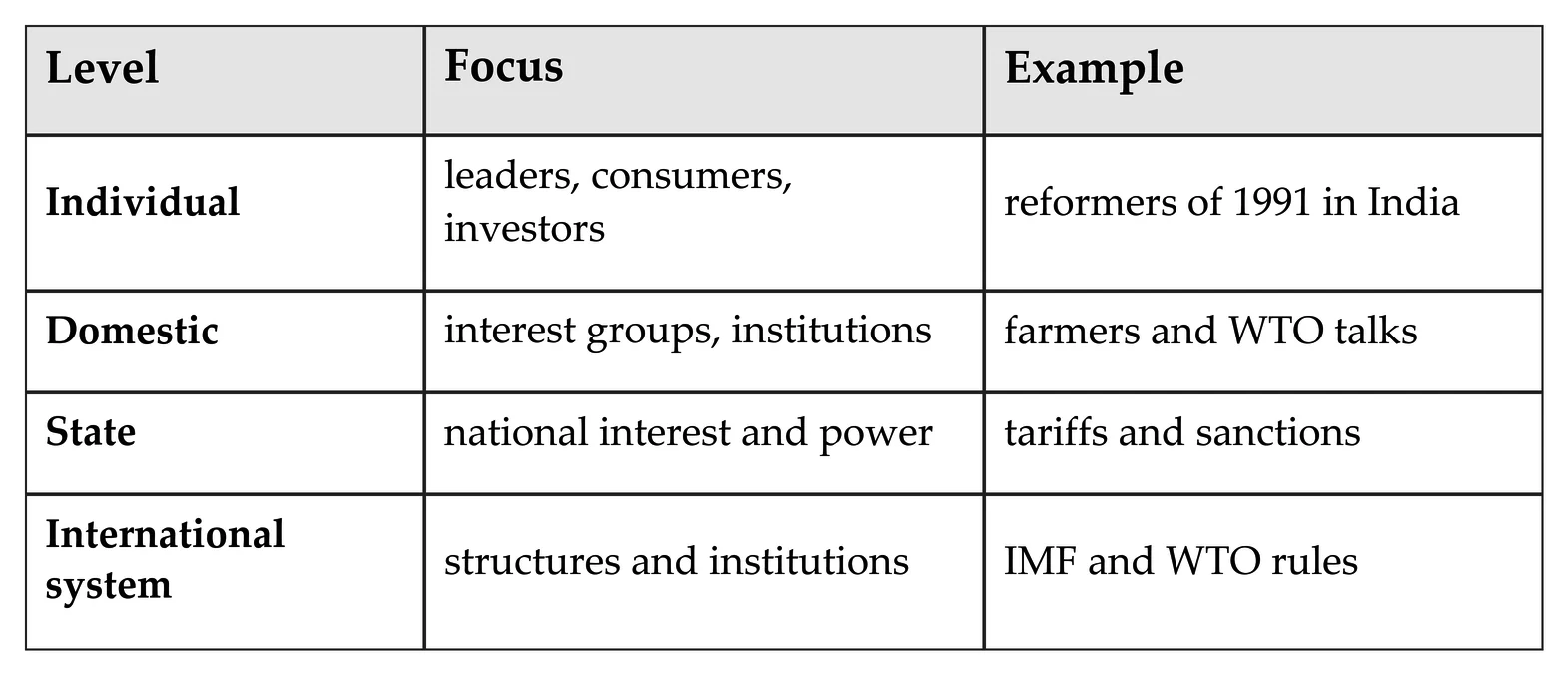
1. Levels of Analysis
IPE studies individuals, domestic groups, states and the international system, each offering a different explanation.
2. Frieden and Martin’s Survey
Frieden and Martin argue that the field has moved towards explaining outcomes through the interaction of domestic and international factors.
3. Domestic Interests
Exporters, import-competing industries, workers and farmers have different interests and lobby for different trade policies.
4. Domestic Institutions
Electoral systems, legislatures and independent central banks shape which interests prevail in economic policy.
5. From Domestic to International
Domestic politics shapes foreign economic policy, as when American tariffs reflect pressures from industrial states.
6. The Second Image Reversed
Peter Gourevitch argued that the international system also shapes domestic politics, as global markets change domestic interests.
7. Putnam’s Two-Level Games
Putnam showed that leaders bargain with foreign governments and with domestic groups at the same time, needing agreement at both levels.
8. Win-Sets
A small domestic win-set can strengthen a negotiator’s hand abroad, but can also make agreement impossible.
9. International Institutions
Bodies such as the WTO and IMF provide information, reduce transaction costs and help states make credible commitments.
10. Hegemony
Hegemonic stability theory argues that an open economy needs a leading state willing to provide public goods, as Britain and the US did.
11. India’s 1991 Reforms
India’s 1991 crisis shows external pressure from the IMF combined with domestic reformers to change economic policy.
12. India at the WTO
India’s tough stance on agriculture at the WTO reflects the domestic power of farmers, a clear two-level game.
13. Globalisation and Backlash
Job losses and inequality linked to trade have fuelled populist movements, showing how global forces reshape domestic politics.
14. Ideas
Ideas such as Keynesianism or neoliberalism travel across borders and shape domestic policy choices.
15. Criticism
Critics say focusing on interests and institutions can neglect structural power, history and inequalities between North and South.
16. Trade and Electoral Politics
Studies of the China shock show that American regions that lost manufacturing jobs to Chinese imports turned towards protectionist and populist candidates, a clear case of the international economy reshaping domestic politics.
17. Central Bank Independence
Many countries gave their central banks greater independence from the 1990s so that monetary policy would be credible to investors; India adopted a formal inflation-targeting framework with a Monetary Policy Committee in 2015–16.
18. Evaluation
The interaction of domestic and international levels is central to IPE, explaining why policies differ even under similar global pressures.
Conclusion. Thus, Frieden and Martin show that IPE must link domestic interests and institutions with the international system. Putnam’s two-level game captures how leaders negotiate at both levels at once, as India’s trade diplomacy shows.
Short Notes
(a) Structural power
Susan Strange’s term for the power to shape the frameworks of security, production, finance and knowledge within which other states and actors must operate.
(b) Embedded liberalism
John Ruggie’s term (1982) for the post-1945 compromise that combined open international trade with domestic welfare and full employment policies.
(c) Two-level game
Robert Putnam’s idea (1988) that leaders negotiate simultaneously with foreign governments and with domestic groups whose support they need.
(d) Complex interdependence
Keohane and Nye’s idea (1977) of a world in which societies are linked by many channels, there is no fixed hierarchy of issues with security always on top, and military force is of little use among interdependent states, so economic issues become central to world politics.
More notes: DSE-3a International Political Economy
These notes are prepared by PADHO TO AISE for study help. They are not an official University of Delhi publication.