
Semester IV DSE-2a Gandhi and the Contemporary World
Unit IV · 23 min read · Updated 24 Nov 2026
As per the University of Delhi (DU) BA (Hons) Political Science syllabus
Contents
- 4.1 Gandhi’s Idea of the Political
- Features of Gandhi’s Idea of the Political
- The State and Enlightened Anarchy
- Kumar: Why Gandhi Matters Today
- 4.2 Swaraj
- Meanings of Swaraj
- Swaraj as Freedom
- Dalton: Gandhi’s Idea of Freedom
- Roy: Liberty versus Liberation
- The Oceanic Circle
- 4.3 Swadeshi
- Meaning of Swadeshi
- Spheres of Swadeshi
- Swadeshi in Practice
- Ragi: RSS and Gandhi on Swadeshi
- Swadeshi Today
- Gandhi’s Political Writings at a Glance
- 4.4 Important Questions
- Explain Gandhi’s concept of swaraj.
- Distinguish between the liberal idea of liberty and Gandhi’s idea of liberation.
- Explain swadeshi and discuss its significance in Gandhi’s thought.
- Discuss Gandhi’s idea of the political and its relevance today.
- Short Notes
जो लोग कहते हैं कि धर्म का राजनीति से कोई संबंध नहीं है, वे नहीं जानते कि धर्म का अर्थ क्या है।
Those who say that religion has nothing to do with politics do not know what religion means.
— M.K. Gandhi, An Autobiography (1927–29), Farewell
FFOR Gandhi, the political was not a separate sphere of power, interests and institutions, but a part of moral and spiritual life. Politics, he believed, must be guided by truth, non-violence and service, which he called religion in the broadest sense. Two ideas express his vision of the political: swaraj, which meant both national independence and self-rule of the individual and community, and swadeshi, the spirit of self-reliance and service to one’s neighbourhood. This chapter examines these ideas, their interpretations by Dennis Dalton, Ramashray Roy and Sangit Ragi, and their relevance today.

4.1 Gandhi’s Idea of the Political
Modern political theory, from Machiavelli onwards, often treated politics as an autonomous sphere concerned with power, the state and the conflict of interests. Gandhi rejected this separation. In the final chapter of his autobiography he wrote that those who say religion has nothing to do with politics do not know what religion means. By religion, he did not mean a particular creed but the commitment to truth and non-violence that underlies all religions. Politics, for him, was a field of service and moral action, in which the means used were as important as the ends sought.
Features of Gandhi’s Idea of the Political
- Ethics and politics united. Politics must be guided by truth, non-violence and service; there can be no separate political morality.
- Purity of means. Good ends cannot be achieved through bad means, so political action must be non-violent and truthful.
- Politics from below. Power should rest with the people, in self-governing villages, rather than in a centralised state.
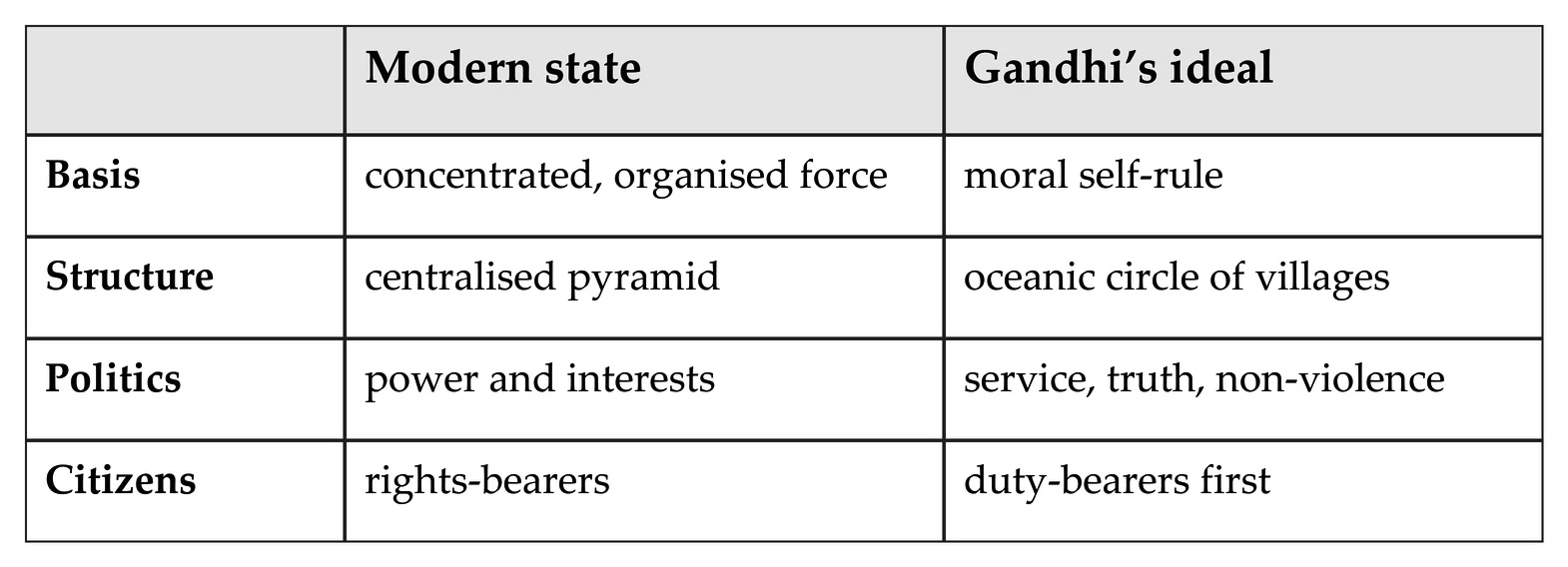
- Critique of the state. Gandhi saw the state as representing violence in a concentrated and organised form, and hoped for a society where coercion would be minimal.
- Duties before rights. Rights flow from the performance of duties; a citizen who performs duties will have rights.
- Constructive work. Politics includes building the moral and economic strength of society through khadi, village industries, education and the removal of untouchability.
The State and Enlightened Anarchy
Gandhi described the ideal as a state of enlightened anarchy, in which national life becomes so perfect and self-regulated that everyone is his own ruler and no representation is needed. He recognised that this ideal could not be fully realised, and accepted that a government is best which governs the least. He was suspicious of the modern state’s concentration of power, since even a state that serves the people relies on force. His alternative was decentralised democracy based on village self-government.
Kumar: Why Gandhi Matters Today
Sanjeev Kumar, in Understanding Gandhi: Why Gandhi Matters Today (introduction to Gandhi and the Contemporary World, 2020), argues that Gandhi’s idea of the political is relevant in a world facing violence, inequality, ecological crisis and the erosion of ethics in public life. He shows that Gandhi’s insistence on moral politics, decentralisation, dialogue and the welfare of the last person offers resources for rethinking democracy, development and global politics today.
4.2 Swaraj
Meanings of Swaraj
The word swaraj means self-rule. Gandhi used it at several levels. At the national level, it meant independence from British rule; the Congress adopted purna swaraj, complete independence, at Lahore in 1929. But for Gandhi, national independence was only part of swaraj. In Hind Swaraj he wrote that it is swaraj when we learn to rule ourselves: true swaraj meant individual self-rule, the control of the self by moral discipline, and freedom from the desires and dependencies of modern civilization. It also meant village swaraj, the self-government and self-sufficiency of village communities, and the freedom of the poorest from exploitation.
Swaraj as Freedom
- Freedom from foreign rule. Political independence for India.
- Freedom from exploitation. Economic freedom for the poor, especially peasants and workers.
- Freedom from social evils. Liberation from untouchability, communal hatred and the oppression of women.
- Self-rule of the individual. Mastery over one’s desires, fear and selfishness through discipline.
- Self-government of communities. Villages governing their own affairs through panchayats.
Dalton: Gandhi’s Idea of Freedom
Dennis Dalton, in Swaraj: Gandhi’s Idea of Freedom (in Mahatma Gandhi: Selected Political Writings, 1996), argues that Gandhi’s concept of swaraj joined individual and national freedom. Dalton shows that Gandhi combined the negative idea of freedom as release from external domination with a positive idea of freedom as self-control and self-realisation. For Gandhi, a nation of individuals enslaved by their desires could not be truly free even after independence, while individuals who had achieved self-rule would be capable of resisting any oppression through non-violence. Dalton emphasises that Gandhi’s idea of freedom was inseparable from his method of satyagraha.
Roy: Liberty versus Liberation
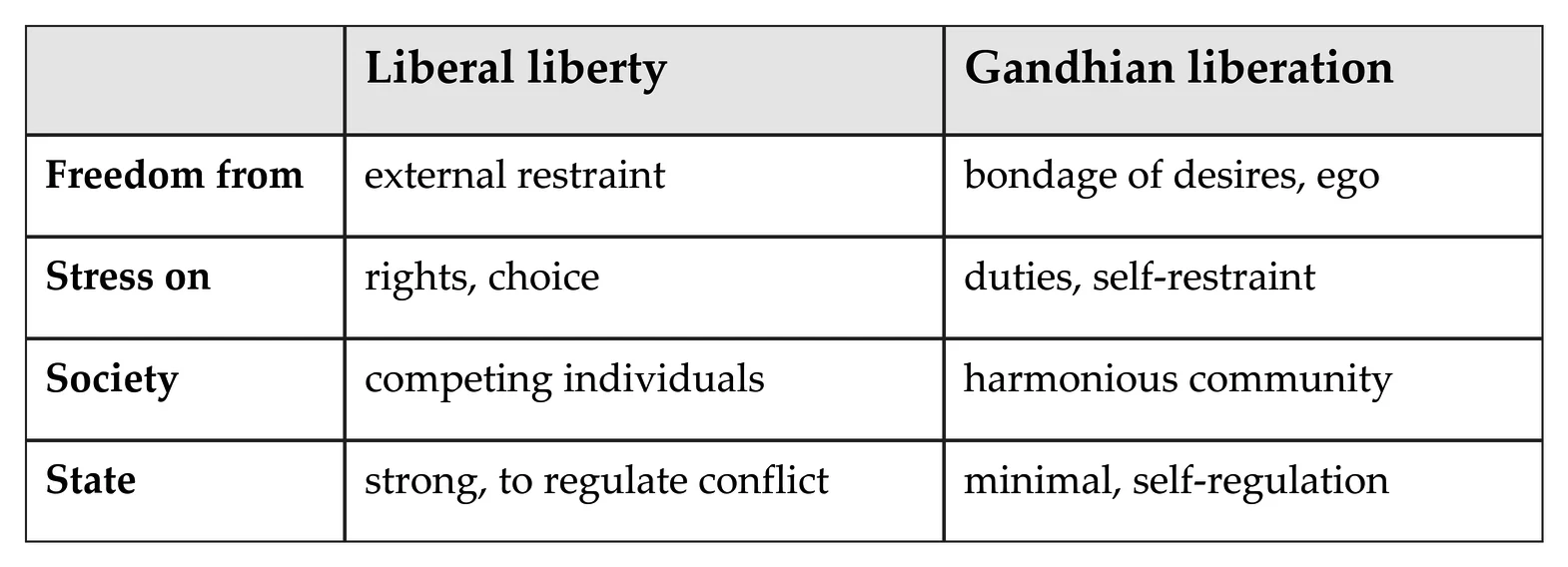
Ramashray Roy, in Liberty Versus Liberation (in Self and Society: A Study in Gandhian Thought, 1984), contrasts the Western liberal idea of liberty with Gandhi’s idea of liberation. Liberal liberty means freedom from external restraint so that individuals can pursue their own interests and desires, protected by rights. Gandhi’s liberation means freedom from the bondage of desires and the ego, achieved through self-restraint and the performance of duties, in harmony with community and the cosmos. Roy argues that liberal liberty, by encouraging the endless pursuit of desires, produces competition, conflict and a powerful state to regulate it, while Gandhian liberation produces self-regulating individuals and communities that need little coercion.
The Oceanic Circle
In Harijan in July 1946, Gandhi described his vision of society not as a pyramid with the apex sustained by the bottom, but as an oceanic circle whose centre is the individual, always ready to sacrifice for the village, and the village ready to sacrifice for the circle of villages, until the whole becomes one life of individuals, never aggressive, but humble and sharing. This image expresses his idea of decentralised swaraj, in which power flows from the individual and village outward.
4.3 Swadeshi
Meaning of Swadeshi
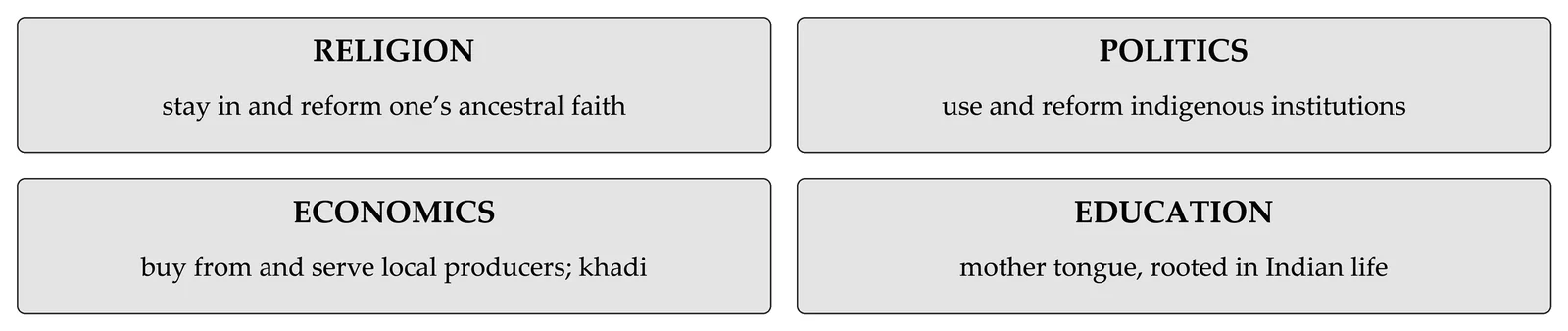
Swadeshi literally means of one’s own country. The idea became prominent during the Swadeshi Movement of 1905 against the partition of Bengal, when Indians boycotted British goods. Gandhi gave it a broader philosophical meaning. In his speech at the Missionary Conference in Madras in February 1916, he defined swadeshi as that spirit in us which restricts us to the use and service of our immediate surroundings to the exclusion of the more remote.
Spheres of Swadeshi
- Religion. One should confine oneself to one’s ancestral religion, reforming it from within rather than converting to another, while respecting all religions.
- Politics. One should make use of indigenous institutions, such as panchayats, and reform them, rather than importing foreign models.
- Economics. One should use only things produced by one’s immediate neighbours and serve local industries, making them efficient and complete.
- Education and culture. Education should be in the mother tongue and rooted in Indian culture, not alienating students from their society.
Swadeshi in Practice
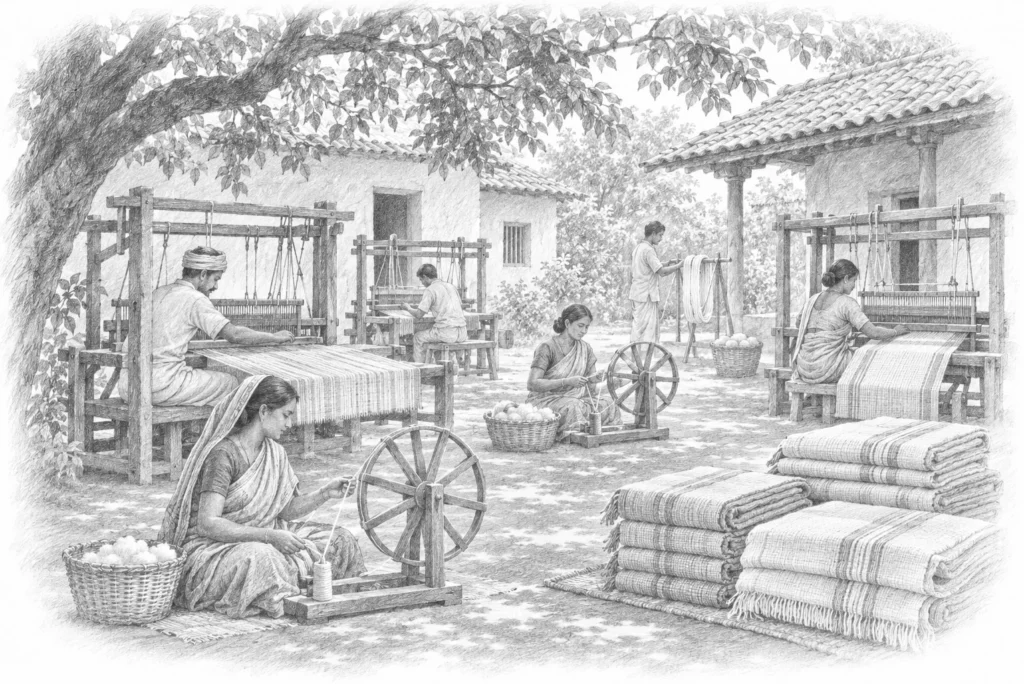
During the Non-Cooperation Movement (1920–22), Gandhi called for the boycott of foreign cloth, and bonfires of foreign cloth were lit across India. He promoted khadi, hand-spun and hand-woven cloth, as the symbol of swadeshi, and the charkha (spinning wheel) became the emblem of the national movement. The All India Spinners’ Association was founded in 1925. Gandhi insisted that swadeshi was not based on hatred of foreigners or foreign goods; it was a duty to serve one’s neighbours first, and goods that could not be produced locally could be imported.
Ragi: RSS and Gandhi on Swadeshi
Sangit K. Ragi, in RSS and Gandhi: The Idea of India (2022), compares Gandhi’s idea of swadeshi with that of the Rashtriya Swayamsevak Sangh and its affiliate, the Swadeshi Jagaran Manch (founded in 1991 by Dattopant Thengadi). Ragi shows that both drew on a civilisational idea of India and valued self-reliance, indigenous knowledge and the protection of local industries against globalisation. He also notes differences: Gandhi’s swadeshi was rooted in non-violence, decentralised village economy and universal ethics, while later swadeshi movements emphasised national economic strength and cultural nationalism. The idea of Atmanirbhar Bharat (2020) has revived debates on swadeshi in contemporary India.
Swadeshi Today
In an age of globalisation, swadeshi raises questions about self-reliance, local economies, fair trade, sustainable consumption and the protection of crafts and small producers. Critics argue that swadeshi can become protectionism or narrow nationalism, while supporters see it as a basis for resilient local economies and ecological responsibility.
Gandhi’s Political Writings at a Glance
- Hind Swaraj (1909): a critique of modern civilisation and a vision of swaraj as self-rule.
- Satyagraha in South Africa (1928): the history of the first satyagraha campaigns, 1906–1914.
- An Autobiography, or The Story of My Experiments with Truth (1927–29): his moral and political development.
- Constructive Programme (1941): eighteen items of village work, from khadi to communal unity, as the basis of swaraj.
- The talisman (1947): his advice to test every decision by its effect on the poorest and weakest person.
Together these texts show that, for Gandhi, the political was inseparable from ethics, economics and everyday conduct, and that true swaraj had to be built from below.
4.4 Important Questions
- Question 1 Explain Gandhi’s concept of swaraj.
- Question 2 Distinguish between the liberal idea of liberty and Gandhi’s idea of liberation.
- Question 3 Explain swadeshi and discuss its significance in Gandhi’s thought.
- Question 4 Discuss Gandhi’s idea of the political and its relevance today.
DU asks the same idea in different words. So learn one broad answer for each question below; the same answer works for every question joined by OR.
Important Question 1
Explain Gandhi’s concept of swaraj.
OR
Swaraj is self-rule. Discuss Gandhi’s view.
OR
Discuss Dennis Dalton’s interpretation of Gandhi’s idea of freedom.
Model Answer
“It is Swaraj when we learn to rule ourselves.”
— M.K. Gandhi, Hind Swaraj (1909)
Introduction. Swaraj, meaning self-rule, was the central political ideal of Gandhi. For most nationalists, it meant independence from British rule. Gandhi gave it a much deeper meaning: true swaraj required individuals to rule themselves through moral discipline, communities to govern their own affairs, and the poorest to be freed from exploitation. Dennis Dalton shows how this idea joined individual and national freedom.
1. Literal Meaning
Swaraj literally means self-rule. The term was used by earlier nationalists such as Dadabhai Naoroji, who demanded swaraj at the Calcutta Congress of 1906, and Tilak, who declared that swaraj is our birthright.
2. National Independence
At the national level, swaraj meant independence from British rule. Under Gandhi’s influence the Congress adopted purna swaraj, complete independence, as its goal at Lahore in 1929.
3. English Rule without the Englishman
Gandhi warned in Hind Swaraj that driving out the British while keeping their civilization would mean English rule without the Englishman, which would not be real swaraj.
4. Self-Rule of the Individual
Gandhi wrote that it is swaraj when we learn to rule ourselves. True swaraj meant mastery over one’s desires, fear and selfishness through moral discipline and self-restraint.
5. Village Swaraj
Swaraj also meant the self-government and self-sufficiency of villages, which would manage their own affairs through panchayats and meet their basic needs locally.
6. Swaraj for the Poorest
Gandhi insisted that swaraj must mean freedom for the poorest, including economic freedom from exploitation and social freedom from untouchability.
7. Swaraj and Non-violence
Swaraj could be won and maintained only through non-violence, since swaraj gained by violence would require violence to sustain it and would not free the people.
8. Swaraj and Duties
Gandhi stressed that swaraj involves duties as well as rights; self-rule requires citizens to perform their duties to others and to society.
9. Dalton’s Interpretation
Dennis Dalton argues that Gandhi joined individual and national freedom, combining the negative idea of freedom from domination with the positive idea of freedom as self-control.
10. Freedom and Satyagraha
Dalton shows that Gandhi’s idea of freedom was inseparable from satyagraha, since self-ruled individuals could resist any oppression through non-violence.
11. The Oceanic Circle
Gandhi described the ideal society as an oceanic circle centred on the individual and village, rather than a pyramid of power, expressing decentralised swaraj.
12. Enlightened Anarchy
At its highest, swaraj would be a state of enlightened anarchy in which everyone rules himself and no coercive government is needed, an ideal Gandhi knew could only be approached.
13. Swaraj and Democracy
Gandhi’s swaraj implied participatory democracy from below, reflected later in Article 40 and the 73rd Amendment on panchayats.
14. Criticism
Critics argue that swaraj as individual self-rule is too demanding for ordinary people and that village swaraj ignored caste hierarchy in villages.
15. Relevance
Swaraj remains relevant in debates on decentralisation, self-reliance and the moral responsibilities of citizens in a democracy.
16. Swaraj and the Constructive Programme
Gandhi argued that swaraj would be built through the constructive programme: communal unity, removal of untouchability, khadi, village industries, basic education, sanitation and the uplift of women. Swaraj, in this sense, was not a gift from the British but something the people had to create through their own work.
17. Swaraj and the Congress after Independence
Just before his death, Gandhi suggested that the Congress, having achieved political independence, should dissolve itself as a political party and become a Lok Sevak Sangh, an organisation of public servants working for village swaraj, showing that he saw political power as only one stage of swaraj.
18. Evaluation
Gandhi’s swaraj transformed a political slogan into a comprehensive ideal of freedom that included the individual, the community and the nation.
Conclusion. Thus, Gandhi’s swaraj meant national independence, village self-government and freedom for the poorest, but above all individual self-rule, for, as he wrote, it is swaraj when we learn to rule ourselves. Dalton shows that this idea joined individual and national freedom through satyagraha.
Important Question 2
Distinguish between the liberal idea of liberty and Gandhi’s idea of liberation.
OR
Examine Ramashray Roy’s analysis of liberty versus liberation.
OR
Discuss Gandhi’s idea of the ideal society and the state.
Model Answer
“Life will not be a pyramid with the apex sustained by the bottom. But it will be an oceanic circle whose centre will be the individual.”
— M.K. Gandhi, Harijan (28 July 1946)
Introduction. Gandhi’s idea of freedom differed fundamentally from that of Western liberalism. Ramashray Roy contrasts the liberal idea of liberty, freedom from external restraint to pursue one’s desires, with Gandhi’s idea of liberation, freedom from the bondage of desires through self-restraint. This contrast underlies Gandhi’s vision of a decentralised society and his suspicion of the modern state.
1. Liberal Liberty
Liberal thinkers from Locke to Mill understood liberty as freedom from external restraint, allowing individuals to pursue their own interests and desires, protected by rights.
2. Liberty and Desires
Roy argues that liberal liberty encourages the endless pursuit of desires, producing competition, inequality and conflict among individuals.
3. Liberty and the State
Because competing desires lead to conflict, liberal society needs a powerful state to regulate it, so liberty paradoxically strengthens coercion.
4. Gandhian Liberation
Gandhi’s liberation means freedom from the bondage of desires and the ego, achieved through self-restraint, akin to the Indian idea of moksha.
5. Duties over Rights
Liberation emphasises duties rather than rights; Gandhi believed that rights flow from the performance of duties to others.
6. Harmony with Community
Liberation seeks harmony with community, nature and the cosmos, rather than the assertion of the self against others.
7. Self-Regulating Society
Roy argues that liberated individuals form self-regulating communities that need little coercion, so liberation reduces the need for the state.
8. The Oceanic Circle
Gandhi described society as an oceanic circle centred on the individual, ready to sacrifice for the village, and the village for wider circles, not as a pyramid of power.
9. Decentralisation
In this vision, power flows outward from individuals and villages, so the ideal society is decentralised and participatory.
10. The State as Organised Violence
Gandhi saw the state as violence in a concentrated and organised form, and hoped for a society in which coercion would be minimal.
11. Enlightened Anarchy
He described the ideal as enlightened anarchy, where everyone rules himself, while accepting that a government is best which governs the least.
12. Dalton’s View
Dalton notes that Gandhi combined negative freedom from domination with positive freedom as self-control, bridging liberty and liberation.
13. Comparison with Western Thinkers
Gandhi’s idea of freedom resembles positive liberty in Rousseau and Green, but grounds it in spiritual self-restraint rather than rational will or the state.
14. Criticism
Critics argue that liberation through self-restraint may justify suppressing individual choices and that rights are needed to protect the weak, as Ambedkar stressed.
15. Relevance
Roy’s contrast is relevant to debates on consumerism, environmental limits and the role of duties in democratic citizenship.
16. Swaraj and Moksha
Gandhi linked political freedom with the spiritual goal of moksha, liberation from the cycle of desire and rebirth. He saw his political work as part of his striving for self-realisation, which made liberation the deepest meaning of freedom.
17. Freedom and Equality
Gandhi’s liberation was not only individual: he believed that no one could be truly free while others were oppressed, so liberation required working for the freedom of the poorest and of untouchables.
18. Evaluation
The contrast between liberty and liberation shows the originality of Gandhi’s idea of freedom and its challenge to liberal individualism.
Conclusion. Thus, Roy shows that liberal liberty frees desires and strengthens the state, while Gandhian liberation frees the self from desires through restraint and duties, producing self-regulating communities. Gandhi’s oceanic circle, rather than a pyramid, expresses this vision of a decentralised society.
Important Question 3
Explain swadeshi and discuss its significance in Gandhi’s thought.
OR
Discuss Gandhi’s idea of swadeshi in religion, politics and economics.
OR
Compare Gandhi’s idea of swadeshi with later swadeshi movements.
Model Answer
“Swadeshi is that spirit in us which restricts us to the use and service of our immediate surroundings to the exclusion of the more remote.”
— M.K. Gandhi, speech at the Missionary Conference, Madras (14 February 1916)
Introduction. Swadeshi, meaning of one’s own country, was a central principle of Gandhi’s thought and of the national movement. Gandhi gave it a broad meaning extending to religion, politics and economics, and made khadi and the charkha its symbols. Sangit Ragi compares Gandhi’s swadeshi with later swadeshi ideas, which have revived in debates on self-reliance today.
1. Meaning
Swadeshi literally means of one’s own country. Gandhi defined it as the spirit that restricts us to the use and service of our immediate surroundings.
2. The Swadeshi Movement of 1905
The idea became prominent during the Swadeshi Movement against the partition of Bengal in 1905, when Indians boycotted British goods and promoted Indian enterprises.
3. Swadeshi in Religion
Gandhi argued that one should remain in one’s ancestral religion and reform it from within rather than convert, while respecting all religions.
4. Swadeshi in Politics
In politics, swadeshi meant using and reforming indigenous institutions, such as panchayats, rather than importing foreign models of government.
5. Swadeshi in Economics
In economics, it meant using goods produced by one’s neighbours and serving local industries, supporting village producers and self-reliance.
6. Swadeshi in Education
Gandhi favoured education in the mother tongue and rooted in Indian culture, as in his Nai Talim or basic education scheme of 1937.
7. Khadi and the Charkha
Khadi and the charkha became symbols of swadeshi, uniting rich and poor in spinning and providing work for villagers. The All India Spinners’ Association was founded in 1925.
8. Boycott of Foreign Cloth
During Non-Cooperation, bonfires of foreign cloth were lit across India, turning swadeshi into a mass political act against colonial economic exploitation.
9. Not Hatred
Gandhi insisted that swadeshi was not based on hatred of foreigners; it was a duty to serve one’s neighbours first, and goods not produced locally could be imported.
10. Swadeshi and Swaraj
Swadeshi was linked to swaraj, since economic self-reliance was necessary for real freedom from colonial domination.
11. Ragi’s Comparison
Sangit Ragi compares Gandhi’s swadeshi with that of the RSS and the Swadeshi Jagaran Manch, founded in 1991 by Dattopant Thengadi to oppose economic globalisation.
12. Similarities
Ragi shows that both valued self-reliance, indigenous knowledge and protection of local industries, drawing on a civilisational idea of India.
13. Differences
Gandhi’s swadeshi was rooted in non-violence, decentralised village economy and universal ethics, while later swadeshi emphasised national economic strength and cultural nationalism.
14. Swadeshi Today
The idea of Atmanirbhar Bharat (2020) and campaigns for local products have revived debates on swadeshi in an age of globalisation.
15. Criticism
Critics argue that swadeshi can become protectionism, raising costs and limiting choice, or narrow nationalism hostile to outsiders.
16. Swadeshi and Global Trade
Gandhi did not reject all trade. He wrote that goods which cannot be produced at home may be imported, and that swadeshi forbids only goods that harm local producers. This makes swadeshi closer to an ethic of responsible, local-first consumption than to complete closure.
17. Swadeshi and Sustainability
Buying from local producers reduces transport, supports small enterprises and keeps money within communities, so swadeshi resonates with contemporary movements for local food, fair trade and sustainable consumption.
18. Evaluation
Gandhi’s swadeshi offers an ethic of local responsibility and self-reliance that remains relevant, though it must avoid becoming exclusionary.
Conclusion. Thus, Gandhi defined swadeshi as the spirit of using and serving one’s immediate surroundings, applying it to religion, politics, economics and education, with khadi as its symbol. Ragi’s comparison shows both continuities and differences between Gandhi’s non-violent swadeshi and later swadeshi movements.
Important Question 4
Discuss Gandhi’s idea of the political and its relevance today.
OR
Politics without ethics is meaningless for Gandhi. Discuss.
OR
Discuss why Gandhi matters today with reference to Sanjeev Kumar.
Model Answer
“The State represents violence in a concentrated and organized form.”
— M.K. Gandhi, interview with N.K. Bose (1934)
Introduction. Gandhi rejected the modern separation of politics from ethics and religion. For him, the political was a field of moral action and service, guided by truth and non-violence. He was suspicious of the centralised state and envisaged a decentralised society of self-governing communities. Sanjeev Kumar argues that this idea of the political is highly relevant to the problems of the contemporary world.
1. Politics and Religion
Gandhi wrote that those who say religion has nothing to do with politics do not know what religion means. By religion, he meant the commitment to truth and non-violence underlying all faiths, not sectarian creed.
2. Rejecting Autonomous Politics
Unlike Machiavelli, who separated politics from conventional morality, Gandhi insisted that political action must obey the same moral standards as private life.
3. Purity of Means
Gandhi held that good ends cannot be achieved through bad means, so political action must be truthful and non-violent.
4. Politics as Service
Politics was for Gandhi a form of service to the people, especially the poorest, rather than a pursuit of power and office.
5. The State as Violence
Gandhi saw the state as violence in a concentrated and organised form, since it ultimately relies on coercion to enforce its laws.
6. Minimal State
He accepted that a government is best which governs the least and hoped for a society in which voluntary cooperation would replace coercion.
7. Decentralised Democracy
Gandhi favoured decentralised democracy based on village swaraj, with power flowing from the individual and village outward, like an oceanic circle.
8. Duties and Rights
He emphasised that rights flow from duties, reminding citizens of their responsibilities to society.
9. Constructive Programme
The political, for Gandhi, included constructive work in khadi, education, sanitation and the removal of untouchability, building society from below.
10. Kumar on Relevance
Sanjeev Kumar argues that Gandhi matters today because of violence, inequality, ecological crisis and the erosion of ethics in public life.
11. Ethics in Public Life
Gandhi’s insistence on truthfulness and service offers a standard against corruption and the pursuit of power for its own sake.
12. Decentralisation Today
The 73rd and 74th Amendments and demands for local self-government reflect Gandhi’s idea of power from below.
13. Ecology and Limits
Gandhi’s idea of limited wants offers resources for ecological politics in an age of climate change.
14. Global Politics
His non-violence and critique of state violence remain relevant to debates on war, terrorism and peace-building.
15. Criticism
Critics argue that mixing religion and politics can encourage communalism, and that Gandhi’s minimal state could not deliver the welfare and protection modern citizens need.
16. Gandhi and Machiavelli
Machiavelli advised rulers to learn how not to be good when necessary, separating politics from conventional morality. Gandhi represents the opposite tradition, insisting that the ruler and the citizen alike must remain moral, even at the cost of power.
17. Gandhian Politics after Independence
Leaders such as Vinoba Bhave, through the Bhoodan movement, and Jayaprakash Narayan, through his call for total revolution in 1974, tried to apply Gandhi’s idea of the political to independent India, emphasising people’s power over state power.
18. Evaluation
Gandhi’s idea of the political offers a powerful moral critique of power politics and a vision of decentralised, ethical democracy.
Conclusion. Thus, Gandhi saw the political as moral action guided by truth and non-violence, rejected the separation of politics and religion, and regarded the state as concentrated violence, favouring decentralised self-government. As Sanjeev Kumar argues, these ideas remain relevant to violence, inequality and the crisis of ethics today.
Short Notes
(a) Purna swaraj
Complete independence, adopted as the goal of the Congress at its Lahore session in December 1929 under the presidency of Jawaharlal Nehru.
(b) Oceanic circle
Gandhi’s image of the ideal society as widening circles centred on the individual and village, rather than a pyramid of power, described in Harijan in 1946.
(c) Swadeshi Jagaran Manch
An organisation founded in 1991 by Dattopant Thengadi to promote economic self-reliance and oppose aspects of globalisation, compared with Gandhi’s swadeshi by Sangit Ragi.
More notes: DSE-2a Gandhi and the Contemporary World
These notes are prepared by PADHO TO AISE for study help. They are not an official University of Delhi publication.