
Semester III DSC-9 Constitutional Government and Democracy in India
Unit IV · 25 min read · Updated 24 Nov 2026
As per the University of Delhi (DU) BA (Hons) Political Science syllabus
Contents
- 4.1 Emergency Provisions
- 4.2 The Emergency of 1975–77 and the 44th Amendment
- 4.3 Emergency Provisions and Federalism
- 4.4 Preventive Detention: Article 22
- 4.5 National Security Laws
- 4.6 Security Laws and Civil Liberties: The Debate
- 4.7 Important Questions
- Analyse the emergency provisions in the Indian Constitution. Do they violate the principles of federalism?
- Critically analyse the preventive detention laws in India. Do they undermine individual freedom?
- Discuss the major national security laws in India. How have they affected civil liberties?
- Short Notes
उचित यही है कि हम आशा करें कि ऐसे अनुच्छेद कभी प्रयोग में नहीं लाए जाएँगे और वे केवल कागज़ पर ही रह जाएँगे।
The proper thing we ought to expect is that such articles will never be called into operation and that they would remain a dead letter.
— B.R. Ambedkar, Constituent Assembly, August 1949
EVERY STATE claims the power to protect itself against war, rebellion and terrorism, and every democracy must ask how far such powers can go without destroying the liberties they are meant to protect. The Indian Constitution gives the Union wide emergency powers and allows preventive detention even within the chapter on Fundamental Rights. Parliament has added a series of national security laws, from the Preventive Detention Act of 1950 to the Unlawful Activities (Prevention) Act. In this chapter we study the emergency provisions and their effect on federalism and rights, the experience of the Emergency of 1975–77, the constitutional framework of preventive detention under Article 22, and the main national security laws and the debates about them.
4.1 Emergency Provisions
The makers of the Constitution, writing amid Partition, war in Kashmir and the integration of the princely states, believed that the Union must have strong powers to deal with crises. Drawing partly on the Government of India Act, 1935, they included three kinds of emergency (Figure 4.2). Article 355 also places a duty on the Union to protect every state against external aggression and internal disturbance and to ensure that its government is carried on according to the Constitution.

A. National emergency (Article 352)
The President may proclaim a national emergency if satisfied that the security of India or any part of it is threatened by war, external aggression or armed rebellion (the words ‘armed rebellion’ replaced ‘internal disturbance’ in 1978). After the 44th Amendment, the proclamation can be made only on the written advice of the Cabinet; it must be approved by both Houses within one month by a special majority, and continues for six months at a time unless renewed. The Lok Sabha can end it by a simple majority. Its effects are far-reaching: the Union can give directions to states on any matter (Article 353); Parliament can make laws on state subjects (Article 250); the distribution of revenues can be altered (Article 354); the life of the Lok Sabha can be extended by a year at a time; the freedoms of Article 19 are suspended during war or external aggression (Article 358); and the President can suspend the enforcement of other Fundamental Rights, except Articles 20 and 21 (Article 359). National emergencies were proclaimed during the war with China (1962), the war with Pakistan (1971) and, on the ground of internal disturbance, in June 1975.
B. President’s Rule (Article 356)
If the President, on the Governor’s report or otherwise, is satisfied that the government of a state cannot be carried on in accordance with the Constitution, the President may assume the functions of the state government, and Parliament exercises the powers of the state legislature. Failure to comply with Union directions can also justify this (Article 365). The proclamation must be approved by Parliament within two months and lasts six months at a time, up to a maximum of three years; continuation beyond one year requires a national emergency and a certificate from the Election Commission. Ambedkar hoped that the provision would remain a dead letter, but it was used more than 130 times, often to dismiss opposition governments, as in 1977 and 1980, when the new Union governments dismissed nine state governments each.
C. Financial emergency (Article 360)
If the financial stability or credit of India is threatened, the President can proclaim a financial emergency, direct states to observe financial propriety, reduce the salaries of public servants, including judges, and require money bills of states to be reserved for the President. It has never been used.
4.2 The Emergency of 1975–77 and the 44th Amendment
On 12 June 1975 the Allahabad High Court set aside Prime Minister Indira Gandhi’s election to the Lok Sabha for electoral malpractice. Faced with the judgment and a mass movement led by Jayaprakash Narayan, the government advised the President to proclaim a national emergency on 25 June 1975 on the ground of internal disturbance, even though an emergency (from 1971) was already in force. Opposition leaders and thousands of others were detained under the Maintenance of Internal Security Act (MISA); the press was censored; the Lok Sabha’s term was extended; and the 38th, 39th and 42nd Amendments limited judicial review, protected the Prime Minister’s election from challenge and centralised power. In ADM Jabalpur v. Shivkant Shukla (1976), the Supreme Court held by four to one that detainees could not approach courts through habeas corpus while the enforcement of Article 21 was suspended; Justice H.R. Khanna dissented and was later superseded for the post of Chief Justice. Granville Austin, in Working a Democratic Constitution (1999), gives a detailed account of how the Emergency strained every part of the constitutional system.
After the Janata Party’s victory in 1977, the Shah Commission investigated the excesses of the Emergency, and the 44th Amendment (1978) introduced safeguards: ‘internal disturbance’ was replaced by ‘armed rebellion’; the proclamation requires the written advice of the Cabinet; parliamentary approval within one month by a special majority and renewal every six months; the Lok Sabha’s power to end an emergency; Articles 20 and 21 cannot be suspended; and Article 19 is suspended automatically only during war or external aggression. In Puttaswamy (2017) the Supreme Court formally overruled ADM Jabalpur.
4.3 Emergency Provisions and Federalism
Ambedkar explained that the Indian federation was designed to be ‘both unitary as well as federal according to the requirements of time and circumstances’. During a national emergency the federation becomes, in effect, unitary: the Union can direct states, legislate on state subjects and alter financial arrangements, while the states continue to exist. Article 356 goes further, allowing the Union to dismiss an elected state government. Critics, from members of the Constituent Assembly such as H.V. Kamath to later state governments, therefore argued that the emergency provisions undermine federalism. The Sarkaria Commission (1988) found that Article 356 had often been used for political reasons and recommended that it be used only as a last resort. In S.R. Bommai v. Union of India (1994), the Supreme Court held that federalism is part of the basic structure, that the President’s satisfaction under Article 356 is subject to judicial review, that the question of majority must be tested on the floor of the House, and that the state assembly should not be dissolved until Parliament approves the proclamation. Since Bommai, and with coalition governments that depended on regional parties, the use of Article 356 has declined sharply, though disputes continue over governors’ reports and recommendations.
4.4 Preventive Detention: Article 22
Preventive detention means detaining a person without trial to prevent them from acting in a way that might threaten security or public order, as opposed to punitive detention, which follows a trial and conviction for an offence already committed. India is among the few democracies whose Constitution permits preventive detention in peacetime, and it does so within the chapter on Fundamental Rights itself (Figure 4.3).

- Ordinary arrest (Article 22(1)–(2)): an arrested person must be told the grounds of arrest, has the right to consult a lawyer of their choice, and must be produced before a magistrate within 24 hours.
- Exception (Article 22(3)): these protections do not apply to enemy aliens or to persons detained under a preventive detention law.
- Limit on detention (Article 22(4)): no one can be detained for more than three months unless an Advisory Board of persons qualified to be High Court judges reports that there is sufficient cause. (The 44th Amendment’s reduction of this to two months has never been brought into force.)
- Grounds and representation (Article 22(5)): the detainee must be told the grounds of detention as soon as possible and given the earliest opportunity to make a representation.
- Withholding facts (Article 22(6)): facts considered against the public interest need not be disclosed.
- Parliament’s power (Article 22(7)): Parliament can prescribe the circumstances and maximum period of detention and the procedure of Advisory Boards. Preventive detention appears in both the Union List (for defence and the security of India) and the Concurrent List (for public order and essential supplies), so both Parliament and the states make such laws.
Ambedkar defended these provisions as necessary in the unsettled conditions of 1949, while arguing that the safeguards were an improvement on colonial practice. In A.K. Gopalan v. State of Madras (1950) the Supreme Court upheld the Preventive Detention Act, reading Article 21 narrowly. After Maneka Gandhi (1978) any procedure depriving a person of liberty must be fair, just and reasonable, and in A.K. Roy v. Union of India (1982) the Court upheld the National Security Act while insisting on strict compliance with safeguards. In Banka Sneha Sheela (2021) the Court warned that preventive detention is an exceptional power that cannot be used for ordinary problems of law and order.
4.5 National Security Laws
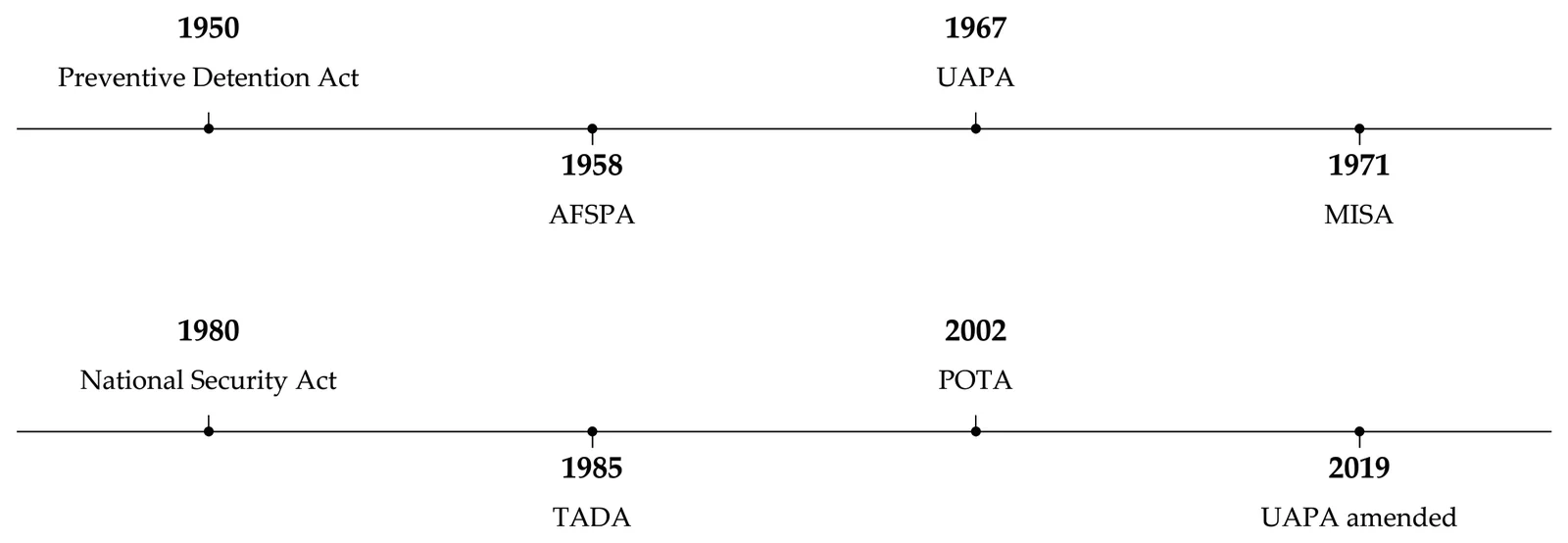
Anil Kalhan and his co-authors, in ‘Colonial Continuities: Human Rights, Terrorism, and Security Laws in India’ (2006), show that independent India’s security laws continue a colonial tradition that began with Bengal Regulation III of 1818 and the Rowlatt Act (1919), which Indians had bitterly opposed. The main laws are shown in Figure 4.4:
- Preventive Detention Act, 1950: the first such law, renewed repeatedly until it lapsed in 1969.
- Armed Forces (Special Powers) Act, 1958 (AFSPA): in areas declared ‘disturbed’, the armed forces can arrest without warrant, search premises and, after warning, fire upon persons, even causing death; no prosecution is possible without the Union’s sanction. It has applied in parts of the north-east and in Jammu and Kashmir.
- Unlawful Activities (Prevention) Act, 1967 (UAPA): originally aimed at unlawful associations, it was expanded in 2004 to cover terrorism after POTA’s repeal, and amended in 2008, 2012 and 2019; the 2019 amendment allows the Union to designate individuals as terrorists.
- Maintenance of Internal Security Act, 1971 (MISA): widely used during the Emergency and repealed in 1978.
- National Security Act, 1980 (NSA): permits preventive detention for up to twelve months to prevent threats to security, public order or essential supplies.
- Terrorist and Disruptive Activities (Prevention) Act, 1985 (TADA): made confessions to senior police officers admissible and restricted bail; it lapsed in 1995 amid evidence of widespread misuse.
- Prevention of Terrorism Act, 2002 (POTA): passed after the attack on Parliament and repealed in 2004 after complaints of misuse.
- Other laws: the National Investigation Agency Act (2008), state laws such as the Jammu and Kashmir Public Safety Act (1978) and the Maharashtra Control of Organised Crime Act (1999), and the Bharatiya Nyaya Sanhita (2023), which replaced the colonial sedition offence with a new offence of endangering the sovereignty, unity and integrity of India.
4.6 Security Laws and Civil Liberties: The Debate
Ujjwal Kumar Singh, in The State, Democracy and Anti-Terror Laws in India (2007), argues that anti-terror laws create a permanent state of exception: powers meant for extraordinary situations become part of normal governance, blurring the line between the normal and the exceptional. Such laws typically define offences vaguely, allow long detention before charges are filed, restrict bail (UAPA’s Section 43D(5) bars bail if the accusation appears prima facie true), admit confessions made to police, reverse the burden of proof, and protect officials from prosecution. Their record shows low conviction rates: of more than 76,000 people arrested under TADA, fewer than one per cent were convicted. Critics argue that the process itself becomes the punishment, and that these laws have often been used against political opponents, journalists, minorities, Dalits and Adivasis. Under AFSPA, allegations of fake encounters led to Irom Sharmila’s sixteen-year fast and to the Jeevan Reddy Committee (2005) recommending its repeal; in 2016 the Supreme Court held that even in disturbed areas excessive force by the armed forces could be investigated.
Defenders reply that India faces real threats from cross-border terrorism, insurgency and organised crime, that ordinary criminal law is too slow to prevent attacks, and that Article 355 obliges the Union to protect states. The courts have usually upheld these laws, as in Kartar Singh (1994) for TADA and PUCL (2004) for POTA, while adding procedural safeguards; in K.A. Najeeb (2021) the Court held that long incarceration without trial can justify bail even under UAPA. The challenge, as Austin noted, is to secure the nation without sacrificing the social revolution and the democratic freedoms that the Constitution was meant to protect.
4.7 Important Questions
- Question 1 Analyse the emergency provisions in the Indian Constitution. Do they violate the principles of federalism?
- Question 2 Critically analyse the preventive detention laws in India. Do they undermine individual freedom?
- Question 3 Discuss the major national security laws in India. How have they affected civil liberties?
DU asks the same idea in different words. So learn one broad answer for each question below; the same answer works for every question joined by OR.
Important Question 1
Analyse the emergency provisions in the Indian Constitution. Do they violate the principles of federalism?
OR
Critically examine the use of Article 356 in India.
OR
Discuss the Emergency of 1975–77 and the safeguards introduced by the 44th Amendment.
Model Answer
“It shall be the duty of the Union to protect every State against external aggression and internal disturbance and to ensure that the government of every State is carried on in accordance with the provisions of this Constitution.”
— Article 355, Constitution of India
Introduction. Part XVIII of the Constitution (Articles 352–360) gives the Union extraordinary powers to deal with war, rebellion, the breakdown of constitutional government in a state and financial crises. These provisions reflect the makers’ concern for unity after Partition, but they have long been criticised for allowing the Union to override the states and suspend rights.
1. National Emergency (Article 352)
The President may proclaim a national emergency on grounds of war, external aggression or armed rebellion, on the written advice of the Cabinet. It must be approved by both Houses within one month by a special majority and renewed every six months. It was proclaimed in 1962, 1971 and 1975. The 1962 emergency lasted until 1968; the 1971 emergency was still in force when the internal emergency was proclaimed in 1975, and both were revoked in 1977.
2. Effects on Federalism and Rights
During a national emergency the Union can direct states on any matter, Parliament can legislate on state subjects, and revenue arrangements can be changed, turning the federation into a virtually unitary system. Article 19 is suspended during war or external aggression, and the enforcement of other rights, except Articles 20 and 21, may be suspended. During the 1975 Emergency a presidential order suspended the enforcement of Articles 14, 21 and 22.
3. President’s Rule (Article 356)
If the constitutional machinery fails in a state, the President can take over its government, and Parliament legislates for it. The proclamation needs parliamentary approval within two months and can last up to three years. Ambedkar hoped it would remain a dead letter. The longest spell of President’s Rule was in Punjab from 1987 to 1992, during militancy.
4. Financial Emergency (Article 360)
If the financial stability of India is threatened, the Union can direct the states’ finances and reduce salaries. It has never been used. Even during the 1991 economic crisis, the government chose not to use it.
5. A Comparative View
Most constitutions provide for emergencies, but India’s are unusually detailed and allow the dismissal of elected state governments, which federations such as the United States do not. The Sarkaria Commission proposed that a state be warned and given a chance to correct itself before President’s Rule is imposed.
6. Argument that They Violate Federalism
Article 356 has been used more than 130 times, often to dismiss opposition governments, as in 1977 and 1980. The Sarkaria Commission found widespread political misuse. The 1975 Emergency showed how national emergency powers could be used to centralise power and suppress dissent rather than to meet a real threat. Opposition-ruled states have long demanded that Article 356 be amended or deleted.
7. The Emergency of 1975–77
The 1975 Emergency, proclaimed on the ground of internal disturbance after the Allahabad High Court set aside Indira Gandhi’s election, showed how national emergency powers could be misused: opposition leaders were detained, the press was censored and the Constitution was amended to centralise power. The Shah Commission documented the excesses.
8. Argument that They Protect the Federation
Ambedkar argued that the ability to become unitary in emergencies is a strength of the Indian federation, which was designed to hold together a diverse country. Article 355 makes protecting states a duty of the Union, and in real crises, such as war or insurgency, these powers preserve the constitutional order. Article 356 has also been used in genuine breakdowns, such as during insurgencies, when no elected government could function.
9. ADM Jabalpur
In ADM Jabalpur (1976) the Supreme Court held that detainees could not seek habeas corpus while Article 21 was suspended, a decision overruled in Puttaswamy (2017); Justice H.R. Khanna’s lone dissent is remembered as a defence of liberty.
10. Safeguards: The 44th Amendment
The 44th Amendment (1978) replaced ‘internal disturbance’ with ‘armed rebellion’, required the Cabinet’s written advice and special-majority approval, allowed the Lok Sabha to end the emergency, and protected Articles 20 and 21. It also limited the extension of President’s Rule beyond one year to cases where a national emergency is in force and the Election Commission certifies that elections cannot be held.
11. Safeguards: S.R. Bommai (1994)
The Supreme Court held federalism to be part of the basic structure, made Article 356 subject to judicial review, required a floor test, and barred dissolution of the assembly before parliamentary approval. Since then, and with coalition politics, its misuse has declined. Later, in Rameshwar Prasad (2006), the Court held the dissolution of the Bihar Assembly in 2005 unconstitutional.
Conclusion. Thus, the emergency provisions do not in themselves violate federalism, but their misuse has; constitutional amendments and judicial review have made them safer, though vigilance remains necessary.
Important Question 2
Critically analyse the preventive detention laws in India. Do they undermine individual freedom?
OR
Discuss the constitutional provisions regarding preventive detention.
OR
Examine the debate between national security and civil liberties in India.
Model Answer
“No person shall be deprived of his life or personal liberty except according to procedure established by law.”
— Article 21, Constitution of India
Introduction. Preventive detention allows the state to detain a person without trial to prevent future harm to security or public order. India permits it even in peacetime, within the Fundamental Rights chapter itself. This creates a tension between the state’s duty to protect security and the individual’s right to liberty.
1. Meaning
Unlike punitive detention, which follows conviction for an offence already committed, preventive detention is based on suspicion of what a person might do. It is therefore a serious exception to the presumption of innocence and the right to a fair trial. Courts have called it a jurisdiction of suspicion, since it rests on the executive’s subjective satisfaction rather than on proof. Few democracies allow preventive detention in peacetime, which makes India’s constitutional provision unusual.
2. Article 22
Article 22 gives arrested persons the rights to know the grounds, consult a lawyer and be produced before a magistrate within 24 hours, but these do not apply to preventive detention. Instead, detention beyond three months needs an Advisory Board’s approval, grounds must be communicated, and the detainee may make a representation, though facts against the public interest may be withheld. Ambedkar defended these provisions as an improvement on colonial law, since they at least required review by an Advisory Board. Article 22(7) even lets Parliament prescribe cases in which a person may be held beyond three months without an Advisory Board’s opinion.
3. Preventive Detention Laws
India has had a series of such laws: the Preventive Detention Act (1950), MISA (1971), COFEPOSA (1974), the National Security Act (1980), and state laws such as the Jammu and Kashmir Public Safety Act. Anti-terror laws such as TADA, POTA and the UAPA have similar features. States also use local laws, such as Tamil Nadu’s Goondas Act, against habitual offenders.
4. The Debate in the Constituent Assembly
Members such as H.V. Kamath and Thakur Das Bhargava criticised the place of preventive detention in the chapter on Fundamental Rights; Ambedkar replied that the state needed such powers in the conditions of 1949 and that the safeguards were an advance on colonial practice.
5. Judicial Interpretation
A.K. Gopalan (1950) upheld preventive detention with a narrow reading of Article 21, and ADM Jabalpur (1976) denied habeas corpus during the Emergency. After Maneka Gandhi (1978), procedures had to be fair, just and reasonable; A.K. Roy (1982) upheld the NSA with safeguards, and recent judgments stress that detention is an exceptional power. In Banka Sneha Sheela (2021) the Court warned that preventive detention cannot be used for ordinary problems of law and order.
6. Arguments for Preventive Detention
Supporters argue that terrorism, insurgency and organised crime require prevention rather than punishment after the event, that ordinary criminal law is slow, and that Article 355 obliges the Union to protect states. Advisory Boards and judicial review provide some safeguards. Other democracies, such as the United Kingdom with its control orders after 2005, have also adopted special powers against terrorism. In A.K. Roy the Supreme Court accepted that the NSA was needed in the conditions of the time.
7. How It Undermines Freedom
Detention on suspicion, withholding of facts, long periods without trial and restrictive bail undermine liberty and fair trial. Low conviction rates, fewer than one per cent under TADA, suggest that detention itself becomes the punishment. Detainees often lose jobs, reputation and family stability even if later released, and compensation is rare.
8. Misuse and Colonial Continuities
Kalhan and others show that these laws continue colonial practices like the Rowlatt Act. Ujjwal Kumar Singh argues that they create a permanent state of exception. They have often been used against political opponents, journalists, minorities and marginalised groups, as during the Emergency under MISA. The National Security Act has been used against journalists and critics as well as suspected criminals, and courts have quashed many such orders. During the Emergency more than a lakh people were detained under MISA and the Defence of India Rules.
9. Advisory Boards and Habeas Corpus
Advisory Boards are meant to check arbitrary detention, but they are appointed by the government, usually do not permit detainees to be represented by lawyers, and often approve detentions routinely. Habeas corpus petitions in High Courts frequently succeed on procedural grounds, which shows both the value of judicial review and the carelessness with which detentions are ordered.
10. International Standards
Article 9 of the International Covenant on Civil and Political Rights forbids arbitrary detention and requires prompt judicial review. India entered a declaration on this article to preserve its preventive detention laws, which human rights bodies have criticised.
11. The Way Forward
Reforms could include strict time limits, independent and speedy Advisory Boards, disclosure of grounds, compensation for wrongful detention, and regular review or sunset clauses for security laws. Civil liberties groups and law reform bodies have proposed such changes, though few have been adopted.
Conclusion. Thus, preventive detention may be necessary in genuine emergencies, but its routine use undermines individual freedom; it must remain a narrow exception under strict safeguards.
Important Question 3
Discuss the major national security laws in India. How have they affected civil liberties?
OR
Examine the Armed Forces (Special Powers) Act and the debate around it.
OR
‘Anti-terror laws create a permanent state of exception.’ Discuss.
Model Answer
“Those who would give up essential Liberty, to purchase a little temporary Safety, deserve neither Liberty nor Safety.”
— Benjamin Franklin (1755)
Introduction. National security laws give the state special powers to deal with terrorism, insurgency and threats to public order. India has enacted many such laws since independence. While they respond to real threats, their wide powers and record of misuse have raised serious concerns about civil liberties.
1. Colonial Roots
Kalhan and his co-authors show that security laws continue colonial practices such as Bengal Regulation III of 1818 and the Rowlatt Act of 1919, which allowed detention without trial and which nationalists had opposed. Gandhi called the Rowlatt Act a ‘black act’, and the protests against it led to the Jallianwala Bagh massacre of 1919. The Defence of India Acts of the two world wars also gave the colonial state sweeping powers.
2. AFSPA (1958)
In disturbed areas, AFSPA lets the armed forces arrest without warrant, search and fire upon persons, with immunity from prosecution without Union sanction. It has been applied in the north-east and Jammu and Kashmir, and the Jeevan Reddy Committee (2005) recommended its repeal. It has been withdrawn from Tripura (2015), Meghalaya (2018) and many districts of Assam, Nagaland and Manipur since 2022.
3. Preventive Detention Laws
The Preventive Detention Act, MISA and the National Security Act permit detention without trial; MISA was notoriously used against opponents during the Emergency. COFEPOSA (1974) extends the same approach to smuggling and foreign exchange offences.
4. TADA and POTA
TADA (1985) admitted confessions to police and restricted bail; of more than 76,000 people arrested, fewer than one per cent were convicted, and it lapsed in 1995. POTA (2002) was repealed in 2004 after complaints of misuse. In Kartar Singh (1994) the Supreme Court upheld TADA but laid down guidelines against abuse.
5. UAPA
After POTA’s repeal, the UAPA absorbed anti-terror provisions and was strengthened in 2008, 2012 and 2019, when it allowed individuals to be designated as terrorists. Its strict bail provision has led to long pre-trial detention. In Watali (2019) the Court held that at the bail stage the prosecution’s case must be taken as broadly true, which makes bail very difficult.
6. Impact on Civil Liberties
Ujjwal Kumar Singh argues that such laws create a permanent state of exception. Vague definitions, restrictive bail, reversed burdens of proof and immunity for officials weaken fair trial, and the laws have been used against dissenters and marginalised groups. The National Human Rights Commission and civil liberties groups have documented custodial violence and fake encounters in conflict areas.
7. Sedition and the New Criminal Laws
Section 124A of the Indian Penal Code, the colonial sedition law once used against Tilak and Gandhi, was put in abeyance by the Supreme Court in 2022. The Bharatiya Nyaya Sanhita (2023) dropped the word sedition but created a broader offence of endangering the sovereignty, unity and integrity of India and also defined terrorist acts, raising fears that old problems may continue under new names. Its Section 152 penalises acts endangering the sovereignty, unity and integrity of India.
8. The NIA and Special Courts
The National Investigation Agency Act (2008), passed after the Mumbai attacks, created a central agency to investigate terrorism across states, with special courts. It improves coordination, but some states argue that it intrudes on their control over police and public order. Chhattisgarh challenged the NIA Act in the Supreme Court in 2020 as an intrusion on state powers.
9. Comparative Experience
Other democracies faced similar dilemmas after the attacks of 11 September 2001: the USA PATRIOT Act and the detention camp at Guantánamo Bay were criticised for weakening civil liberties, which shows that the tension between security and liberty is universal.
10. Balancing Security and Liberty
A balanced approach would combine effective intelligence and policing with safeguards: precise definitions of terrorism, time limits on investigation, independent review, speedy trials, compensation for wrongful detention and parliamentary oversight of security agencies.
11. Civil Society and Accountability
Civil liberties organisations such as the People’s Union for Civil Liberties, founded in 1976 during the Emergency, have challenged security laws in court and documented their misuse, keeping public attention on the costs of security policy.
12. The Security Argument and the Courts
Defenders point to real threats from terrorism and insurgency. Courts have upheld these laws, as in Kartar Singh (1994) and PUCL (2004), but have also added safeguards, as when K.A. Najeeb (2021) allowed bail after long incarceration.
Conclusion. Thus, national security laws are needed to meet real threats, but without strong safeguards they erode the liberties that make India a democracy.
Short Notes
(a) National security laws
Laws giving the state special powers against threats to security and public order, including the National Security Act (1980), AFSPA (1958), UAPA (1967, amended 2004–2019), and the repealed MISA, TADA and POTA. They allow preventive detention, restrict bail and give wide powers to security forces, and are criticised for low conviction rates and misuse.
(b) AFSPA
The Armed Forces (Special Powers) Act, 1958 gives the armed forces powers to arrest, search and use force in areas declared disturbed, with immunity from prosecution without Union sanction. It has been withdrawn from several areas of the north-east in recent years.
(c) The 44th Amendment
Passed in 1978 after the Emergency, it replaced ‘internal disturbance’ with ‘armed rebellion’, required the Cabinet’s written advice for a national emergency, made Articles 20 and 21 non-suspendable, and removed the right to property from the Fundamental Rights.
More notes: DSC-9 Constitutional Government and Democracy in India
These notes are prepared by PADHO TO AISE for study help. They are not an official University of Delhi publication.