
Semester III DSC-9 Constitutional Government and Democracy in India
Unit I · 23 min read · Updated 24 Nov 2026
As per the University of Delhi (DU) BA (Hons) Political Science syllabus
Contents
- 1.1 The Making of the Constitution: The Constituent Assembly
- 1.2 Philosophy of the Constitution
- 1.3 The Preamble
- 1.4 Features of the Constitution
- 1.5 Citizenship
- 1.6 Fundamental Rights, Directive Principles and Fundamental Duties
- 1.7 Important Questions
- Discuss the main features and philosophy of the Indian Constitution.
- Analyse the citizenship provisions in the Indian Constitution. Discuss the Constituent Assembly debates over citizenship.
- Discuss the relationship between Fundamental Rights and Directive Principles of State Policy.
- Short Notes
हमें अपने राजनीतिक लोकतंत्र को सामाजिक लोकतंत्र भी बनाना होगा। राजनीतिक लोकतंत्र तब तक टिक नहीं सकता जब तक उसके आधार में सामाजिक लोकतंत्र न हो।
We must make our political democracy a social democracy as well. Political democracy cannot last unless there lies at the base of it social democracy.
— B.R. Ambedkar, Constituent Assembly, 25 November 1949
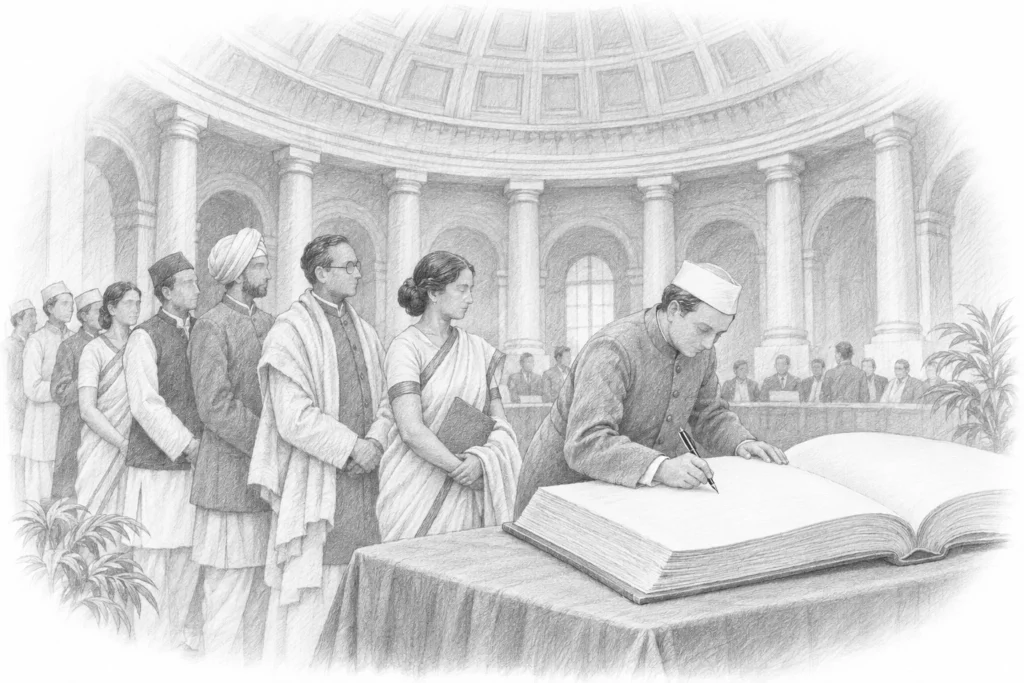
BETWEEN DECEMBER 1946 AND NOVEMBER 1949, a Constituent Assembly of about three hundred members debated, clause by clause, the constitution of a country that had just been partitioned, was torn by communal violence, and contained more than five hundred princely states, hundreds of languages and deep inequalities of caste, class and gender. The result was the longest written constitution in the world, which has now governed India for more than seven decades. In this chapter we study how the Constituent Assembly worked, the philosophy of the Constitution, the Preamble and the main features of the Constitution, and four of its key parts: citizenship, Fundamental Rights, Directive Principles and Fundamental Duties.
1.1 The Making of the Constitution: The Constituent Assembly
A. Background
The demand that Indians should frame their own constitution grew during the national movement. The Nehru Committee Report (1928), prepared by an all-parties conference under Motilal Nehru, proposed dominion status, a parliamentary system and a list of fundamental rights, and opposed separate electorates. In 1934–35 the Congress formally demanded a Constituent Assembly elected by the people. Gandhians offered an alternative in Shriman Narayan Agarwal’s Gandhian Constitution for Free India (1946), with a foreword by Gandhi, which proposed a decentralised polity based on self-governing village republics. The Cabinet Mission Plan (1946) finally provided for an Assembly elected indirectly by the provincial legislatures, with representatives of the princely states.
B. A microcosm in action
The Assembly began with 389 members; after Partition and the withdrawal of members from Pakistan, it had 299. Although the Congress dominated it, Granville Austin, in The Indian Constitution: Cornerstone of a Nation (1966), called it a ‘microcosm in action’, because it included people of many regions, religions, castes and opinions, from socialists to conservatives, and because the Congress itself was a broad coalition. Austin showed that the Assembly worked by consensus and accommodation rather than by majority vote, seeking agreement among different views. Its work was organised through committees: the Union Powers Committee (Nehru), the Provincial Constitution Committee and the Advisory Committee on Fundamental Rights and Minorities (Sardar Patel), and the Drafting Committee (Ambedkar). Nehru’s Objectives Resolution (13 December 1946) set out its guiding principles. B. Shiva Rao’s The Framing of India’s Constitution (1968) documents its debates in detail, and Arun Thiruvengadam, in The Constitution of India: A Contextual Analysis (2017), places its making in the context of Partition, the integration of the princely states and nation-building.
Criticisms of the Assembly were that it was not elected by universal franchise, that it was dominated by one party, by upper castes and by lawyers, and that it borrowed heavily from foreign constitutions and the Government of India Act, 1935. Ambedkar answered that the Assembly represented every section of opinion and that borrowing from tested constitutions was wise, provided it was adapted to Indian conditions.
1.2 Philosophy of the Constitution
What political theory does the Constitution express? Rajeev Bhargava, in ‘Outline of a Political Theory of the Indian Constitution’ (2008), argues that it is a distinctive document that combines several values: individual freedom, protected by Fundamental Rights; social justice and equality, through the abolition of untouchability, reservations and Directive Principles; respect for communities, through minority cultural and educational rights; democracy, through universal adult franchise; principled-distance secularism; federalism and unity in diversity; and fraternity and the dignity of the individual. Granville Austin argued that the makers pursued three goals together, national unity and integrity, democracy and a social revolution, which he later described as a ‘seamless web’. S.K. Chaube describes the spirit of the Constitution as a commitment to liberal democracy combined with social transformation. Ambedkar insisted that liberty, equality and fraternity form a trinity: each would be destroyed without the others. The Supreme Court has described the Constitution as transformative, intended to change an unequal society rather than simply preserve existing arrangements.
1.3 The Preamble
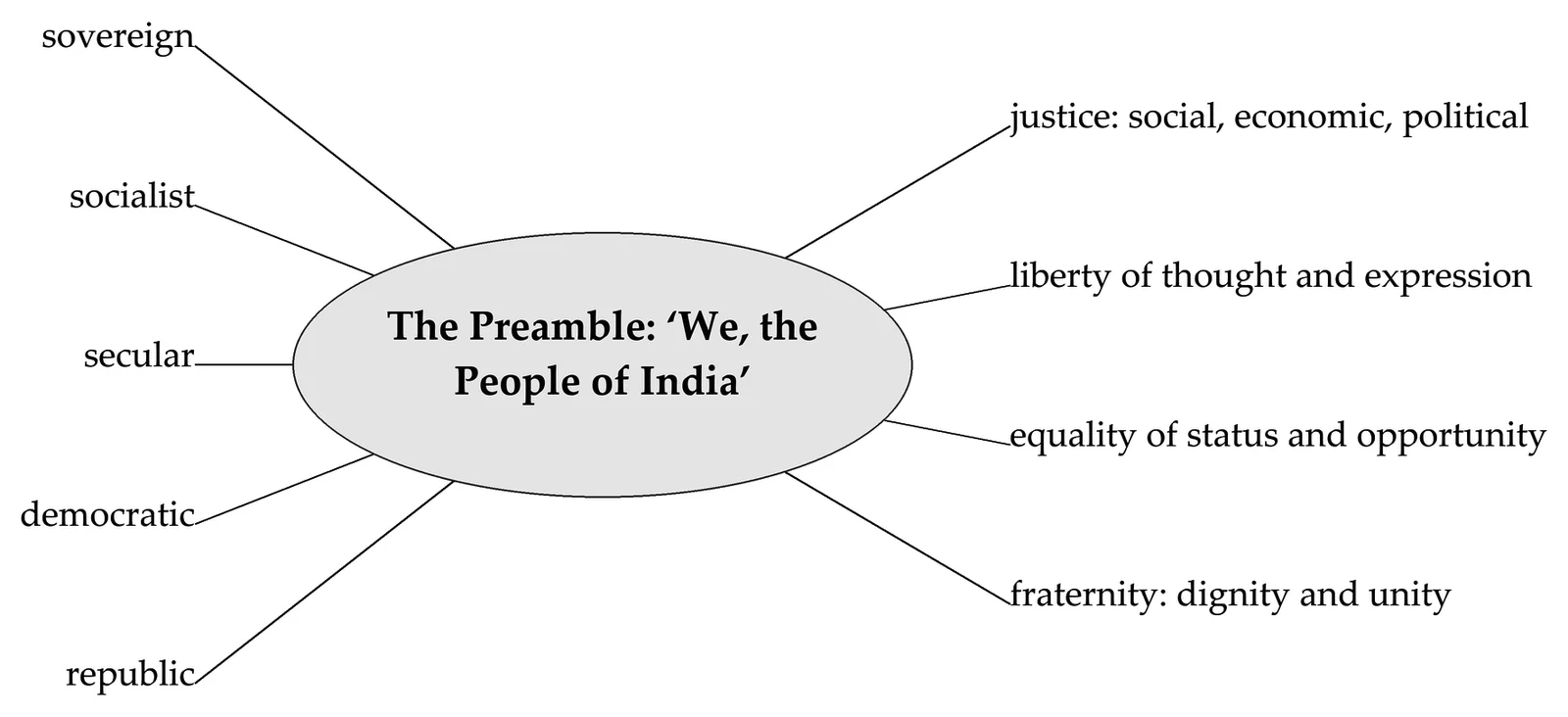
The Preamble states the source, nature and objectives of the Constitution (Figure 1.2). It begins ‘We, the People of India’, declaring that authority comes from the people. It describes India as a sovereign, socialist, secular, democratic republic, the words ‘socialist’ and ‘secular’ being added by the 42nd Amendment (1976), and it resolves to secure to all citizens justice, social, economic and political; liberty of thought, expression, belief, faith and worship; equality of status and of opportunity; and fraternity, assuring the dignity of the individual and the unity and integrity of the nation. K.M. Munshi called it the horoscope of the sovereign democratic republic. In Berubari (1960) the Supreme Court said that the Preamble was not part of the Constitution, but in Kesavananda Bharati (1973) it held that the Preamble is part of the Constitution and a key to its interpretation, though not itself a source of power.
1.4 Features of the Constitution
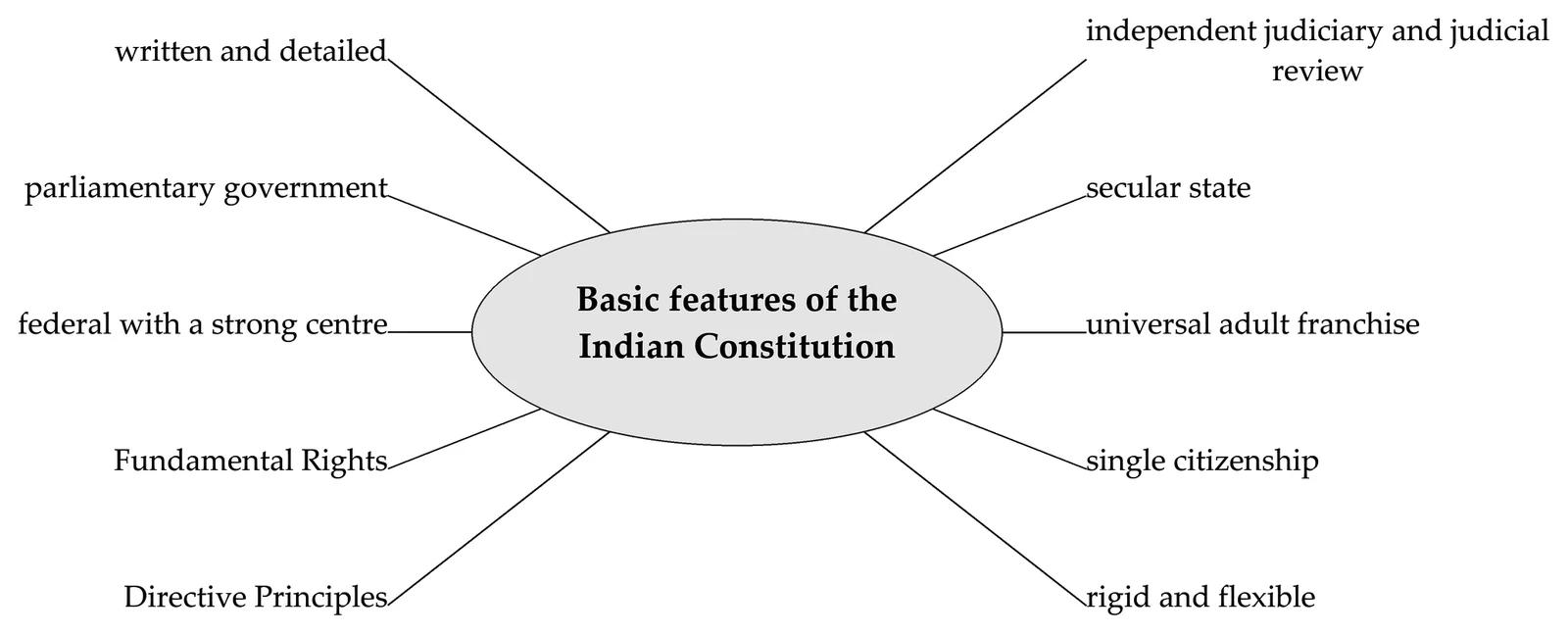
Bipan Chandra, Mridula Mukherjee and Aditya Mukherjee, in India Since Independence, describe the main provisions that give the Constitution its character. Its basic features are as follows (Figure 1.3):
- Written and detailed: the longest written constitution in the world, drawing on the Government of India Act, 1935 for much of its administrative structure, and on British, American, Irish, Canadian and other models.
- Parliamentary government: the executive is responsible to the legislature; Ambedkar explained that the makers preferred responsibility to stability.
- Federal with a strong centre: a dual polity with a division of powers, but a strong Union, emergency powers and a ‘Union of States’ that no state can leave.
- Fundamental Rights, Directive Principles and Fundamental Duties.
- Independent judiciary and judicial review: an integrated judiciary headed by the Supreme Court, which can strike down unconstitutional laws.
- Universal adult franchise from the first general election of 1951–52.
- Secular state: no state religion and equal treatment of all religions.
- Single citizenship and a single integrated system of law and administration, including the all-India services.
- Rigid and flexible: different provisions can be amended by different procedures (Article 368).
- Emergency provisions that allow the Union to deal with crises.
- Basic structure: since 1973, Parliament’s amending power cannot destroy the Constitution’s basic features.
1.5 Citizenship
A. Constitutional provisions
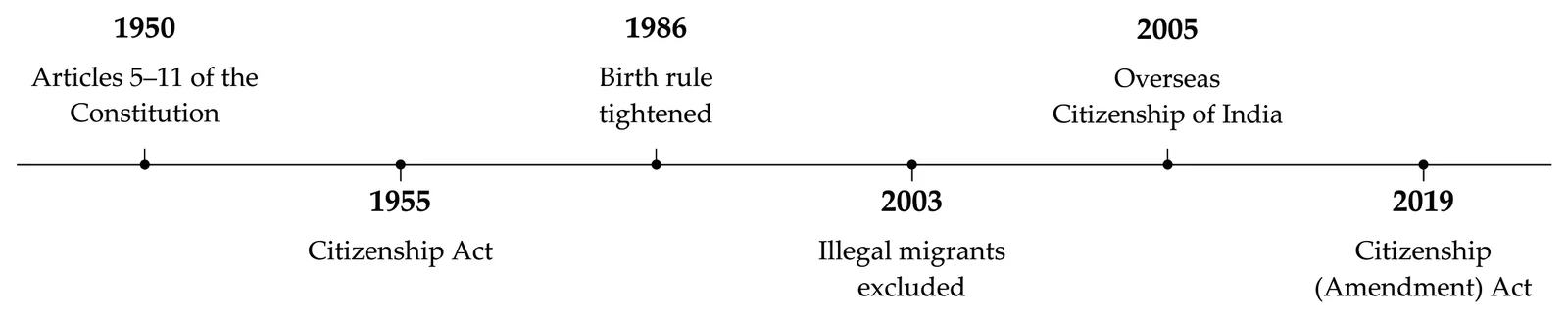
Part II of the Constitution (Articles 5–11) deals with citizenship at its commencement. Article 5 gave citizenship to every person domiciled in India who was born in India, whose parent was born in India, or who had lived in India for five years. Article 6 dealt with migrants from Pakistan, giving citizenship to those who came before 19 July 1948, and to later arrivals who registered. Article 7 dealt with those who had migrated to Pakistan, who lost Indian citizenship unless they returned under a permit for permanent resettlement. Article 8 provided for persons of Indian origin living abroad, Article 9 denied citizenship to those who voluntarily acquired foreign citizenship, and Article 11 gave Parliament the power to regulate citizenship by law. India adopted single citizenship: there is no separate state citizenship.
B. The Citizenship Act and its amendments
The Citizenship Act, 1955 provides for acquiring citizenship by birth, descent, registration, naturalisation and incorporation of territory, and for losing it by renunciation, termination and deprivation (Figure 1.4). Amendments have changed the basis of citizenship. In 1986, birth in India after 1 July 1987 conferred citizenship only if one parent was an Indian citizen. In 2003, birth after 2004 required that one parent be a citizen and the other not an illegal migrant, and the Overseas Citizenship of India scheme followed. The Citizenship (Amendment) Act, 2019 made certain non-Muslim migrants from Afghanistan, Bangladesh and Pakistan who entered before 2015 eligible for faster citizenship, which critics argued introduced religion as a criterion.
C. The Constituent Assembly debates
Citizenship was among the most difficult questions before the Assembly, because Partition had uprooted millions. Valerian Rodrigues, in ‘Citizenship and the Indian Constitution’ (2008), and Anupama Roy, in Citizenship in India (2016), show that the debates centred on three issues. First, jus soli (citizenship by birth on the soil) versus jus sanguinis (citizenship by descent): the Assembly adopted a broad, birth- and residence-based civic conception. Second, the treatment of migrants: some members, such as P.S. Deshmukh, wanted citizenship to be offered to Hindus and Sikhs anywhere in the world, and others wanted to deny citizenship to those who had gone to Pakistan and returned; the Assembly rejected religion as a basis and adopted secular rules based on domicile and dates. Third, whether citizenship should be fully defined in the Constitution or left to Parliament; the Assembly chose to settle only the position at commencement. Roy argues that later amendments shifted Indian citizenship from jus soli towards jus sanguinis, creating what she calls a more ‘hyphenated’ citizenship, and current debates on the NRC and the CAA reopen the questions the Assembly faced.
1.6 Fundamental Rights, Directive Principles and Fundamental Duties
A. Fundamental Rights
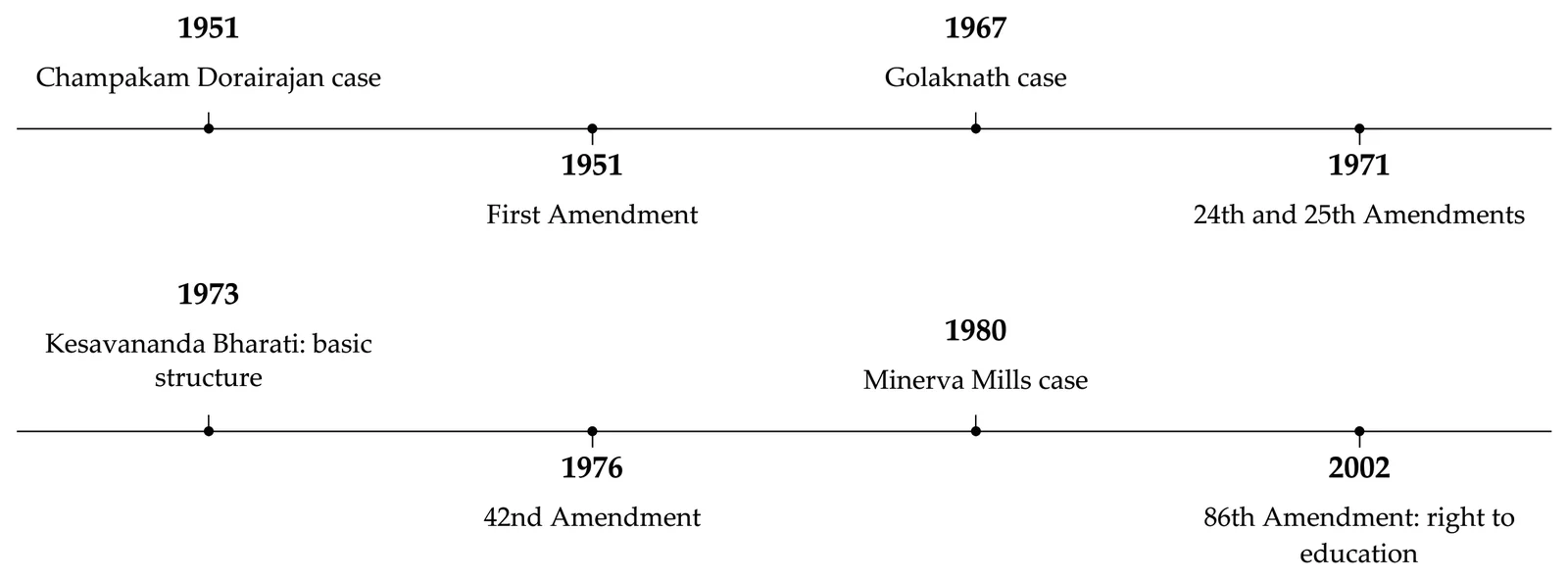
Granville Austin called Parts III and IV the conscience of the Constitution. Part III guarantees six groups of Fundamental Rights: equality (Articles 14–18), freedom (19–22), against exploitation (23–24), freedom of religion (25–28), cultural and educational rights (29–30) and constitutional remedies (32). S.K. Chaube and Madhav Khosla show how the courts have shaped them: from the property disputes of the 1950s and the basic structure doctrine of Kesavananda Bharati (1973), through the expansion of Article 21 after Maneka Gandhi (1978), to recognition of privacy in Puttaswamy (2017) and the decriminalisation of homosexuality in Navtej Singh Johar (2018) (Figure 1.5).
B. Directive Principles of State Policy
Part IV contains the Directive Principles, non-justiciable but fundamental in governance (Article 37): socialist principles such as the right to livelihood and the prevention of concentration of wealth (Articles 38–39), Gandhian principles such as village panchayats and cottage industries, and liberal principles such as a uniform civil code and separation of the judiciary from the executive. In Minerva Mills (1980) the Court held that the harmony and balance between Fundamental Rights and Directive Principles is part of the basic structure.
C. Fundamental Duties
The 42nd Amendment (1976), on the recommendation of the Swaran Singh Committee, added Part IVA (Article 51A) with ten Fundamental Duties; the 86th Amendment (2002) added an eleventh, the duty of parents to provide education to children aged six to fourteen. The duties include respecting the Constitution, the flag and the anthem; cherishing the ideals of the freedom struggle; upholding sovereignty and unity; promoting harmony and renouncing practices derogatory to women; protecting the environment; developing a scientific temper; safeguarding public property; and striving for excellence. In 1999 a committee chaired by Justice J.S. Verma recommended ways of teaching and operationalising the duties. They are not directly enforceable, but courts use them to interpret laws and rights.
1.7 Important Questions
- Question 1 Discuss the main features and philosophy of the Indian Constitution.
- Question 2 Analyse the citizenship provisions in the Indian Constitution. Discuss the Constituent Assembly debates over citizenship.
- Question 3 Discuss the relationship between Fundamental Rights and Directive Principles of State Policy.
DU asks the same idea in different words. So learn one broad answer for each question below; the same answer works for every question joined by OR.
Important Question 1
Discuss the main features and philosophy of the Indian Constitution.
OR
Examine the working of the Constituent Assembly as a ‘microcosm in action’.
OR
Discuss the significance of the Preamble.
Model Answer
“The Indian Constitution is first and foremost a social document.”
— Granville Austin, The Indian Constitution: Cornerstone of a Nation (1966)
Introduction. The Constitution of India, framed by the Constituent Assembly between 1946 and 1949 and in force since 26 January 1950, is the foundation of the Indian Republic. Its features reflect its philosophy: a commitment to democracy, national unity and social transformation in a diverse and unequal society.
1. The Making of the Constitution
The Assembly, elected indirectly under the Cabinet Mission Plan, worked for nearly three years. Austin called it a microcosm in action because it represented diverse opinions and worked by consensus and accommodation, though critics note that it was not elected by universal franchise and was dominated by the Congress. Nehru’s Objectives Resolution of 13 December 1946 set out the Assembly’s aims, and the Drafting Committee under Ambedkar prepared the draft that was debated clause by clause.
2. The Philosophy: Austin’s Seamless Web
Austin argued that the makers pursued national unity, democracy and social revolution together, as a seamless web in which each goal depended on the others. The Constitution was meant to transform society, not merely to organise government.
3. Bhargava’s Political Theory
Bhargava identifies the values of individual freedom, social justice, respect for communities, democracy, principled-distance secularism, federalism and fraternity. Their combination makes the Indian Constitution a distinctive political theory rather than a copy of Western models.
4. The Preamble
The Preamble declares that authority comes from ‘We, the People’, describes India as a sovereign, socialist, secular, democratic republic, and promises justice, liberty, equality and fraternity. Kesavananda Bharati (1973) held it to be part of the Constitution and a key to its interpretation.
5. Parliamentary and Federal Features
The Constitution establishes parliamentary government, preferring responsibility to stability, and a federal system with a strong centre, emergency powers and an indestructible Union. The makers chose the parliamentary system because Indians knew it from the colonial legislatures, and a strong centre because of Partition and the integration of more than five hundred princely states.
6. Rights, Directives and Duties
Fundamental Rights protect liberty and equality and are enforceable; Directive Principles guide the state towards social and economic justice; Fundamental Duties remind citizens of their obligations. Austin called Parts III and IV the conscience of the Constitution, because together they express its commitment to both liberty and social justice.
7. Judiciary and Basic Structure
An independent, integrated judiciary exercises judicial review, and the basic structure doctrine protects core features such as democracy, secularism and federalism from destruction by amendment. Since Kesavananda Bharati (1973), features such as democracy, secularism, federalism, judicial review and the rule of law cannot be destroyed even by amendment.
8. Democracy, Secularism and Citizenship
Universal adult franchise from the first election, a secular state and single citizenship express the commitment to equal citizenship in a diverse society. Universal adult franchise was a bold choice in a country where most people were poor and unable to read, and it expressed faith in the political capacity of ordinary citizens.
9. Unity in Diversity
The Constitution balances unity with diversity through linguistic and cultural rights, special provisions for particular regions, minority protections and federalism, so that one nation can accommodate many identities.
10. Independent Institutions
The Constitution creates independent institutions such as the Election Commission, the Comptroller and Auditor General, the Union Public Service Commission and the Finance Commission. They secure free elections, financial accountability, merit-based recruitment and a fair sharing of revenues, and they form part of the design for a democratic and efficient state.
11. A Living Document
The Constitution has been amended more than a hundred times, and the courts have widened its meaning, for example by reading new rights into Article 21. This flexibility, balanced by the basic structure doctrine, has allowed it to adapt to new needs while preserving its core values. Ambedkar insisted that each generation must be free to change it.
12. Evaluation
Critics call the Constitution a ‘bag of borrowings’, too long and too centralising. Yet it has survived for over seven decades, adapted through amendments and judicial interpretation, and provided a framework for democracy in a vast, plural society. Ambedkar warned that its success depends on making political democracy a social democracy. Ivor Jennings thought it too long and too rigid, while others note that its success depends on the political culture and institutions that work it.
Conclusion. Thus, the main features of the Constitution flow from its philosophy of democracy, unity and social justice, making it a transformative document for a new nation.
Important Question 2
Analyse the citizenship provisions in the Indian Constitution. Discuss the Constituent Assembly debates over citizenship.
OR
Discuss the evolution of citizenship law in India.
OR
Is Indian citizenship moving from jus soli to jus sanguinis? Discuss.
Model Answer
“Except one other article in the Draft Constitution, I do not think that any other article has given the Drafting Committee such a headache as this particular article.”
— B.R. Ambedkar on the citizenship article, Constituent Assembly, August 1949
Introduction. Citizenship defines who belongs to the political community and holds rights within it. For India, which became independent amid Partition and mass migration, deciding who would be a citizen was one of the hardest questions before the Constituent Assembly, and it remains contested today.
1. Meaning of Citizenship
Rodrigues shows that citizenship is a legal status, a bundle of rights and duties, a form of participation and an identity. The Indian Constitution adopted single citizenship for the whole country. T.H. Marshall described citizenship as full membership of a community, bringing civil, political and social rights.
2. Citizenship at Commencement (Articles 5–8)
Article 5 gave citizenship to those domiciled in India by birth, parentage or five years’ residence; Article 6 covered migrants from Pakistan before 19 July 1948 or later registered; Article 7 excluded those who migrated to Pakistan unless they returned under a resettlement permit; Article 8 covered persons of Indian origin abroad.
3. Parliament’s Power (Articles 9–11)
Article 9 denied citizenship to those who voluntarily acquired foreign citizenship, Article 10 ensured continuity, and Article 11 left future regulation to Parliament.
4. Debate: Jus Soli or Jus Sanguinis
The Assembly debated whether citizenship should depend on birth on Indian soil or on descent. It adopted a broad civic conception based on birth and residence, in keeping with a secular, inclusive nationhood. Jus soli was seen as more inclusive and suited to a secular republic, while jus sanguinis ties citizenship to ancestry and is associated with ethnic nationalism.
5. Debate: Migrants and Religion
Some members, such as P.S. Deshmukh, wanted citizenship for Hindus and Sikhs from anywhere; others wanted to exclude Muslims who had gone to Pakistan and returned. The Assembly rejected religion as a criterion and adopted secular rules based on domicile and dates, though the permit system was debated sharply. Nehru and Ambedkar defended a secular test based on domicile and dates, rejecting any religious criterion.
6. Citizenship and Partition
Partition created millions of refugees and left Muslims who stayed in India under suspicion. The Assembly’s choice of an inclusive, secular citizenship was therefore a deliberate rejection of the two-nation theory.
7. Why the Question Was So Difficult
Ambedkar admitted that hardly any other article had given the Drafting Committee such a headache. The provisions had to cover millions displaced by Partition, residents of the princely states and Indians living abroad in a single scheme. The final articles were a compromise that settled only the position on 26 January 1950 and left later questions to Parliament.
8. Citizenship as Rights and Participation
Rodrigues argues that the Constitution also defined citizenship through rights. Equality before law, the abolition of untouchability, universal adult franchise and Fundamental Rights made formerly excluded groups equal members of the political community. Citizenship was thus not only a legal status but a promise of equal standing in a deeply hierarchical society.
9. The Citizenship Act, 1955
Parliament provided for citizenship by birth, descent, registration, naturalisation and incorporation of territory, and for loss by renunciation, termination and deprivation. Naturalisation requires long residence and good character, and registration covers persons of Indian origin and spouses of citizens.
10. Amendments and the Shift to Descent
The amendments of 1986 and 2003 required an Indian parent and excluded children of illegal migrants, which Roy describes as a shift from jus soli towards jus sanguinis and a more ‘hyphenated’ citizenship. These changes responded to concerns about illegal migration from Bangladesh, especially in Assam after the Assam Accord of 1985; Section 6A, inserted for Assam, was upheld by the Supreme Court in 2024.
11. Overseas Citizenship
The Overseas Citizenship of India, in operation since 2005, gives persons of Indian origin a lifelong visa and residence rights, but not the right to vote or hold public office. It is not full dual citizenship, which Article 9 does not permit, but it reflects the growing importance of the diaspora.
12. Contemporary Debates
The NRC in Assam and the CAA (2019), which made religion a criterion for faster citizenship for certain migrants, reopened the Assembly’s debates on secularism, belonging and the treatment of migrants. Supporters argue that the CAA protects persecuted minorities of neighbouring countries, while critics argue that excluding Muslims violates Article 14 and the secular basis of citizenship; its rules were notified in 2024.
Conclusion. Thus, the Constituent Assembly adopted an inclusive, secular citizenship in the shadow of Partition, but later changes have made citizenship more descent-based and contested.
Important Question 3
Discuss the relationship between Fundamental Rights and Directive Principles of State Policy.
OR
‘Fundamental Rights and Directive Principles are the conscience of the Constitution.’ Discuss.
Model Answer
“The conscience of the Constitution.”
— Granville Austin on Parts III and IV of the Constitution
Introduction. Parts III and IV of the Constitution, the Fundamental Rights and the Directive Principles, express its commitment to liberty and to social justice. Austin called them the conscience of the Constitution. Their relationship has been one of the central debates of Indian constitutional history.
1. Fundamental Rights
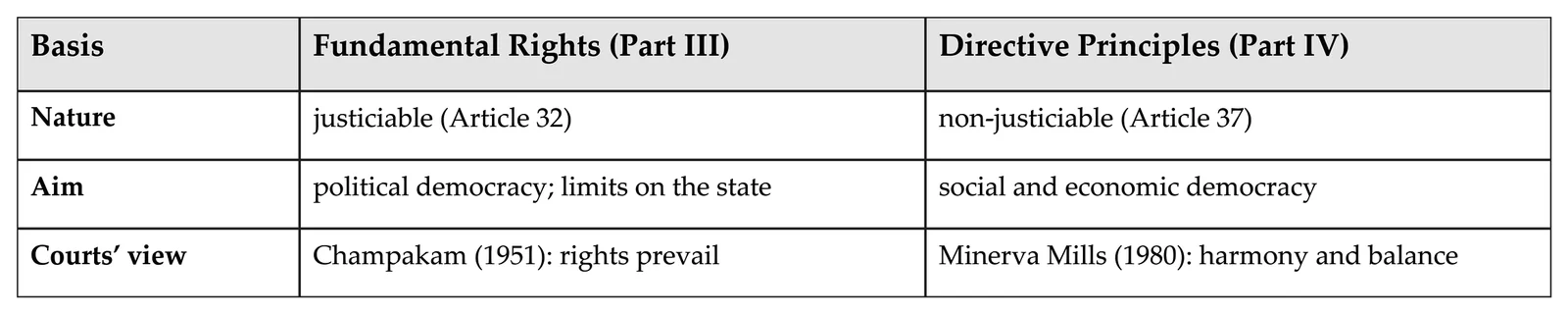
Six groups of rights, equality, freedom, against exploitation, religion, cultural and educational rights and constitutional remedies, are enforceable in courts and protect individuals against the state. They are justiciable: Article 32 allows citizens to move the Supreme Court directly for their enforcement, and some rights, such as those against untouchability and forced labour, apply against private persons too.
2. Directive Principles
The Directive Principles, inspired by the Irish Constitution, direct the state to secure social, economic and political justice; they are not enforceable but are fundamental in governance. Article 37 declares them fundamental in the governance of the country and makes it the duty of the state to apply them in making laws; B.N. Rau, the constitutional adviser, had suggested dividing rights into justiciable and non-justiciable categories.
3. Classification of Directives
The directives can be grouped as socialist (equal pay, a living wage, preventing concentration of wealth), Gandhian (village panchayats, cottage industries, prohibition, protection of cattle) and liberal-intellectual (a uniform civil code, separation of the judiciary from the executive, protection of monuments and international peace).
4. The Debate in the Constituent Assembly
Some members, such as K.T. Shah, wanted the directives to be enforceable, and Shah compared non-justiciable directives to a cheque on a bank payable only when the bank is able. The Assembly kept them non-justiciable but binding on the conscience of governments, answerable to the electorate.
5. Early Conflict
In Champakam Dorairajan (1951) and land reform cases, the courts gave priority to Fundamental Rights; Parliament responded with the First Amendment and the Ninth Schedule. In Champakam Dorairajan the Court struck down caste-based reservation in Madras medical colleges, and Parliament responded by adding Article 15(4).
6. The Amendment Battles
Golaknath (1967) denied Parliament the power to amend Fundamental Rights; the 24th and 25th Amendments (1971) reasserted it and added Article 31C; Kesavananda Bharati (1973) allowed amendment but protected the basic structure. The conflict was also political: Indira Gandhi’s government presented the Directive Principles as the basis of a socialist programme, including bank nationalisation and the abolition of privy purses, against a Court seen as defending property.
7. Harmony and Balance
In Minerva Mills (1980) the Court held that the Constitution rests on the balance between Parts III and IV, and that destroying this balance would violate the basic structure. Chief Justice Chandrachud wrote that the goals of Part IV must be achieved without abrogating the means provided by Part III.
8. Complementary Interpretation
Courts now read Directive Principles into Fundamental Rights, especially Article 21, recognising rights to livelihood, education, health and a clean environment. In Olga Tellis (1985) the Court recognised the right to livelihood, and in Unni Krishnan (1993) it read the right to education into Article 21, which later became Article 21A.
9. Implementation
Many directives have been implemented through land reforms, panchayati raj, the RTE Act, MGNREGA and the Food Security Act, while others, such as a uniform civil code, remain contested. Laws such as the National Food Security Act and the Maternity Benefit Act give legal form to directives in Articles 39, 42 and 47.
10. The Ninth Schedule and Article 31C
To protect land reform laws from challenge, the First Amendment created the Ninth Schedule, and the 25th Amendment inserted Article 31C to protect laws giving effect to Articles 39(b) and (c). The 42nd Amendment extended this protection to all Directive Principles, but Minerva Mills struck down that extension. In I.R. Coelho (2007) the Court held that laws placed in the Ninth Schedule after April 1973 can be reviewed if they violate the basic structure.
11. Fundamental Duties and the Balance
The Fundamental Duties added in 1976 complete the picture, reminding citizens of obligations such as promoting harmony and protecting the environment. Courts now read rights, directives and duties together: environmental cases, for example, draw on Article 21, Article 48A and Article 51A(g) at the same time. The Justice Verma Committee (1999) suggested ways of making citizens aware of these duties.
12. Rights and Directives Today
Recent judgments continue to read the two parts together: the right to a clean environment draws on Articles 21, 48A and 51A(g), and courts have used Article 39 to support welfare and labour legislation.
13. Evaluation
The relationship has moved from conflict to harmony. Rights without social justice would be empty for the poor; social justice without rights could become authoritarian. Ambedkar described the directives as an instrument of instructions to future governments, and Austin saw both parts as complementary instruments of the social revolution.
Conclusion. Thus, Fundamental Rights and Directive Principles together form the conscience of the Constitution, combining liberty with justice.
Short Notes
(a) Fundamental Duties
Added by the 42nd Amendment (1976) on the Swaran Singh Committee’s recommendation, Article 51A lists the duties of citizens, such as respecting the Constitution, flag and anthem, upholding sovereignty and unity, promoting harmony, renouncing practices derogatory to women, protecting the environment and developing a scientific temper. The 86th Amendment (2002) added the parents’ duty to educate children. They are not enforceable but guide the interpretation of laws.
(b) Directive Principles
Part IV (Articles 36–51) directs the state to promote justice: securing livelihood and preventing concentration of wealth, organising village panchayats, providing education and public assistance, securing a uniform civil code and protecting the environment. They are non-justiciable but fundamental in governance, and the balance between them and Fundamental Rights is part of the basic structure.
(c) The Preamble
The introductory statement of the Constitution declaring that authority comes from ‘We, the People of India’, that India is a sovereign, socialist, secular, democratic republic, and that the Constitution seeks justice, liberty, equality and fraternity. Kesavananda Bharati held it to be part of the Constitution and a key to its interpretation.
More notes: DSC-9 Constitutional Government and Democracy in India
These notes are prepared by PADHO TO AISE for study help. They are not an official University of Delhi publication.