
Semester III DSC-7 Political Theory: Concepts and Debates
Unit III · 25 min read · Updated 24 Nov 2026
As per the University of Delhi (DU) BA (Hons) Political Science syllabus
Contents
- 3.1 The Meaning of Justice
- 3.2 Justice: Procedural and Substantive
- 3.3 Rawls’s Theory of Justice
- 3.4 Rawls and His Critics
- 3.5 Debate: Scope of Justice – National vs Global
- 3.6 Important Questions
- Critically examine Rawls’s theory of justice.
- Distinguish between procedural and substantive justice.
- Discuss the debate on the scope of justice: national versus global.
- Short Notes
न्याय सामाजिक संस्थाओं का प्रथम गुण है, जैसे सत्य विचार-व्यवस्थाओं का।
Justice is the first virtue of social institutions, as truth is of systems of thought.
— John Rawls, A Theory of Justice (1971)
WHAT DO WE OWE one another? Is a society just if its rules are fair, whatever the results, or must the results themselves be fair, so that no one is left in poverty while others live in luxury? And do our obligations of justice stop at the borders of our country, or do they extend to every human being? These are the questions of justice, which Plato placed at the centre of political philosophy and John Rawls revived in the twentieth century. In this chapter we study the distinction between procedural and substantive justice, Rawls’s theory of justice as fairness and his many critics, and the debate on the scope of justice: is justice national or global?
3.1 The Meaning of Justice
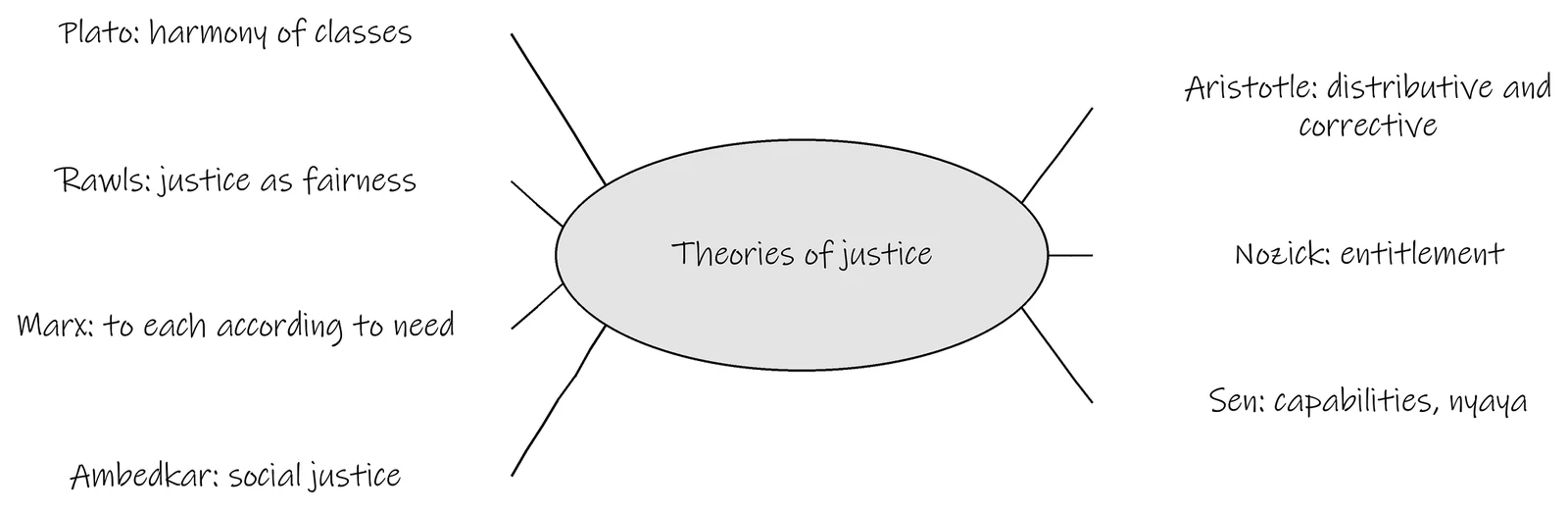
The classical definition of justice, found in Roman law, is giving each person his or her due. Plato, in the Republic, understood justice as harmony, each part of the soul and each class of the city performing its proper function. Aristotle distinguished distributive justice, the fair distribution of honours and goods according to merit, from corrective justice, which restores the balance when one person wrongs another. Modern political theory is concerned above all with social justice: the fair distribution of the benefits and burdens of social cooperation, such as income, wealth, opportunities, rights and power. Krishna Menon notes that justice is the most demanding of political values, because it asks not only what is good but what we can rightfully claim from one another; Jonathan Wolff shows how theories of social justice differ according to the principles they use: need, desert, equality or entitlement.
3.2 Justice: Procedural and Substantive
A. Procedural justice
Procedural justice holds that a distribution is just if it results from a fair process, whatever the outcome. The focus is on the rules of the game: equal rules, fair competition, voluntary exchange and the absence of fraud and force. Rawls distinguished three kinds. In perfect procedural justice, there is an independent standard of a fair outcome and a procedure guaranteed to reach it, as when the person who cuts a cake takes the last piece. In imperfect procedural justice, there is a standard but no procedure that always reaches it, as in a criminal trial, which may convict an innocent person. In pure procedural justice, there is no independent standard: whatever results from a fair procedure is fair, as in a fair lottery.
F.A. Hayek, in The Mirage of Social Justice (1976), argued that in a market society no one designs the distribution of income, so it makes no sense to call the outcome just or unjust; only individual conduct can be just. Robert Nozick’s entitlement theory (1974) is the most important procedural theory. A distribution is just if everyone is entitled to what they hold, which depends on three principles: justice in acquisition (how unowned things come to be owned), justice in transfer (voluntary exchange and gifts) and rectification of past injustice. Nozick called his theory historical and unpatterned: justice depends on how a distribution came about, not on whether it matches a pattern such as equality or need.
B. Substantive justice
Substantive justice judges distributions by their outcomes, measured against principles such as need, desert and equality. David Miller, in Principles of Social Justice (1999), argued that people use all three principles in different contexts: need in solidaristic communities, desert in economic exchange and equality among citizens. Marx’s principle of distribution according to needs and the socialist demand for equal outcomes are substantive. Critics of purely procedural justice argue that fair rules applied to deeply unequal starting points produce unjust results, and that the market rewards luck and inheritance as much as effort. Rawls tried to combine the two approaches: his original position is a fair procedure, but it produces substantive principles that govern the distribution of goods.
3.3 Rawls’s Theory of Justice
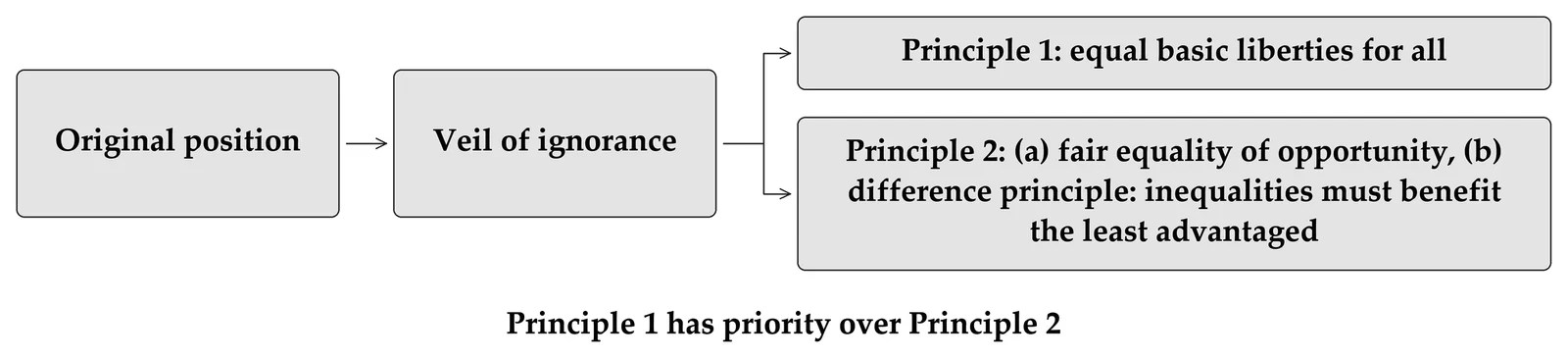
John Rawls (1921–2002), in A Theory of Justice (1971), revived normative political philosophy, which many believed was dead under the influence of logical positivism. Reacting against utilitarianism, which seeks the greatest happiness of the greatest number and can sacrifice individuals for the sum of welfare, Rawls insisted that each person has an inviolability founded on justice that even the welfare of society as a whole cannot override. He called his theory justice as fairness, and built it in the tradition of the social contract (Figure 3.2).
- The original position: imagine people choosing the principles that will govern their society from a hypothetical position of equality.
- The veil of ignorance: in this position no one knows his or her class, wealth, talents, sex, race, religion or conception of the good life. Because no one can design principles to favour themselves, the principles chosen will be fair.
- Primary goods: the parties want more rather than less of the primary goods that any rational person needs, rights and liberties, opportunities, income and wealth, and the social bases of self-respect.
- Maximin reasoning: under uncertainty, rational parties will choose the principles whose worst outcome is the best, protecting themselves against ending up at the bottom.
- Two principles: first, each person has an equal right to the most extensive scheme of equal basic liberties compatible with a similar scheme for all; second, social and economic inequalities are acceptable only if (a) attached to positions open to all under fair equality of opportunity, and (b) to the greatest benefit of the least advantaged (the difference principle).
- Lexical priority: the first principle has priority over the second, so basic liberties cannot be traded for economic gains, and fair equality of opportunity has priority over the difference principle.
- Reflective equilibrium: principles are tested against our considered judgements, and each is adjusted until they fit together.
In Political Liberalism (1993) Rawls recast justice as fairness as a political conception that citizens with different religious and moral doctrines could endorse through an overlapping consensus, rather than a comprehensive philosophy. Rawls’s theory justifies the liberal welfare state: equal rights, public education, progressive taxation and support for the worst-off.
3.4 Rawls and His Critics
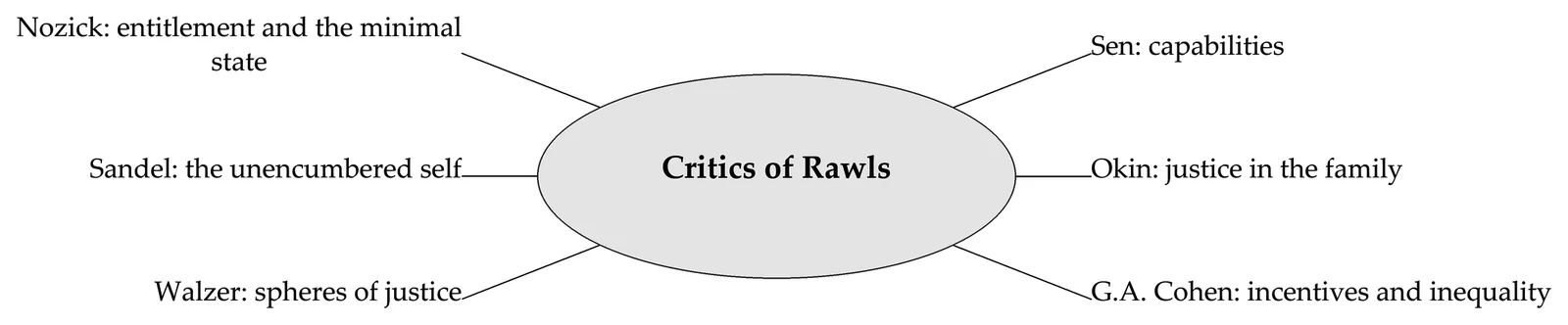
Rawls’s theory provoked criticism from every side (Figure 3.3):
- Libertarian critique: Nozick. In Anarchy, State, and Utopia (1974), Nozick argued that Rawls treats goods as if they fell like manna from heaven, ignoring who produced them. Redistribution violates people’s rights to what they have legitimately acquired; taxation of earnings is on a par with forced labour; and the Wilt Chamberlain example shows that liberty upsets patterns. Only a minimal state is just.
- Communitarian critique: Sandel, Walzer, MacIntyre. Michael Sandel, in Liberalism and the Limits of Justice (1982), argued that the parties behind the veil are unencumbered selves, stripped of the commitments and community ties that actually constitute who we are. Michael Walzer, in Spheres of Justice (1983), argued that different goods, such as money, office, education and love, have different meanings in each community and should be distributed by different principles (complex equality), not one universal formula. Alasdair MacIntyre criticised liberalism’s abstraction from tradition.
- The capability critique: Sen. Amartya Sen, in The Idea of Justice (2009), argued that primary goods ignore differences in people’s ability to convert resources into well-being; a disabled person needs more resources to achieve the same. Justice should focus on capabilities. Sen also criticised Rawls’s ‘transcendental institutionalism’, the search for perfectly just institutions, preferring a comparative approach that reduces manifest injustices; he contrasted niti (rules and institutions) with nyaya (realised justice).
- The feminist critique: Okin. Susan Moller Okin, in Justice, Gender, and the Family (1989), argued that Rawls assumed the just family without examining it; the family is a school of injustice where gender inequality begins, and principles of justice must apply within it.
- The socialist critique: Cohen. G.A. Cohen argued that the difference principle allows the talented to demand incentives, which is a form of bargaining rather than justice; in a truly just society, people would act on egalitarian principles in their own choices.
- The politics of difference: Young and Nussbaum. Iris Marion Young (1990) argued that the ‘distributive paradigm’ ignores oppression and domination, and Martha Nussbaum (Frontiers of Justice, 2006) argued that the contract model cannot deal with disability, nationality and animals.
3.5 Debate: Scope of Justice – National vs Global
Most theories of justice, including Rawls’s, assume that justice applies within a society, among fellow citizens. But in a world where a child born in a poor country has a far shorter and harder life than one born in a rich country, many ask whether principles of justice should apply globally. Gillian Brock sets out the two main positions (Figure 3.4).
A. Cosmopolitanism
Cosmopolitans argue that every human being has equal moral worth, so justice does not stop at borders. Peter Singer, in ‘Famine, Affluence, and Morality’ (1972), argued that if it is in our power to prevent something bad without sacrificing anything of comparable moral importance, we ought to do it; just as we would save a child drowning in front of us, we must help the distant poor. Charles Beitz (1979) argued that the world is a scheme of social cooperation through trade and institutions, so Rawls’s difference principle should apply globally. Thomas Pogge, in World Poverty and Human Rights (2002), argued that the rich countries impose a global institutional order, rules of trade, debt and resource ownership, that foreseeably keeps people poor; we therefore violate a negative duty not to harm, and he proposed a Global Resources Dividend.
B. Statism and nationalism
Statists and nationalists argue that principles of distributive justice apply within states. Rawls, in The Law of Peoples (1999), rejected a global difference principle and proposed only a duty of assistance to help ‘burdened societies’ become well-ordered. Thomas Nagel (2005) argued that justice requires a sovereign authority that coerces people in their name, which exists only within states. David Miller, in National Responsibility and Global Justice (2007), argued that nations are responsible for their own choices and that fellow nationals have special obligations to one another, though all humans have basic rights.

The debate has practical consequences for foreign aid, fair trade, debt relief, migration, and climate justice, where developing countries such as India argue that rich countries, responsible for most historical emissions, must bear a greater burden. Many scholars take a middle position: everyone has basic human rights that create global duties, while fuller distributive justice operates within political communities.
3.6 Important Questions
- Question 1 Critically examine Rawls’s theory of justice.
- Question 2 Distinguish between procedural and substantive justice.
- Question 3 Discuss the debate on the scope of justice: national versus global.
DU asks the same idea in different words. So learn one broad answer for each question below; the same answer works for every question joined by OR.
Important Question 1
Critically examine Rawls’s theory of justice.
OR
Discuss Rawls’s theory of justice and its critics.
OR
Explain the original position and the veil of ignorance.
Model Answer
“Each person possesses an inviolability founded on justice that even the welfare of society as a whole cannot override.”
— John Rawls, A Theory of Justice (1971)
Introduction. John Rawls’s A Theory of Justice (1971) is the most influential work of political philosophy of the twentieth century. Against utilitarianism, which can sacrifice individuals for the greatest happiness, Rawls developed a theory of justice as fairness in the social contract tradition, which justifies equal liberties and a fair distribution of social goods.
1. Context and Aim
Rawls wrote when political philosophy was thought to be dead and utilitarianism dominated. He wanted principles that respect the separateness of persons and provide a moral foundation for a liberal democratic welfare state. A Theory of Justice (1971) appeared amid the American civil rights movement, debates on poverty and the Vietnam war, when the justice of social institutions was being questioned. Rawls opened it by calling justice the first virtue of social institutions, as truth is of systems of thought.
2. The Original Position and the Veil of Ignorance
Rawls imagined people choosing principles in an original position of equality, behind a veil of ignorance that hides their class, talents, sex, race, religion and conception of the good. Since no one can tailor principles to their own advantage, the principles chosen are fair. The device is hypothetical, not historical: it models fairness by making sure that no one can tailor principles to their own advantage, so whatever is agreed there is fair. This is why Rawls called his theory ‘justice as fairness’.
3. Primary Goods and Maximin
The parties seek primary goods, rights, liberties, opportunities, income, wealth and the bases of self-respect. Reasoning under uncertainty, they follow maximin, choosing principles whose worst outcome is the best.
4. The Two Principles
First, equal basic liberties for all. Second, inequalities must be attached to positions open under fair equality of opportunity and must benefit the least advantaged, the difference principle. The first principle has lexical priority over the second. The first principle protects freedom of thought, conscience, speech, association, the vote and the person; the second allows a doctor to earn more than a cleaner only if the system of incentives also improves the position of the poorest.
5. Significance
Rawls revived normative theory, gave a philosophical defence of the welfare state, and provided a powerful method for thinking about fairness; his later Political Liberalism (1993) adapted it to pluralist societies through an overlapping consensus.
6. The Libertarian Critique
Nozick argued that Rawls ignores entitlements: goods do not fall from heaven, and redistribution violates rights, taxation being on a par with forced labour. Free exchanges upset any pattern of distribution. Nozick also objected that Rawls treats natural talents as a common asset, which fails to respect individuals as the owners of themselves and their abilities.
7. The Communitarian Critique
Sandel argued that Rawls assumes an unencumbered self without community attachments; Walzer argued that goods have different social meanings requiring different principles; MacIntyre criticised liberal abstraction from tradition. Charles Taylor added that the priority of the right over the good ignores the social sources of the self, since our values and identities are formed within particular communities and traditions.
8. Capability, Feminist and Socialist Critiques
Sen argued that primary goods ignore differences in converting resources into capabilities and preferred comparative justice to perfect institutions. Okin argued that justice must apply within the family. Cohen argued that the difference principle legitimises incentive-seeking inequality. G.A. Cohen argued that incentive-based inequalities are not truly necessary, since the talented could work hard without demanding extra rewards, and that a just society needs an egalitarian ethos as well as just institutions.
9. Evaluation
Despite these criticisms, Rawls set the terms of the debate: his critics define their positions in relation to him. His theory remains the most systematic defence of a just liberal society that combines liberty with concern for the worst-off. Even critics accept that Rawls gave liberalism a strong egalitarian commitment and showed that liberty and equality can be reconciled within one theory.
10. Political Liberalism
In Political Liberalism (1993) Rawls responded to the fact of reasonable pluralism: citizens hold different religions and philosophies. He presented justice as fairness as a political conception that people with different comprehensive doctrines could accept through an overlapping consensus, and argued that citizens should justify laws by public reason, arguments that others can reasonably accept, rather than by their own religious beliefs.
11. Rawls and India
Rawls’s ideas have been widely used in India. The difference principle and fair equality of opportunity have been invoked to justify reservations and welfare for the worst-off, and Amartya Sen developed his critique by drawing on the Indian distinction between niti, institutions and rules, and nyaya, justice as actually realised in people’s lives.
Conclusion. Thus, Rawls’s theory of justice as fairness is a landmark in political philosophy. Its critics have exposed its limits, but its central idea, that a just society must be acceptable to those who are worst off, remains compelling.
Important Question 2
Distinguish between procedural and substantive justice.
OR
Examine Nozick’s entitlement theory of justice.
OR
Is social justice a mirage? Discuss.
Model Answer
“Taxation of earnings from labor is on a par with forced labor.”
— Robert Nozick, Anarchy, State, and Utopia (1974)
Introduction. Theories of justice differ on whether justice is a matter of fair procedures or fair outcomes. Procedural justice judges the process by which a distribution arises; substantive justice judges the distribution itself by principles such as need, desert and equality.
1. Meaning of Procedural Justice
Procedural justice holds that a distribution is just if it results from fair rules: equal treatment, voluntary exchange and the absence of force and fraud. The outcome, whatever it is, is just if the process was fair. A familiar example is a fair race: if the rules are followed and no one cheats, whoever wins deserves to win, and it makes no sense to ask whether the result itself is just.
2. Rawls’s Three Types
Rawls distinguished perfect procedural justice (a fair standard and a procedure that guarantees it, like cake-cutting), imperfect procedural justice (a standard but a fallible procedure, like a trial) and pure procedural justice (no independent standard, like a fair lottery). Rawls designed his own original position as pure procedural justice: because the procedure is fair, whatever principles it produces are fair. Gambling is his example of pure procedural justice: if the bets are fair and freely made, whatever distribution results is fair.
3. Hayek
Hayek argued that social justice is a mirage: in a spontaneous market order no one designs the distribution, so the outcome cannot be just or unjust; redistribution threatens freedom and the rule of law. In Law, Legislation and Liberty (1976), Hayek argued that justice is an attribute of individual conduct, not of the impersonal outcomes of the market, and that the pursuit of social justice leads towards a planned and coercive state.
4. Nozick’s Entitlement Theory
Nozick held that a distribution is just if holdings were justly acquired, justly transferred or rectified. His theory is historical and unpatterned. Redistribution violates rights; taxation is on a par with forced labour. For Nozick the only legitimate state is a minimal state, limited to protection against force, theft and fraud and the enforcement of contracts.
5. Meaning of Substantive Justice
Substantive justice judges outcomes by principles. Miller identifies need, desert and equality as the three principles people use in different contexts, while Marx proposed distribution according to needs. Substantive theories are often called ‘patterned’ or ‘end-state’ theories, because they judge a distribution by whether it fits a desired pattern, such as equality or need. Aristotle’s distinction between distributive justice, which gives each person what is proportionate to merit, and corrective justice, which restores a balance disturbed by wrongdoing, is an early form of this idea.
6. Critique of Purely Procedural Justice
Fair rules applied to unequal starting points produce unjust results; markets reward luck and inheritance as much as effort; and historical injustices such as colonialism and caste make current holdings hard to justify. A landless labourer and a large landowner may sign a formally free contract, but the inequality of bargaining power makes its terms unjust; fair procedure alone cannot correct such imbalances.

7. Critique of Purely Substantive Justice
Imposing a pattern requires continual interference with free choices, ignores responsibility and may reduce incentives, as Nozick’s Wilt Chamberlain example shows. Hayek also warned that no authority has enough knowledge to decide what each person deserves, so attempts to impose desert-based patterns become arbitrary.
8. Young: Justice beyond Distribution
Iris Marion Young, in Justice and the Politics of Difference (1990), argued that both views focus too narrowly on the distribution of goods. Injustice also consists of oppression built into social structures, which she described as exploitation, marginalisation, powerlessness, cultural imperialism and violence. Justice therefore requires changing institutions and relationships, not only redistributing goods.
9. Sen: Niti and Nyaya
Amartya Sen, in The Idea of Justice (2009), contrasted niti, just rules and institutions, with nyaya, justice as actually realised in people’s lives. A purely procedural focus on correct rules can ignore whether people really live better lives, so Sen urged a comparative approach that judges states of affairs by their outcomes.
10. Combining the Two
Rawls combines both: the original position is a fair procedure that produces substantive principles, equal liberties and the difference principle. Most modern democracies combine fair procedures with redistributive policies. In practice, democracies combine procedural guarantees such as equality before law, due process and free markets with substantive goals such as minimum wages, public education and progressive taxation.
11. The Principle of Rectification
Nozick admitted that many present holdings arose from past injustices such as conquest and theft, so his third principle requires rectification. Critics point out that in societies shaped by colonialism, slavery or caste, rectification could justify large-scale redistribution, so even a procedural theory may lead to substantive changes.
12. An Indian Illustration
The conflict between the two ideas was seen in India’s land reforms. Landowners argued that their property was legally acquired and protected by the right to property; reformers argued that land ownership reflected historical injustice and that redistribution was required by justice. Parliament amended the Constitution several times to protect land reform, giving priority to substantive justice. The Constitution finally sided with substantive social justice: the Directive Principles in Articles 38 and 39 direct the state to reduce inequalities of income and to prevent the concentration of wealth.
Conclusion. Thus, procedural and substantive justice capture two essential aspects of fairness. A just society needs both fair rules and outcomes that do not leave people without the means to live with dignity.
Important Question 3
Discuss the debate on the scope of justice: national versus global.
OR
What is global justice? Discuss the cosmopolitan view.
OR
Do we have obligations of justice to distant strangers? Discuss.
Model Answer
“If it is in our power to prevent something bad from happening, without thereby sacrificing anything of comparable moral importance, we ought, morally, to do it.”
— Peter Singer, ‘Famine, Affluence, and Morality’ (1972)
Introduction. Theories of justice traditionally apply within a state. But global poverty, inequality between nations, migration and climate change raise the question whether justice is global. Brock sets out the debate between cosmopolitans and statists.
1. The Problem
A person’s life chances depend greatly on the country of birth. If birth into a class is morally arbitrary, as Rawls argued, birth into a nation may be too. A child born in a rich country can expect a longer life, better education and a higher income than a child born in a poor one, through no merit or fault of either. The question is whether principles of justice stop at national borders.
2. Singer’s Argument
Singer argued that we must prevent bad outcomes if we can do so without sacrificing anything of comparable importance; distance makes no moral difference, so the rich must help the distant poor. In ‘Famine, Affluence, and Morality’ (1972), written during the humanitarian crisis in East Bengal, Singer gave the example of a child drowning in a shallow pond: anyone would wade in to save it even at the cost of ruined clothes, and distance should make no moral difference.
3. Beitz and the Global Difference Principle
Beitz argued that global trade and institutions form a scheme of cooperation, so Rawls’s principles, including the difference principle, should apply worldwide. In Political Theory and International Relations (1979), Beitz also argued that the uneven distribution of natural resources among countries is as morally arbitrary as the distribution of talents among individuals.
4. Pogge and Institutional Harm
Pogge argued that the global order of trade, debt and resource rules, imposed by rich countries, foreseeably keeps people poor, so we violate a negative duty not to harm; he proposed a Global Resources Dividend. In World Poverty and Human Rights (2002), Pogge showed how international rules that let whoever controls a country sell its resources and borrow in its name reward dictators and keep populations poor.
5. Rawls’s Law of Peoples
Rawls rejected a global difference principle and proposed only a duty of assistance to burdened societies, respecting the self-determination of peoples. In The Law of Peoples (1999), Rawls argued that a society’s wealth depends mainly on its political culture and institutions, so the duty of assistance ends once burdened societies become well-ordered.
6. Nagel and Miller
Nagel argued that justice requires a sovereign that coerces people in their name, existing only within states. Miller argued that nations bear responsibility for their choices and that co-nationals have special obligations, while everyone has basic human rights. Miller, in National Responsibility and Global Justice (2007), accepts that all human beings have basic rights but holds that equality of opportunity and distributive justice apply mainly within national communities. Nagel’s essay ‘The Problem of Global Justice’ (2005) concluded that, without a world government, demands of socio-economic equality do not apply globally, leaving only humanitarian duties.
7. Practical Issues
The debate affects foreign aid, fair trade, debt relief, migration and climate justice, where countries like India argue that historical polluters must carry more of the burden. Debt-relief campaigns such as Jubilee 2000 and proposals for global taxes on financial transactions or great wealth show how cosmopolitan ideas enter real politics.
8. The View from the Global South
Countries of the Global South argue that global justice must address the legacy of colonialism and unequal rules of trade and finance. India’s insistence on ‘common but differentiated responsibilities’ in climate negotiations and its campaigns for access to affordable medicines under intellectual property rules reflect this view.
9. Evaluation
Cosmopolitans rightly stress equal human worth and global interdependence; statists rightly note that democratic institutions and solidarity are national. A middle view recognises global duties to secure basic rights while fuller justice remains national. The debate also shows that national and global justice are connected: domestic justice in poor countries depends on fair global rules, and global justice depends on effective, accountable states.
10. Climate Justice
Climate change makes the debate urgent. Rich countries produced most historical emissions, while poor countries and future generations suffer most of the harm. Cosmopolitans argue that justice requires rich countries to cut emissions faster and pay for adaptation; the principle of common but differentiated responsibilities in climate agreements reflects this argument.
11. Migration and Borders
Cosmopolitans such as Joseph Carens argue that restrictions on migration preserve unjust privilege based on birthplace, while statists argue that political communities have a right to control membership to protect their institutions and culture. Michael Walzer, in Spheres of Justice (1983), defended the right of communities to decide their own membership as a condition of preserving their distinct character.
12. A Minimum of Global Justice
Many theorists agree at least on a global minimum: every human being has rights to subsistence, security and basic liberty, and rich states and the international community have duties to secure these rights, even if fuller distributive justice applies within states.
Conclusion. Thus, the scope of justice is one of the central debates of contemporary political theory. In an interdependent world, justice can no longer stop entirely at national borders.
Short Notes
(a) Global justice
The question whether principles of justice apply across borders. Cosmopolitans such as Singer, Beitz and Pogge argue that equal human worth and global interdependence create duties to the world’s poor; statists and nationalists such as Rawls (The Law of Peoples), Nagel and Miller argue that distributive justice applies mainly within states, with only a duty of assistance or basic rights globally.
(b) The veil of ignorance
Rawls’s device in the original position: those choosing principles of justice do not know their class, talents, sex, race, religion or conception of the good. It ensures impartiality, since no one can design principles to favour themselves, and leads to the choice of equal liberties and the difference principle.
(c) The capability approach
Developed by Amartya Sen and Martha Nussbaum, it holds that justice should be measured by people’s real freedoms or capabilities to achieve valuable functionings, such as being healthy, educated and taking part in community life, rather than by resources or welfare alone.
More notes: DSC-7 Political Theory: Concepts and Debates
These notes are prepared by PADHO TO AISE for study help. They are not an official University of Delhi publication.