
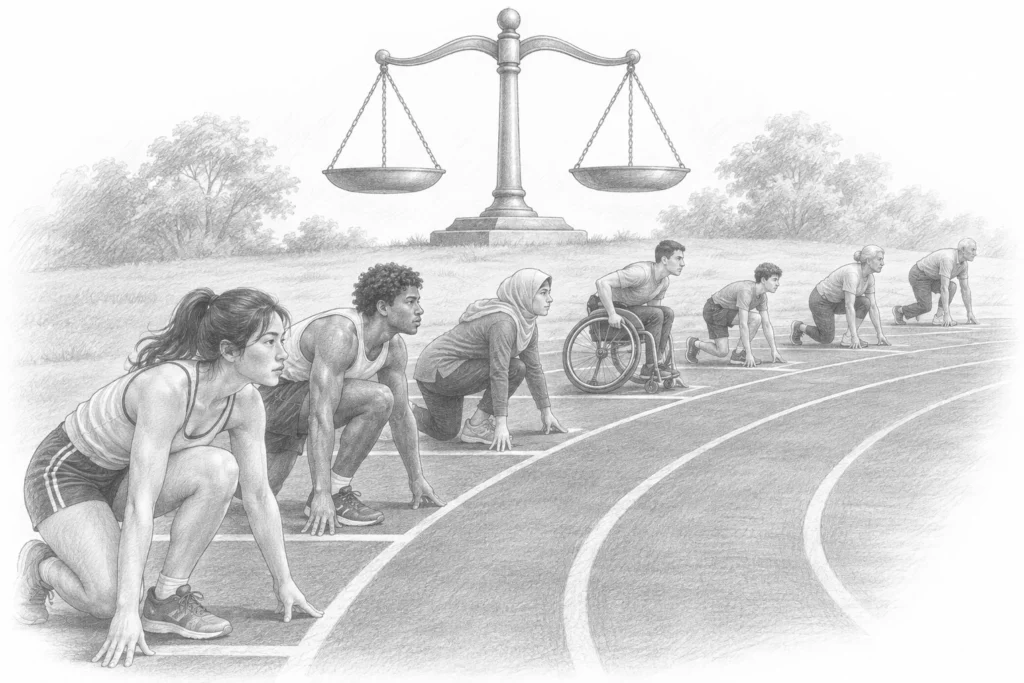
Semester III DSC-7 Political Theory: Concepts and Debates
Unit II · 24 min read · Updated 24 Nov 2026
As per the University of Delhi (DU) BA (Hons) Political Science syllabus
Contents
- 2.1 The Meaning of Equality
- 2.2 Equality of Opportunity
- 2.3 Equality of Outcome
- 2.4 Egalitarianism: Background Inequalities and Differential Treatment
- 2.5 Debate: Affirmative Action
- 2.6 Important Questions
- Analyse the concepts of equality of opportunity and equality of outcome. Do you agree that emphasis on equality of outcome hampers individual freedom?
- With reference to affirmative action, explain how positive discrimination ensures equality.
- Discuss egalitarianism with reference to background inequalities and differential treatment.
- Short Notes
प्राकृतिक वितरण न तो न्यायपूर्ण है न अन्यायपूर्ण… न्यायपूर्ण या अन्यायपूर्ण वह तरीका है जिससे संस्थाएँ इन तथ्यों से निपटती हैं।
The natural distribution is neither just nor unjust… What is just and unjust is the way that institutions deal with these facts.
— John Rawls, A Theory of Justice (1971)
ALL HUMAN BEINGS are equal in moral worth: this is one of the founding beliefs of modern politics, written into declarations of rights and constitutions across the world. But people are obviously unequal in wealth, power, talents, health and opportunities. Which of these inequalities are unjust, and what should be done about them? Should we only make sure that everyone has a fair chance at the start, or should we also care about how people end up? Should the state treat everyone in exactly the same way, or sometimes treat people differently in order to treat them as equals? In this chapter we study the concepts of equality of opportunity and equality of outcome, the theories of egalitarianism that deal with background inequalities and differential treatment, and the debate on affirmative action.
2.1 The Meaning of Equality
Equality is the idea that people should be treated as equals in some important respect. Aristotle distinguished numerical equality, giving everyone the same, from proportional equality, giving to each according to merit or need, and held that justice means treating equals equally and unequals unequally. Modern theory distinguishes formal equality, the same rules for all, as in equality before the law and one person one vote, from substantive equality, which asks whether people actually enjoy similar conditions and chances in life. Equality is also discussed in different spheres: legal, political, social and economic. Paula Casal and Andrew Williams note that egalitarians disagree about two questions: equality of what? and why does equality matter?

2.2 Equality of Opportunity
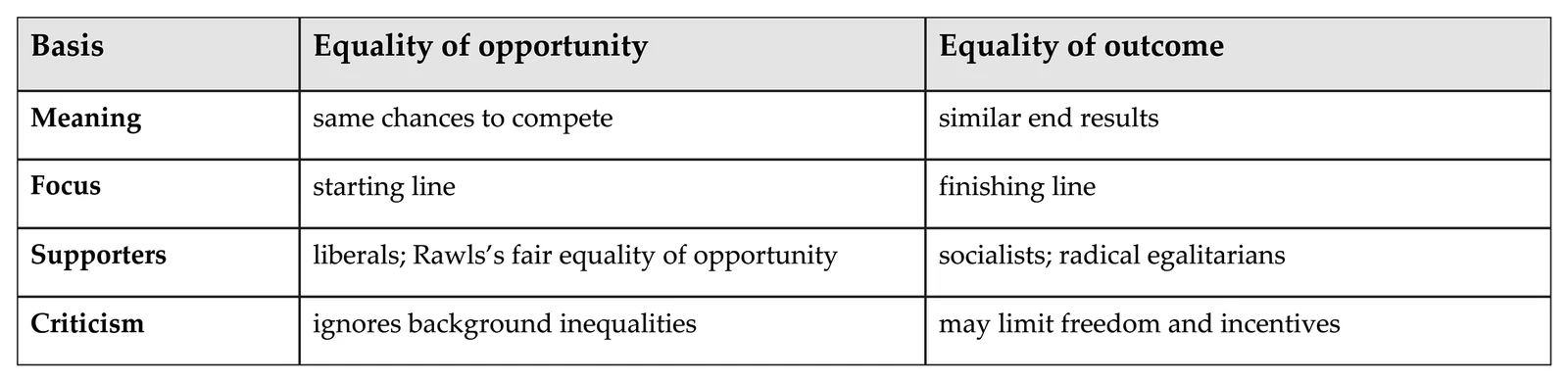
Equality of opportunity means that people should have equal chances to compete for positions, jobs and rewards, so that outcomes depend on their own talent and effort rather than on their birth. Adam Swift distinguishes three levels of the idea:
- Formal (minimal) equality of opportunity: positions are open to all and selection is not based on irrelevant characteristics such as caste, religion, race or sex; ‘careers open to talents’, as the French revolutionaries put it.
- Fair (meritocratic) equality of opportunity: people with similar talent and motivation should have similar chances whatever their social class. John Rawls insisted on this ‘fair equality of opportunity’, which requires public education and the removal of the advantages of wealth and family background.
- Radical equality of opportunity: even natural talents are unchosen and morally arbitrary, so the state should compensate for differences in talent and in the family into which one is born, leaving only the effects of people’s own choices.
Equality of opportunity is popular because it seems to combine fairness with freedom and efficiency. But it faces serious problems. It accepts large inequalities of outcome as long as the competition is fair. Its fair version is very demanding, because families pass on advantages through upbringing, networks and wealth, and the state cannot fully equalise starting points without interfering in family life. Michael Young, who coined the word meritocracy in a satire (1958), warned that a society ruled by merit could become arrogant towards those who fail, a criticism developed by Michael Sandel in The Tyranny of Merit (2020). R.H. Tawney described equality of opportunity in an unequal society as an impertinent courtesy offered to guests who cannot accept it.
2.3 Equality of Outcome
Equality of outcome means that people should end up with similar levels of income, wealth or well-being, not just similar chances. It looks at the finishing line rather than the starting line (Figure 2.3). Socialists have been its main advocates. Marx, in the Critique of the Gotha Programme (1875), proposed the principle ‘from each according to his ability, to each according to his needs’ for a fully communist society. Tawney, in Equality (1931), argued that great inequalities of income create a society of masters and servants, destroy fellowship and make equal citizenship impossible. Supporters make three arguments: outcomes shape the opportunities of the next generation, so unequal outcomes today destroy equal opportunities tomorrow; much of what people achieve depends on luck rather than desert; and extreme inequality damages democracy and social solidarity.
Equality of outcome and freedom
Critics argue that equality of outcome conflicts with liberty. Robert Nozick’s famous Wilt Chamberlain example in Anarchy, State, and Utopia (1974) imagines an equal distribution; then many people freely pay to watch a great basketball player, who becomes rich. The new, unequal distribution arose from free choices, so maintaining any pattern of equality would require continual interference with people’s lives. F.A. Hayek warned that enforcing equal results requires a powerful state that directs individuals. Others add that equality of outcome ignores effort and desert, reduces incentives and efficiency, and may ‘level down’, making the better-off worse off without helping anyone, an objection Derek Parfit called the levelling down objection. Egalitarians reply that inequality itself limits freedom: money gives people the power to do things, so the poor have less real freedom, as G.A. Cohen argued. Rawls offered a middle path: inequalities are acceptable only if they benefit the least advantaged.
2.4 Egalitarianism: Background Inequalities and Differential Treatment
A. The currency of equality
Egalitarianism is the view that people should be treated as equals and that certain inequalities are unjust. Ronald Dworkin argued that the basic principle of modern politics is equal concern and respect for every person. But equal concern for what? Amartya Sen asked this question in his lecture ‘Equality of What?’ (1979), and different answers have been given: equality of welfare, of resources, of primary goods (Rawls), or of capabilities (Sen).
B. Dworkin: equality of resources
In ‘What is Equality?’ (1981) Dworkin rejected equality of welfare, because it would reward people with expensive tastes, who need more resources to be as satisfied as others. He proposed equality of resources (Figure 2.4). Imagine shipwrecked people on an island who hold an auction with equal shares of clamshells to buy its resources; the result is fair when no one prefers another’s bundle (the ‘envy test’). Because people also differ in handicaps and talents, Dworkin added a hypothetical insurance market in which people insure against bad luck, with taxation modelled on the premiums. His aim was a distribution that is ambition-sensitive, reflecting people’s choices, but endowment-insensitive, not reflecting unchosen circumstances. This inspired luck egalitarianism (Richard Arneson, G.A. Cohen), which distinguishes brute luck, which people do not choose and should be compensated for, from option luck, the result of deliberate gambles.

C. Background inequalities
Egalitarians stress that many inequalities arise from background conditions that people do not choose: the class, caste, gender and region into which they are born, disabilities, and even natural talents. Rawls called the distribution of natural talents a ‘natural lottery’ that is arbitrary from a moral point of view. When background inequalities are deep, formally equal treatment simply reproduces them. A child from a family of landless labourers and a child of professionals are not equal competitors in an examination, however fair its rules.
D. Differential treatment
Dworkin distinguished equal treatment, giving everyone the same, from treatment as an equal, giving everyone equal concern and respect, which may require treating people differently. Ramps for wheelchair users, maternity benefits, special schools and reservations are examples of differential treatment that serve equality. The Indian Constitution permits special provisions for women and children (Article 15(3)) and for socially and educationally backward classes, Scheduled Castes and Scheduled Tribes (Articles 15(4), 16(4) and 46). In State of Kerala v. N.M. Thomas (1976) the Supreme Court held that such provisions are not exceptions to equality but a means of achieving substantive equality.
E. Other forms of egalitarianism
- Prioritarianism (Derek Parfit, 1991): what matters is not equality as such but giving priority to the worse-off.
- Sufficientarianism (Harry Frankfurt, 1987): what matters is that everyone has enough.
- Relational equality (Elizabeth Anderson, ‘What is the Point of Equality?’, 1999): the point of equality is not distributing goods but ending oppressive hierarchies, so that people can relate to one another as equals.
2.5 Debate: Affirmative Action
Affirmative action refers to policies that give special consideration to members of groups that have suffered discrimination and remain disadvantaged, in education, employment and political representation. It ranges from outreach and training programmes to preferences in selection and fixed quotas or reservations. In India it is called positive or protective discrimination and takes the form of reservations for Scheduled Castes, Scheduled Tribes and Other Backward Classes.
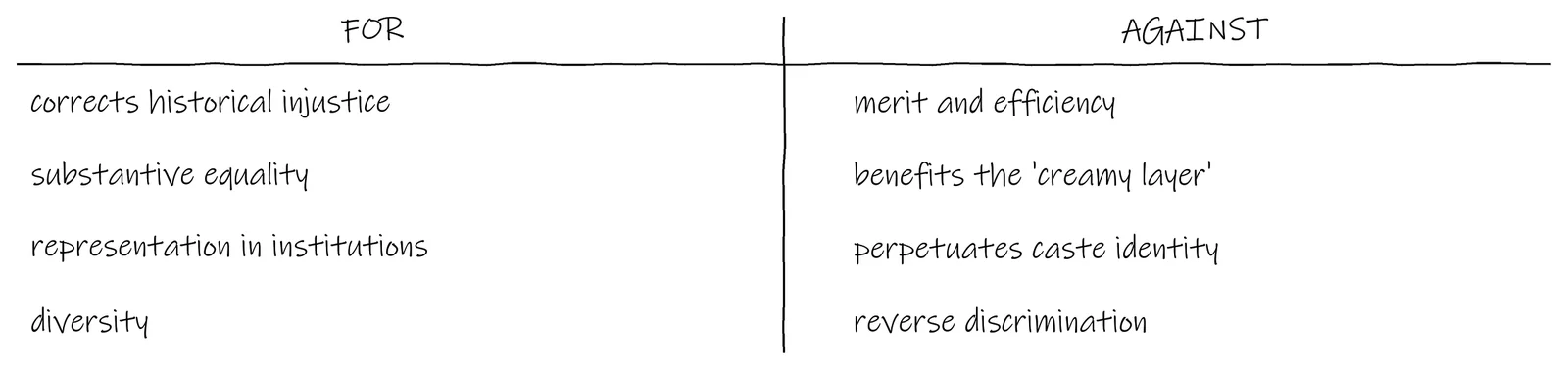
A. The case for affirmative action
- Compensatory justice: it compensates groups for past injustices, such as untouchability and slavery, whose effects continue.
- Substantive equality of opportunity: Ashok Acharya argues that where disadvantage is group-based and structural, as with caste, formal equality cannot produce real equality; positive discrimination removes background inequalities so that members of disadvantaged groups can compete as equals.
- Representation and diversity: it ensures that institutions such as legislatures, universities and the bureaucracy reflect society, which improves their legitimacy and decisions.
- Role models and breaking stereotypes: successful members of disadvantaged groups inspire others and challenge prejudice.
- Social integration: it brings excluded groups into the mainstream and strengthens democracy.
B. The case against
- Reverse discrimination: it treats individuals unfairly on the basis of group membership, harming those who did not cause past injustice.
- Merit and efficiency: it may select less qualified candidates.
- Stigma: beneficiaries may be seen as undeserving.
- Benefits the better-off: gains may go to the ‘creamy layer’ within groups rather than the poorest.
- Perpetuating identity: it may keep caste and group identities alive.
Katherine Smits, asking whether affirmative action is fair, concludes that much depends on design: policies that target genuine disadvantage, are reviewed regularly and are combined with broader measures are easier to justify. In India, Indra Sawhney (1992) upheld OBC reservation with a 50 per cent ceiling and the exclusion of the creamy layer; the 103rd Amendment (2019) added a 10 per cent quota for economically weaker sections, upheld in 2022; and in 2024 the Supreme Court permitted the sub-classification of Scheduled Castes so that the most backward among them benefit. In the United States, the Supreme Court struck down race-conscious university admissions in 2023, showing that the debate continues across democracies.
2.6 Important Questions
- Question 1 Analyse the concepts of equality of opportunity and equality of outcome. Do you agree that emphasis on equality of outcome hampers individual freedom?
- Question 2 With reference to affirmative action, explain how positive discrimination ensures equality.
- Question 3 Discuss egalitarianism with reference to background inequalities and differential treatment.
DU asks the same idea in different words. So learn one broad answer for each question below; the same answer works for every question joined by OR.
Important Question 1
Analyse the concepts of equality of opportunity and equality of outcome. Do you agree that emphasis on equality of outcome hampers individual freedom?
OR
Distinguish between equality of opportunity and equality of outcome.
OR
Is there a conflict between liberty and equality? Discuss.
Model Answer
“The impertinent courtesy of an invitation offered to unwelcome guests, in the certainty that circumstances will prevent them from accepting it.”
— R.H. Tawney on equality of opportunity in an unequal society, Equality (1931)
Introduction. Equality is a central value of democracy, but egalitarians disagree about what should be equal. Equality of opportunity seeks equal chances at the start; equality of outcome seeks similar results at the end. The relationship between these ideas, and between equality and freedom, is one of the oldest debates in political theory.
1. Meaning of Equality of Opportunity
Equality of opportunity means that positions and rewards should be open to all and distributed according to talent and effort, not birth. It focuses on a fair starting line and a fair competition, and it accepts that results will be unequal. It is the most widely accepted idea of equality in liberal societies because it combines fairness with freedom: everyone has the same chance, but individuals remain free to succeed or fail by their own efforts. The French Declaration of the Rights of Man (1789) expressed it by opening all public offices to citizens according to their abilities.
2. Levels of Equality of Opportunity
Swift distinguishes formal equality of opportunity, non-discrimination in selection; fair equality of opportunity, Rawls’s requirement that people of similar talent have similar chances whatever their class; and radical equality of opportunity, which would compensate even for differences in natural talent and family background.
3. Limits of Equality of Opportunity
It can justify great inequality of outcomes; family advantages make true equality of starting points almost impossible; and a meritocracy may humiliate those who lose, as Young and Sandel warned. Tawney called equal opportunity in an unequal society an impertinent courtesy. In India, a student from a poor rural family who studies in an under-staffed government school competes in the same examinations as a student with private coaching, which shows how formal equality of opportunity can hide very unequal starting points.
4. Meaning of Equality of Outcome
Equality of outcome seeks similar levels of income, wealth or well-being. Marx’s principle ‘to each according to his needs’ and Tawney’s vision of a society of equals express it. Supporters argue that unequal outcomes today become unequal opportunities tomorrow and that much of success depends on luck. Equality of outcome need not mean identical incomes for everyone; in its moderate forms it means narrowing gaps through progressive taxation, public services and a social minimum, so that differences of wealth do not turn into domination.
5. Nozick’s Argument: Liberty Upsets Patterns
Nozick’s Wilt Chamberlain example shows that free exchanges will quickly upset any equal distribution, so maintaining equality of outcome requires continual interference with people’s free choices. On this view, equality of outcome does hamper individual freedom. Nozick, writing Anarchy, State, and Utopia (1974) against Rawls, argued that justice depends on how holdings came about, not on their pattern, and that taxing earnings for redistribution is on a par with forced labour.
6. Other Objections
Hayek warned that enforcing equal results requires a directing state; critics add that it ignores effort and desert, weakens incentives and may level down, making some worse off without helping anyone.
7. The Egalitarian Reply
Egalitarians reply that freedom requires resources: the poor are less free because they lack the means to act, as Cohen argued. Redistribution may limit the freedom of the rich but increase the real freedom of the poor, so the overall effect on freedom is not simply negative. As the familiar saying puts it, freedom for the pike is death for the minnows: unrestrained liberty for the strong destroys the liberty of the weak. On this view equality and liberty are complementary rather than opposed.
8. Middle Positions
Rawls’s difference principle permits inequalities only if they benefit the least advantaged, combining incentives with concern for the worst-off. Dworkin’s equality of resources allows outcomes to reflect choices but not unchosen circumstances. Social democrats such as Anthony Crosland, in The Future of Socialism (1956), combined equality of opportunity with strong public services and redistribution, arguing that a fair society needs both a fair race and a reasonable distance between winners and losers.
9. Evaluation
Strict equality of outcome would indeed restrict freedom, but some reduction of inequality is necessary for both real equality of opportunity and meaningful freedom. Most democracies combine fair opportunity with welfare and progressive taxation. The real question is therefore not whether to choose freedom or equality but how much inequality is compatible with equal citizenship and equal dignity.
10. Equality and Freedom in the Indian Constitution
The Indian Constitution tries to combine both ideals. Article 14 guarantees equality before the law and Articles 15 and 16 equality of opportunity, while the Directive Principles in Articles 38 and 39 direct the state to minimise inequalities of income and prevent the concentration of wealth. When property rights clashed with land reform, the Supreme Court in Minerva Mills (1980) held that the Constitution rests on a balance between liberty and equality, so that neither can be sacrificed entirely to the other.
Conclusion. Thus, equality of opportunity and equality of outcome are connected rather than opposed. A strong emphasis on equal outcomes can limit freedom, but extreme inequality also destroys the freedom and opportunities of the poor; a just society seeks a balance.
Important Question 2
With reference to affirmative action, explain how positive discrimination ensures equality.
OR
Is affirmative action fair? Discuss.
OR
Discuss the arguments for and against reservation in India.
Model Answer
“In order to get beyond racism, we must first take account of race.”
— Justice Harry Blackmun, Regents of the University of California v. Bakke (1978)
Introduction. Affirmative action, called positive or protective discrimination in India, consists of policies that give special consideration to members of disadvantaged groups in education, employment and representation. It appears to contradict equality, since it treats people differently, but its defenders argue that it is necessary to achieve substantive equality in societies marked by deep group-based inequality.
1. Meaning and Forms
Affirmative action ranges from outreach and training to preferences in selection and fixed quotas. In India it takes the form of reservations for Scheduled Castes, Scheduled Tribes and Other Backward Classes in legislatures, education and public employment. In the United States the term entered policy through President Kennedy’s Executive Order 10925 (1961), which required government contractors to take ‘affirmative action’ against discrimination, and it later developed into race-conscious admissions in universities.
2. Formal and Substantive Equality
Formal equality treats everyone the same; substantive equality asks whether people actually have equal chances. Where some groups have suffered centuries of exclusion, identical treatment simply reproduces their disadvantage. Ambedkar argued in the Constituent Assembly that equality of opportunity had to be reconciled with the claims of communities that had so far been denied entry into the administration, and reservations were his answer to this problem.
3. Treatment as an Equal
Dworkin distinguished equal treatment from treatment as an equal, which may require treating people differently. Positive discrimination treats disadvantaged groups differently in order to treat them as equals.
4. Removing Background Inequalities
Acharya argues that caste-based disadvantage is structural and inherited; reservations remove background inequalities so that members of these groups can compete fairly. The Supreme Court in N.M. Thomas (1976) held that reservations are a facet of equality, not an exception to it. Inherited disadvantage includes poor schooling, lack of social networks, discrimination in hiring and the stigma of untouchability, none of which disappear simply because laws become formally equal.
5. Compensation, Representation and Diversity
Affirmative action compensates for past injustice, ensures that institutions represent society, increases diversity and provides role models, which strengthens democracy. Diversity also improves institutions: courts, universities and bureaucracies that include people from different backgrounds make better-informed decisions and enjoy greater legitimacy among all sections of society.
6. Arguments Against
Critics argue that it is reverse discrimination, compromises merit and efficiency, stigmatises beneficiaries, helps the creamy layer more than the poorest, and keeps caste identities alive. Libertarian critics add that individuals today should not pay for injustices committed by others in the past, and that the state should be blind to caste and race.
7. Smits on Fairness
Smits concludes that fairness depends on design: policies should target real disadvantage, be reviewed periodically and be combined with education and welfare. Targeting matters as much as principle.
8. The Indian Experience
Indra Sawhney (1992) upheld OBC reservation with a 50 per cent ceiling and the creamy layer exclusion; the EWS quota (2019) extended reservation on economic grounds; and the 2024 judgment allowing sub-classification of Scheduled Castes sought to reach the most backward. Reservation has created a Dalit and OBC middle class and greater representation, though gaps remain. Reservations have helped create a visible Dalit and Adivasi middle class and political leadership, though the benefits have been unevenly shared among sub-groups, which explains the debates on the creamy layer and sub-classification.
9. The Mandal Debate
The Mandal Commission (1980) found that Other Backward Classes formed a large share of the population but were poorly represented in public employment, and recommended 27 per cent reservation. Its implementation in 1990 provoked protests by upper-caste students, who argued that it violated merit, while its supporters argued that caste disadvantage was real and that the ‘merit’ of the privileged reflected their background advantages. The debate showed clearly the conflict between formal and substantive ideas of equality.
10. Affirmative Action beyond Reservation
Affirmative action need not mean only quotas. It also includes scholarships, free coaching, hostels, outreach in recruitment, support for entrepreneurs from disadvantaged groups and anti-discrimination laws. Acharya and other scholars argue that reservations work best when combined with such measures and with investment in school education, so that more members of disadvantaged groups can benefit.
11. Opportunity and Outcome
Affirmative action is mainly a policy of equalising opportunity, since it gives disadvantaged groups a fair chance to compete. But it also aims at a fairer outcome, the presence of all groups in positions of power and prestige, which makes institutions more representative and legitimate. Positive discrimination is therefore not a departure from equality but a means of realising it in an unequal society.
Conclusion. Thus, positive discrimination ensures equality by correcting background inequalities and treating disadvantaged groups as equals; its fairness depends on careful targeting and periodic review.
Important Question 3
Discuss egalitarianism with reference to background inequalities and differential treatment.
OR
Explain Dworkin’s idea of equality of resources.
OR
‘Equality of what?’ Discuss.
Model Answer
“The right to treatment as an equal … is the right, not to receive the same distribution of some burden or benefit, but to be treated with the same respect and concern as anyone else.”
— Ronald Dworkin, Taking Rights Seriously (1977)
Introduction. Egalitarianism holds that people should be treated as equals and that some inequalities are unjust. Modern egalitarians ask which inequalities matter and how the state should respond to them, especially to inequalities arising from circumstances people do not choose.
1. Equal Concern and Respect
Dworkin argued that the basic principle of legitimate government is equal concern and respect for every citizen. This does not require identical treatment but requires that each person’s life be treated as equally important. Dworkin developed this idea in Taking Rights Seriously (1977) and Sovereign Virtue (2000), where he called equal concern the sovereign virtue of political community, without which government is only tyranny.
2. The Currency of Equality
Sen (1979) asked what should be equalised. Answers include welfare, resources, Rawls’s primary goods and Sen’s capabilities, the real freedom to achieve valuable functionings. The question matters because equalising one thing usually means accepting inequality in another: equal incomes may leave a disabled person worse off, while equal welfare may require large transfers to people with expensive tastes.
3. Against Equality of Welfare
Dworkin rejected equality of welfare because it would reward expensive tastes and penalise people with modest wants.
4. Equality of Resources
Dworkin imagined an auction on a desert island with equal clamshells, producing a distribution that passes the envy test, plus an insurance market against handicaps. The aim is a distribution that is ambition-sensitive but endowment-insensitive. In the auction no one prefers another person’s bundle to their own; inequalities that then arise from different choices about work and leisure are fair, but those caused by handicaps or lack of talent should be compensated through insurance-based taxation.
5. Luck Egalitarianism
Arneson and Cohen developed luck egalitarianism, which compensates for brute luck, unchosen circumstances, but not option luck, the results of deliberate choices. Cohen argued that the egalitarian aim is to remove involuntary disadvantage, for which the sufferer cannot be held responsible, while respecting the consequences of genuine choice.
6. Background Inequalities
Class, caste, gender, disability, region and natural talents are unchosen. Rawls called natural talents a lottery that is morally arbitrary. Formally equal rules in their presence reproduce inequality. In India, a child born into a landless Dalit family, a tribal village without a school or a household that keeps daughters at home faces barriers that no amount of individual effort can easily overcome.
7. Differential Treatment
Treating people as equals may require treating them differently: ramps, maternity benefits and reservations. The Indian Constitution permits special provisions under Articles 15(3), 15(4), 16(4) and 46. Differential treatment must be justified by the aim of equality: it is legitimate when it helps the disadvantaged stand as equals, not when it protects privilege, which is why courts insist on a rational link between a classification and its purpose.
8. Alternatives and Criticisms
Prioritarians (Parfit) give priority to the worse-off; sufficientarians (Frankfurt) seek enough for all; and Anderson’s relational equality seeks to end oppressive hierarchies rather than equalise goods. Critics of luck egalitarianism say it can be harsh to those whose bad choices lead to misery.
9. Sen’s Capability Approach
Sen argued that equality of resources is not enough, because people differ in their ability to convert resources into a good life. A disabled person, a pregnant woman or a person living in a harsh climate needs more resources to achieve the same functioning as others. Equality should therefore be measured in capabilities, the real freedom to be healthy, educated and take part in social life, which makes differential treatment a requirement of equality. Sen and Martha Nussbaum use capabilities to judge development, and the UNDP’s Human Development Index (1990), which Sen helped design, measures health, education and income rather than income alone.
10. Anderson’s Relational Critique
Elizabeth Anderson criticised luck egalitarianism for focusing on compensating bad luck and for being harsh to those who make bad choices. She argued that the point of equality is to end oppressive social hierarchies, of caste, race, class and gender, so that people can stand as equals in society and politics. This relational view fits well with the Indian struggle against untouchability.
11. Egalitarianism in the Indian Constitution
The Constitution recognises background inequalities by providing special measures for women, children, Scheduled Castes, Scheduled Tribes and backward classes, and the courts have described these not as exceptions but as instruments of substantive equality, a clear example of treatment as an equal through differential treatment. In N.M. Thomas (1976) and Indra Sawhney (1992) the Supreme Court treated special provisions as a facet of equality itself, reflecting the egalitarian idea that treating people as equals sometimes requires treating them differently.
Conclusion. Thus, egalitarianism today focuses on correcting unchosen background inequalities, often through differential treatment, so that people can live as equals.
Short Notes
(a) Luck egalitarianism
The view, developed from Dworkin by Richard Arneson and G.A. Cohen, that inequalities resulting from brute luck, circumstances people do not choose, such as disability or the family of birth, are unjust and should be compensated, while inequalities resulting from people’s own choices may be acceptable. Elizabeth Anderson criticised it for neglecting relations of oppression.
(b) The levelling down objection
Derek Parfit’s objection to strict equality: if equality matters in itself, then making the better-off worse off, without making anyone better off, would be an improvement in one respect. Since this seems absurd, many prefer prioritarianism, which gives priority to improving the position of the worse-off.
More notes: DSC-7 Political Theory: Concepts and Debates
These notes are prepared by PADHO TO AISE for study help. They are not an official University of Delhi publication.