
Semester III DSC-7 Political Theory: Concepts and Debates
Unit I · 27 min read · Updated 24 Nov 2026
As per the University of Delhi (DU) BA (Hons) Political Science syllabus
Contents
- 1.1 The Meaning of Freedom
- 1.2 Negative Liberty
- 1.3 Positive Liberty and Berlin’s Warnings
- 1.4 Beyond the Two Concepts: MacCallum and Republican Freedom
- 1.5 Freedom, Emancipation and Swaraj
- 1.6 Debate: Free Speech, Expression and Dissent
- 1.7 Important Questions
- Discuss the concepts of negative and positive liberty. Discuss the warnings associated with positive freedom.
- Explain the defence for freedom of expression. Does censorship have a place in liberal democracy?
- Discuss freedom as emancipation and as swaraj.
- Short Notes
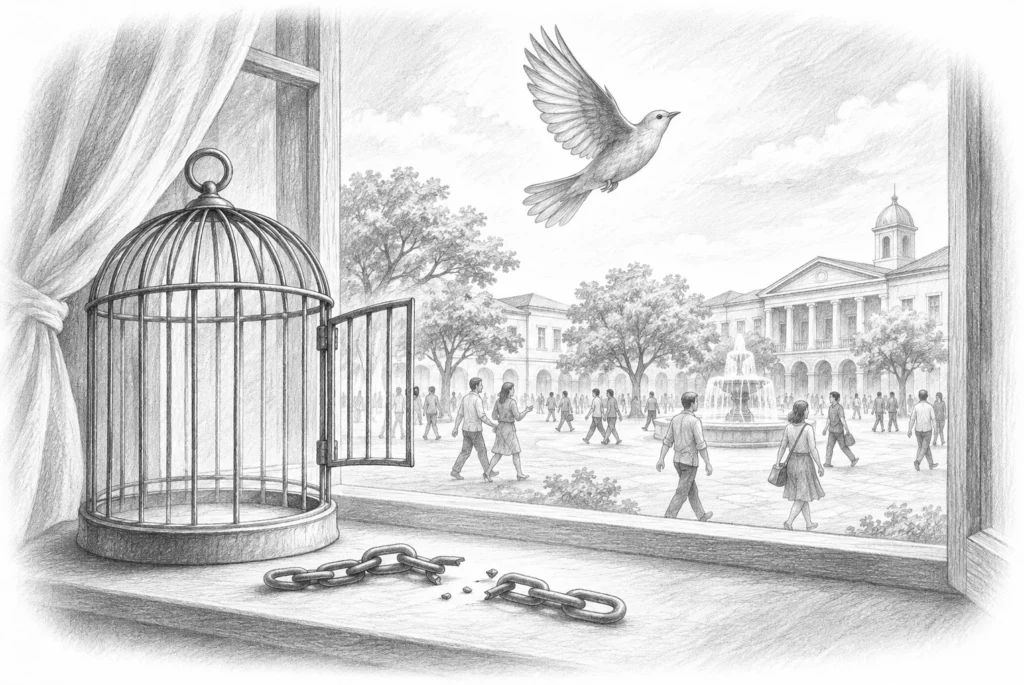
मनुष्य स्वतंत्र पैदा होता है, पर हर जगह वह जंजीरों में जकड़ा हुआ है।
Man is born free, and everywhere he is in chains.
— Jean-Jacques Rousseau, The Social Contract (1762)
FREEDOM is perhaps the most valued and the most disputed idea in politics. Revolutions have been fought in its name, constitutions guarantee it, and almost every government claims to protect it. Yet people mean very different things by it. For some, I am free when nobody stops me from doing what I want; for others, I am free only when I have the power and the capacity to live a worthwhile life; for still others, freedom means liberation from deep structures of domination, such as class, caste, patriarchy or colonial rule. In this chapter we study the classic distinction between negative and positive liberty, Isaiah Berlin’s warnings about positive freedom, the ideas of emancipation and swaraj, and the great practical debate on free speech, expression and dissent.
1.1 The Meaning of Freedom
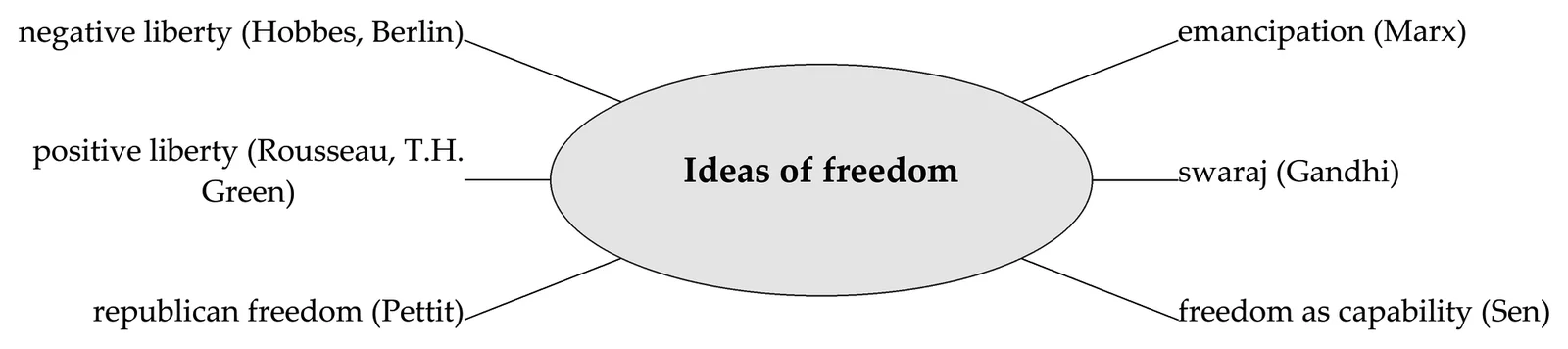
The words freedom and liberty are generally used to mean the same thing. In its simplest sense, freedom is the condition of being able to act as one chooses, without being prevented. Jonathan Riley and Ian Carter point out that political theorists ask three questions about it: whose freedom is at stake, from what constraints, and to do what. Different answers to these questions produce different conceptions of freedom. The modern debate was shaped above all by Isaiah Berlin [बर्लिन], who distinguished two concepts of liberty, and by critics who argued that his distinction was too simple. The main ideas we will meet in this chapter are summarised in Figure 1.2.
1.2 Negative Liberty
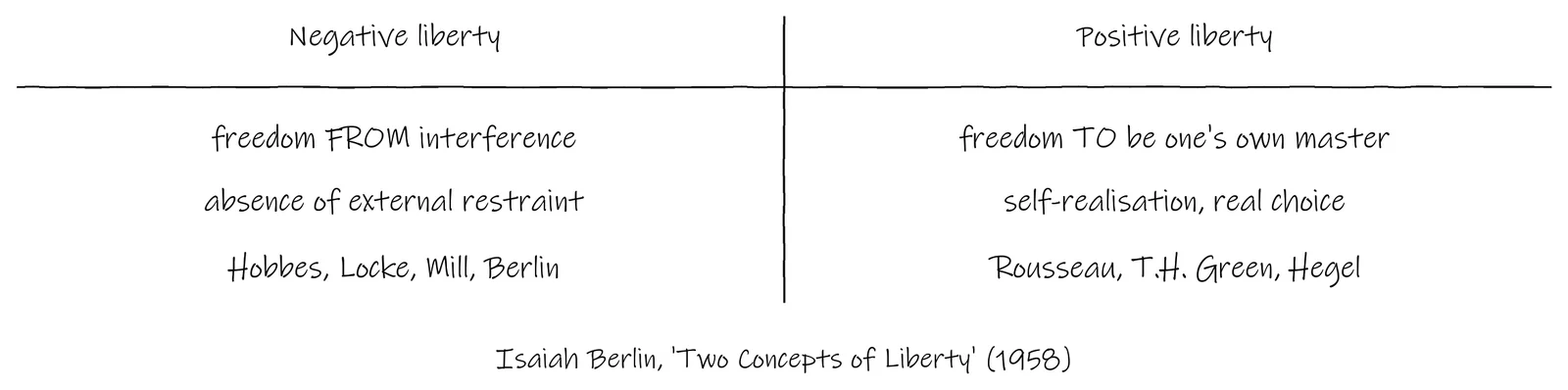
In ‘Two Concepts of Liberty’ (1958), Berlin defined negative liberty as the area within which a person can act without being obstructed by others. I am free to the degree that no other human being interferes with my activity; coercion means the deliberate interference of others within the area in which I could otherwise act. Negative liberty answers the question, ‘How large is the area within which I am left alone?’ It is freedom from. Its main features, developed by different thinkers in different contexts, are:
- Absence of external interference: Thomas Hobbes, writing during the English Civil War in Leviathan (1651), defined a free man as one who is not hindered from doing what he has the will and ability to do. Freedom is simply the absence of external obstacles.
- A protected private sphere: John Locke, in the Second Treatise of Government (1690), written to justify the Glorious Revolution, argued that individuals have natural rights to life, liberty and property that government must not invade.
- The harm principle: J.S. Mill, in On Liberty (1859), worried about the ‘tyranny of the majority’ and the pressure of public opinion in Victorian England. He argued that the only purpose for which power can be rightfully exercised over any member of a civilised community, against his will, is to prevent harm to others. Over himself, over his own body and mind, the individual is sovereign (Figure 1.4).
- Liberty is not other values: Berlin, writing in the Cold War against totalitarian regimes, insisted that liberty must not be confused with equality, justice or happiness; a person may be poor yet free, and sacrifices of liberty for other goods should be called by their name.
- Liberty under the rule of law: F.A. Hayek, in The Constitution of Liberty (1960), defined freedom as the absence of coercion by the arbitrary will of others, secured by general and known rules.
- Economic freedom and the minimal state: Milton Friedman (Capitalism and Freedom, 1962) and Robert Nozick (Anarchy, State, and Utopia, 1974) linked negative liberty with free markets and argued that only a minimal state respects individual liberty.
Criticism: critics argue that negative liberty is formal: the poor are ‘free’ to stay at expensive hotels, but cannot. It ignores obstacles such as poverty, ignorance and illness, and treats only deliberate human interference as a limit on freedom. Charles Taylor, in ‘What’s Wrong with Negative Liberty’ (1979), called it an opportunity concept, concerned only with options, and argued that freedom also requires the ability to exercise control over one’s life.
1.3 Positive Liberty and Berlin’s Warnings
Berlin described positive liberty as the wish to be one’s own master: to be a subject, not an object, moved by one’s own reasons and purposes rather than by external causes. It answers the question, ‘Who governs me?’ It is freedom to. Its main features are:
- Self-mastery and self-government: Jean-Jacques Rousseau [रूसो], in The Social Contract (1762), held that obedience to a law one prescribes for oneself is liberty, and that a citizen who refuses to obey the general will may be ‘forced to be free’.
- Autonomy: Immanuel Kant argued that a person is free when acting according to rational laws he gives himself, not when following desires.
- Freedom realised in the community: G.W.F. Hegel, writing after the French Revolution, saw freedom as realised in the ethical life of the family, civil society and the state.
- Capacity to do worthwhile things: T.H. Green, facing the poverty of industrial England, defined freedom in his lecture on ‘Liberal Legislation and Freedom of Contract’ (1881) as a positive power or capacity of doing or enjoying something worth doing or enjoying, and justified state action in education, health and labour.
- Conditions for self-development: Harold Laski, in A Grammar of Politics (1925), described liberty as the eager maintenance of an atmosphere in which people have the opportunity to be their best selves; L.T. Hobhouse defended the welfare state on similar grounds.
- An exercise concept: Charles Taylor (1979) argued that freedom involves actually exercising control over one’s life, which requires reflection and self-understanding.
- Freedom as capability: Amartya Sen, in Development as Freedom (1999), defined freedom as the real capability of people to achieve the things they have reason to value.
Berlin’s warnings about positive liberty
Berlin did not reject positive liberty, but he warned that it had historically been turned into a justification for tyranny. The argument proceeds in steps. Positive liberty speaks of self-mastery. This leads to a division of the self into a ‘higher’, rational or ‘real’ self and a ‘lower’, empirical self of passing desires. The higher self is then identified with something larger than the individual, a church, a nation, a class or a party, which claims to know what people would want if they were fully rational. Finally, this authority coerces people in the name of their ‘real’ freedom, and claims that they are not really being coerced at all. Rousseau’s phrase ‘forced to be free’ captured this danger, which Berlin saw realised in the Jacobins, in fascism and in communist regimes. He also described a second path, the retreat to the inner citadel, in which people make themselves free by giving up desires they cannot satisfy. Against these dangers Berlin defended value pluralism: human goods are many and can conflict, no single authority can know the true end of all people, and therefore a protected area of negative liberty is the safer ideal.
1.4 Beyond the Two Concepts: MacCallum and Republican Freedom
Gerald MacCallum, in ‘Negative and Positive Freedom’ (1967), argued that there is really only one concept of freedom, a triadic relation: an agent (X) is free from some constraint (Y) to do or become something (Z). Negative and positive theorists simply disagree about how to fill in the three variables: who the agent is, what counts as a constraint, and which goals matter. Adam Swift similarly suggests that we should ask which freedoms matter and why, rather than choosing between two labels.
A third conception is republican freedom, revived by Philip Pettit [पेटिट] in Republicanism (1997) and Quentin Skinner in Liberty before Liberalism (1998). For republicans, freedom means non-domination: not being subject to the arbitrary will of another. A slave with a kind master who never interferes is still unfree, because he lives at the master’s mercy; while a citizen subject to non-arbitrary, democratically controlled laws is free even though the laws interfere with him. This view highlights forms of unfreedom, such as dependence on employers, husbands or officials, that the negative view misses.
1.5 Freedom, Emancipation and Swaraj
A. Emancipation
Emancipation means liberation from structures of domination, not only from particular acts of interference. The word originally referred to the freeing of slaves. Karl Marx, in On the Jewish Question (1843), distinguished political emancipation, the granting of equal civil and political rights by the liberal state, from human emancipation, the overcoming of alienation and class domination in society itself. For Marx, workers in capitalism are formally free to sell their labour but are compelled by need to do so; real freedom would come in a society in which, as the Communist Manifesto (1848) put it, the free development of each is the condition for the free development of all. The idea of emancipation has been taken up by feminists, from Mary Wollstonecraft (1792) to Simone de Beauvoir, against patriarchy; by B.R. Ambedkar against caste, in Annihilation of Caste (1936); and by anti-colonial thinkers such as Frantz Fanon. Emancipation is therefore collective and structural: it requires changing social relations, not just leaving individuals alone.
B. Swaraj
Swaraj means self-rule. Bal Gangadhar Tilak declared in 1916 that swaraj is my birthright and I shall have it, using the word for national self-government. M.K. Gandhi, in Hind Swaraj (1909), gave it a deeper meaning. He criticised those who wanted ‘English rule without the Englishman’, the tiger’s nature without the tiger, because they would keep the modern industrial civilisation that he believed enslaved Indians. For Gandhi, swaraj has two levels. At the individual level, it is self-rule: the rule of oneself through self-control, truth and non-violence; he wrote that it is swaraj when we learn to rule ourselves. At the collective level, it means political independence and gram swaraj, self-governing, self-reliant village communities. Swaraj thus combines a negative aspect, freedom from foreign domination, with a positive aspect, moral self-mastery, but unlike Berlin’s feared version it is pursued through non-violent satyagraha and voluntary self-discipline, not through coercion by the state.
1.6 Debate: Free Speech, Expression and Dissent
A. The defence of free speech
In chapter 2 of On Liberty, Mill gave the classic defence of freedom of thought and discussion. If all mankind minus one were of one opinion, mankind would be no more justified in silencing that one person than he would be in silencing mankind. He offered four reasons: a silenced opinion may be true, and to suppress it assumes our own infallibility; even a false opinion may contain part of the truth; even a wholly true opinion, if not challenged, becomes a ‘dead dogma’ held without understanding; and its very meaning may be lost. Other defences add that free speech respects autonomy, the right of people to make up their own minds; that it is necessary for democratic self-government, as Alexander Meiklejohn [मिकलजॉन] argued (1948); that truth emerges from a ‘marketplace of ideas’, as Justice Holmes wrote in Abrams v. United States (1919); and that dissent is a safety valve that allows grievances to be voiced peacefully.

B. The case for limits
Almost no one defends unlimited speech. Mill himself accepted that speech can be restricted when it becomes direct incitement to harm, as when an opinion that corn dealers starve the poor is shouted to an angry mob outside a corn dealer’s house. Joel Feinberg (1985) proposed an offence principle for seriously offensive conduct in public places. Jeremy Waldron, in The Harm in Hate Speech (2012), argued that hate speech attacks the dignity and equal standing of members of vulnerable groups. K. Smits, asking whether offensive speech should be regulated, shows how these arguments must be balanced against the danger of allowing governments to decide what is offensive. Figure 1.5 sets out the two sides.

C. Censorship and dissent in India
Article 19(1)(a) guarantees freedom of speech and expression, while Article 19(2) allows reasonable restrictions in the interests of sovereignty and integrity, security of the state, friendly relations with foreign states, public order, decency or morality, contempt of court, defamation and incitement to an offence. A. Sethi, discussing freedom of speech and the question of censorship, shows that censorship in India comes not only from the state, through bans on books and films, but also from communities and mobs that threaten violence, creating a ‘heckler’s veto’, and from the market. Courts have tried to protect speech: in Romesh Thappar (1950) the Supreme Court struck down a ban on a journal, and in Shreya Singhal (2015) it struck down Section 66A of the IT Act, holding that only speech that amounts to incitement, not mere discussion or advocacy, may be restricted. The colonial-era law of sedition was put on hold by the Supreme Court in 2022. Judges have often described dissent as the safety valve of democracy.
1.7 Important Questions
- Question 1 Discuss the concepts of negative and positive liberty. Discuss the warnings associated with positive freedom.
- Question 2 Explain the defence for freedom of expression. Does censorship have a place in liberal democracy?
- Question 3 Discuss freedom as emancipation and as swaraj.
DU asks the same idea in different words. So learn one broad answer for each question below; the same answer works for every question joined by OR.
Important Question 1
Discuss the concepts of negative and positive liberty. Discuss the warnings associated with positive freedom.
OR
Critically examine Isaiah Berlin’s ‘Two Concepts of Liberty’.
OR
Is positive liberty a threat to individual freedom? Discuss.
Model Answer
“Everything is what it is: liberty is liberty, not equality or fairness or justice or culture, or human happiness or a quiet conscience.”
— Isaiah Berlin, ‘Two Concepts of Liberty’ (1958)
Introduction. Liberty is a central value of modern politics, but it has been understood in two very different ways. Isaiah Berlin, in his famous Oxford lecture ‘Two Concepts of Liberty’ (1958), distinguished negative liberty, freedom from interference, from positive liberty, freedom as self-mastery, and warned that the second could be twisted into a justification for tyranny. His distinction, and the debate it provoked, remain the starting point of any discussion of freedom.
1. Negative Liberty
Negative liberty is the area within which a person can act without obstruction by others. It answers the question, ‘How far am I left alone?’ Hobbes, writing during the Civil War, defined a free man as one who is not hindered from doing what he wills; Locke defended natural rights against arbitrary government; and Mill, fearing the tyranny of the majority, proposed that society may interfere with an individual only to prevent harm to others. Locke and Bentham also understood liberty as the absence of restraint, and Berlin later described it as an area of non-interference whose frontier must be fixed by law. The wider this area, the freer a person is, and laws are justified only when they protect the equal liberty of others.
2. Later Defenders of Negative Liberty
Berlin, writing in the Cold War, insisted that liberty should not be confused with other values. Hayek defined freedom as the absence of arbitrary coercion under the rule of law, and Friedman and Nozick linked it with free markets and a minimal state. For all of them, the state’s main duty is to protect a private sphere.
3. Positive Liberty
Positive liberty is the freedom to be one’s own master, to live according to one’s own rational purposes. It answers the question, ‘Who governs me?’ Rousseau saw freedom as obedience to a self-prescribed law, Kant as rational autonomy, and Hegel as freedom realised in the ethical community of the state. On this view a person who is addicted, ignorant or desperately poor is not fully free even if no one interferes, because that person cannot shape his or her own life. Charles Taylor later called this an ‘exercise concept’ of freedom, as against the ‘opportunity concept’ of negative liberty.
4. Positive Liberty and the Welfare State
T.H. Green (1881) defined freedom as a positive power of doing or enjoying something worth doing, and justified state action in education, health and labour. Laski saw liberty as an atmosphere in which people can be their best selves, and Sen describes freedom as capability. On this view poverty and ignorance are real limits on freedom, and the state can enlarge freedom.
5. Berlin’s Warning: The Divided Self
Berlin argued that positive liberty divides the self into a higher, rational self and a lower, empirical self. The higher self is then identified with a collective body, a nation, class, church or party, which claims to know what people would truly want if they were rational.
6. Berlin’s Warning: Coercion in the Name of Freedom
That authority may then coerce people for the sake of their ‘real’ freedom and claim that it is not coercing them at all. Rousseau’s phrase ‘forced to be free’ captures the danger, which Berlin saw in the Jacobins, fascism and communism. He also criticised the ‘retreat to the inner citadel’, in which people call themselves free by suppressing their desires. Berlin, delivering ‘Two Concepts of Liberty’ in 1958 after the experience of Nazism and Stalinism, argued that the worst tyrannies of the century had spoken the language of liberation. The danger lies not in self-mastery as such but in the claim of rulers to know the ‘true’ self of the people better than the people themselves.
7. Value Pluralism
Berlin’s deeper argument was value pluralism: human goods are many and can conflict, and no single authority can know the true ends of everyone. A protected area of negative liberty is therefore the safer ideal for a free society. Because liberty, equality, justice and security cannot all be fully realised together, every society must make painful trade-offs. A regime that claims to have found the final harmony of all values will sooner or later sacrifice living individuals to that vision.
8. Criticisms of Berlin
MacCallum (1967) argued that there is only one triadic concept of freedom, X is free from Y to do Z, and that the two ‘concepts’ differ only in how they fill these variables. Taylor (1979) argued that negative liberty, as an opportunity concept, ignores whether people can actually exercise control over their lives. Republicans such as Pettit argue that freedom means non-domination, which both concepts miss. Critics on the left point out that negative liberty is empty for the poor. Feminists add that the private sphere protected by negative liberty can hide domination within the family. Republicans such as Philip Pettit argue that freedom means non-domination, so that a slave with a kind master is still unfree even if never actually interfered with.
9. Evaluation
Berlin’s warning remains important: governments have often justified repression in the name of people’s ‘true’ interests. But in a society with deep inequality, freedom also requires the capacity to act, which only social and economic conditions can provide. Modern liberal democracies combine both: protected rights and welfare policies. The Indian Constitution reflects both ideas: Article 19 protects freedoms against state interference, while the Directive Principles and laws such as the Right to Education Act, 2009 seek to give citizens the real capacity to use those freedoms.
Conclusion. Thus, negative and positive liberty are complementary rather than opposed. Berlin rightly warned that positive liberty can be abused, but a meaningful freedom must protect individuals from interference and also empower them to shape their own lives.
Important Question 2
Explain the defence for freedom of expression. Does censorship have a place in liberal democracy?
OR
Discuss the debate on free speech, expression and dissent.
OR
Should offensive speech be regulated? Discuss.
Model Answer
“If all mankind minus one, were of one opinion, … mankind would be no more justified in silencing that one person, than he, if he had the power, would be justified in silencing mankind.”
— J.S. Mill, On Liberty (1859)
Introduction. Freedom of expression, the freedom to speak, write, publish, protest and dissent, is regarded as the lifeblood of democracy. Yet every democracy places some limits on it. The central question is not whether speech can ever be restricted, but on what grounds, by whom and to what extent.
1. Mill’s Argument from Truth
Mill argued that a silenced opinion may be true, and to suppress it assumes our infallibility; that even a false opinion may contain part of the truth; and that even a true opinion, if never challenged, becomes a ‘dead dogma’ whose meaning is lost. Free discussion is the only way to discover and keep alive the truth. Mill wrote On Liberty (1859) to defend individuality against the ‘tyranny of the majority’ and of social opinion, which he thought more dangerous than legal penalties. His argument is consequentialist: free discussion is the best method of discovering truth and of keeping beliefs alive and meaningful.
2. Autonomy and Self-Respect
Free speech respects people as autonomous agents who are capable of hearing arguments and making up their own minds. Censorship treats citizens as children who must be protected from ideas. Thomas Scanlon (1972) and Ronald Dworkin argue that a government which silences views because citizens might be persuaded by them denies citizens equal respect as reasoning agents. Expression is also part of self-development, because people discover who they are by speaking, writing and creating.
3. Democracy and Dissent
Meiklejohn argued that self-government requires citizens to hear all views on public questions. Dissent allows minorities and critics to challenge those in power, exposes abuses and acts as a safety valve that channels grievances into peaceful debate rather than violence. Dissent has special importance in India: the freedom struggle depended on newspapers, pamphlets and public meetings that the colonial state banned, and judges of the Supreme Court have described dissent as the safety valve of democracy.
4. The Marketplace of Ideas
Justice Holmes, in Abrams v. United States (1919), argued that the best test of truth is the power of an idea to get itself accepted in the competition of the market. Critics reply that the marketplace is unequal, since the powerful own the media. Feminists such as Catharine MacKinnon argue that some speech, such as pornography, silences women, and critical race theorists argue that hate speech drives minorities out of public debate. Formal freedom of speech may therefore not produce real equality of voice.
5. The Harm Principle and Incitement
Mill accepted limits where speech becomes direct incitement to harm, as with an angry mob outside a corn dealer’s house. Most liberal democracies restrict incitement to violence, defamation and threats to security. The United States Supreme Court, in Brandenburg v. Ohio (1969), allowed restriction only where speech is directed to inciting imminent lawless action and is likely to produce it, a strict test that protects even offensive political speech.
6. Offence and Hate Speech
Feinberg’s offence principle permits regulating seriously offensive public conduct. Waldron argues that hate speech undermines the dignity and equal standing of vulnerable groups. Smits shows that these arguments must be weighed against the danger of giving governments the power to define offence.
7. Censorship in India
Article 19(2) permits reasonable restrictions on grounds such as public order, security, decency and defamation. Sethi shows that censorship comes from the state, from communities and mobs through a ‘heckler’s veto’, and from the market. Courts have protected speech in Romesh Thappar (1950) and Shreya Singhal (2015), which allowed restriction only for incitement. Indian courts have tried to narrow these restrictions. In S. Rangarajan (1989) the Supreme Court held that expression can be restricted only when the danger is proximate and direct, like a spark in a powder keg, and in Shreya Singhal (2015) it struck down Section 66A of the Information Technology Act for vagueness.
8. The Place of Censorship
A liberal democracy can accept only narrow, clearly defined, harm-based restrictions applied by independent courts, not broad censorship of unpopular, offensive or critical views. Prior restraint, sedition laws and bans that silence dissent are inconsistent with liberal democracy, while laws against incitement and hate speech that targets vulnerable groups can be justified. New questions arise from social media, misinformation and internet shutdowns. Here too the tests of legality, necessity and proportionality, which the Supreme Court applied to internet restrictions in Anuradha Bhasin (2020), offer the best guide.
9. Evaluation
The defence of free speech is strongest for political speech and dissent; the case for limits is strongest where speech directly causes harm or denies others equal dignity. Proportionality and judicial review are the best safeguards. Censorship therefore has only a limited place, and the burden of proof must always lie on those who wish to restrict speech, not on those who wish to speak.
Conclusion. Thus, freedom of expression is essential to truth, autonomy and democracy. Censorship has a place in a liberal democracy only as a narrow exception to prevent real harm, never as a tool to silence dissent.
Important Question 3
Discuss freedom as emancipation and as swaraj.
OR
Examine Gandhi’s concept of swaraj.
OR
Distinguish between political emancipation and human emancipation.
Model Answer
“It is Swaraj when we learn to rule ourselves.”
— M.K. Gandhi, Hind Swaraj (1909)
Introduction. Liberal theories of freedom focus on the individual and the limits of state interference. But many thinkers have argued that freedom also requires liberation from deeper structures of domination, such as class, caste, patriarchy and colonial rule. The ideas of emancipation and swaraj express this broader view of freedom.
1. Meaning of Emancipation
Emancipation means liberation from domination. The word originally referred to the freeing of slaves, and it implies that people can be unfree even when no single person interferes with them, because social structures hold them down. Unlike negative liberty, which asks whether someone is interfering with me, emancipation asks whether structures such as class, caste, patriarchy or colonialism prevent people from shaping their lives. It is therefore a collective as well as an individual project.
2. Marx: Political and Human Emancipation
In On the Jewish Question (1843), Marx argued that the liberal state grants political emancipation, equal rights for citizens, but leaves people divided and dominated in civil society. Human emancipation requires overcoming alienation and class exploitation. Political emancipation was real progress, since it abolished religious and property qualifications for citizenship, but it treated people as equal citizens in the state while leaving them as competing, egoistic individuals in the market. Human emancipation would end this split between citizen and private person.
3. Freedom in Communist Society
Workers under capitalism are formally free but compelled by need to sell their labour. Marx envisaged a society in which the free development of each is the condition for the free development of all, where people control their collective life. In The German Ideology (1846), Marx and Engels imagined a society in which one could hunt in the morning, fish in the afternoon and criticise after dinner, without being confined to one occupation. Freedom means the all-round development of human capacities, possible only when scarcity and class division are overcome.
4. Other Emancipatory Traditions
Feminists from Wollstonecraft to de Beauvoir sought women’s emancipation from patriarchy; Ambedkar sought emancipation from caste in Annihilation of Caste (1936); and anti-colonial thinkers such as Fanon sought liberation from colonial rule and its psychological effects. Ambedkar argued that political democracy would be hollow without social democracy and urged the oppressed to free themselves through education, organisation and struggle. Fanon, writing during the Algerian war, argued that the colonised must free themselves from the psychological as well as the political domination of colonialism.
5. Ambedkar and Emancipation from Caste
Ambedkar, in Annihilation of Caste (1936), argued that caste is not merely a division of labour but a division of labourers, graded one above the other, and that freedom for Dalits required destroying the religious sanction behind caste. His conversion to Buddhism in 1956 was itself an act of emancipation: the choice of a religion founded on liberty, equality and fraternity.
6. Meaning of Swaraj
Swaraj means self-rule. Tilak used it for national self-government, declaring that swaraj is my birthright. Gandhi, in Hind Swaraj (1909), gave it a moral and civilisational meaning. The word joins swa (self) and raj (rule), so it means both rule over oneself and rule by one’s own people. Gandhi wrote Hind Swaraj in 1909 on a voyage from London to South Africa, as a dialogue between a Reader and an Editor, and argued that true swaraj begins with the individual.
7. Gandhi’s Critique
Gandhi rejected the idea of ‘English rule without the Englishman’: replacing British rulers with Indian ones while keeping modern industrial civilisation, which he believed enslaved people to machines and desires. He criticised railways, lawyers and doctors as instruments of a civilisation that multiplied wants and made people dependent. Real freedom, he believed, lies in limiting desires and in self-reliance through swadeshi, so that Indians would not merely change masters.
8. Individual and Collective Swaraj
At the individual level, swaraj is self-rule through self-control, truth and non-violence. At the collective level, it is political independence and gram swaraj, self-governing and self-reliant villages. It combines freedom from foreign domination with moral self-mastery. Gandhi linked the two levels: a nation of self-disciplined individuals and self-governing villages would need little coercive state power, which is why he described his ideal polity as an ‘oceanic circle’ rather than a pyramid with the state at the top.
9. Swaraj and Positive Liberty
Swaraj resembles positive liberty in stressing self-mastery, but it avoids Berlin’s danger because it is pursued voluntarily and through satyagraha, not imposed by the state. It also adds a critique of modern civilisation absent from Western theories. Like Rousseau and Kant, Gandhi saw freedom as obedience to a law one gives oneself, but he located that law in conscience and truth, not in a general will or a state. Swaraj therefore combines self-mastery with deep suspicion of centralised power.
10. Evaluation
Emancipation and swaraj show that freedom is not only about leaving individuals alone but about transforming relations of domination and the self. Critics say Marx’s vision led to authoritarian states and Gandhi’s rejection of modern industry was impractical. Yet both ideas remain influential: Marxist ideas of emancipation shaped labour movements and welfare states, and Gandhian swaraj inspired panchayati raj, decentralisation and movements for ecological and local self-reliance.
Conclusion. Thus, emancipation and swaraj widen the idea of freedom from the absence of interference to liberation from domination and the rule of oneself.
Short Notes
(a) J.S. Mill on liberty
In On Liberty (1859), Mill argued that the only legitimate ground for interfering with an individual’s liberty against his will is to prevent harm to others; in matters concerning only himself, the individual is sovereign. He defended freedom of thought and discussion on the grounds that silenced opinions may be true, partly true, or necessary to keep truth alive, and he valued individuality and experiments in living against the tyranny of the majority.
(b) Emancipation
Liberation from structures of domination, such as slavery, class, caste, patriarchy or colonialism. Marx distinguished political emancipation, equal civil rights in the liberal state, from human emancipation, the overcoming of alienation and exploitation. Emancipation is collective and structural, requiring changes in social relations.
(c) Freedom as non-domination
The republican conception revived by Philip Pettit (1997): a person is free when not subject to the arbitrary will of another. A slave with a kind master is unfree even if never interfered with, while laws that are non-arbitrary and controlled by citizens do not make people unfree.
More notes: DSC-7 Political Theory: Concepts and Debates
These notes are prepared by PADHO TO AISE for study help. They are not an official University of Delhi publication.