
Semester II MDSC-2B India's Foreign Policy
Unit IV · 19 min read · Updated 24 Nov 2026
As per the University of Delhi (DU) BA (Hons) Political Science syllabus
Contents
- 4.1 India in a Multipolar World
- 4.2 India’s Engagements in Multilateral Forums: Negotiations on Trade
- 4.3 Negotiations on Climate Change
- 4.4 India as a Global Power: Prospects and Challenges
- 4.5 Important Questions
- Discuss India’s role in multilateral trade negotiations.
- Examine India’s position in international climate change negotiations.
- Is India a global power? Discuss its prospects and challenges.
- Short Notes
यह समय अमेरिका से जुड़ने, चीन को संभालने, यूरोप से संबंध बढ़ाने, रूस को आश्वस्त करने और जापान को साथ लाने का है।
This is a time for us to engage America, manage China, cultivate Europe, reassure Russia, bring Japan into play.
— S. Jaishankar, The India Way (2020)
TODAY’S WORLD is often described as multipolar: power is spread among several centres, the United States, China, the European Union, Russia, India and others, rather than concentrated in one or two superpowers. In this world, much of the important bargaining takes place in multilateral forums, where many states negotiate rules on trade, climate, health and security. India, once a poor postcolonial state demanding a fairer world order, is now one of the largest economies and a nuclear power that seeks a leading role. In this chapter we study India’s engagement in multilateral negotiations on trade and climate change, and the debate on India as a global power: its prospects and the challenges it faces.
4.1 India in a Multipolar World
After the Cold War, the United States was the sole superpower for about two decades. The rise of China, the recovery of Russia, the economic weight of the European Union and the growth of India and other emerging economies have produced a more multipolar world. India’s response has been multi-alignment: building partnerships with many powers and joining many groupings without exclusive alliances. India is a member of the G20, BRICS (from 2009, expanded in 2024), the Shanghai Co-operation Organisation (2017), IBSA with Brazil and South Africa (2003), the Quad with the United States, Japan and Australia, and the G4 with Brazil, Germany and Japan, which seeks reform of the UN Security Council. In multilateral negotiations India has traditionally spoken for developing countries, defending their right to development and a fair share of global rules.
4.2 India’s Engagements in Multilateral Forums: Negotiations on Trade
A. From GATT to the WTO
India was a founding member of the General Agreement on Tariffs and Trade (GATT, 1947) and of the World Trade Organization (WTO), created in 1995 after the Uruguay Round (1986–94). The Uruguay Round extended trade rules to agriculture, services and intellectual property (TRIPS), which India accepted reluctantly, fearing the impact on farmers and on its generic medicines industry.
B. India’s main concerns
- Agriculture and food security: India argues that rich countries’ large farm subsidies distort trade, while its own support to poor farmers and its public stockholding of food grains for the poor must be protected. At the Bali ministerial (2013) India secured a ‘peace clause’ protecting its stockholding programmes from legal challenge, and in 2014 it agreed to the Trade Facilitation Agreement only after this protection was made indefinite.
- Special and differential treatment: developing countries should have longer periods and flexibility to implement commitments.
- Medicines and TRIPS: India led the campaign for the Doha Declaration on TRIPS and Public Health (2001), which affirmed that countries can protect public health, for example through compulsory licensing of medicines.
- Services: India seeks easier movement of professionals (Mode 4) to sell its services abroad.
- New issues: India has resisted rules on investment, competition and e-commerce that might limit its policy space, and opposed the permanent moratorium on customs duties on electronic transmissions.

C. Coalitions and the Doha Round
The Doha Development Round (2001) promised to address the concerns of developing countries but has stalled, largely over agriculture. India has worked through coalitions: the G-20 of developing countries formed with Brazil at Cancún (2003) to resist the farm proposals of the United States and EU, and the G-33, which defends food security and special products. India has also negotiated regional and bilateral agreements: the South Asian Free Trade Area (2006), the ASEAN–India agreement (2010), and newer agreements with the United Arab Emirates and Australia (2022), the European Free Trade Association (2024) and the United Kingdom (concluded in 2025). In 2019 India withdrew from the Regional Comprehensive Economic Partnership (RCEP), fearing a flood of Chinese imports and harm to its farmers and industries.
4.3 Negotiations on Climate Change
A. Principles
The UN Framework Convention on Climate Change (UNFCCC, 1992) established the principle of common but differentiated responsibilities and respective capabilities (CBDR-RC): all countries must act, but developed countries, which caused most past emissions and have greater resources, should take the lead. India has consistently argued that its per capita emissions are far below those of developed countries, that developed countries bear historical responsibility, and that developing countries have a right to development and need finance and technology to move to clean energy.
B. From Kyoto to Paris
The Kyoto Protocol (1997) required binding emission cuts only from developed countries, which India supported. At Copenhagen (2009), India worked with Brazil, South Africa and China in the BASIC group to resist binding targets for developing countries. Domestically, India adopted the National Action Plan on Climate Change (2008) with eight national missions, including the solar mission. Under the Paris Agreement (2015) all countries set their own Nationally Determined Contributions; India pledged to reduce the emissions intensity of its GDP and expand non-fossil power, and in 2022 updated its targets to a 45 per cent reduction in emissions intensity from 2005 levels and 50 per cent of power capacity from non-fossil sources by 2030. India and France launched the International Solar Alliance (2015), and India started the Coalition for Disaster Resilient Infrastructure (2019).
C. Glasgow and after
At Glasgow (COP26, 2021) India announced its Panchamrit commitments, including a target of net zero emissions by 2070, and promoted LiFE (Lifestyle for Environment). It insisted on changing the language on coal from ‘phase out’ to ‘phase down’, reflecting its dependence on coal for energy. India continues to press developed countries to deliver climate finance; it criticised the new finance goal agreed at COP29 (2024) as inadequate. India’s position thus combines defence of developing countries’ interests with growing domestic action on renewable energy.
4.4 India as a Global Power: Prospects and Challenges
A. Prospects
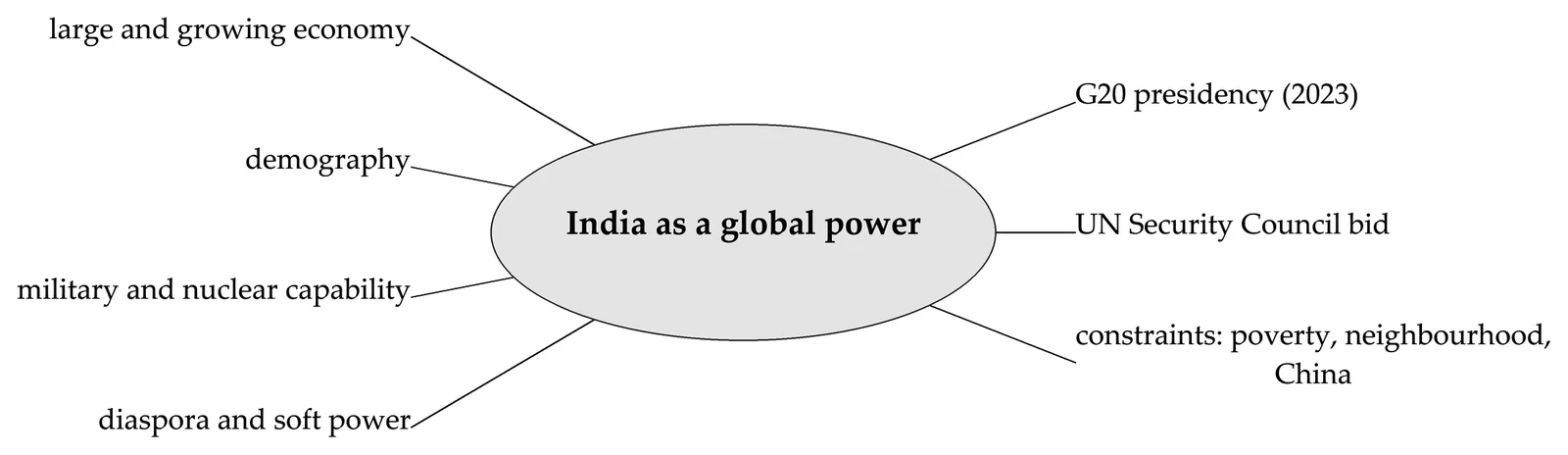
India has many attributes of a global power (Figure 4.3). It is one of the world’s largest and fastest-growing major economies; it became the world’s most populous country in 2023, with a young workforce; it has large armed forces and nuclear weapons; its space programme landed Chandrayaan-3 near the Moon’s south pole in 2023; its information technology industry and large diaspora give it global reach; its democracy, culture and yoga give it soft power; and its diplomacy has grown more ambitious. Its G20 presidency (2023) brought the African Union into the G20 as a permanent member, and its Voice of the Global South summits presented India as a bridge between the developed and developing worlds. Many major powers support its claim to a permanent seat on the UN Security Council. S. Jaishankar’s The India Way (2020) argues that India should engage all major powers and pursue its interests confidently as a ‘leading power’.
B. Challenges
- Development gaps: low per capita income, poverty, unemployment, malnutrition and weak human development limit India’s power and its attractiveness as a model.
- A difficult neighbourhood: hostility with Pakistan, the unsettled border with China and competition for influence in South Asia absorb India’s attention and resources.
- China: China’s economy and military are several times larger than India’s, and its influence in India’s neighbourhood is growing.
- Defence and technology dependence: India remains one of the world’s largest arms importers and depends on others for critical technologies and energy.
- Institutional reform: India is still outside the UN Security Council as a permanent member and the Nuclear Suppliers Group, and has a relatively small diplomatic service.
- Balancing partners: India must manage relations with the United States and Russia, the West and the Global South, without losing strategic autonomy.
- Domestic cohesion: social divisions and debates about democracy and minority rights can affect India’s image and soft power.
4.5 Important Questions
- Question 1 Discuss India’s role in multilateral trade negotiations.
- Question 2 Examine India’s position in international climate change negotiations.
- Question 3 Is India a global power? Discuss its prospects and challenges.
DU asks the same idea in different words. So learn one broad answer for each question below; the same answer works for every question joined by OR.
Important Question 1
Discuss India’s role in multilateral trade negotiations.
OR
Examine India’s position at the WTO on agriculture and food security.
OR
Why did India withdraw from RCEP? Discuss India’s trade diplomacy.
Model Answer
“Relations in the field of trade and economic endeavour should be conducted with a view to raising standards of living, ensuring full employment.”
— Marrakesh Agreement Establishing the WTO (1994), Preamble
Introduction. Trade rules shape the development prospects of every country. India, a founding member of GATT and the WTO, has used multilateral trade negotiations to protect its farmers, its industries and its policy space, while seeking access to markets for its goods and services.
1. From GATT to WTO
India joined GATT in 1947 and the WTO in 1995. The Uruguay Round extended rules to agriculture, services and intellectual property, which India accepted with concern for its farmers and medicines industry. The WTO also created a binding dispute settlement system.
2. Agriculture and Food Security
India opposes the large farm subsidies of rich countries and defends its support to poor farmers and its public stockholding of food grains for the poor. India argues that its support helps poor farmers rather than exports. Its public distribution system depends on procurement at minimum support prices.
3. The Peace Clause
At Bali (2013) India secured protection for its food stockholding programmes and in 2014 made it indefinite before agreeing to the Trade Facilitation Agreement. It protects public stockholding programmes from challenge until a permanent solution is found.
4. TRIPS and Medicines
India led the campaign for the Doha Declaration on TRIPS and Public Health (2001), protecting countries’ right to make affordable medicines. The Doha Declaration (2001) affirmed the right of countries to protect public health.
5. Special and Differential Treatment
India insists that developing countries need special and differential treatment, including longer timeframes and flexibility, which developed countries now question.
6. The COVID-19 TRIPS Waiver
India and South Africa proposed a TRIPS waiver for COVID-19 vaccines in 2020, which led to a limited decision in 2022.
7. Services and New Issues
India seeks movement of professionals abroad and resists rules on investment, competition and e-commerce that would reduce its policy space. The temporary movement of professionals (Mode 4) is India’s priority.
8. E-Commerce, Data and Fisheries
India resists binding rules on e-commerce and data flows to keep policy space for its digital economy, and seeks protection for small fishermen in talks on fisheries subsidies.
9. Coalitions
India worked with Brazil in the G-20 at Cancún (2003) and in the G-33 on food security, giving developing countries a stronger collective voice. India also leads the G-33 on special products and safeguards for developing countries.
10. Regional and Bilateral Agreements
India withdrew from RCEP in 2019, fearing Chinese imports and harm to farmers and small industry, but signed agreements with the UAE, Australia, EFTA and the UK. India has since signed agreements with the UAE (2022), Australia (2022) and the EFTA countries (2024).
11. The Appellate Body Crisis
Since 2019 the WTO’s Appellate Body has been paralysed because the United States blocked appointments, weakening dispute settlement.
12. Trade and Strategy
Trade policy is increasingly linked to security, as supply chains shift away from China.
13. Ministerial Conferences
At WTO ministerial conferences, such as Bali (2013), Nairobi (2015) and Abu Dhabi (2024), India has defended food security and blocked agreements it considered unfair.
14. India and Free Trade Agreements
India was cautious about FTAs after its agreement with ASEAN (2010) widened its trade deficit, but has since negotiated agreements with developed partners.
15. Evaluation
India has successfully defended food security and public health, but critics say it has been defensive and has missed opportunities to integrate into global value chains. India must balance defensive interests with export ambitions.
16. Trade and Domestic Politics
India’s trade positions reflect domestic interests: the political power of farmers, the need to protect small industries, and the goal of building manufacturing through Atmanirbhar Bharat and production-linked incentive schemes (2020). Governments must balance openness with protection. Farmers’ and small traders’ interests shape India’s positions.
17. WTO Reform
India supports reform of the WTO but insists on consensus decision-making and special treatment for developing countries, and calls for restoring the Appellate Body, the WTO’s highest dispute court, which has been paralysed since December 2019.
Conclusion. Thus, India’s trade diplomacy seeks to balance development and food security with access to global markets, often as a leader of developing countries.
Important Question 2
Examine India’s position in international climate change negotiations.
OR
Discuss the principle of common but differentiated responsibilities.
OR
Discuss India’s commitments under the Paris Agreement.
Model Answer
“On the basis of equity and in accordance with their common but differentiated responsibilities and respective capabilities.”
— UN Framework Convention on Climate Change (1992), Article 3.1
Introduction. Climate change is a global problem that requires collective action, but its causes and costs are unequally distributed. India, a large developing country with low per capita emissions and high vulnerability, has sought a fair sharing of responsibility while increasing its own action.
1. CBDR-RC
The UNFCCC (1992) established common but differentiated responsibilities: all must act, but developed countries should lead because of their historical emissions and greater capabilities. The principle recognises historical responsibility and differing capacities.
2. India’s Arguments
India stresses its low per capita emissions, developed countries’ historical responsibility, the right to development and the need for finance and technology. It stresses climate justice and changes in lifestyle.
3. Kyoto and Copenhagen
India supported the Kyoto Protocol (1997), which bound only developed countries, and worked with the BASIC group at Copenhagen (2009) to resist binding targets for developing countries. At Copenhagen (2009) India joined the BASIC group with Brazil, South Africa and China. Kyoto imposed binding cuts only on developed countries.
4. Domestic Action
The National Action Plan on Climate Change (2008) set up eight missions, including solar energy and energy efficiency. It set up eight national missions, including the National Solar Mission.
5. Vulnerability and Adaptation
India is highly vulnerable to climate change through heatwaves, floods, glacier melt and sea-level rise, so it stresses adaptation and finance.
6. Paris and NDCs
Under the Paris Agreement (2015) India pledged to reduce emissions intensity and expand non-fossil power; in 2022 it raised its targets to 45 per cent intensity reduction and 50 per cent non-fossil capacity by 2030. India updated its pledges in 2022, aiming for fifty per cent non-fossil power capacity by 2030. It also pledged an additional carbon sink of 2.5–3 billion tonnes through forests.
7. Leadership Initiatives
India co-founded the International Solar Alliance (2015), launched the Coalition for Disaster Resilient Infrastructure (2019) and promoted LiFE. It also launched the Coalition for Disaster Resilient Infrastructure (2019).
8. Glasgow and After
At COP26 (2021) India announced net zero by 2070, pressed for ‘phase down’ rather than ‘phase out’ of coal, and continues to demand adequate climate finance, criticising the COP29 goal as insufficient. India pressed for the phrase ‘phase down’ rather than ‘phase out’ of coal.
9. Loss and Damage
At COP27 (2022) countries agreed to create a fund for loss and damage, a long-standing demand of developing countries.
10. Mission LiFE and Green Hydrogen
India launched Mission LiFE (Lifestyle for Environment), a National Green Hydrogen Mission (2023) and a domestic carbon credit trading scheme.
11. Coal and Development
Coal still provides most of India’s electricity, so India argues that a rapid phase-out would harm development and energy security.
12. A Voice of the Global South
India hosted the Voice of the Global South summits (2023) and emphasised climate finance and technology transfer for developing countries.
13. Per Capita Emissions
India’s per capita emissions are far below the world average and those of the United States, the EU and China.
14. Evaluation
India has moved from a defensive to a more proactive stance, but its dependence on coal and its development needs make the energy transition difficult. Balancing development needs with climate action remains India’s central challenge.
15. The Energy Transition at Home
India has rapidly expanded solar and wind power, launched the National Green Hydrogen Mission (2023) and set a target of 500 gigawatts of non-fossil capacity by 2030, though coal still produces most of its electricity. India targets 500 gigawatts of non-fossil capacity by 2030.
16. Finance and Equity
Developed countries’ promise of 100 billion dollars a year in climate finance was met late; a loss and damage fund was agreed at COP27 (2022); and the new goal of 300 billion dollars a year by 2035, agreed at COP29, was criticised by India as far below what developing countries need. India criticised the new climate finance goal agreed at COP29 (2024) as inadequate.
Conclusion. Thus, India’s climate diplomacy seeks climate justice for developing countries while showing growing leadership in renewable energy.
Important Question 3
Is India a global power? Discuss its prospects and challenges.
OR
Examine India’s role in the contemporary multipolar world.
Model Answer
“India, constituted as she is, cannot play a secondary part in the world. She will either count for a great deal or not count at all.”
— Jawaharlal Nehru, The Discovery of India (1946)
Introduction. India’s rise has been one of the major developments of the twenty-first century. With a large economy, population, military and diaspora, it seeks a leading role in a multipolar world, but it also faces serious constraints.
1. Meaning of a Global Power
A global power can shape outcomes beyond its region through economic, military and diplomatic influence and through the ideas and institutions it promotes.
2. The Multipolar World
Power is spread among the United States, China, the EU, Russia, India and others. India practises multi-alignment through the G20, BRICS, SCO, Quad, IBSA and G4. India seeks a multipolar Asia as well as a multipolar world.
3. Economic Strength
India is one of the largest and fastest-growing major economies, with strong IT and services sectors and a growing manufacturing ambition. It is now one of the five largest economies in the world. It is also a major hub for IT services and pharmaceuticals.
4. Demography and Diaspora
India became the most populous country in 2023, with a young workforce; its large diaspora gives it influence abroad. Its diaspora of over thirty million is the world’s largest.
5. Military, Nuclear and Space Capabilities
India has large armed forces, nuclear weapons and an advanced space programme, demonstrated by Chandrayaan-3 (2023). Chandrayaan-3 (2023) landed near the Moon’s south pole.
6. Diplomacy and Soft Power
India’s G20 presidency (2023), the inclusion of the African Union, the Voice of the Global South summits, vaccine diplomacy and its culture and democracy enhance its standing. The African Union became a permanent member of the G20 under India’s presidency.
7. Institutional Status
India is not a permanent member of the UN Security Council or a member of the Nuclear Suppliers Group, which limits its formal status.
8. Developmental Challenges
Low per capita income, poverty, unemployment and weak human development limit India’s power. India still ranks low on the Human Development Index.
9. Human Capital
A young population is an asset only if education, health and skills improve; otherwise the demographic dividend may become a burden.
10. Strategic Challenges
Pakistan, the China border and China’s influence in South Asia, defence import dependence and exclusion from the UNSC and NSG constrain India. Maritime competition in the Indian Ocean is growing.
11. Regional Power First
Many scholars argue that India must consolidate its position in South Asia and the Indian Ocean before it can become a global power.
12. Technology and Digital Power
India’s digital public infrastructure and IT industry give it influence in global technology debates.
13. Democracy as an Asset
India’s democracy and pluralism are sources of soft power, though some observers have raised concerns about democratic backsliding.
14. Defence Industry
India is building a domestic defence industry and has begun exporting weapons such as the BrahMos missile.
15. Balancing Partners
India must balance the United States and Russia, the West and the Global South, while preserving strategic autonomy, as Jaishankar’s The India Way argues.
16. Leadership of the Global South
India supplied vaccines to many countries under Vaccine Maitri (2021), championed the African Union’s entry into the G20, and has expanded development partnerships in Africa and the Indian Ocean, presenting itself as a voice of the Global South.
17. Debates on India’s Role
Some describe India as a ‘swing state’ whose choices will shape the global balance; others see it as a cautious or ‘reluctant’ power; Jaishankar speaks of India as a ‘leading power’. Its bid for a permanent Security Council seat with the G4 remains blocked by the slow pace of UN reform. Others call it a ‘leading power’ in the making.
18. Evaluation
India is an emerging global power with growing economic, military and diplomatic weight, but its global role depends on solving domestic development challenges and managing China; for now it acts as a leading power through coalitions.
Conclusion. Thus, India is an emerging global power with great prospects; translating its potential into power depends on development at home and wise diplomacy abroad.
Short Notes
(a) International Solar Alliance
An alliance of countries launched by India and France at the Paris climate conference in 2015 and headquartered in Gurugram, India. It promotes the deployment of solar energy, especially in sunny developing countries, through finance, technology and capacity building.
(b) Common but differentiated responsibilities
The principle of the UNFCCC (1992) that all countries share responsibility for addressing climate change, but developed countries, which caused most historical emissions and have greater resources, should take the lead and support developing countries with finance and technology.
More notes: MDSC-2B India's Foreign Policy
These notes are prepared by PADHO TO AISE for study help. They are not an official University of Delhi publication.