
Semester II MDSC-2B India's Foreign Policy
Unit III · 22 min read · Updated 24 Nov 2026
As per the University of Delhi (DU) BA (Hons) Political Science syllabus
Contents
- 3.1 India’s Neighbourhood and Neighbourhood Policies
- 3.2 Border Disputes
- 3.3 Migration and Refugee Issues
- 3.4 Cross-border Terrorism
- 3.5 Important Questions
- Discuss India’s border disputes with its neighbours.
- Examine migration and refugee issues in India’s relations with its neighbours.
- Discuss cross-border terrorism as a challenge to India’s foreign policy.
- Discuss India’s neighbourhood policy and its challenges.
- Short Notes
आप मित्र बदल सकते हैं, पर पड़ोसी नहीं।
You can change friends but not neighbours.
— Atal Bihari Vajpayee, as Prime Minister
INDIA’S NEIGHBOURHOOD is its most immediate and most difficult foreign policy arena. India shares land or maritime borders with Pakistan, China, Nepal, Bhutan, Bangladesh, Myanmar, Sri Lanka and the Maldives, and its security and prosperity depend on peace in the region. Yet South Asia is one of the least integrated regions in the world. India is much larger than all its neighbours together, which creates fears of a ‘big brother’; borders drawn during colonial rule and Partition remain disputed; people move across porous borders as migrants and refugees; and terrorism has crossed borders, especially from Pakistan. In this chapter we study three major issues in India’s relations with its neighbours: border disputes, migration and refugee issues, and cross-border terrorism, along with India’s neighbourhood policies.
3.1 India’s Neighbourhood and Neighbourhood Policies
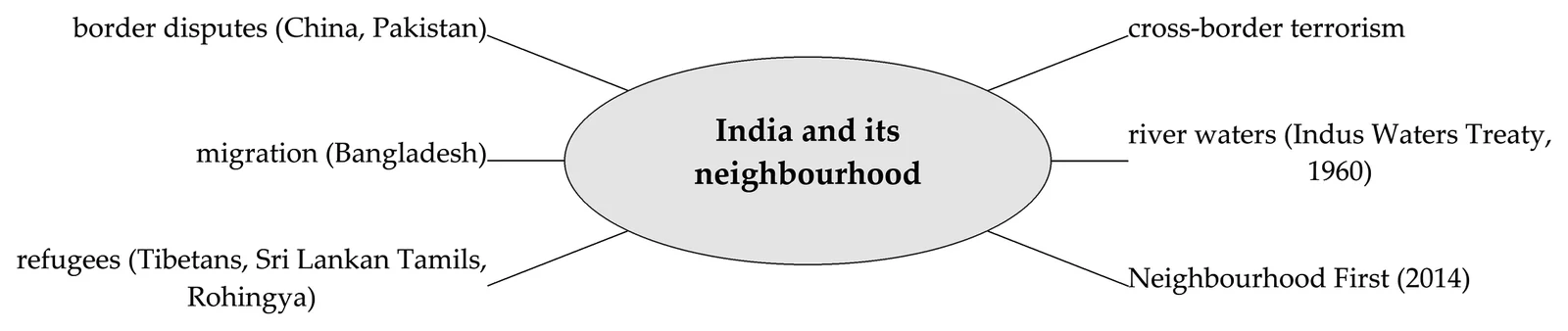
India dominates South Asia in size, population, economy and military power. This asymmetry shapes the region: India sees itself as the natural leader and guarantor of regional security, while smaller neighbours fear Indian domination and sometimes turn to outside powers, especially China, to balance it. Shared history, culture, rivers and porous borders bind the region together, but also produce disputes over territory, water, migration and identity. India’s policies have changed over time. Indira Gandhi’s approach, sometimes called the Indira Doctrine, treated South Asia as India’s sphere and opposed outside interference. The Gujral Doctrine (1996) promised generosity towards smaller neighbours without insisting on reciprocity. Since 2014 the Neighbourhood First policy has stressed connectivity, trade and development partnerships, and SAGAR (Security and Growth for All in the Region, 2015) has focused on the Indian Ocean. Regional co-operation through SAARC (1985) has been largely stalled by India–Pakistan hostility, and India has turned to BIMSTEC, linking South and Southeast Asia (Figure 3.2).
3.2 Border Disputes
A. Pakistan
The central dispute with Pakistan is over Jammu and Kashmir, which acceded to India in October 1947. The war of 1947–48 ended with a UN-brokered ceasefire line, leaving part of the state under Pakistani control. After the war of 1971, the Simla Agreement (1972) converted the ceasefire line into the Line of Control (LoC) and committed both countries to settle their differences bilaterally and peacefully. Further conflicts followed: the Siachen glacier, which India secured in 1984; the Kargil war of 1999, when Pakistani forces intruded across the LoC; and the Sir Creek dispute over a strip of marshland in the Rann of Kutch, which affects maritime boundaries. Water is shared under the Indus Waters Treaty (1960), brokered by the World Bank; India held the treaty in abeyance after the terrorist attack at Pahalgam in April 2025.
B. China
The India–China boundary, about 3,488 kilometres long, has never been agreed. In the western sector, China occupies Aksai Chin, which India claims; in the eastern sector, China rejects the McMahon Line of 1914 and claims Arunachal Pradesh; there are also disputes in the middle sector. The two armies face each other along an undefined Line of Actual Control. Agreements in 1993, 1996, 2005 and 2013 sought to keep peace, but standoffs at Doklam (2017), on the Bhutan–China–India trijunction, and the Galwan clash (2020) showed the dangers of an unsettled border.
C. Nepal, Bangladesh, Sri Lanka and Myanmar
- Nepal: the two countries share an open border under the 1950 Treaty of Peace and Friendship, but disagree over Kalapani–Lipulekh–Limpiyadhura; Nepal issued a new map claiming the area in 2020.
- Bangladesh: a long-standing problem of enclaves, pockets of one country’s territory inside the other, was solved by the Land Boundary Agreement of 1974, finally implemented through the Constitution’s 100th Amendment (2015), which exchanged 111 Indian and 51 Bangladeshi enclaves. The maritime boundary was settled by arbitration in 2014. Water sharing of the Teesta remains unresolved, though the Ganga Water Treaty (1996) covers the Ganga.
- Sri Lanka: India recognised Sri Lanka’s sovereignty over the island of Katchatheevu in 1974, but the arrest of Indian fishermen in the Palk Strait remains a recurring issue.
- Myanmar: the porous border with the North-East has allowed insurgent movement; in 2024 India announced the end of the Free Movement Regime and plans to fence the border.
3.3 Migration and Refugee Issues
A. Migrants and refugees
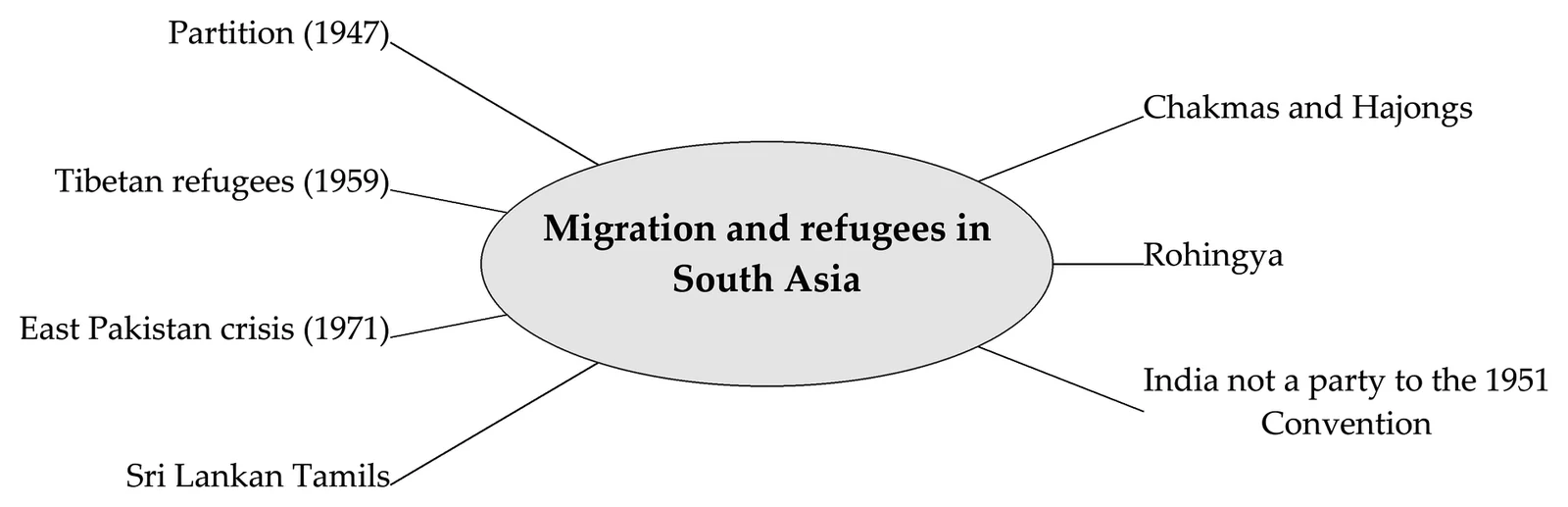
A migrant moves voluntarily, usually for work or a better life; a refugee, as defined by the UN Refugee Convention (1951), flees across a border because of a well-founded fear of persecution. India is not a party to the 1951 Convention or its 1967 Protocol and has no national refugee law; it deals with refugees case by case under the Foreigners Act (1946) and administrative decisions, though courts have protected refugees against forced return. Despite this, India has hosted large refugee populations throughout its history.
B. Refugees in India
- Partition (1947): millions of Hindus and Sikhs from Pakistan and Muslims to Pakistan crossed the new borders.
- Tibetans (from 1959): after the Dalai Lama fled to India, tens of thousands of Tibetans settled in India, with the government-in-exile at Dharamshala, a source of tension with China.
- East Pakistan (1971): about ten million refugees fled the Pakistani army’s crackdown, a burden that was one cause of India’s intervention in the Bangladesh war.
- Sri Lankan Tamils (from 1983): refugees from the civil war have lived in camps in Tamil Nadu, linking domestic politics to policy towards Sri Lanka.
- Chakmas and Hajongs: refugees from East Pakistan settled in the North-East since the 1960s, whose citizenship remains contested.
- Rohingya (from 2017): Muslims fleeing persecution in Myanmar; India has treated them mainly as illegal migrants and a security concern, and has sought to deport some, which human rights groups have criticised. Refugees from Myanmar also entered Mizoram after the coup of 2021.
C. Migration from Bangladesh
Large-scale migration from Bangladesh, both before and after 1971, has changed the demography of Assam and other border states. It led to the Assam movement (1979–85) and the Assam Accord (1985), which fixed 24 March 1971 as the cut-off date for detecting foreigners. The updated National Register of Citizens in Assam (final list 2019) left out about nineteen lakh people. The Citizenship (Amendment) Act, 2019 offers a faster path to citizenship for Hindu, Sikh, Buddhist, Jain, Parsi and Christian migrants from Afghanistan, Bangladesh and Pakistan who entered before 2015, which critics say discriminates against Muslims. These issues have caused friction with Bangladesh, which denies large-scale illegal migration. With Nepal, the open border allows free movement of workers in both directions, which is a strength of the relationship.
3.4 Cross-border Terrorism
Cross-border terrorism is terrorism carried out by groups based in one country against another, often with the support or tolerance of the host state. It has been one of India’s gravest security challenges.
A. Pakistan
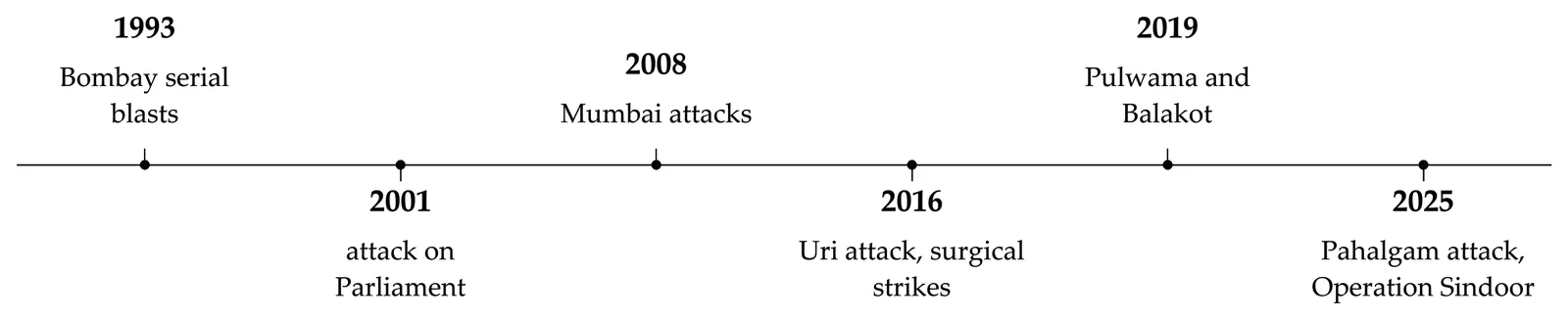
India accuses Pakistan of using terrorist groups as an instrument of state policy to ‘bleed India’ after failing in conventional wars. Pakistan supported militancy in Punjab in the 1980s and the insurgency in Kashmir from 1989, through groups such as Lashkar-e-Taiba, Jaish-e-Mohammed and Hizbul Mujahideen. Major attacks include the hijacking of IC-814 (1999), the attack on Parliament (December 2001), which led to a military standoff, the Mumbai attacks of 26/11 (2008), in which 166 people were killed, the attacks on Uri (2016), followed by Indian ‘surgical strikes’ across the LoC, and Pulwama (2019), which killed forty paramilitary personnel and was followed by an Indian air strike at Balakot. After the attack on tourists at Pahalgam in April 2025, India struck terrorist infrastructure in Pakistan in Operation Sindoor (May 2025).
B. Other neighbours
Insurgent groups of the North-East long used camps in Bangladesh, Bhutan and Myanmar. Bhutan’s army cleared camps in 2003, and Bangladesh under Sheikh Hasina handed over insurgent leaders and co-operated against terrorism after 2009. The LTTE in Sri Lanka assassinated Rajiv Gandhi in 1991.
C. India’s responses
- Diplomacy: isolating Pakistan internationally, pressing for its listing on the grey list of the Financial Action Task Force (2018–22), securing the UN listing of Jaish chief Masood Azhar (2019), and proposing a Comprehensive Convention on International Terrorism at the UN (1996).
- Military responses: surgical strikes (2016), the Balakot air strike (2019) and Operation Sindoor (2025) signalled a more forceful doctrine.
- Domestic measures: the National Investigation Agency (2008), anti-terror laws such as the UAPA, intelligence reform and border fencing.
- Co-operation with neighbours: counter-terrorism co-operation with Bangladesh, Bhutan and Myanmar.
3.5 Important Questions
- Question 1 Discuss India’s border disputes with its neighbours.
- Question 2 Examine migration and refugee issues in India’s relations with its neighbours.
- Question 3 Discuss cross-border terrorism as a challenge to India’s foreign policy.
- Question 4 Discuss India’s neighbourhood policy and its challenges.
DU asks the same idea in different words. So learn one broad answer for each question below; the same answer works for every question joined by OR.
Important Question 1
Discuss India’s border disputes with its neighbours.
OR
Examine the India–Pakistan dispute over Kashmir.
OR
Discuss the India–China boundary dispute.
Model Answer
“The two countries are resolved to settle their differences by peaceful means through bilateral negotiations.”
— Simla Agreement between India and Pakistan (1972)
Introduction. Many of India’s borders were drawn during colonial rule or at Partition and remain contested. Border disputes with Pakistan and China have caused wars, while disputes with smaller neighbours have been managed, and sometimes resolved, through negotiation.
1. Kashmir
Jammu and Kashmir acceded to India in 1947; the war of 1947–48 left part of it under Pakistani control. The Simla Agreement (1972) created the Line of Control and committed both sides to bilateral settlement. The Simla Agreement (1972) turned the ceasefire line into the Line of Control. Pakistan controls part of the former state, which India calls Pakistan-occupied Kashmir.
2. The 2019 Change in Kashmir
In 2019 India revoked the special status of Jammu and Kashmir and reorganised it into two union territories, which Pakistan protested.
3. Other India–Pakistan Disputes
Siachen (secured by India in 1984), the Kargil intrusion (1999) and Sir Creek remain issues; the Indus Waters Treaty (1960) governed water sharing until India held it in abeyance in 2025. Sir Creek in Gujarat is a further maritime dispute.
4. The Indus Waters Treaty
The Indus Waters Treaty (1960), mediated by the World Bank, survived wars, but India placed it in abeyance in 2025 after the Pahalgam terror attack.
5. The India–China Boundary
China occupies Aksai Chin in the west and claims Arunachal Pradesh in the east, rejecting the McMahon Line. The undefined Line of Actual Control has seen the 1962 war and clashes at Doklam (2017) and Galwan (2020). India accepts the McMahon Line (1914) in the east, which China rejects.
6. Shaksgam and Aksai Chin
Pakistan ceded the Shaksgam Valley to China in 1963, which India does not recognise.
7. Managing the LAC
Agreements of 1993, 1996, 2005 and 2013 and talks by Special Representatives sought peace, and disengagement agreements followed the 2020 crisis. The Special Representatives have met more than twenty times.
8. Bhutan and Doklam
Bhutan’s boundary talks with China, especially near Doklam, matter for India because of the narrow Siliguri Corridor.
9. Nepal
Nepal’s 2020 map claiming Kalapani–Lipulekh–Limpiyadhura strained relations, despite the open border and close ties. India and Nepal share an open border under the 1950 treaty.
10. Bangladesh: A Success Story
The Land Boundary Agreement, implemented in 2015, exchanged 111 Indian and 51 Bangladeshi enclaves; the maritime boundary was settled by arbitration in 2014. The maritime boundary was settled by arbitration in 2014.
11. Sri Lanka and Myanmar
The Katchatheevu agreement (1974) and fishermen’s issues affect ties with Sri Lanka; the porous Myanmar border raises security concerns, leading to plans for fencing. India and Myanmar allowed free movement for border communities, though India has moved to end it.
12. Maritime Boundaries
India settled maritime boundaries with Sri Lanka (1974–76), the Maldives and Bangladesh (2014), showing that peaceful settlement is possible.
13. Border Infrastructure
India has built roads, tunnels and airstrips along the LAC, such as the Atal Tunnel (2020), and launched the Vibrant Villages Programme (2023) for border villages.
14. Evaluation
Disputes with smaller neighbours show that negotiation can succeed; with Pakistan and China, disputes are linked to deep rivalry and require both deterrence and diplomacy. Disputes with China and Pakistan remain the most serious.
15. Why Borders Remain Unsettled
Many borders were drawn by colonial officials, such as the McMahon Line (1914) and the Radcliffe Line (1947), without the consent of the peoples affected. National sentiment, the strategic value of high ground and passes, and China’s linking of the border with its control of Tibet make compromise difficult. The Radcliffe Line (1947) divided Punjab and Bengal in haste.
16. Border Management
India guards its borders through forces such as the Border Security Force and the Indo-Tibetan Border Police, builds roads and fences, and has launched the Vibrant Villages Programme (2023) to develop villages along the northern border. Fencing, floodlights and technology are used along the Pakistan and Bangladesh borders.
Conclusion. Thus, border disputes are a colonial legacy and a continuing challenge; their peaceful settlement is essential for a stable neighbourhood.
Important Question 2
Examine migration and refugee issues in India’s relations with its neighbours.
OR
Why is India not a party to the 1951 Refugee Convention? How does it deal with refugees?
OR
Discuss the issue of migration from Bangladesh.
Model Answer
“Owing to well-founded fear of being persecuted for reasons of race, religion, nationality, membership of a particular social group or political opinion.”
— UN Convention Relating to the Status of Refugees (1951), Article 1
Introduction. People have moved across South Asia’s porous borders for centuries. Migration and refugee flows have shaped India’s demography and politics and affected its relations with neighbours.
1. Migrants and Refugees
Migrants move voluntarily, usually for work; refugees flee persecution. The distinction matters for protection, though in practice the two often overlap. Climate change is also creating new forms of displacement.
2. India’s Legal Approach
India is not a party to the 1951 Convention or 1967 Protocol and has no refugee law; it deals with refugees case by case under the Foreigners Act, though courts have protected some against forced return. India argues that the Convention reflects European concerns and that its regional conditions require flexibility. Refugees are governed by the Foreigners Act (1946) and administrative decisions.
3. Historical Refugee Flows
India received Partition refugees, Tibetans after 1959, around ten million East Pakistani refugees in 1971, Sri Lankan Tamils from 1983 and Chakmas and Hajongs. Sri Lankan Tamils arrived from the 1980s and Chakmas earlier from East Pakistan. Partition alone displaced about fifteen million people.
4. Tibetan Refugees
India hosts the Tibetan government-in-exile at Dharamshala, a sensitive issue in relations with China.
5. Refugees and Foreign Policy
The 1971 refugee crisis contributed to the Bangladesh war; Tibetan refugees affect relations with China; Tamil refugees link Tamil Nadu’s politics to policy on Sri Lanka. About ten million refugees entered India in 1971.
6. Afghan and Sri Lankan Refugees
India has hosted Afghan refugees since the 1980s and still hosts Sri Lankan Tamil refugees in camps in Tamil Nadu.
7. Rohingya and Myanmar Refugees
India treats Rohingya mainly as illegal migrants and a security concern and has sought to deport some, which has been criticised on humanitarian grounds; refugees from Myanmar also entered Mizoram after 2021. After the 2021 coup, refugees from Myanmar entered Mizoram and Manipur.
8. Migration from Bangladesh
Migration changed the demography of Assam, leading to the Assam movement and Accord (1985), the NRC (2019), which excluded about nineteen lakh people, and debates over the CAA (2019). The Assam Accord (1985) set 25 March 1971 as the cut-off date for detecting foreigners.
9. The CAA and Neighbours
The Citizenship (Amendment) Act (2019) offered faster citizenship to certain non-Muslim migrants from Afghanistan, Bangladesh and Pakistan, affecting India’s image in neighbouring countries.
10. Nepal and Open Borders
The open border with Nepal allows free movement of workers, strengthening ties but raising security concerns.
11. Indian Migrants Abroad
India is also the world’s largest source of migrants and remittances, which links migration to foreign policy in the Gulf and elsewhere.
12. UNHCR in India
UNHCR registers some refugees in India, mainly in Delhi, while the government deals with other groups directly.
13. Balancing Humanitarianism and Security
India balances humanitarian traditions with concerns about security, demography and resources, which explains its uneven treatment of different groups.
14. Courts and Refugees
Courts have sometimes protected refugees, as in NHRC v. State of Arunachal Pradesh (1996) for the Chakmas, applying Article 21 to non-citizens.
15. Evaluation
India has been generous in hosting refugees but lacks a consistent legal framework; balancing humanitarian duties, security and good relations with neighbours remains a challenge. A national refugee law has often been proposed.
16. Statelessness and Rights
People excluded from the NRC must prove their citizenship before Foreigners Tribunals, and critics warn of the risk of statelessness and detention. The Supreme Court in 2015 directed that Chakma and Hajong refugees be granted citizenship, but implementation has been slow. Over nineteen lakh people were left out of Assam’s final NRC in 2019.
17. Nepal and the Gorkhas
Under the 1950 treaty, Nepali citizens can work in India and serve in the Gorkha regiments of the Indian Army. In 2022 Nepal paused recruitment under India’s new Agnipath scheme, showing how migration and employment issues affect bilateral relations. Gorkha regiments of the Indian Army recruit Nepali citizens.
Conclusion. Thus, migration and refugee issues link domestic politics with foreign policy; a clear and humane national policy would serve both India and its neighbours.
Important Question 3
Discuss cross-border terrorism as a challenge to India’s foreign policy.
OR
Examine India’s responses to cross-border terrorism from Pakistan.
Model Answer
“Any act of international terrorism constitutes a threat to international peace and security.”
— UN Security Council Resolution 1373 (2001)
Introduction. Cross-border terrorism, especially from groups based in Pakistan, has been one of India’s most serious security threats and a central issue in its relations with Pakistan and the world.
1. Meaning
Cross-border terrorism is violence by groups based in one country against civilians or security forces in another, often with the support or tolerance of the host state. It is often supported by state agencies in the sanctuary country.
2. Terrorism as State Policy
India accuses Pakistan of using militant groups to bleed India, supporting militancy in Punjab in the 1980s and in Kashmir from 1989 through groups such as Lashkar-e-Taiba and Jaish-e-Mohammed. Groups such as Lashkar-e-Taiba and Jaish-e-Mohammed are based in Pakistan.
3. Earlier Cross-Border Militancy
India has also faced cross-border support for Khalistan militancy in the 1980s and for insurgent groups in the North-East operating from camps in neighbouring countries.
4. Major Attacks
The IC-814 hijacking (1999), the Parliament attack (2001), Mumbai 26/11 (2008), Uri (2016), Pulwama (2019) and Pahalgam (2025) are among the deadliest attacks. The Mumbai attacks of 2008 killed more than 160 people. The attack on Parliament (2001) led to a long military standoff.
5. Military Responses
After Uri, India carried out surgical strikes; after Pulwama, the Balakot air strike; and after Pahalgam, Operation Sindoor, signalling a more forceful doctrine of punishment. After the Pahalgam attack of April 2025, India launched Operation Sindoor against terror infrastructure. These marked a shift from strategic restraint to calibrated retaliation.
6. Pulwama and Balakot
After the Pulwama attack (2019), India’s airstrike at Balakot and Pakistan’s response showed the risk of escalation between nuclear neighbours.
7. Diplomatic Responses
India has worked to isolate Pakistan, secured its FATF grey-listing (2018–22), obtained the UN listing of Masood Azhar (2019), and championed a Comprehensive Convention on International Terrorism. Pakistan was on the FATF grey list from 2018 to 2022.
8. Domestic Measures
The National Investigation Agency (2008), anti-terror laws, intelligence reforms and border fencing strengthen India’s defences. NATGRID and multi-agency centres improve intelligence sharing. The UAPA was amended in 2019 to allow individuals to be designated as terrorists.
9. Other Neighbours
Bhutan cleared insurgent camps in 2003; Bangladesh co-operated after 2009; the Myanmar border remains a concern for the North-East. Cooperation with Nepal and Bhutan helps prevent militants from using their territory.
10. Afghanistan
The Taliban’s return in 2021 raised fears that Afghanistan could again shelter groups targeting India.
11. Terror Financing and Technology
India hosted the ‘No Money for Terror’ conference (2022) and warns of terrorists’ use of drones, cryptocurrencies and social media.
12. The Nuclear Shadow
Because India and Pakistan both have nuclear weapons, responses to terrorism carry risks of escalation, which shapes India’s calibrated strikes.
13. Narco-Terrorism
Drug trafficking across the Punjab border finances militancy, linking terrorism with organised crime.
14. Evaluation
Terrorism has prevented normal relations with Pakistan and stalled SAARC. Lasting solutions require dismantling terrorist networks, international pressure and, eventually, dialogue. A balance of deterrence, diplomacy and international cooperation is needed.
15. Terror and Dialogue
India has held that ‘terror and talks cannot go together’. Peace efforts such as the Lahore bus journey (1999), the Agra summit (2001) and the composite dialogue (2004–08) were undermined by attacks, and dialogue was suspended after 26/11. The composite dialogue was suspended after the Mumbai attacks of 2008.
16. A Convention on Terrorism
India proposed a Comprehensive Convention on International Terrorism at the UN in 1996, but it has not been adopted because states disagree on a definition.
17. International Co-operation
India works through the UN Security Council’s sanctions committee to list terrorists, co-operates with partners such as the United States and the Quad, and hosted the ‘No Money for Terror’ ministerial conference in 2022 to target terrorist financing. India also works with the Quad, BRICS and the SCO on counter-terrorism.
Conclusion. Thus, cross-border terrorism remains a central challenge in India’s neighbourhood, requiring a combination of deterrence, diplomacy and regional co-operation.
Important Question 4
Discuss India’s neighbourhood policy and its challenges.
OR
Examine the ‘Neighbourhood First’ policy.
Model Answer
“The king who is situated anywhere immediately on the circumference of the conqueror’s territory is termed the enemy.”
— Kautilya, Arthashastra (Book VI, tr. R. Shamasastry)
Introduction. India’s neighbourhood is its first circle of foreign policy. India’s size, the legacy of Partition and the presence of China make it a difficult region, and India’s policies have alternated between assertion and generosity.
1. Asymmetry
India is larger than all its neighbours together; smaller states fear domination and sometimes turn to China, while India expects them to respect its security concerns. This creates fears of ‘big brother’ domination.
2. The Indira Doctrine
India treated South Asia as its sphere, opposed outside interference and intervened in Bangladesh (1971) and Sri Lanka (1987). India intervened in Sri Lanka (1987) and the Maldives (1988).
3. The Gujral Doctrine
In 1996 India offered generosity to smaller neighbours without demanding reciprocity, leading to the Ganga Water Treaty with Bangladesh (1996). It led to the Ganga Waters Treaty (1996) with Bangladesh.
4. Bhutan as a Model
Bhutan’s close partnership with India, based on hydropower cooperation and the friendship treaty of 2007, shows mutually beneficial ties.
5. Neighbourhood First
Since 2014 India has stressed connectivity, trade, energy links and development aid, invited neighbours’ leaders to its swearing-in ceremonies and settled the boundary with Bangladesh. The leaders of SAARC countries were invited to the Prime Minister’s swearing-in in 2014. It aims at connectivity through roads, railways, power grids and waterways.
6. Afghanistan
India built roads, the Afghan Parliament building and the Salma Dam, gaining goodwill, but the Taliban’s return in 2021 limited its role.
7. Regional Co-operation
SAARC has been stalled by India–Pakistan hostility; India has turned to BIMSTEC and sub-regional initiatives, and to SAGAR in the Indian Ocean. BIMSTEC and BBIN offer alternatives to SAARC.
8. Crisis Diplomacy
India’s aid to Sri Lanka during its economic crisis (2022) and to Nepal after the 2015 earthquake showed its role as a first responder.
9. Regional Trade
South Asia is one of the least integrated regions of the world, with trade far below its potential, partly because of India–Pakistan hostility.
10. The China Factor
China’s investments, ports and loans in Sri Lanka, Nepal, the Maldives and Bangladesh compete with Indian influence. Sri Lanka leased Hambantota port to a Chinese company in 2017.
11. Domestic Changes in Neighbours
Political changes, such as in Bangladesh (2024), the Maldives and Nepal, can rapidly change relations, requiring India to engage all political actors. Anti-India sentiment has sometimes been used in neighbours’ elections. The fall of Sheikh Hasina’s government in Bangladesh in 2024 was a setback for India.
12. Water Sharing
Water disputes, such as the Teesta with Bangladesh and the Indus with Pakistan, are major neighbourhood issues.
13. Federalism and Neighbours
Border states such as West Bengal, Tamil Nadu and Punjab influence policy towards neighbours.
14. Culture and Delivery
Shared religion, languages, films and families give India cultural influence, but slow delivery of projects compared with China has hurt its credibility.
15. Island Neighbours
Relations with the Maldives have swung between ‘India Out’ campaigns and renewed cooperation, showing the influence of domestic politics.
16. Evaluation
India has built strong partnerships with Bhutan and, for long, Bangladesh, but faces hostility from Pakistan and competition from China; consistent, generous engagement serves its interests. Respecting neighbours’ sovereignty while delivering projects quickly is the key.
17. Connectivity and Development Partnerships
India has extended lines of credit and grants for roads, railways, ports and power in neighbouring countries, such as the Kaladan multimodal project in Myanmar, cross-border rail and energy links with Bangladesh, power trade with Nepal and Bhutan, and about four billion dollars of assistance to Sri Lanka during its economic crisis in 2022. India supplies electricity and fuel to Bangladesh and Nepal through cross-border links.
18. The Maritime Neighbourhood
Under SAGAR, India works with the Maldives, Sri Lanka, Mauritius and Seychelles on maritime security, disaster relief and development, including through the Colombo Security Conclave. SAGAR stands for Security and Growth for All in the Region.
Conclusion. Thus, a peaceful and prosperous neighbourhood is essential for India’s rise, and requires patience, generosity and firmness.
Short Notes
(a) The Simla Agreement (1972)
Signed by Indira Gandhi and Zulfikar Ali Bhutto after the 1971 war, it converted the ceasefire line in Kashmir into the Line of Control and committed both countries to settle their differences peacefully through bilateral negotiations. India cites it to oppose third-party mediation on Kashmir.
(b) The Land Boundary Agreement (1974/2015)
The agreement between India and Bangladesh, signed in 1974 and implemented through the Constitution (100th Amendment) Act, 2015, which exchanged 111 Indian enclaves in Bangladesh and 51 Bangladeshi enclaves in India, ending a long-standing problem and allowing residents to choose their citizenship.
More notes: MDSC-2B India's Foreign Policy
These notes are prepared by PADHO TO AISE for study help. They are not an official University of Delhi publication.