

Semester II DSC-4 Perspectives on Public Administration
Unit III · 28 min read · Updated 24 Nov 2026
As per the University of Delhi (DU) BA (Hons) Political Science syllabus
Contents
- 3.1 Why the Old Model Was Challenged
- 3.2 New Public Management
- 3.3 New Public Service
- 3.4 From Government to Governance
- 3.5 Multiple Perspectives on Governance
- 3.6 Important Questions
- What is New Public Management? Critically examine its main features.
- Discuss the New Public Service. How is it different from New Public Management?
- What is good governance? Discuss its features and limitations.
- Discuss collaborative, network and digital governance as perspectives on governance.
- Short Notes
हमें अधिक या कम सरकार की नहीं, बेहतर सरकार की आवश्यकता है।
We do not need more government or less government, we need better government. To be more precise, we need better governance.
— David Osborne and Ted Gaebler, Reinventing Government (1992)
BY THE 1970s the large, rule-bound bureaucracy described by Weber was under attack from all sides. Governments were running out of money, citizens complained of slow and wasteful services, and economists argued that bureaucrats served themselves rather than the public. The answer of the 1980s and 1990s was the New Public Management, which asked government to behave like a business. Its critics replied with the New Public Service, which asked government to serve citizens rather than customers. At the same time scholars began to speak of governance rather than government, because public services were now delivered by networks of state agencies, private firms and civil society. In this chapter we study these contemporary perspectives and the four main ways of understanding governance: good, collaborative, network and digital governance.
3.1 Why the Old Model Was Challenged
The ‘old public administration’ of Wilson and Weber rested on hierarchy, rules, a neutral career civil service and direct provision of services by the state. From the 1970s several forces challenged it:
- Fiscal crisis of the welfare state: after the oil shocks of the 1970s, governments faced slow growth, inflation and rising deficits, and could no longer afford to expand.
- The New Right: Margaret Thatcher (1979) and Ronald Reagan (1981) believed that big government was the problem, not the solution, and promoted privatisation and markets.
- Public choice theory: economists argued that bureaucrats, like everyone else, pursue self-interest; William Niskanen [निस्कानेन] (1971) said they try to maximise their budgets, so bureaucracy grows and wastes resources.
- Globalisation: competition between economies demanded efficient, low-cost governments; the World Bank and IMF linked loans to reform.
- Information technology: new technology made it possible to deliver services in new ways.
- Citizens’ dissatisfaction: citizens, used to choice in the market, demanded better, faster and more responsive public services.
3.2 New Public Management
New Public Management (NPM) is the name given by Christopher Hood in ‘A Public Management for All Seasons?’ (1991) to a set of reforms that apply the ideas and methods of the private sector and the market to government. It began in the United Kingdom, New Zealand and Australia in the 1980s and spread across the world in the 1990s. NPM grew from two roots: managerialism, which said that professional managers should be free to manage, and new institutional economics, including public choice, which recommended competition, contracts and incentives.
A. Hood’s seven doctrines
- Hands-on professional management: visible managers at the top, free to manage, with clear responsibility.
- Explicit standards and measures of performance: clear goals, targets and indicators of success.
- Greater emphasis on output controls: resources allocated according to measured results, not inputs.
- Disaggregation: large departments broken into smaller, separate units, such as executive agencies.
- Greater competition: contracts, tendering and competition between public and private providers.
- Private-sector styles of management: flexibility in hiring, pay and rewards.
- Discipline and parsimony in resource use: cutting costs and doing more with less.
B. Reinventing government
In the United States, David Osborne and Ted Gaebler [गेबलर]’s Reinventing Government (1992) gave NPM its most popular form. They called for an entrepreneurial government guided by ten principles: government should be catalytic (steering rather than rowing), community-owned (empowering rather than serving), competitive, mission-driven rather than rule-driven, results-oriented (funding outcomes, not inputs), customer-driven, enterprising (earning rather than spending), anticipatory (prevention rather than cure), decentralised and market-oriented. Their ideas inspired the National Performance Review (1993) led by Vice-President Al Gore.
C. NPM in practice
The British Next Steps programme (1988) separated policy-making ministries from executive agencies run by chief executives on contracts; the Citizen’s Charter (1991) set service standards; New Zealand turned departments into contract-based agencies; and many countries privatised public enterprises, contracted out services, introduced user charges and performance-related pay. In India the economic reforms of 1991 brought disinvestment, public–private partnerships, outsourcing, Citizens’ Charters (1997) and results-framework documents (2009).
D. NPM in context
Stephen P. Osborne and Kate McLaughlin, in ‘New Public Management in Context’ (2002), warn against treating NPM as a universal recipe. They trace the relationship between the state and other providers through several stages: the minimal state of the nineteenth century, the unequal partnership between the state and voluntary bodies in the early twentieth century, the welfare state, and the plural state of the late twentieth century, in which many public, private and voluntary agencies deliver services. NPM, they argue, was a product of this plural state; its methods suit some services and countries but not others, and it is already giving way to more relational forms of governance.
E. Criticism
NPM turned the citizen into a customer, but a citizen has rights and duties, not merely preferences; Henry Mintzberg protested that he was not a mere customer of his government. Competition and contracts fragmented government into many agencies, blurring accountability: when an outsourced service fails, who is responsible? Cost-cutting harmed the poor and weakened equity; performance targets encouraged gaming; the public service ethos of duty was replaced by self-interest; and R.A.W. Rhodes (1994) spoke of the hollowing out of the state. In developing countries with weak markets and weak regulation, NPM often led to corruption in contracting. By 2006 Patrick Dunleavy and his colleagues declared that ‘NPM is dead’ and that a new digital-era governance was taking its place.
3.3 New Public Service
The New Public Service (NPS) was proposed by Robert and Janet Denhardt [डेनहार्ट] in ‘The New Public Service: Serving Rather than Steering’ (2000) and in their book of the same name (2003). It is a normative alternative to both the old public administration and NPM. Its roots lie in theories of democratic citizenship, community and civil society, organisational humanism and discourse theory, which see public administration as a conversation among citizens about shared values.
A. The seven principles
- Serve citizens, not customers: the public interest arises from dialogue about shared values, not from adding up individual self-interests.
- Seek the public interest: administrators must help build a collective, shared notion of the public interest.
- Value citizenship over entrepreneurship: public servants and citizens committed to society serve it better than entrepreneurial managers acting as if public money were their own.
- Think strategically, act democratically: policies are best achieved through collective, collaborative processes.
- Recognise that accountability is not simple: public servants must attend to law, constitutional values, community values, political norms, professional standards and citizens’ interests, not only to the market.
- Serve rather than steer: public servants should help citizens articulate and meet their shared interests rather than control society.
- Value people, not just productivity: organisations succeed through collaboration and shared leadership based on respect for all people.
B. Old public administration, NPM and NPS compared
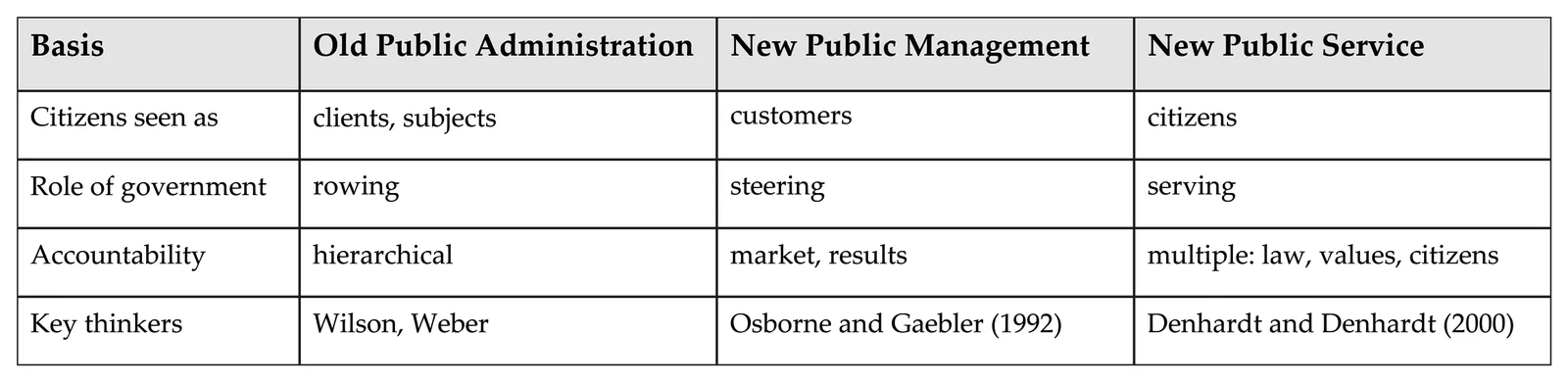
The three models answer the same questions very differently (Figure 3.2). For the old public administration the citizen is a client or subject, the role of government is rowing (directly providing services) and accountability is hierarchical. For NPM the citizen is a customer, the role of government is steering (setting goals for markets and agencies) and accountability is to the market and results. For NPS the citizen is a citizen, the role of government is serving (negotiating and brokering shared interests) and accountability is multiple.
C. Evaluation
NPS restored democratic values, citizenship and the public interest to the centre of public administration and influenced participatory practices such as social audits, participatory budgeting (first developed in Porto Alegre, Brazil, in 1989) and decentralised planning. But critics say it is more a set of values than a theory; it says little about how to deliver services efficiently or under fiscal pressure; and genuine participation is slow, costly and often captured by the better-off. In practice governments combine elements of all three models.
3.4 From Government to Governance
Government refers to the formal institutions of the state that make and enforce decisions through authority. Governance is a broader idea: it refers to the processes through which a society is steered and public problems are solved, involving not only the state but also markets, civil society organisations, communities and international bodies. The World Bank used the word in its 1989 report on Sub-Saharan Africa, which spoke of a ‘crisis of governance’, and in Governance and Development (1992) it defined governance as the manner in which power is exercised in the management of a country’s economic and social resources for development.
Gerry Stoker’s ‘Governance as Theory: Five Propositions’ (1998) summarises the change: governance involves institutions and actors from within and beyond government; it blurs boundaries and responsibilities for tackling social and economic issues; it involves power dependence among the actors; it involves autonomous self-governing networks; and it recognises that things can be done without relying on the command and authority of government, which instead uses new tools to steer and guide. Scholars have developed several perspectives on governance (Figure 3.3).

3.5 Multiple Perspectives on Governance
A. Good governance
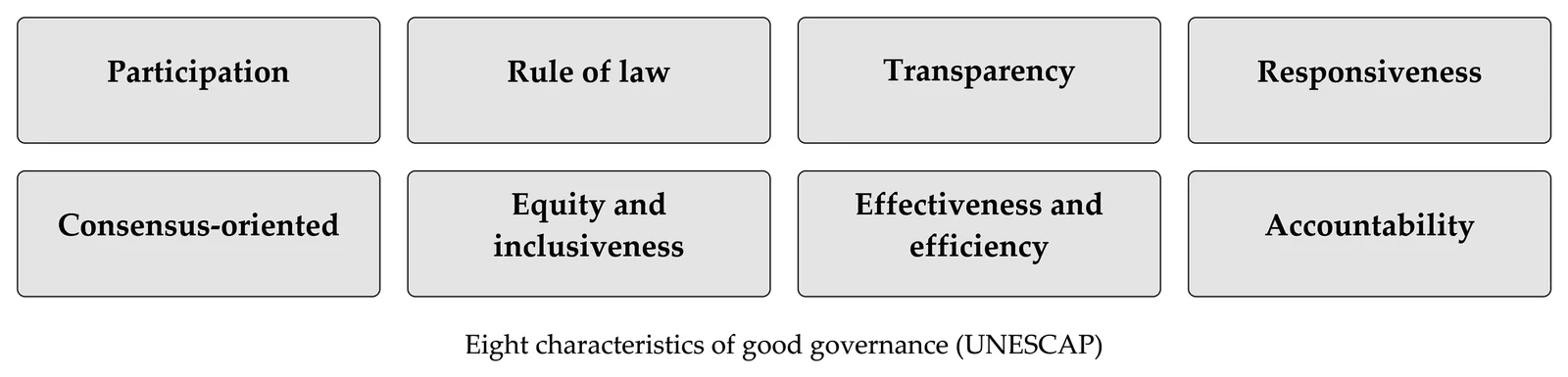
Good governance is a normative idea promoted by international agencies from the late 1980s. The World Bank’s Governance and Development (1992) identified four areas: public sector management, accountability, a legal framework for development, and transparency and information. The UNDP (1997) and UNESCAP described eight characteristics (Figure 3.4): good governance is participatory, follows the rule of law, is transparent, responsive, consensus-oriented, equitable and inclusive, effective and efficient, and accountable. It also seeks to minimise corruption, take the views of minorities into account and hear the voices of the most vulnerable.
In India the idea is reflected in the Right to Information Act (2005), the reports of the Second Administrative Reforms Commission, Citizens’ Charters, social audits and the observance of Good Governance Day (25 December, from 2014). Criticism: good governance was used by donors as a condition for loans and aid, imposing a Western, market-friendly model on developing countries; it treats political problems as technical ones; its list of desirable qualities is so long that no country can achieve it at once. Merilee Grindle (2004) therefore argued for ‘good enough governance’, which sets priorities according to each country’s context.
B. Collaborative governance
Chris Ansell [एन्सेल] and Alison Gash (2008) define collaborative governance as a governing arrangement in which one or more public agencies directly engage non-state stakeholders in a collective decision-making process that is formal, consensus-oriented and deliberative, and that aims to make or implement public policy or manage public programmes or assets. Their model has four parts:
- Starting conditions: imbalances of power, resources and knowledge among stakeholders, their incentives to participate, and their history of conflict or co-operation.
- Institutional design: clear ground rules, inclusive participation and a transparent process.
- Facilitative leadership: leaders who bring parties together, build trust and empower weaker stakeholders.
- The collaborative process: a cycle of face-to-face dialogue, trust-building, commitment to the process, shared understanding and ‘small wins’ (intermediate outcomes), which in turn deepen trust.
Examples include public–private partnerships, river-basin and watershed committees, and Joint Forest Management in India (1990), in which forest departments and village communities manage forests together. Collaboration can solve complex problems that no single agency can, but it is slow, depends on trust, and can be dominated by powerful participants.
C. Network governance
R.A.W. Rhodes, in ‘The New Governance: Governing without Government’ (1996) and Understanding Governance (1997), described governance as self-organising, inter-organisational networks. Such networks are marked by interdependence between organisations, continuing exchange of resources, game-like interactions based on trust and rules of the game, and a significant degree of autonomy from the state. Scholars contrast three modes of co-ordination: hierarchy, which works through authority; markets, which work through prices and competition; and networks, which work through trust and co-operation. Eva Sørensen [सॉरेनसेन] and Jacob Torfing [टॉरफ़िंग] studied how such governance networks can be made democratic, and Bob Jessop introduced the idea of metagovernance, the ‘governance of governance’, in which the state steers networks by setting rules, framing goals and arbitrating conflicts. Networks bring together knowledge and resources, but they raise problems of accountability (the problem of ‘many hands’), exclusion of weaker groups and a democratic deficit.
D. Digital governance
Digital governance means the use of information and communication technology to transform the way government works, delivers services and interacts with citizens. Patrick Dunleavy [डनलेवी], Helen Margetts and their colleagues, in Digital Era Governance (2006), argued that it was replacing NPM. They identified three themes: reintegration, reversing the fragmentation caused by NPM by joining up agencies; needs-based holism, reorganising government around the needs of citizens through one-stop services; and digitisation changes, such as online services, automated processes and open, transparent government.
E-government is usually classified by the parties involved (Figure 3.5): government to citizen (G2C), government to business (G2B), government to government (G2G) and government to employee (G2E). Aroon Manoharan and Marc Holzer stress e-democracy and civic engagement: digital tools for information, consultation, e-petitions and participation in decisions, whose success depends on access, trust and the capacity of governments to respond. In India the Digital India programme (2015), Aadhaar, Direct Benefit Transfer, UPI, MyGov and online grievance redressal (CPGRAMS) have changed the delivery of services; S. Dhal’s study of e-governance and citizen engagement (2022) shows both the promise and the limits of this shift.

Concerns: the digital divide between those who have access and skills and those who do not; exclusion when biometric authentication fails; threats to privacy and the risk of surveillance, recognised by the Supreme Court in Puttaswamy (2017) and addressed by the Digital Personal Data Protection Act (2023); and bias in automated, algorithmic decisions. Digital governance improves efficiency and transparency only when it remains inclusive and accountable.
3.6 Important Questions
- Question 1 What is New Public Management? Critically examine its main features.
- Question 2 Discuss the New Public Service. How is it different from New Public Management?
- Question 3 What is good governance? Discuss its features and limitations.
- Question 4 Discuss collaborative, network and digital governance as perspectives on governance.
DU asks the same idea in different words. So learn one broad answer for each question below; the same answer works for every question joined by OR.
Important Question 1
What is New Public Management? Critically examine its main features.
OR
Discuss the principles of ‘reinventing government’.
OR
Examine New Public Management in context.
OR
NPM is a shift from administration to management. Discuss.
Model Answer
“Steering rather than rowing.”
— Osborne and Gaebler, Reinventing Government (1992), on catalytic government
Introduction. New Public Management (NPM) is a set of public sector reforms that apply private-sector management techniques and market mechanisms to government. The term was coined by Christopher Hood (1991), and the approach dominated reforms across the world from the 1980s to the early 2000s. It marked a shift from administration, the following of rules, to management, the achievement of results.
1. Context
The fiscal crisis of the welfare state, the New Right governments of Thatcher and Reagan, public choice theory’s critique of self-interested, budget-maximising bureaucrats (Niskanen, 1971), globalisation, the conditions of the World Bank and IMF, and new information technology all created pressure to make government smaller, cheaper and more efficient. Globalisation and declining confidence in big government also contributed.
2. Theoretical Roots
NPM combined managerialism, the belief that management is a generic skill and managers should be free to manage, with new institutional economics and public choice, which recommended competition, contracting, user choice and incentives. Public choice theorists such as William Niskanen (1971) argued that bureaucrats seek to maximise their budgets.
3. Hood’s Doctrines
Hood identified seven doctrines: hands-on professional management; explicit standards and measures of performance; emphasis on output controls; disaggregation of public units; greater competition; private-sector styles of management; and discipline and parsimony in the use of resources. Christopher Hood set these out in ‘A Public Management for All Seasons?’ (1991).
4. Reinventing Government
Osborne and Gaebler (1992) called for entrepreneurial government that is catalytic (steering, not rowing), community-owned, competitive, mission-driven, results-oriented, customer-driven, enterprising, anticipatory, decentralised and market-oriented. Their ten principles included steering rather than rowing, empowering communities, being mission-driven and focusing on results.
5. NPM in Practice
Britain’s Next Steps agencies (1988) and Citizen’s Charter (1991), New Zealand’s contract-based reforms, and America’s National Performance Review (1993) were leading examples. In India, the reforms after 1991 brought disinvestment, PPPs, outsourcing, Citizens’ Charters and performance monitoring. India’s reforms after 1991, including disinvestment, public–private partnerships and citizen’s charters, show NPM influence.
6. NPM in Context
Osborne and McLaughlin (2002) argue that NPM emerged in the plural state, where many agencies deliver services, and should not be treated as universal. Its success depends on the nature of the service and the strength of markets and regulation. Pollitt and Bouckaert showed that NPM was adopted differently in different countries.
7. Public–Private Partnerships
NPM encouraged public–private partnerships, contracting out and user charges for services such as roads, airports and water supply, in India as elsewhere.
8. The Citizen as Customer
NPM introduced the idea of the citizen as a customer of public services, leading to charters, service standards and user feedback, but critics argue that citizens have rights and duties that customers do not.
9. Achievements
NPM focused attention on results, costs and service quality, made agencies more responsive to users, introduced performance measurement and encouraged innovation and the use of technology. Performance measurement and agencies with clear targets improved some services.
10. NPM in Developing Countries
Critics noted that NPM assumed strong institutions and markets, which many developing countries lacked, so its results there were mixed.
11. Criticism
NPM reduced citizens to customers; blurred accountability through fragmentation and contracting; sacrificed equity to efficiency; weakened the public service ethos; encouraged gaming of targets; and hollowed out the state’s capacity (Rhodes). In developing countries it often led to corruption in contracts. The Denhardts offered the New Public Service, and Dunleavy argued that digital-era governance had replaced NPM. Christopher Pollitt called it a form of ‘managerialism’ that ignored the political nature of public services.
12. Old Public Administration and NPM Compared
The old public administration emphasised rules, inputs, hierarchy, permanent tenure and uniform services; NPM emphasised results, outputs, contracts, flexible employment and choice for users. The first trusted the neutral official; the second trusted the market and the manager.
13. After NPM
The fragmentation caused by NPM led to new reforms from the late 1990s: ‘joined-up government’ in Britain (1997), ‘whole-of-government’ approaches in Australia and New Zealand, digital-era governance, and what Stephen Osborne (2006) called the New Public Governance, which focuses on relationships, networks and the co-production of services with citizens rather than on competition. Digital-era governance and the New Public Service are among its successors.
Conclusion. Thus, NPM made governments more efficient and results-conscious, but it neglected citizenship, equity and accountability. Today its tools are used selectively within broader models of governance.
Important Question 2
Discuss the New Public Service. How is it different from New Public Management?
OR
Compare the Old Public Administration, New Public Management and New Public Service.
OR
‘Serving rather than steering.’ Discuss.
Model Answer
“Government shouldn’t be run like a business; it should be run like a democracy.”
— Janet and Robert Denhardt, The New Public Service (2003)
Introduction. The New Public Service (NPS), proposed by Robert and Janet Denhardt (2000), is a normative model of public administration that places citizens, democracy and the public interest at the centre. It developed as a response to NPM, which had turned citizens into customers and government into a business.
1. Intellectual Roots
NPS draws on theories of democratic citizenship, which see citizens as active participants; on models of community and civil society; on organisational humanism, which values people over control; and on discourse theory, which sees governance as dialogue among citizens. Robert and Janet Denhardt set it out in The New Public Service: Serving, Not Steering (2003).
2. The Seven Principles
Serve citizens, not customers; seek the public interest; value citizenship over entrepreneurship; think strategically and act democratically; recognise that accountability is not simple; serve rather than steer; and value people, not just productivity. The others are: think strategically and act democratically; recognise that accountability is not simple; serve rather than steer; and value people, not just productivity.
3. Public Value
NPS is linked with Mark Moore’s idea of ‘public value’ (1995), which asks managers to create value for the public as a whole, not merely efficiency.
4. The Citizen
For NPM the citizen is a customer with individual preferences; for NPS the citizen is a member of a political community with rights, duties and a shared interest. Public servants must build relationships of trust and collaboration with citizens. Citizens have rights and duties and share responsibility for the community.
5. Role of Government
The old public administration rowed, providing services directly; NPM steered, setting targets for agencies and markets; NPS serves, helping citizens articulate and meet their shared interests, often by brokering coalitions of public, private and non-profit actors. Government should serve, helping citizens articulate and meet shared interests.
6. Public Interest and Accountability
For NPM the public interest is the sum of individual interests and accountability is to results and customers. For NPS the public interest emerges from dialogue about shared values, and accountability is multidimensional: to law, constitutional values, community values, professional standards and citizens.
7. Motivation and Organisation
NPM assumes self-interested managers motivated by incentives; NPS assumes public servants motivated by public service and the desire to contribute to society, and favours collaborative structures with shared leadership.
8. NPS in Practice
Participatory budgeting (Porto Alegre, 1989), citizens’ juries, social audits, decentralised planning through local bodies, and public consultations on draft policies are practical expressions of NPS values. India’s gram sabhas, social audits and participatory planning reflect NPS ideas.
9. Criticism of NPS
Critics argue that NPS is idealistic, that participation is slow and costly, and that it gives little guidance on managing complex organisations efficiently.
10. Evaluation
NPS restored democratic values to public administration and corrected the narrowness of NPM. Critics say it is idealistic and vague about implementation, ignores fiscal constraints, and that participation is slow and may be captured by elites. Most governments combine NPM tools for efficiency with NPS values for legitimacy. It is best seen as a corrective to NPM rather than a complete replacement.
11. Rowing, Steering and Serving
In short, the old public administration rowed, NPM steered and NPS serves; the old model saw people as clients, NPM as customers and NPS as citizens.
12. A Comparative View
The Denhardts compare the three models on several further points. The theoretical foundation of the old model was political theory and early social science, that of NPM economic theory, and that of NPS democratic theory. Their idea of rationality was administrative rationality, technical and economic rationality, and strategic rationality tested by politics and citizens respectively. Administrative discretion was limited in the old model, wide in NPM, and needed but constrained and accountable in NPS. Their ideal structure was the bureaucratic agency, the decentralised agency, and the collaborative structure with shared leadership.
Conclusion. Thus, NPS reminds us that the purpose of public administration is not only efficiency but democracy. Government must serve citizens, not merely satisfy customers.
Important Question 3
What is good governance? Discuss its features and limitations.
OR
Distinguish between government and governance.
OR
Examine the different perspectives on governance.
Model Answer
“Governance is the manner in which power is exercised in the management of a country’s economic and social resources for development.”
— World Bank, Governance and Development (1992)
Introduction. From the late 1980s the word governance replaced government in much of the discussion of public administration, because public problems were now addressed by many actors, not the state alone. Good governance is the normative version of the idea, describing the qualities that governance should have.
1. Government and Governance
Government refers to the formal institutions of the state that act through authority. Governance refers to the wider processes of steering society, involving the state, markets and civil society. Rhodes called it ‘governing without government’, and Stoker’s five propositions stress multiple actors, blurred boundaries, power dependence, self-governing networks and new tools of steering. Rhodes described governance as ‘governing without government’, through networks.
2. Origin of Good Governance
The World Bank’s 1989 report on Sub-Saharan Africa blamed the region’s problems on a crisis of governance. Its 1992 report identified public sector management, accountability, legal framework and transparency as the dimensions of good governance. Its 1992 report Governance and Development defined governance as the manner in which power is exercised in managing a country’s resources for development.
3. Features of Good Governance
UNDP and UNESCAP list eight features: participation, rule of law, transparency, responsiveness, consensus orientation, equity and inclusiveness, effectiveness and efficiency, and accountability. Good governance also seeks to reduce corruption and protect minorities and the vulnerable. These are participation, rule of law, transparency, responsiveness, consensus orientation, equity and inclusiveness, effectiveness and efficiency, and accountability.
4. Good Governance in India
The RTI Act (2005), Citizens’ Charters, the Lokpal Act (2013), social audits, e-governance, Direct Benefit Transfer and the reports of the Second Administrative Reforms Commission all seek to make Indian administration more transparent, accountable and citizen-centric. Good Governance Day is observed on 25 December, and the Good Governance Index (2019) ranks the states.
5. Governance and Corruption
Corruption is the opposite of good governance; India’s responses include the Prevention of Corruption Act (1988), the CVC, the Lokpal and e-governance.
6. Other Perspectives on Governance
Besides good governance, scholars speak of collaborative governance (Ansell and Gash, 2008), in which agencies engage stakeholders in consensus-oriented decision-making; network governance (Rhodes), in which self-organising networks of interdependent actors govern; and digital governance (Dunleavy, 2006), which uses technology to reintegrate government around citizens’ needs.
7. Good Governance and Human Rights
UNDP links good governance with human development and human rights, arguing that people must be able to participate and claim their rights for governance to be good.
8. Limitations of Good Governance
Critics argue that good governance was imposed by donors as a condition for aid, promoting a Western, market-friendly model; that it depoliticises questions of power and inequality; that it neglects the state’s capacity and history; and that its long list of qualities is unrealistic. Grindle proposed ‘good enough governance’ suited to each country’s priorities. Some argue that it depoliticised development and neglected democracy and social justice.
9. Indian Ideas of Good Governance
Indian thought has its own ideas of good governance, from Kautilya’s view that the king’s happiness lies in the happiness of his subjects to Gandhi’s talisman of recalling the face of the poorest person when making a decision.
10. Evaluation
Despite these criticisms, the values of good governance, transparency, accountability, participation and the rule of law, are widely accepted as standards for judging any government, and citizens use them to demand better administration.
11. Measuring Governance
The World Bank’s Worldwide Governance Indicators, developed by Daniel Kaufmann and his colleagues from 1996, measure six dimensions: voice and accountability; political stability and absence of violence; government effectiveness; regulatory quality; rule of law; and control of corruption. Such indicators allow comparison across countries, though critics say they rely heavily on perceptions.
12. Good Governance and Development
Kofi Annan called good governance perhaps the single most important factor in eradicating poverty and promoting development. Good governance builds trust, attracts investment, ensures that public resources reach the poor and protects citizens’ rights.
Conclusion. Thus, governance widened public administration from the state to society, and good governance gave it a set of democratic standards. These standards must be adapted to each society rather than imposed from outside.
Important Question 4
Discuss collaborative, network and digital governance as perspectives on governance.
OR
Explain the concept of collaborative governance.
OR
What is network governance? Discuss its merits and problems.
OR
Examine digital governance and its role in citizen engagement.
Model Answer
“Governance refers to self-organizing, interorganizational networks.”
— R.A.W. Rhodes, ‘The New Governance: Governing without Government’ (1996)
Introduction. Contemporary public problems, such as climate change, urban services or public health, cannot be solved by one department acting alone. New perspectives on governance therefore study how government works with other actors, through collaboration, networks and digital technology.
1. Collaborative Governance: Meaning
Ansell and Gash (2008) define it as an arrangement in which public agencies directly engage non-state stakeholders in a formal, consensus-oriented and deliberative process to make or implement public policy or manage public programmes. The process is formal, consensus-oriented and deliberative, and aims to make or implement public policy.
2. The Collaborative Model
Collaboration depends on starting conditions (power and resource imbalances, incentives, history of conflict), institutional design (inclusive participation, clear rules), facilitative leadership, and a cyclical process of face-to-face dialogue, trust-building, commitment, shared understanding and small wins. Examples include PPPs, watershed committees and Joint Forest Management. Face-to-face dialogue, trust-building, commitment and shared understanding drive the process.
3. Network Governance: Meaning
Rhodes describes governance as self-organising networks characterised by interdependence, resource exchange, rules of the game based on trust, and autonomy from the state. Networks are a third mode of co-ordination, besides hierarchy and markets. Rhodes argued that the British state was being ‘hollowed out’ as power moved to networks, agencies and the European Union.
4. Metagovernance
The state does not disappear in networks. Jessop’s idea of metagovernance, the governance of governance, means that the state designs the rules, frames the goals, provides resources and arbitrates conflicts within networks. Sørensen and Torfing study how networks can be made democratic and accountable.
5. Public–Private–People Partnerships
Collaboration increasingly includes citizens and civil society along with government and business, as in sanitation campaigns and disaster management, often called public–private–people partnerships.
6. Problems of Collaboration and Networks
They are slow and depend on trust; powerful actors may dominate; accountability becomes unclear when many hands are involved; and decisions may be taken outside elected institutions, creating a democratic deficit.
7. Accountability in Networks
Because many actors share responsibility, it can be hard to know who is accountable; scholars propose transparent rules, performance information and democratic oversight of networks.

8. Digital Governance
Dunleavy and Margetts (2006) argued that digital-era governance replaces NPM through reintegration of fragmented agencies, needs-based holism and digitisation. E-governance operates through G2C, G2B, G2G and G2E interactions. In India, Digital India, Aadhaar, DBT, UPI and MyGov have transformed service delivery. Its main themes are reintegration, needs-based holism and digitisation.
9. Digital Governance and Citizen Engagement
Manoharan and Holzer show that digital tools allow information, consultation, e-petitions and online participation, creating e-democracy. But engagement depends on access, digital literacy, trust and government responsiveness. The digital divide, exclusion, surveillance, data privacy and algorithmic bias are serious concerns, addressed in India by the Puttaswamy judgement (2017) and the Data Protection Act (2023).
10. The Digital Divide
Digital governance can exclude those without access or skills, so inclusion must be built into its design.
11. Evaluation
All three perspectives show a shift from command to co-operation. They make government more capable of dealing with complex problems, but they require a strong, accountable state to steer them and protect the weak. Governance today is a mix of hierarchy, markets, networks and digital platforms.
12. Comparing the Three Perspectives
Collaborative governance is usually initiated by a public agency and is formal and consensus-oriented; network governance stresses self-organisation and interdependence among many actors, with the state as one participant; digital governance is driven by technology and seeks to reintegrate government around citizens’ needs. All three are reactions to the fragmentation of NPM, and all of them shift government from command towards co-ordination.
13. Examples
Joint Forest Management and watershed committees illustrate collaboration; partnerships of ministries, NGOs, firms and international agencies in health missions illustrate networks; and Common Service Centres, DigiLocker and online grievance systems illustrate digital governance. Aadhaar-based services and UPI illustrate digital governance in India.
Conclusion. Thus, collaborative, network and digital governance describe how modern governments govern through partnerships and technology. Their success depends on trust, inclusion and accountability.
Short Notes
(a) Metagovernance
The ‘governance of governance’: the role of the state in steering self-organising networks and partnerships by setting rules, framing goals, providing resources, monitoring results and resolving conflicts. The idea, developed by Bob Jessop and by Sørensen and Torfing, shows that governance through networks does not make the state irrelevant; it changes the state’s role from commanding to orchestrating.
(b) The digital divide
The gap between those who have access to digital technology and the skills to use it and those who do not, often along lines of income, region, gender, age and education. In digital governance it can exclude the very people who most need public services, so inclusive design, assisted service centres and offline alternatives are necessary.
More notes: DSC-4 Perspectives on Public Administration
These notes are prepared by PADHO TO AISE for study help. They are not an official University of Delhi publication.