
Semester I MDSC-1B Public Administration in India
Unit IV · 15 min read · Updated 24 Nov 2026
As per the University of Delhi (DU) BA (Hons) Political Science syllabus
Contents
- 4.1 E-Governance: Meaning and Objectives
- Objectives and Benefits
- 4.2 The Journey of E-Governance in India
- 4.3 Models of E-Governance
- 4.4 Case Study: The Digital India Mission
- Three Vision Areas
- Nine Pillars
- Major Achievements
- Problems and Criticism
- 4.5 Challenges of E-Governance
- 4.6 Important Questions
- What is e-governance? Trace the journey of e-governance in India.
- Discuss the models of e-governance with reference to the Digital India Mission.
- Short Notes
Power to Empower.
— Tagline of the Digital India programme, (2015)
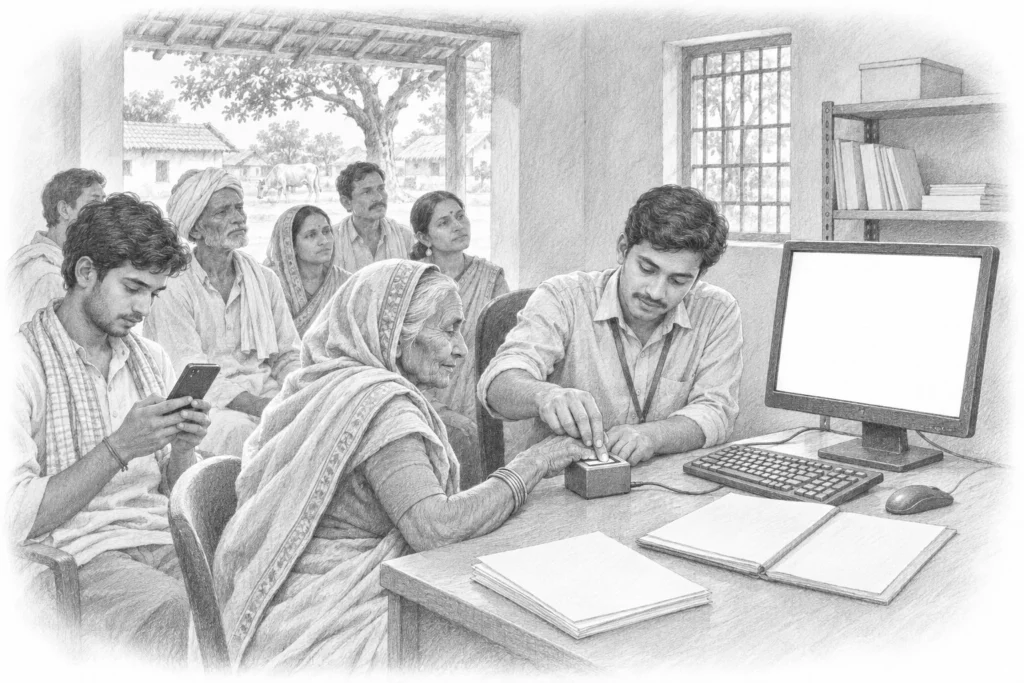
THIRTY YEARS AGO, getting a caste certificate, a land record or a railway ticket meant long queues, many visits to offices and often a bribe. Today many of these services are available on a mobile phone or at a village common service centre, and welfare money is transferred directly into bank accounts. This change is the result of e-governance, i.e. the use of information and communication technology (ICT) to deliver government services, exchange information and make administration more efficient, transparent and accountable. This chapter traces the journey of e-governance in India, explains its models, and studies the Digital India mission as a case study.
4.1 E-Governance: Meaning and Objectives
E-governance (electronic governance) means the use of ICT, such as computers, the internet and mobile phones, by the government to deliver services to citizens and businesses, to exchange information between departments, and to improve internal administration. The Second Administrative Reforms Commission, in its eleventh report ‘Promoting e-Governance: The SMART Way Forward’ (2008), described good e-governance as SMART: Simple, Moral, Accountable, Responsive and Transparent. E-governance is different from e-government: e-government means putting government services online, while e-governance is the wider transformation of the relationship between government and citizens.
Objectives and Benefits
- Efficiency: faster processing, less paperwork and lower costs.
- Transparency: online records and tracking reduce discretion and corruption.
- Accessibility: services available anytime, anywhere, including in villages through service centres.
- Accountability: digital records allow monitoring of officials and programmes.
- Participation: platforms such as MyGov (2014) allow citizens to give suggestions.
- Better targeting of welfare: Direct Benefit Transfer (DBT) reduces leakages by paying beneficiaries directly.
4.2 The Journey of E-Governance in India
E-governance in India developed in several phases (Figure 4.2):
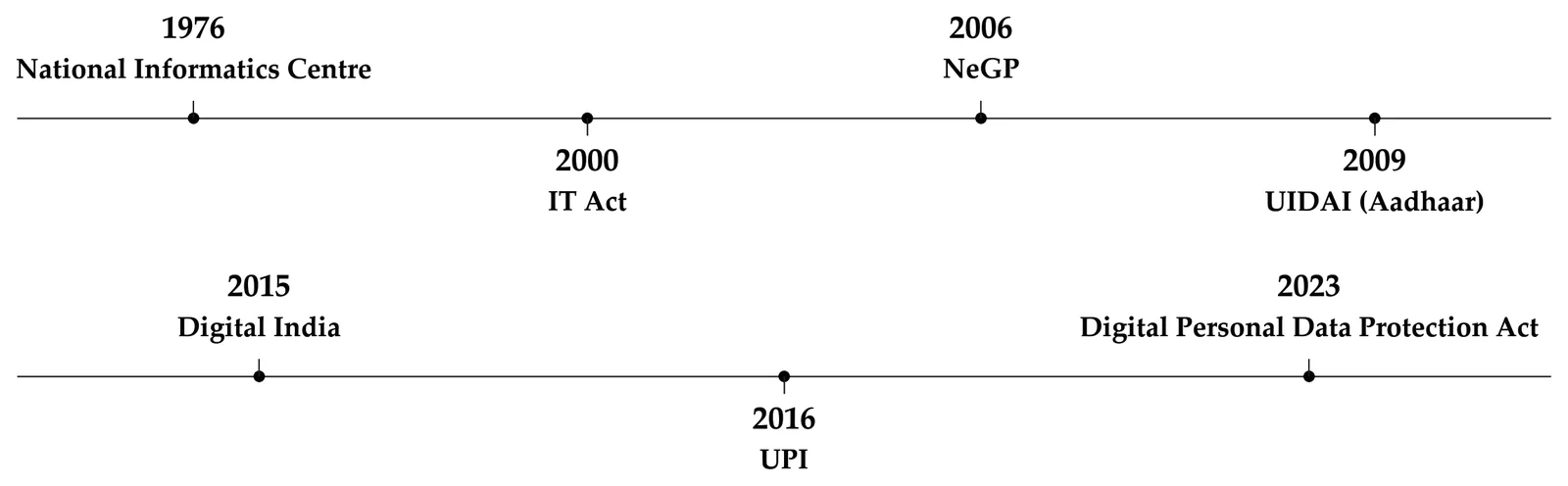
- Computerisation (1970s–1980s). The Department of Electronics was set up in 1970, and the National Informatics Centre in 1976. NICNET (1987) linked district headquarters by satellite. Early computerisation focused on internal use, such as the census, elections and payroll.
- Early citizen services and state initiatives (1990s–early 2000s). Railway passenger reservations were computerised from the mid-1980s; states launched pioneering projects such as Bhoomi in Karnataka (land records, 2000), e-Seva in Andhra Pradesh (2001), Gyandoot in Madhya Pradesh (1999–2000) and FRIENDS in Kerala. The Information Technology Act, 2000 gave legal recognition to electronic records and digital signatures.
- National e-Governance Plan (2006). NeGP adopted a programme of Mission Mode Projects (MMPs) at central, state and integrated levels, such as income tax, passports, land records, e-courts and e-procurement, supported by common infrastructure: State Wide Area Networks (SWAN), State Data Centres and Common Service Centres (CSCs) in villages.
- Digital identity and payments (2009–2016). The UIDAI was set up in 2009 to issue Aadhaar, a unique biometric identity, later given statutory backing by the Aadhaar Act, 2016. The ‘JAM trinity’ of Jan Dhan bank accounts (2014), Aadhaar and Mobile phones made Direct Benefit Transfer possible, and the Unified Payments Interface (UPI, 2016) transformed digital payments.
- Digital India (2015 onwards). Launched on 1 July 2015, it brought e-governance initiatives together under one programme (Section 4.4), and e-Kranti became NeGP 2.0.
- Data protection. After the Supreme Court recognised privacy as a fundamental right in Justice K.S. Puttaswamy v. Union of India (2017), Parliament passed the Digital Personal Data Protection Act, 2023.
The legal framework
E-governance rests on a legal framework. The Information Technology Act, 2000 gave legal recognition to electronic records and digital signatures; the Aadhaar Act, 2016 governs the unique identity number, which the Supreme Court upheld for welfare in 2018 while limiting its use by private bodies; and the Digital Personal Data Protection Act, 2023 sets rules for collecting and using personal data. These laws try to balance efficiency with privacy and security.
4.3 Models of E-Governance
E-governance is usually classified by the parties involved in an interaction (Figure 4.3):
- Government to Citizen (G2C): services to citizens, such as certificates, land records, passports (Passport Seva), income tax filing, DigiLocker and Direct Benefit Transfer.
- Government to Business (G2B): services to businesses, such as company registration (MCA21), GST filing, e-procurement and the Government e-Marketplace (GeM, 2016).
- Government to Government (G2G): exchange of information within and between governments, such as e-Office, the Public Financial Management System (PFMS) and data sharing between departments.
- Government to Employee (G2E): services to government employees, such as online payroll, e-HRMS, attendance systems and online training (iGOT).

Scholars also describe models of how e-governance develops. The stages model of Karen Layne and Jungwoo Lee (2001) describes four stages: cataloguing (putting information online), transaction (online services and payments), vertical integration (linking local, state and national systems for the same function) and horizontal integration (linking different functions into a one-stop service). Other classifications speak of the broadcasting, critical flow, comparative analysis, mobilisation and interactive-service models of e-governance.
4.4 Case Study: The Digital India Mission
Digital India was launched on 1 July 2015 with the aim of transforming India into a digitally empowered society and knowledge economy. It is coordinated by the Ministry of Electronics and Information Technology (MeitY).
Three Vision Areas
- Digital infrastructure as a core utility to every citizen: high-speed internet, a unique digital identity, mobile phone and bank account, safe cyberspace and shareable private space on the cloud.
- Governance and services on demand: integrated services across departments, available online and on mobile in real time, with digital financial transactions.
- Digital empowerment of citizens: universal digital literacy, digital resources and services in Indian languages, and participatory governance.
Nine Pillars
The programme rests on nine pillars: (1) broadband highways (including BharatNet to connect gram panchayats); (2) universal access to mobile connectivity; (3) the Public Internet Access Programme (Common Service Centres and post offices); (4) e-Governance: reforming government through technology; (5) e-Kranti: electronic delivery of services in education, health, farming, justice and finance; (6) information for all (open data, MyGov); (7) electronics manufacturing; (8) IT for jobs; and (9) early harvest programmes, such as biometric attendance and Wi-Fi in universities.
Major Achievements
Digital India has delivered Aadhaar to over a billion people, UPI payments on a massive scale, DigiLocker for digital documents, UMANG (2017) as a single mobile app for many services, e-Hospital, e-NAM (2016) for agricultural markets, CoWIN for vaccination during COVID-19, and Direct Benefit Transfer across hundreds of schemes. India’s Digital Public Infrastructure (identity, payments and data exchange) has been praised internationally.
Problems and Criticism
Critics point to the digital divide between urban and rural areas, rich and poor, men and women; exclusion when biometric authentication fails, which has denied rations and pensions to some vulnerable people; concerns about privacy and surveillance; cyber-security risks; poor connectivity in remote areas; and low digital literacy. The Supreme Court, in the Aadhaar judgment (2018), upheld Aadhaar for welfare but struck down its mandatory use by private companies.
Reaching the last mile
To bring e-governance to villages, the government created Common Service Centres, run by local entrepreneurs, which provide services such as certificates, bill payments and pension applications. BharatNet aims to connect all gram panchayats with broadband, and the PMGDISHA programme trains rural citizens in digital literacy. Without such efforts, online services would widen the gap between the connected and the unconnected.
4.5 Challenges of E-Governance
- Digital divide: unequal access to devices, internet and skills.
- Exclusion errors: failures of authentication and connectivity can deny entitlements.
- Privacy and data protection: large databases raise risks of misuse and surveillance.
- Cyber security: government systems face hacking and data breaches.
- Language and design barriers: many services are not user-friendly or available in local languages.
- Back-end reform: technology alone does not help if processes and attitudes do not change; the Second ARC stressed process re-engineering before computerisation.
India in global perspective
Countries such as Estonia, where almost all public services are online, and South Korea are often cited as leaders in e-government. India’s distinctive contribution is its Digital Public Infrastructure, open, interoperable platforms for identity, payments and data sharing that serve hundreds of millions of people at low cost, which other countries have begun to study and adopt.
4.6 Important Questions
- Question 1 What is e-governance? Trace the journey of e-governance in India.
- Question 2 Discuss the models of e-governance with reference to the Digital India Mission.
DU asks the same idea in different words. So learn one broad answer for each question below; the same answer works for every question joined by OR.
Important Question 1
What is e-governance? Trace the journey of e-governance in India.
OR
Discuss the evolution of e-governance in India.
OR
Examine the role of technology in public administration in India.
Model Answer
“Simple, Moral, Accountable, Responsive and Transparent.”
— Second ARC on SMART e-governance (2008)
Introduction. E-governance means the use of information and communication technology by the government to deliver services, exchange information and improve administration. In India it has grown from internal computerisation in the 1970s to a vast digital public infrastructure.
1. Meaning and Objectives
E-governance aims at efficiency, transparency, accessibility, accountability, participation and better targeting of welfare; the Second ARC described good e-governance as SMART. The World Bank describes e-governance as the use of information technology by government agencies to transform relations with citizens, businesses and other arms of government. It aims to shift government from paper files to citizen-centred online services.
2. Stages of E-Governance
E-governance usually develops in stages: publishing information online, two-way interaction, online transactions and finally integrated services across departments.
3. Computerisation Phase
The Department of Electronics (1970), the National Informatics Centre (1976) and NICNET (1987) computerised internal tasks such as the census and elections. NICNET (1987) linked district headquarters through a satellite network. Railway reservations were computerised from 1986, a landmark for public services.
4. State Initiatives and Legal Framework
Bhoomi (Karnataka), e-Seva (Andhra Pradesh), Gyandoot (Madhya Pradesh) and FRIENDS (Kerala) pioneered citizen services; the IT Act, 2000 recognised electronic records and signatures. The Information Technology Act (2000) gave legal recognition to electronic records and digital signatures.
5. The National e-Governance Plan (2006)
NeGP launched Mission Mode Projects in areas such as income tax, passports, land records and e-courts, supported by State Wide Area Networks, State Data Centres and Common Service Centres. Common Service Centres were set up in villages to deliver services.
6. Identity, Payments and Digital India
Aadhaar (UIDAI, 2009), the JAM trinity and UPI (2016) enabled Direct Benefit Transfer, and Digital India (2015) brought initiatives together; the DPDP Act (2023) addresses privacy. Digital India (2015) aimed to make India a digitally empowered society and knowledge economy.
7. E-Governance and Accountability
Online tracking of applications, public dashboards and grievance portals such as CPGRAMS make officials more accountable and reduce discretion and corruption.
8. Cyber Security and Privacy
The growth of digital government raises risks of data breaches and surveillance; the Digital Personal Data Protection Act (2023) seeks to protect personal data.
9. Achievements and Challenges
E-governance has reduced delays and leakages and widened access, but the digital divide, exclusion errors, privacy concerns and cyber threats remain, and technology must be accompanied by process re-engineering. Language barriers also limit use, since many services work best in English.
10. Models and Pioneering Projects
E-governance serves citizens (G2C), businesses (G2B), other governments (G2G) and employees (G2E). Pioneering projects showed its potential: Bhoomi computerised millions of land records in Karnataka, reducing bribery; e-Seva offered bill payments and certificates at one counter in Andhra Pradesh; and Gyandoot brought information kiosks to tribal villages in Dhar, Madhya Pradesh. Gyandoot (2000) in Dhar district of Madhya Pradesh used village kiosks to provide information and services.
11. Process Re-engineering
The Second ARC warned that computerising inefficient processes only makes them faster, not better. Successful e-governance requires simplifying procedures, removing unnecessary steps and changing attitudes, along with training officials and citizens. Bhoomi succeeded because it changed procedures, not just records.
12. Achievements
E-governance has reduced queues and delays through online passports, income tax and certificates, cut leakages through DBT, increased transparency through online land records and e-procurement, and widened access through Common Service Centres and mobile apps such as UMANG.
13. Good Governance and E-Governance
E-governance supports the aims of good governance by making government simple, moral, accountable, responsive and transparent, the ‘SMART’ idea often used in Indian policy.
14. Evaluation
E-governance has transformed the delivery of many services in India, but technology is only a tool: its success depends on process reform, digital inclusion, privacy protection and the will to serve citizens.
Conclusion. Thus, India’s journey of e-governance shows how technology can make administration faster and more transparent, provided it remains inclusive and protects citizens’ rights.
Important Question 2
Discuss the models of e-governance with reference to the Digital India Mission.
OR
Critically evaluate the Digital India programme.
OR
Write a note on G2C and G2B services.
Model Answer
“Power to Empower.”
— Digital India (2015)
Introduction. E-governance can be classified into models according to the parties involved. The Digital India Mission, launched in 2015, is the most comprehensive attempt to apply these models in India.
1. Models of E-Governance
G2C (certificates, passports, DBT, DigiLocker), G2B (GST, MCA21, e-procurement, GeM), G2G (e-Office, PFMS) and G2E (e-HRMS, iGOT training). The Layne and Lee stages model describes the growth from cataloguing and transactions to vertical and horizontal integration. Government-to-employee (G2E) services, such as online payroll and training, form a further model.
2. Functional Models
Textbooks also describe models by function: the broadcasting model puts information online, the critical flow model directs information to target groups, the comparative analysis model uses data to improve decisions, the mobilisation model supports advocacy, and the interactive-service model allows two-way transactions.
3. Digital India: Vision Areas
Digital infrastructure as a core utility, governance and services on demand, and digital empowerment of citizens. It was launched on 1 July 2015 as an umbrella programme.
4. Nine Pillars
Broadband highways (BharatNet), mobile connectivity, public internet access, e-governance, e-Kranti, information for all, electronics manufacturing, IT for jobs and early harvest programmes. e-Kranti aims at electronic delivery of services in education, health, agriculture and justice.
5. Digital India and Federalism
Many services are delivered by states, and states such as Kerala, Andhra Pradesh and Karnataka have their own platforms, so Digital India depends on cooperation between the Union and the states.
6. Achievements
Aadhaar, UPI, DigiLocker, UMANG, e-NAM, CoWIN and large-scale DBT show the reach of India’s digital public infrastructure. UPI handles billions of transactions every month and has been adopted by several other countries.
7. Technology and Democracy
Digital tools have made information more accessible but also raise concerns about surveillance, internet shutdowns and misinformation, showing that technology can both empower and control citizens.
8. Beyond Administration
Platforms such as e-NAM for agricultural markets, Soil Health Cards, CoWIN for vaccination and e-Sanjeevani for telemedicine show how digital tools reach sectors beyond administration.
9. Criticism
The digital divide, authentication failures that exclude the poor, privacy and surveillance concerns, cyber-security risks and low digital literacy limit its benefits; the Aadhaar judgment (2018) set limits on its use. Reports of ration denial because of authentication failures in Jharkhand illustrated the human cost of exclusion.
10. The Aadhaar Debate
Aadhaar enabled direct transfers and reduced duplicate beneficiaries, but critics raised concerns about privacy, surveillance and exclusion. In Puttaswamy (2018), the Supreme Court upheld Aadhaar for welfare schemes and income tax, but struck down its mandatory use by private companies and for bank accounts and mobile connections. In the Aadhaar judgment (2018) the Supreme Court upheld it for welfare but struck down its mandatory use by private companies.
11. Digital Public Infrastructure
India’s Digital Public Infrastructure combines a digital identity (Aadhaar), a payments layer (UPI) and data exchange (DigiLocker and consent-based data sharing), often called the ‘India Stack’. It allows public and private services to be built on common platforms, and India promoted the idea during its G20 presidency (2023). India promoted DPI internationally during its G20 presidency in 2023.
12. Inclusion and Digital Literacy
To bridge the digital divide, the government launched the Pradhan Mantri Gramin Digital Saksharta Abhiyan (2017) to make rural households digitally literate, BharatNet to connect gram panchayats, and services in Indian languages; yet women, the elderly and the poor still have less access to devices and the internet. Women and rural residents remain less likely to own smartphones or use the internet.
13. Data and Governance
Digital systems produce large amounts of data that can improve policy, as in targeting welfare or tracking disease, but they also need safeguards against misuse and exclusion.
14. Evaluation
Digital India has made India a global leader in digital public infrastructure, but its benefits will be fully realised only when every citizen has access, skills and protection of their rights in the digital world.
Conclusion. Thus, Digital India has applied the main models of e-governance on a vast scale. Its success depends on making technology inclusive, secure and accountable to citizens.
Short Notes
(a) Common Service Centres
Common Service Centres (CSCs) are village-level ICT access points, created under the National e-Governance Plan (2006), run by local entrepreneurs called Village Level Entrepreneurs. They deliver government services such as certificates, Aadhaar enrolment, bill payments, banking and insurance to rural citizens, bridging the digital divide. They are a key part of the Public Internet Access Programme of Digital India.
(b) Direct Benefit Transfer (DBT)
Launched on 1 January 2013, DBT transfers subsidies and welfare payments directly into beneficiaries’ bank accounts, often linked to Aadhaar. It aims to reduce leakages, delays and corruption, and covers schemes such as LPG subsidy (PAHAL), scholarships, pensions and PM-KISAN. Critics note exclusion when bank or Aadhaar linkage fails.
More notes: MDSC-1B Public Administration in India
These notes are prepared by PADHO TO AISE for study help. They are not an official University of Delhi publication.