
Semester I MDSC-1B Public Administration in India
Unit III · 18 min read · Updated 24 Nov 2026
As per the University of Delhi (DU) BA (Hons) Political Science syllabus
Contents
- 3.1 Concept of the Budget
- Features and Functions of the Budget
- Parts of the Union Budget
- 3.2 The Budget Cycle in India
- 3.3 Types of Budget
- 3.4 Budget Making: The Role of the Finance Ministry
- 3.5 Important Questions
- What is a budget? Explain the budget cycle in India.
- Distinguish between line-item, performance and zero-based budgeting.
- Short Notes
सभी कार्य कोष पर निर्भर हैं; इसलिए सबसे पहले कोष पर ध्यान देना चाहिए।
All undertakings depend upon finance. Hence foremost attention shall be paid to the treasury.
— Kautilya, Arthashastra
EVERY YEAR on 1 February the Union Finance Minister presents the budget in Parliament, and the whole country watches. The budget decides how much the government will collect in taxes and how much it will spend on defence, education, health, roads, subsidies and welfare. It is therefore much more than an accounting statement: it is the government’s main policy document and the most important instrument of financial administration. This chapter explains the concept of the budget, the budget cycle in India, the main types of budgeting (line-item, performance, planning-programming and zero-based), and the role of the Finance Ministry in making the budget.
3.1 Concept of the Budget
A budget is a statement of the estimated receipts and expenditure of the government for a financial year, which in India runs from 1 April to 31 March. The Constitution does not use the word ‘budget’; Article 112 calls it the Annual Financial Statement. It shows the government’s plans for raising money through taxes and borrowing and for spending it on different purposes.
Features and Functions of the Budget
- Financial plan: it estimates income and expenditure for the coming year.
- Instrument of legislative control: under Articles 265 and 266, no tax can be collected and no money spent from the Consolidated Fund without the approval of Parliament.
- Policy document: it reflects the government’s priorities, such as poverty reduction, defence or infrastructure.
- Instrument of economic management: through taxes, spending and borrowing it influences growth, inflation and employment, as J.M. Keynes argued during the Great Depression.
- Instrument of administrative control and accountability: it allocates resources to departments and makes them answerable for their use.
- Instrument of redistribution: through taxes and welfare spending it can reduce inequality.
Parts of the Union Budget
The budget has two main parts. The revenue budget consists of revenue receipts (tax and non-tax revenue) and revenue expenditure (salaries, interest, subsidies, grants). The capital budget consists of capital receipts (borrowing, recovery of loans, disinvestment) and capital expenditure (building assets such as roads and dams, and loans). The difference between total expenditure and total receipts other than borrowings is the fiscal deficit. Government money is kept in three funds: the Consolidated Fund of India (Article 266), the Contingency Fund (Article 267) for unforeseen expenditure, and the Public Account for money held in trust, such as provident funds.
3.2 The Budget Cycle in India
The budget cycle is the sequence of stages through which a budget passes every year (Figure 3.2). Each year’s cycle overlaps with the next, so that at any time one budget is being executed, another prepared and an earlier one audited.

Stage 1: Preparation
Preparation begins around August–September with a budget circular issued by the Budget Division of the Department of Economic Affairs in the Finance Ministry. Spending departments prepare estimates of their expenditure, which are examined by their financial advisers and discussed with the Finance Ministry. The Department of Revenue estimates tax receipts, and the Finance Minister, in consultation with the Prime Minister and NITI Aayog, decides priorities and tax proposals. The finalised budget is approved by the cabinet just before presentation.
Stage 2: Enactment (legislative approval)
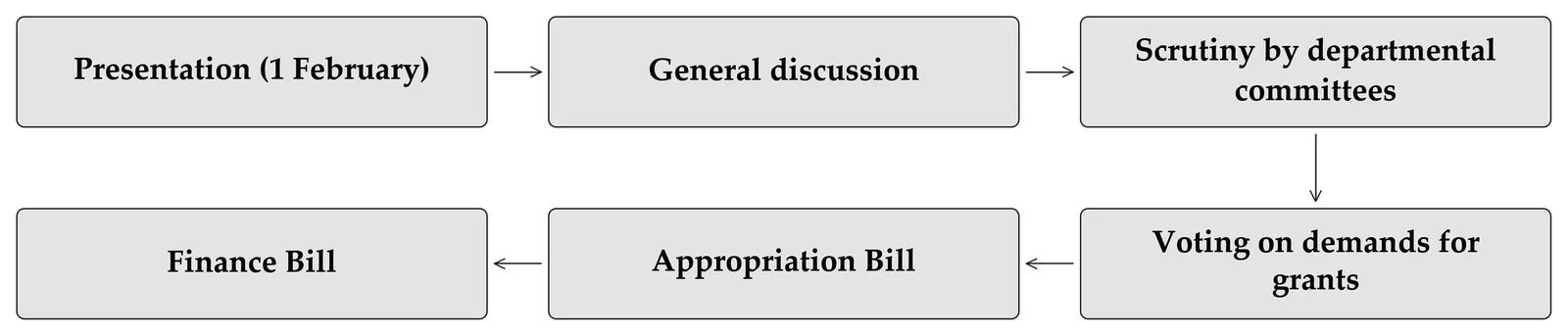
Parliament passes the budget in several steps (Figure 3.3): the presentation by the Finance Minister on 1 February; a general discussion in both Houses; scrutiny of each ministry’s demands by the Departmentally Related Standing Committees; discussion and voting on demands for grants in the Lok Sabha, which may approve, reduce (through cut motions) or reject them, though the Rajya Sabha cannot vote on demands; the Appropriation Bill (Article 114), which authorises withdrawal of money from the Consolidated Fund; and the Finance Bill, which gives effect to the tax proposals. Since the whole process may not be completed by 31 March, Parliament can pass a vote on account (Article 116) to allow spending for a few months.
Stage 3: Execution
After approval, the Finance Ministry releases funds to ministries, which spend them through their departments. Expenditure is controlled through financial advisers, the Controller General of Accounts and the system of re-appropriation and supplementary grants (Article 115) when needs change during the year.
Stage 4: Audit and parliamentary review
The Comptroller and Auditor General (CAG), an independent constitutional authority under Article 148, audits government accounts and reports to Parliament. The Public Accounts Committee, traditionally chaired by a member of the opposition, examines the CAG’s reports, and the Estimates Committee examines how estimates can be made more economical. This completes the cycle of accountability.
3.3 Types of Budget
Budgeting has developed through several systems, each answering a different question (Figure 3.4).

A. Line-item (traditional) budget
The line-item budget lists expenditure by objects or items, such as salaries, travel, office supplies and equipment, for each department. Its focus is on inputs and its aim is control: ensuring that money is spent only on approved items and preventing misuse. It is simple, easy to prepare and audit, and encourages accountability. But it says nothing about what the money achieves, encourages incremental increases year after year, and makes it hard to judge performance or set priorities. It remains the basic format of most government budgets.
B. Performance budget
A performance budget classifies expenditure by functions, programmes and activities, and relates money spent to the work done and results achieved, for example the number of kilometres of road built or students enrolled. It was recommended by the Hoover Commission in the United States (1949). In India the First Administrative Reforms Commission (1968) recommended it, and it was introduced in several ministries from 1969. In 2005 the Government of India introduced the Outcome Budget, linking outlays to measurable outcomes. Its strength is its focus on results; its weakness is that outputs in government are often hard to measure.
C. Planning-Programming-Budgeting System (PPBS)
PPBS links budgeting to long-term planning and to the choice among alternative programmes. It was introduced in the US Department of Defense by Robert McNamara in 1961 and extended to other departments by President Lyndon Johnson in 1965. It involves setting objectives, identifying alternative programmes, analysing their costs and benefits, and budgeting for the best ones over several years. It encourages rational, long-term thinking but requires detailed data and analysis, and it was abandoned in the US federal government in 1971 because of its complexity.
D. Zero-based budgeting (ZBB)
In zero-based budgeting, every programme must be justified afresh from zero each year, rather than taking the previous year’s budget as the base. Each activity is described in a ‘decision package’, ranked by priority and funded accordingly. ZBB was developed by Peter Pyhrr at Texas Instruments (1969, published 1970) and adopted by Jimmy Carter as Governor of Georgia (1973) and as US President (1977). In India it was introduced in the Department of Science and Technology (1983) and extended to other departments from 1986–87. It eliminates wasteful and outdated programmes, but it is time-consuming and costly, and many government commitments, such as salaries and interest, cannot really start from zero.
| Type | Basic question | Focus | Origin | Main limitation |
|---|---|---|---|---|
| Line-item | What will be bought? | Inputs; control | Traditional | Ignores results |
| Performance | What will be done and achieved? | Activities, outputs | Hoover Commission (1949) | Outputs hard to measure |
| PPBS | Which programmes best meet goals? | Planning, alternatives | McNamara (1961) | Complex, data-heavy |
| Zero-based | Should this activity exist at all? | Justification from zero | Peter Pyhrr (1970) | Time-consuming |
Parliament’s financial committees
Three committees help Parliament control public money. The Public Accounts Committee, chaired by a member of the opposition since 1967, examines the CAG’s audit reports; the Estimates Committee examines whether money is being spent economically; and the Committee on Public Undertakings examines public sector enterprises. Departmentally related standing committees also examine the demands for grants of each ministry before they are voted.
3.4 Budget Making: The Role of the Finance Ministry
The Ministry of Finance is the central agency of financial administration. It has several departments: Economic Affairs, Expenditure, Revenue, Financial Services, Investment and Public Asset Management (DIPAM) and Public Enterprises. Its roles in budget making are these:
- Preparing the budget: the Budget Division of the Department of Economic Affairs issues the budget circular, consolidates estimates and prepares the budget documents.
- Estimating revenue: the Department of Revenue, through the Central Board of Direct Taxes and the Central Board of Indirect Taxes and Customs, estimates receipts and prepares tax proposals.
- Controlling expenditure: the Department of Expenditure scrutinises proposals, sets ceilings and appoints financial advisers in ministries.
- Economic policy: the Finance Ministry prepares the Economic Survey, presented a day before the budget, and sets fiscal targets under the Fiscal Responsibility and Budget Management (FRBM) Act, 2003.
- Coordination: it coordinates with the Prime Minister’s Office, NITI Aayog, the Reserve Bank of India and the GST Council.
- Presentation and defence: the Finance Minister presents the budget, defends it in Parliament and pilots the Finance Bill.
Recent changes include advancing the budget to 1 February (2017) so that funds are available from the start of the year, merging the Railway Budget into the Union Budget (2017), removing the distinction between Plan and Non-Plan expenditure after the Planning Commission was replaced, and introducing gender budgeting (2005–06) and outcome budgets. Critics argue that the Finance Ministry dominates spending ministries, that parliamentary scrutiny is weak because many demands are passed without discussion (the ‘guillotine’), and that budgets lack transparency about off-budget borrowing.
The budget, the Finance Commission and the GST
The Union budget is shaped by two other institutions. The Finance Commission (Article 280) decides what share of central taxes goes to the states, which determines how much the Union itself can spend. Since 2017 the GST Council, in which the Union and states decide together, sets the rates of most indirect taxes, so these taxes are no longer changed in the budget speech. Budgeting in India is therefore a matter of cooperative fiscal federalism as well as of the Finance Ministry.
3.5 Important Questions
- Question 1 What is a budget? Explain the budget cycle in India.
- Question 2 Distinguish between line-item, performance and zero-based budgeting.
DU asks the same idea in different words. So learn one broad answer for each question below; the same answer works for every question joined by OR.
Important Question 1
What is a budget? Explain the budget cycle in India.
OR
Discuss the process of budget making in India.
OR
Examine the role of Parliament in the budgetary process.
Model Answer
“All undertakings depend upon finance.”
— Kautilya, Arthashastra
Introduction. A budget is a statement of the estimated receipts and expenditure of the government for a financial year. In India the Constitution calls it the Annual Financial Statement (Article 112). It passes every year through a cycle of preparation, enactment, execution and audit.
1. Meaning and Significance
The budget is a financial plan, a policy document, an instrument of economic management and redistribution, and a means of legislative and administrative control. Articles 265 and 266 require parliamentary approval for every tax and every expenditure from the Consolidated Fund. Article 112 calls it the Annual Financial Statement, showing estimated receipts and expenditure for the coming year.
2. Principles of Budgeting
A sound budget is comprehensive, annual, as balanced as possible, transparent and subject to legislative approval, so that public money is used legally and efficiently.
3. Preparation
From August–September the Budget Division of the Department of Economic Affairs issues a budget circular; ministries prepare estimates; the Department of Revenue estimates receipts; and the Finance Minister, with the Prime Minister and the cabinet, finalises priorities and tax proposals. Ministries send their estimates, and the Finance Ministry holds pre-budget consultations with industry, farmers, economists and states.
4. Charged and Voted Expenditure
Charged expenditure, such as the salaries of the President and judges and interest on debt, is not voted on by Parliament, while all other expenditure is voted through demands for grants.
5. Enactment
The budget is presented on 1 February; it undergoes general discussion, scrutiny by standing committees, and voting on demands for grants in the Lok Sabha; then the Appropriation Bill (Article 114) and the Finance Bill are passed. A vote on account (Article 116) allows interim spending. After the standing committees examine the demands for grants, the Lok Sabha votes on them, and Parliament then passes the Appropriation Bill and the Finance Bill.
6. Vote on Account and Guillotine
If the budget cannot be passed before 1 April, Parliament passes a vote on account (Article 116) to allow spending for a few months; when the time for discussion ends, all remaining demands are put to the vote together, which is called the ‘guillotine’.
7. Execution
The Finance Ministry releases funds; ministries spend through their departments under the control of financial advisers and the Controller General of Accounts; supplementary grants (Article 115) meet new needs. The Controller General of Accounts maintains the accounts, and the Public Financial Management System tracks spending.
8. Supplementary Grants
If the money voted proves insufficient, the government seeks supplementary or additional grants under Article 115, and excess grants after the year ends.
9. Audit
The CAG (Article 148) audits accounts and reports to Parliament; the Public Accounts Committee and the Estimates Committee examine the reports and estimates. The CAG’s reports have exposed major irregularities, such as in the allocation of telecom spectrum and coal blocks. The CAG is independent and can be removed only in the manner of a Supreme Court judge.
10. Gender and Outcome Budgets
Since 2005–06 India has published a gender budget statement showing allocations for women, and outcome budgets that link spending to results.
11. Fiscal Responsibility
The Fiscal Responsibility and Budget Management Act (2003) set targets for reducing deficits, making budget-making more disciplined.
12. Evaluation
The cycle ensures legality and accountability, but parliamentary scrutiny is often weak, many demands are passed by the guillotine without discussion, and audit comes long after the money is spent. Much of the budget is passed by the ‘guillotine’ without discussion.
13. Constitutional Provisions
Article 112 (Annual Financial Statement), Article 113 (procedure for estimates), Article 114 (Appropriation Bill), Article 115 (supplementary grants), Article 116 (vote on account), Article 117 (financial bills), Article 265 (no tax without law) and Articles 266–267 (Consolidated and Contingency Funds) together provide the legal framework of the budget. Article 114 provides for the Appropriation Bill and Article 117 for financial bills.
14. Recent Changes
Since 2017 the budget is presented on 1 February so that funds are available from 1 April; the Railway Budget has been merged into the Union Budget; the distinction between Plan and Non-Plan expenditure has been removed; and outcome budgets (2005) and gender budgeting (2005–06) link spending to results and equity. The Railway Budget was merged with the Union Budget in 2017.
Conclusion. Thus, the budget cycle links planning, legislative approval, implementation and accountability, making the budget the central instrument of democratic financial administration.
Important Question 2
Distinguish between line-item, performance and zero-based budgeting.
OR
Write a note on zero-based budgeting.
OR
Discuss the different types of budget.
Model Answer
“The budget is the skeleton of the state stripped of all misleading ideologies.”
— Rudolf Goldscheid (1917), quoted by Joseph Schumpeter
Introduction. Budgeting systems have evolved from simple control of expenditure to systems that link money with results, plans and priorities. The main types are line-item, performance, planning-programming-budgeting and zero-based budgeting.
1. Line-item Budget
It lists expenditure by objects such as salaries and supplies, focusing on inputs and control. It is simple and easy to audit, but ignores results and encourages incremental growth. It developed in the nineteenth and early twentieth centuries to control spending and prevent fraud.
2. Performance Budget
It classifies expenditure by programmes and activities and relates spending to outputs. Recommended by the Hoover Commission (1949) and in India by the First ARC (1968), it led to the Outcome Budget (2005). Outputs are, however, hard to measure. The Hoover Commission (1949) in the United States recommended it, and India’s First ARC recommended it in 1968.
3. PPBS
Introduced by McNamara (1961), it links budgeting to long-term planning and the choice among alternative programmes through cost-benefit analysis, but it proved complex and data-heavy. It was extended across the US federal government in 1965 but abandoned in 1971 as too complex. It required clear goals, alternative programmes and cost–benefit analysis.
4. Zero-based Budget
Developed by Peter Pyhrr (1970), it requires every activity to be justified from zero through ranked decision packages. India introduced it in 1983 (Department of Science and Technology) and more widely from 1986–87. It removes outdated programmes but is time-consuming. President Jimmy Carter applied it in the US federal government in 1977, and India introduced it in some departments from 1986–87.
5. Outcome Budget
The outcome budget goes beyond performance budgeting by measuring results, such as children learning or diseases reduced, not just activities completed.
6. Gender Budgeting
Gender budgeting examines how spending affects women and men differently, and India has issued a gender budget statement since 2005–06.
7. Participatory Budgeting
In participatory budgeting, pioneered in Porto Alegre, Brazil (1989), citizens help decide how part of a local budget is spent, and Indian cities such as Pune have experimented with it.
8. Budgeting and Accountability
Each type answers a different accountability question: whether money was spent legally (line-item), whether it produced work (performance), whether it achieved goals (outcome) and whether an activity should continue at all (zero-based).
9. Comparison
Line-item budgeting asks what will be bought; performance budgeting what will be achieved; PPBS which programme best meets goals; and ZBB whether an activity should exist at all. Modern governments combine them: line-items for control, outcome budgets for results. Each reflects a stage in the evolution of public budgeting, from control to management to planning and prioritisation.
10. Choosing the Best System
No single system fits every purpose: line-item budgets suit control, performance and outcome budgets suit management, and zero-based budgets suit periodic review. Modern governments combine them.
11. Budgeting Reforms in India
India has adopted elements of several systems: line-item heads for control, performance budgets from 1969, zero-based reviews from the 1980s, and the Outcome Budget from 2005, which states the physical outputs and outcomes expected from each scheme. The FRBM Act, 2003 set targets for fiscal and revenue deficits to promote fiscal discipline. Outcome budgets, introduced in 2005, link outlays to measurable outcomes.
12. Use in Indian States
States such as Maharashtra and Madhya Pradesh have experimented with zero-based and outcome budgeting, and several states publish gender budgets.
13. Merits and Demerits Compared
Line-item budgeting is simple, controllable and easy to audit, but rigid and incremental. Performance budgeting focuses on results and efficiency but struggles to measure outputs in services such as education or policing. PPBS encourages long-term, rational choice but needs sophisticated data and analysts. Zero-based budgeting removes obsolete programmes but is time-consuming and impractical for committed expenditure such as salaries, pensions and interest. This is why most governments use a mix. Zero-based budgeting is thorough but time-consuming, while performance budgeting needs reliable measures of output.
14. Evaluation
Budgeting has evolved from a tool of financial control into an instrument of planning, performance and accountability. In India the challenge is to use these methods to link public money to real results for citizens.
Conclusion. Thus, the evolution of budgeting reflects a shift from controlling inputs to managing for results, though no single system is sufficient on its own.
Short Notes
(a) The Comptroller and Auditor General (CAG)
Appointed by the President under Article 148 for a term of six years or until the age of 65, the CAG audits all receipts and expenditure of the Union and the states and submits reports to the President and Governors, which are laid before the legislatures. Removable only like a Supreme Court judge, the CAG is an independent guardian of public money; reports such as those on the 2G spectrum and coal block allocations show its importance.
(b) Gender Budgeting
Introduced in India in 2005–06, gender budgeting analyses the budget for its impact on women and men, and identifies allocations for schemes that benefit women. The Union budget includes a Gender Budget Statement, and many ministries have gender budget cells. It aims to make public spending more equitable.
More notes: MDSC-1B Public Administration in India
These notes are prepared by PADHO TO AISE for study help. They are not an official University of Delhi publication.