
Semester I DSC-1 Understanding Political Theory
Unit V · 30 min read · Updated 24 Nov 2026
As per the University of Delhi (DU) BA (Hons) Political Science syllabus
Contents
- 5.1 The Idea of Political Community
- Conceptions of Political Community
- 5.2 Citizenship
- T.H. Marshall’s Three Elements of Citizenship
- 5.3 Political Obligation: Meaning and the Problem
- 5.4 Theories of Political Obligation
- Critics of Political Obligation
- 5.5 The Limits of Obligation: Resistance and Civil Disobedience
- 5.6 Important Questions
- What are the main arguments in favour of political obligation?
- Discuss the idea of political community.
- What is citizenship? Discuss T.H. Marshall’s theory of citizenship.
- Is there a right to disobey the state? Discuss with reference to civil disobedience.
- Short Notes
तलवार के बिना अनुबंध केवल शब्द हैं।
Covenants, without the sword, are but words.
— Thomas Hobbes, Leviathan (1651)
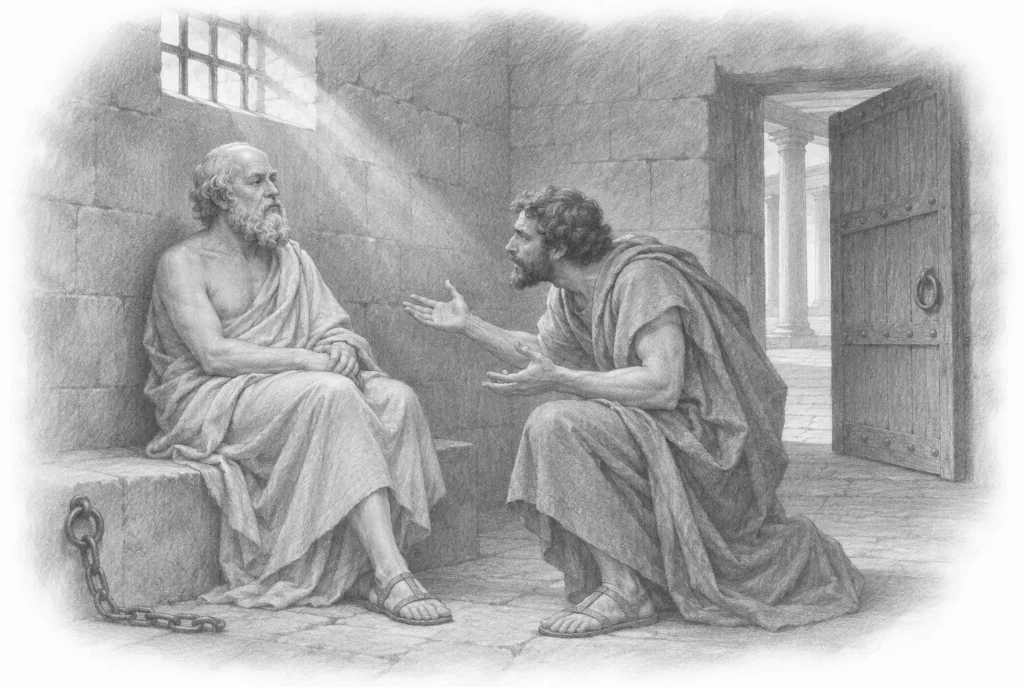
WHY SHOULD I OBEY the law, even a law I think is wrong? In 399 BCE Socrates, condemned to death by an Athenian jury, sat in prison while his friend Crito begged him to escape. Socrates refused: he had lived all his life under the laws of Athens and benefited from them, so he could not now break them. This is the oldest discussion of political obligation, and it already shows that the question is tied to another: to which political community do I belong, and what does membership demand of me? This final unit brings the whole paper together, because the meaning of politics, the normative approach, the great traditions and the critical perspectives all meet in the question of why, and how far, we owe obedience to the state.
5.1 The Idea of Political Community
In simple words, a political community is a group of people who share a common political life. They live under the same authority and laws, take part in common decisions, and see themselves as members of one whole. It is more than a collection of individuals who happen to live in the same territory: its members share some sense of belonging, some common rules and some idea of a common good. The modern form of political community is the nation-state, but people also belong to smaller communities, such as cities and villages, and, some argue, to a wider community of all humanity.
Why does this idea matter for political theory? Because citizenship, political obligation and justice all presuppose an answer to one basic question: who are ‘we’? Before we can ask why citizens should obey their state, we must ask what binds them into a community in the first place.
Conceptions of Political Community
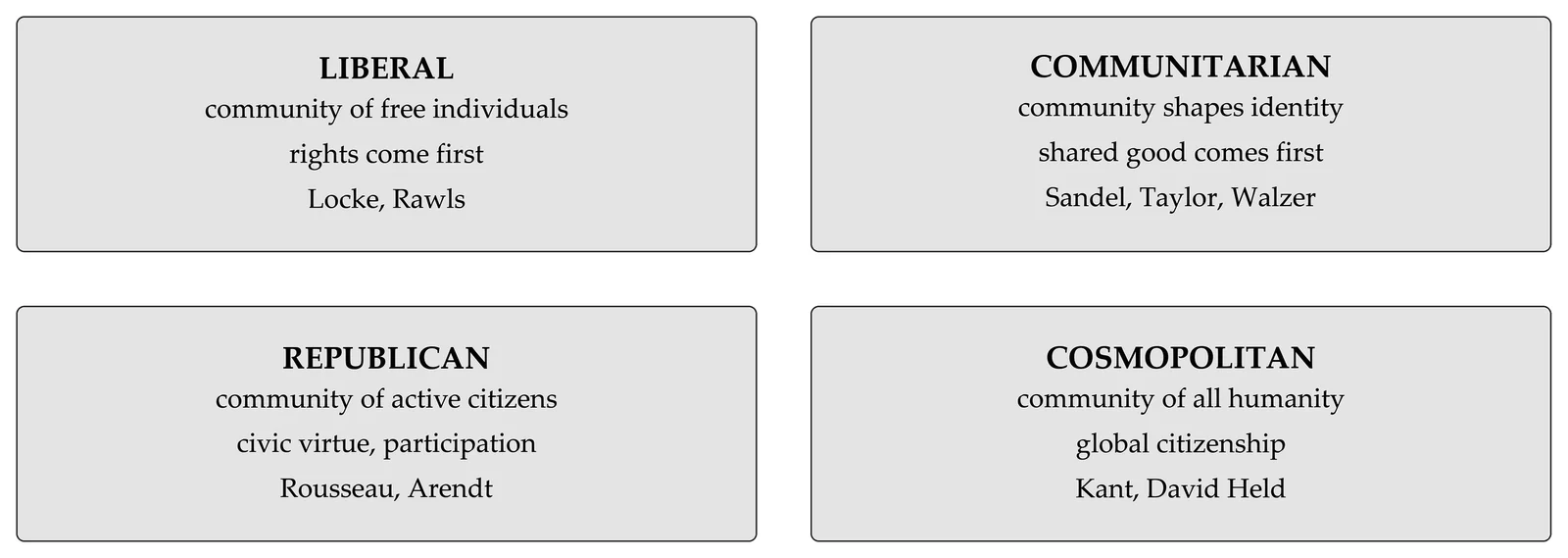
Different traditions understand political community in different ways. Notice the thinker and the context of each view (Figure 5.2):
- Liberal: a community of free individuals. The community exists to protect individual rights and rests on consent. John Rawls, in Political Liberalism (1993), written for modern societies divided by deep religious and moral disagreements, described a just society as a fair system of cooperation among free and equal citizens who need not share one idea of the good life.
- Communitarian: community shapes identity. Michael Sandel, in Liberalism and the Limits of Justice (1982), replied to Rawls that we are not ‘unencumbered selves’: our identities are partly made by the communities to which we belong. Charles Taylor and Michael Walzer, writing in the 1980s amid concern about growing individualism in America, made similar arguments.
- Republican: a community of active citizens. Freedom depends on citizens taking part in governing themselves. Rousseau argued in The Social Contract (1762), in an age of absolute monarchy, that citizens must make the laws they live under through the general will; Hannah Arendt, reflecting on totalitarianism in The Human Condition (1958), saw the political community as a space of shared action.
- Nationalist: a community of the nation. J.S. Mill argued in Considerations on Representative Government (1861), in the age of European national movements, that free institutions are next to impossible in a country made up of different nationalities. Benedict Anderson, in Imagined Communities (1983), showed how print, language and shared history created the feeling of belonging to a nation.
- Multicultural: a community of communities. Will Kymlicka’s Multicultural Citizenship (1995), written in Canada with its French-speaking Québécois and indigenous peoples, defended special rights for minority groups. Bhikhu Parekh’s report on Britain (2000) described the country as ‘a community of communities’.
- Cosmopolitan: a community of humanity. Immanuel Kant’s Perpetual Peace (1795), written amid the wars of the French Revolution, proposed a ‘cosmopolitan right’ belonging to all human beings. David Held, in Democracy and the Global Order (1995), argued that in an age of globalisation democracy must extend beyond the nation-state.
5.2 Citizenship
Membership of a political community is called citizenship. A citizen is a full member of the community who enjoys rights, bears duties and shares in its public life. In ancient Athens citizenship meant sharing in ruling and being ruled, but it was limited to free adult men; the modern idea of the equal citizen was proclaimed by the American and French Revolutions. Today citizenship has four elements: a legal status, a set of rights, a set of duties, and a sense of identity and belonging. (In India, citizenship is governed by Part II of the Constitution, Articles 5 to 11, and the Citizenship Act of 1955.)
Liberals see citizenship mainly as a status that carries rights against the state. Republicans see it as an activity: a good citizen participates in public life and puts the common good above private interest. Communitarians stress belonging, i.e. the shared identity that membership gives.
T.H. Marshall’s Three Elements of Citizenship
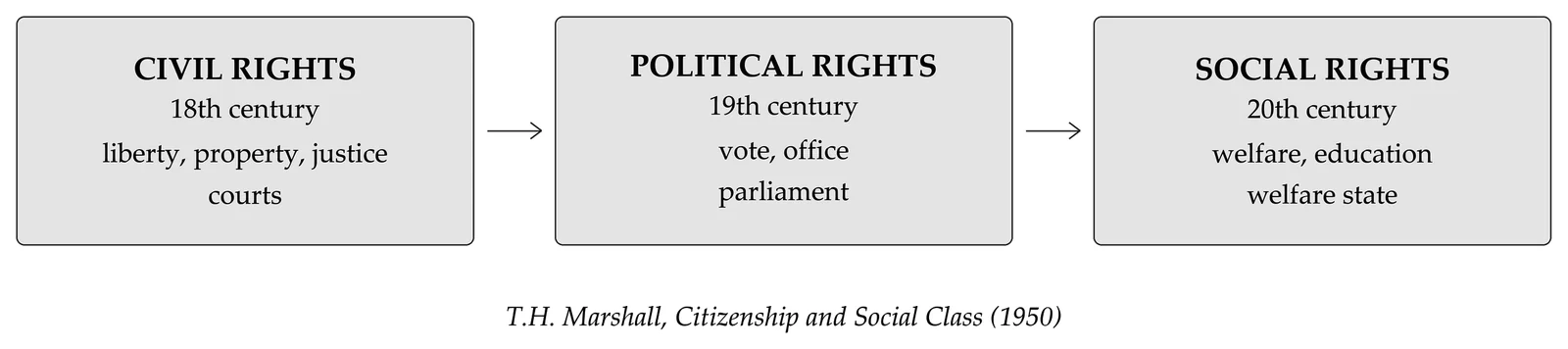
The most influential modern account is T.H. Marshall’s Citizenship and Social Class (1950), written as Britain was building its welfare state after the Second World War. Marshall defined citizenship as a status given to those who are full members of a community, and traced how it grew in England in three stages (Figure 5.3). Civil rights, such as liberty of person, freedom of speech, the right to own property and the right to justice, developed mainly in the eighteenth century and are protected by the courts. Political rights, i.e. the right to vote and to stand for office, spread in the nineteenth century through parliament. Social rights, such as education, health care and a minimum standard of welfare, came in the twentieth century through the welfare state. Marshall argued that social rights reduce the inequalities of class and allow everyone to live as a full member of society.
Critics note that Marshall’s story was based on the experience of English men: women gained political rights only in the twentieth century, and minorities and colonial subjects were left out. Neo-liberal policies since the 1980s have also reduced social rights. Iris Marion Young, in ‘Polity and Group Difference’ (1989), argued for differentiated citizenship, i.e. special representation and rights for oppressed groups, because treating unequal groups identically can preserve injustice.
Citizenship gives us rights, but it also seems to impose duties, above all the duty to obey the law. This brings us to the central question of this unit: political obligation.
5.3 Political Obligation: Meaning and the Problem
Political obligation means the moral duty of citizens to obey the laws of their state and to support its institutions. It is different from a mere legal duty, which only tells us what the law requires, and from prudence, which tells us to obey in order to avoid punishment. The question of political obligation is a moral question: even if no one were watching, ought I to obey?
Philosophers have noticed two special features of this obligation. It is content-independent, a term used by H.L.A. Hart: we are asked to obey a law because it is the law, not because we agree with its content. And it is particular, as A. John Simmons stressed: it binds me to my own state, not to every just state in the world. Any good theory of political obligation must explain both features.
Political obligation is the other side of political authority: if the state has a legitimate right to rule, citizens have a duty to obey. So the question ‘why should I obey?’ is also the question ‘what makes authority legitimate?’, which takes us back to Weber’s idea of legitimacy in Chapter 1.
5.4 Theories of Political Obligation
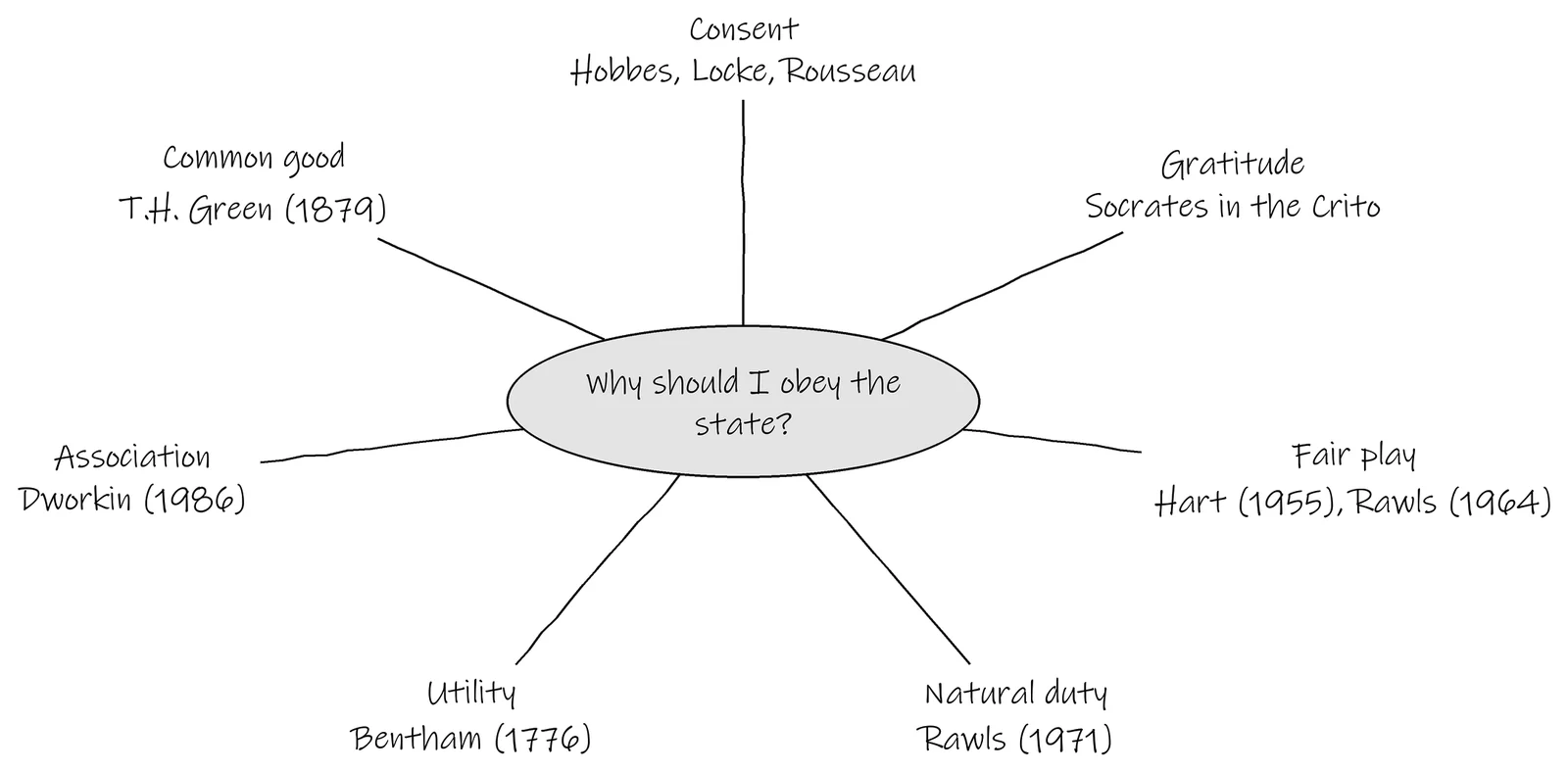
Political theorists have given many answers to the question ‘why obey?’. Each theory below is shown with the thinker who developed it and the context in which he wrote.
- Divine right. Obedience is a religious duty, because kings receive their authority from God. Robert Filmer’s Patriarcha (published 1680), written to defend the Stuart kings, traced royal power back to the fatherly authority God gave to Adam. Locke’s First Treatise (1690) demolished this argument, and it has little support today.
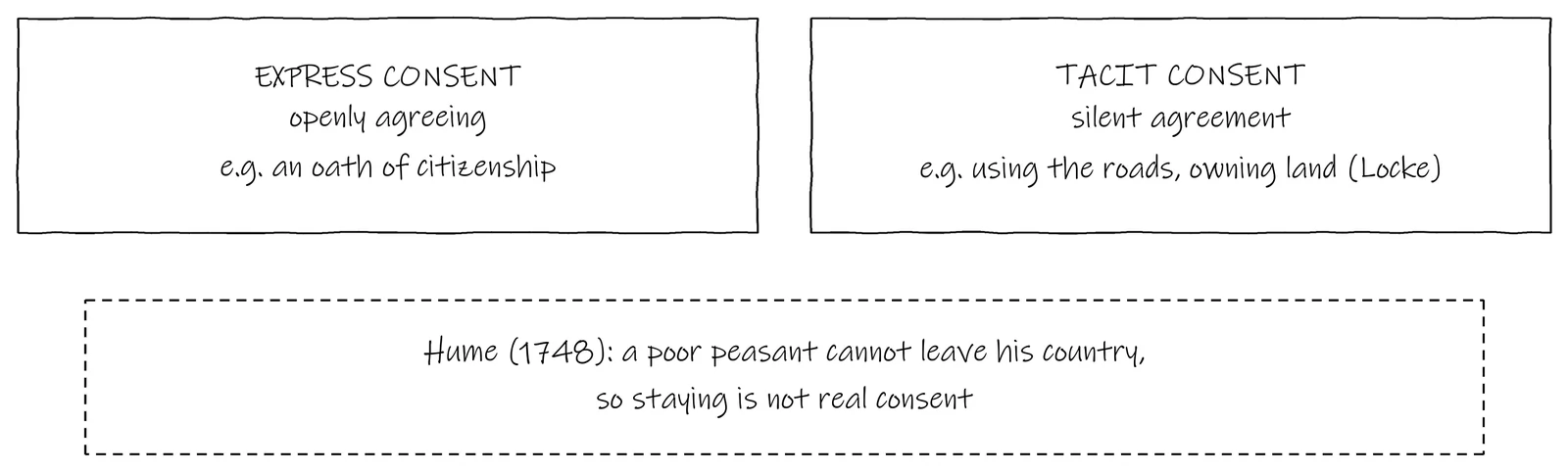
- Consent. We are obliged to obey because we have agreed to obey. Thomas Hobbes, writing Leviathan (1651) during the English Civil War, argued that people consent to an absolute sovereign to escape a state of nature in which life is ‘solitary, poor, nasty, brutish and short’. John Locke (1690) distinguished express consent, i.e. open agreement such as an oath, from tacit consent, i.e. silent agreement shown by enjoying the benefits of a state, such as owning land or travelling on its roads (Figure 5.4). Rousseau (1762) located legitimate obligation in the general will, through which citizens obey only themselves.
- Gratitude. We owe obedience in return for the benefits we have received. This was Socrates’ argument in Plato’s Crito (399 BCE): the laws of Athens had given him birth, upbringing and education, and to break them would be ungrateful and unjust.
- Fair play. Those who benefit from a cooperative scheme must do their fair share. H.L.A. Hart, in ‘Are There Any Natural Rights?’ (1955), and John Rawls (1964), writing in post-war Anglo-American legal philosophy, argued that when citizens enjoy the benefits of a system of laws that others obey, it is unfair for them to disobey.
- Natural duty of justice. We have a duty to support just institutions that apply to us. Rawls, in A Theory of Justice (1971), written amid the civil rights struggles in America, grounded obligation not in consent but in a natural duty to support and comply with just institutions.
- Utility. We should obey because obedience produces more happiness than disobedience. Jeremy Bentham, attacking the social contract theory of Blackstone in A Fragment on Government (1776), held that citizens should obey so long as the probable harms of obedience are less than the probable harms of resistance.
- The common good. We obey because the state makes possible a moral life for all. T.H. Green, in his lectures of 1879–1880 during the age of Victorian social reform, declared that ‘will, not force, is the basis of the state’: citizens obey because the state serves the common good they share.
- Association. Membership itself creates obligation, as in a family. Ronald Dworkin, in Law’s Empire (1986), argued that members of a genuine political community owe one another obligations simply by belonging to it, a view close to communitarianism.
Critics of Political Obligation
Each theory faces objections. David Hume pointed out in 1748 that most people never consented to their government; to say that a poor peasant consents by staying in his country is like saying that a man consents to the master of a ship by staying on board, though he was carried there asleep. Robert Nozick (1974) objected to fair play that benefits forced upon us cannot create obligations: if my neighbours start a public address system and enjoy its broadcasts, I am not obliged to take my turn running it. Marxists see political obligation as ideology that makes workers obey a state serving the ruling class. Philosophical anarchists such as Robert Paul Wolff (1970) and A. John Simmons (1979) conclude that no theory succeeds in proving a general duty to obey, although there may be other good reasons to obey particular laws. George Klosko (2005) replies that political obligation rests on several principles together, such as fair play, natural duty and the common good, rather than on any single one.
5.5 The Limits of Obligation: Resistance and Civil Disobedience
Even those who defend political obligation accept that it has limits. John Locke held that when a government violates the natural rights it was created to protect, it dissolves itself, and the people may resist and replace it. Henry David Thoreau [थॉरो], who refused to pay taxes that supported slavery and the Mexican–American War, argued in Civil Disobedience (1849) that conscience must come before law. Gandhi turned this into the mass method of satyagraha, first in South Africa in 1906 and later in India, most famously in the Salt Satyagraha of 1930. Martin Luther King, in his ‘Letter from Birmingham Jail’ (1963), wrote that one has a moral responsibility to disobey unjust laws, recalling Augustine’s view that an unjust law is no law at all.
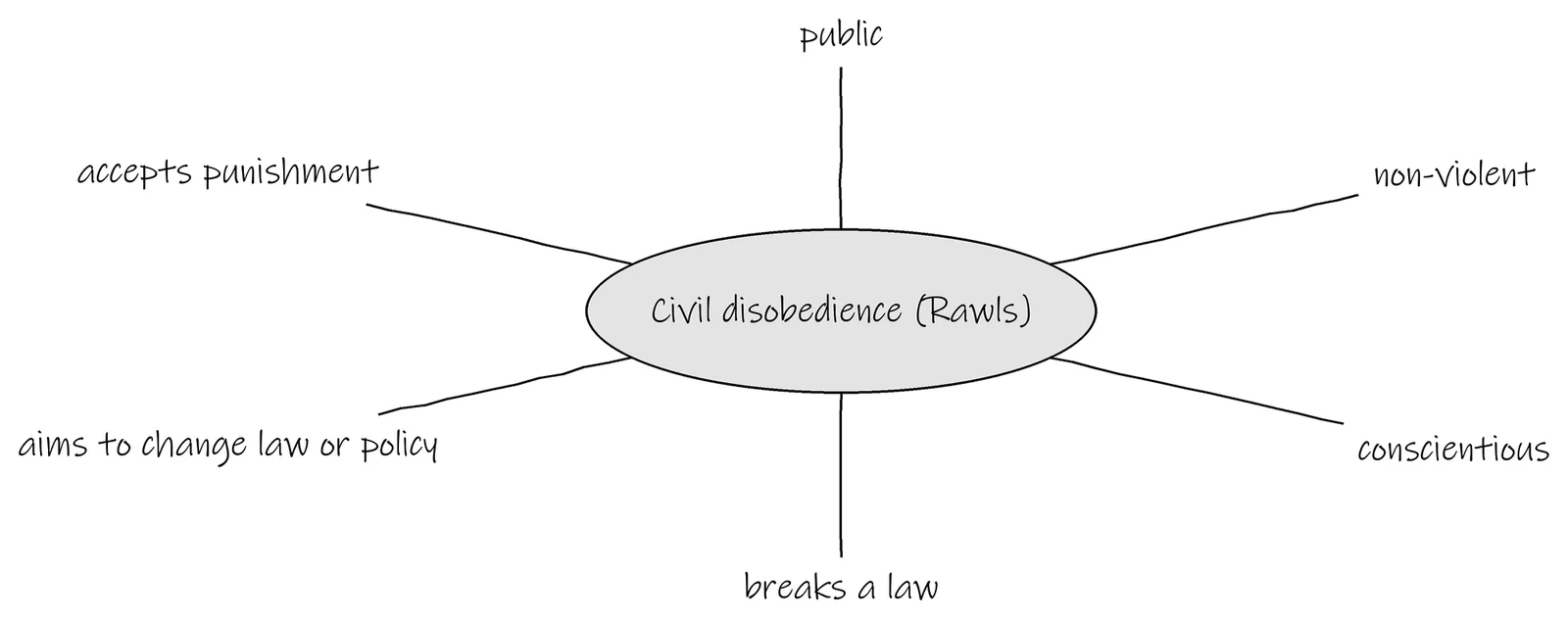
John Rawls gave the best-known definition. Civil disobedience, he wrote in 1971, is a public, non-violent, conscientious yet political act contrary to law, usually done with the aim of bringing about a change in the law or policies of the government. It differs from ordinary crime, because it is public and principled; from conscientious objection, which simply refuses to obey without trying to change the law; and from revolution, because it accepts the legitimacy of the system as a whole and its participants usually accept punishment. For Rawls, civil disobedience is justified in a nearly just society when it targets serious injustice, when normal legal methods have failed, and when it does not threaten the stability of the constitution.
5.6 Important Questions
- Question 1 What are the main arguments in favour of political obligation?
- Question 2 Discuss the idea of political community.
- Question 3 What is citizenship? Discuss T.H. Marshall’s theory of citizenship.
- Question 4 Is there a right to disobey the state? Discuss with reference to civil disobedience.
DU asks the same idea in different words. So learn one broad answer for each question below; the same answer works for every question joined by OR.
Important Question 1
What are the main arguments in favour of political obligation?
OR
Why should we obey the state? Discuss the theories of political obligation.
OR
Critically examine the consent theory of political obligation.
Model Answer
“Will, not force, is the basis of the state.”
— T.H. Green, Lectures on the Principles of Political Obligation
Introduction. Political obligation is the moral duty of citizens to obey the laws of their state and support its institutions. The question ‘why should I obey?’ is as old as Socrates, and political theorists have offered several arguments, each grounded in a different view of the relation between the individual and the state.
1. Meaning and the Problem
Political obligation is moral, not merely legal or prudential. It is content-independent, since we are asked to obey laws because they are laws, and particular, since it binds us to our own state. It is the counterpart of legitimate political authority.
2. Consent
For Hobbes (1651), people consent to an absolute sovereign to escape the war of all against all. Locke (1690) grounded obligation in express and tacit consent and limited it by natural rights. Rousseau (1762) placed it in the general will, so that in obeying the law citizens obey themselves. Consent theory respects individual freedom, but Hume objected that few people ever consented, and tacit consent is too weak to bind those who cannot leave. Hume objected in ‘Of the Original Contract’ (1748) that most people never consented, and that a poor peasant who cannot leave his country no more consents by staying than a man carried on board a ship while asleep.
3. Gratitude
In Plato’s Crito, Socrates argued that the laws had given him birth, nurture and education, and that disobeying them would be ungrateful. Critics reply that benefits we did not ask for cannot create a strict duty of obedience. Critics reply that gratitude is owed to persons for voluntary favours, not to institutions.
4. Fair Play
H.L.A. Hart (1955) and John Rawls (1964) argued that those who accept the benefits of a cooperative system of laws must accept its burdens. Nozick (1974) objected that benefits forced upon us do not oblige us. Robert Nozick objected that benefits forced on us without our agreement cannot create obligations.
5. Natural Duty of Justice
In A Theory of Justice (1971), Rawls argued that everyone has a natural duty to support just institutions that apply to them. This explains why we should obey just laws, but struggles to explain why we owe obedience to our own state in particular.
6. Utility
Bentham (1776) held that citizens should obey so long as the probable harms of obedience are less than those of resistance. The argument is practical, but it makes obligation depend on constant calculation and may justify disobedience whenever it seems useful.
7. The Common Good
T.H. Green argued that the state rests on the will of citizens for a common good; we obey because the state secures the conditions in which all can develop morally. The theory links obligation to moral purpose, but it may idealise the actual state.
8. Association
Ronald Dworkin (1986) argued that membership of a genuine political community, like membership of a family, creates obligations by itself. Critics fear that this may justify obedience even to unjust communities. Critics reply that associative obligations might justify loyalty even to unjust communities.
9. Obligation in India
In India, Gandhi’s satyagraha challenged the obligation to obey colonial laws, while after independence Ambedkar argued that constitutional methods had replaced the need for civil disobedience; the Fundamental Duties also express the idea that citizens owe obligations to the political community.
10. Critics
Marxists see obligation as ideology serving the ruling class, and philosophical anarchists such as Wolff (1970) and Simmons (1979) argue that no theory proves a general duty to obey.
11. Evaluation
No single argument is fully convincing. George Klosko (2005) argues that political obligation is best explained by several principles together, such as fair play, natural duty and the common good. Obligation is also limited: it gives way when the state commits grave injustice.
Conclusion. Thus, the arguments for political obligation show that obedience to the state can be justified by consent, fairness, justice and the common good. But the obligation is never absolute; it depends on the state remaining legitimate and broadly just.
Important Question 2
Discuss the idea of political community.
OR
Write a short note on political community.
OR
Examine the liberal and communitarian views of political community.
Model Answer
“He who is unable to live in society, or who has no need because he is sufficient for himself, must be either a beast or a god.”
— Aristotle, Politics
Introduction. A political community is a group of people who share a common political life under common authority and laws, with a sense of belonging and some idea of a common good. The idea raises basic questions: who belongs, what binds members together, and what they owe one another.
1. Meaning
A political community is more than people living in one territory. Its members share rules, take part in collective decisions and identify with the whole. Its modern form is the nation-state, though people also belong to local and, some argue, global communities. Its members recognise a shared public authority and see one another as fellow citizens, not merely as neighbours.
2. Features of Political Community
- Common authority: members live under one authority that claims obedience; Weber (1919), in defeated post-war Germany, defined the state by its monopoly of legitimate force in a territory.
- Shared identity: members feel they belong together; Benedict Anderson (1983) showed how print and language made nations ‘imagined communities’.
- Common good: members pursue shared ends, not only private interests; Aristotle’s polis existed for the sake of the good life.
- Membership and boundaries: a community decides who belongs; Michael Walzer’s Spheres of Justice (1983) called membership the first good a community distributes.
- Participation: members share in making common decisions; Rousseau’s general will (1762) made citizens the authors of their laws.
- Mutual obligations: membership creates duties to fellow members; Ronald Dworkin’s ‘associative obligations’ in Law’s Empire (1986).
Together these features distinguish a political community from a mere collection of individuals living in one place.
3. The Classical Idea
Aristotle saw the polis as a koinonia politike, a partnership of citizens who rule and are ruled in turn for the sake of the good life. For him, the community comes before the individual, because only in the polis can human beings realise their nature. For Aristotle the polis exists not merely for life but for the good life, and a person who lives outside it is either a beast or a god.
4. The Liberal View
Liberals see the community as an association of free individuals formed to protect rights. Rawls’s Political Liberalism (1993) describes a just society as a fair system of cooperation among free and equal citizens who may hold different ideas of the good. For Locke, the community is formed by a social contract to protect life, liberty and property.
5. The Communitarian View
Communitarians such as Michael Sandel, Charles Taylor, Alasdair MacIntyre and Michael Walzer argue that community comes first: our identities are shaped by the communities we belong to. Sandel criticised the liberal ‘unencumbered self’, and Walzer called membership the primary good that a community distributes. Sandel criticised the liberal ‘unencumbered self’, arguing that our identities are partly constituted by our communities.
6. Republican, Nationalist and Multicultural Views
Republicans such as Rousseau and Arendt see the community as made by active citizens. Nationalists, from J.S. Mill (1861) to Benedict Anderson’s ‘imagined communities’ (1983), tie it to the nation. Multiculturalists such as Will Kymlicka (1995) and Bhikhu Parekh see it as a ‘community of communities’ that must recognise minority cultures. Ambedkar stressed fraternity, a sense of common brotherhood, as what makes a political community possible.
7. Imagined Communities
Benedict Anderson argued in Imagined Communities (1983) that nations are imagined because members never meet most of their fellows yet feel a deep comradeship; print capitalism, newspapers and novels made this imagination possible.
8. The Cosmopolitan View
Kant’s Perpetual Peace (1795) and David Held’s idea of cosmopolitan democracy (1995) extend political community to all humanity, arguing that problems such as war, migration and climate change cross national borders. Martha Nussbaum argued that our first allegiance should be to the worldwide community of human beings.
9. Contemporary Challenges
Globalisation, migration and the movement of refugees blur the boundaries of national communities, while multicultural societies must decide how far shared identity can coexist with cultural difference. Hannah Arendt, writing in The Origins of Totalitarianism (1951) about the stateless refugees of inter-war Europe, showed that those who lose membership of a political community lose ‘the right to have rights’, which proves how much rights depend on belonging. In India, the political community rests on a civic idea of citizenship, but debates over citizenship laws, regional identities and minority rights show that its boundaries remain contested.
10. Evaluation
The liberal view protects individual freedom but may neglect belonging; the communitarian view explains belonging but may suppress dissent and minorities. Most theorists now seek a balance: a community that gives its members identity and solidarity while respecting individual rights and cultural diversity. (Draw Figure 5.2 in the answer.) A democratic political community needs both individual rights and a shared sense of belonging, and in diverse societies like India it must rest on civic rather than ethnic or religious foundations.
Conclusion. Thus, the idea of political community answers the question ‘who are we?’. That answer shapes citizenship, justice and political obligation, which is why political theory cannot ignore it.
Important Question 3
What is citizenship? Discuss T.H. Marshall’s theory of citizenship.
OR
Examine the different conceptions of citizenship.
OR
Discuss the relationship between citizenship and political community.
Model Answer
“Citizenship is a status bestowed on those who are full members of a community.”
— T.H. Marshall, Citizenship and Social Class (1950)
Introduction. Citizenship is full membership of a political community. It combines a legal status, rights, duties and a sense of belonging. Its meaning has changed from the restricted citizenship of ancient Athens to the universal citizenship of modern democracies.
1. Meaning and Elements
Citizenship has four elements: legal status, rights against the state, duties to the community, and identity or belonging. It defines who is included in the political community and who is excluded. Aristotle defined a citizen as one who shares in deliberative and judicial office.
2. Features of Citizenship
- Full membership: citizenship is a status of full membership; T.H. Marshall (1950), as Britain built its welfare state.
- Equality of status: all citizens are equal before the law, a principle proclaimed by the French Declaration of the Rights of Man and of the Citizen (1789).
- Rights: civil, political and social rights, in Marshall’s threefold scheme (1950).
- Duties: obeying laws, paying taxes and defending the community; Rousseau (1762) held that citizens who share in making the law must also obey it.
- Participation: citizens share in ruling and being ruled; Aristotle defined the citizen by participation in judging and in office.
- Identity and loyalty: citizenship gives a sense of belonging to a political community, as Benedict Anderson’s study of nations (1983) shows.
3. Historical Development
In Athens citizens shared in ruling and being ruled, but women, slaves and foreigners were excluded. The American (1776) and French (1789) Revolutions proclaimed the equal citizen, and the extension of citizenship to workers, women and colonised peoples has been a central theme of modern politics. The French Revolution’s idea of the citizen (citoyen) replaced the subject of a monarch with a member of a sovereign people.
4. Liberal and Republican Conceptions
The liberal conception sees citizenship as a status that gives individuals rights and protects their private freedom. The republican conception sees it as active participation in self-government, demanding civic virtue and concern for the common good. The republican tradition, from Aristotle to Rousseau and Arendt, sees active participation in public life as the essence of citizenship.
5. Marshall’s Theory
T.H. Marshall, writing in 1950 as Britain built its welfare state, traced three elements of citizenship. Civil rights (liberty, property, justice) developed in the eighteenth century through the courts; political rights (the vote and the right to stand for office) in the nineteenth century through parliament; and social rights (education, health and welfare) in the twentieth century through the welfare state. Social rights, he argued, reduce class inequality and make full membership real for everyone. (Draw Figure 5.3 in the answer.) Marshall argued that social rights to welfare, education and health would reduce class inequality, making citizenship a status of equality within a capitalist society.
6. Criticisms of Marshall
Marshall’s account was based on English men: women won political rights only in the twentieth century, and minorities and colonial subjects were left out. His sequence does not fit other countries, and neo-liberal reforms since the 1980s have shown that social rights can be reduced. The sequence also differed elsewhere: in India, universal political rights came in 1950, before many civil and social rights were secured in practice.
7. Citizenship as Practice
Citizenship is not only a legal status but a practice: people become full members by voting, joining associations, protesting and holding governments accountable, as the movement for the right to information in India shows.
8. Newer Conceptions
Iris Marion Young (1989) proposed differentiated citizenship, with special rights for oppressed groups. Will Kymlicka (1995) defended multicultural citizenship for national and ethnic minorities. Feminists ask that citizenship recognise care work, and cosmopolitans speak of global citizenship in an interconnected world. Kymlicka’s Multicultural Citizenship (1995) defended group-differentiated rights for national minorities and immigrant groups.
9. Feminist and Global Perspectives
Ruth Lister, in Citizenship: Feminist Perspectives (1997), argued that the citizen was traditionally imagined as a male wage-earner and soldier, and that citizenship must value care and recognise women’s experiences. Cosmopolitan thinkers argue for global citizenship in an age of migration and climate change, while Arendt’s warning about statelessness (1951) reminds us that millions still live without the protection of any citizenship. Global citizenship theorists argue that problems such as climate change require citizens to accept responsibilities beyond national borders.
10. Citizenship in India
The Constitution created a single, equal citizenship with universal adult franchise from 1950, a radical step in a society divided by caste. Niraja Gopal Jayal, in Citizenship and Its Discontents (2013), shows how Indian citizenship has combined legal equality with persistent social inequality and contested debates over who belongs.
11. Citizenship, Community and Obligation
Citizenship is membership of a political community, and membership brings duties as well as rights, above all the duty to obey just laws. The richer the rights a community guarantees, the stronger its claim on the loyalty of its citizens. Citizenship thus links the individual to the political community through a balance of rights and duties.
Conclusion. Thus, citizenship has grown from a privilege of a few into a universal status with civil, political and social rights. Its continuing challenge is to combine equal rights with recognition of difference and real participation.
Important Question 4
Is there a right to disobey the state? Discuss with reference to civil disobedience.
OR
Discuss the limits of political obligation.
OR
What is civil disobedience? How is it justified?
Model Answer
“One has a moral responsibility to disobey unjust laws.”
— Martin Luther King Jr., Letter from Birmingham Jail (1963)
Introduction. Political obligation is not unlimited. When laws are seriously unjust, many thinkers argue that citizens have a right, and sometimes a duty, to disobey. The most important modern form of principled disobedience is civil disobedience.
1. The Limits of Obligation
Obligation depends on the legitimacy and basic justice of the state. Even Socrates, who refused to escape, had told the jury that he would not stop teaching philosophy if ordered to do so. Antigone’s defiance of Creon in Sophocles’ play is the classic image of conscience against the law.
2. Locke and the Right of Resistance
Locke (1690) argued that a government which violates the natural rights it was created to protect dissolves itself, and the people may resist and replace it.
3. Thoreau
Thoreau refused to pay taxes supporting slavery and the Mexican–American War, and argued in Civil Disobedience (1849) that individual conscience must come before the law. He spent a night in jail in 1846 for refusing the poll tax, and his essay later influenced Gandhi and King.
4. Gandhi’s Satyagraha
Gandhi developed satyagraha, i.e. ‘holding firmly to truth’, as a method of non-violent mass resistance, first in South Africa in 1906 and then in India, most famously in the Salt Satyagraha of 1930. Satyagrahis broke unjust laws openly and accepted punishment, so that their suffering would change the hearts of their opponents. The Salt March of 1930 showed how a deliberate, public breach of an unjust law could mobilise millions and expose the moral weakness of colonial rule.
5. Martin Luther King
In his ‘Letter from Birmingham Jail’ (1963), King defended the American civil rights movement’s disobedience of segregation laws, arguing that an unjust law is no law at all and must be broken openly, lovingly and with willingness to accept the penalty. He distinguished just laws, which uplift human personality, from unjust laws, which degrade it, following Augustine’s view that an unjust law is no law at all.
6. Rawls’s Definition and Conditions
John Rawls (1971) defined civil disobedience as a public, non-violent, conscientious yet political act contrary to law, done to change a law or policy. In a nearly just society it is justified when it targets serious injustice, when normal legal means have failed, and when it does not threaten the constitutional order. It is justified only against substantial and clear injustice, after normal appeals have failed, and with willingness to accept punishment.
7. Civil Disobedience, Objection and Revolution
Civil disobedience is different from conscientious objection, which simply refuses to obey without seeking to change the law, and from revolution, which rejects the whole political order. Civil disobedience accepts the legitimacy of the system and appeals to its own sense of justice. Revolution, by contrast, seeks to overthrow the whole system, often by force.
8. Conditions for Justified Disobedience
Most theorists agree that disobedience is justified when the law is seriously unjust, legal remedies have been exhausted, the action is public and non-violent, and the disobedients accept the legal consequences; these conditions distinguish it from mere lawbreaking.
9. Criticisms
Critics, following Hobbes, warn that disobedience threatens order and may encourage lawlessness. In a democracy, others argue, citizens should change laws through elections and courts, not by breaking them. Defenders reply that majorities can be unjust and that civil disobedience, being public and non-violent, strengthens rather than weakens democracy. Ambedkar warned the Constituent Assembly in 1949 that methods of civil disobedience, justified under colonial rule, were the ‘grammar of anarchy’ in a constitutional democracy.
10. Dworkin and Arendt on Civil Disobedience
Ronald Dworkin, in Taking Rights Seriously (1977), argued that when the law is uncertain, citizens who disobey on grounds of conscience may be acting on a reasonable view of what the law really is, and that the state should not always prosecute them. Hannah Arendt, in ‘Civil Disobedience’ (in Crises of the Republic, 1972), saw civil disobedients as organised minorities who, like voluntary associations, keep democracy alive by challenging the majority; she suggested that civil disobedience should be given a recognised place in the constitution. Arendt saw civil disobedients as organised minorities acting together, a form of voluntary association essential to democracy.
11. Civil Disobedience in Contemporary India
Non-violent protests such as the Chipko movement, the anti-corruption movement of 2011 and the farmers’ protests of 2020–21 show the continuing appeal of Gandhian methods, while courts have recognised peaceful protest as part of the freedoms of speech and assembly.
12. Civil Disobedience in a Democracy
In a democracy, civil disobedience is justified only as a last resort, after legal remedies have been tried, and only if it is public, non-violent and aimed at serious injustice. Critics such as Ambedkar, speaking in the Constituent Assembly on 25 November 1949, warned that once constitutional methods are available, the methods of civil disobedience and satyagraha are ‘nothing but the grammar of anarchy’ and should be abandoned.
Conclusion. Thus, there is a limited right to disobey. Political obligation binds citizens to a legitimate and broadly just state, but when laws are seriously unjust, principled, public and non-violent disobedience can itself be an act of loyalty to justice.
Short Notes
(a) Tacit consent
John Locke’s answer to the problem that few people ever explicitly consent to government. In the Second Treatise of Government (1690) he argued that anyone who enjoys the benefits of a government’s territory, even by travelling on its highways, gives tacit consent and is obliged to obey its laws. Critics, beginning with David Hume, replied that people who cannot afford to leave their country cannot be said to consent freely.
(b) Civil disobedience
A public, non-violent and conscientious breach of law intended to bring about a change in laws or policies, as John Rawls defined it in A Theory of Justice (1971). Henry David Thoreau’s essay of 1849 defended refusing taxes that supported slavery and war, and Gandhi turned it into a mass method through satyagraha. Those who practise it usually accept punishment, showing fidelity to law as a whole.
More notes: DSC-1 Understanding Political Theory
These notes are prepared by PADHO TO AISE for study help. They are not an official University of Delhi publication.