
Semester I DSC-1 Understanding Political Theory
Unit III · 38 min read · Updated 24 Nov 2026
As per the University of Delhi (DU) BA (Hons) Political Science syllabus
Contents
- 3.1 Political Traditions and Ideologies
- 3.2 Liberalism
- Features of Liberalism
- Types of Liberalism
- Criticisms of Liberalism
- 3.3 Marxism
- Features of Marxism
- Key Concepts of Marxism
- Types of Marxism
- Criticisms of Marxism
- 3.4 Anarchism
- Features of Anarchism
- Types of Anarchism
- Criticisms of Anarchism
- 3.5 Conservatism
- Features of Conservatism
- Types of Conservatism
- Criticisms of Conservatism
- 3.6 Comparing the Four Traditions
- 3.7 Important Questions
- Evaluate the core conceptions of liberty within liberal thought.
- Why did Marx consider capitalism to be an exploitative system? Give reasons.
- “The state is an unnecessary evil.” Do you agree with this statement? Give reasons to support your answer.
- What is traditionalism? Answer with reference to conservatism.
- Short Notes
दार्शनिकों ने केवल विभिन्न तरीकों से दुनिया की व्याख्या की है; असली बात इसे बदलने की है।
The philosophers have only interpreted the world, in various ways; the point is to change it.
— Karl Marx, Theses on Feuerbach (1845)
EVERY POLITICAL TRADITION begins with a picture of human beings and of the good society, and from that picture it draws its view of the state, of liberty and equality, and of change. In Chapter 2 we studied the approaches, i.e. the ways of studying politics. In this chapter we study the great traditions, i.e. the families of political ideas that have shaped the modern world: liberalism, Marxism, anarchism and conservatism. A tradition is wider than a single thinker. It is a continuing conversation in which many thinkers share some core values while disagreeing on much else.
3.1 Political Traditions and Ideologies
In simple words, a political tradition is a family of ideas about how society should be organised. In the language of political science, such a family is also called an ideology. Each tradition gives its own answer to the basic questions of political theory: What are human beings like? What is the most important value: liberty, equality, order or something else? What is the proper role of the state? And should society be preserved as it is, reformed gradually or changed completely? Figure 3.2 gives a first picture of the four traditions; the rest of the chapter explains each of them.
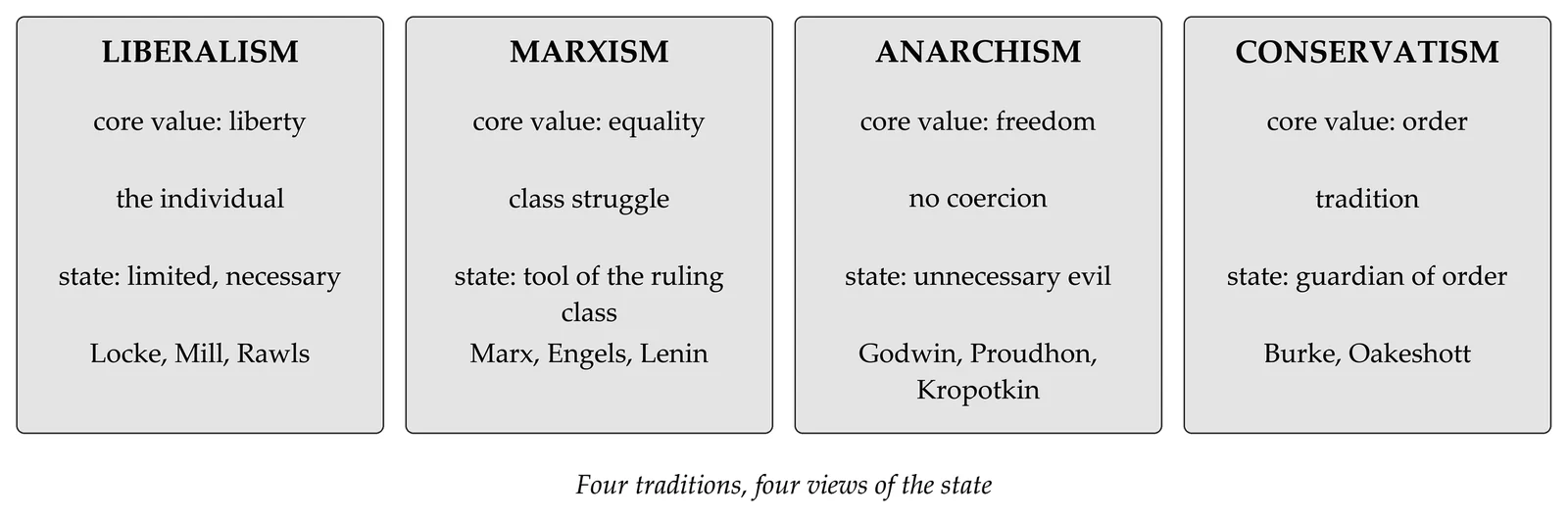
Notice that each tradition is defined above all by the value it puts first and by its attitude towards the state. We begin with liberalism, the dominant tradition of the modern Western world.
3.2 Liberalism
Liberalism grew out of the breakdown of feudalism and the rise of a market society in Europe. The Reformation, the scientific revolution and the Enlightenment encouraged people to trust their own reason rather than tradition or the church, and the English Revolution of 1688, the American Revolution of 1776 and the French Revolution of 1789 put liberal ideas into practice. At its heart is a simple idea: the individual is the basic unit of society, and the purpose of politics is to protect the individual’s liberty.
Features of Liberalism
- Individualism. Society is made up of individuals, each with natural rights and dignity. John Locke argued this in Two Treatises of Government (1690) against the Stuart kings’ claim to rule by divine right.
- Liberty. Individuals should be free to think, speak and live as they choose, so long as they do not harm others. J.S. Mill defended this in On Liberty (1859) against the social conformity and ‘tyranny of the majority’ of Victorian England.
- Reason. Human beings can understand the world and solve problems by reason and discussion. Immanuel Kant summed up this Enlightenment faith in the motto ‘Dare to know!’ in ‘What is Enlightenment?’ (1784), written in Prussia.
- Equality of rights and opportunity. All individuals are equal in rights, though not necessarily in outcomes. The American Declaration of Independence (1776), drafted by Thomas Jefferson, proclaimed that “all men are created equal”, although slavery continued, which shows the gap between liberal ideals and practice.
- Toleration. Different beliefs and ways of life must be tolerated. Locke’s A Letter Concerning Toleration (1689) was written after a century of religious wars and persecution in Europe.
- Government by consent. Legitimate government rests on the consent of the governed. Thomas Paine’s Rights of Man (1791) defended this principle and the French Revolution against Burke.
- Constitutionalism. Government must be limited by law and by the separation of powers. Montesquieu’s The Spirit of the Laws (1748), written under French absolutism, admired the English constitution, and James Madison built checks and balances into the US Constitution in The Federalist (1787–1788).
Types of Liberalism
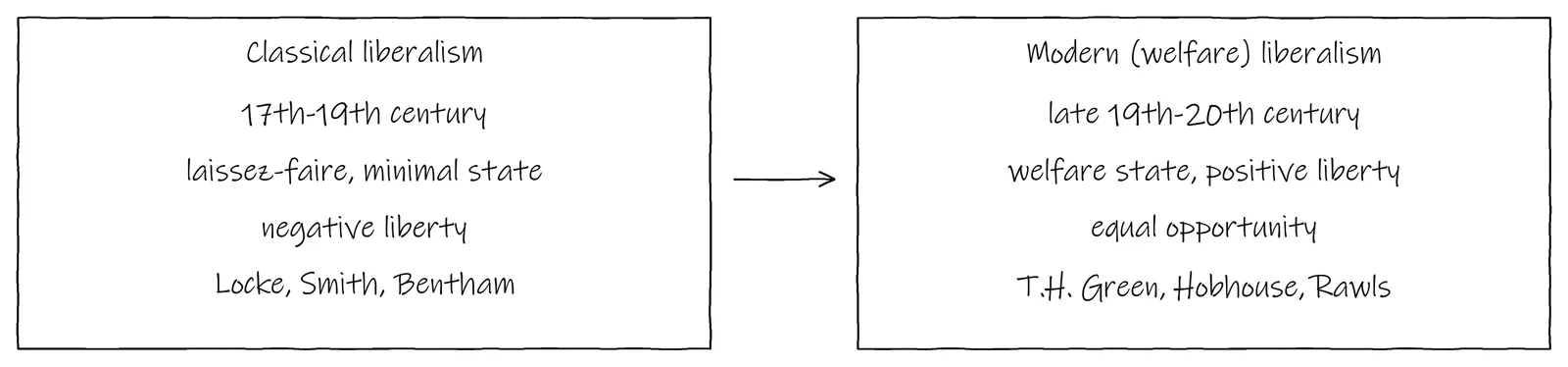
Liberalism is not one single doctrine. It has changed its form as society changed, and four main types can be identified (Figure 3.3).
A. Classical liberalism (17th to 19th century)
- Natural rights and negative liberty: liberty means freedom from interference. Locke (1690) defended the rights to life, liberty and property against absolute monarchy.
- Laissez-faire: the economy should be left to the market. Adam Smith’s The Wealth of Nations (1776), written in early industrial Britain, argued that an ‘invisible hand’ turns private interest into public prosperity.
- Minimal state: the state should be a ‘night-watchman’, limited to order, defence and contracts; Thomas Paine called government “but a necessary evil” (1776).
- Utility: Jeremy Bentham judged laws by ‘the greatest happiness of the greatest number’, and J.S. Mill’s harm principle (1859) protected the individual’s own sphere; Mill’s stress on individuality also prepared the ground for modern liberalism.
- Social Darwinism (late form): Herbert Spencer, in The Man versus the State (1884), opposed state welfare as interference with the ‘survival of the fittest’.
B. Modern (welfare or positive) liberalism (late 19th to 20th century)
- Positive liberty: T.H. Green, lecturing at Oxford in 1879–1880 amid the poverty of industrial England, defined freedom as the positive power of doing something worth doing.
- Welfare state: L.T. Hobhouse’s Liberalism (1911) supported the reforms of Britain’s New Liberal government, such as old-age pensions (1908); the Beveridge Report (1942) attacked the ‘five giants’ of Want, Disease, Ignorance, Squalor and Idleness.
- Managed economy: J.M. Keynes’s General Theory (1936), written during the Great Depression, argued that government spending must rescue the economy from mass unemployment.
- Equality of opportunity: public education, labour laws and progressive taxation make freedom real for the poor.
C. Neo-liberalism and libertarianism (from the 1970s)
- Revival of the free market: Friedrich Hayek [हायेक]’s The Road to Serfdom (1944), written in wartime Britain, warned that economic planning leads to tyranny, and Milton Friedman’s Capitalism and Freedom (1962) defended free markets.
- Minimal state: Robert Nozick’s Anarchy, State, and Utopia (1974), replying to Rawls, argued that taxation for redistribution is on a par with forced labour.
- Privatisation and deregulation: after the economic crisis of the 1970s, Margaret Thatcher (1979) and Ronald Reagan (1981) cut taxes, privatised industries and reduced the welfare state.
D. Egalitarian (contemporary) liberalism
- Justice as fairness: John Rawls’s A Theory of Justice (1971), written in the America of the civil rights movement, joined equal liberties with the difference principle, which permits inequalities only if they benefit the least advantaged.
- Equality of resources: Ronald Dworkin’s Sovereign Virtue (2000) argued that people should begin with equal resources but bear the consequences of their own choices.
- Political liberalism: Rawls’s Political Liberalism (1993) sought an ‘overlapping consensus’ on basic principles among citizens of different religions and moral views.
Criticisms of Liberalism
Marxists argue that liberal freedom is merely formal, since it hides the exploitation of workers behind the language of free contract. Communitarians such as Michael Sandel and Charles Taylor criticise its picture of the individual as an isolated self without community. Feminists argue that its public–private divide hides domination in the family, and conservatives fear that its individualism weakens tradition and community. Liberalism’s greatest critic, however, was Karl Marx.
3.3 Marxism
Marxism is the body of ideas developed by Karl Marx (1818–1883) and Friedrich Engels (1820–1895), above all in The Communist Manifesto (1848) and Capital (Volume I, 1867). Where liberalism starts from the individual, Marxism starts from classes and from the way society produces its material life.
Features of Marxism
- Materialist view of history. Material production, not ideas, shapes history. Marx and Engels set this out in The German Ideology (1845–1846) and the Preface of 1859, as industrial capitalism was transforming Europe.
- Dialectical method. Change comes through the conflict of opposing forces. Marx took Hegel’s dialectic but, in his words of 1873, set it ‘right side up’, applying it to material conditions instead of ideas.
- Class struggle. History is a struggle between owning and labouring classes. The Communist Manifesto appeared in February 1848, on the eve of revolutions that swept across Europe that year.
- Critique of capitalism. Profit comes from the exploitation of labour. Capital (1867) drew on the factory conditions of industrial Britain, which Engels had described in The Condition of the Working Class in England (1845).
- The state as a class instrument and the need for revolution. In The Civil War in France (1871) Marx hailed the Paris Commune as a first model of a workers’ state.
- Communism and the withering away of the state. Marx’s Critique of the Gotha Programme (1875) and Engels’s Anti-Dühring (1878) described a classless society in which the state would no longer be needed.
- Internationalism. “Workers of the world, unite!” closes the Manifesto; Marx helped found the International Working Men’s Association, the First International, in 1864.
Key Concepts of Marxism
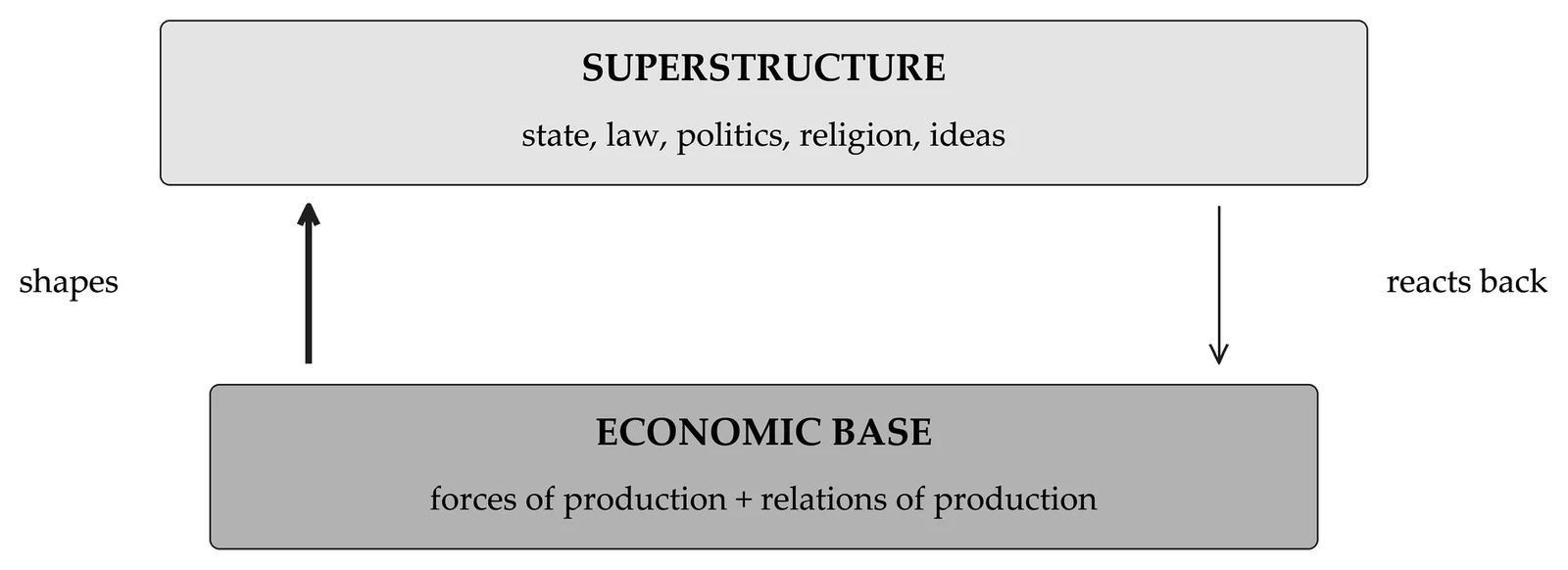
Historical materialism. Every society has an economic base, made up of the forces of production (tools, machines, skills) and the relations of production (who owns and who works). On this base rises a superstructure of state, law, politics, religion and ideas (Figure 3.4). In Marx’s words, “It is not the consciousness of men that determines their being, but, on the contrary, their social being that determines their consciousness.” Society passes through a series of modes of production: primitive communism, slavery, feudalism, capitalism and, finally, socialism and communism.
Class struggle. “The history of all hitherto existing society is the history of class struggles,” the Manifesto begins. In capitalism the struggle is between the bourgeoisie [बूर्ज्वाज़ी] (the capitalist class) and the proletariat (the working class).
Surplus value, alienation and the state are explained in detail in Important Question 2.
Types of Marxism
A. Classical Marxism (Marx and Engels)
- Historical materialism, class struggle and the inevitable collapse of capitalism through proletarian revolution in the most advanced industrial countries.
- Engels presented it as scientific socialism, in contrast to ‘utopian’ socialism, in Socialism: Utopian and Scientific (1880).
B. Revisionism (evolutionary socialism)
- Eduard Bernstein’s Evolutionary Socialism (1899), written as the German Social Democratic Party grew through elections, argued that capitalism was not collapsing and that workers’ conditions were improving.
- Socialism, he said, could come gradually through democracy and reform. Rosa Luxemburg replied in Reform or Revolution? (1900) that reform alone could never end capitalism.
C. Orthodox Communism: Leninism and Stalinism
- Vanguard party: Lenin, in What Is to Be Done? (1902), written under the police repression of Tsarist Russia, argued that a disciplined party of professional revolutionaries must lead the workers.
- Imperialism: in Imperialism, the Highest Stage of Capitalism (1916) Lenin explained why revolution could break out in a backward country, the ‘weakest link’ of the capitalist chain; the Bolsheviks took power in 1917.
- Stalinism: after Lenin, Stalin proclaimed ‘socialism in one country’ (1924) and built a centrally planned economy through Five-Year Plans (from 1928), forced collectivisation and a one-party dictatorship.
D. Maoism
- Mao Zedong adapted Marxism to a peasant society: in China the revolutionary force was the peasantry, not the industrial working class.
- Revolution would come through a protracted people’s war from the countryside, leading to the People’s Republic in 1949; the Cultural Revolution (1966–1976) expressed his idea of continuous revolution.
E. Western Marxism and Neo-Marxism
- After the failure of revolutions in Western Europe (1918–1923) and the rise of fascism, Marxists turned to culture and consciousness.
- Georg Lukács’s History and Class Consciousness (1923) studied why workers fail to see their own interests; Antonio Gramsci, writing his Prison Notebooks (1929–1935) in Mussolini’s jail, developed the concept of hegemony.
- The Frankfurt School, founded in 1923, produced critical theory: Adorno and Horkheimer’s Dialectic of Enlightenment (1944) and Herbert Marcuse’s One-Dimensional Man (1964), a critique of consumer society.
F. Structural Marxism
- Louis Althusser, in Paris in the 1960s, argued that capitalism is reproduced not only by force but by ideological state apparatuses, such as schools, the church, the family and the media (1970).
- He gave the superstructure ‘relative autonomy’ from the economic base, and Nicos Poulantzas applied this to the theory of the capitalist state.
Criticisms of Marxism
Critics argue that Marxism is economically determinist and reduces politics, religion and culture to class. Its predictions failed: revolutions came in backward Russia and China rather than in advanced capitalist countries, while workers in the West gained higher wages and welfare rights. Communist states became authoritarian, and the Soviet Union collapsed in 1991. Yet Marx’s analysis of inequality and of the power of capital remains influential.
Marx wanted the state to wither away after the revolution; anarchists wanted to abolish it at once. This quarrel split the First International, and Bakunin was expelled from it at The Hague in 1872.
3.4 Anarchism
The word anarchism comes from the Greek anarkhos, i.e. ‘without a ruler’. Anarchism does not mean chaos. It is the belief that the state is an unnecessary evil and that society can be organised through free and voluntary cooperation. Anarchists see the state as coercive, because it forces obedience through law and punishment; as exploitative, because it protects the property of the rich; and as corrupting, because power corrupts both rulers and ruled.
Features of Anarchism
- Anti-statism. All compulsory political authority is rejected. Proudhon, writing in France after the failed revolution of 1848, described government as endless surveillance and control in General Idea of the Revolution (1851).
- Natural order. Human beings can live in harmony without government. William Godwin, inspired by the French Revolution’s faith in reason, argued in Political Justice (1793) that rational people need no state.
- Mutual aid. Cooperation, not competition, is natural. Kropotkin wrote Mutual Aid (1902) in reply to T.H. Huxley’s social Darwinist essay ‘The Struggle for Existence’ (1888).
- Anti-clericalism. The church is an ally of the state in keeping people obedient. Bakunin’s God and the State (published 1882) attacked religious and political authority together.
- Economic freedom and equality. Exploitation by property-owners is rejected. Proudhon declared “property is theft” (1840).
- Individual autonomy. The individual should obey no authority but his own conscience. Max Stirner [श्टिर्नर], a member of the Young Hegelian circle in Berlin, celebrated the sovereign ego in The Ego and Its Own (1844).
- Direct action and civil disobedience. Change must come from below, not through parties. Henry David Thoreau [थॉरो] refused to pay taxes in protest against slavery and the Mexican–American War, and wrote Civil Disobedience (1849).
Types of Anarchism
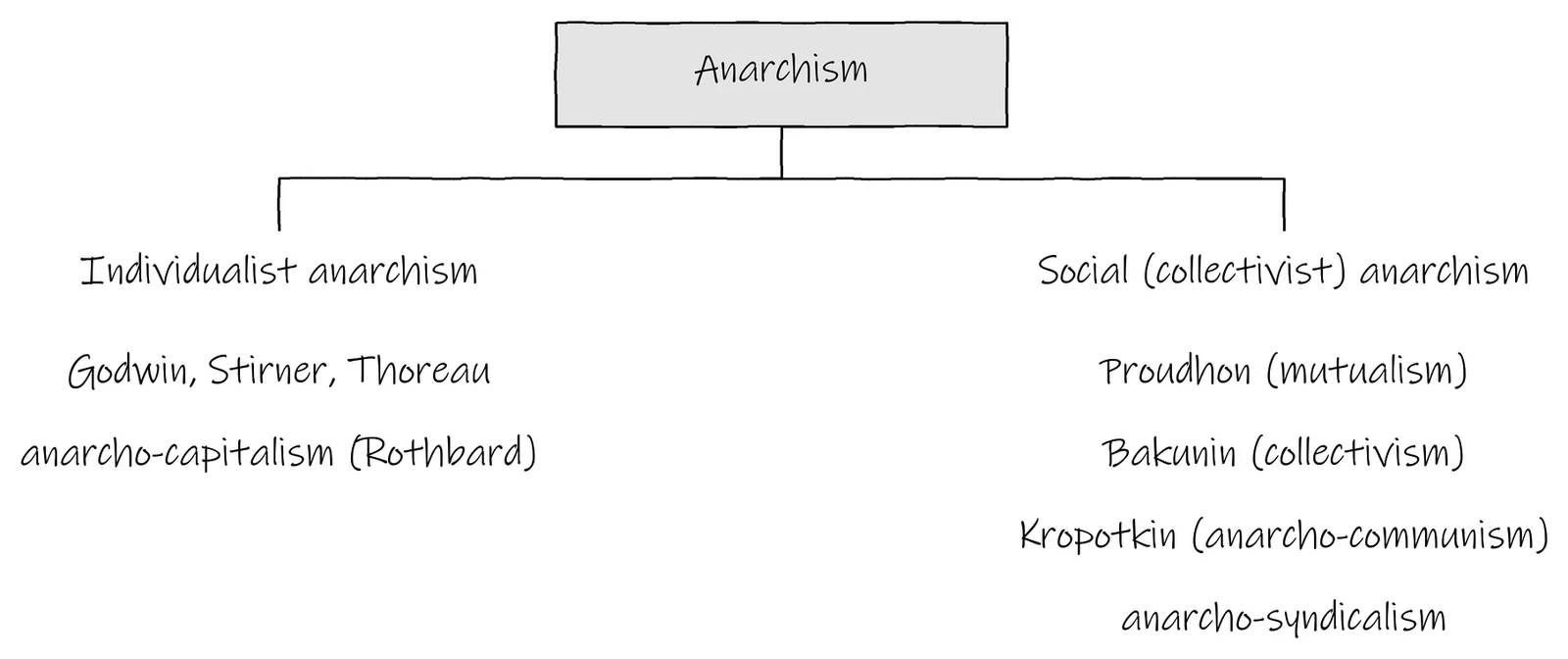
Anarchists agree on rejecting the state but disagree about the economy and about how a free society should be organised. They fall into two broad families, individualist and social (collectivist) anarchism, with several types within them (Figure 3.5).
A. Individualist anarchism
- The sovereign individual is supreme; all coercion, including that of the majority, is rejected, and society should rest on voluntary contracts.
- William Godwin (1793), Max Stirner’s egoism (1844), Thoreau (1849) and the American Benjamin Tucker, whose journal Liberty (1881–1908) defended individual sovereignty.
B. Mutualism
- Small, independent producers and cooperatives exchange goods fairly according to the labour they contain, and a ‘people’s bank’ gives them interest-free credit.
- Pierre-Joseph Proudhon [प्रूधों], the first thinker to call himself an anarchist, developed it in What is Property? (1840) and proposed a federation of free communes in The Principle of Federation (1863).
C. Collectivist anarchism
- The means of production should be owned collectively by voluntary associations of workers, and reward should depend on work done.
- Mikhail Bakunin [बाकूनिन] trusted the spontaneous revolt of the masses, including peasants, wrote that “the passion for destruction is a creative passion” (1842), and warned that Marx’s workers’ state would become a new tyranny.
D. Anarcho-communism
- Goods should be shared in common and distributed according to need, in self-governing communes.
- Peter Kropotkin [क्रोपोटकिन], a Russian prince turned revolutionary, set this out in The Conquest of Bread (1892) and Mutual Aid (1902); Emma Goldman spread these ideas in America (Anarchism and Other Essays, 1910).
E. Anarcho-syndicalism
- Revolutionary trade unions (syndicates) will overthrow capitalism through the general strike and then run society.
- France’s CGT adopted it in the Charter of Amiens (1906); Georges Sorel’s Reflections on Violence (1908) described the ‘myth’ of the general strike; Spain’s CNT collectivised land and factories in the Civil War of 1936.
F. Anarcho-capitalism
- Even police, courts and defence can be supplied by private firms competing in a free market; the state is replaced by the market.
- Murray Rothbard’s For a New Liberty (1973) and David Friedman’s The Machinery of Freedom (1973) emerged from the American libertarian movement.
G. Pacifist (Christian) anarchism
- The state rests on violence, which true Christians and believers in non-violence must reject; change must come through moral example.
- Leo Tolstoy’s The Kingdom of God Is Within You (1894) based this on the Sermon on the Mount; Gandhi, influenced by Tolstoy, saw the state as violence in an organised form and dreamt of self-governing villages.
Criticisms of Anarchism
Critics argue that anarchism is utopian and too optimistic about human nature; without a state, they say, the strong would dominate the weak, as in Hobbes’s state of nature. It offers no clear answer to problems of security, public goods and large-scale coordination, and anarchist experiments, such as in Spain in 1936, were short-lived.
If anarchists trust human nature most, conservatives trust it least. This leads us to the fourth tradition.
3.5 Conservatism
Conservatism, as its name suggests, is the desire to conserve. As a political tradition it arose as a reaction against the French Revolution of 1789 and its claim to rebuild society on abstract principles of reason. Its founding text is Edmund Burke’s Reflections on the Revolution in France (1790). Burke did not oppose all change; he insisted that “a state without the means of some change is without the means of its conservation”. But change, he argued, must be gradual and must grow out of tradition, not be imposed by revolutionaries.
Features of Conservatism
- Tradition. Customs and institutions contain the wisdom of generations. Burke defended them in Reflections on the Revolution in France (1790) against revolutionaries who wished to rebuild society from abstract principles; society, he wrote, is a partnership “between those who are living, those who are dead, and those who are to be born”.
- Human imperfection. Human beings are limited in reason and morality, so attempts to perfect society are dangerous. Anthony Quinton called this the politics of imperfection (1978), summing up a long conservative tradition.
- Organic society. Society is a living whole, not a machine built by contract. Burke contrasted this inherited partnership with the social contract theories of the revolutionaries.
- Hierarchy and authority. Order needs leadership and obedience. Joseph de Maistre, horrified by the Terror of the French Revolution, defended the authority of throne and altar in Considerations on France (1797).
- Property. Property gives security and a stake in society. Roger Scruton, in The Meaning of Conservatism (1980), written in Thatcher’s Britain, defended property as the way individuals put down roots and connect themselves to a shared world.
- Pragmatism. Politics should follow experience, not abstract theory. Michael Oakeshott [ओकशॉट]’s Rationalism in Politics (1962) criticised the post-war faith in planning and ideological politics in Britain.
Types of Conservatism
A. Traditional (Burkean) conservatism
- Change in order to conserve: gradual reform within tradition, respect for inherited institutions and distrust of abstract reason.
- Burke (1790) set it out against the French Revolution; Oakeshott restated it in the twentieth century, describing the conservative disposition as preferring “the familiar to the unknown, the tried to the untried”.
B. Authoritarian conservatism
- Order requires absolute, unquestioned authority, of the monarch and the church, and the people owe complete obedience.
- Joseph de Maistre [द मेस्त्र] (1797) and Louis de Bonald, writing against the French Revolution, defended throne and altar as the only protection against chaos.
C. Paternalist (one-nation) conservatism
- The rich have a duty to look after the poor, both from moral obligation and to prevent revolution; reform is accepted to preserve social unity.
- Benjamin Disraeli’s ‘one nation’ conservatism (1840s–1870s) supported the Second Reform Act (1867) and social reforms such as the Public Health Act (1875); Harold Macmillan’s The Middle Way (1938) prepared Conservatives to accept the post-war welfare state.
D. Christian Democracy
- Conservative values of family, faith and community combined with social welfare and partnership between capital and labour, inspired by Catholic social teaching (Rerum Novarum, 1891).
- After 1945 Konrad Adenauer’s Christian Democratic Union in West Germany built a social market economy, i.e. a free market with a strong welfare system.
E. The New Right
- A combination of neo-liberal economics, i.e. free markets, low taxes and privatisation taken from liberal thinkers such as Hayek and Friedman, and neo-conservative social values, i.e. law and order, family values and national identity.
- It shaped the governments of Margaret Thatcher (Britain, from 1979) and Ronald Reagan (USA, from 1981); in America Irving Kristol is called the father of neo-conservatism. Thatcher’s remark that “there is no such thing as society” (1987) expressed its individualism.
Criticisms of Conservatism
Critics argue that conservatism defends privilege and inequality, that it gives no clear test of which traditions deserve to be conserved, and that traditions may themselves contain injustice, such as slavery or caste.
3.6 Comparing the Four Traditions
| Basis | Liberalism | Marxism | Anarchism | Conservatism |
|---|---|---|---|---|
| Human nature | Rational, self-interested individuals | Shaped by class and social conditions | Naturally sociable and cooperative | Imperfect, limited in reason |
| Highest value | Liberty | Equality | Freedom without domination | Order and tradition |
| View of the state | Necessary but limited | Tool of class rule; will wither away | Unnecessary evil; abolish it | Guardian of order and authority |
| Attitude to change | Gradual reform | Revolution | Revolution from below | Slow, organic change |
| Key thinkers | Locke, Mill, Green, Rawls | Marx, Engels, Lenin, Gramsci | Godwin, Proudhon, Bakunin, Kropotkin | Burke, Oakeshott |
The four traditions are in constant dialogue. Modern liberalism borrowed from socialism in building the welfare state; conservatives borrowed free-market ideas from liberals; and the anarchist critique of authority influenced both the New Left and many modern social movements. Understanding each tradition, therefore, also means understanding its quarrels with the others.
3.7 Important Questions
- Question 1 Evaluate the core conceptions of liberty within liberal thought.
- Question 2 Why did Marx consider capitalism to be an exploitative system? Give reasons.
- Question 3 “The state is an unnecessary evil.” Do you agree with this statement? Give reasons to support your answer.
- Question 4 What is traditionalism? Answer with reference to conservatism.
DU asks the same idea in different words. So learn one broad answer for each question below; the same answer works for every question joined by OR.
Important Question 1
Evaluate the core conceptions of liberty within liberal thought.
OR
Distinguish between negative and positive liberty.
OR
Discuss the main features of liberalism. How did classical liberalism change into modern liberalism?
Model Answer
“Over himself, over his own body and mind, the individual is sovereign.”
— J.S. Mill, On Liberty (1859)
Introduction. Liberty is the central value of liberalism. Yet liberals have understood it in different ways: as the absence of interference, as the real capacity to develop oneself, and, more recently, as freedom from domination. The history of liberalism is largely the history of these conceptions.
1. Negative Liberty
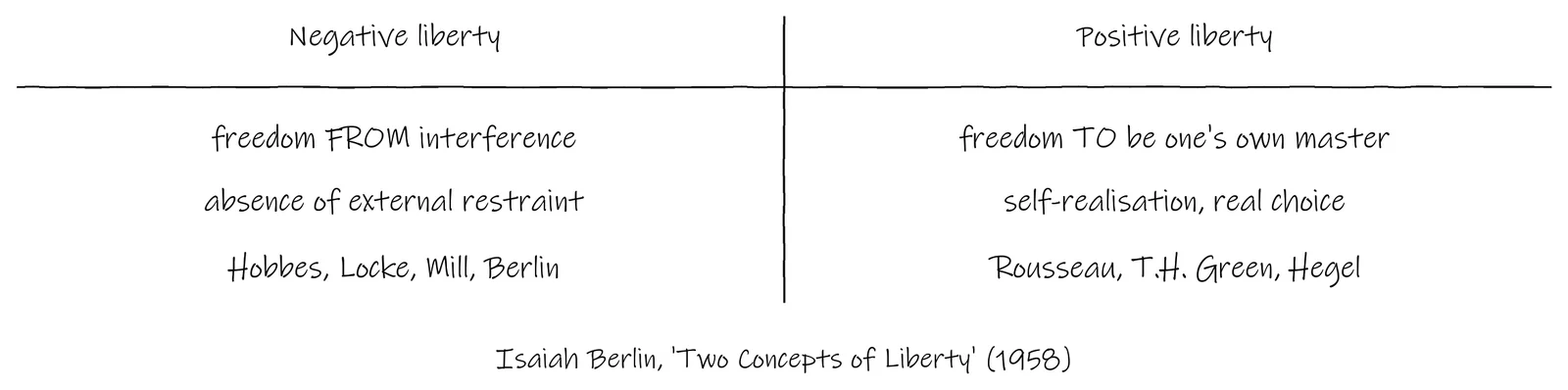
Negative liberty means freedom from interference. For Hobbes, a free man is one who is not hindered from doing what he has the will to do. Locke saw liberty as the right to act within the law of nature without being subject to the arbitrary will of another. J.S. Mill’s harm principle marked the boundary: the state may restrain an individual only to prevent harm to others, while in matters that concern only himself the individual is sovereign. On this view, the larger the area of non-interference, the greater the freedom. Mill’s On Liberty (1859) defended a sphere of self-regarding conduct in which society has no right to interfere, subject only to the harm principle.
2. Mill on Liberty
Mill defended liberty of thought and discussion, liberty of tastes and pursuits, and liberty of association, arguing that individuality is essential to human well-being and progress. The only purpose for which power can rightly be exercised over anyone against his will, he wrote, is to prevent harm to others.
3. Positive Liberty
Positive liberty means freedom to be one’s own master and to realise one’s capacities. Rousseau argued that true freedom lies in obeying a law one prescribes to oneself through the general will. T.H. Green, writing about the poverty of industrial England, argued that freedom is a positive power of doing something worth doing, and that the state must remove obstacles such as ignorance, disease and want. This idea justified state education, public health and labour laws. T.H. Green defined freedom as a positive power or capacity of doing or enjoying something worth doing or enjoying, in common with others.
4. Berlin’s Two Concepts of Liberty
Isaiah Berlin, in ‘Two Concepts of Liberty’ (1958), defended negative liberty. He warned that positive liberty can be dangerous, because rulers may claim to know a person’s ‘true’ or ‘higher’ self better than the person does, and so coerce people in the name of their own freedom; this, he argued, opened the door to totalitarianism. His warning drew on the experience of totalitarian regimes that claimed to liberate people while crushing them.
5. From Classical to Modern Liberalism
Classical liberals linked liberty with laissez-faire and a minimal state. Modern liberals such as Green and L.T. Hobhouse linked it with equal opportunity and the welfare state. John Rawls gave equal basic liberties priority in his theory of justice, while allowing inequalities only if they benefit the least advantaged. Hobhouse’s Liberalism (1911) argued that the state must secure conditions such as education and protection against unemployment for liberty to be real.
6. The Neo-liberal Return
Hayek and Nozick revived negative liberty, arguing that welfare policies and economic planning threaten freedom and that the market is the realm of liberty. Hayek defined freedom as independence from the arbitrary will of another. Hayek’s The Road to Serfdom (1944) argued that central planning leads to tyranny.
7. Rawls and Egalitarian Liberalism
Rawls gave priority to equal basic liberties but insisted that their ‘worth’ depends on social and economic conditions, so a just society must guarantee fair equality of opportunity and help the least advantaged. Egalitarian liberalism thus tries to reconcile liberty and equality.
8. Liberty and the Market
Classical and neo-liberals link liberty with private property and free markets, while modern liberals argue that unregulated markets can create poverty and dependence that destroy real liberty; the debate continues in arguments over welfare and regulation.
9. Liberty as Non-domination
Republican thinkers such as Philip Pettit (Republicanism, 1997) and Quentin Skinner argue that a person is unfree not only when interfered with but also when living under another’s arbitrary power, like a slave with a kind master. Liberty, on this view, means non-domination. On this view a wife subject to a husband’s legal power, or a worker dependent on an arbitrary employer, is unfree even if never actually interfered with.
10. Marxist and Feminist Critiques
Marxists argue that liberal liberty is formal freedom for property-owners while workers remain dependent on wages, and feminists argue that liberal liberty ignored domination within the family.
11. Critical Evaluation
Gerald MacCallum (1967) argued that the two concepts are not really opposed: every freedom has the form ‘X is free from Y to do Z’. Marxists reply that liberal liberty is merely formal, since economic dependence makes workers unfree; feminists show that freedom in public life can coexist with domination at home; and communitarians criticise the idea of an unencumbered individual. The Indian Constitution protects negative liberty through Article 19 and promotes positive liberty through the Directive Principles and welfare rights. Liberty thus remains a contested concept whose meaning depends on how we understand the person, society and the state.
Conclusion. Thus, liberal thought has moved from freedom as non-interference to freedom as real capacity and, more recently, to freedom as non-domination. Each conception captures part of the truth, and a full theory of liberty must combine protection from interference with the real conditions that make choice possible.
Important Question 2
Why did Marx consider capitalism to be an exploitative system? Give reasons.
OR
Explain Marx’s theory of surplus value.
OR
Discuss the main tenets of Marxism.
Model Answer
“The history of all hitherto existing society is the history of class struggles.”
— Marx and Engels, The Communist Manifesto (1848)
Introduction. For Marx, capitalism is a system in which a class of owners, the bourgeoisie, lives on the unpaid labour of a class of workers, the proletariat. Exploitation is not an accident or the result of bad employers; it is built into the very structure of capitalist production.
1. Capitalism in Historical Materialism
Marx saw history as a succession of modes of production, each marked by a ruling and a subject class. Capitalism is the latest class society: the bourgeoisie owns the means of production, and the proletariat owns only its capacity to work. In the Preface to A Contribution to the Critique of Political Economy (1859), Marx wrote that the economic structure is the real foundation on which the legal and political superstructure rises.
2. The Labour Theory of Value
Following Adam Smith and David Ricardo, Marx held that the value of a commodity is determined by the socially necessary labour time required to produce it. Labour is therefore the source of all new value. Capital, Marx wrote, is dead labour that, vampire-like, lives only by sucking living labour.
3. Labour Power and Surplus Value
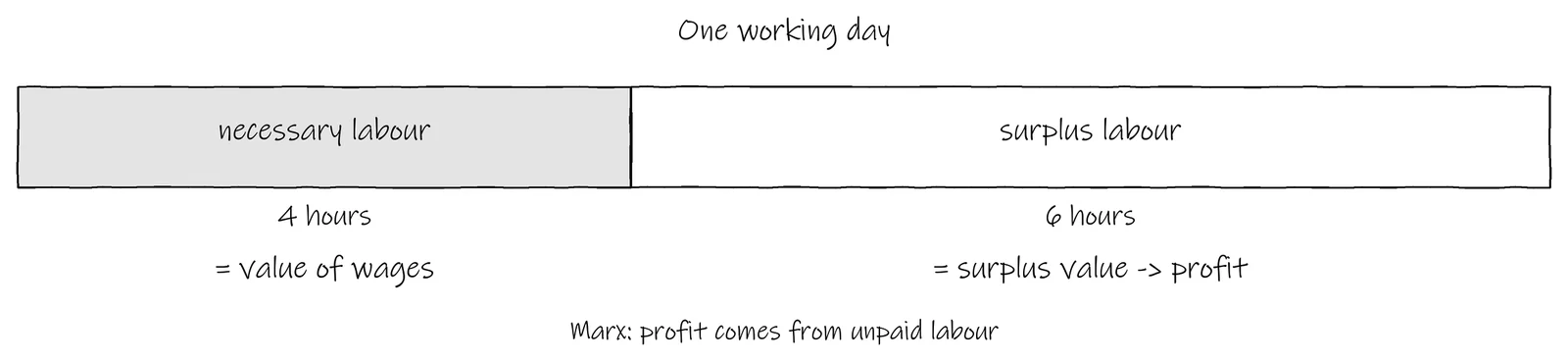
The worker sells his labour power for a wage equal to the value of what he needs to live. But in a working day he produces more value than this. If four hours of work produce the value of his wages, the remaining hours are surplus labour, and the value they create, surplus value, is taken by the capitalist as profit. Capitalists increase it in two ways: by lengthening the working day (absolute surplus value) and by raising productivity through machinery (relative surplus value). If a worker needs six hours to produce the value of his wage but works ten, the remaining four hours produce surplus value that the capitalist takes without payment.
4. Exploitation behind a Free Contract
Exploitation is hidden because the wage contract appears free and equal. Yet the worker is ‘free’ in a double sense: free to sell his labour, and ‘free’ of any means of production, so that he must sell it or starve. Formal equality in the market conceals real inequality in production. Freedom of contract thus hides a relation of domination, since the worker must sell his labour power or starve.
5. Commodity Fetishism
Marx argued that under capitalism social relations between people appear as relations between things: the value of commodities seems natural, hiding the labour and exploitation behind them. This ‘fetishism of commodities’ makes exploitation invisible.
6. Alienation
In the Economic and Philosophic Manuscripts (1844), Marx argued that capitalism alienates workers from the product of their labour, from the activity of work, from their human nature (species-being) and from other human beings. Work becomes a means of survival rather than an expression of creativity. Workers are also alienated from their ‘species-being’, their creative human nature, so labour becomes a mere means of survival.
7. Polarisation and Crisis
Competition forces capitalists to cut costs and replace workers with machines. Wealth concentrates in fewer hands, small producers fall into the proletariat, and periodic crises of overproduction bring unemployment and misery. Marx predicted that a reserve army of the unemployed would keep wages low and that periodic crises of overproduction would deepen.
8. Class Struggle and Revolution
Because capitalists and workers have opposed interests, class struggle is built into capitalism. Marx believed that the proletariat, concentrated in factories and impoverished, would become conscious of its interests and overthrow capitalism, establishing socialism and finally a classless communist society.
9. The State and Ideology
The state, as ‘a committee for managing the common affairs of the whole bourgeoisie’, protects private property and the wage system, while ruling ideas present capitalism as natural and just. Exploitation is therefore defended by both force and consent. The ruling ideas of every age, Marx and Engels wrote, are the ideas of its ruling class.
10. Marx’s Moral Critique
Although Marx avoided moral language, his analysis implies a deep moral criticism: capitalism denies workers control over their lives and the fruits of their labour, and turns human beings into instruments of profit.
11. Evaluation
Critics reject the labour theory of value; economists of the marginal utility school, such as Eugen von Böhm-Bawerk [बॉम-बावर्क], argued that value depends on utility and scarcity. Rising real wages and welfare states in the West seemed to disprove Marx’s prediction of growing misery, and communist economies failed. Yet his analysis of inequality, the power of capital and the insecurity of workers remains relevant. Yet his analysis still informs debates on inequality, insecure work and the gig economy, as Thomas Piketty’s Capital in the Twenty-First Century (2013) shows in a different way.
Conclusion. Thus, for Marx capitalism is exploitative because profit comes from the unpaid labour of workers who have no choice but to sell their labour power. Abolishing exploitation, he concluded, requires abolishing private ownership of the means of production itself.
Important Question 3
“The state is an unnecessary evil.” Do you agree with this statement? Give reasons to support your answer.
OR
Discuss the main features of anarchism.
OR
Distinguish between individualist and social anarchism.
Model Answer
“To be governed is to be watched, inspected, spied upon, directed.”
— Pierre-Joseph Proudhon (1851)
Introduction. The statement expresses the anarchist view of the state. Liberals, following Thomas Paine, see the state as a necessary evil; Marxists see it as an instrument of class rule that will wither away after the revolution; anarchists alone hold that it is both evil and unnecessary, and should be abolished.
1. Why the State is Evil
Anarchists argue that the state is coercive, since it rests on force, prisons and armies; exploitative, since it protects the property of the rich, which Proudhon called theft; and corrupting, since power corrupts those who hold it, as Bakunin warned about Marx’s workers’ state. Robert Paul Wolff, in In Defense of Anarchism (1970), added that a morally autonomous person cannot accept any authority merely because it is authority. Proudhon, in What is Property? (1840), declared that property is theft and described being governed as being watched, inspected, spied upon and regulated.
2. Why the State is Unnecessary
Anarchists believe that order arises naturally. Godwin trusted human reason; Kropotkin, in Mutual Aid (1902), showed that cooperation is a basic law of nature and society. Communities, cooperatives and voluntary associations can, in their view, meet human needs without compulsion. Kropotkin argued that cooperation, not competition, is the main factor in evolution, so people can organise themselves through voluntary federations.
3. Varieties of Anarchism
Individualist anarchists such as Godwin, Stirner and Thoreau defend the sovereign individual, and anarcho-capitalists would leave everything to the market. Social anarchists such as Proudhon (mutualism), Bakunin (collectivism), Kropotkin (anarcho-communism) and the anarcho-syndicalists combine the abolition of the state with common ownership and equality. Tolstoy and, in part, Gandhi gave anarchism a moral and non-violent form. (Draw Figure 3.5 in the answer.) Bakunin, rejecting Marx’s dictatorship of the proletariat, warned that a workers’ state would become a new tyranny.
4. Arguments against the Statement
Hobbes argued that without a common power life would be “solitary, poor, nasty, brutish and short”. Liberals reply that the state, though dangerous, is necessary to protect rights, enforce contracts and provide security. Others point to public goods such as defence, roads and public health, which voluntary cooperation struggles to supply on a large scale, and note that anarchist experiments have been short-lived. Even Marx held that the state can wither away only after classes have disappeared. Marxists agree that the state is an instrument of class rule but hold that it will wither away only after a transitional workers’ state.
5. Contemporary Anarchism
Anarchist ideas have revived in the anti-globalisation movement, Occupy Wall Street (2011) and experiments in local self-governance, which favour horizontal, leaderless organisation and direct action.

6. A Balanced View
The state is not unnecessary: in a complex society it remains essential for security, justice and welfare. But the anarchist critique is valuable. It reminds us that state power must be limited, accountable and decentralised, and that much of social life can be organised from below through voluntary associations and local self-government. In this sense the anarchist challenge is a permanent reminder that state power must justify itself.
7. Anarchism and Feminism
Anarchist feminists such as Emma Goldman argued that the state, the church and the patriarchal family were linked forms of domination, and that freedom required liberation from all of them.
8. Anarchism in Practice
Anarchist ideas have been tried in practice. The Paris Commune (1871) inspired both Marxists and anarchists with its elected, recallable delegates. During the Spanish Civil War (1936–39), the anarcho-syndicalist CNT collectivised land and factories in Catalonia and Aragon, and George Orwell described Barcelona in Homage to Catalonia (1938) as a city where the working class was in the saddle. These experiments were short-lived and were crushed by war, but they showed that self-management on a large scale was possible for a time. During the Spanish Civil War (1936–39), anarchist collectives ran farms and factories in Catalonia and Aragon.
9. Philosophical Anarchism and Gandhi
Some thinkers accept the anarchist critique without demanding the immediate abolition of the state. Robert Paul Wolff (1970) argued that no state has legitimate authority over an autonomous person, yet it may still be wise to obey particular laws. Gandhi called the state ‘violence in a concentrated and organised form’ and described his ideal as ‘enlightened anarchy’, in which every person rules himself; but he accepted that a minimal, decentralised state was needed in the world as it is, and favoured self-governing village republics. Robert Nozick, in Anarchy, State, and Utopia (1974), replied to the anarchists by arguing that a minimal state would arise legitimately from a state of nature through protective associations, without violating anyone’s rights. Gandhi called himself a philosophical anarchist and described the state as violence in a concentrated and organised form. He spoke of an ideal of enlightened anarchy in which each person rules himself, though he accepted that the state would remain in practice.
Conclusion. Thus, the statement captures the anarchist ideal of a free society without coercion, but it underestimates human conflict and the need for collective institutions. The wiser conclusion is that the state is necessary, but its power must always be questioned and checked.
Important Question 4
What is traditionalism? Answer with reference to conservatism.
OR
Discuss the main features of conservatism.
OR
Write a note on ‘the politics of imperfection’.
Model Answer
“Society is a partnership between those who are living, those who are dead, and those who are to be born.”
— Edmund Burke, Reflections on the Revolution in France (1790)
Introduction. Traditionalism is the belief that inherited customs, institutions and values deserve respect and should guide political life. It lies at the heart of conservatism, which arose as a reaction against the French Revolution’s attempt to rebuild society on abstract principles.
1. Meaning of Traditionalism
Tradition means the values, practices and institutions handed down from the past. For conservatives it is the accumulated wisdom of many generations, tested by experience. Burke also defended prescription, i.e. the authority that institutions gain from long existence, and prejudice, by which he meant inherited wisdom that guides action without lengthy reasoning. G.K. Chesterton called tradition ‘the democracy of the dead’, giving votes to our ancestors. Traditionalism is therefore not mere nostalgia but a theory of how political knowledge is stored in institutions, customs and habits.
2. Why Conservatives Value Tradition
Tradition embodies wisdom greater than that of any single generation; it gives society stability and continuity; it provides identity and belonging; and it allows organic change that grows out of existing institutions. Burke described society as a partnership between those who are living, those who are dead and those who are to be born.
3. The Politics of Imperfection
Conservatism rests on a view of human beings as imperfect. Anthony Quinton’s The Politics of Imperfection (1978) identified three kinds of imperfection: psychological (people seek security and the familiar), moral (people are selfish and need restraint) and intellectual (human reason is too limited to grasp the complexity of society). Because human reason is limited, conservatives distrust grand designs to remake society and prefer gradual reform.
4. Other Features of Conservatism
- Organic society: society is a living whole, not a machine; Burke contrasted it with the revolutionaries’ contract (1790).
- Hierarchy and authority: order needs leadership; de Maistre defended throne and altar after the Terror (1797).
- Property: property gives security and a stake in society; Scruton saw it as the root that ties people to a shared world (1980).
- Pragmatism: experience is a better guide than theory; Oakeshott attacked post-war ‘rationalism in politics’ (1962).
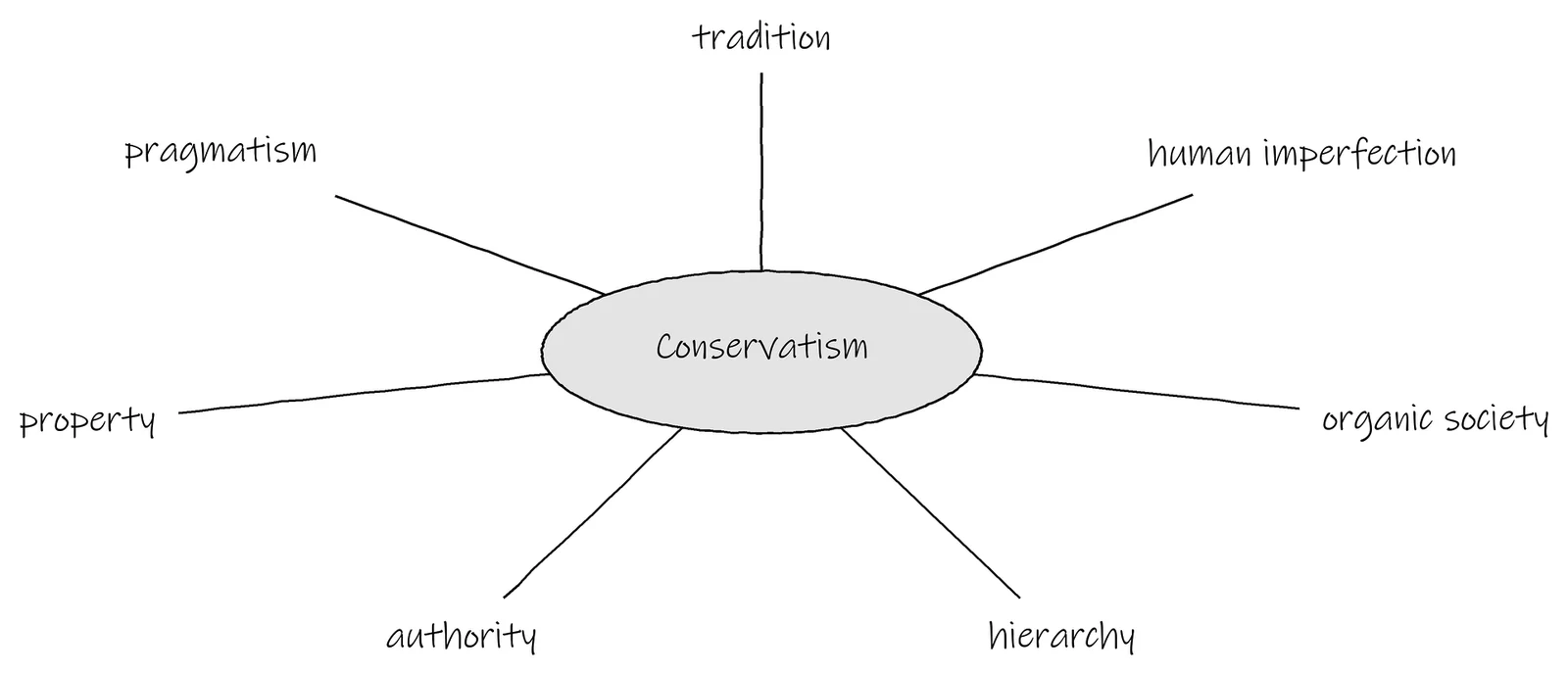
Together these features describe a politics of order, continuity and caution rather than abstract design.
5. Change in Order to Conserve
Burke insisted that a state without the means of some change is without the means of its conservation. Conservatism therefore accepts reform, but gradual reform that grows out of existing institutions, as in Disraeli’s one-nation conservatism and its social reforms.
6. Traditionalism in India
In India, traditionalist arguments have been used to defend caste and gender hierarchies, but Gandhi drew on tradition selectively to criticise modern industrial civilisation, rejecting untouchability while valuing village self-rule.
7. Conservatism and the New Right
The New Right of Thatcher and Reagan combined traditional values of authority, family and nation with neo-liberal economics, showing that conservatism can adapt by absorbing elements of liberalism.
8. Criticisms
Critics argue that traditionalism defends privilege and inequality, that it cannot tell us which traditions deserve to be kept, and that many traditions, such as slavery, untouchability and the subordination of women, are unjust. Liberals add that appeals to tradition have historically been used to defend slavery, caste and the subordination of women. Thomas Paine replied to Burke in Rights of Man (1791) that each generation must be free to act for itself, since governing beyond the grave is the most insolent of tyrannies.
9. Burke’s Critique of Abstract Rights
Burke attacked the French revolutionaries’ Declaration of the Rights of Man (1789) for basing government on abstract ‘metaphysical’ rights that ignored circumstances and experience. Real rights, he argued, are the inherited liberties of a particular people, such as the rights of Englishmen secured by Magna Carta and the Glorious Revolution. He predicted that abstract principles would lead to disorder and tyranny, and the Terror of 1793–94 seemed to confirm his warning. He predicted that the attempt to rebuild society on abstract reason would end in terror and military rule, which the Terror and Napoleon seemed to confirm.
10. Oakeshott and Practical Knowledge
Michael Oakeshott, in Rationalism in Politics (1962), distinguished technical knowledge, which can be written down in rules, from practical knowledge, which exists only in use and is learnt through experience, like cooking or a craft. Politics, he argued, depends on practical knowledge embodied in traditions of behaviour, so the ‘rationalist’ who tries to run society from a book of principles misunderstands it. The conservative disposition is therefore ‘to prefer the familiar to the unknown, the tried to the untried, fact to mystery, the actual to the possible’. He compared politics to sailing a boundless sea with neither harbour nor destination, where the task is simply to keep afloat on an even keel.
11. Evaluation
Traditionalism reminds us that societies are not machines that can be redesigned at will and that inherited institutions often contain hidden wisdom. But a tradition must itself be judged by standards of justice and freedom; otherwise the defence of the past becomes a defence of privilege.
Conclusion. Thus, traditionalism is the conservative belief that the wisdom of the past is a better guide than abstract reason. It does not reject all change, as Burke himself accepted, but demands reform that is gradual and continuous with the past. It rightly warns against reckless change, but it must be combined with critical judgement, since not everything inherited from the past deserves to be conserved.
Short Notes
(a) Dictatorship of the proletariat
Marx’s term for the transitional state after a socialist revolution, in which the working class uses state power to suppress the old ruling class and reorganise production. In the Critique of the Gotha Programme (1875) he placed it between capitalist and communist society, and Lenin’s The State and Revolution (1917) developed it. Critics argue that in practice it became the dictatorship of a single party over the proletariat.
(b) Mutual aid
Peter Kropotkin’s idea, set out in Mutual Aid: A Factor of Evolution (1902), that cooperation, not only competition, is a key factor in the survival of species and in human progress. Against social Darwinists who stressed the struggle for existence, he drew on evidence from animals, villages, guilds and medieval cities. Mutual aid became the basis of his anarcho-communism, in which free communities cooperate without the state.
More notes: DSC-1 Understanding Political Theory
These notes are prepared by PADHO TO AISE for study help. They are not an official University of Delhi publication.