
Semester I DSC-1 Understanding Political Theory
Unit I · 31 min read · Updated 24 Nov 2026
As per the University of Delhi (DU) BA (Hons) Political Science syllabus
Contents
- 1.1 The Meaning of Politics
- 1.2 Four Conceptions of Politics
- 1.3 Theorizing ‘the Political’
- Different Thinkers, Different Meanings of ‘the Political’
- 1.4 Power: The Common Thread
- The Three Dimensions of Power
- Foucault: Power is Everywhere
- Power, Authority and Legitimacy
- 1.5 Political Theory: Meaning and Need
- Decline and Revival of Political Theory
- 1.6 Important Questions
- What is politics? Discuss the different ways of understanding politics.
- What is the distinction between the political and political theory? Why do we need political theory?
- “The concept of power is crucial to understanding politics.” Elaborate.
मनुष्य स्वभाव से ही एक राजनीतिक प्राणी है।
Man is by nature a political animal.
— ARISTOTLE, Politics
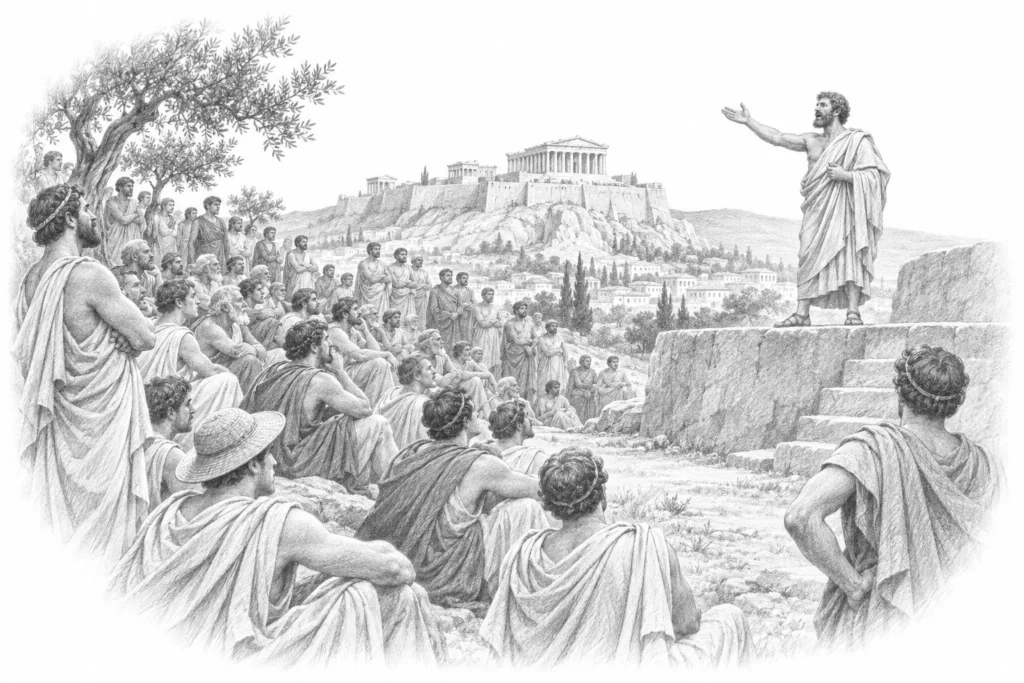
IN ANCIENT ATHENS citizens used to gather on a hill called the Pnyx [निक्स] to decide the big questions of their city, i.e. war and peace, taxes and punishment. For the Greeks, this shared life of the polis was what made a human being truly human. That is why Aristotle called man a zoon politikon [ज़ून पोलिटिकॉन], i.e. a political animal. Today, however, the word politics has got a bad name; we often use it for tricks and selfish games. Political theory asks us to keep this prejudice aside and study the idea properly.
1.1 The Meaning of Politics
Let us start with the word itself. In ancient Greece, the polis was a small city that governed itself, like Athens or Sparta, and ta politika meant ‘the affairs of the polis’. So, in its oldest sense, politics simply means the affairs of a community that runs itself. For Aristotle, politics was the ‘master science’, because the polis did not exist only to keep people alive; it existed to help them live a good life. Politics, for him, was the highest activity of free and equal citizens who deliberate together about what is good for the community.
Over time, however, the meaning of politics has widened and become a matter of debate. Every definition carries a different picture of society, so scholars will never fully agree. Still, if we look closely, all definitions use the word in one of three senses. In the first sense, politics means political power, i.e. the capacity to control decisions and resources; this is the sense used by Weber and Lasswell. In the second sense, it means political activity, i.e. what governments, parties and citizens actually do, such as voting, making laws and protesting; Easton’s definition belongs here. In the third sense, it means the political process, i.e. the way conflicts are turned, step by step, into decisions that bind everyone; this is Crick’s emphasis. Keep these three meanings in mind, because every thinker in this chapter stresses one of them.
| Thinker and work | Politics is… | Emphasis | What it overlooks |
|---|---|---|---|
| Aristotle, Politics | the pursuit of the good life by citizens of the polis | Activity; ethics | Excluded women, slaves and foreigners |
| Max Weber [वेबर], ‘Politics as a Vocation’ (1919) | the striving to share power or to influence its distribution | Power; the state | Consensus and shared values |
| Harold Lasswell, Politics: Who Gets What, When, How (1936) | the question of who gets what, when and how | Power; distribution | Becomes too broad to be precise |
| David Easton, The Political System (1953) | the ‘authoritative allocation of values’ for a society | Activity of government | Informal power outside the state |
| Bernard Crick, In Defence of Politics (1962) | the conciliation of differing interests by giving them a share in power | Process; compromise | Coercion and violence |
| Adrian Leftwich, What is Politics? (1984) | present in all collective social activity, formal and informal | Power everywhere | The line between political and social |
So what is common in all these definitions? Two things. First, politics begins with disagreement, because people want different things and resources such as wealth, land, jobs and respect are limited. Second, it ends in a collective decision that binds the whole group. In simple words, where there is no disagreement there is nothing to decide, and where there is no binding decision there is only a quarrel. Politics lives between the two.
1.2 Four Conceptions of Politics
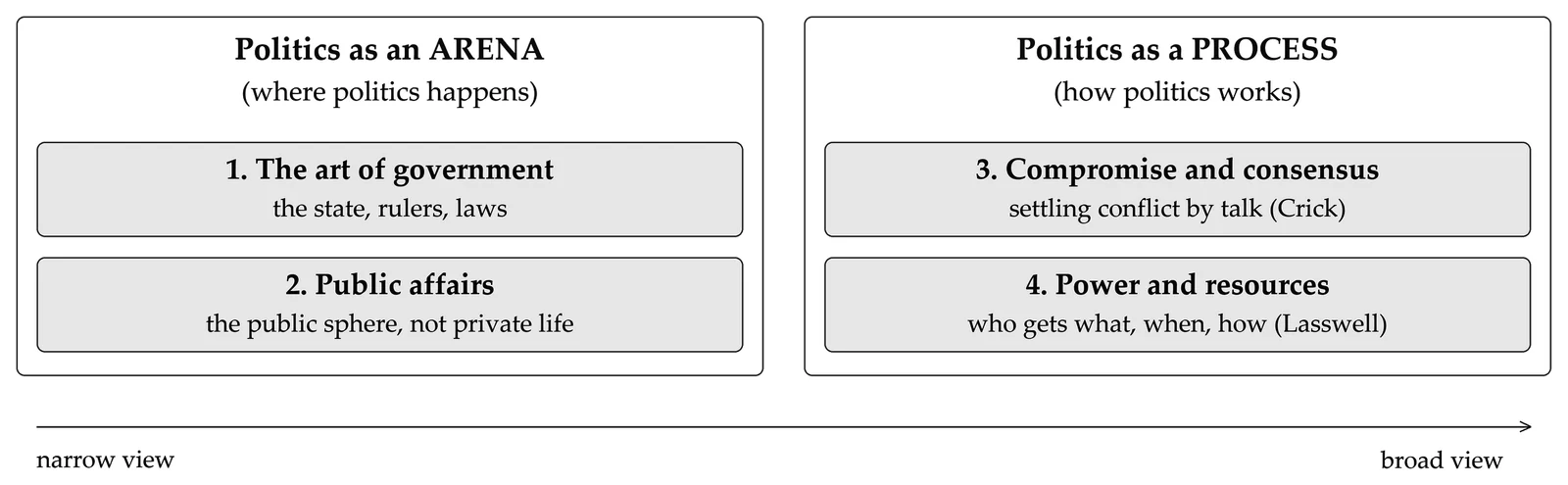
Now the question is where politics happens and how it works. Andrew Heywood has grouped the many definitions into four broad conceptions. The first two see politics as an arena, i.e. a particular place where politics happens. The last two see it as a process, i.e. a particular way in which things happen, wherever that may be. As we move from the first to the fourth, the meaning of politics becomes broader and slowly moves out of the boundary of the state.
Politics as the art of government. This is the oldest and narrowest view. Politics is identified with the state: it is the making, enforcing and interpreting of laws by government. David Easton’s definition of politics as the ‘authoritative allocation of values’ belongs to this view, and so does our everyday habit of calling ministers and members of Parliament ‘politicians’. The view is clear and precise, but it confines politics to a small group of professionals and ignores the power that exists outside the state, in society, the economy and the family.
Politics as public affairs. This broader view, which goes back to Aristotle, places politics in the public sphere as opposed to private life. The public sphere includes not only the state but also the institutions of civil society, such as political parties, trade unions, pressure groups and the media. The family and personal relationships, however, are treated as private and therefore outside politics. Liberals defend this boundary because it protects the freedom of the individual from interference by the state. Feminists, as we shall see, challenge it, because the family itself can be a place of domination.
Politics as compromise and consensus. Here politics is not a place but a particular way of resolving conflict: by debate, negotiation and compromise rather than by force. Bernard Crick, in In Defence of Politics (1962), described politics as the activity by which different interests within a community are reconciled by giving them a share in power. On this view, politics is a civilised achievement that exists only where people are free to disagree and to bargain. Its weakness is that it treats force and violence as the end of politics, while in reality coercion is often a part of political life.
Politics as power. This is the broadest view. Politics is found in all social activity wherever scarce resources are produced, distributed and used, from the household and the workplace to the university and the nation. Harold Lasswell’s phrase ‘who gets what, when, how’ and Adrian Leftwich’s claim that politics is at the heart of all collective social activity express this view. It is supported by Marxists and feminists, who see power in class and gender relations. Its problem is that if everything is political, the word loses its sharpness and becomes difficult to use.
Interestingly, this debate is also a debate between ideologies. Liberals keep politics inside the public sphere, so that the private life of the individual is protected. Marxists argue that political power is rooted in economic power, so that the state serves the class that owns property. Feminists reject the line between public and private altogether. This movement of politics from the state to the whole of society is exactly why modern thinkers started talking not only about politics but also about the political. This is what we study next.
1.3 Theorizing ‘the Political’
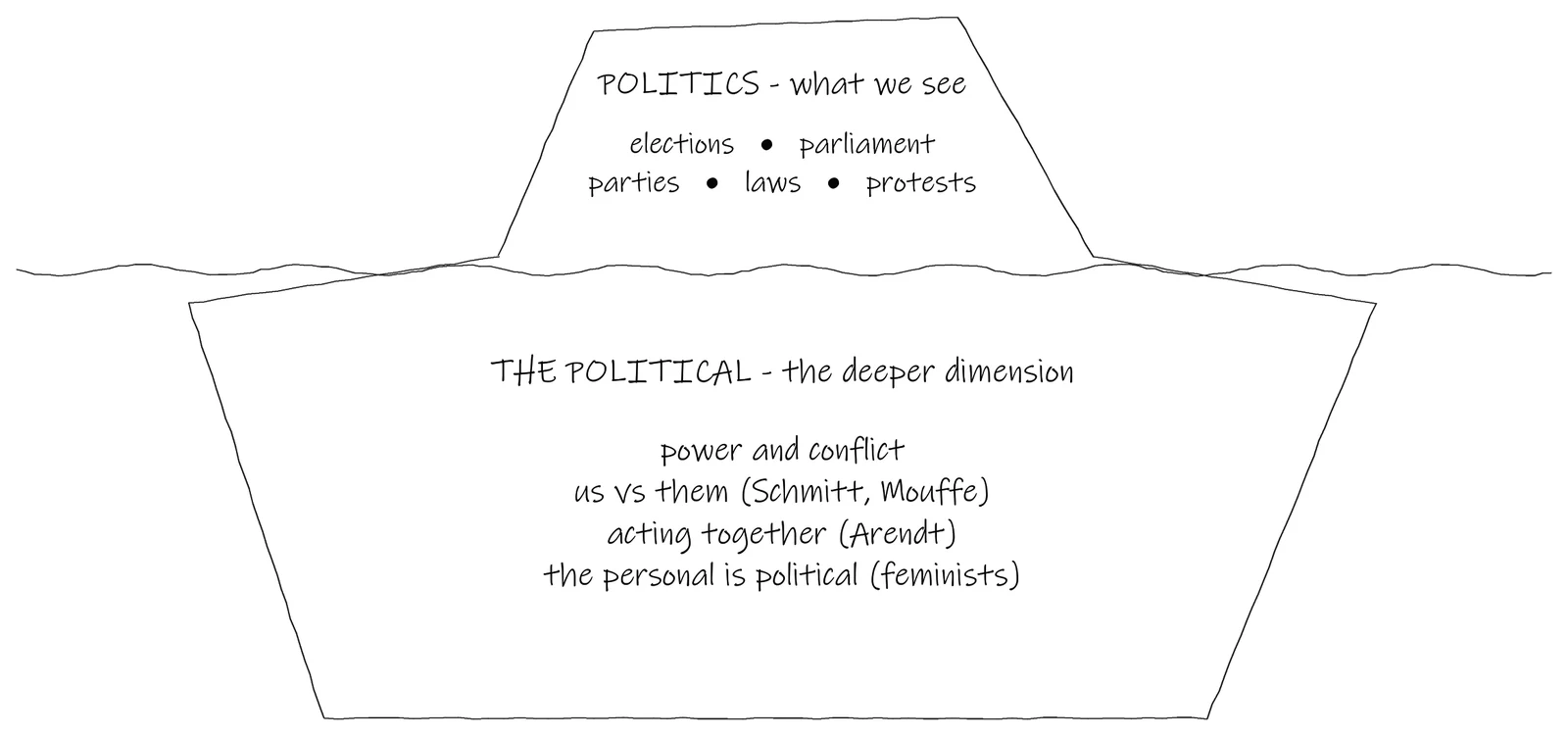
Now you may ask: if we already have the word politics, why do we need another word, the political? The answer is that the two words point to two different levels. Politics refers to the visible activities and institutions of government: parties, elections, Parliament, laws and policies. The political refers to the deeper dimension of social life in which power, conflict and group identity are formed, and which gives a society its basic shape. The French thinker Claude Lefort [लेफ़ोर] described the political as the way in which a society is instituted, i.e. given its form. Chantal Mouffe [मूफ़] makes the same point in philosophical language: the political belongs to the level of what a society fundamentally is, while politics belongs to the level of its everyday practices. In simple words, politics is what we see; the political is what makes it possible. The image of an iceberg explains this well (Figure 1.2).
Different Thinkers, Different Meanings of ‘the Political’
Why do Schmitt, Mouffe, Arendt and the feminists come in this chapter? Because the political does not have one fixed meaning. Each of these thinkers gives a different answer to the question of what the political is, and together they show how wide it is.
A. Carl Schmitt [श्मिट]: friend and enemy
In The Concept of the Political (1932), the German jurist Carl Schmitt argued that every field of human life rests on its own basic distinction: morality on good and evil, aesthetics on beautiful and ugly, economics on profitable and unprofitable. The political, he said, rests on the distinction between friend and enemy. Any conflict, whether religious, economic or ethnic, becomes political when it becomes so intense that people are divided into ‘us’ and ‘them’. For Schmitt, the sovereign is the one who decides who the enemy is. His idea shows how deep political conflict can go, but it is also dangerous, because it can justify treating opponents as enemies to be destroyed. Schmitt himself joined the Nazi party in 1933.
B. Chantal Mouffe: from enemy to adversary
In On the Political (2005), Chantal Mouffe accepts Schmitt’s insight that conflict, which she calls antagonism, i.e. deep hostility between groups, can never be removed from society. Liberal theorists who dream of a society without conflict, she says, are mistaken. But she gives the idea a democratic turn. Democracy cannot remove conflict, but it can transform it into agonism, i.e. a contest between adversaries who disagree strongly but accept each other’s right to exist and to compete. In a healthy democracy, rival parties are adversaries, not enemies.
C. Hannah Arendt [आरेंट]: acting together
In The Human Condition (1958), Hannah Arendt saw the political as the public space in which equal but different people come together to act and speak. She called the fact that the world is shared by many different people plurality, and she believed that it is through political action that human beings show who they are and begin something new. For Arendt, real power arises when people act in concert, as in a peaceful mass movement; violence, in contrast, appears when power is lost. Critics say that she separated politics too sharply from social and economic questions such as poverty.
D. Feminists: the personal is political
The slogan ‘the personal is political’ became famous through Carol Hanisch’s essay of 1969 and the women’s movement of the 1970s. Feminists argued that relations within the family, such as who does the housework, who takes decisions and who owns property, are shaped by power and are therefore political. Kate Millett called this system of male domination patriarchy. By bringing the family and the body into the political, feminists widened the concept more than anyone else, although critics fear that this may leave no space for privacy.
Notice that all four answers talk about power: who decides who the enemy is, who acts together, who rules inside the home. So power is the common thread of this whole chapter, and that is what we study next.
1.4 Power: The Common Thread
Let us begin with a simple definition. According to Max Weber, power is the probability that one person in a social relationship can carry out his will even against the resistance of others. Political thinkers also make a useful distinction between power over others, i.e. the ability to control them, and power to act, i.e. the ability of people to achieve something together. Most of the debate below is about power over others; Arendt’s idea of acting in concert is an example of power to.
The Three Dimensions of Power
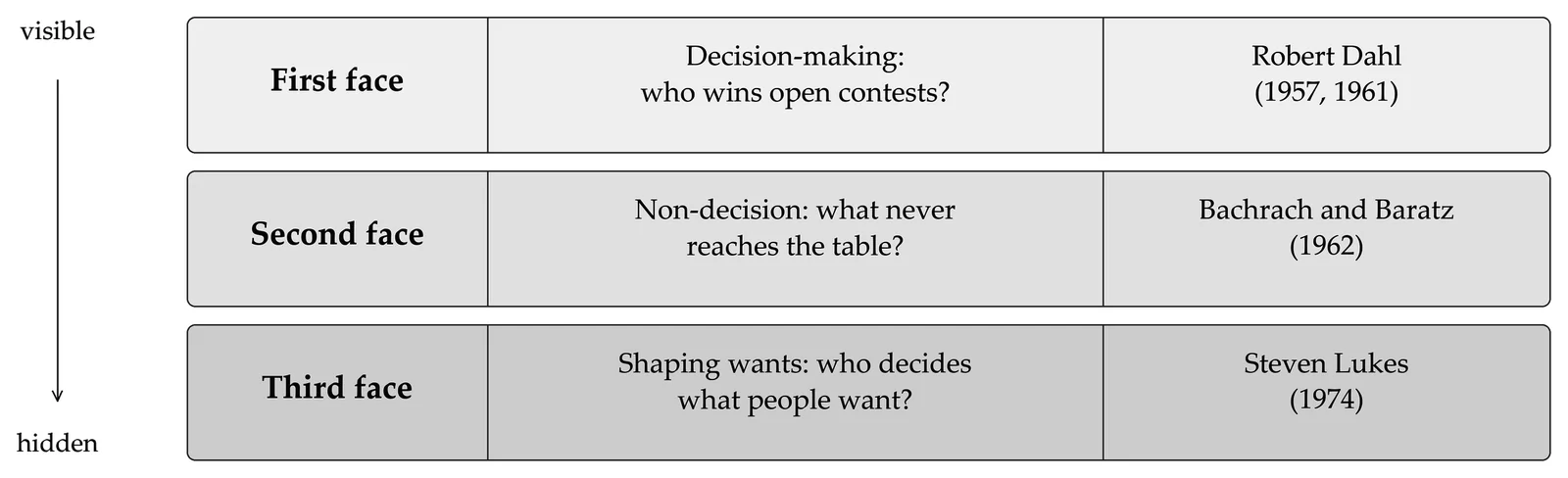
Between the 1950s and the 1970s there was a famous debate on how power should be studied. Steven Lukes [ल्यूक्स] later summed it up as three dimensions of power, each going deeper than the one before.
The first dimension: power as decision-making. The first view was given by the American political scientist Robert Dahl. In his article ‘The Concept of Power’ (1957), he defined power in a simple way: A has power over B to the extent that A can get B to do something that B would not otherwise do. To find out who has power, Dahl said, we should study actual decisions on important issues and see whose proposals succeed when there is an open conflict. In Who Governs? (1961), he applied this method to the city of New Haven in the United States. He studied decisions on urban development, public education and party nominations, and found that different groups won on different issues. No single elite controlled everything. He concluded that power in a democracy is spread among many competing groups, a view known as pluralism.
The second dimension: power as agenda-setting. Peter Bachrach and Morton Baratz criticised Dahl in their article ‘Two Faces of Power’ (1962). They argued that Dahl had studied only the face of power that is visible in open decisions. Power has a second face: the ability to prevent certain issues from being raised at all. A powerful group can make sure that questions which threaten its interests never reach the stage of decision. They called this non-decision-making. To explain how it happens, they borrowed E.E. Schattschneider [शैट्सश्नाइडर]’s phrase, the ‘mobilisation of bias’: every political system favours some issues and ignores others, and those who benefit from this bias use it to keep inconvenient questions off the table. So if we study only the decisions that are taken, we miss the decisions that are never allowed to be taken.
The third dimension: power as shaping wants. Steven Lukes, in Power: A Radical View (1974), argued that even the second dimension was not enough, because it still assumed that people know what they want and are aware of a conflict. For Lukes, the most effective form of power shapes people’s beliefs and desires so that they do not even recognise their own subordination. In such cases there is no visible conflict at all, because the dominated have come to accept their situation as natural or unavoidable. Lukes therefore distinguished between what people say they want and their real interests. For example, if a group accepts an unequal social hierarchy as its fate and never protests, Lukes would say that power is working on it silently. This idea is close to Antonio Gramsci [ग्राम्शी]’s concept of hegemony [हेजेमनी], i.e. the way a ruling class rules not only by force but by winning the consent of the ruled through ideas, religion, culture and education.
In short, the three dimensions move from the visible to the hidden: the first looks at decisions, the second at the agenda, and the third at the formation of people’s wants (Figure 1.3).
Foucault: Power is Everywhere
Michel Foucault [फूको] took the discussion in a new direction. The three-dimensional debate still treated power as something that some people hold over others. In Discipline and Punish (1975), Foucault argued that power is not a possession but a relationship that runs through the whole of society. It is exercised in prisons, schools, hospitals, factories and the army, through everyday practices such as timetables, examinations, inspections and records. He called this disciplinary power; its aim is not to punish now and then but to shape behaviour continuously, producing what he called ‘docile bodies’, i.e. people who are useful and obedient.
His symbol for this kind of power is the panopticon [पैनॉप्टिकॉन], a prison designed by Jeremy Bentham in which a guard in a central tower can watch every cell without being seen. Since the prisoners never know when they are being watched, they begin to watch and control themselves. Foucault also argued that power is productive: it does not only forbid, it creates norms, identities and knowledge. The knowledge produced by fields such as medicine, psychiatry and criminology defines what is ‘normal’ and so becomes a means of control; this is why he speaks of power/knowledge. Finally, because power is always a relationship, wherever there is power there is also resistance.
Power, Authority and Legitimacy
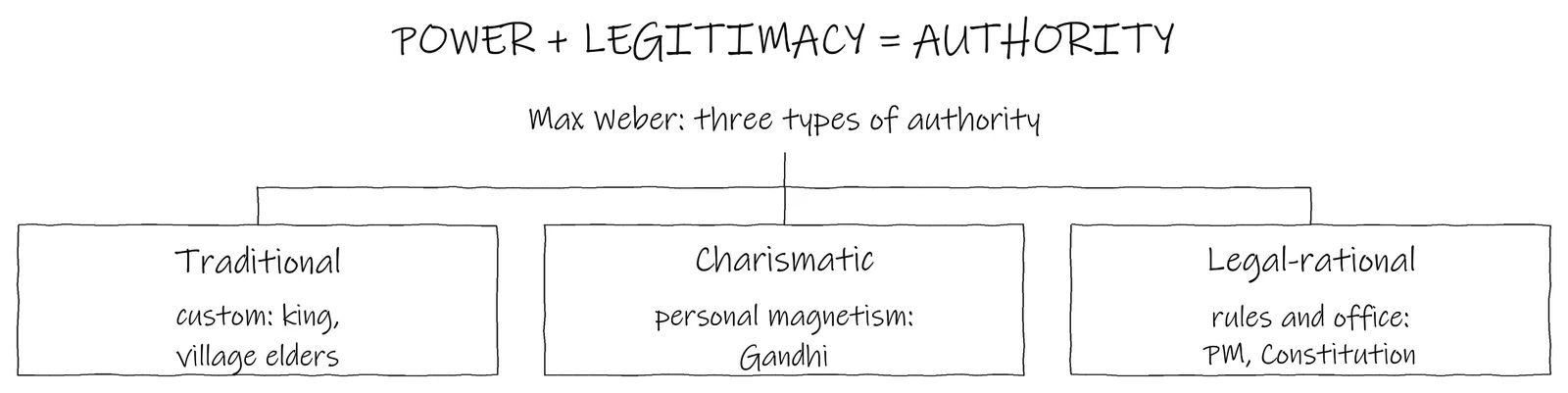
Power alone cannot keep any ruler in place for long, because rule based only on force is costly and unstable. Rulers therefore seek authority, i.e. the recognised right to give commands and to be obeyed. Authority rests on legitimacy, i.e. the belief of the ruled that the ruler or the system is rightful. In short, power + legitimacy = authority. A robber has power over his victim but no authority; a traffic policeman has authority because people accept his right to direct them. Max Weber identified three ideal types of legitimate authority (Figure 1.4):
- Traditional authority rests on custom and on the belief that things have always been done this way, as in hereditary monarchy or the rule of village elders.
- Charismatic authority rests on the extraordinary personal qualities of a leader, which inspire loyalty and devotion; Gandhi is a common example. It is unstable, because it depends on one person.
- Legal-rational authority rests on impersonal rules: officials are obeyed because they hold an office under a legal order, as in modern bureaucracies and constitutional governments.
We have now studied politics, the political and power. The discipline that thinks about all of these carefully is called political theory.
1.5 Political Theory: Meaning and Need
In simple words, political theory is thinking about politics in a careful and organised manner. David Held describes it as a network of concepts and generalisations about political life, i.e. ideas about the nature, purpose and key features of government, state and society, and about the political capabilities of human beings. Political theory has two sides. Its empirical side explains what is: why people obey, why states rise and fall, why some societies are more democratic than others. Its normative side asks what ought to be: whether the state should reduce inequality, what makes a law just, or when disobedience is justified.
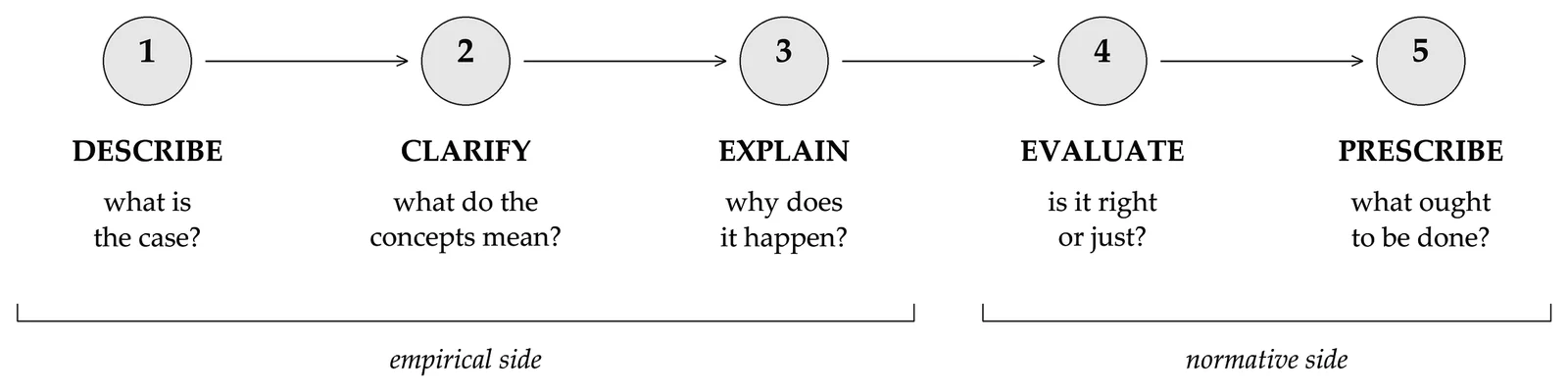
Every one of us carries some political theory in the mind, even if we never call it that: whenever we say that a law is ‘unfair’, we are using a standard of fairness. The discipline of political theory makes such thinking explicit, consistent and open to argument. It works in five steps: it describes political reality, clarifies the concepts we use, explains why things happen, evaluates them and finally prescribes what should be done (Figure 1.5).
It is also useful to distinguish political theory from its neighbours. Political thought refers to the ideas of a particular thinker or tradition in history, such as Kautilya or Gandhi, which need not form a complete system. Political philosophy is the most abstract and normative level, asking about the good life and the just order, as Plato and Rawls do. Political science studies how institutions and actors actually behave, often with empirical and statistical methods, for example in studies of voting. Political theory stands between them: it uses conceptual analysis and normative argument, but it also draws on empirical knowledge, in order to understand and to judge political life.
Decline and Revival of Political Theory
- 1953 → Alfred Cobban wrote of the ‘decline of political theory’, and David Easton called for a scientific study of politics. This marked the beginning of the behavioural revolution, which wanted a value-free science of politics.
- 1956 → Peter Laslett wrote that “for the moment, anyway, political philosophy is dead”.
- 1962 → Isaiah Berlin replied that political theory will live as long as people disagree about the ends of life.
- 1971 → John Rawls’s A Theory of Justice revived normative theory; debates between liberals, communitarians, feminists and multiculturalists followed.
Why we still need political theory is a favourite exam question, so it is answered in detail in Important Question 2.
1.6 Important Questions
- Question 1 What is politics? Discuss the different ways of understanding politics.
- Question 2 What is the distinction between the political and political theory? Why do we need political theory?
- Question 3 “The concept of power is crucial to understanding politics.” Elaborate.
DU asks the same idea in different words. So learn one broad answer for each question below; the same answer works for every question joined by OR.
Important Question 1
What is politics? Discuss the different ways of understanding politics.
OR
Is politics only about the state? Discuss.
OR
“Politics is everywhere.” Do you agree?
OR
Explain the meaning and nature of politics.
Model Answer
“Who gets what, when, how”
— Harold Lasswell’s definition of politics (1936)
Introduction. Politics is the activity through which people with different interests and values make decisions that bind the whole community. Its meaning, however, is essentially contested: for some it is the business of the state, for others it is present wherever power is exercised. Its scope has widened from the affairs of the Greek polis to every area of social life.
1. Meaning of Politics
The word comes from polis, the Greek city-state. In modern usage politics has three senses: political power, political activity and the political process, through which conflict becomes binding decision. Aristotle called the human being a political animal (zoon politikon), meaning that people realise their nature only by living in a political community.
2. Nature of Politics
- Universal: wherever human beings live together, politics exists in some form.
- Collective: it concerns decisions that bind a group, not purely private choices.
- Conflict and cooperation: it arises from disagreement but aims at a settlement.
- Linked to power: decisions must be backed by power or authority to be effective.
Andrew Heywood sums up these features by describing politics as the activity through which people make, preserve and amend the general rules under which they live.
3. Politics as an Arena
The art of government. The narrowest and oldest view identifies politics with the state. David Easton defined it as the ‘authoritative allocation of values’, and in everyday speech politicians are those who hold or seek public office. This view is clear and precise, but it reduces politics to the work of professionals and ignores power outside the state.
Public affairs. A broader view, going back to Aristotle, places politics in the public sphere, which includes both the state and the institutions of civil society such as parties, trade unions and the press. Private life, above all the family, remains outside.
4. Politics as a Process
Compromise and consensus. Bernard Crick, in In Defence of Politics (1962), saw politics as a particular way of resolving conflict: through negotiation and compromise rather than force. Its weakness is that it treats coercion and violence as the absence of politics rather than as part of it.
Power and the distribution of resources. The broadest view, held by Lasswell and Adrian Leftwich, finds politics in all collective social activity, from the family to the workplace. Politics is about who gets what, when and how, and it is present wherever scarce resources are produced, distributed and used.
5. Perspectives on Politics
Liberal. Politics is confined to the public sphere, and the state acts as a neutral umpire that protects individual rights. A limited state and a protected private sphere are the liberal ideals. Gandhian thought adds that politics must be spiritualised, i.e. guided by truth and non-violence.
Marxist. Political power reflects economic power. The state is an instrument of the ruling class, and politics is ultimately the expression of class struggle; it will wither away in a classless society.
Feminist. ‘The personal is political.’ Patriarchy operates within the family, sexuality and the division of household labour, so the liberal line between public and private itself conceals power.
Indian thought. Gandhi insisted that politics be bound by ethics, and Ambedkar warned in 1949 that political democracy cannot last unless it rests on social democracy, which again carries politics into society.
6. Politics in the Indian Context
In India, politics has always extended beyond the state: the freedom movement politicised villages, caste associations and women’s organisations; the 73rd Amendment brought politics to the panchayat; and movements such as Chipko and the Narmada Bachao Andolan showed that politics happens in forests and river valleys as much as in Parliament. Rajni Kothari, in Caste in Indian Politics (1970), showed how castes themselves became politicised and organised.
7. Evaluation: Politics Beyond the State
The narrow view has real strengths. Only the state makes laws that bind everyone, and, as Weber said, only the state claims a monopoly of legitimate force within a territory. Yet the broad view captures what the narrow one misses: power in the family, the market and social hierarchies shapes people’s lives as deeply as any law. The most persuasive position combines the two. The state remains the centre of formal politics, but the political runs through society as a whole.
Conclusion. Thus, politics is not merely the game of politicians. It begins as the art of government but extends to every place where people disagree and must decide together. A sound understanding keeps the state at the centre while recognising the power at work throughout society.
Important Question 2
What is the distinction between the political and political theory? Why do we need political theory?
OR
What is political theory? Discuss its nature and significance.
OR
Distinguish between politics and the political.
OR
Is political theory dead? Discuss its decline and revival.
Model Answer
“Justice is the first virtue of social institutions, as truth is of systems of thought.”
— John Rawls, A Theory of Justice (1971)
Introduction. The political refers to the dimension of collective life in which power, conflict and binding decisions arise, wherever they occur. Political theory is the systematic reflection on that dimension: it seeks to explain it and also to judge it. One is the object of study; the other is the study itself.
1. Meaning of ‘the Political’
Theorists distinguish politics, the visible activities and institutions of government, from the political, the deeper dimension that gives a society its form. Different thinkers understand this dimension differently. For Carl Schmitt, the political is the most intense form of conflict, the grouping of people as friends and enemies. Chantal Mouffe accepts that antagonism is permanent but argues that democracy can turn enemies into adversaries, a relationship she calls agonism. For Hannah Arendt, the political is the public space in which equals act and speak together. Feminists extend it to the family and the body with the slogan ‘the personal is political’.
2. Meaning of Political Theory
Political theory, from the Greek theoria (contemplation), is a disciplined reflection on political life. David Held describes it as a network of concepts and generalisations about the nature and purpose of government, state and society. It has an empirical side, which explains what is, and a normative side, which asks what ought to be. Its work proceeds through five steps: it describes political reality, clarifies concepts such as liberty and justice, explains why things happen, evaluates them and finally prescribes what should be done.
3. The Distinction
| Basis | The political | Political theory |
|---|---|---|
| Nature | A dimension of social reality | A form of knowledge about that reality |
| Mode | Lived and practised: conflict, protest, rule | Examined and reflected upon |
| Character | Simply exists (what is) | Explains what is and judges what ought to be |
| Scope | Diffused through society | Organised through concepts such as state, power, liberty, justice |
| Illustration | A movement demanding equal rights | An argument about what equality requires and why |

In short, politics is what happens, the political is what makes it possible and gives it shape, and political theory is the reflection that helps us understand and judge both.
4. Need for Political Theory
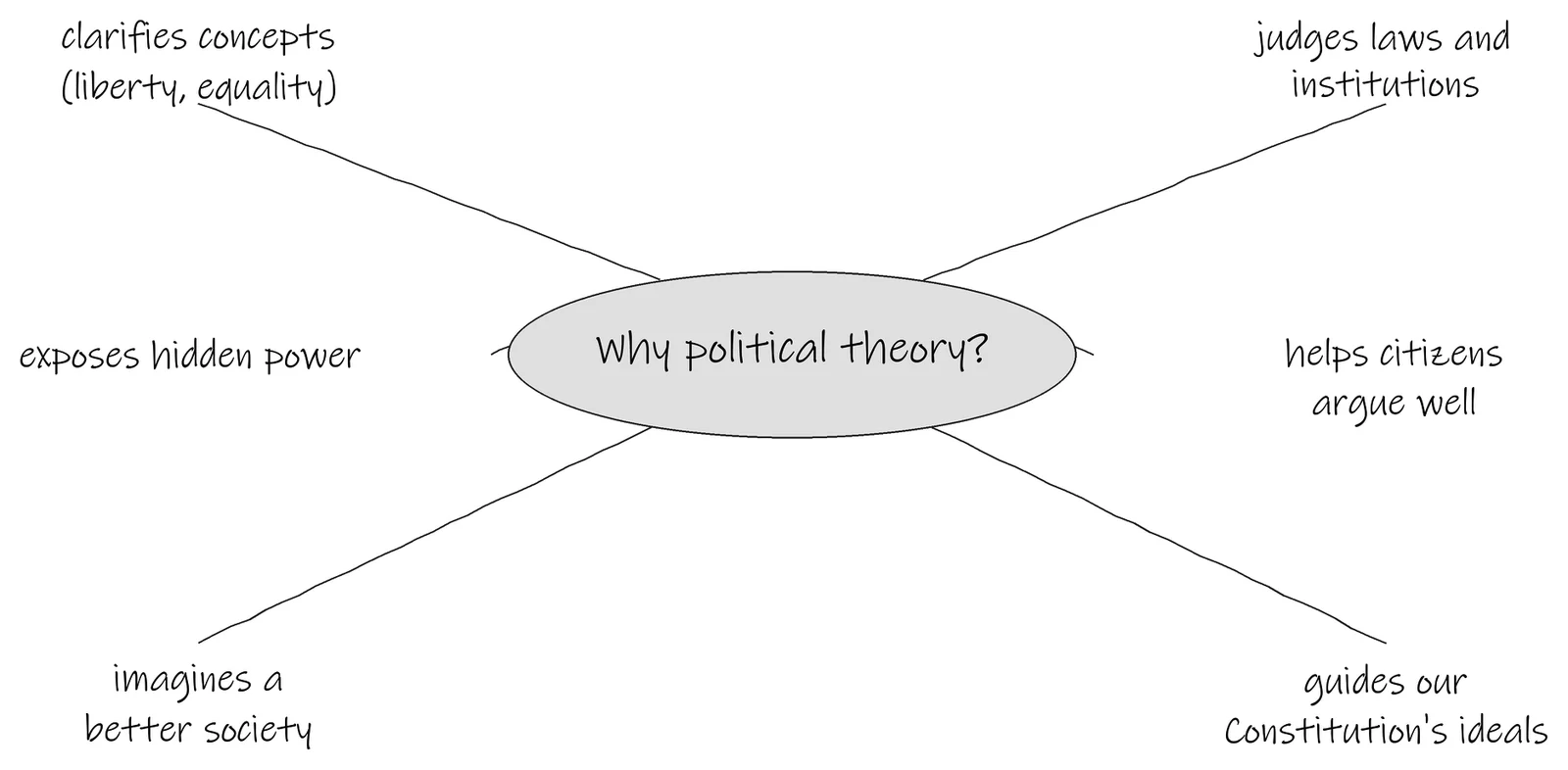
- To clarify concepts. Terms such as liberty, equality and democracy are used loosely. Theory distinguishes, for example, formal equality (the same rules for all) from substantive equality (fair outcomes for the disadvantaged).
- To evaluate laws and institutions. Theory supplies standards such as justice and rights by which any law or government can be judged, and helps us decide when obedience is owed and when resistance is justified.
- To expose hidden power. Marxist, feminist and anti-caste thought, including Ambedkar’s, reveals domination in arrangements that appear natural.
- To form reflective citizens. Democracy depends on citizens who argue with reasons, respect opponents and resist propaganda.
- To imagine alternatives. From Plato’s Republic and Thomas More’s Utopia (1516) to Marx’s classless society, political theory pictures a better order and so gives direction to change.
- To understand constitutional ideals. The values written into constitutions, such as justice, liberty, equality and fraternity in the Preamble to the Indian Constitution, are concepts of political theory.
5. Decline and Revival
In 1953 Alfred Cobban wrote of the ‘decline of political theory’ and David Easton called for an empirical science of politics; the behavioural revolution treated values as unscientific, and in 1956 Peter Laslett declared political philosophy ‘dead’. Isaiah Berlin replied in 1962 that political theory survives as long as people disagree about the ends of life. Rawls’s A Theory of Justice (1971) revived normative theory, and later debates showed that the discipline is very much alive.
6. Limitations
Political theory is sometimes criticised as too abstract, remote from the experience of ordinary people. It has also been largely Western in origin, so its concepts must be tested against other societies, for example against caste and religious diversity in India. Scholars such as Bhikhu Parekh and Rajeev Bhargava therefore call for a political theory that engages with non-Western traditions and Indian experience.
Conclusion. Thus, the political is the field and political theory is the map. Without the field there would be nothing to study; without the map we would be lost in it. As long as people disagree about how they should live together, political theory will remain necessary.
Important Question 3
“The concept of power is crucial to understanding politics.” Elaborate.
OR
Discuss the three faces (dimensions) of power.
OR
Distinguish between power, authority and legitimacy.
OR
Examine Foucault’s view of power.
Model Answer
“Power tends to corrupt, and absolute power corrupts absolutely.”
— Lord Acton (1887)
Introduction. Power is the ability to make others act as one wishes, or the capacity of people to act together. Since politics is about conflict over scarce resources and about decisions that bind a community, power determines who wins, who loses and who is never heard. Thomas Hobbes saw in human beings “a perpetual and restless desire of power after power, that ceaseth only in death”.
1. Meaning and Forms of Power
Weber defined power as the probability that one actor can carry out his will despite resistance. Theorists distinguish power over others (domination) from power to act (capacity). Power takes several forms: force, which compels; influence or persuasion, which changes minds; manipulation, which works without the other’s knowledge; and authority, which is power accepted as rightful.
2. Why Power Is Central to Politics
Weber defined the state itself by power: it is the community that successfully claims a monopoly of the legitimate use of physical force within a territory. Lasswell’s ‘who gets what, when, how’ and Easton’s ‘authoritative allocation of values’ both assume that decisions must be enforced. Without power no decision binds, and without binding decisions there is no politics.
3. The Three Dimensions of Power
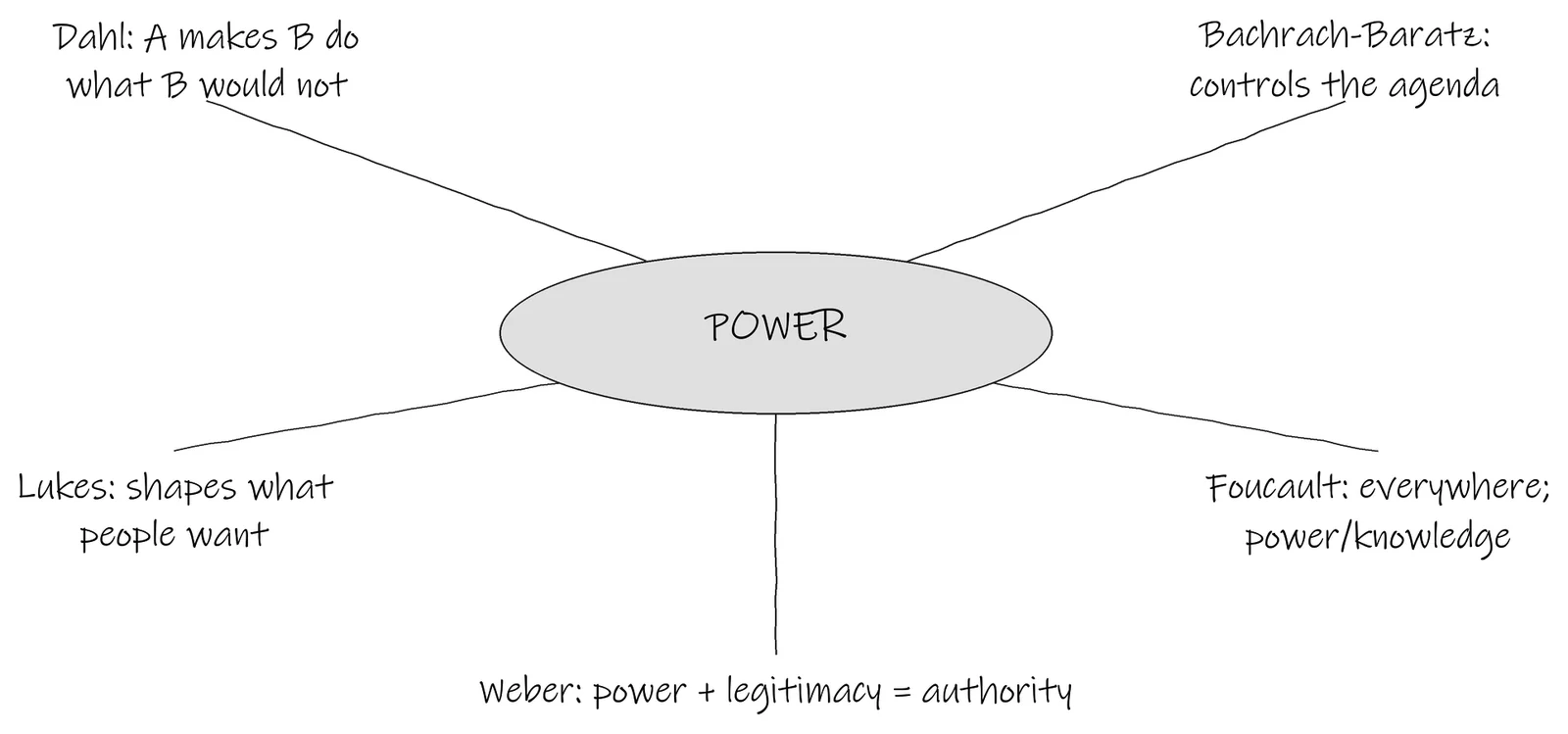
First dimension. Robert Dahl (1957) defined power as A getting B to do what B would not otherwise do. Studying open decisions in New Haven, he concluded that power is dispersed among competing groups, a pluralist view of politics.
Second dimension. Bachrach and Baratz (1962) showed that power also works through non-decision-making: the powerful keep issues off the agenda, using what E.E. Schattschneider called the ‘mobilisation of bias’.
Third dimension. Steven Lukes (1974) argued that the most effective power shapes people’s very wants, so that the dominated accept their position as natural. People may then act against their ‘real interests’, an idea close to Gramsci’s hegemony.
4. Other Perspectives on Power
Marxist. Power is rooted in the ownership of the means of production. In the Communist Manifesto (1848) Marx and Engels called the executive of the modern state “but a committee for managing the common affairs of the whole bourgeoisie [बूर्ज्वाज़ी]”, i.e. the capitalist class.
Elitist. Pareto, Mosca and Robert Michels argued that an organised minority always rules; Michels called this the ‘iron law of oligarchy’ (1911), i.e. the rule of a few.
Feminist. Kate Millett (Sexual Politics, 1970) identified patriarchy, i.e. the domination of men over women, as the most basic system of power, operating through the family, culture and sexuality as well as through law.
Foucauldian. Foucault sees power as everywhere and productive, working through discipline and knowledge rather than from a single centre. Because power is a relation, he argued, “where there is power, there is resistance”.
Arendtian. In On Violence (1970) Arendt argued that power belongs to a group acting in concert, whereas violence is merely instrumental; violence appears precisely where power is being lost.
5. Power in Indian Society
In India, power works through caste, gender and class as well as through the state. Ambedkar showed how caste concentrated social, religious and economic power in a few hands, while feminist scholars show how patriarchy shapes power within the family. Such power often works through the third and Foucauldian dimensions, by shaping what people accept as normal.
6. Power, Authority and Legitimacy
Power becomes authority when it is accepted as legitimate. Weber identified three types of legitimate authority: traditional, resting on custom and inheritance; charismatic, resting on the extraordinary qualities of a leader, as with Gandhi; and legal-rational, resting on impersonal rules and office.
7. Hard Power and Soft Power
In international politics Joseph Nye distinguished hard power, the ability to coerce through military and economic strength, from soft power, the ability to attract through culture, values and policies, which shows that power need not always be coercive.
8. Critical Evaluation
Power is necessary for understanding politics, but it is not sufficient. Crick reminds us that politics is also the conciliation of interests, and normative theory asks not only who holds power but whether it is exercised justly. To reduce politics to a struggle for power is to become cynical and to ignore legitimacy, consent and the common good. Yet the analysis of power remains indispensable; Acton’s warning is the reason why democracies divide and check power through the separation of powers and judicial review. Hannah Arendt even argued that power arises when people act together, and is the opposite of violence rather than its expression.
Conclusion. Thus, power is the key to politics because it shows who decides and who is silenced. A full understanding, however, joins the analysis of power with the questions of legitimacy and justice, which is precisely the task of political theory.
More notes: DSC-1 Understanding Political Theory
These notes are prepared by PADHO TO AISE for study help. They are not an official University of Delhi publication.