
Semester V MDSE-3b Understanding Ambedkar
Unit III · 24 min read · Updated 24 Nov 2026
As per the University of Delhi (DU) BA (Hons) Political Science syllabus
Contents
- 3.1 Ambedkar on Women and Brahmanical Patriarchy
- Caste, Endogamy and the Control of Women
- Rege: Against the Madness of Manu
- The Rise and Fall of the Hindu Woman
- Women and the Counter-Revolution
- Women in the Ambedkarite Movement
- 3.2 The Hindu Code Bill
- Background
- Main Provisions
- Opposition and Resignation
- Later Laws
- Gender Justice in the Constitution
- 3.3 The Uniform Civil Code
- Ambedkar in the Constituent Assembly
- Debates after Independence
- Personal Laws in India Today
- 3.4 Important Questions
- Discuss Ambedkar’s views on women and the link between caste and gender.
- Discuss Ambedkar’s argument in The Rise and Fall of the Hindu Woman.
- Discuss Ambedkar’s role in the Hindu Code Bill and its significance for gender justice.
- Discuss Ambedkar’s views on the Uniform Civil Code.
- Short Notes
मैं किसी समुदाय की प्रगति को उस प्रगति की मात्रा से मापता हूँ जो महिलाओं ने हासिल की है।
I measure the progress of a community by the degree of progress which women have achieved.
— B. R. Ambedkar, All India Depressed Classes Women’s Conference, Nagpur, July 1942
AAMBEDKAR was one of the few leaders of his time who saw that caste and the subordination of women are bound together. He argued that the caste system depends on controlling women’s marriage and sexuality, and he blamed the law-giver Manu, not the Buddha, for the decline of Hindu women. As Law Minister he fought for the Hindu Code Bill, which sought to give Hindu women rights in property, marriage and divorce, and he resigned when it was stalled. He also defended the idea of a Uniform Civil Code in the Constituent Assembly. This chapter studies Unit III of the syllabus: Ambedkar on women, the Hindu Code Bill and the Uniform Civil Code.

3.1 Ambedkar on Women and Brahmanical Patriarchy
Caste, Endogamy and the Control of Women
In Castes in India (1916), Ambedkar argued that caste is created by imposing endogamy, marriage within the group, on a society that was originally exogamous. To keep a caste closed, its numbers of marriageable men and women must be balanced. This, he argued, is why Hindu society developed customs such as sati (burning the widow with her dead husband), enforced widowhood, and child marriage: they prevented surplus women from marrying outside the caste. In simple words, the control of women’s sexuality and marriage is the mechanism that keeps caste alive. Ambedkar was thus among the first to theorise the link between caste and gender.
Rege: Against the Madness of Manu
Sharmila Rege, in Against the Madness of Manu: B. R. Ambedkar’s Writings on Brahmanical Patriarchy (2013), collects and interprets Ambedkar’s writings on women. She argues that Ambedkar should be read as a major theorist of Brahmanical patriarchy, i.e. a system in which caste hierarchy and male dominance support each other, with upper-caste control over women’s sexuality at its centre. Rege criticises mainstream Indian feminism for long ignoring Ambedkar and for treating women as a single category without attention to caste. She shows that Dalit women face a double or triple oppression of caste, class and gender, and that Ambedkar’s writings offer resources for an anti-caste feminism. She also highlights the role of women in the Ambedkarite movement, who took part in satyagrahas, conferences and the conversion of 1956.
The Rise and Fall of the Hindu Woman
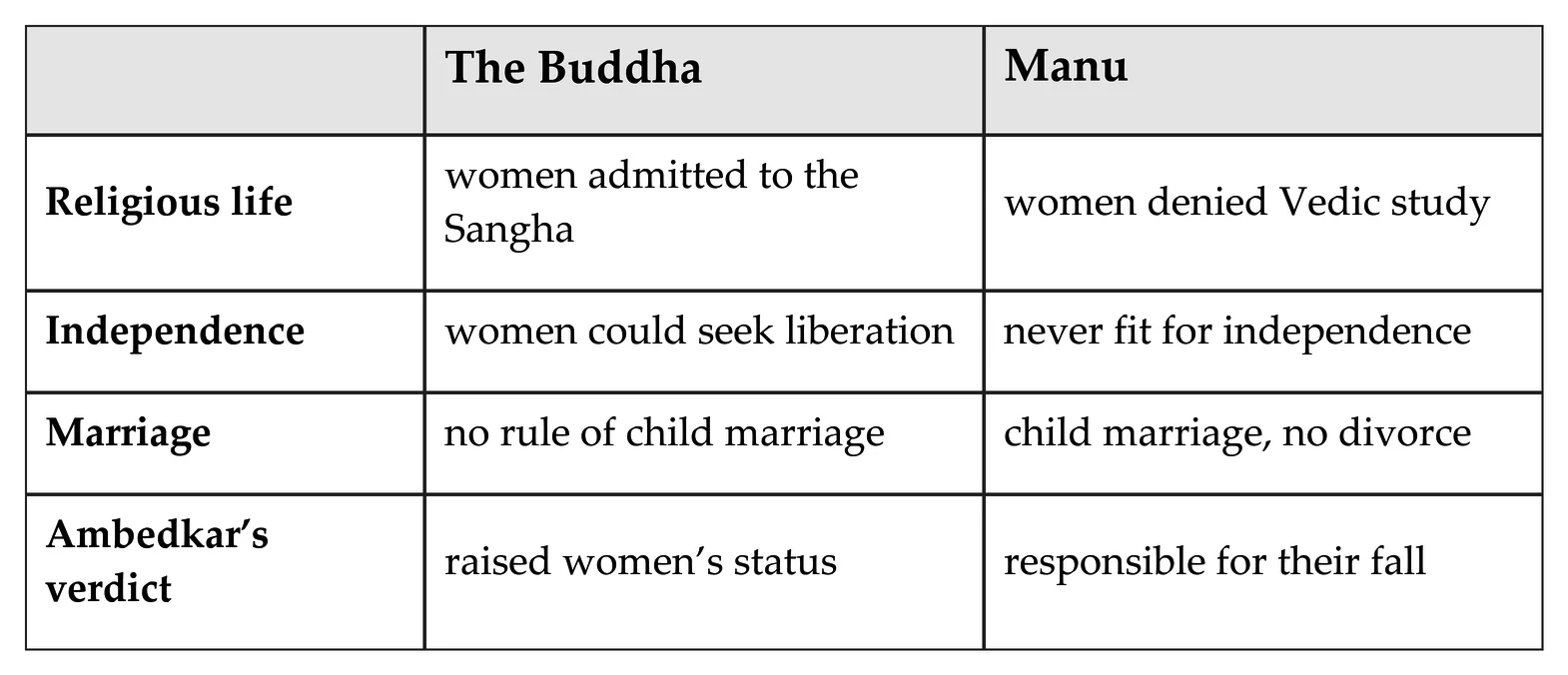
In The Rise and Fall of the Hindu Woman: Who Was Responsible for It? (1951), Ambedkar replied to a writer who had blamed the Buddha for the decline of women’s status because he admitted women to the monastic order only reluctantly. Ambedkar argued instead that women enjoyed a relatively high status in early Vedic and Buddhist times: they could study, take part in public debates and seek spiritual liberation. The Buddha admitted women such as Mahaprajapati Gotami to the Sangha, and the poems of Buddhist nuns in the Therigatha show their spiritual achievements. The real responsibility for women’s decline, he argued, lay with Manu, whose code declared that a woman is never fit for independence, denied women the right to study the Vedas, permitted child marriage and forbade divorce.
Women and the Counter-Revolution
In The Women and the Counter-Revolution, Ambedkar placed Manu’s laws in a larger history. He saw Buddhism as a revolution that challenged caste and gave dignity to women and Shudras, and the Brahmanical revival after the fall of the Mauryas as a counter-revolution. Manu’s code, in his view, was a political document of this counter-revolution, which degraded women and Shudras together to restore Brahmanical supremacy.
- Education. Ambedkar urged women to educate themselves and their children, especially daughters.
- Marriage. He advised women not to marry early and to treat their husbands as friends and equals, not as masters.
- Public life. Women took part in the Mahad satyagraha, the Kalaram temple entry movement and conferences he organised.
- Labour. As Labour Member (1942–46), he supported maternity benefit for women workers in mines and equal pay principles.
Women in the Ambedkarite Movement
Women were active participants, not passive followers, in Ambedkar’s movement. They joined the Mahad satyagraha and the Kalaram temple entry struggle, organised women’s conferences such as the one at Nagpur in 1942, and took part in the mass conversion of 1956. Urmila Pawar and Meenakshi Moon, in We Also Made History (Marathi 1989; English 2008), recovered the stories of these women activists, showing how they fought both caste and patriarchy, often at great personal cost.
3.2 The Hindu Code Bill
Background
Before independence, Hindu personal law varied across regions and schools, such as Mitakshara and Dayabhaga, and generally denied women equal rights in property, marriage and divorce. A committee chaired by B. N. Rau (1941, reconstituted in 1944) prepared a draft code. After independence, Ambedkar, as Law Minister, revised it and introduced the Hindu Code Bill in the Constituent Assembly acting as Parliament. He called it the greatest social reform measure ever undertaken by the legislature in India.
Main Provisions
- Property. It gave daughters a share in their father’s property and made a woman’s property her absolute property rather than a limited estate.
- Monogamy. It made marriage monogamous for Hindus, ending the right of men to take more than one wife.
- Divorce. It allowed divorce on specified grounds for both husband and wife.
- No caste bar. It recognised marriages and adoptions across castes as valid.
- Codification. It unified Hindu law across regions, including for Buddhists, Jains and Sikhs.
Opposition and Resignation
The Bill faced fierce opposition from conservative Hindu groups, sections of the Congress, and leaders including President Rajendra Prasad, who questioned whether a provisional Parliament should pass it. Opponents argued that it interfered with religion and would break up the Hindu family. Nehru supported the Bill but, facing division and the approaching first general election, allowed it to be postponed in 1951. Ambedkar resigned from the cabinet on 27 September 1951. In his statement, he said that leaving inequality between class and class and between sex and sex untouched while passing economic laws was like building a palace on a dung heap.
Later Laws
After the 1952 election, the Bill was passed in parts: the Hindu Marriage Act (1955), the Hindu Succession Act (1956), the Hindu Minority and Guardianship Act (1956) and the Hindu Adoptions and Maintenance Act (1956). These laws carried out much of Ambedkar’s programme, though in diluted form. The Hindu Succession (Amendment) Act, 2005 finally made daughters coparceners with equal rights in ancestral property, a step Ambedkar had sought half a century earlier.

Gender Justice in the Constitution
- Article 14 and 15(1). Equality before law and no discrimination on grounds of sex.
- Article 15(3). The state may make special provisions for women and children.
- Article 39(a) and 39(d). Directive Principles on equal right to livelihood and equal pay for equal work for men and women.
- Article 42. Just and humane conditions of work and maternity relief.
- 73rd and 74th Amendments (1992). One-third of seats in panchayats and municipalities reserved for women.
- 106th Amendment (2023). One-third of seats in the Lok Sabha and state assemblies to be reserved for women after a fresh delimitation.
3.3 The Uniform Civil Code
Ambedkar in the Constituent Assembly
Draft Article 35, which became Article 44 of the Constitution, directs the state to endeavour to secure a uniform civil code for all citizens. When some Muslim members opposed it in November 1948, Ambedkar defended it. He pointed out that India already had uniform laws in almost every area, such as the criminal law and the law of contracts, so personal law was the main exception. He argued that Muslim personal law had not always been uniform or immutable, noting that until the 1930s Muslims in parts of the North-West Frontier Province and elsewhere followed Hindu customary law in matters of succession, until the Shariat Application Act of 1937 changed this. At the same time he reassured the members that the state would not impose the code on unwilling communities, and suggested that Parliament might begin by making it voluntary for those who chose to be bound by it.
Debates after Independence
- Shah Bano (1985). The Supreme Court upheld a divorced Muslim woman’s right to maintenance; Parliament then passed the Muslim Women (Protection of Rights on Divorce) Act, 1986.
- Special Marriage Act (1954). It offers a secular, optional civil marriage law for all citizens, close to Ambedkar’s idea of a voluntary code.
- Shayara Bano (2017). The Supreme Court declared instant triple talaq invalid, and Parliament made it a criminal offence in 2019.
- Law Commission (2018). Its consultation paper said that a uniform civil code was neither necessary nor desirable at that stage, recommending reform within each personal law.
- Uttarakhand (2024). Uttarakhand passed the first state uniform civil code, which came into force in January 2025.
The debate involves a tension between equality for women and the rights of religious minorities to their own laws. Ambedkar’s approach suggests a balance: a uniform code is a goal grounded in equality and citizenship, but it should be achieved with consent, and reform of all personal laws, including Hindu law, should come first, as the Hindu Code Bill attempted.

Personal Laws in India Today
India still has separate personal laws. Hindu law was codified in 1955–56. Muslim personal law is applied under the Muslim Personal Law (Shariat) Application Act, 1937. Christians are governed by laws such as the Indian Christian Marriage Act, 1872 and the Indian Divorce Act, 1869, and Parsis by the Parsi Marriage and Divorce Act, 1936. Goa has had a common civil code for all communities since Portuguese rule, based on the Portuguese Civil Code of 1867. Any citizen may also marry under the secular Special Marriage Act, 1954.
3.4 Important Questions
- Question 1 Discuss Ambedkar’s views on women and the link between caste and gender.
- Question 2 Discuss Ambedkar’s argument in The Rise and Fall of the Hindu Woman.
- Question 3 Discuss Ambedkar’s role in the Hindu Code Bill and its significance for gender justice.
- Question 4 Discuss Ambedkar’s views on the Uniform Civil Code.
DU asks the same idea in different words. So learn one broad answer for each question below; the same answer works for every question joined by OR.
Important Question 1
Discuss Ambedkar’s views on women and the link between caste and gender.
OR
Examine Sharmila Rege’s reading of Ambedkar as a theorist of Brahmanical patriarchy.
OR
Explain Ambedkar’s argument that the control of women sustains caste.
Model Answer
“Thus the superposition of endogamy on exogamy means the creation of caste.”
— B. R. Ambedkar, Castes in India (1916)
Introduction. Ambedkar was one of the first thinkers to show that caste and the subordination of women are linked. He argued that caste depends on endogamy, which is maintained by controlling women through customs such as sati and child marriage. Sharmila Rege calls this a theory of Brahmanical patriarchy and argues that Ambedkar offers resources for an anti-caste feminism.
1. Endogamy and Caste
In 1916 Ambedkar argued that caste is created when endogamy is imposed on an exogamous society. Closed groups marry only within themselves, and this keeps the caste boundaries intact.
2. The Problem of Surplus Women
To keep a caste closed, the numbers of marriageable men and women must be balanced. Widows and unmarried women were seen as a threat, since they might marry outside the caste.
3. Sati, Widowhood and Child Marriage
Ambedkar explained sati, enforced widowhood and child marriage as means of solving this problem. They prevented women from crossing caste boundaries through marriage.
4. Control of Sexuality
Caste therefore rests on control over women’s bodies and choices. In simple words, the honour of the caste was placed on the conduct of its women.
5. Rege’s Brahmanical Patriarchy
Sharmila Rege calls this system Brahmanical patriarchy, in which caste hierarchy and male dominance support each other. Upper-caste control of women is at its centre.
6. Critique of Mainstream Feminism
Rege argues that Indian feminism long ignored Ambedkar and treated women as one category. She insists that caste must be central to feminist analysis.
7. Dalit Women’s Oppression
Dalit women face oppression of caste, class and gender together. They suffer sexual violence, low wages and humiliation that upper-caste women may not face.
8. Manu and Women
Ambedkar blamed Manu’s code for declaring women unfit for independence. He saw it as the legal foundation of women’s subordination in Hindu society.
9. Buddhism and Women
He praised the Buddha for admitting women to the Sangha. The poems of the Therigatha show that Buddhist women could seek spiritual liberation.
10. Education
Ambedkar urged women to educate themselves and their daughters. He saw education as the first step to independence and dignity.
11. Marriage as Partnership
He advised women not to marry early and to treat their husbands as friends and equals. Marriage, for him, should rest on choice and respect.
12. Women in the Movement
Women took part in the Mahad satyagraha, temple entry campaigns and Ambedkar’s conferences. Rege highlights their role as active participants, not followers.
13. Labour Rights
As Labour Member, he supported maternity benefit for women in mines and the principle of equal pay. He linked women’s freedom with economic security.
14. Legal Reform
His work on the Hindu Code Bill sought rights in property, marriage and divorce. It turned his ideas into a programme of legal change.
15. Inter-Caste Marriage
He saw inter-caste marriage as a remedy for caste, which also meant freeing women’s choices. Ending endogamy would weaken both caste and patriarchy.
16. Criticism
Some argue that his remarks on women’s conduct reflected the norms of his time. Yet his overall analysis was far ahead of most contemporaries.
17. Honour and Violence
Violence against couples who marry across caste, often called honour killing, shows how caste is still enforced through control of women’s choices, as Ambedkar explained.
18. Dalit Feminism Today
Dalit feminist writers and organisations, such as the National Federation of Dalit Women founded in 1995, build on Ambedkar’s ideas to address caste and gender together.
19. Evaluation
Ambedkar’s linking of caste and gender is a lasting contribution to Indian feminist thought. It shows that ending caste requires freeing women.
Conclusion. Thus, Ambedkar showed that the superposition of endogamy on exogamy creates caste, and that controlling women sustains it. Rege’s reading of his work as a theory of Brahmanical patriarchy makes him a founding figure of anti-caste feminism in India.
Important Question 2
Discuss Ambedkar’s argument in The Rise and Fall of the Hindu Woman.
OR
Discuss Ambedkar’s view of the roles of Manu and the Buddha in the status of women.
OR
Examine Ambedkar’s idea of women and the counter-revolution.
Model Answer
“Her father protects her in childhood, her husband protects her in youth, and her sons protect her in old age; a woman is never fit for independence.”
— Manusmriti 9.3 (tr. G. Bühler, 1886)
Introduction. In The Rise and Fall of the Hindu Woman (1951), Ambedkar answered a writer who blamed the Buddha for the decline of women. He argued that women had enjoyed a high status in early times and under Buddhism, and that the real cause of their degradation was Manu’s code. In The Women and the Counter-Revolution, he placed this within a history of Buddhist revolution and Brahmanical counter-revolution.
1. The Occasion
A writer had argued that the Buddha lowered the status of women by admitting them to the order reluctantly. Ambedkar wrote his essay in 1951 to refute this claim.
2. Women in Early Times
Ambedkar argued that women in early Vedic times could study, take part in debates and perform rituals. Learned women such as Gargi and Maitreyi showed this.
3. The Buddha and Women
The Buddha admitted women to the Sangha, beginning with Mahaprajapati Gotami. He recognised that women could attain enlightenment.
4. The Therigatha
The poems of the Buddhist nuns in the Therigatha express their spiritual freedom. Ambedkar cited them as evidence of women’s dignity under Buddhism.
5. Answering the Charge
Ambedkar argued that the Buddha’s caution about admitting women reflected the social conditions of the time. It did not show contempt for women.
6. Manu’s Code
Manu declared that a woman must be protected by father, husband and son and is never fit for independence. Ambedkar saw this as the root of women’s subordination.
7. Denial of Education
Manu denied women the right to study the Vedas, placing them on a level with Shudras. This cut women off from learning and religious authority.
8. Marriage Laws
Manu’s laws permitted child marriage, forbade divorce for women and allowed men to abandon wives. Women lost control over their own lives.
9. Property
Women were denied independent rights to property, making them economically dependent on men. This dependence reinforced their subordination.
10. Revolution and Counter-Revolution
Ambedkar saw Buddhism as a revolution for equality and the Brahmanical revival after the Mauryas as a counter-revolution. Manu’s code was its political charter.
11. Women and Shudras Together
The counter-revolution degraded women and Shudras together to restore Brahmanical supremacy. This links gender oppression with caste oppression.
12. Burning the Manusmriti
At Mahad in 1927, Ambedkar burned the Manusmriti as a symbol of this law of inequality. The act was a protest on behalf of both untouchables and women.
13. Historical Method
Ambedkar used ancient texts to show that women’s subordination was historical, not eternal. What history created, reform could undo.
14. Link to the Hindu Code Bill
His historical critique of Manu supported his legal reform through the Hindu Code Bill. He sought to replace Manu’s law with a law of equality.
15. Rege’s Reading
Rege includes these essays in her collection as key texts of Ambedkar’s theory of Brahmanical patriarchy. They show his sustained concern with women.
16. Criticism
Some historians argue that Ambedkar idealised early Buddhist society. Yet his central point, that Manu’s code institutionalised subordination, is widely accepted.
17. Lessons for Reform
By showing that women’s status had once been higher, Ambedkar argued that their degradation was not natural and that reform could restore their dignity.
18. Women and Buddhism Today
Ambedkarite Buddhism has given women new roles in religious life, and many Dalit women see conversion as a source of self-respect.
19. Evaluation
The essay shows Ambedkar’s use of history to defend women’s equality and to undermine scriptural authority.
Conclusion. Thus, Ambedkar argued that Manu, who declared that a woman is never fit for independence, and not the Buddha, was responsible for the fall of the Hindu woman. His history of revolution and counter-revolution linked the degradation of women with that of the Shudras.
Important Question 3
Discuss Ambedkar’s role in the Hindu Code Bill and its significance for gender justice.
OR
Examine the main provisions of the Hindu Code Bill and the reasons for the opposition to it.
OR
Discuss the reasons for Ambedkar’s resignation from the cabinet in 1951.
Model Answer
“To leave inequality between class and class, between sex and sex, which is the soul of Hindu society untouched and to go on passing legislation relating to economic problems is to make a farce of our Constitution and to build a palace on a dung heap.”
— B. R. Ambedkar, statement on his resignation (October 1951)
Introduction. The Hindu Code Bill was Ambedkar’s most ambitious effort to reform Hindu society through law. It sought to give Hindu women equal rights in property, marriage, divorce and adoption, and to unify Hindu law. Fierce opposition stalled it, and Ambedkar resigned in 1951. Its provisions were later passed in parts, making it a landmark in the history of gender justice in India.
1. The Need for Reform
Hindu personal law varied across regions and schools and denied women equal rights. Women could not inherit fully, divorce or prevent their husbands from remarrying.
2. The Rau Committee
A committee chaired by B. N. Rau prepared a draft code in the 1940s. Ambedkar, as Law Minister, revised it after independence.
3. A Great Social Reform
Ambedkar called the Bill the greatest social reform measure ever undertaken by the legislature. He saw it as completing the work of the Constitution in the family.
4. Property Rights
The Bill gave daughters a share in their father’s property and made women’s property absolute. This attacked the economic basis of women’s dependence.
5. Monogamy
It made Hindu marriage monogamous, ending men’s right to take more than one wife. This protected women’s security within marriage.
6. Divorce
It allowed both husband and wife to seek divorce on specified grounds. Women gained a way out of cruel or failed marriages.
7. Inter-Caste Marriage and Adoption
It recognised marriages and adoptions across castes as valid. This struck at caste endogamy, which Ambedkar saw as the root of caste.
8. Codification
It unified Hindu law across regions and applied it to Buddhists, Jains and Sikhs. A single, written law replaced varied customs.
9. Conservative Opposition
Conservative Hindu groups, sections of the Congress and religious organisations opposed the Bill. They claimed it interfered with religion and would break up the family.
10. Rajendra Prasad’s Objection
President Rajendra Prasad questioned whether a provisional Parliament should pass such a law. His opposition added weight to the critics.
11. Nehru’s Position
Nehru supported the Bill but allowed it to be postponed in 1951 amid division and the coming election. Ambedkar felt betrayed by this delay.
12. Resignation
Ambedkar resigned on 27 September 1951. He said that leaving inequality of sex untouched while passing economic laws was building a palace on a dung heap.
13. Passage in Parts
Between 1955 and 1956, Parliament passed the Hindu Marriage, Succession, Minority and Guardianship, and Adoptions and Maintenance Acts. These carried out much of his programme.
14. The 2005 Amendment
The Hindu Succession (Amendment) Act, 2005 made daughters coparceners with equal rights in ancestral property. It fulfilled a goal Ambedkar had set decades earlier.
15. Significance
The Bill showed that social democracy required reform of the family as well as politics. It made the state an agent of gender justice.
16. Criticism
Critics note that the Bill reformed only Hindu law and that the 1950s laws were diluted. Practice also lagged behind the law.
17. Debates in Parliament
Debates on the Bill stretched over years, with opponents using delaying tactics; Ambedkar defended it clause by clause, citing ancient texts that allowed divorce and women’s property.
18. Women’s Organisations
Women’s organisations such as the All India Women’s Conference supported the Bill and campaigned for its passage, showing a link between Ambedkar and the women’s movement.
19. Evaluation
The Hindu Code Bill remains a landmark of legal reform and a central part of Ambedkar’s legacy for women.
Conclusion. Thus, the Hindu Code Bill was Ambedkar’s effort to end inequality between sex and sex, which he called the soul of Hindu society. Though stalled in 1951 and passed later in parts, it transformed Hindu family law and remains a milestone of gender justice.
Important Question 4
Discuss Ambedkar’s views on the Uniform Civil Code.
OR
Examine the debate on the Uniform Civil Code in the Constituent Assembly.
OR
Discuss the debate on the Uniform Civil Code in contemporary India.
Model Answer
“The State shall endeavour to secure for the citizens a uniform civil code throughout the territory of India.”
— Constitution of India, Article 44
Introduction. Article 44 of the Constitution directs the state to endeavour to secure a uniform civil code. In the Constituent Assembly in 1948, Ambedkar defended this provision against objections from some Muslim members. He argued that India already had uniform laws in most fields, but he also promised that the code would not be imposed on unwilling communities. The debate continues today.
1. Meaning of a Uniform Civil Code
A uniform civil code means one law for all citizens in matters of marriage, divorce, inheritance and adoption. It would replace separate personal laws based on religion.
2. Article 44
Draft Article 35 became Article 44, a Directive Principle that the state shall endeavour to secure such a code. It is not enforceable in courts.
3. Objections in the Assembly
Some Muslim members argued that personal law was part of their religion and should be protected. They proposed exempting personal laws from the code.
4. Ambedkar’s Reply
Ambedkar pointed out that India already had uniform laws in criminal law, contracts and property transfer. Personal law was the main exception.
5. Personal Law Not Immutable
He noted that Muslims in parts of the north-west followed Hindu customary law in succession until the Shariat Act of 1937. Personal law had changed before and could change again.
6. Separating Religion from Law
He argued that religion should not cover the whole of life, or the state could not reform society. Secular matters such as inheritance should be governed by the state.
7. Assurance of Consent
He assured members that the state would not impose the code on unwilling communities. He suggested Parliament might begin by making it voluntary.
8. Equality for Women
For Ambedkar, a common code was linked to equality for women across communities. Personal laws often discriminated against women.
9. Reform of Hindu Law First
He began with the Hindu Code Bill, reforming the law of the majority. This showed that reform should not target minorities alone.
10. The Special Marriage Act
The Special Marriage Act of 1954 offers an optional civil law of marriage. It reflects Ambedkar’s idea of a voluntary beginning.
11. Shah Bano
The Shah Bano case of 1985 upheld a divorced Muslim woman’s right to maintenance. The 1986 law that followed revived the UCC debate.
12. Triple Talaq
In 2017 the Supreme Court invalidated instant triple talaq, and Parliament criminalised it in 2019. This was reform within personal law.
13. Law Commission 2018
The Law Commission said a uniform code was neither necessary nor desirable at that stage. It recommended reforming discriminatory provisions in each law.
14. Uttarakhand Code
Uttarakhand passed the first state uniform civil code in 2024, in force from January 2025. It has drawn both support and criticism.
15. Equality versus Diversity
The debate involves a tension between equal rights for women and the rights of minorities to their own laws. Both values are constitutional.
16. Criticism
Critics fear that a uniform code may impose majority norms on minorities. Supporters argue it would secure equal citizenship.
17. Goa’s Example
Goa has applied a common civil code to all communities since Portuguese rule, which supporters of a uniform code cite as a working model.
18. Citizenship and Law
For Ambedkar, equal citizenship meant that the rights of a woman should not depend on the religion into which she was born.
19. Evaluation
Ambedkar’s approach combined the goal of equality with respect for consent, a balance still relevant today.
Conclusion. Thus, Ambedkar defended Article 44’s goal of a uniform civil code as part of equal citizenship, while promising that it would not be imposed without consent. His approach of reforming all personal laws with consent offers a guide to the continuing debate.
Short Notes
(a) Brahmanical patriarchy
Sharmila Rege’s term, drawing on Ambedkar, for the system in which caste hierarchy and male dominance support each other through control of women’s sexuality and marriage.
(b) Hindu Code Bill
The Bill introduced by Ambedkar as Law Minister to give Hindu women rights in property, marriage and divorce; stalled in 1951, it was passed in parts in 1955–56.
(c) Article 44
The Directive Principle that the state shall endeavour to secure a uniform civil code for citizens throughout India.
(d) Hindu Succession (Amendment) Act, 2005
The law that made daughters coparceners in a Hindu joint family, with the same rights and liabilities in ancestral property as sons, fulfilling a central aim of Ambedkar’s Hindu Code Bill more than fifty years later.
More notes: MDSE-3b Understanding Ambedkar
These notes are prepared by PADHO TO AISE for study help. They are not an official University of Delhi publication.