
Semester V MDSE-3a International Political Economy
Unit II (b) · 23 min read · Updated 24 Nov 2026
As per the University of Delhi (DU) BA (Hons) Political Science syllabus
Contents
- 3.1 Historical Sociology and Critical IPE
- What Is Historical Sociology
- Hobson: The Wealth of States
- Neo-Gramscian Critical IPE
- Mann: The Sources of Social Power
- 3.2 Feminism and the Global Political Economy
- Why Gender Matters
- Griffin: Gender and the Global Political Economy
- Steans: The Private Is Global
- Rai: Gender and Development
- Feminist Ideas in Policy
- 3.3 Postcolonialism and the Colonial Global Economy
- Postcolonial Critique
- Bhambra: The Colonial Global Economy
- Escobar: Development as Discourse
- Indian Contributions
- Postcolonial Debates Today
- 3.4 Important Questions
- Discuss the contribution of historical sociology to International Political Economy with reference to John Hobson.
- Discuss the feminist perspective in International Political Economy.
- Discuss the postcolonial perspective in International Political Economy.
- Discuss the neo-Gramscian perspective on global hegemony and the structural power of capital.
- Short Notes
व्यक्तिगत अंतरराष्ट्रीय है … अंतरराष्ट्रीय व्यक्तिगत है।
The personal is international … the international is personal.
— Cynthia Enloe, Bananas, Beaches and Bases (1989)
WWHO is missing from the classic theories of political economy? Liberalism, economic nationalism and structuralism all focus on states, markets and classes. Newer perspectives ask what these theories leave out. Historical sociology asks how states and economies were shaped by history and by the interaction of domestic and international forces. Feminism asks why women’s work, especially unpaid care work, is invisible in economic theory, and how the global economy depends on gender inequality. Postcolonialism asks why colonialism, which built the modern world economy, is so often left out of the story. This chapter studies these perspectives, the second part of Unit II, through John Hobson, Penny Griffin, Jill Steans, Gurminder Bhambra, Arturo Escobar, and Stephen Gill and David Law.
3.1 Historical Sociology and Critical IPE
What Is Historical Sociology
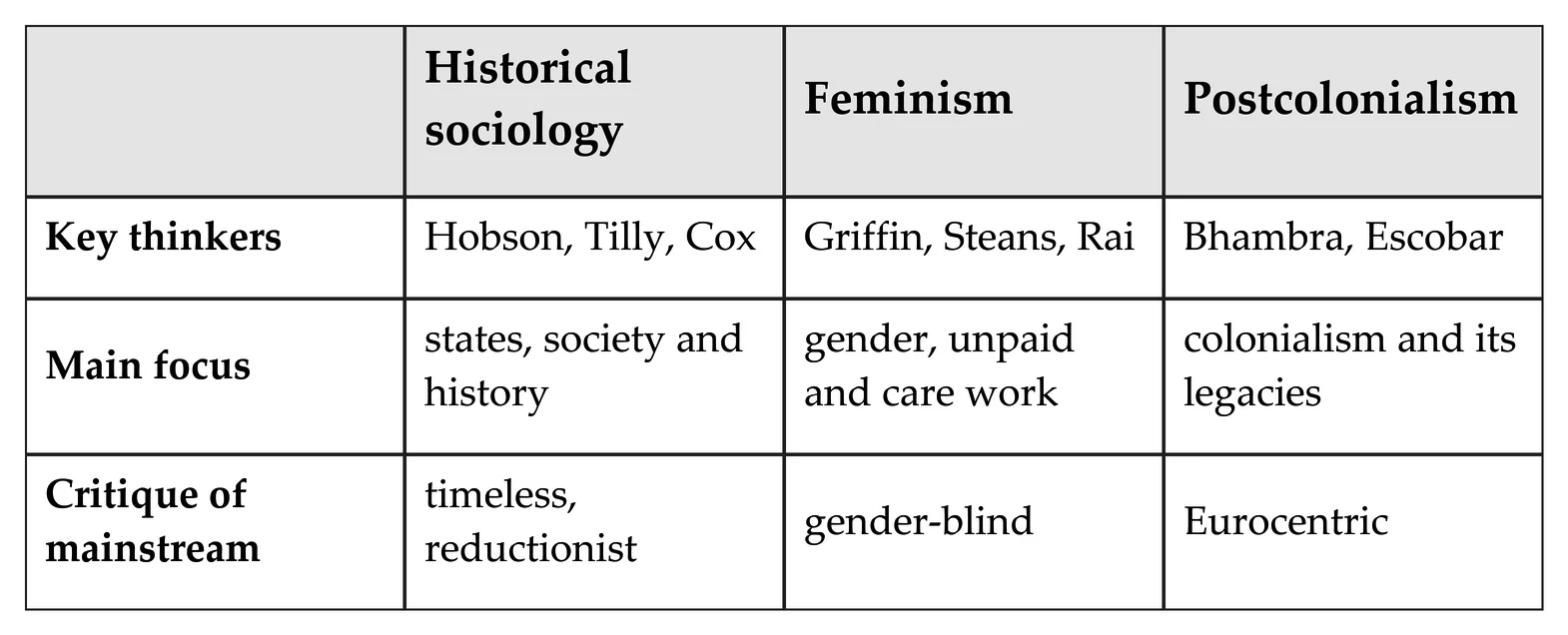
Historical sociology studies how large social structures, such as states, markets, classes and empires, emerged and changed over long periods of time. Thinkers such as Max Weber, Charles Tilly and Michael Mann showed that modern states were built through war, taxation and bargaining with social groups. Tilly’s famous phrase is that war made the state and the state made war. In IPE, historical sociology rejects the idea that the state and the market are timeless, separate things; both are products of history.
Hobson: The Wealth of States
John M. Hobson, in The Wealth of States (1997), calls for a sociology of international relations and an international relations of sociology. He criticises two kinds of reductionism. System-centric theories such as Kenneth Waltz’s neorealism explain state behaviour by the pressures of the international system alone, while society-centric theories such as Marxism and pluralism explain the state as a tool of classes or interest groups. Both, he argues, deny the state real agency. Hobson proposes a non-reductionist approach in which states have varying degrees of autonomy both at home and in the international system, and in which domestic and international forces shape each other.
He applies this to the rise of tariff protectionism in Europe between about 1870 and 1914. Instead of explaining tariffs only by the demands of landlords or industrialists, he shows that states such as Germany and Russia raised tariffs largely because they needed revenue to pay for growing military spending, especially where they lacked the capacity to collect direct taxes. Britain, with a stronger capacity for income tax, could remain committed to free trade. In simple words, the fiscal needs of states, shaped by geopolitical competition and their relations with society, explain economic policy.
Neo-Gramscian Critical IPE
Robert Cox (1981; Production, Power and World Order, 1987) drew on the Italian Marxist Antonio Gramsci to build a critical, historical IPE. He argued that a world order rests on a fit between three forces, i.e. material capabilities, ideas and institutions, and that hegemony means dominance based largely on consent, when the leading state’s ideas and institutions appear to serve general interests. Stephen Gill and David Law, in Global Hegemony and the Structural Power of Capital (1993), argue that the growing mobility of capital gives transnational capital structural power over states: governments must keep investors confident or face capital flight, so they adopt market-friendly policies. Gill later called this disciplinary neoliberalism and new constitutionalism, i.e. locking market rules into treaties and laws beyond democratic control.

Mann: The Sources of Social Power
Michael Mann, in The Sources of Social Power (first volume, 1986), argued that societies are made of overlapping networks of four kinds of power: ideological, economic, military and political. No single source, not even the economy, determines the others. This model is useful for IPE because it shows that economic power always works alongside military force, state authority and belief systems, which is why historical sociologists reject purely economic or purely geopolitical explanations.
3.2 Feminism and the Global Political Economy
Why Gender Matters
Feminist IPE argues that mainstream theories are gender-blind. They assume a rational, self-interested economic man, they count only paid work in markets, and they treat the household as private and outside the economy. Yet the world economy depends on enormous amounts of unpaid domestic and care work, mostly done by women, and on women’s low-paid labour in factories, farms and homes. Marilyn Waring, in If Women Counted (1988), showed that national accounts such as GDP ignore unpaid work. Cynthia Enloe, in Bananas, Beaches and Bases (1989), showed how international politics and economics rely on women as plantation workers, domestic servants, sex workers and diplomats’ wives, arguing that the personal is international.
Griffin: Gender and the Global Political Economy
Penny Griffin, in Refashioning IPE (2007) and Gender and the Global Political Economy (2017), argues that gender is not just about adding women to existing theories. Gender analysis shows how the core concepts of IPE, such as the market, the rational actor, productivity and efficiency, are built on masculine norms that value some activities and devalue others. She studies how institutions such as the World Bank construct gendered subjects, for example presenting women as untapped resources whose entry into the market will boost growth, while leaving their unpaid burdens unchanged. For Griffin, gender analysis refashions IPE by showing how power works through everyday economic practices.
Steans: The Private Is Global
Jill Steans, in The Private is Global: Feminist Politics and Global Political Economy (1999), argues that the private sphere of the household is connected to the global economy. Structural adjustment policies that cut public spending shift the burden of care onto women in households. Export processing zones employ young women as cheap, flexible labour. Women migrate across borders as nurses, nannies and domestic workers, forming what Arlie Hochschild called global care chains. Feminist politics therefore must link struggles in the home with struggles over trade, finance and development.
Rai: Gender and Development
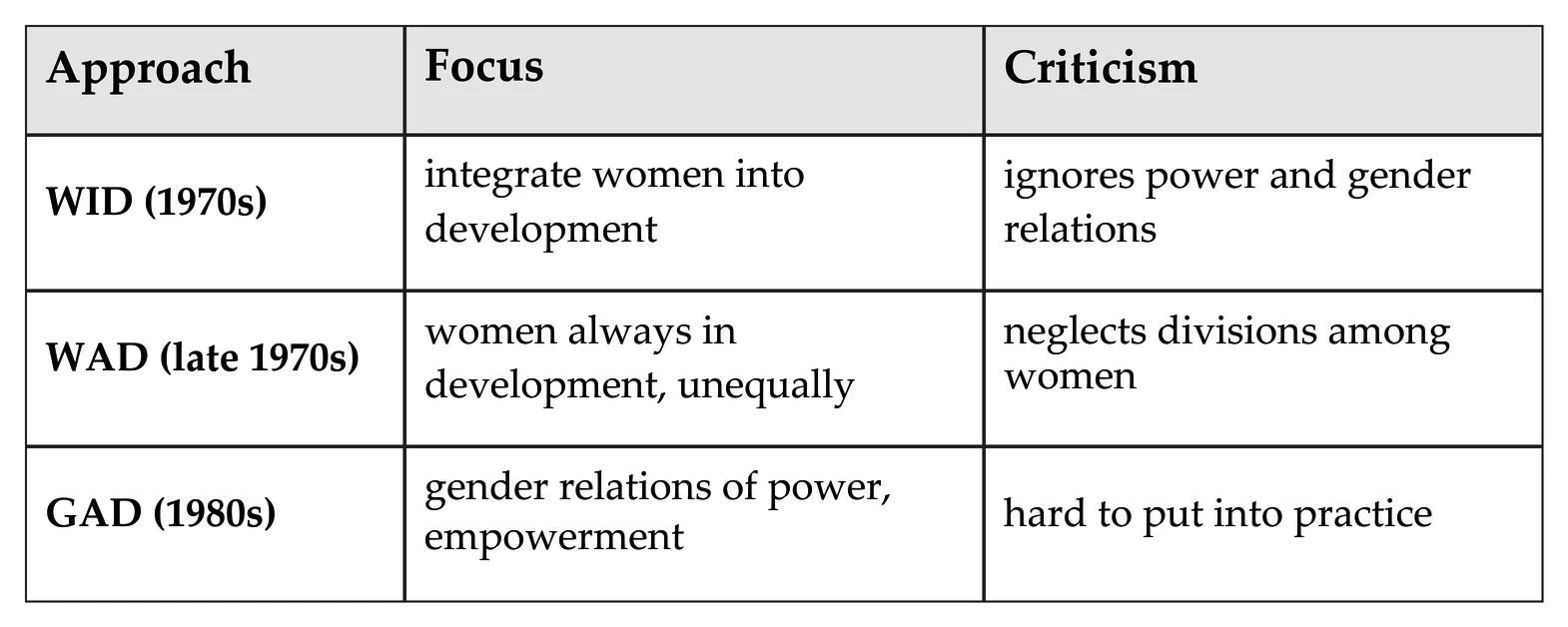
Shirin Rai, in Gender and the Political Economy of Development (2002), traces the main approaches. Women in Development (WID), starting with Ester Boserup (1970), sought to integrate women into development projects. Women and Development (WAD), influenced by Marxism, argued that women were always part of development but on unequal terms. Gender and Development (GAD) from the 1980s focused on gender relations of power in households, markets and states, and on empowerment. Rai stresses the role of nationalism and the state in shaping women’s economic position, including in India.
- Unpaid care work. Women in India do several times more unpaid domestic and care work than men, according to the Time Use Survey of 2019.
- Female labour force participation. India’s rate has long been among the lowest in major economies, though it rose in recent surveys.
- Microfinance and self-help groups. Programmes such as Kudumbashree in Kerala and the National Rural Livelihoods Mission organise women, but critics warn of debt burdens.
- Global supply chains. The Rana Plaza factory collapse in Bangladesh in 2013, which killed more than 1,100 workers, mostly women, exposed the costs of cheap fashion.
Feminist Ideas in Policy
- SDG 5 (2015). The Sustainable Development Goal on gender equality includes a target to recognise and value unpaid care and domestic work.
- ILO Convention 189 (2011). It set standards of decent work for domestic workers, many of them women migrants.
- SEWA. The Self-Employed Women’s Association, founded by Ela Bhatt in 1972, organises women in India’s informal economy as workers with rights.
- Gender budgeting. Governments, including India since 2005–06, examine how public spending affects women and men differently.
3.3 Postcolonialism and the Colonial Global Economy
Postcolonial Critique
Postcolonialism examines how colonialism shaped the modern world and how its legacies continue in knowledge, institutions and economic relations. Drawing on thinkers such as Edward Said (Orientalism, 1978), it criticises Eurocentrism, i.e. the habit of treating European history as the universal model and the rest of the world as backward or passive. In IPE, it questions stories of the rise of the West that ignore the contribution of colonised peoples and the wealth extracted from them.
Bhambra: The Colonial Global Economy
Gurminder K. Bhambra, in Colonial Global Economy: Towards a Theoretical Reorientation of Political Economy (2020), argues that both liberal and Marxist political economy take the national economy as the unit of analysis and tell the history of capitalism as if it developed within European nations. This erases the fact that Britain and other powers were empires, whose economies included colonies. Wealth extracted from India and the Caribbean through taxes, tribute, slavery and trade financed British investment and welfare, but appears in standard accounts as national achievement. Bhambra calls for starting from the colonial global economy and for connected histories that treat colonies and metropoles together. This reorientation has implications for debates on reparations, migration and global justice today.
Escobar: Development as Discourse
Arturo Escobar, in Discourse and Power in Development (1984) and later Encountering Development (1995), applies Michel Foucault’s ideas about discourse and power to development. He argues that after President Truman’s 1949 speech about underdeveloped areas, the West created the Third World as an object of knowledge and intervention. The development discourse defined poverty as a problem to be solved by experts, economists and institutions such as the World Bank, through plans, projects and statistics. This discourse gave power to experts and the West, ignored local knowledge and ways of life, and often harmed the people it claimed to help. Escobar called for alternatives to development rather than alternative forms of development.

Indian Contributions
Indian thinkers developed postcolonial political economy long before the term existed. Dadabhai Naoroji described the drain of wealth from India to Britain in Poverty and Un-British Rule in India (1901), and R. C. Dutt documented the ruin of Indian industries in his Economic History of India (1902). Later, the Subaltern Studies group and scholars such as Utsa Patnaik estimated the scale of colonial extraction, and Shashi Tharoor’s An Era of Darkness (2016) brought the debate to a wide audience. These themes are studied further in Chapter 4.
Postcolonial Debates Today
Postcolonial political economy shapes current debates. Caribbean states set up a CARICOM Reparations Commission in 2013 to seek redress for slavery and colonialism. In climate negotiations, developing countries argue that rich countries owe a climate debt because they caused most historical emissions; this led to the agreement on a loss and damage fund at COP27 in 2022. Debates on reforming the IMF and World Bank, whose voting shares still favour the West, also draw on postcolonial critiques.
3.4 Important Questions
- Question 1 Discuss the contribution of historical sociology to International Political Economy with reference to John Hobson.
- Question 2 Discuss the feminist perspective in International Political Economy.
- Question 3 Discuss the postcolonial perspective in International Political Economy.
- Question 4 Discuss the neo-Gramscian perspective on global hegemony and the structural power of capital.
DU asks the same idea in different words. So learn one broad answer for each question below; the same answer works for every question joined by OR.
Important Question 1
Discuss the contribution of historical sociology to International Political Economy with reference to John Hobson.
OR
Examine Hobson’s critique of system-centric and society-centric theories.
OR
Explain Hobson’s idea of a sociology of international relations and an international relations of sociology.
Model Answer
“War made the state, and the state made war.”
— Charles Tilly, The Formation of National States in Western Europe (1975)
Introduction. Historical sociology studies how states, markets and classes emerged and changed over time. In IPE, it rejects timeless theories and shows how domestic and international forces shape each other. John Hobson’s The Wealth of States (1997) is a leading example, explaining economic policy through the fiscal needs and agency of states.
1. Meaning of Historical Sociology
Historical sociology studies long-term change in large structures such as states, empires, markets and classes.
2. Weber, Tilly and Mann
Thinkers such as Weber, Tilly and Mann showed that modern states were built through war, taxation and bargaining with society.
3. Tilly’s Insight
Tilly’s phrase that war made the state and the state made war captures the link between geopolitics and state-building.
4. Against Timeless Theories
Historical sociology argues that states and markets are not timeless but products of particular historical processes.
5. Hobson’s Dual Programme
Hobson calls for a sociology of international relations and an international relations of sociology, linking both levels.
6. System-Centric Reductionism
Neorealism explains states only by pressures of the international system, ignoring domestic society and history.
7. Society-Centric Reductionism
Marxism and pluralism explain the state as a tool of classes or interest groups, denying it independent agency.
8. State Agency
Hobson argues that states have varying degrees of autonomy both domestically and internationally.
9. Mutual Shaping
Domestic and international forces shape each other; neither level alone explains state behaviour.
10. The Tariff Puzzle
Hobson asks why many European states turned to tariff protection between 1870 and 1914.
11. Fiscal Explanation
He shows that states raised tariffs largely to fund rising military spending when they lacked capacity for direct taxes.
12. Britain’s Exception
Britain could stay with free trade because it had a stronger capacity to raise income tax.
13. Lessons for IPE
Economic policy reflects the fiscal and geopolitical needs of states, not only the demands of economic interest groups.
14. Critical Historical Approaches
Cox’s neo-Gramscian approach also studies world orders historically, as fits between ideas, material capabilities and institutions.
15. Hobson’s Later Work
In The Eastern Origins of Western Civilisation (2004), Hobson argued that the West’s rise depended on Eastern ideas and technologies.
16. Criticism
Critics say historical sociology can be descriptive and hard to generalise, and that fiscal explanations may underplay interests.
17. Fiscal Sociology Today
Hobson’s focus on state revenue remains relevant: governments still use tariffs and taxes to meet fiscal needs, and India’s introduction of GST in 2017 shows how tax reform reshapes relations between the Union, the states and business.
18. Beyond Eurocentrism
Historical sociology has increasingly turned to non-Western history, showing that China, India and the Islamic world shaped the global economy long before European dominance.
19. Mann’s Four Sources of Power
Michael Mann’s model of ideological, economic, military and political power supports Hobson’s approach, since it shows that economic outcomes always depend on several overlapping networks of power.
20. Evaluation
Historical sociology enriches IPE by showing that states and markets are historical, and that states have real agency.
Conclusion. Thus, historical sociology, from Tilly’s view that war made the state to Hobson’s non-reductionist theory, shows that economic policy reflects the agency and fiscal needs of states shaped by both domestic and international forces. It corrects the timeless and one-sided views of mainstream theories.
Important Question 2
Discuss the feminist perspective in International Political Economy.
OR
Examine how gender analysis refashions International Political Economy.
OR
Explain the idea that the private is global with reference to Jill Steans.
Model Answer
“Human development, if not engendered, is endangered.”
— UNDP, Human Development Report (1995)
Introduction. Feminist IPE argues that mainstream theories are gender-blind: they ignore unpaid work, treat the household as outside the economy and assume a rational economic man. Scholars such as Penny Griffin, Jill Steans and Shirin Rai show that the global economy depends on gendered divisions of labour and that gender analysis changes our understanding of markets, development and power.
1. Gender-Blind Mainstream
Mainstream IPE assumes a rational, self-interested economic man and counts only paid market work.
2. Unpaid Work
Marilyn Waring showed that GDP ignores unpaid domestic and care work, most of which is done by women.
3. The Personal Is International
Cynthia Enloe showed that world politics and economics rely on women’s labour, from plantations to diplomatic households.
4. Griffin’s Refashioning
Penny Griffin argues that gender analysis does not merely add women but shows how IPE’s core concepts are built on masculine norms.
5. Gendered Institutions
Griffin shows how the World Bank presents women as untapped resources for growth while ignoring their unpaid burdens.
6. Steans: The Private Is Global
Jill Steans argues that the household is linked to the global economy, so the private sphere is part of global politics.
7. Structural Adjustment
Cuts in public spending under adjustment programmes shifted care burdens onto women in households.
8. Export Processing Zones
Global firms employ young women as cheap, flexible labour in export zones, as in garment factories.
9. Global Care Chains
Women migrate as nurses, nannies and domestic workers, forming global care chains that link households across countries.
10. WID, WAD and GAD
Rai traces the move from integrating women into development, through critiques of unequal integration, to analysing gender relations.
11. Boserup’s Contribution
Ester Boserup’s book of 1970 showed that development projects often bypassed or harmed women, launching the WID approach.
12. Indian Evidence
India’s Time Use Survey (2019) showed women doing far more unpaid work, and female labour force participation has long been low.
13. Rana Plaza
The 2013 Rana Plaza collapse in Bangladesh, killing more than 1,100 mostly women workers, exposed the gendered costs of global supply chains.
14. Empowerment Programmes
Self-help groups and microfinance, such as Kudumbashree, organise women, though critics warn of debt and limited change.
15. Policy Impact
Gender budgeting, introduced in India’s Union Budget in 2005–06, reflects feminist demands to make public spending gender-sensitive.
16. Criticism
Critics say feminist IPE sometimes treats women as a single group, ignoring differences of class, caste, race and nation.
17. Intersectionality
Feminist scholars influenced by Kimberlé Crenshaw stress intersectionality, i.e. the way gender combines with class, caste, race and nationality to shape women’s experience of the global economy.
18. Care Economy and the Pandemic
The COVID-19 pandemic showed the importance of care work, as closures of schools and services shifted burdens onto women and many lost paid jobs, strengthening demands to value care.
19. Evaluation
Feminist IPE reveals the hidden foundations of the world economy and broadens the meaning of work, value and power.
Conclusion. Thus, feminist IPE shows that the global economy rests on women’s paid and unpaid labour. As the 1995 Human Development Report put it, human development, if not engendered, is endangered, and Griffin and Steans show that gender analysis refashions IPE itself.
Important Question 3
Discuss the postcolonial perspective in International Political Economy.
OR
Examine Gurminder Bhambra’s argument on the colonial global economy.
OR
Discuss Arturo Escobar’s view of development as a discourse of power.
Model Answer
“We must embark on a bold new program for making the benefits of our scientific advances and industrial progress available for the improvement and growth of underdeveloped areas.”
— Harry S. Truman, Inaugural Address (20 January 1949)
Introduction. Postcolonialism examines how colonialism shaped the modern world economy and how its legacies continue. It criticises Eurocentric accounts that treat Western development as a national achievement and ignore colonial extraction. Gurminder Bhambra calls for a reorientation of political economy around the colonial global economy, while Arturo Escobar shows how the discourse of development created the Third World as an object of Western power.
1. Meaning of Postcolonialism
Postcolonialism studies the effects and legacies of colonialism on knowledge, institutions and economic relations.
2. Said and Eurocentrism
Edward Said’s Orientalism (1978) showed how the West represented the East as backward, inspiring critiques of Eurocentrism.
3. Eurocentric IPE
Mainstream IPE tells the history of capitalism as if it developed within European nations, leaving out colonies.
4. Bhambra’s Critique
Bhambra argues that both liberal and Marxist political economy wrongly take the national economy as the unit of analysis.
5. Empires not Nations
Britain and other powers were empires, whose economies included colonies, so their histories must be studied together.
6. Extraction and Welfare
Wealth extracted through taxes, tribute, slavery and trade financed metropolitan investment and welfare, yet appears as national achievement.
7. Connected Histories
Bhambra calls for connected histories that treat colonies and metropoles as parts of one colonial global economy.
8. Truman and Development
Truman’s 1949 speech about underdeveloped areas marked the start of the era of international development.
9. Escobar’s Discourse Analysis
Escobar uses Foucault to argue that development is a discourse that produced the Third World as an object of knowledge and control.
10. Power of Experts
The development discourse gave power to Western experts and institutions such as the World Bank, through plans and statistics.
11. Silencing Local Knowledge
Development projects often ignored local knowledge and ways of life, sometimes harming the people they aimed to help.
12. Alternatives to Development
Escobar called for alternatives to development rather than alternative forms of development, valuing local movements.
13. Naoroji and the Drain
Dadabhai Naoroji’s drain theory was an early postcolonial political economy, showing how Britain extracted India’s wealth.
14. Contemporary Relevance
Postcolonial ideas inform debates on reparations, climate justice, migration and reform of global institutions.
15. Indian Voices
Scholars such as Utsa Patnaik and writers such as Shashi Tharoor have revived debate on the scale of colonial extraction from India.
16. Criticism
Critics argue that postcolonial theory can neglect material analysis and that rejecting development ignores people’s wish for better lives.
17. Decolonising Knowledge
Postcolonial scholars call for decolonising the curriculum of economics and IR, so that the experiences and ideas of the Global South are treated as sources of theory rather than only as cases.
18. Neo-Colonialism
Kwame Nkrumah, in Neo-Colonialism: The Last Stage of Imperialism (1965), argued that formally independent states could remain economically controlled by former colonial powers, an idea that postcolonial IPE develops.
19. Evaluation
Postcolonialism corrects the Eurocentric story of capitalism and reminds IPE of the colonial roots of global inequality.
Conclusion. Thus, postcolonialism shows that the modern world economy was built through colonialism. Bhambra’s colonial global economy and Escobar’s critique of the development discourse that began with Truman’s call to help underdeveloped areas reveal how power shaped both wealth and knowledge.
Important Question 4
Discuss the neo-Gramscian perspective on global hegemony and the structural power of capital.
OR
Examine Stephen Gill and David Law’s argument on the structural power of capital.
OR
Explain Robert Cox’s critical theory of world order.
Model Answer
“World hegemony is describable as a social structure, an economic structure, and a political structure; and it cannot be simply one of these things but must be all three.”
— Robert W. Cox, Gramsci, Hegemony and International Relations (1983)
Introduction. The neo-Gramscian perspective, developed by Robert Cox, Stephen Gill and David Law, applies the ideas of the Italian Marxist Antonio Gramsci to the world economy. It studies world orders historically and argues that hegemony rests on consent as well as force. Gill and Law show how the mobility of capital gives it structural power over states.
1. Gramsci’s Hegemony
Gramsci argued that ruling classes dominate not only by force but through consent, by making their ideas appear as common sense.
2. Cox’s Critical Theory
Cox distinguished problem-solving theory, which accepts the existing order, from critical theory, which asks how it came about and how it may change.

3. Three Forces
For Cox, a world order rests on a fit between material capabilities, ideas and institutions.
4. World Hegemony
Cox describes world hegemony as at once a social, economic and political structure, led by a dominant state and class.
5. Pax Americana
After 1945, US hegemony rested on economic power, liberal ideas and institutions such as the IMF, World Bank and GATT.
6. Historic Bloc
A historic bloc is an alliance of social forces, ideas and institutions that supports a particular order.
7. Transnational Capital
Gill and Law argue that globalisation created a transnational capitalist class with interests across borders.
8. Structural Power of Capital
Because capital can move freely, governments must keep investors confident, so capital shapes policy without direct pressure.
9. Capital Flight
The threat of capital flight disciplines states, pushing them towards low taxes, deregulation and fiscal restraint.
10. Disciplinary Neoliberalism
Gill describes how market discipline became the dominant mode of governing economies from the 1980s.
11. New Constitutionalism
Gill argues that trade treaties, central bank rules and investment agreements lock market rules beyond democratic control.
12. Role of Institutions
Institutions such as the IMF, the World Bank and the G7 spread neoliberal ideas and help create consent.
13. Counter-Hegemony
Neo-Gramscians see social movements, unions and the global justice movement as possible sources of counter-hegemony.
14. Link to Historical Sociology
Like historical sociology, this approach studies world orders as historical structures that rise and fall.
15. Indian Example
India’s 1991 reforms, adopted amid a balance of payments crisis and pressure from lenders, show how capital and institutions shape national policy.
16. Criticism
Critics say the perspective overstates the power of capital and understates state capacity and national differences.
17. Problem-Solving and Critical Theory
Cox’s distinction matters for students: problem-solving theory asks how to make the existing order work smoothly, while critical theory asks whose interests it serves and how it might be transformed.
18. Transnational Policy Networks
Forums such as the World Economic Forum at Davos and the Trilateral Commission, studied by Gill, bring together business and political elites and help build consensus around market-friendly policies.
19. Hegemony and Consent
For neo-Gramscians, the stability of the post-war order came less from American force than from the consent of allies and elites, who accepted American leadership because it seemed to bring prosperity.
20. Evaluation
The neo-Gramscian perspective explains how power in the world economy works through ideas and consent as well as material force.
Conclusion. Thus, the neo-Gramscian perspective sees world hegemony, as Cox says, as a social, economic and political structure at once. Gill and Law show that the mobility of capital gives it structural power over states, while social movements may build counter-hegemony.
Short Notes
(a) Global care chains
Arlie Hochschild’s term for the links between households across countries created when women migrate to do care work abroad, leaving their own care needs to others.
(b) Development discourse
Escobar’s term, drawn from Foucault, for the system of knowledge and practices through which the West defined the Third World as underdeveloped and in need of expert intervention.
(c) Structural power of capital
Gill and Law’s idea that the mobility of capital disciplines states, which must keep investors confident or face capital flight.
More notes: MDSE-3a International Political Economy
These notes are prepared by PADHO TO AISE for study help. They are not an official University of Delhi publication.