
Semester V MDSC-5B Modern Indian Political Thought
Unit V · 19 min read · Updated 24 Nov 2026
As per the University of Delhi (DU) BA (Hons) Political Science syllabus
Contents
- 5.1 Tilak: Swaraj as a Birthright
- 5.2 Gandhi: Swaraj as Self-rule
- 5.3 Tilak and Gandhi: Two Ideas of Swaraj
- 5.4 Important Questions
- Discuss Bal Gangadhar Tilak’s ideas of nationalism and swaraj.
- Examine Gandhi’s concept of swaraj as presented in Hind Swaraj.
- Compare the ideas of swaraj in the thought of Tilak and Gandhi.
- Short Notes
जब हम स्वयं पर शासन करना सीख लेते हैं, तभी स्वराज है।
It is Swaraj when we learn to rule ourselves.
— M.K. Gandhi, Hind Swaraj (1909), Chapter XIV
SWARAJ, literally self-rule, was the central idea of the Indian national movement. But Indian thinkers gave it very different meanings. For Bal Gangadhar Tilak (1856–1920), swaraj was the birthright of Indians: political self-government, to be won through boycott, swadeshi, national education and mass mobilisation, and justified by a reading of the Bhagavad Gita that called for energetic action in the world. For M.K. Gandhi (1869–1948), swaraj meant much more than the departure of the British. In Hind Swaraj (1909) he described it as self-rule over oneself, freedom from modern civilisation and a society of self-reliant villages, to be achieved only by truth and non-violence. This unit studies both ideas and compares them.
5.1 Tilak: Swaraj as a Birthright
Bal Gangadhar Tilak, called Lokmanya, was the leading figure of the Extremist or nationalist wing of the Congress. Through Kesari and Mahratta, the public Ganapati festival (1893) and the Shivaji festival (1895–96), he turned nationalism into a mass movement in Maharashtra. He was imprisoned for sedition in 1897 and again from 1908 to 1914 in Mandalay. In 1916 he founded the Home Rule League and declared that swaraj was his birthright. N.R. Inamdar and S.P. Singh study his political ideas and his idea of swaraj.
For Tilak, swaraj meant self-government, Indians managing their own affairs, at first as Home Rule within the empire. It was a natural right, not a gift of the rulers. Its methods were boycott of foreign goods, swadeshi, national education and passive resistance. In Gita Rahasya, he read the Gita as a gospel of karmayoga, selfless action in the world for lokasangraha, the welfare of all, rather than renunciation. He also gave swaraj a moral meaning: self-government was necessary for the full development of the self and of dharma.

5.2 Gandhi: Swaraj as Self-rule
M.K. Gandhi wrote Hind Swaraj as a dialogue between a Reader, who speaks for the young nationalists of the time, and an Editor, who speaks for Gandhi. The Reader wants to drive out the British and make India a strong modern nation. The Editor replies that this would be English rule without the Englishman. Real swaraj requires freedom from modern civilisation itself, with its railways, lawyers, doctors and machinery, which Gandhi saw as making people slaves to their bodies and desires. It is self-rule, when each person learns to govern himself or herself.
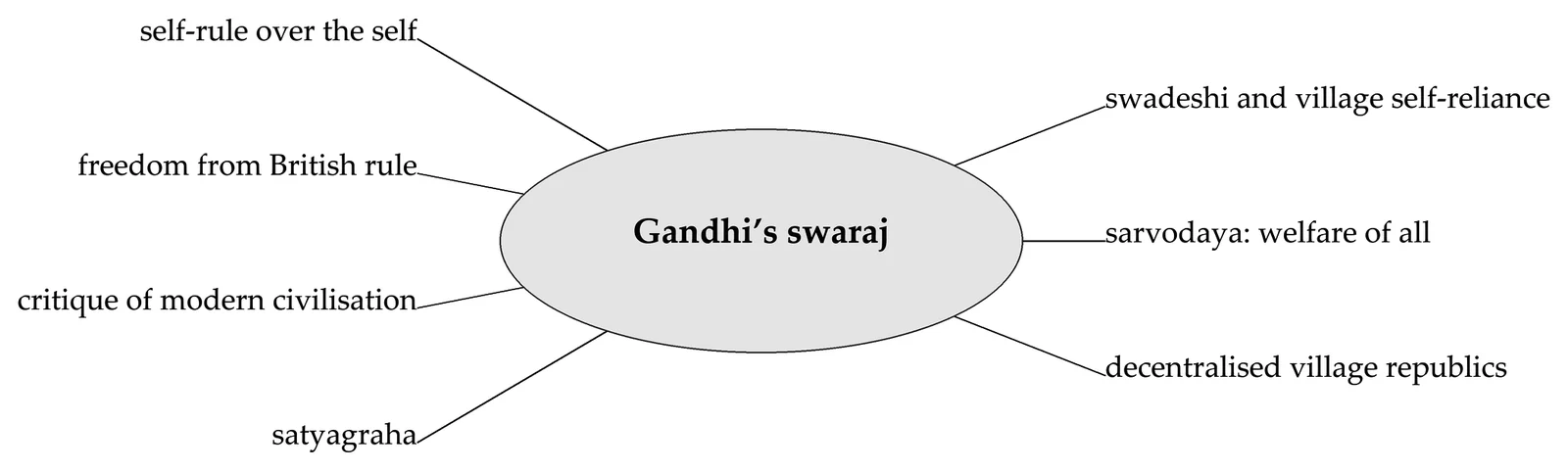
Anthony Parel, in his introduction to Gandhi, Freedom and Self-Rule (2002), identifies four meanings of Gandhi’s swaraj: national independence, the political freedom of the individual, economic freedom from poverty, and spiritual freedom or self-rule. These are achieved through satyagraha, swadeshi, the constructive programme and decentralised village republics. For Gandhi, means and ends were inseparable: swaraj won by violence would not be true swaraj.
5.3 Tilak and Gandhi: Two Ideas of Swaraj
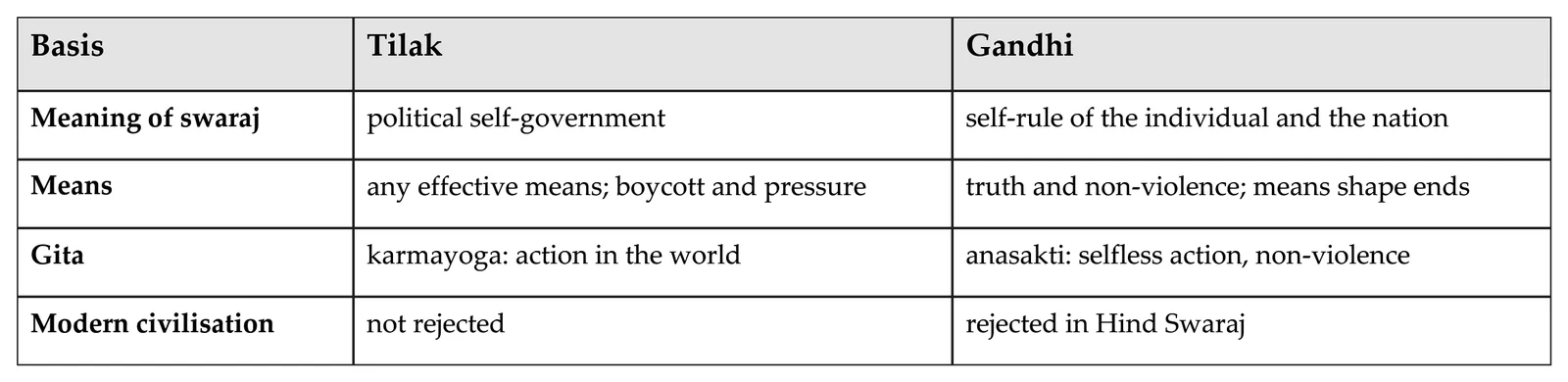
Tilak and Gandhi shared a commitment to swaraj, swadeshi and the moral authority of the Gita, but they differed sharply. Tilak sought political self-government and accepted any effective means; Gandhi sought moral self-rule and insisted on truth and non-violence. Tilak read the Gita as teaching action, including the use of force against injustice; Gandhi read it as an allegory teaching non-violent, selfless action. In January 1920 they debated this in Young India: Tilak wrote that politics is a game of worldly people and not of sadhus, while Gandhi replied that truth and non-violence apply in politics too.
Christopher Pinney describes Tilak as Gandhi’s counter-guru: a leader whom Gandhi respected but against whom he defined his own idea of swaraj. The title of Pinney’s essay comes from Hind Swaraj, where Gandhi warns that the nationalists want the tiger’s nature, but not the tiger. Shruti Kapila shows that both thinkers, in different ways, criticised liberalism and rethought the self as the basis of politics.
5.4 Important Questions
- Question 1 Discuss Bal Gangadhar Tilak’s ideas of nationalism and swaraj.
- Question 2 Examine Gandhi’s concept of swaraj as presented in Hind Swaraj.
- Question 3 Compare the ideas of swaraj in the thought of Tilak and Gandhi.
DU asks the same idea in different words. So learn one broad answer for each question below; the same answer works for every question joined by OR.
Important Question 1
Discuss Bal Gangadhar Tilak’s ideas of nationalism and swaraj.
OR
‘Swaraj is my birthright and I shall have it.’ Examine Tilak’s idea of swaraj.
OR
Examine the political ideas of Lokmanya Tilak.
Model Answer
“Swaraj is my birthright and I shall have it.”
— Bal Gangadhar Tilak (1916)
Introduction. Bal Gangadhar Tilak was the most powerful leader of the national movement before Gandhi. He transformed the Congress from a forum of petitions into a movement of the people and gave Indians the slogan of swaraj as a birthright. N.R. Inamdar and S.P. Singh show that his nationalism combined political radicalism with deep roots in Indian religion and culture.
1. Life and Work
Born in Ratnagiri in 1856, Tilak was a mathematics graduate and a Sanskrit scholar. He helped found the Deccan Education Society (1884) and Fergusson College, and started Kesari and Mahratta in 1881. He was imprisoned for sedition in 1897 and from 1908 to 1914, and led the Home Rule movement from 1916 until his death in 1920.
2. Critique of the Moderates
Tilak rejected the Moderates’ method of prayer, petition and protest, which he called political mendicancy. He argued that the British would not give up power through persuasion and that Indians must rely on their own strength, organisation and sacrifice. This led to the split between Moderates and Extremists at the Surat Congress of 1907.
3. Swaraj as a Natural Right
For Tilak, swaraj was a natural, inherent right of every nation, not a privilege granted by rulers. His slogan, swaraj is my birthright, expressed the claim that self-government belonged to Indians by right. At first he demanded Home Rule within the British Empire, like that of the self-governing dominions, but the principle was that Indians must control their own government.
4. The Fourfold Programme
Tilak was the main force behind the programme adopted at the Calcutta Congress of 1906: swaraj, swadeshi, boycott and national education. Boycott of British goods would hurt British economic interests; swadeshi would build Indian industry; national education would create self-respecting citizens; and swaraj was the goal.
5. Passive Resistance
Tilak advocated passive resistance: Indians should refuse to cooperate with the administration, decline to serve it and withhold the support on which British rule depended. He believed that the British ruled India only because Indians helped them, and that organised refusal could make the government unworkable.
6. Cultural Nationalism
Tilak used religion and history to mobilise the masses. The public Ganapati festival (1893) and the Shivaji festival (1895–96) brought people together and spread nationalist ideas. Inamdar argues that Tilak saw Indian culture as the foundation of national unity and pride, though critics note that these symbols drew mainly on Hindu and Maratha traditions.
7. Gita Rahasya and Karmayoga
In Gita Rahasya, written in Mandalay prison, Tilak argued that the Gita teaches karmayoga, the duty of selfless action in the world, rather than renunciation. The aim of action is lokasangraha, the welfare and stability of society. This gave nationalists a philosophical justification for active political struggle.
8. Moral Meaning of Swaraj
Inamdar shows that Tilak did not see swaraj as merely political. Self-government was necessary for the moral and spiritual development of the people, because a subject people could not practise its dharma fully. Political freedom and spiritual freedom were therefore connected.
9. Means
Tilak judged political methods by their effectiveness. He did not preach violence, but he refused to condemn it absolutely and argued, in his writings on Shivaji, that actions done without selfish motive for the good of society could not be judged by ordinary rules. This brought him into conflict with the British and later with Gandhi.
10. Social Reform
Tilak opposed the Age of Consent Bill (1891), arguing that social reform should come from within Indian society and not be imposed by a foreign government. Critics saw this as conservatism, while Singh argues that Tilak gave priority to political freedom, believing reform would follow self-government.
11. Democracy and Unity
Tilak supported representative government, freedom of the press and a federal structure with linguistic provinces. He worked for Hindu–Muslim cooperation in the Lucknow Pact of 1916 and, in 1920, accepted the Montagu–Chelmsford reforms in a spirit of responsive cooperation, working them while demanding more.
12. Evaluation
Tilak made swaraj a mass demand, gave nationalism self-confidence and cultural roots, and laid the foundation for Gandhi’s mass movements. His use of Hindu symbols and his conservatism on social reform remain controversial, but his claim of swaraj as a birthright became the core of Indian nationalism.
Conclusion. Thus, Tilak saw swaraj as a natural right of Indians, to be won through boycott, swadeshi, national education and passive resistance, and grounded in a reading of the Gita as a call to action. He turned nationalism into a mass movement and prepared the ground for the struggle that followed.
Important Question 2
Examine Gandhi’s concept of swaraj as presented in Hind Swaraj.
OR
Discuss Gandhi’s critique of modern civilisation and his idea of swaraj.
OR
Explain the different meanings of swaraj in Gandhi’s thought with reference to Anthony Parel.
Model Answer
“Civilization is that mode of conduct which points out to man the path of duty.”
— M.K. Gandhi, Hind Swaraj (1909), Chapter XIII
Introduction. Gandhi’s Hind Swaraj (1909) is the founding text of his political thought. Written as a dialogue between a Reader and an Editor, it rejects the idea that swaraj simply means expelling the British and building a modern nation-state. For Gandhi, swaraj means self-rule in a deep moral sense. Anthony Parel shows that this idea has several connected meanings.
1. Context of Hind Swaraj
Gandhi wrote Hind Swaraj in Gujarati in November 1909 on his voyage from London to South Africa, after meeting Indian revolutionaries in London who believed in violence. It was published in Indian Opinion, banned by the Bombay government in 1910, and translated by Gandhi into English as Indian Home Rule. The book has twenty short chapters. Gandhi wrote it to answer the Indians who believed that only violence could free India, and to show that their impatience rested on a mistaken idea of freedom.
2. English Rule without the Englishman
The Reader wants India free of the British but with the same army, parliament, industry and power. Gandhi replies that this would be English rule without the Englishman: India would become English. Expelling the British while keeping their civilisation would not be swaraj.
3. Critique of Modern Civilisation
Gandhi called modern civilisation a disease. It measures progress by bodily comfort and material goods, multiplies wants and makes people slaves of machines. Railways spread plague and famine, lawyers profit from quarrels and kept the British in power, and doctors encourage indulgence. The British held India not by force alone but because Indians accepted this civilisation. Even the British Parliament, he wrote, had not of its own accord done a single good thing; the English themselves were victims of the civilisation they spread.
4. True Civilisation
True civilisation, for Gandhi, is that mode of conduct which points out to human beings the path of duty. It means mastery over the mind and the passions. Indian civilisation, he argued, had wisely limited wants and kept people close to the land and to moral life.
5. Swaraj as Self-rule
Gandhi wrote that it is swaraj when we learn to rule ourselves, and that such swaraj is in the palm of our hands. Self-rule means control over one’s desires and the capacity to act according to truth. A nation of self-ruled individuals would be free whoever ruled it formally.
6. Parel’s Four Meanings
Parel identifies four meanings of swaraj in Gandhi: national independence from foreign rule; the political freedom of the individual against the state; economic freedom, or freedom from poverty; and spiritual freedom, or self-rule. Gandhi’s originality lay in holding all four together, with spiritual self-rule as their foundation.
7. Means and Ends
Gandhi rejected the revolutionaries’ view that violence could win freedom. He wrote that the means may be likened to a seed and the end to a tree, with the same inviolable connection between them. Swaraj won by violence would produce a violent state, not freedom.
8. Satyagraha
The method of swaraj is satyagraha, soul-force or truth-force, which Gandhi contrasted with brute force. The satyagrahi resists injustice by accepting suffering rather than inflicting it, aiming to convert the opponent. Gandhi had practised it in South Africa and later used it in India.
9. Swadeshi and Economic Swaraj
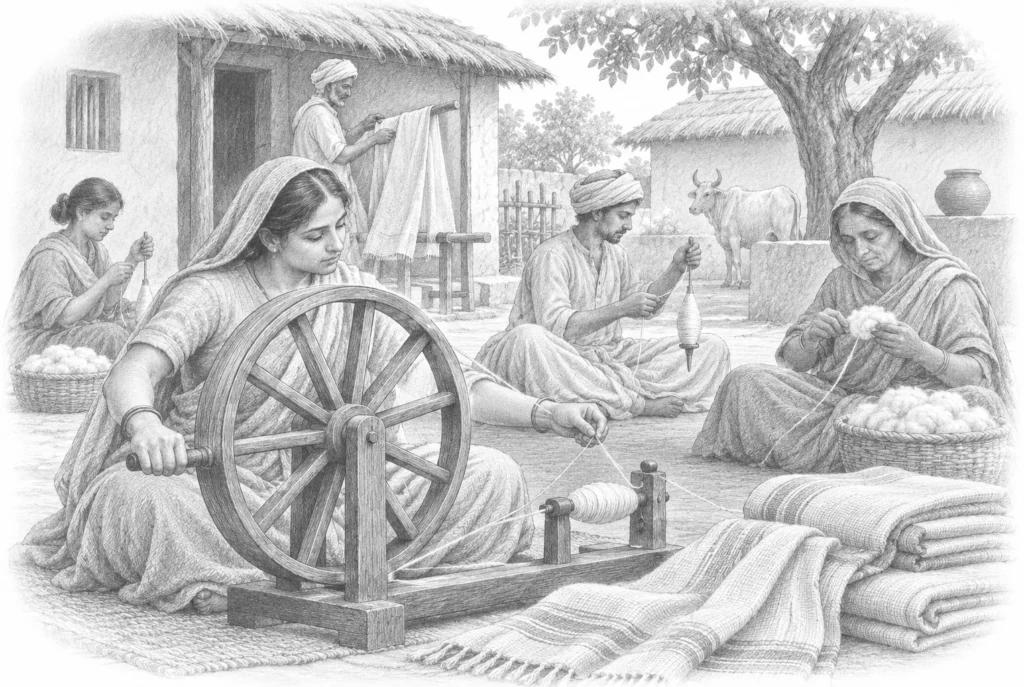
Swaraj required swadeshi: reliance on what is produced locally, especially through hand-spinning and village industries. The charkha symbolised economic self-reliance and dignity of labour. Economic swaraj meant freedom from poverty for the poorest, not industrial wealth.
10. Village Republics
Gandhi later described his ideal polity as one in which independence begins at the bottom, every village being a republic or panchayat with full powers. Society would be an oceanic circle of villages rather than a pyramid, with the state reduced to a minimum.
11. Swaraj and the State
Gandhi was deeply suspicious of state power. In a 1935 interview he described the state as violence in a concentrated and organised form, a soulless machine. In 1931 he wrote that in the ideal society everyone would be his own ruler, so there would be no political power and no state. Since this ideal could not be fully realised, he preferred the state that governs least, with power dispersed to villages.
12. The Constructive Programme
Swaraj was to be built from below through the constructive programme, set out in 1941: communal unity, removal of untouchability, prohibition, khadi and village industries, basic education, the uplift of women and service to the poor. For Gandhi, this daily work of rebuilding society was as much a part of swaraj as the struggle against the British.
13. Criticisms
Critics, including Nehru and Ambedkar, considered Gandhi’s rejection of machinery and modern institutions impractical and romantic. Ambedkar saw the village as a den of caste oppression. Others argue that Gandhi’s critique of modernity anticipated later concerns about consumerism, ecology and centralised power.
14. Evaluation
Gandhi’s swaraj transformed nationalism from a demand for power into a moral and social project. Parel argues that it seeks a balance between material and spiritual goods. Although India did not adopt his village-based model, his ideas of self-rule, non-violence and decentralisation remain influential.
Conclusion. Thus, Gandhi’s swaraj meant far more than independence. It combined national freedom, individual liberty, economic self-reliance and spiritual self-rule, rejected modern civilisation and violent means, and envisaged a decentralised society of village republics achieved through satyagraha and swadeshi.
Important Question 3
Compare the ideas of swaraj in the thought of Tilak and Gandhi.
OR
‘Tilak was Gandhi’s counter-guru.’ Discuss with reference to Christopher Pinney.
OR
Discuss the similarities and differences between Tilak and Gandhi on the means of achieving swaraj.
Model Answer
“You want the tiger’s nature, but not the tiger; that is to say, you would make India English.”
— M.K. Gandhi, Hind Swaraj (1909), Chapter IV
Introduction. Tilak and Gandhi were the two most important leaders of the Indian national movement, and Gandhi succeeded Tilak as its leader after 1920. Both made swaraj the goal of Indians and both drew on the Bhagavad Gita, but they understood swaraj, its means and its relation to religion and modernity very differently. Christopher Pinney calls Tilak Gandhi’s counter-guru.
1. Shared Goal
Both leaders rejected the Moderates’ politics of petition and sought to make swaraj a demand of the masses. Both believed that British rule depended on Indian cooperation and that organised refusal could end it. Both emphasised swadeshi and boycott of foreign goods.
2. Meaning of Swaraj
For Tilak, swaraj meant political self-government, Indians controlling their state and administration. For Gandhi, swaraj meant self-rule: control over one’s desires, freedom from modern civilisation and a decentralised society of villages. Gandhi warned that political independence alone would be English rule without the Englishman.
3. Attitude to Modernity
Tilak did not reject modern science, industry or institutions; he wanted India to develop them under Indian control. Gandhi, in Hind Swaraj, rejected modern civilisation as a disease that enslaved people to machines and desires. This was Gandhi’s main point in the image of the tiger’s nature without the tiger.
4. Means
Tilak judged methods by their effectiveness and did not rule out force. Gandhi insisted on truth and non-violence and argued that means and ends are inseparable. This was their sharpest difference.
5. Two Readings of the Gita
Tilak’s Gita Rahasya read the Gita as a call to karmayoga, selfless action in the world, which could include fighting injustice, as Krishna urged Arjuna to fight. Gandhi read the Gita as an allegory of the struggle within the self and found in it the teaching of anasakti, detached action, and non-violence.
6. The Debate of 1920
In Young India in January 1920, Tilak wrote that politics is a game of worldly people and not of sadhus, and preferred the principle of responding to others as they treat us. Gandhi replied that truth and non-violence must guide politics as much as private life. The exchange summed up their difference.
7. Religion and Politics
Both used religion in politics. Tilak used Hindu festivals and Maratha history to mobilise people, which critics say alienated Muslims. Gandhi spoke the language of a universal religion of truth, supported the Khilafat movement and sought Hindu–Muslim unity, though critics argue that his religious idiom also had Hindu overtones.
8. Social Reform
Tilak placed political freedom before social reform and opposed reforms imposed by the colonial state. Gandhi made social reform, especially the removal of untouchability and the uplift of women, part of the constructive programme and of swaraj itself.
9. Pinney’s Counter-guru
Pinney argues that Tilak functioned as Gandhi’s counter-guru: a figure Gandhi honoured but against whom he defined his own position. Hind Swaraj, written against the advocates of violence, rejects the politics of force and modern power that Tilak’s followers represented, while sharing their goal of swaraj.
10. Continuity
Despite their differences, Gandhi built on Tilak’s achievements. Tilak had made swaraj a mass demand and popularised boycott, swadeshi and passive resistance. Gandhi transformed these into the non-violent mass movements of non-cooperation, civil disobedience and Quit India.
11. Kapila’s View
Shruti Kapila argues that both Tilak and Gandhi, in different ways, criticised liberalism and placed the self at the centre of politics. For Tilak the self was realised through action and sacrifice for society; for Gandhi it was realised through self-discipline, truth and non-violence.
12. Mass Mobilisation
Both leaders brought the masses into politics, but differently. Tilak worked mainly through the press, festivals and associations of Maharashtra and spoke to an educated and urban audience as well as to peasants. Gandhi built an all-India organisation that drew in peasants, workers, women and the poor, using simple symbols such as the charkha, khadi and salt.
13. Attitude to the British
In 1919–20 Tilak favoured responsive cooperation, working the Montagu–Chelmsford reforms while pressing for more. Gandhi, after the Jallianwala Bagh massacre and the Khilafat issue, moved to non-cooperation. Tilak died on 1 August 1920, the very day Gandhi launched the Non-Cooperation Movement, which marked the passing of leadership from one to the other.
14. Evaluation
Tilak gave swaraj political urgency and mass appeal; Gandhi gave it moral depth and a non-violent method. Together they show the range of Indian thinking on freedom, from the claim of political self-government to the ideal of self-rule over oneself.
Conclusion. Thus, Tilak and Gandhi shared the goal of swaraj and drew on the Gita, but Tilak sought political self-government by any effective means while Gandhi sought moral self-rule through truth and non-violence. As Pinney suggests, Gandhi defined his swaraj partly in conversation with, and against, Tilak.
Short Notes
(a) Gita Rahasya
A commentary on the Bhagavad Gita written in Marathi by Tilak in Mandalay prison and published in 1915. It argued that the Gita teaches karmayoga, the path of selfless action in the world for lokasangraha, the welfare of society, rather than renunciation. It provided a philosophical basis for active nationalist struggle.
(b) Home Rule League
Tilak founded the Indian Home Rule League at Belgaum in April 1916, and Annie Besant founded a separate league later that year. They demanded self-government for India within the British Empire and spread nationalist ideas through branches, pamphlets and meetings, preparing the ground for Gandhi’s mass movements.
(c) Satyagraha
Gandhi’s method of non-violent resistance, meaning holding firmly to truth or soul-force. The satyagrahi resists injustice by refusing to cooperate and by accepting suffering without retaliation, seeking to convert the opponent rather than defeat them. Gandhi first used it in South Africa in 1906.
(d) Swadeshi
Literally ‘of one’s own country’. For Tilak, swadeshi meant using Indian goods and building Indian industry, together with boycott of British goods. For Gandhi, it was a wider principle of serving one’s immediate neighbourhood and relying on local production, symbolised by the charkha and khadi.
More notes: MDSC-5B Modern Indian Political Thought
These notes are prepared by PADHO TO AISE for study help. They are not an official University of Delhi publication.