
Semester V DSC-14 Modern Indian Political Thought
Unit III · 22 min read · Updated 24 Nov 2026
As per the University of Delhi (DU) BA (Hons) Political Science syllabus
Contents
- 3.1 Nehru: The National Philosophy of a Modern State
- 3.2 Deendayal Upadhyay: Integral Humanism
- 3.3 Ram Manohar Lohia: Socialism and the Four-pillar State
- 3.4 B.R. Ambedkar: The Conditions of Democracy
- 3.5 Important Questions
- Discuss Jawaharlal Nehru’s ideas on the state and democracy.
- Examine Deendayal Upadhyay’s philosophy of Integral Humanism.
- Discuss Ram Manohar Lohia’s ideas on socialism, caste and the decentralised state.
- Examine B.R. Ambedkar’s views on democracy and the challenges before parliamentary democracy in India.
- Short Notes
राजनीतिक लोकतंत्र तब तक टिक नहीं सकता जब तक उसके आधार में सामाजिक लोकतंत्र न हो।
Political democracy cannot last unless there lies at the base of it social democracy.
— B.R. Ambedkar, Constituent Assembly (25 November 1949)
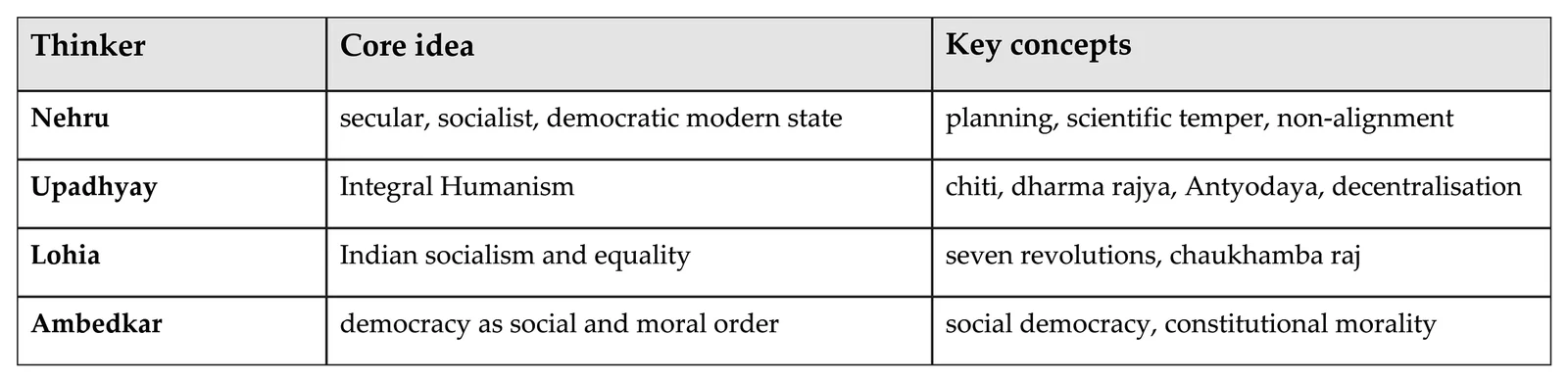
WHAT kind of state should independent India build, and what should democracy mean in a society marked by poverty, caste and diversity? Four thinkers gave influential but very different answers. Jawaharlal Nehru envisioned a secular, socialist and democratic state that would modernise India through planning and science. Deendayal Upadhyay proposed Integral Humanism, an indigenous alternative to both capitalism and communism rooted in dharma and decentralisation. Ram Manohar Lohia developed an Indian socialism that combined struggles against caste, class, gender and colour with a decentralised four-pillar state. B.R. Ambedkar insisted that political democracy would fail unless it rested on social and economic democracy. This unit studies their ideas of state and democracy.
3.1 Nehru: The National Philosophy of a Modern State
Jawaharlal Nehru (1889–1964) was the chief architect of the post-independence Indian state. Bhikhu Parekh, in ‘Nehru and the National Philosophy of India’ (1991), argues that Nehru developed a coherent national philosophy that guided Indian politics for decades. Its main elements were modernisation, through industrialisation, science and the scientific temper; secularism, a state that treats all religions equally and does not identify with any; socialism, meaning planning, a large public sector and the reduction of inequality, expressed in the ‘socialistic pattern of society’ (1955); democracy, with universal suffrage, parliamentary government and civil liberties; and non-alignment in foreign policy.
Nehru saw Indian civilisation as having a long history of unity in diversity but also of stagnation, which modern science and the state must overcome. The state was to be the main agent of change, through the Planning Commission, dams and steel plants he called the temples of modern India. Parekh argues that this philosophy was elitist and largely imposed from above by a Westernised elite, distant from the traditions and idioms of ordinary Indians, and that it encouraged a powerful, bureaucratic state. Rajni Kothari emphasised instead Nehru’s role in building democratic institutions and a culture of consensus.
3.2 Deendayal Upadhyay: Integral Humanism
Deendayal Upadhyay (1916–1968), a leader of the Bharatiya Jana Sangh, presented Integral Humanism (Ekatma Manav Darshan) as an indigenous philosophy for independent India. He argued that both capitalism and communism were Western, materialist ideologies that treated human beings as merely economic creatures and divided individual from society. Indian thought, by contrast, saw the human being as an integrated whole of body, mind, intellect and soul, pursuing the four purusharthas, dharma, artha, kama and moksha, in balance.
Upadhyay saw the nation as a living organism with its own chiti, its innate soul or character, and virat, the vital energy that sustains it. The state is only one institution of society, and dharma, the principles that sustain society, stands above the state; dharma rajya meant the rule of law and righteousness, not theocracy. Economically, he favoured decentralisation, small-scale and village industries, swadeshi and technology suited to Indian conditions, and Antyodaya, the uplift of the last and poorest person. Supporters see Integral Humanism as an authentic Indian alternative; critics argue that its organic view of the nation, rooted in Hindu traditions, may marginalise minorities and dissent, and that its economic ideas were vague.
3.3 Ram Manohar Lohia: Socialism and the Four-pillar State
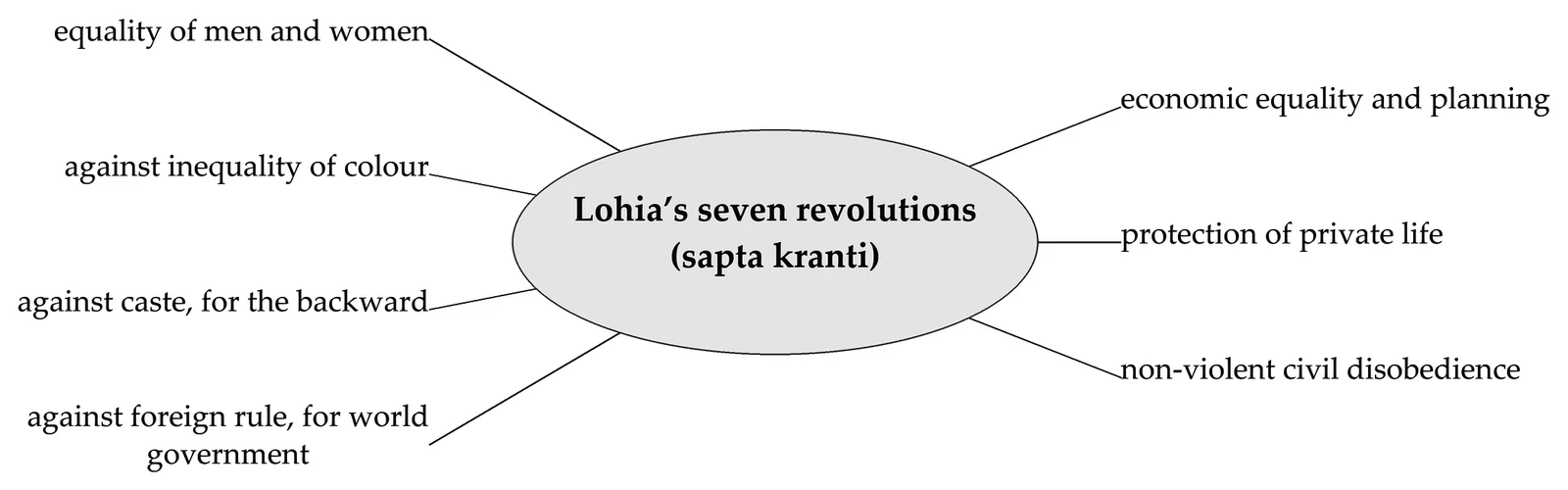
Ram Manohar Lohia (1910–1967) was a leading socialist who combined Marxism, Gandhism and Indian experience. In Marx, Gandhi and Socialism (1963), he argued that both capitalism and communism belonged to the same Western industrial civilisation and were equally irrelevant to Asia. India needed its own socialism based on equality, decentralisation and small machines. He proposed sapta kranti, seven simultaneous revolutions: equality of men and women; against inequality based on skin colour; against caste and for special opportunities for the backward; against foreign domination and for world government; for economic equality and planned production; protection of private life; and non-violent civil disobedience against injustice.
Lohia’s chaukhamba raj, the four-pillar state, divided power among the village, the district, the province and the centre, so that power would be decentralised and people would participate directly. He mobilised the backward castes, demanding that they receive sixty per cent of opportunities, campaigned for Hindi and Indian languages against English, and pioneered non-Congressism, which helped bring coalition governments to power in several states in 1967. Yogendra Yadav, in ‘What is Living and What is Dead in Ram Manohar Lohia?’ (2010), argues that his understanding of the intersection of caste, class, gender and language, and his search for an alternative modernity, remain living ideas, while some of his political tactics are dead.
3.4 B.R. Ambedkar: The Conditions of Democracy
B.R. Ambedkar (1891–1956), chairman of the Drafting Committee of the Constitution, saw democracy not merely as a form of government but as a form of social life. Influenced by John Dewey, under whom he studied at Columbia University, he wrote in Annihilation of Caste (1936) that democracy is primarily a mode of associated living. In his speech of 25 November 1949 he warned that India was entering a life of contradictions: political equality alongside social and economic inequality. Political democracy cannot last unless it rests on social democracy, which recognises liberty, equality and fraternity as principles of life.
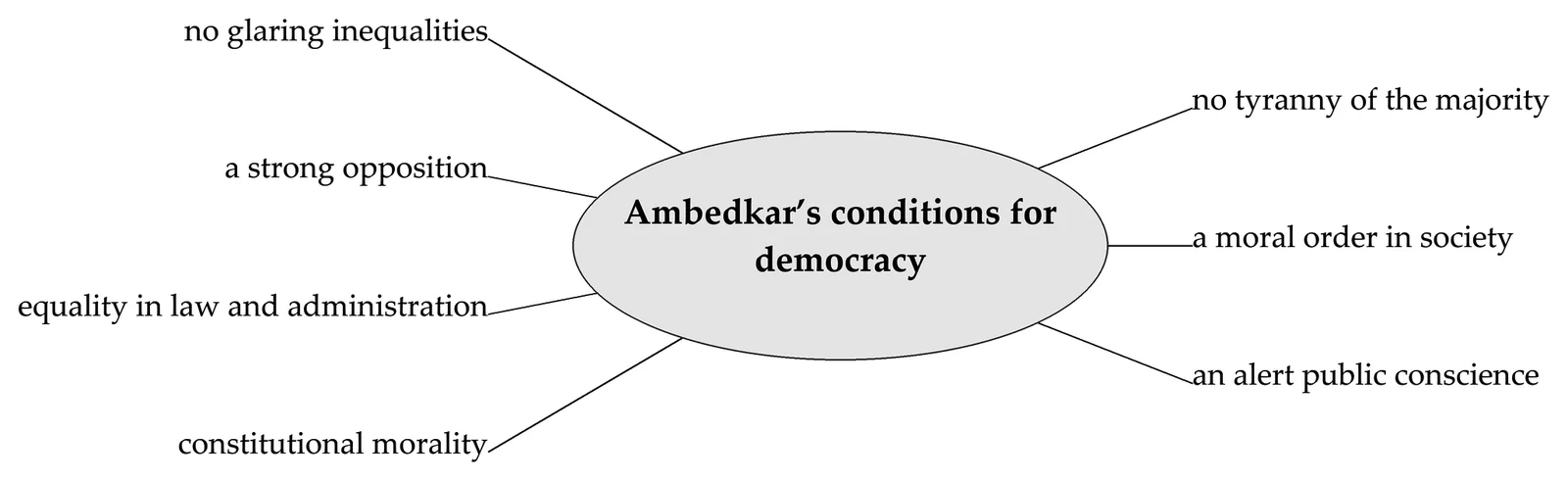
In a lecture of 1952 on the conditions for the successful working of democracy, Ambedkar defined democracy as a form and method of government whereby revolutionary changes in the economic and social life of the people are brought about without bloodshed. He listed its conditions: no glaring inequalities; a strong opposition; equality before law and in administration; observance of constitutional morality; no tyranny of the majority over the minority; a functioning moral order; and an alert public conscience. In 1949 he also warned against abandoning constitutional methods and against hero-worship, saying that bhakti in politics is a sure road to degradation and dictatorship.
3.5 Important Questions
- Question 1 Discuss Jawaharlal Nehru’s ideas on the state and democracy.
- Question 2 Examine Deendayal Upadhyay’s philosophy of Integral Humanism.
- Question 3 Discuss Ram Manohar Lohia’s ideas on socialism, caste and the decentralised state.
- Question 4 Examine B.R. Ambedkar’s views on democracy and the challenges before parliamentary democracy in India.
DU asks the same idea in different words. So learn one broad answer for each question below; the same answer works for every question joined by OR.
Important Question 1
Discuss Jawaharlal Nehru’s ideas on the state and democracy.
OR
Examine Bhikhu Parekh’s view of Nehru’s national philosophy.
OR
Discuss Nehru’s ideas of secularism, socialism and democracy.
Model Answer
“I am convinced that the only key to the solution of the world’s problems and of India’s problems lies in socialism.”
— Jawaharlal Nehru, Presidential Address, Lucknow Congress (1936)
Introduction. Jawaharlal Nehru, India’s first Prime Minister, shaped the institutions and ideology of the Indian state for nearly two decades. His vision of a secular, socialist and democratic state committed to modernisation through planning and science became the dominant framework of Indian politics. Bhikhu Parekh describes this vision as Nehru’s national philosophy and offers a critical assessment of it.
1. Nehru’s Background
Educated at Harrow and Cambridge, Nehru combined Western liberal and socialist ideas with a deep attachment to India. He joined Gandhi’s movement, spent long years in prison, and wrote Glimpses of World History (1934), his Autobiography (1936) and The Discovery of India (1946), which reflect his historical and modern outlook.
2. Parekh’s National Philosophy
Bhikhu Parekh argues that Nehru developed a national philosophy, a coherent set of ideas about India’s past, present and future that guided state policy. It defined India’s goals as unity, modernisation, secularism, socialism, democracy and an independent role in world affairs.
3. Modernisation and Science
Nehru believed that India’s poverty and backwardness could be overcome only through industrialisation and science. He promoted the scientific temper, built institutions such as the IITs and atomic energy establishments, and called dams and steel plants the temples of modern India.
4. Secularism
Nehru’s secularism meant that the state would not identify with any religion, would treat all religions equally and would ensure freedom of religion and equal citizenship. After Partition, he insisted that India would not become a Hindu state, regarding communalism as the greatest danger to the nation.
5. Socialism and Planning
Influenced by Fabian and Soviet ideas, Nehru advocated a democratic socialism: a mixed economy with a large public sector, Five-Year Plans and the reduction of inequality. The Congress adopted the goal of a socialistic pattern of society at Avadi in 1955. Unlike the Soviet model, his socialism was to be achieved through democratic means.
6. Democracy
Nehru was deeply committed to parliamentary democracy, universal adult suffrage, civil liberties and an independent judiciary and press. He respected Parliament, encouraged debate and saw democracy as the means to reconcile India’s diversity and achieve change peacefully.
7. The Role of the State
For Nehru the state was the main agent of social and economic transformation. It would plan development, own key industries, promote science and education and protect minorities and the weak. This made the state central to Indian life.
8. Non-alignment
In foreign policy, Nehru advocated non-alignment, keeping India independent of the Cold War blocs, promoting peace and decolonisation, and the principles of Panchsheel (1954). He helped found the Non-Aligned Movement (1961).
9. Parekh’s Critique
Parekh argues that Nehru’s philosophy was the outlook of a Westernised elite that saw Indian traditions as backward and imposed modernisation from above. It neglected the moral and cultural resources of Indian society and created a powerful bureaucratic state, distant from ordinary people.
10. Kothari’s View
Rajni Kothari, in ‘The Meaning of Jawaharlal Nehru’ (1964), emphasised Nehru’s role as a builder of democratic institutions and a culture of accommodation and consensus, which helped India sustain democracy when many new states failed.
11. Legacy
Nehru’s legacy includes durable democratic institutions, a secular Constitution, scientific institutions and an independent foreign policy. His economic model was later criticised for inefficiency and was substantially changed after 1991, and his secularism faces challenges from religious nationalism.
12. Evaluation
Nehru gave independent India a modern, democratic and secular vision and built institutions that sustained it. Critics rightly note its top-down character and limited engagement with Indian traditions, but his commitment to democracy and pluralism remains central to Indian political thought.
Conclusion. Thus, Nehru’s national philosophy combined modernisation, secularism, democratic socialism, parliamentary democracy and non-alignment, with the state as the main agent of change. Parekh criticises it as elitist and top-down, but it laid the foundations of India’s democratic institutions.
Important Question 2
Examine Deendayal Upadhyay’s philosophy of Integral Humanism.
OR
Discuss Upadhyay’s critique of capitalism and communism.
OR
Explain the concepts of chiti, dharma rajya and Antyodaya.
Model Answer
“Recall the face of the poorest and the weakest man whom you may have seen, and ask yourself if the step you contemplate is going to be of any use to him.”
— M.K. Gandhi, ‘Gandhi’s Talisman’ (1947), an ideal echoed in Upadhyay’s Antyodaya
Introduction. Deendayal Upadhyay was a leading ideologue of the Bharatiya Jana Sangh. In lectures delivered in 1965, he presented Integral Humanism as an indigenous philosophy for independent India, offering an alternative to both Western capitalism and communism. The Jana Sangh adopted it as its guiding philosophy, and the Bharatiya Janata Party later made it its basic philosophy.
1. Context
Upadhyay believed that after independence India had adopted Western ideologies, liberal democracy, capitalism and socialism, without reflecting on its own traditions. He sought a philosophy based on Indian culture that could guide politics, economics and society.
2. Critique of Western Ideologies
Upadhyay argued that capitalism and communism were both products of Western materialism. Capitalism exalted the individual and profit, while communism exalted the state and the class, but both treated human beings as economic creatures and ignored their moral and spiritual needs.
3. The Integral Human Being
Integral Humanism sees the human being as an integrated whole of body, mind, intellect and soul. All four must be developed in harmony. A good society must satisfy material needs while also fostering moral and spiritual growth.
4. The Four Purusharthas
Drawing on Indian tradition, Upadhyay used the four purusharthas: dharma, moral duty; artha, wealth; kama, desire; and moksha, liberation. A balanced life pursues artha and kama within the limits of dharma, aiming ultimately at moksha. Western ideologies, he argued, focus only on artha and kama.
5. Individual and Society
Upadhyay rejected the Western view that individual and society are in conflict. In the Indian view, individual, family, community, nation and humanity are concentric circles, each fulfilling the other. Social harmony rather than competition or class struggle should guide politics.
6. Chiti and Virat
Upadhyay described the nation as a living organism with chiti, its innate soul or national character, which determines its direction, and virat, the vital energy that sustains its institutions. A nation thrives when its institutions express its chiti.
7. Dharma Rajya
For Upadhyay, dharma, the principles that sustain society, is supreme, above the state and the people. Dharma rajya means a state governed by these principles and by the rule of law, not a theocracy ruled by priests or one religion. No authority, even a majority, may violate dharma.
8. Decentralised Economy
Upadhyay favoured a decentralised economy based on small-scale and village industries, swadeshi and technology suited to Indian conditions, rather than large-scale industrialisation. Every able person should have work, and the economy should meet basic needs without exploiting nature.
9. Antyodaya
Antyodaya means the uplift of the last person, the poorest in society. Upadhyay argued that development should be judged by its impact on the weakest, an idea that echoes Gandhi’s talisman and sarvodaya. Later governments named welfare schemes after this idea, such as the Antyodaya Anna Yojana (2000).
10. Influence
Integral Humanism became the official philosophy of the Jana Sangh and later the basic philosophy of the BJP. Its ideas of cultural nationalism, decentralisation and Antyodaya have shaped political programmes and debates about an Indian path of development.
11. Criticisms
Critics argue that Integral Humanism’s organic view of the nation, based on a shared chiti rooted in Hindu tradition, may marginalise religious minorities and dissenting groups. Others consider its economic ideas vague and difficult to translate into policy, and note a tension between its decentralism and centralised political practice.
12. Comparison with Gandhi
Integral Humanism shares much with Gandhi’s thought: rejection of Western materialism, swadeshi, decentralisation, village industries and concern for the last person. But Gandhi’s idea of the nation was explicitly inclusive of all religions and grounded in non-violence, whereas Upadhyay’s idea of the nation’s chiti drew more directly on Hindu tradition, which is where critics locate the difference.
13. Evaluation
Integral Humanism is a significant attempt to articulate an indigenous political philosophy that integrates material and spiritual life and prioritises the poorest. Its value depends on reconciling its cultural nationalism with the pluralism and equal citizenship of the Indian Constitution.
Conclusion. Thus, Upadhyay’s Integral Humanism rejected Western materialist ideologies and proposed an integrated view of the human being, a nation with its own chiti, the supremacy of dharma, a decentralised economy and Antyodaya. It remains an influential but contested vision of Indian state and society.
Important Question 3
Discuss Ram Manohar Lohia’s ideas on socialism, caste and the decentralised state.
OR
‘What is living and what is dead in Ram Manohar Lohia?’ Discuss with reference to Yogendra Yadav.
OR
Explain Lohia’s idea of sapta kranti and chaukhamba raj.
Model Answer
“Living nations do not wait for five years.”
— Ram Manohar Lohia
Introduction. Ram Manohar Lohia was one of the most original socialist thinkers of modern India. A freedom fighter and fierce critic of the Congress, he sought an Indian socialism that went beyond both Western capitalism and Soviet communism. His ideas on caste, gender, language, decentralisation and equality shaped the politics of the backward castes and of opposition coalitions in north India.
1. Life and Context
Lohia studied in Germany, joined the Congress Socialist Party in 1934 and played a leading role in the Quit India movement, running an underground radio. After independence he led socialist parties, entered Parliament in 1963 and pioneered the strategy of non-Congressism.
2. Equal Irrelevance
In Marx, Gandhi and Socialism (1963), Lohia argued that capitalism and communism were both products of European industrial civilisation, based on large-scale production and centralisation. Both were equally irrelevant to Asia, which needed its own path combining socialism with decentralisation and small machines.
3. Synthesis of Marx and Gandhi
Lohia combined Marx’s concern for economic equality and class struggle with Gandhi’s emphasis on decentralisation, non-violence, civil disobedience and small-scale technology. He saw civil disobedience as the method by which people should resist injustice.
4. Sapta Kranti
Lohia called for seven simultaneous revolutions: for equality between men and women; against inequality based on skin colour; against caste and for special opportunities for the backward castes; against foreign domination and for world government; for economic equality and planned production; against unjust intrusions into private life; and for non-violent civil disobedience in place of weapons.
5. Caste
Lohia saw caste as the most important cause of India’s weakness and stagnation. He argued that class and caste were linked and that the backward castes, Dalits, women and minorities must be given preferential opportunities, famously demanding sixty per cent of opportunities for them. This made him a forerunner of the politics of social justice.
6. Gender
Lohia regarded gender inequality as a central injustice and supported women’s freedom, including in marriage and sexuality. He contrasted the obedient ideal of Savitri with Draupadi, whom he admired as an intelligent and assertive woman.
7. Chaukhamba Raj
Lohia proposed a four-pillar state, chaukhamba raj, in which power would be divided among the village, the district, the province and the centre. Each level would have real powers and resources, enabling people to participate directly and preventing the concentration of power.
8. Language
Lohia opposed the dominance of English, which he saw as the language of a privileged elite excluding the masses from power. He campaigned for Hindi and other Indian languages in administration and education.
9. Non-Congressism
Lohia believed that Congress dominance blocked democratic change and promoted the alliance of opposition parties against it. This strategy contributed to the defeat of Congress in several states in 1967 and the formation of coalition governments.
10. Yadav’s Assessment
Yogendra Yadav argues that much in Lohia remains living: his search for a non-Eurocentric socialism, his understanding of the intersection of caste, class, gender, colour and language, his decentralism and his critique of the English-speaking elite. Anand Kumar similarly emphasises his intersectional political sociology. What is dead, Yadav suggests, includes some of his tactical positions and the parties that claimed his legacy.
11. Legacy
Lohia’s ideas influenced the rise of backward-caste politics and leaders such as those of the Samajwadi Party and Rashtriya Janata Dal. His call for special opportunities anticipated the Mandal Commission’s recommendations on OBC reservation implemented in 1990.
12. Evaluation
Lohia was an original thinker who connected socialism with India’s social realities. His intersectional view of inequality and decentralised vision of the state remain relevant, though his ideas were not always systematically developed, and his followers often turned his social justice politics into caste-based patronage.
Conclusion. Thus, Lohia developed an Indian socialism rejecting both capitalism and communism, centred on seven revolutions against inequality, preferential opportunities for the backward, gender equality and a decentralised four-pillar state. As Yadav argues, much of his thought remains living.
Important Question 4
Examine B.R. Ambedkar’s views on democracy and the challenges before parliamentary democracy in India.
OR
‘Political democracy cannot last unless there lies at the base of it social democracy.’ Discuss.
OR
What, according to Ambedkar, are the conditions for the successful working of democracy?
Model Answer
“Democracy is a form and a method of government whereby revolutionary changes in the economic and social life of the people are brought about without bloodshed.”
— B.R. Ambedkar, lecture on the conditions for the successful working of democracy (1952)
Introduction. B.R. Ambedkar, the principal architect of the Indian Constitution and the leader of the movement against untouchability, was a profound thinker on democracy. He saw democracy not only as a system of government but as a way of social life based on liberty, equality and fraternity. He warned that India’s parliamentary democracy faced serious challenges from social and economic inequality and from the habits of hero-worship.
1. Ambedkar’s Experience
Born into an untouchable Mahar family, Ambedkar experienced caste discrimination throughout his life. He studied at Columbia University, where he was influenced by John Dewey, and at the London School of Economics. His experience shaped his insistence that democracy must transform social relations.
2. Democracy as Associated Living
In Annihilation of Caste (1936), influenced by Dewey, Ambedkar wrote that democracy is not merely a form of government but primarily a mode of associated living, of conjoint communicated experience. It requires an attitude of respect and reverence towards fellow human beings. A caste society, which divides people into closed groups, cannot be truly democratic.
3. Definition of Democracy
In a 1952 lecture, Ambedkar defined democracy as a form and a method of government whereby revolutionary changes in the economic and social life of the people are brought about without bloodshed. Democracy is valuable because it allows peaceful transformation of an unjust society.
4. Social Democracy
In his speech of 25 November 1949, Ambedkar argued that political democracy cannot last unless there lies at its base social democracy, a way of life that recognises liberty, equality and fraternity as a union, each necessary to the others. Without equality, liberty would produce the supremacy of the few; without fraternity, liberty and equality would not become natural.
5. A Life of Contradictions
Ambedkar warned that on 26 January 1950 India would enter a life of contradictions: in politics it would have equality, one person one vote one value, but in social and economic life it would have inequality. If this contradiction persisted, those who suffered inequality would blow up the structure of political democracy.
6. Conditions for Democracy
In 1952 Ambedkar listed the conditions for democracy’s success: there must be no glaring inequalities; there must be an opposition; there must be equality in law and administration; there must be observance of constitutional morality; there must be no tyranny of the majority over the minority; there must be a moral order in society; and there must be a public conscience that protests against injustice to anyone.
7. Constitutional Morality
Ambedkar emphasised constitutional morality, respect for constitutional forms, procedures and restraints, which he said was not a natural sentiment but had to be cultivated. Without it, even a good constitution would fail.
8. Warnings against Unconstitutional Methods
Ambedkar urged Indians to abandon the bloody methods of revolution and also civil disobedience, non-cooperation and satyagraha, which he called the grammar of anarchy, once constitutional methods were available for achieving social and economic objectives.
9. Warning against Hero-worship
Ambedkar warned against laying liberties at the feet of even a great man or trusting him with powers that could subvert institutions. In religion, bhakti may be a road to salvation, but in politics bhakti or hero-worship is a sure road to degradation and eventual dictatorship.
10. Role of the Opposition and Minorities
Ambedkar stressed the importance of a strong opposition to check government and of protecting minorities from majority tyranny. He favoured safeguards such as reservations and fundamental rights to ensure that democracy served all, not only the majority community.
11. Relevance Today
Scholars such as Christophe Jaffrelot and Narender Kumar, in Dr. Ambedkar and Democracy (2018), show that Ambedkar’s warnings about inequality, hero-worship and constitutional morality remain highly relevant to Indian democracy, where caste discrimination, inequality and personality-centred politics persist.
12. Evaluation
Ambedkar offered one of the deepest analyses of the social foundations of democracy. His insistence that democracy must transform social relations, and his warnings about its fragility, make him a central figure in modern Indian and global democratic thought.
Conclusion. Thus, Ambedkar saw democracy as a mode of associated living and a method of peaceful revolutionary change. He warned that political democracy cannot last without social democracy, and he identified equality, opposition, constitutional morality, minority protection and public conscience as its essential conditions.
Short Notes
(a) Antyodaya
A principle emphasised by Deendayal Upadhyay meaning the rise or upliftment of the last person, the poorest and weakest in society. Development should be judged by its benefit to those at the bottom. It echoes Gandhi’s talisman and sarvodaya, and later welfare schemes, such as the Antyodaya Anna Yojana (2000) for the poorest households, took its name.
(b) Chaukhamba raj
Ram Manohar Lohia’s idea of a four-pillar state in which power is shared among the village, district, province and centre, each with real functions and resources. It aimed to decentralise power, increase popular participation and prevent bureaucratic centralisation, combining socialist equality with Gandhian decentralisation.
(c) Constitutional morality
A phrase Ambedkar borrowed from the historian George Grote, meaning a paramount reverence for the forms of the constitution and its procedures, combined with freedom to criticise those in authority. Ambedkar warned in 1948 that constitutional morality is not a natural sentiment and must be cultivated for democracy to survive.
(d) Non-Congressism
A strategy developed by Ram Manohar Lohia in the 1960s. He argued that the Congress’s long dominance blocked democratic change and that opposition parties of different ideologies should combine against it. In the 1967 elections the Congress lost power in several states to coalition governments (Samyukta Vidhayak Dal), and the strategy later shaped the Janata experiment of 1977.
More notes: DSC-14 Modern Indian Political Thought
These notes are prepared by PADHO TO AISE for study help. They are not an official University of Delhi publication.