
Semester VIII DSC-20 Development Process and Social Movements in Contemporary India
Unit IV · 28 min read · Updated 24 Nov 2026
As per the University of Delhi (DU) BA (Hons) Political Science syllabus
Contents
- 4.1 Tribal, Farmers’, Dalit and Women’s Movements
- 4.2 The Civil Rights Movement
- 4.3 Migration and Development
- 4.4 Important Questions
- Discuss the nature and demands of tribal movements in India.
- Discuss the nature of farmers’ movements in India since Independence.
- Discuss the Dalit movement in India and its changing nature.
- Trace the development of the women’s movement in India since Independence.
- Discuss the civil rights movement in India and its relationship with the state.
- Discuss the relationship between migration and development in India.
- Short Notes
शिक्षित बनो, संघर्ष करो, संगठित रहो।
Educate, agitate, organise.
— B.R. Ambedkar, Message to the Depressed Classes
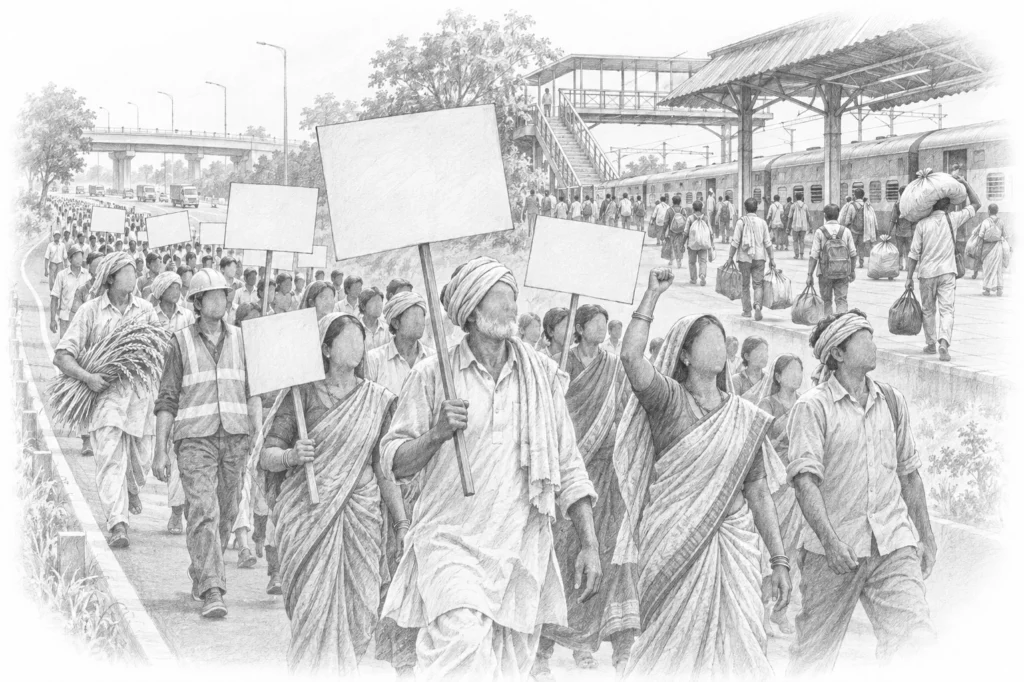
DEVELOPMENT does not only come from the state; it is also contested and shaped from below. Social movements of tribals, farmers, Dalits and women have challenged development policies that dispossess or exclude them, and have demanded land, prices, dignity and rights. The civil rights movement has defended citizens against state violence and expanded the meaning of rights. Meanwhile, millions of Indians migrate in search of work, linking villages and cities and raising new questions about rights and development. This chapter draws on Surajit Sinha, Tom Brass, Gail Omvedt, Myron Weiner, Anupama Roy, G. Haragopal and K. Balagopal, Manoranjan Mohanty, Priya Deshingkar and Kamala Sankaran.
4.1 Tribal, Farmers’, Dalit and Women’s Movements
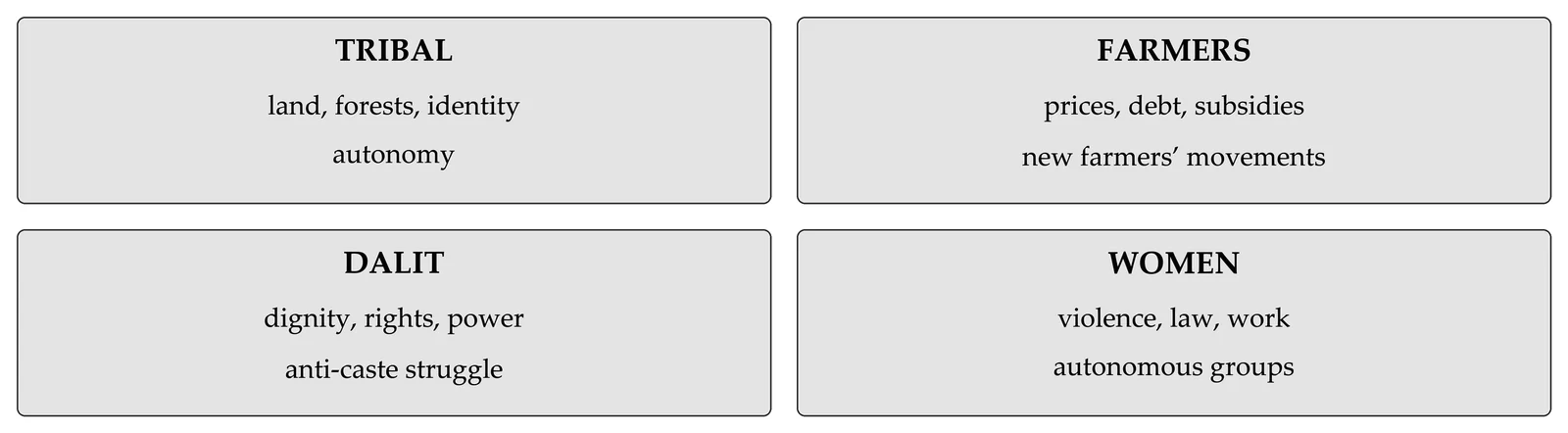
Tribal movements have fought for land, forests and autonomy against displacement by dams and mines, winning statehood for Jharkhand in 2000 and the Forest Rights Act in 2006. Farmers’ movements moved from the class struggles of tenants and labourers, as in Telangana, to the new farmers’ movements of the 1980s for remunerative prices, and to the protests of 2020–21. The Dalit movement, inspired by Ambedkar, has struggled against untouchability and for dignity and power, while the women’s movement has campaigned against violence and for legal equality and representation.

4.2 The Civil Rights Movement
The civil rights movement emerged in the 1970s in response to police repression of the Naxalite movement and the suspension of rights during the Emergency (1975–77). Organisations such as the Andhra Pradesh Civil Liberties Committee, the People’s Union for Civil Liberties and the People’s Union for Democratic Rights investigate custodial violence and encounter killings and challenge special security laws. G. Haragopal and K. Balagopal link civil liberties to the struggles of the poor, and Manoranjan Mohanty shows how the meaning of rights has expanded through such struggles.

4.3 Migration and Development
The Census of 2011 counted about 45.6 crore internal migrants, about 37 per cent of the population. Many poor workers are circular migrants, moving seasonally between villages and cities to work in construction, brick kilns and factories. Priya Deshingkar argues that such migration is a livelihood strategy that can reduce poverty, while Kamala Sankaran defends the freedom to migrate within India. The COVID-19 lockdown of 2020 exposed the vulnerability of migrant workers.

4.4 Important Questions
- Question 1 Discuss the nature and demands of tribal movements in India.
- Question 2 Discuss the nature of farmers’ movements in India since Independence.
- Question 3 Discuss the Dalit movement in India and its changing nature.
- Question 4 Trace the development of the women’s movement in India since Independence.
- Question 5 Discuss the civil rights movement in India and its relationship with the state.
- Question 6 Discuss the relationship between migration and development in India.
DU asks the same idea in different words. So learn one broad answer for each question below; the same answer works for every question joined by OR.
Important Question 1
Discuss the nature and demands of tribal movements in India.
OR
Examine tribal solidarity movements in India with reference to Surajit Sinha.
OR
How have development policies given rise to tribal movements in India?
Model Answer
“The State shall promote with special care the educational and economic interests of the weaker sections of the people, and in particular, of the Scheduled Castes and the Scheduled Tribes, and shall protect them from social injustice and all forms of exploitation.”
— Constitution of India, Article 46
Introduction. Scheduled Tribes form about 8.6 per cent of India’s population according to the Census of 2011, living mainly in central and north-eastern India. Their history has been marked by resistance to outsiders who took their land and forests. After Independence, development projects such as dams, mines and industries displaced them on a large scale, giving rise to movements for land, forests, identity and autonomy.
1. Colonial Roots of Resistance
Colonial forest laws restricted tribal use of forests, while moneylenders, traders and landlords, called dikus, took tribal land. This provoked rebellions such as the Santhal Hul of 1855 and Birsa Munda’s Ulgulan of 1899–1900. These struggles remain powerful memories that inspire tribal movements today.
2. Types of Tribal Movements
The anthropologist K.S. Singh classified tribal movements into three broad types: movements for political autonomy and statehood, agrarian and forest-based movements over land and resources, and socio-religious or cultural movements that reform or revive tribal identity. Many movements combine these elements.
3. Sinha: Tribal Solidarity Movements
Surajit Sinha reviewed tribal solidarity movements, which seek to unite different tribal communities in a shared identity against dominant outsiders. Through cultural revival, language and political organisation, they assert tribal identity and demand control over territory and resources. Sinha shows how such solidarity grows from shared experiences of exploitation and marginalisation.
4. Movements for Autonomy and Statehood
The Jharkhand movement, from the Jharkhand Party of Jaipal Singh Munda to the Jharkhand Mukti Morcha, demanded a separate state for the tribal regions of Bihar. Jharkhand was created in 2000, along with Chhattisgarh. In the north-east, Naga, Mizo and Bodo movements demanded autonomy, leading to new states and autonomous councils.
5. Development and Displacement
Tribals have been displaced far more than their share of the population by dams, mines and industries. The Narmada Bachao Andolan, led by Medha Patkar, opposed the Sardar Sarovar dam because of the displacement of tribal and peasant families, raising the question of who pays the costs of development.
6. The Niyamgiri Struggle
The Dongria Kondh of Odisha resisted bauxite mining by Vedanta in the Niyamgiri hills, which they regard as sacred. In 2013, the Supreme Court ruled that the gram sabhas should decide, and the village councils rejected the project, a landmark victory for tribal rights.
7. Forest Rights and Self-Rule
Campaigns by tribal organisations led to the Panchayats (Extension to Scheduled Areas) Act, 1996, which gives gram sabhas powers over local resources, and the Forest Rights Act, 2006, which recognises individual and community rights over forest land. Implementation has been uneven, and many claims have been rejected.
8. Naxalism and the State
Maoist insurgency has spread in the tribal belt of central India, drawing on grievances over land and displacement. The state’s counter-insurgency, including the Salwa Judum militia, which the Supreme Court declared unconstitutional in 2011, has caught tribals between the state and the insurgents.
9. Identity and Culture
Tribal movements also assert cultural identity: demands for recognition of tribal languages led to the inclusion of Santali in the Eighth Schedule in 2003, and some groups demand a separate Sarna religion code. The Pathalgadi movement in Jharkhand asserted the authority of gram sabhas.
10. Achievements
Tribal movements have won new states, protective laws such as PESA and the Forest Rights Act, recognition of languages and victories such as Niyamgiri. They have made displacement and tribal rights central issues in debates about development.
11. Limitations
Tribal movements face divisions among communities, the rise of a tribal elite that benefits more than ordinary tribals, co-optation by parties and continued displacement. New tribal states have not always protected tribal interests against mining and industry.
12. Evaluation
Tribal movements express resistance to a development model that has taken tribal land and forests. As Sinha shows, they build solidarity and identity, and they have expanded tribal rights, though dispossession continues.
Conclusion. Thus, tribal movements in India, rooted in colonial resistance, have fought for autonomy, land, forests and identity against development that displaced them. Movements such as Jharkhand, Narmada and Niyamgiri won important gains, including PESA and the Forest Rights Act, but tribal communities still face dispossession and marginalisation.
Important Question 2
Discuss the nature of farmers’ movements in India since Independence.
OR
Examine the new farmers’ movements of the 1980s.
OR
Discuss the farmers’ protests of 2020–21 and their significance.
Model Answer
“All citizens shall have the right to assemble peaceably and without arms.”
— Constitution of India, Article 19(1)(b)
Introduction. Agrarian struggles have been central to Indian politics. Early peasant movements were class struggles of tenants and labourers against landlords. From the late 1970s, new farmers’ movements of owner-cultivators mobilised against the state for better prices and subsidies. The protests of 2020–21 against three farm laws became one of the largest and longest movements in independent India.
1. Peasant and Farmers’ Movements
Scholars distinguish peasant movements, which mobilise tenants, sharecroppers and labourers against landlords over land and rent, from farmers’ movements, which mobilise landowning cultivators against the state over prices, inputs and debts. The first are class struggles within the village, the second are struggles of the countryside against the city and the state.
2. Tebhaga and Telangana
In the Tebhaga movement of 1946–47 in Bengal, sharecroppers demanded two-thirds of the crop. In the Telangana armed struggle of 1946–51, led by the Communists, peasants rose against landlords of the Nizam’s Hyderabad and redistributed land. These struggles placed land reform on the national agenda.
3. Naxalbari
In 1967, a peasant uprising at Naxalbari in north Bengal, led by Charu Majumdar and Kanu Sanyal, attacked landlords and seized land. It gave birth to the Naxalite movement, which spread among landless labourers and tribals and still influences parts of central India.
4. The New Farmers’ Movements
From the late 1970s, new farmers’ movements arose in Green Revolution regions: Sharad Joshi’s Shetkari Sanghatana in Maharashtra, M.D. Nanjundaswamy’s Karnataka Rajya Raitha Sangha and Mahendra Singh Tikait’s Bharatiya Kisan Union in Uttar Pradesh. They demanded remunerative prices, cheaper inputs and electricity and loan waivers, using road blockades and mass rallies.
5. Bharat against India
Sharad Joshi argued that urban ‘India’ exploited rural ‘Bharat’ by keeping farm prices low to provide cheap food and raw materials for industry. On this view, all farmers formed a single exploited class, and the main conflict was between the countryside and the city rather than within the village.
6. Brass: The New Farmers’ Movements
Tom Brass argued that the new farmers’ movements were led by rich and middle peasants who claimed to speak for all rural people. Using a populist ideology that he called the agrarian myth, they hid class differences between farmers and labourers and pursued the interests of surplus-producing farmers.
7. Dhanagare: Populism and Power
D.N. Dhanagare analysed the Shetkari Sanghatana in Maharashtra as a populist movement rooted in market-oriented farmers. He traced how it moved from a non-party stance to involvement in electoral politics, showing the tension between movement and power.
8. Agrarian Distress and New Protests
Since the 2000s, agrarian distress has produced new protests: the Kisan Long March from Nashik to Mumbai in 2018, protests after police firing on farmers in Mandsaur in 2017 and agitations by castes such as Jats, Marathas and Patidars for reservations. Sudhir Kumar Suthar describes a new rural–agrarian situation in which farming households depend increasingly on non-farm incomes.
9. The Farm Laws of 2020
In September 2020, Parliament passed three laws allowing trade outside regulated mandis, promoting contract farming and relaxing stock limits on essential commodities. The government said they would give farmers more choice, but farmers feared they would weaken mandis and minimum support prices and increase corporate control.
10. The Protests of 2020–21
Led by the Samyukt Kisan Morcha, a coalition of many unions, farmers from Punjab, Haryana and western Uttar Pradesh camped at Delhi’s borders from November 2020 for about a year. Despite harsh weather and many deaths, the protest remained largely peaceful, and the government repealed the laws in November 2021.
11. Interpreting the Protests
Amita Baviskar and Michael Levien see the protests as resistance to the corporatisation of agriculture and as a broad alliance across classes. Satendra Kumar shows how class and caste shaped the movement, which bridged divisions among Jats and Muslims in western Uttar Pradesh but drew less support from landless labourers.
12. Evaluation
Farmers’ movements have shifted from class struggles over land to struggles against the state over prices and markets. The 2020–21 protests showed their power to change policy, but questions remain about how far they represent small farmers and labourers.
Conclusion. Thus, farmers’ movements in India moved from the class struggles of Tebhaga, Telangana and Naxalbari to the new farmers’ movements of the 1980s and the historic protests of 2020–21. As Brass and others show, they have often been led by better-off farmers, yet they remain a powerful force shaping agrarian policy.
Important Question 3
Discuss the Dalit movement in India and its changing nature.
OR
Examine Gail Omvedt’s analysis of the anti-caste movement and the discourse of power.
OR
Discuss caste and the struggle for equality in Indian politics with reference to Myron Weiner.
Model Answer
“‘Untouchability’ is abolished and its practice in any form is forbidden.”
— Constitution of India, Article 17
Introduction. Dalits, formerly called untouchables, form about 16.6 per cent of India’s population as Scheduled Castes according to the Census of 2011. For centuries they faced exclusion, humiliation and exploitation under the caste system. The Dalit movement has struggled against untouchability and for dignity, rights and political power, from the anti-caste movements of the nineteenth century to Ambedkar and the political parties and protests of today.
1. Early Anti-Caste Movements
In the nineteenth century, Jotirao Phule founded the Satyashodhak Samaj in 1873 to challenge Brahmanical dominance. In the south, Narayana Guru in Kerala and E.V. Ramasamy Periyar’s Self-Respect Movement, launched in 1925, attacked caste hierarchy and promoted the dignity of lower castes.
2. Ambedkar’s Leadership
B.R. Ambedkar led the Mahad Satyagraha of 1927 for the right of untouchables to use a public water tank, publicly burned the Manusmriti, founded political parties and fought for separate representation. As chairman of the Drafting Committee he secured constitutional safeguards, and in 1956 he converted to Buddhism with lakhs of followers.
3. Omvedt: The Anti-Caste Movement
Gail Omvedt argues that the anti-caste movement built an alternative discourse that challenged Brahmanical hegemony and the upper-caste nationalism of the Congress. Drawing on Phule, Ambedkar and Buddhist traditions, it shifted from seeing Dalits as victims to claiming power, demanding a share in the state, the economy and culture.
4. The Dalit Panthers
Founded in Bombay in 1972 by young writers such as Namdeo Dhasal, Raja Dhale and J.V. Pawar, and inspired by the Black Panthers of the United States, the Dalit Panthers combined militant protest with powerful literature. They popularised the word Dalit, meaning broken or oppressed, as a proud political identity.
5. Political Mobilisation
Kanshi Ram built BAMCEF, an organisation of Dalit employees, and founded the Bahujan Samaj Party in 1984 to unite Dalits, backward castes and minorities. The BSP captured power in Uttar Pradesh, where Mayawati served four times as Chief Minister, showing that Dalits could become rulers.
6. Weiner: The Struggle for Equality
Myron Weiner argues that democratic politics transformed caste from a hierarchy into a basis for political competition. Lower castes used votes, parties and reservations to struggle for equality. But he notes that the focus on reservations benefited an educated minority, while mass education and economic change lagged behind.
7. Legal Protection
The Scheduled Castes and Scheduled Tribes (Prevention of Atrocities) Act, 1989, punishes caste violence. When the Supreme Court diluted its provisions in 2018, Dalit organisations called a Bharat Bandh, and Parliament restored the law the same year.
8. Atrocities and New Protests
Violence against Dalits continues, as in the Khairlanji massacre of 2006 and the flogging of Dalit youths in Una in 2016, which sparked a movement demanding land. The death of the student Rohith Vemula in 2016 led to protests against caste discrimination in universities.
9. Dalit Capitalism and the Middle Class
Reservations and education have created a Dalit middle class. The Dalit Indian Chamber of Commerce and Industry, founded in 2005, promotes Dalit entrepreneurs, and some thinkers see markets as a route to liberation from caste. Critics reply that most Dalits remain landless labourers and informal workers.
10. Divisions and Debates
The Dalit movement is divided by sub-caste, region and party. In 2024, the Supreme Court allowed states to sub-classify Scheduled Castes so that the most backward groups get a fair share of reservations, a decision that divided Dalit opinion.
11. Achievements
The Dalit movement has made untouchability illegal and morally indefensible, secured reservations and legal protection, created Dalit political parties and literature, and made Ambedkar a national symbol of social justice.
12. Evaluation
From Phule and Ambedkar to the BSP and new protests, the Dalit movement has transformed Indian politics. As Omvedt and Weiner show, it has challenged hierarchy and won power, though caste violence and economic inequality persist.
Conclusion. Thus, the Dalit movement, rooted in anti-caste struggles and led by Ambedkar, has fought untouchability through protest, law and politics. As Omvedt shows, it built a discourse of power, and as Weiner shows, it turned caste into a basis for the struggle for equality, though discrimination and violence remain serious challenges.
Important Question 4
Trace the development of the women’s movement in India since Independence.
OR
Discuss the major issues taken up by the women’s movement in India.
OR
Examine the relationship between the women’s movement and the state in India.
Model Answer
“The State shall not discriminate against any citizen on grounds only of religion, race, caste, sex, place of birth or any of them.”
— Constitution of India, Article 15(1)
Introduction. The women’s movement in India has roots in the social reform and national movements, but its contemporary form emerged in the 1970s. It has campaigned against violence, dowry and discrimination and for legal equality, work and political representation. Anupama Roy shows how the movement has engaged with the state, law and questions of difference such as caste, class and religion.
1. Reform and Nationalism
Nineteenth-century reformers such as Raja Ram Mohan Roy and Ishwar Chandra Vidyasagar campaigned against sati and for widow remarriage. Women joined the national movement in large numbers, and the All India Women’s Conference, founded in 1927, demanded education, legal reforms and the vote.
2. After Independence
The Constitution granted equality and universal franchise, and the Hindu Code Bills of 1955–56 reformed marriage, divorce and inheritance. Many believed that legal equality had been achieved, and organised women’s activism declined until the early 1970s.
3. Towards Equality
The report of the Committee on the Status of Women in India, Towards Equality (1974), shattered this belief. It showed a declining sex ratio, poor health and education of women and weak political participation, and it became a catalyst for the new women’s movement.
4. The Autonomous Women’s Movement
From the mid-1970s, autonomous women’s groups, independent of political parties, emerged in cities, such as the Progressive Organisation of Women in Hyderabad and Saheli in Delhi. Women also joined the anti-price-rise protests in Bombay, the Shahada movement of tribal women and the Chipko movement.
5. The Campaign against Rape
In 1979, the Supreme Court acquitted policemen accused of raping Mathura, a young tribal girl, in custody. Four law teachers wrote an open letter protesting the judgment, sparking a national campaign that led to the Criminal Law Amendment of 1983 on custodial rape.
6. Dowry and Domestic Violence
Campaigns against dowry deaths led to amendments to the Dowry Prohibition Act and the addition of Section 498A to the Indian Penal Code in 1983 against cruelty by husbands and relatives. The Protection of Women from Domestic Violence Act followed in 2005.
7. Religion and Personal Law
The Shah Bano case of 1985 and the law that followed in 1986, and the sati of Roop Kanwar in 1987, showed how women’s rights could be subordinated to community identity. The movement struggled to defend women’s rights without feeding communal politics. Instant triple talaq was struck down by the Supreme Court in 2017.
8. Roy: The Movement and the State
Anupama Roy shows the tension within the women’s movement between autonomy from the state and the need to use law and the state to secure rights. She also highlights questions of difference, as Dalit, Muslim and tribal women challenged a movement dominated by urban, upper-caste women.
9. Sexual Harassment at Work
After the gang rape of Bhanwari Devi, a government worker in Rajasthan, women’s groups petitioned the Supreme Court, which issued the Vishaka guidelines in 1997. These became the basis of the Sexual Harassment of Women at Workplace Act, 2013.
10. Political Representation
The 73rd and 74th Amendments of 1992 reserved one-third of seats in local bodies for women, bringing lakhs of women into politics. After decades of campaigning, the Women’s Reservation Act of 2023 reserved one-third of seats in the Lok Sabha and state assemblies, to take effect after the next delimitation.
11. Nirbhaya and After
The Delhi gang rape of December 2012 led to mass protests, the Justice Verma Committee and the Criminal Law Amendment Act, 2013. The #MeToo campaign of 2018 exposed harassment in media and other workplaces, showing new forms of feminist mobilisation.
12. Women and Work
The movement also took up women’s work. Most women workers are in the informal sector, as agricultural labourers, home-based workers and domestic workers, with low wages and no security. Organisations such as SEWA organised them, and feminists drew attention to unpaid care work in the home, which is essential to the economy but not counted or rewarded.
13. Dalit Feminism
From the 1990s, Dalit women formed their own organisations, such as the National Federation of Dalit Women, founded in 1995. Scholars such as Sharmila Rege argued that Dalit women talk differently, because they face caste and gender oppression together, and that a movement led by upper-caste women had ignored caste. This pushed the movement to recognise intersecting inequalities.
14. Evaluation
The women’s movement has transformed laws and public debate on violence, work and representation. As Roy shows, it continues to balance engagement with the state and attention to differences among women.
Conclusion. Thus, the women’s movement in India, revived after Towards Equality in 1974, has campaigned against rape, dowry and harassment and for legal equality and political representation. It has won many legal reforms, though, as Anupama Roy shows, it faces the challenges of working with the state and representing diverse women.
Important Question 5
Discuss the civil rights movement in India and its relationship with the state.
OR
Examine the changing definition of rights in India with reference to Manoranjan Mohanty.
OR
What role have civil liberties organisations played in Indian democracy?
Model Answer
“No person shall be deprived of his life or personal liberty except according to procedure established by law.”
— Constitution of India, Article 21
Introduction. The civil rights or civil liberties movement in India defends citizens against violations of their rights, especially by the state. It emerged in the 1970s during the repression of the Naxalite movement and the Emergency. Over time, it has broadened from defending political prisoners to supporting the democratic rights of workers, tribals, Dalits and other marginalised groups.
1. Meaning of Civil Rights
Civil rights include freedom of speech and association, the right to life and personal liberty, fair trial and protection against torture and arbitrary detention. Civil rights organisations investigate violations, publish reports, file cases and campaign for legal reforms.
2. Origins in the 1970s
Police repression of Naxalites, including encounter killings in Andhra Pradesh and West Bengal, led to the formation of the Andhra Pradesh Civil Liberties Committee in 1974. During the Emergency of 1975–77, fundamental rights were suspended and thousands were detained without trial.
3. Major Organisations
Jayaprakash Narayan founded the People’s Union for Civil Liberties and Democratic Rights in 1976. After the Emergency, it divided into the People’s Union for Civil Liberties and the People’s Union for Democratic Rights. Their report Who Are the Guilty? on the anti-Sikh violence of 1984 named those responsible.
4. Haragopal and Balagopal
G. Haragopal and K. Balagopal, writing from experience in Andhra Pradesh, argue that the state is the main violator of rights, using police violence and special laws to defend the existing social order. They link the civil liberties movement to the struggles of the poor, arguing that it cannot remain neutral between oppressors and the oppressed.
5. Ray: Rights and Social Struggle
A. Ray argues that the civil rights movement must connect with wider social struggles. Defending the rights of workers, peasants, tribals and Dalits against both state and private power turns civil liberties into democratic rights.
6. Mohanty: The Changing Definition of Rights
Manoranjan Mohanty argues that the meaning of rights in India has expanded from civil and political liberties to social, economic and collective rights, such as the rights to food, livelihood, environment and identity. These rights are created through people’s struggles, not simply granted by the state.
7. Legal Strategies
Civil rights groups used public interest litigation. In PUDR v Union of India (1982), the Supreme Court protected workers on Asian Games sites, and the PUCL case on the right to food from 2001 led to orders on mid-day meals and food schemes.
8. Special Laws and State Violence
The movement challenges laws such as the Armed Forces (Special Powers) Act (1958), TADA (1985–95), POTA (2002–04) and the Unlawful Activities (Prevention) Act, along with custodial deaths, torture and encounter killings. In 2022, the Supreme Court put the colonial sedition law in abeyance.
9. Rights-Based Laws
Rights movements contributed to laws such as the Right to Information Act (2005), born from the Mazdoor Kisan Shakti Sangathan’s campaign, the rural employment guarantee (2005), the Forest Rights Act (2006) and the Right to Education (2009). The National Human Rights Commission was set up in 1993.
10. The State’s Response
The state has sometimes accepted demands through courts and laws, but has also labelled rights activists as anti-national. The arrest of activists in the Bhima Koregaon case from 2018 and restrictions on foreign funding of NGOs show the shrinking space for civil liberties work.
11. Fact-Finding on Communal Violence
Civil rights groups have investigated communal violence, from the anti-Sikh violence of 1984 to the Gujarat violence of 2002 and later riots. Their fact-finding reports collect testimonies of victims, examine the role of the police and administration and demand prosecution of those responsible, keeping the issue of justice alive when official inquiries are slow.
12. Achievements
The civil rights movement has documented abuses, secured justice in some cases, contributed to new rights and kept the issue of state accountability alive in Indian democracy.
13. Evaluation
The movement has broadened rights in India from civil liberties to democratic and socio-economic rights, as Mohanty shows. Its relationship with the state remains tense, since the state is both the protector and violator of rights.
Conclusion. Thus, the civil rights movement in India, born in the 1970s amid repression and the Emergency, has defended citizens against state violence and special laws. As Haragopal, Balagopal and Mohanty show, it has linked civil liberties to social struggles and expanded the meaning of rights, though its relationship with the state remains conflictual.
Important Question 6
Discuss the relationship between migration and development in India.
OR
Examine the nature of circular migration in India and its implications for development.
OR
Discuss the freedom to migrate within India with reference to the experience of migrant workers during the COVID-19 lockdown.
Model Answer
“All citizens shall have the right to move freely throughout the territory of India.”
— Constitution of India, Article 19(1)(d)
Introduction. Migration is closely linked to development. People move from poorer to richer regions, from villages to cities and abroad in search of work. Migration can reduce poverty through remittances and new opportunities, but migrants often face exploitation and exclusion. Scholars such as Deshingkar, Upadhya and Rutten, Marchang and Sankaran examine its patterns and its implications for rights and development.
1. Meaning and Types
Migration may be internal or international, permanent or temporary. The Census of 2011 counted about 45.6 crore internal migrants by place of last residence, about 37 per cent of the population. Most were women who moved after marriage, but labour migration is central to the economy.
2. Causes of Migration
People are pushed by agrarian distress, landlessness, drought, displacement and caste oppression, and pulled by jobs in construction, industry and services. Major flows run from Bihar, Uttar Pradesh, Odisha, Jharkhand and Rajasthan to Maharashtra, Gujarat, Delhi, Punjab, Kerala and Tamil Nadu.
3. Deshingkar: Circular Migration
Priya Deshingkar argues that circular migration, in which workers move seasonally between villages and work sites, is growing and is an important livelihood strategy for poor households. It can reduce poverty through remittances, but policies ignore circular migrants because official data and welfare systems assume people live in one place.
4. Conditions of Migrant Workers
Migrants in brick kilns, construction and sugarcane cutting are often recruited through contractors who pay advances, creating debt bondage. They live in poor housing, lack social security, face discrimination and lose access to welfare tied to their home state.
5. Upadhya and Rutten: Transnational Flows
Carol Upadhya and Mario Rutten examine migration and development from a regional perspective. Migration from Kerala to the Gulf and from Gujarat and Punjab to other countries has brought remittances, investment and philanthropy to home regions, and India has become the world’s largest recipient of remittances.
6. Migration and Megacities
R. Marchang studies emerging patterns of migration to megacities such as Mumbai, Delhi, Kolkata, Chennai and Bengaluru. Migrants supply labour for urban growth but often live in slums and work informally, and some parties have used sons-of-the-soil politics against them.
7. Sankaran: The Freedom to Migrate
Kamala Sankaran argues that the freedom to move and settle anywhere in India is a fundamental freedom under Article 19. Yet domicile rules, local job quotas and weak enforcement of the Inter-State Migrant Workmen Act, 1979, restrict migrants in practice. She calls for portable welfare and rights.
8. The COVID-19 Lockdown
When a national lockdown was announced in March 2020, millions of migrant workers lost jobs and shelter and walked hundreds of kilometres home. In May 2020, sixteen migrants were killed by a train near Aurangabad. The crisis exposed how invisible migrants had been in policy.
9. Policy Responses
After the crisis, the government extended One Nation One Ration Card, allowing ration access anywhere in India, launched the e-Shram portal to register informal workers and announced affordable rental housing for migrants. The Occupational Safety Code includes provisions for inter-state migrant workers.
10. Migration as Development
Remittances finance education, housing and consumption in sending areas, reduce poverty and spread new skills and ideas. Migration also allows Dalits and other marginalised groups to escape caste oppression in villages.
11. Costs of Migration
Migration also has costs: families are separated, women bear more farm and household work, children’s schooling is disrupted, cities become congested and migrants face exploitation. International migration of skilled workers can cause a loss of talent.
12. Women and Migration
Most women migrants move after marriage, but female labour migration is growing. Women migrate as domestic workers to cities, as construction and brick-kiln workers with their families and as nurses from Kerala to the Gulf and the West. Women migrants face specific risks, including sexual harassment, trafficking and lower wages than men.
13. Sons of the Soil Politics
Myron Weiner’s study Sons of the Soil (1978) showed how migration produces conflict when local people feel that migrants take their jobs. Such politics continues: Haryana passed a law in 2020 reserving 75 per cent of private-sector jobs for local residents, which the Punjab and Haryana High Court struck down in 2023 as unconstitutional.
14. Evaluation
Migration is a central part of India’s development, linking regions and supporting livelihoods. But migrants’ rights and welfare remain neglected, as the pandemic showed.
Conclusion. Thus, migration in India, much of it circular, is a key livelihood strategy that links villages and cities and supports development through remittances. As Deshingkar and Sankaran argue, migrants need recognition and portable rights, a need that the COVID-19 lockdown made painfully clear.
Short Notes
(a) Chipko movement
A forest protection movement that began in 1973 in the Garhwal Himalaya, in which villagers, especially women, hugged trees to stop commercial felling. Led by figures such as Chandi Prasad Bhatt and Sunderlal Bahuguna, it became a symbol of ecological movements.
(b) Towards Equality
The 1974 report of the Committee on the Status of Women in India, which showed declining sex ratios and women’s poor health, education and political participation. It shattered the belief that legal equality had been achieved and inspired the new women’s movement.
(c) One Nation One Ration Card
A scheme allowing beneficiaries of the public distribution system to draw their food grain entitlement from any ration shop in India. Extended across the country after the COVID-19 crisis, it helps migrant workers access food away from home.
(d) Forest Rights Act, 2006
The Scheduled Tribes and Other Traditional Forest Dwellers (Recognition of Forest Rights) Act, which recognises the individual and community rights of forest dwellers over land they cultivate and forests they use. Won through campaigns by tribal organisations, it gives gram sabhas a role in protecting forests, though many claims have been rejected.
More notes: DSC-20 Development Process and Social Movements in Contemporary India
These notes are prepared by PADHO TO AISE for study help. They are not an official University of Delhi publication.