
Semester VI DSE-4b Understanding Savarkar
Unit II · 22 min read · Updated 24 Nov 2026
As per the University of Delhi (DU) BA (Hons) Political Science syllabus
Contents
- 2.1 The Revolutionary Phase, 1899–1910
- Mitra Mela and Abhinav Bharat
- India House, London
- Arrest and the Marseilles Episode
- Revolutionary Nationalism in Context
- 2.2 Imprisonment, Ratnagiri and the Contested Legacy
- The Cellular Jail
- The Petitions
- The Ratnagiri Years, 1924–1937
- Biographies and Perspectives
- 2.3 The Hindu Mahasabha Years and Partition
- President of the Hindu Mahasabha, 1937–1943
- Politics during the Second World War
- After Independence
- Gilmartin: The Historiography of Partition
- Savarkar in Present-Day Politics
- 2.4 Important Questions
- Discuss Savarkar’s role in revolutionary nationalism between 1899 and 1910.
- Discuss Savarkar’s imprisonment and the debate over his contested legacy.
- Discuss Savarkar’s role as president of the Hindu Mahasabha.
- Discuss Savarkar’s views on the two-nation question and the historiography of Partition.
- Short Notes
सारी राजनीति का हिंदूकरण करो और हिंदू समाज का सैनिकीकरण करो।
Hinduise all politics and militarise Hindudom.
— V. D. Savarkar, Slogan of the Hindu Mahasabha under his presidency (1937–43)
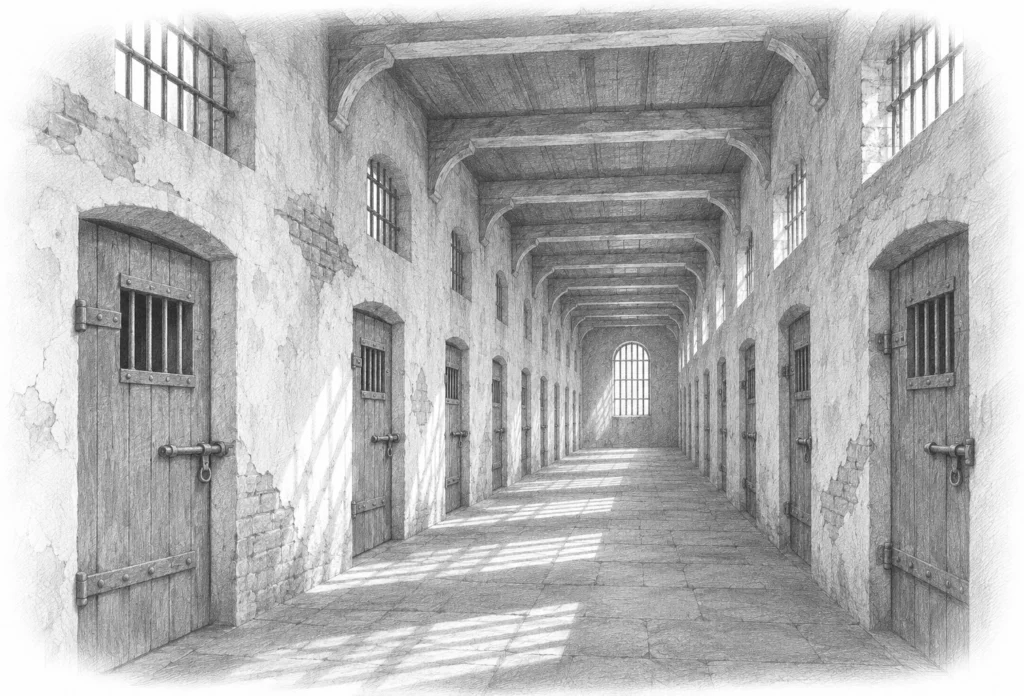
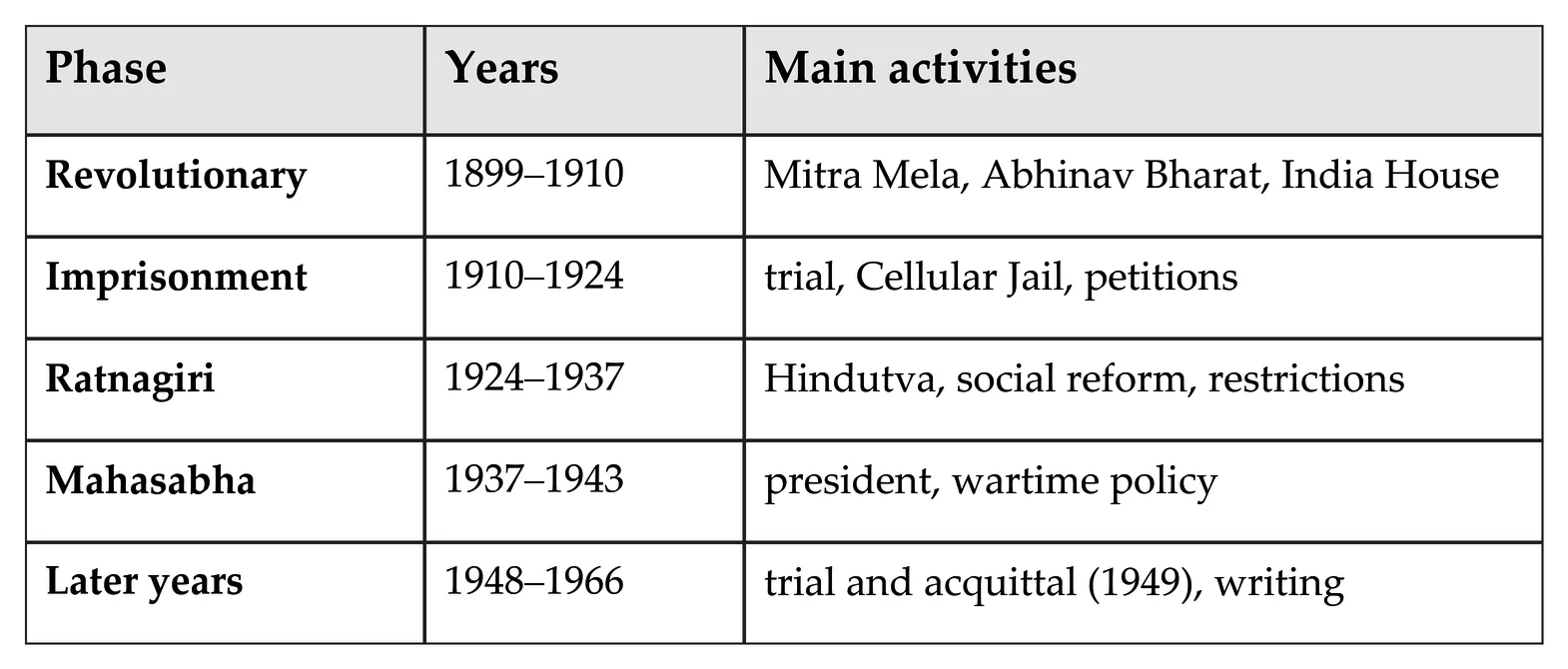
SSAVARKAR’S role in the national movement passed through sharply different phases. As a young man he was a revolutionary who organised secret societies and inspired acts of violence against British officials. After his arrest in 1910 he spent over a decade in prison, including ten years in the Cellular Jail of the Andamans, and then thirteen years of restricted life at Ratnagiri. From 1937 he led the Hindu Mahasabha, opposing both the Congress and the Muslim League. His legacy is fiercely contested: admirers call him Veer (brave) Savarkar, while critics point to his petitions from prison, his politics during the Second World War and his ideology. This chapter studies Unit II of the syllabus: Savarkar and the Indian national movement, including the historiography of Partition.
2.1 The Revolutionary Phase, 1899–1910
Mitra Mela and Abhinav Bharat
Influenced by the Chapekar brothers, who had assassinated a plague officer in Pune in 1897, and by the nationalism of Bal Gangadhar Tilak, the young Savarkar founded the Mitra Mela in Nashik in 1899. In 1904 it became Abhinav Bharat (Young India), a secret society modelled on Mazzini’s Young Italy, aiming at the overthrow of British rule by armed revolution. As a student at Fergusson College, Pune, Savarkar organised a public bonfire of foreign cloth in 1905 during the Swadeshi movement, for which he was expelled from the college hostel.
India House, London
In 1906, with a scholarship offered by Shyamji Krishna Varma, Savarkar went to London to study law and lived at India House, a centre of Indian revolutionary activity. He organised the Free India Society, wrote his history of 1857, celebrated the anniversary of the revolt and arranged for bomb-making manuals and pistols to be sent to India. In July 1909 Madan Lal Dhingra, a member of the India House circle, assassinated Sir William Curzon Wyllie, an official of the India Office. Savarkar defended Dhingra’s action, and Dhingra’s statement before his execution, which declared that a nation held down by foreign bayonets is in a perpetual state of war, became a famous revolutionary text.
Arrest and the Marseilles Episode
In December 1909, Anant Kanhere shot the Nashik collector A. M. T. Jackson with a pistol that had been sent from London. Savarkar was arrested in London in March 1910 and shipped to India for trial. When the ship docked at Marseilles in July 1910, he escaped through a porthole and swam ashore, but was recaptured by French police and handed back to the British. France protested, and the case went to the Permanent Court of Arbitration at The Hague, which ruled in 1911 that Britain was not obliged to return him. In India he was sentenced to transportation for life twice, a total of fifty years.

Revolutionary Nationalism in Context
Savarkar’s groups were part of a wider wave of revolutionary nationalism in the early twentieth century. In Bengal, the Anushilan Samiti (1902) and the Jugantar group carried out attacks on officials, leading to the Alipore bomb case of 1908, in which Aurobindo Ghose was tried and acquitted and his brother Barindra was sentenced. In 1913 Indian migrants in North America founded the Ghadar Party. The government responded with laws such as the Explosive Substances Act and the Newspapers Act of 1908. Revolutionaries differed from the moderates and extremists of the Congress in their belief that only armed struggle could end British rule.
2.2 Imprisonment, Ratnagiri and the Contested Legacy
The Cellular Jail
Savarkar arrived at the Cellular Jail in Port Blair in July 1911, where his elder brother Ganesh was also imprisoned. Prisoners faced solitary confinement, hard labour such as turning oil mills, poor food and harsh punishment. Savarkar later described these years in his Marathi memoir My Transportation for Life (1927).
The Petitions
During his imprisonment, Savarkar submitted several petitions to the government seeking release, including in 1911, 1913, 1914, 1917 and 1920. In the petition of November 1913 he wrote that he was ready to serve the government in any capacity it liked. In 1921 the brothers were moved to jails on the mainland, and in 1924 Savarkar was released on condition that he would stay in Ratnagiri district and not take part in politics. These restrictions lasted until 1937.
The petitions are at the centre of the debate on his legacy. Vikram Sampath, in Savarkar: A Contested Legacy (2021), and Uday Mahurkar and Chirayu Pandit, in Veer Savarkar (2021), argue that petitions were a normal legal remedy used by many political prisoners, that Savarkar’s were tactical attempts to escape a living death and continue his work, and that his later activity shows he did not abandon the national cause. Critics argue that the petitions show capitulation, since he promised loyalty and, after release, avoided anti-British activity and later opposed the Quit India movement. Students should understand both readings and the evidence offered for each.
The Ratnagiri Years, 1924–1937
- Hindutva. While still in prison, Savarkar wrote Essentials of Hindutva, published in 1923, setting out his idea of Hindu nationhood (Chapter 3).
- Social reform. At Ratnagiri he campaigned against untouchability, organised inter-caste dining and built the Patit Pavan Mandir (1931), a temple open to all castes (Chapter 6).
- Language reform. He promoted the purification of Marathi by replacing Persian, Arabic and English words (Chapter 4).
- Shuddhi. He supported the reconversion of those who had left Hinduism (Chapter 5).
- Writing. He wrote plays, essays, poems and his prison memoir.

Biographies and Perspectives
- Dhananjay Keer, Veer Savarkar (1950): an early, admiring biography based on access to Savarkar.
- Vikram Sampath, two volumes (2019 and 2021): a detailed, sympathetic biography using archival sources; the second volume is titled A Contested Legacy.
- Uday Mahurkar and Chirayu Pandit, Veer Savarkar (2021): argue that his ideas could have prevented Partition.
- A. G. Noorani, Savarkar and Hindutva: The Godse Connection (2002): a critical account focusing on his politics and the assassination case.
- Jyotirmaya Sharma, Hindutva (2003), and Janaki Bakhle (2010): critical scholarly studies of his ideology and writings.
2.3 The Hindu Mahasabha Years and Partition
President of the Hindu Mahasabha, 1937–1943
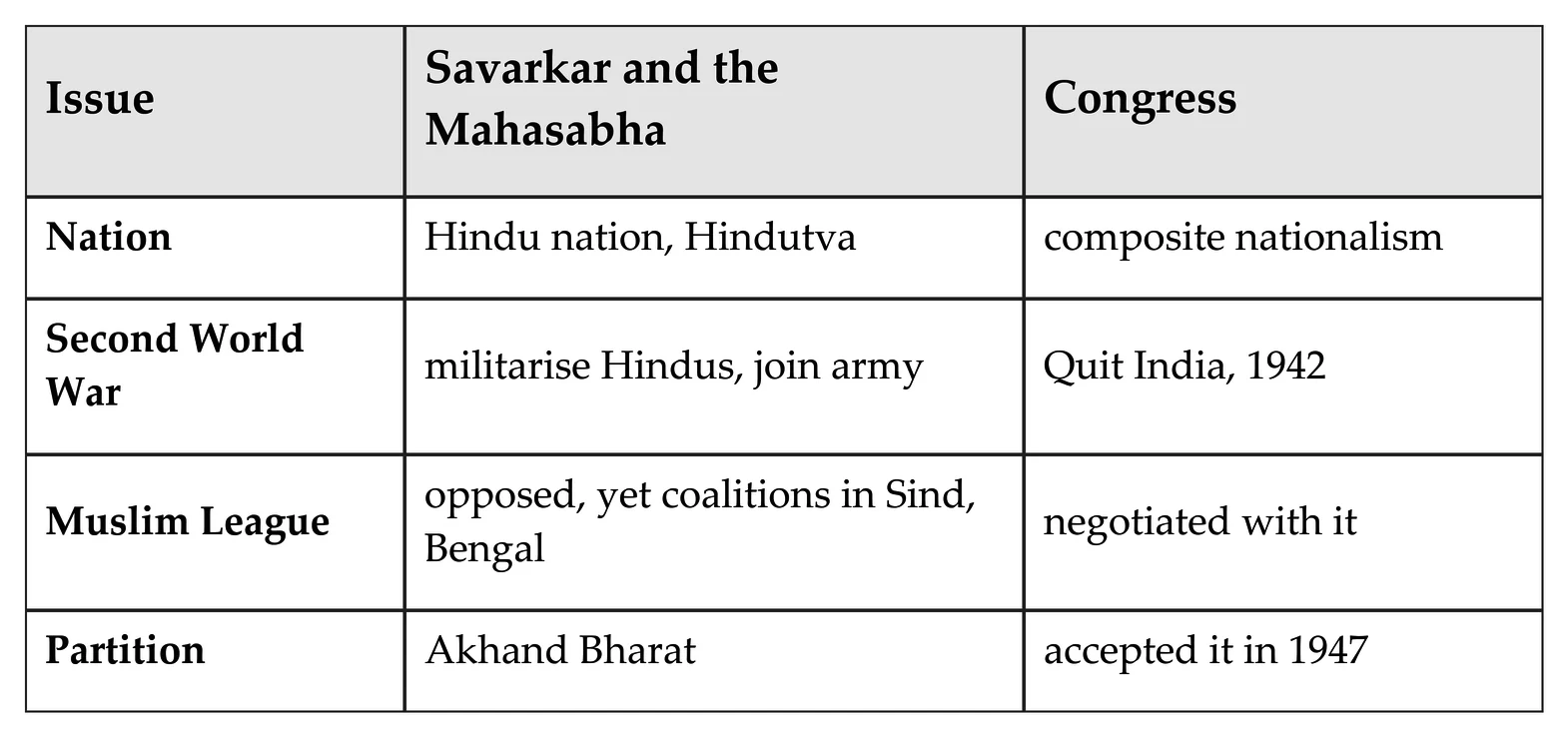
After his unconditional release in 1937, Savarkar was elected president of the Hindu Mahasabha and re-elected each year until 1943. His presidential addresses, later collected as Hindu Rashtra Darshan (1949), set out his politics. In his address at Ahmedabad in 1937 he said that India could not be assumed to be a homogeneous nation, and that there were two nations in the main, the Hindus and the Muslims. He criticised the Congress for what he called the appeasement of Muslims, and opposed the Muslim League’s demand for Pakistan, calling for an undivided India (Akhand Bharat) in which Hindus, as the majority, would have their rightful place and minorities would have equal rights as individual citizens but no special privileges.
Politics during the Second World War
- Militarisation. Under the slogan Hinduise all politics and militarise Hindudom, Savarkar urged Hindus to join the British Indian armed forces to gain military training.
- Quit India. The Mahasabha did not join the Quit India movement of 1942, and Savarkar asked members holding public offices to remain at their posts.
- Coalitions. The Mahasabha joined coalition governments with the Muslim League in Sind and with Fazlul Huq in Bengal, where Syama Prasad Mookerjee served as finance minister (1941–42).
- Opposition to Partition. The Mahasabha opposed the Cripps proposals and the partition plan, but could not prevent Partition in 1947.
After Independence
After the assassination of Mahatma Gandhi on 30 January 1948 by Nathuram Godse, a former member of the Hindu Mahasabha, Savarkar was tried as a conspirator but was acquitted in February 1949 for lack of corroborating evidence. The Kapur Commission (1965–69), set up to inquire into the conspiracy, later made observations adverse to Savarkar, which his supporters reject as made after his death without a chance of defence. Savarkar died on 26 February 1966. His legacy has since been both honoured, with a postage stamp in 1970, the naming of the Port Blair airport (2002) and a portrait in Parliament (2003), and strongly contested.
Gilmartin: The Historiography of Partition
David Gilmartin, in The Historiography of India’s Partition: Between Civilization and Modernity (2015), argues that historians have explained Partition in two ways. One stresses civilization: Hindus and Muslims as distinct civilisations with deep differences, a view shared, in different forms, by the Muslim League and by Hindu nationalists such as Savarkar. The other stresses modernity: Partition as the product of modern politics, i.e. colonial categories, separate electorates, elections, mass mobilisation and struggles over the state. Gilmartin suggests that the two must be combined: modern politics reshaped older ideas of community into political identities claiming states. Ambedkar, in Pakistan or the Partition of India (1945), observed that Savarkar and Jinnah, though opponents, agreed that there were two nations in India, differing only on whether they should live in one state or two.

Savarkar in Present-Day Politics
Savarkar’s legacy is invoked very differently by different parties. Hindu nationalist parties honour him as a patriot and thinker; the new Parliament building was inaugurated on his birth anniversary, 28 May 2023. Critics, including many in the Congress and the Left, highlight his petitions, his wartime politics and his ideology of Hindutva. This makes Savarkar one of the most debated figures in Indian public life, and students need to separate historical evidence from political rhetoric when studying him.
2.4 Important Questions
- Question 1 Discuss Savarkar’s role in revolutionary nationalism between 1899 and 1910.
- Question 2 Discuss Savarkar’s imprisonment and the debate over his contested legacy.
- Question 3 Discuss Savarkar’s role as president of the Hindu Mahasabha.
- Question 4 Discuss Savarkar’s views on the two-nation question and the historiography of Partition.
DU asks the same idea in different words. So learn one broad answer for each question below; the same answer works for every question joined by OR.
Important Question 1
Discuss Savarkar’s role in revolutionary nationalism between 1899 and 1910.
OR
Examine the activities of Abhinav Bharat and India House.
OR
Discuss Savarkar’s contribution to the freedom struggle in his early life.
Model Answer
“I believe that a nation held down by foreign bayonets is in a perpetual state of war.”
— Madan Lal Dhingra, statement before his execution (1909)
Introduction. Savarkar began his political life as a revolutionary. He founded secret societies in Nashik, organised Swadeshi protests in Pune and, in London, became a leader of the revolutionaries at India House. His activities, and the acts of violence they inspired, led to his arrest in 1910 and a sentence of fifty years. This phase made him a hero to many nationalists.
1. Early Influences
The Chapekar brothers’ action in Pune in 1897 and Tilak’s nationalism shaped the young Savarkar. He was drawn to revolutionary methods early.
2. Mitra Mela
In 1899 he founded the Mitra Mela in Nashik. It drew young men into nationalist activity.
3. Abhinav Bharat
In 1904 the Mitra Mela became Abhinav Bharat, a secret society modelled on Mazzini’s Young Italy. It aimed at armed revolution.
4. Swadeshi Bonfire
In 1905 he organised a bonfire of foreign cloth in Pune. He was expelled from his college hostel for it.
5. India House
In London from 1906, he lived at India House, founded by Shyamji Krishna Varma. It was a centre of revolutionary activity.
6. Free India Society
He organised the Free India Society to spread nationalist ideas among Indian students in London.
7. History as Propaganda
His book on 1857 and the commemoration of the revolt in 1908 were meant to inspire revolution.
8. Arms and Manuals
The India House group arranged for bomb-making manuals and pistols to be sent to India.
9. Dhingra’s Action
In July 1909 Madan Lal Dhingra assassinated Curzon Wyllie. Savarkar defended the act.
10. Dhingra’s Statement
Dhingra declared that a nation held down by foreign bayonets is in a perpetual state of war. The statement became a revolutionary text.
11. The Jackson Assassination
In December 1909 the Nashik collector Jackson was shot with a pistol sent from London.
12. Arrest
Savarkar was arrested in London in March 1910 and shipped to India for trial.
13. Marseilles
His escape attempt at Marseilles and recapture led to an international case decided at The Hague in 1911.
14. Sentence
He was sentenced to transportation for life twice, a total of fifty years.
15. Significance
This phase made Savarkar a symbol of revolutionary courage and earned him the title Veer among admirers.
16. Criticism
Critics note that revolutionary violence did not end British rule, and question its morality and effectiveness.
17. International Links
India House revolutionaries made contact with Irish, Egyptian and Russian revolutionaries, placing Indian nationalism in an international revolutionary network.
18. The Nashik Conspiracy Case
The Nashik conspiracy case tried members of Abhinav Bharat, and several were sentenced, showing how seriously the government viewed the movement.
19. Wider Revolutionary Wave
Savarkar’s groups were part of a wider wave that included the Anushilan Samiti, the Alipore bomb case of 1908 and later the Ghadar Party.
20. Ideas of Violence
Savarkar justified political violence as legitimate resistance to foreign rule, a view that Gandhi strongly rejected in Hind Swaraj (1909).
21. Law Studies and Barrister Status
Savarkar passed his law examinations in London but was refused admission as a barrister because of his political activities, a sign of official suspicion.
22. Gandhi and Savarkar in London
Gandhi met Savarkar at India House in 1906 and 1909; their disagreement over violence and the nature of swaraj foreshadowed later divisions.
23. Evaluation
Savarkar’s early revolutionary nationalism was bold and influential, and formed one strand of the freedom struggle.
Conclusion. Thus, through Abhinav Bharat and India House, Savarkar became a leader of revolutionary nationalism. Dhingra’s claim that a nation under foreign bayonets is in a perpetual state of war captures the spirit of this phase, which ended with his arrest and long imprisonment.
Important Question 2
Discuss Savarkar’s imprisonment and the debate over his contested legacy.
OR
Examine the debate over Savarkar’s petitions from the Cellular Jail.
OR
Discuss Savarkar’s life and work at Ratnagiri between 1924 and 1937.
Model Answer
“I am ready to serve the Government in any capacity they like, for as my conversion is conscientious so I hope my future conduct would be.”
— V. D. Savarkar, petition from the Cellular Jail (November 1913)
Introduction. Savarkar spent ten years in the Cellular Jail of the Andamans and thirteen more years under restrictions at Ratnagiri. During his imprisonment he submitted several petitions for release. These petitions are at the heart of the debate on his legacy: admirers see them as tactical, while critics see them as capitulation. Vikram Sampath’s biography calls his legacy contested.
1. The Cellular Jail
Savarkar arrived at the Cellular Jail in Port Blair in July 1911. His brother Ganesh was also imprisoned there.
2. Harsh Conditions
Prisoners faced solitary confinement, hard labour at oil mills, poor food and harsh punishments.
3. The Petitions
He submitted petitions for release in 1911, 1913, 1914, 1917 and 1920. They asked for clemency or release.
4. The 1913 Petition
In November 1913 he wrote that he was ready to serve the government in any capacity it liked.
5. Transfer and Release
In 1921 he was moved to mainland jails, and in 1924 he was released on condition of staying in Ratnagiri.
6. Restrictions
He had to stay in Ratnagiri district and keep out of politics until 1937.
7. Sampath’s View
Sampath argues that petitions were a legal remedy used by many prisoners and that Savarkar’s were tactical.
8. Mahurkar and Pandit
Mahurkar and Pandit present him as a patriot whose strategy aimed to continue his work outside prison.
9. Critics’ View
Critics argue that the petitions show capitulation, since he promised loyalty and avoided anti-British activity after release.
10. The Wider Pattern
Critics also point to his later stance in the Second World War and his opposition to Quit India.
11. Hindutva at Ratnagiri
At Ratnagiri he published Essentials of Hindutva (1923), his most influential work.
12. Social Reform
He campaigned against untouchability and built the Patit Pavan Mandir in 1931, open to all castes.
13. Prison Memoir
His memoir of 1927 described the cruelty of the Cellular Jail and shaped his heroic image.
14. Honours
Port Blair airport was named after him in 2002 and his portrait placed in Parliament in 2003.
15. Weighing Evidence
Students should weigh the documents, the context of colonial prisons and his later actions in judging his legacy.
16. A Political Debate
The debate over his petitions has become part of present-day party politics, which makes careful judgement harder.
17. Other Prisoners
Other revolutionaries in the Cellular Jail, such as Barindra Kumar Ghose, also submitted petitions, which supporters cite as context for Savarkar’s.
18. Historians’ Caution
Historians caution against judging the petitions only by present-day politics, and stress reading them alongside Savarkar’s actions before and after.
19. Archival Evidence
The petitions are available in official records and were published in R. C. Majumdar’s Penal Settlements in Andamans (1975), allowing readers to examine them directly.
20. Brothers in Prison
Savarkar’s elder brother Ganesh was also imprisoned in the Andamans, and the family’s suffering is part of the story told by his admirers.
21. Conditions of Release
The conditions of his release in 1924 barred him from politics, which supporters say explains his silence on British rule during the Ratnagiri years.
22. Evaluation
Savarkar’s imprisonment shows both great suffering and contested choices, which is why his legacy remains divided.
Conclusion. Thus, Savarkar’s years in the Cellular Jail and Ratnagiri combined suffering, writing and reform with petitions in which he offered to serve the government. Whether these were tactics or capitulation remains the core of the debate over his contested legacy.
Important Question 3
Discuss Savarkar’s role as president of the Hindu Mahasabha.
OR
Examine Savarkar’s slogan Hinduise all politics and militarise Hindudom.
OR
Discuss Savarkar’s differences with Gandhi and the Congress.
Model Answer
“Here is a mantra, a short one, that I give you. You may imprint it on your hearts and let every breath of yours give expression to it. The mantra is: Do or Die.”
— M. K. Gandhi, Quit India speech (8 August 1942)
Introduction. From 1937 to 1943 Savarkar led the Hindu Mahasabha. He set out a programme of Hindu nationalism, opposed both the Congress and the Muslim League, and during the Second World War urged Hindus to join the armed forces while keeping the Mahasabha out of the Quit India movement. His presidential speeches, collected as Hindu Rashtra Darshan, express this politics.
1. Release and Election
After his unconditional release in 1937, Savarkar became president of the Hindu Mahasabha. He was re-elected until 1943.
2. Hindu Rashtra Darshan
His presidential addresses were collected as Hindu Rashtra Darshan (1949). They set out his political ideas.
3. The Ahmedabad Address
In 1937 at Ahmedabad he said that there were two nations in the main in India, Hindus and Muslims.
4. Critique of the Congress
He accused the Congress of appeasing Muslims and of weakening Hindu interests.
5. Akhand Bharat
He opposed the Pakistan demand and called for an undivided India in which Hindus were the majority.
6. Minorities as Individuals
He held that minorities should have equal rights as individual citizens but no special group privileges.
7. Militarise Hindudom
Under the slogan Hinduise all politics and militarise Hindudom, he urged Hindus to join the British armed forces.
8. Rationale
He argued that military training would strengthen Hindus for future challenges, including after the war.
9. Quit India
While Gandhi called on Indians to do or die, the Mahasabha stayed out of Quit India and Savarkar asked members to keep their posts.
10. Coalitions
The Mahasabha joined coalition governments with the Muslim League in Sind and with Fazlul Huq in Bengal.
11. Differences with Gandhi
Savarkar rejected Gandhi’s non-violence and his idea of a composite nationalism uniting Hindus and Muslims.
12. Limited Electoral Support
The Mahasabha performed poorly in the 1945–46 elections, showing limited mass support compared with the Congress.
13. Partition
The Mahasabha opposed Partition but could not prevent it in 1947.
14. Supporters’ View
Supporters argue that Savarkar foresaw the dangers of Muslim League politics and the need for military strength.
15. Critics’ View
Critics argue that his stance during the war weakened the freedom struggle and that his politics deepened communal division.
16. Assassination Trial
After Gandhi’s assassination in 1948, Savarkar was tried and acquitted in 1949, though the Kapur Commission later made adverse observations.
17. Bhagalpur Session
In 1941 Savarkar defied a government ban to hold the Mahasabha session at Bhagalpur, and was briefly arrested, showing that his relationship with the government was not simple.
18. Influence on Later Politics
Though weak in his lifetime, his ideas later influenced the Jana Sangh, founded by Syama Prasad Mookerjee in 1951, and Hindu nationalist politics.
19. Evaluation
Savarkar’s Mahasabha years shaped Hindu nationalist politics, but in his lifetime they won limited support.
Conclusion. Thus, as Mahasabha president, Savarkar sought to Hinduise politics and militarise Hindus, while Gandhi called for the nation to do or die in 1942. These sharply different strategies explain both his appeal to some and the criticism he faces from others.
Important Question 4
Discuss Savarkar’s views on the two-nation question and the historiography of Partition.
OR
Examine David Gilmartin’s account of the historiography of Partition.
OR
Discuss Ambedkar’s comparison of Savarkar and Jinnah on the two-nation theory.
Model Answer
“Strange as it may appear, Mr. Savarkar and Mr. Jinnah instead of being opposed to each other on the one nation versus two nations issue are in complete agreement about it.”
— B. R. Ambedkar, Pakistan or the Partition of India (1945)
Introduction. Partition was the most traumatic event of the national movement. Historians explain it in different ways, and David Gilmartin shows that they have oscillated between explanations based on civilisational difference and those based on modern politics. Savarkar’s view that Hindus and Muslims were two nations, though he opposed a separate state, places him at the centre of this debate.
1. Partition as Trauma
Partition in 1947 caused mass violence and the migration of millions, shaping the politics of South Asia ever since.
2. Savarkar’s Ahmedabad Speech
In 1937 Savarkar said that there were two nations in the main in India, Hindus and Muslims.
3. One State, Hindu Majority
Unlike Jinnah, he wanted the two nations to live in one undivided state with Hindus as the majority.
4. Ambedkar’s Observation
Ambedkar noted that Savarkar and Jinnah agreed on the existence of two nations, differing only on whether they should share a state.
5. Gilmartin’s Two Approaches
Gilmartin shows that historians explain Partition either through civilisation or through modernity.
6. The Civilisational Approach
This approach sees Hindus and Muslims as distinct civilisations, a view shared in different forms by the League and Hindu nationalists.
7. The Modernity Approach
This approach explains Partition through colonial categories, separate electorates, elections and struggles over the state.
8. Combining Both
Gilmartin argues that modern politics reshaped older ideas of community into political identities claiming states.
9. Separate Electorates
Separate electorates from 1909 made religious identity a basis of representation, contributing to division.
10. The Lahore Resolution
The Muslim League’s Lahore Resolution of 1940 demanded independent states for Muslim-majority areas.
11. Congress’s Composite Nationalism
The Congress, led by Gandhi and Nehru, held that Indians of all religions formed one nation.
12. Hindu Mahasabha’s Opposition
The Mahasabha opposed Partition and called for Akhand Bharat, but had limited influence.
13. Historians’ Debates
Ayesha Jalal, for example, argued that Jinnah used the Pakistan demand as a bargaining counter, showing how contingent Partition was.
14. Savarkar’s Responsibility
Critics argue that Savarkar’s two-nation rhetoric strengthened communal polarisation, while supporters say he only described reality.
15. Legacy
Debates on Partition remain politically charged, and Savarkar’s role is interpreted very differently.
16. Criticism of Civilisational Views
Historians warn that civilisational explanations ignore centuries of shared life and the contingency of 1947.
17. Rights of Minorities
Savarkar promised minorities equal rights as citizens and cultural freedom, but rejected weightage, separate electorates and special privileges.
18. Population Exchange
Like Ambedkar, some leaders discussed population exchange as a possible solution, but Savarkar’s focus remained on keeping India undivided.
19. Evaluation
Gilmartin’s approach helps place Savarkar’s ideas within the interplay of ideology and modern politics that produced Partition.
Conclusion. Thus, as Ambedkar observed, Savarkar and Jinnah agreed that India had two nations while disagreeing about statehood. Gilmartin shows that Partition must be understood through both civilisational ideas and modern politics, a framework that helps place Savarkar’s role.
Short Notes
(a) India House
A hostel and centre of Indian revolutionary activity in London, founded by Shyamji Krishna Varma in 1905, where Savarkar lived from 1906 to 1910.
(b) Hindu Rashtra Darshan
The collection of Savarkar’s presidential addresses to the Hindu Mahasabha (1937–43), published in 1949, setting out his politics of Hindu nationalism.
(c) Akhand Bharat
The idea of an undivided India, promoted by the Hindu Mahasabha in opposition to the Muslim League’s demand for Pakistan.
More notes: DSE-4b Understanding Savarkar
These notes are prepared by PADHO TO AISE for study help. They are not an official University of Delhi publication.