
Semester VII DSC-19 Themes in Western Political Philosophy
Unit II · 21 min read · Updated 24 Nov 2026
As per the University of Delhi (DU) BA (Hons) Political Science syllabus
Contents
- 3.1 Wollstonecraft and Her Context
- 3.2 Women and Paternalism
- 3.3 Sentiment and Reason
- 3.4 Legal Rights and Representation
- 3.5 Important Questions
- Discuss Mary Wollstonecraft’s critique of paternalism and the subordination of women.
- Examine Wollstonecraft’s views on sentiment and reason.
- Discuss Wollstonecraft’s arguments for the legal and political rights of women.
- Examine Wollstonecraft’s Vindications and their political tradition.
- Short Notes
मैं नहीं चाहती कि उनका पुरुषों पर अधिकार हो, बल्कि स्वयं पर।
I do not wish them to have power over men; but over themselves.
— Mary Wollstonecraft, A Vindication of the Rights of Woman (1792)
MARY Wollstonecraft (1759–1797) wrote in the age of the French Revolution, when thinkers across Europe debated the rights of man. She asked a question most of them ignored: what about the rights of women? In A Vindication of the Rights of Men (1790) she defended the Revolution against Edmund Burke, and in A Vindication of the Rights of Woman (1792) she argued that women are rational beings who have been made weak and dependent by an education designed to please men. She attacked paternalism, the rule of fathers and husbands over women, questioned the cult of sentiment, and called for legal rights and even representation for women. This unit studies her ideas, drawing on Chris Jones’s account of the Vindications and their political tradition.
3.1 Wollstonecraft and Her Context
Wollstonecraft grew up in a family troubled by a violent, improvident father, worked as a companion, teacher and governess, and became a writer in London among radical Dissenters such as Richard Price and the publisher Joseph Johnson. When Burke attacked Price’s sermon praising the French Revolution, she replied in A Vindication of the Rights of Men (1790), defending rights grounded in reason against inherited privilege. Two years later, provoked by a French proposal that would limit girls’ education, she wrote A Vindication of the Rights of Woman.
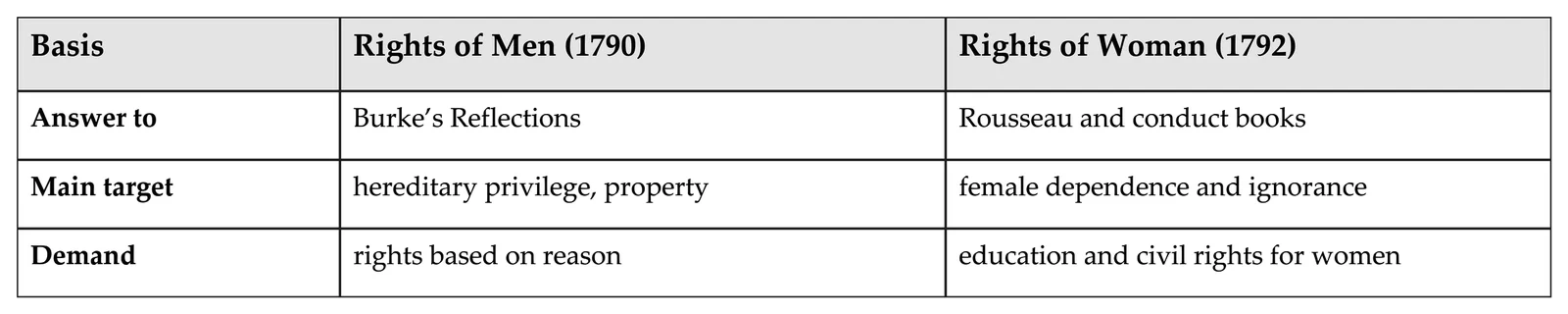
Chris Jones places the Vindications in the political tradition of rational Dissent and English radicalism, which held that rights derive from reason and God-given human nature, opposed hereditary privilege and placed hope in moral and political reform. Wollstonecraft extended this tradition to women, insisting that the principles of the Revolution must apply to half of humanity.
3.2 Women and Paternalism
Wollstonecraft argued that women’s apparent weakness is not natural but the product of their education and dependence. Girls are taught from infancy that beauty is woman’s sceptre and that their purpose is to please men. Writers such as Rousseau, in Emile, prescribed for Sophie an education designed to make her pleasing, modest and obedient to her husband. Conduct books by writers such as Dr Gregory and James Fordyce taught the same lesson. Women thus became like birds in a gilded cage.

Wollstonecraft compared women’s dependence to the tyranny of kings and aristocrats: just as hereditary power corrupts both rulers and subjects, the power of husbands corrupts both men and women. She wrote that the divine right of husbands, like the divine right of kings, could be contested in an enlightened age. Paternalism keeps women in perpetual childhood and makes them cunning rather than virtuous.
3.3 Sentiment and Reason
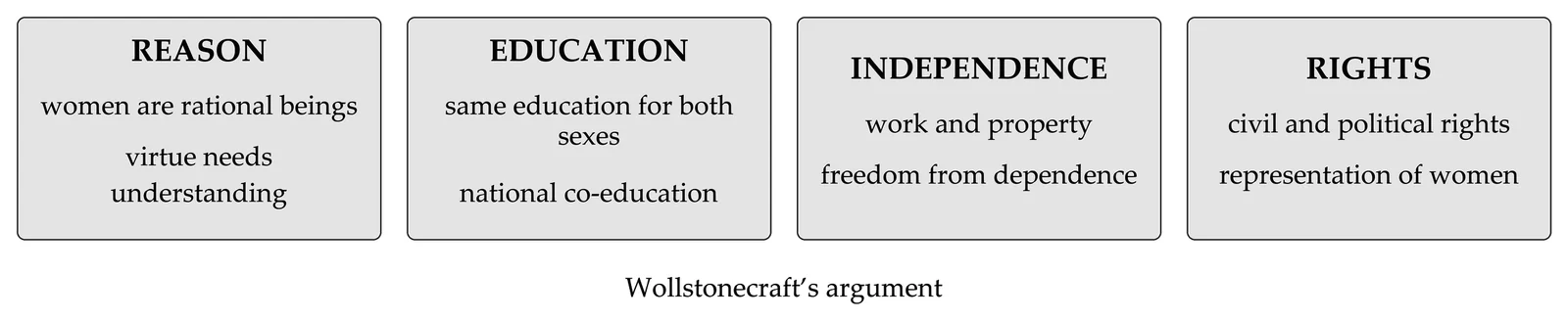
In the eighteenth century, women were associated with sensibility, refined feeling and emotion, while men claimed reason. Wollstonecraft argued that an exaggerated cult of sentiment made women slaves to their feelings and to men’s approval. Virtue requires reason and understanding; a being who cannot reason cannot be truly virtuous. Women must therefore be educated to think, so that they can be rational companions, mothers and citizens.
She also accused Burke of sentimentalism: his defence of tradition and chivalry appealed to feelings, such as pity for Marie Antoinette, rather than to reason and justice. Yet Wollstonecraft did not reject feeling altogether. She valued rational affection, friendship and benevolence, and in her later writings expressed a deeper appreciation of emotion, which links her to the Romantic movement.
3.4 Legal Rights and Representation
Wollstonecraft argued that women should have the same rights as men because they share the same rational nature and the same duties to God, family and society. She demanded a national system of co-education, in which girls and boys would study together; access for women to professions such as medicine and business; and economic independence, since dependence on a husband for subsistence degrades women. Married women’s legal subordination, under which a wife’s property and person belonged to her husband, was a form of slavery.
Most strikingly, she hinted that women ought to have representatives instead of being arbitrarily governed without any share in government. Though she developed this only briefly, it was among the earliest calls for women’s political representation. Her ideas influenced later feminists, including John Stuart Mill and Harriet Taylor, and the movement for women’s suffrage.
3.5 Important Questions
- Question 1 Discuss Mary Wollstonecraft’s critique of paternalism and the subordination of women.
- Question 2 Examine Wollstonecraft’s views on sentiment and reason.
- Question 3 Discuss Wollstonecraft’s arguments for the legal and political rights of women.
- Question 4 Examine Wollstonecraft’s Vindications and their political tradition.
DU asks the same idea in different words. So learn one broad answer for each question below; the same answer works for every question joined by OR.
Important Question 1
Discuss Mary Wollstonecraft’s critique of paternalism and the subordination of women.
OR
Examine Wollstonecraft’s critique of Rousseau’s ideas on women.
OR
‘Women’s weakness is the product of education, not nature.’ Discuss with reference to Wollstonecraft.
Model Answer
“The divine right of husbands, like the divine right of kings, may, it is hoped, in this enlightened age, be contested without danger.”
— Mary Wollstonecraft, A Vindication of the Rights of Woman (1792)
Introduction. Mary Wollstonecraft’s A Vindication of the Rights of Woman is a founding text of modern feminism. Its central target is paternalism, the system by which women are kept dependent on fathers and husbands and educated to please rather than to think. She argued that women’s subordination is not natural but produced by custom, education and law.
1. Context
In the 1790s, revolutionaries in France proclaimed the rights of man, but few extended them to women. The French statesman Talleyrand proposed a plan of national education that would give girls only limited schooling. Wollstonecraft dedicated her book to him, urging him to reconsider.
2. Paternalism
Paternalism means governing others for their supposed good, as a father governs children. Wollstonecraft argued that women were treated as perpetual children, under the authority of fathers and then husbands, and denied the chance to become responsible adults.
3. Education to Please
Women were taught from infancy that beauty is woman’s sceptre. Their education focused on manners, appearance and accomplishments designed to attract husbands, rather than on knowledge and reason.
4. Critique of Rousseau
Rousseau, in Emile, argued that a woman should be educated to please and be useful to man, to be modest, obedient and dependent. Wollstonecraft admired Rousseau’s genius but attacked this view as degrading, arguing that it made women slaves of sensuality and men’s whims.
5. Conduct Books
Wollstonecraft also criticised popular conduct books by Dr John Gregory and James Fordyce, which taught young women to be delicate, modest and submissive, hiding their intelligence to win husbands.
6. Weakness Is Made, Not Natural
Women appear weak, vain and frivolous, but this is the effect of their education and confinement. If women were educated like men, they would show the same reason and virtue. Their minds, she wrote, shape themselves to their bodies and roam round their gilt cage.
7. Analogy with Soldiers
Wollstonecraft compared women to soldiers: both are taught to value appearance and obedience, both acquire manners rather than knowledge, and both are prepared for a life of dependence on superiors.
8. Analogy with the Aristocracy
She compared women to the idle rich and aristocrats, whose privileges and idleness corrupt them. Unearned power and dependence, she argued, degrade character in all ranks.
9. The Divine Right of Husbands
Wollstonecraft linked domestic and political tyranny. Just as the divine right of kings was being contested, so should the divine right of husbands. Arbitrary power in the family corrupts both husband and wife.
10. Cunning and Dependence
Denied power over themselves, women seek power over men through charm and cunning. Wollstonecraft wanted women to have power not over men but over themselves, through reason and independence.
11. Effects on Society
The subordination of women harms society as a whole: ignorant women make poor mothers and companions, and the family, the foundation of public virtue, becomes a school of despotism.
12. Jones on Her Tradition
Chris Jones shows that Wollstonecraft’s critique belongs to a tradition of radical Dissent that opposed all forms of arbitrary and hereditary power. She applied this critique to the family and to relations between the sexes.
13. Limitations
Critics note that Wollstonecraft accepted that most women would be wives and mothers, focused on middle-class women and sometimes shared the prejudices of her time against women’s sensuality.
14. Influence
Her critique influenced nineteenth-century feminists, John Stuart Mill’s The Subjection of Women (1869) and the women’s suffrage movement, and she is regarded as a founder of liberal feminism.
15. Evaluation
Wollstonecraft’s critique of paternalism exposed the social construction of women’s weakness and linked domestic tyranny to political tyranny. It remains a powerful argument for women’s education, independence and equality.
Conclusion. Thus, Wollstonecraft argued that paternalism kept women in perpetual childhood through an education designed to please, as in Rousseau and conduct books. Women’s weakness is made, not natural, and the divine right of husbands, like that of kings, must be challenged in the name of reason.
Important Question 2
Examine Wollstonecraft’s views on sentiment and reason.
OR
Why did Wollstonecraft insist that virtue requires reason? Discuss.
OR
Discuss Wollstonecraft’s critique of sensibility and Burke’s sentimentalism.
Model Answer
“Taught from their infancy that beauty is woman’s sceptre, the mind shapes itself to the body, and roaming round its gilt cage, only seeks to adorn its prison.”
— Mary Wollstonecraft, A Vindication of the Rights of Woman (1792)
Introduction. Eighteenth-century culture associated women with feeling and sensibility and men with reason. Wollstonecraft challenged this division. She argued that reason is the common gift of all human beings, that virtue depends on reason, and that the cult of sentiment imposed on women kept them weak. At the same time, she did not reject feeling, but sought to unite it with reason.
1. The Cult of Sensibility
In the late eighteenth century, sensibility, a capacity for refined feeling and sympathy, was highly valued, especially in women. Novels and conduct books praised women’s tears, delicacy and emotional responsiveness.
2. Reason as Common Humanity
Wollstonecraft held, as a rational Dissenter, that God gave reason to all human beings, and that the capacity to reason is what distinguishes humans from animals. Women, as human beings, share this capacity.
3. Virtue Requires Reason
Virtue is not mere obedience or good feeling but the result of understanding and choice. A being without reason can be innocent but not virtuous. To deny women reason is therefore to deny them virtue.
4. Sensibility as a Trap
Wollstonecraft argued that the exaggerated sensibility cultivated in women made them slaves to their feelings and to the opinions of men. Women became creatures of impulse, unable to govern themselves.
5. The Gilt Cage
Taught that beauty is their sceptre, women’s minds shape themselves to their bodies. They roam round their gilt cage, seeking only to adorn their prison, rather than develop their understanding.
6. Critique of Burke
In A Vindication of the Rights of Men, Wollstonecraft accused Burke of appealing to sentiment and imagination rather than reason. His lament for the French queen and his praise of chivalry, tradition and inherited property substituted feeling for justice.
7. Sentiment and Property
She argued that Burke’s sentimental defence of tradition hid a defence of property and privilege, ignoring the sufferings of the poor. True sensibility would feel for the oppressed, not for queens.
8. Rational Affection
Wollstonecraft did not reject feeling. She valued rational affection, friendship, benevolence and the love of God, guided by reason. Marriage, she argued, should be based on friendship and respect rather than passion.
9. Education of Feeling
Proper education would cultivate both reason and feeling, so that women could control their passions and act from principle. She proposed co-education to develop both sexes’ understanding.
10. Romantic Elements
In her later writings, such as her letters from Scandinavia (1796), Wollstonecraft expressed a deep response to nature and emotion, linking her to the Romantic movement, which valued imagination and feeling.
11. Jones’s Interpretation
Chris Jones shows that Wollstonecraft’s use of reason and sentiment must be understood within debates of the 1790s, where radicals and conservatives contested whether politics should rest on reason or on feeling and tradition.
12. Feminist Significance
By insisting on women’s rationality, Wollstonecraft challenged the foundation of their exclusion from education, professions and politics, which rested on the claim that they were creatures of feeling.
13. Criticisms
Some later feminists argue that Wollstonecraft accepted a masculine ideal of reason and undervalued emotion and care, which feminist ethics of care later revalued.
14. Relevance
Her argument that stereotypes about emotion and reason are socially produced remains central to debates about gender and education.
15. Wollstonecraft and Rousseau on Feeling
Wollstonecraft admired Rousseau’s passionate writing and his critique of corrupt society, and she shared his sensitivity to nature and feeling. But she rejected his view that women are naturally creatures of feeling while men are creatures of reason. For her, the same reason and the same capacity for feeling belong to both sexes, and both must be educated.
16. Evaluation
Wollstonecraft’s treatment of sentiment and reason was subtle: she rejected the cult of sensibility that kept women weak while seeking a balance of reason and feeling in human life.
Conclusion. Thus, Wollstonecraft insisted that reason is the common gift of humanity and that virtue requires reason. She criticised the cult of sensibility imposed on women and Burke’s sentimental defence of tradition, while valuing rational affection, linking her to both Enlightenment and Romantic thought.
Important Question 3
Discuss Wollstonecraft’s arguments for the legal and political rights of women.
OR
Examine Wollstonecraft’s views on education, independence and representation of women.
OR
Is Wollstonecraft a liberal feminist? Discuss.
Model Answer
“I really think that women ought to have representatives, instead of being arbitrarily governed without having any direct share allowed them in the deliberations of government.”
— Mary Wollstonecraft, A Vindication of the Rights of Woman (1792)
Introduction. Wollstonecraft’s critique of women’s subordination led to concrete demands: education, economic independence, legal rights and even political representation. Writing at the time of the French Revolution, she argued that the rights of man must be extended to women, and she is regarded as one of the founders of liberal feminism.
1. Rights Based on Reason
Wollstonecraft argued that rights derive from human reason and from God, not from sex. If women are rational beings with duties, they must have the rights necessary to fulfil them.
2. Duties and Rights
She stressed that women have duties as mothers, wives and citizens. To perform these duties well, they need education, independence and rights. Rights and duties are inseparable.
3. National Education
Wollstonecraft proposed national day schools in which boys and girls of all ranks would be educated together in early years, learning reading, writing, arithmetic, natural history and politics. Co-education would make the sexes companions.
4. Professions
Women should be able to study medicine and practise as physicians, run businesses and farms, and earn their own living. Economic independence would free them from marrying for support.
5. Economic Independence
Dependence on husbands for subsistence degrades women and makes marriage a form of legal prostitution. Independence would allow marriage to be a partnership of equals based on friendship.
6. Legal Subordination
Under English law, a married woman’s legal identity was merged with her husband’s; she could not own property or make contracts independently. Wollstonecraft condemned this as a form of slavery.
7. Representation
She suggested that women should have representatives instead of being arbitrarily governed without any share in government. Though she did not develop the point fully, it was an early call for women’s political rights.
8. Citizenship
Wollstonecraft argued that women could not be good citizens without rights and education. A nation in which half the population is kept ignorant and dependent cannot be truly free.
9. Rights of the Poor
In both Vindications, she criticised the hereditary privileges of the rich and the poverty of the many, linking women’s rights to a broader radical critique of inequality.
10. Liberal Feminism
Wollstonecraft is regarded as a founder of liberal feminism, which demands equal rights, education and opportunities for women within existing institutions, based on their equal rationality.
11. Influence on Mill
John Stuart Mill and Harriet Taylor developed her arguments in the nineteenth century, demanding votes, property rights and professional opportunities for women.
12. Limits
Wollstonecraft accepted that motherhood would be the main duty of most women and did not challenge the division of domestic labour. Her focus was on middle-class women.
13. Later Feminist Readings
Later feminists have read her as more radical, emphasising her critique of marriage, sexuality and domestic tyranny, and her linking of personal and political relations.
14. Reception
After her death, William Godwin’s memoir revealed her unconventional life, damaging her reputation for a century. She was rediscovered by later generations of feminists as a pioneer.
15. Marriage as Friendship
Wollstonecraft argued that marriage should be a partnership of rational equals founded on friendship and mutual respect, not on passion or economic necessity. Women who marry for support are forced into a kind of legal prostitution. Equal education and independence would make marriage a free choice and a school of virtue rather than of domination.
16. Critique of Property and Rank
Wollstonecraft argued that the respect paid to property and rank, rather than to merit and virtue, is the source of many social evils. Hereditary wealth makes the rich idle and the poor servile, just as dependence corrupts women. Genuine reform therefore required not only rights for women but an end to the privileges of birth and wealth that distort all human relations.
17. Evaluation
Wollstonecraft’s demands for education, independence, legal equality and representation laid the foundations of the feminist programme of the following two centuries.
Conclusion. Thus, Wollstonecraft grounded women’s rights in their reason and duties, demanding co-education, access to professions, economic independence, legal rights and representation. She founded liberal feminism and influenced Mill and the suffrage movement, though within the limits of her time.
Important Question 4
Examine Wollstonecraft’s Vindications and their political tradition.
OR
Discuss Wollstonecraft’s reply to Burke in A Vindication of the Rights of Men.
OR
Discuss the place of Wollstonecraft in the radical tradition of the 1790s with reference to Chris Jones.
Model Answer
“The birthright of man … is such a degree of liberty, civil and religious, as is compatible with the liberty of every other individual with whom he is united in a social compact.”
— Mary Wollstonecraft, A Vindication of the Rights of Men (1790)
Introduction. Wollstonecraft’s two Vindications belong to the great debate of the 1790s on the French Revolution, the ‘revolution controversy’ in Britain. Chris Jones shows that they drew on a tradition of rational Dissent and radical thought that challenged hereditary privilege and defended rights grounded in reason.
1. The Revolution Controversy
The French Revolution of 1789 sparked a fierce debate in Britain. Richard Price’s sermon of 1789 welcomed it; Burke’s Reflections on the Revolution in France (1790) attacked it and Price; and radicals such as Wollstonecraft and Thomas Paine replied.
2. Rational Dissent
Wollstonecraft moved among Dissenters, Protestants outside the Church of England, such as Price, who believed in reason, liberty of conscience and progress. Jones shows how these ideas shaped her thought.
3. Rights of Men
A Vindication of the Rights of Men (1790), one of the first replies to Burke, defended rights based on reason and God’s will rather than on inheritance and tradition. She defined the birthright of man as liberty compatible with the liberty of others.
4. Against Hereditary Property
Wollstonecraft attacked Burke’s defence of hereditary property and aristocracy, arguing that they produced idleness, vice and poverty. She pointed to the misery of the poor that Burke ignored.
5. Against Sentimentalism
She accused Burke of substituting feeling and rhetoric for reason, of pitying a queen while ignoring the oppressed, and of using the language of chivalry to defend injustice.
6. Rights of Woman
A Vindication of the Rights of Woman (1792) extended the same principles to women. If reason grounds rights, and women are rational, then women must share the rights proclaimed for men.
7. Consistency of the Radical Argument
Jones argues that the two works form a consistent critique of arbitrary and hereditary power, whether of kings, aristocrats or husbands. The second Vindication applies the logic of the first to the family.
8. Republican Virtue
Wollstonecraft drew on the republican idea that liberty depends on independence and virtue. Dependent persons, whether courtiers or wives, cannot be virtuous citizens.
9. Comparison with Paine
Like Thomas Paine’s Rights of Man (1791), Wollstonecraft’s work defended natural rights against Burke. Unlike Paine, she extended the argument systematically to women.
10. The French Revolution
Wollstonecraft went to Paris in 1792 and witnessed the Revolution, writing a historical and moral view of it in 1794. She supported its principles but was disturbed by the Terror.
11. Reception
Her work was praised by radicals and attacked by conservatives. As reaction grew in the later 1790s, radicals were persecuted and her reputation suffered.
12. Romantic Connections
She married the philosopher William Godwin, and her daughter Mary Shelley became a Romantic novelist. Her later writing shows Romantic sensibility to nature and feeling.
13. Legacy
The Vindications became classics of political thought, linking the radical critique of hereditary power to the demand for women’s equality.
14. Limitations
Critics note her reliance on religious arguments, her focus on the middle class and her limited development of political demands such as women’s suffrage.
15. Price’s Sermon and Burke’s Attack
Richard Price’s sermon of November 1789, ‘A Discourse on the Love of Our Country’, praised the French Revolution and argued that the British people had the right to choose and remove their governors. Burke’s Reflections attacked Price fiercely, defending inherited institutions. Wollstonecraft, a member of Price’s circle, defended him in the first Vindication, joining the controversy on the radical side.
16. The Dedication to Talleyrand
Wollstonecraft dedicated the second Vindication to Talleyrand, whose 1791 report to the French Assembly on public education gave girls only limited schooling. She urged him to recognise that if women are excluded from the rights of citizens, the Revolution contradicts its own principles. The dedication shows her intention to influence revolutionary policy directly.
17. Evaluation
The Vindications express the radical tradition of the 1790s at its most consistent, applying the principle of rights grounded in reason to both men and women.
Conclusion. Thus, Wollstonecraft’s Vindications, rooted in rational Dissent and the revolution controversy, defended rights grounded in reason against Burke and extended them to women. As Jones shows, they form a consistent radical critique of hereditary and arbitrary power.
Short Notes
(a) A Vindication of the Rights of Woman
Wollstonecraft’s book of 1792, dedicated to Talleyrand, arguing that women are rational beings whose apparent weakness results from an education designed to please men. It demanded education, independence and rights for women and is a founding text of feminism.
(b) Paternalism
Governing others for their supposed good, as a father governs children. Wollstonecraft argued that women were kept in perpetual childhood under the authority of fathers and husbands, and compared this domestic tyranny to the political tyranny of kings.
(c) Sensibility
The eighteenth-century ideal of refined feeling and emotional responsiveness, especially expected of women. Wollstonecraft criticised it for making women slaves of feeling and men’s approval, and argued that virtue requires reason.
(d) Revolution controversy
The debate in Britain in the 1790s about the French Revolution, begun by Richard Price’s sermon of 1789 and Edmund Burke’s Reflections (1790). Wollstonecraft, Thomas Paine and others replied to Burke, defending natural rights and reform.
More notes: DSC-19 Themes in Western Political Philosophy
These notes are prepared by PADHO TO AISE for study help. They are not an official University of Delhi publication.