
Semester VII MDSC-7 Themes in Western Political Philosophy
Unit II · 23 min read · Updated 24 Nov 2026
As per the University of Delhi (DU) BA (Hons) Political Science syllabus
Contents
- 2.1 Critique of Modern Civilisation
- 2.2 Origins of Inequality
- 2.3 State of Nature and the Contract
- 2.4 The General Will, Democracy and Self-government
- 2.5 Important Questions
- Discuss Rousseau’s critique of modern civilisation and his account of the origins of inequality.
- Examine Rousseau’s ideas of the state of nature and the social contract.
- Explain Rousseau’s concept of the general will.
- Discuss Rousseau’s ideas on democracy and self-government.
- Short Notes
मनुष्य स्वतंत्र पैदा होता है, और हर जगह वह ज़ंजीरों में जकड़ा है।
Man is born free, and everywhere he is in chains.
— Jean-Jacques Rousseau, The Social Contract (1762), Book I, Chapter 1
JEAN-JACQUES Rousseau (1712–1778), born in Geneva, was the Enlightenment’s most powerful internal critic. While his contemporaries praised the progress of reason, science and commerce, Rousseau argued that civilisation had corrupted natural human goodness, created inequality and made people slaves to the opinions of others. Yet he did not call for a return to nature. In The Social Contract (1762) he sought a form of political association in which people could be free by obeying laws they make themselves through the general will. Rousseau influenced the French Revolution, Kant, Hegel, Marx and modern democratic thought. This unit studies his critique of modern civilisation, the origins of inequality, the state of nature and the contract, the general will and democracy, drawing on M. Keens-Soper, John Rawls and Allan Bloom.
2.1 Critique of Modern Civilisation
In his Discourse on the Sciences and Arts (1750), Rousseau answered the Dijon Academy’s question whether the revival of the sciences and arts had improved morals. His answer was no: the arts and sciences had flourished alongside luxury, idleness and vanity, and they adorned the chains of servitude with garlands of flowers. Civilised people, he argued, live outside themselves, constantly seeking the esteem of others. Their politeness hides envy and deceit. Simple, virtuous societies such as Sparta and republican Rome were superior to refined but corrupt ones.
Rousseau’s critique turned on amour-propre, the socially generated desire to be esteemed above others, which he contrasted with natural amour de soi, a healthy concern for self-preservation. Modern commercial society inflames amour-propre, producing dependence, competition and inauthenticity. This made Rousseau a founder of the Romantic critique of modernity, valuing feeling, nature, authenticity and community over cold reason and luxury.

2.2 Origins of Inequality
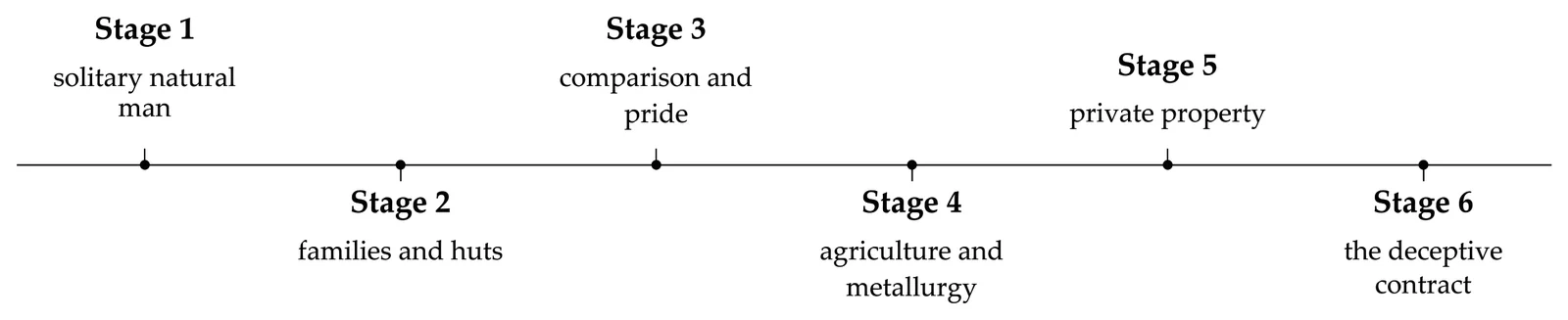
In the Discourse on the Origin of Inequality (1755), Rousseau distinguished natural inequality, of age, health and strength, from moral or political inequality, of wealth, honour and power, which is established by convention. He reconstructed a conjectural history. Natural man was solitary, free, self-sufficient and moved by self-love and pity; he possessed perfectibility, the capacity to develop. Over time people formed families and small communities, a happy middle stage, but they also began to compare themselves with others.
The decisive change came with agriculture and metallurgy, which created the division of labour and private property. Rousseau wrote that the first man who enclosed a piece of land, said this is mine and found people simple enough to believe him was the real founder of civil society. Conflict between rich and poor followed, and the rich proposed a deceptive contract that created government and law to protect their property, turning usurpation into right and fixing inequality forever.
2.3 State of Nature and the Contract
Unlike Hobbes, who saw the state of nature as a war of all against all, Rousseau argued that Hobbes had projected the passions of civilised people onto natural man. Natural man is neither good nor evil in a moral sense, but peaceful, because he has few needs and feels pity. Unlike Locke, Rousseau denied that property and rights existed in the state of nature. The problem is not nature but the corrupting effects of society.
In The Social Contract (1762), Rousseau did not propose returning to nature, which is impossible. He sought a legitimate association in which each person, uniting with all, still obeys only himself and remains as free as before. The solution is that each gives himself totally to the community, so that no one has an interest in making conditions burdensome for others. Each loses natural liberty but gains civil liberty and moral liberty, obedience to a law one prescribes for oneself.
2.4 The General Will, Democracy and Self-government
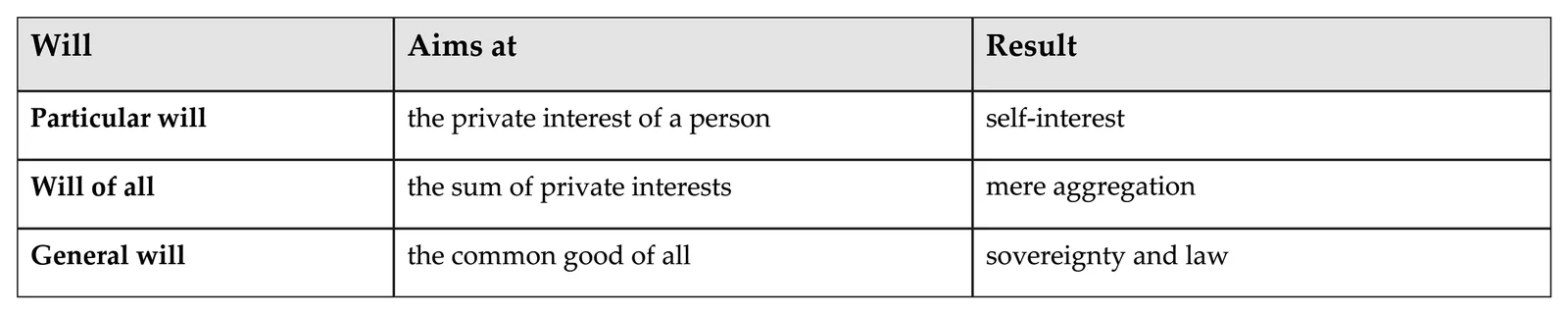
The community is directed by the general will, which aims at the common good, unlike the will of all, which is merely the sum of private interests. Sovereignty, the exercise of the general will, is inalienable and indivisible and cannot be represented: Rousseau said the English people were free only during elections. Laws must be made by the people assembled, while government is merely an agent that executes them. Whoever refuses to obey the general will may be forced to be free.
Rousseau thought true democracy was possible only in small states where citizens could assemble and share simple manners. He introduced the legislator, an exceptional figure who gives a people its first laws, and a civil religion to support civic virtue. John Rawls reads the general will as shared deliberative reason about the common good, while critics such as J.L. Talmon saw Rousseau as a source of totalitarian democracy.

2.5 Important Questions
- Question 1 Discuss Rousseau’s critique of modern civilisation and his account of the origins of inequality.
- Question 2 Examine Rousseau’s ideas of the state of nature and the social contract.
- Question 3 Explain Rousseau’s concept of the general will.
- Question 4 Discuss Rousseau’s ideas on democracy and self-government.
DU asks the same idea in different words. So learn one broad answer for each question below; the same answer works for every question joined by OR.
Important Question 1
Discuss Rousseau’s critique of modern civilisation and his account of the origins of inequality.
OR
‘The first man who enclosed a piece of land … was the real founder of civil society.’ Discuss.
OR
Examine Rousseau’s distinction between natural and moral inequality.
Model Answer
“The first man who, having enclosed a piece of ground, bethought himself of saying ‘This is mine’, and found people simple enough to believe him, was the real founder of civil society.”
— Jean-Jacques Rousseau, Discourse on the Origin of Inequality (1755)
Introduction. Rousseau challenged the Enlightenment’s confidence in progress. In two discourses, he argued that the development of the arts, sciences and property had corrupted human beings and created inequality. His critique of civilisation and his conjectural history of inequality made him one of the most original and influential critics of modern society.
1. The First Discourse
In 1750 the Academy of Dijon asked whether the restoration of the sciences and arts had helped to purify morals. Rousseau answered that they had corrupted them, and his essay won the prize, making him famous.
2. Arts, Sciences and Luxury
Rousseau argued that the arts and sciences grow out of vices such as pride, idleness and curiosity, and that they spread luxury and weaken courage and virtue. They cover the chains of servitude with garlands of flowers, making people love their slavery.
3. Appearance and Reality
Civilised people live in appearances. Politeness and refinement hide envy, suspicion and deceit. People no longer dare to appear as they are, but seek the approval of others.
4. Amour-propre
At the root of corruption is amour-propre, the desire to be esteemed and preferred by others, which arises in society through comparison. It differs from amour de soi, a natural and healthy love of self concerned with self-preservation.
5. Two Kinds of Inequality
In the Second Discourse (1755), Rousseau distinguished natural or physical inequality, of age, health, strength and mind, from moral or political inequality, of wealth, honour and power, which depends on convention and the consent of others.
6. Natural Man
Natural man was solitary, independent and content, with few needs that nature easily satisfied. He was moved by self-love and pity, a natural repugnance at seeing others suffer, and he possessed free agency and perfectibility.
7. Perfectibility
Perfectibility, the capacity to develop and change, distinguishes humans from animals. It is the source of all human achievements but also of all human misfortunes, since it leads humans out of their natural condition.
8. The Golden Age
As people formed families and huts and gathered in small communities, they enjoyed the happiest age, between natural indolence and the restless activity of amour-propre. But comparison began, and people sought to be looked at and esteemed.
9. Agriculture, Metallurgy and Property
The invention of agriculture and metallurgy brought the division of labour and private property. Inequalities of talent became inequalities of wealth, and dependence and domination spread.
10. The Founder of Civil Society
Rousseau wrote that the first man who enclosed land, said this is mine and found people simple enough to believe him was the real founder of civil society. How many crimes and miseries would have been avoided, he added, if someone had pulled up the stakes.
11. The Deceptive Contract
Conflict between rich and poor led to a state of war. The rich proposed a contract to establish laws and government in the name of peace, but it protected their property and turned usurpation into legal right. All ran to their chains believing they secured their liberty.
12. From Government to Despotism
Inequality progressed in stages, from the establishment of property, to the institution of magistrates, to the transformation of legitimate power into arbitrary despotism, where all become equal again because they are nothing before the despot.
13. Influence
Rousseau’s account influenced Marx’s analysis of property and class, and later critics of inequality. Its emphasis on social rather than natural causes of inequality shaped modern social theory.
14. Criticisms
Critics argue that Rousseau idealised the state of nature, ignored the benefits of civilisation and contradicted himself by writing about the arts. Voltaire mocked him for wanting people to walk on all fours. Rousseau replied that he did not seek a return to nature.
15. Evaluation
Rousseau’s critique remains powerful because it shows how inequality and dependence arise from social institutions, especially property, and how social esteem shapes human psychology. It challenged the easy optimism of the Enlightenment.
Conclusion. Thus, Rousseau argued that the arts, sciences and commerce corrupted natural goodness through amour-propre, and that moral and political inequality arose from property and a deceptive contract by which the rich secured their wealth. His critique laid foundations for later critiques of modern society.
Important Question 2
Examine Rousseau’s ideas of the state of nature and the social contract.
OR
Compare Rousseau’s state of nature with those of Hobbes and Locke.
OR
‘Man is born free, and everywhere he is in chains.’ Discuss Rousseau’s solution in The Social Contract.
Model Answer
“To find a form of association which will defend and protect with the whole common force the person and goods of each associate, and in which each, while uniting himself with all, may still obey himself alone, and remain as free as before.”
— Jean-Jacques Rousseau, The Social Contract (1762), Book I, Chapter 6
Introduction. Like Hobbes and Locke, Rousseau used the idea of a state of nature and a social contract. But he reversed many of their assumptions. His state of nature was peaceful and innocent, and his contract was not a surrender of liberty to a ruler but a way for people to remain free by governing themselves. Keens-Soper and Rawls examine his argument.
1. Method
Rousseau’s state of nature is a conjectural reconstruction, not a historical description. By stripping away everything society has added, he sought to discover what is natural in human beings.
2. Critique of Hobbes
Hobbes described natural man as fearful, competitive and violent, living in a war of all against all. Rousseau argued that Hobbes attributed to natural man passions such as pride and greed that are products of society.
3. Critique of Locke
Locke held that natural rights to life, liberty and property exist before government. Rousseau argued that property is a social creation, not a natural right, and that it is the source of inequality.
4. Natural Man
Rousseau’s natural man is solitary, peaceful and free, with few needs, moved by self-love and pity. He is good in the sense of being innocent and harmless, not virtuous, since morality requires society.
5. Man in Chains
The Social Contract begins: man is born free, and everywhere he is in chains. Rousseau did not ask how this change came about, but what could make it legitimate.
6. Force Is Not Right
Rousseau rejected force as a basis of legitimate authority: to yield to force is an act of necessity, not of will. Nor can slavery be legitimate, since to renounce one’s liberty is to renounce one’s quality as a human being.
7. The Fundamental Problem
The problem is to find a form of association that protects each person and his goods with the common force, in which each, uniting with all, still obeys only himself and remains as free as before.
8. Total Alienation
The solution is the total alienation of each associate, with all his rights, to the whole community. Because each gives himself entirely, conditions are equal for all, and no one has an interest in making them burdensome for others.
9. The Sovereign People
The contract creates a moral and collective body, the sovereign, made up of all citizens. Each is both a member of the sovereign, making laws, and a subject, obeying them.
10. Natural and Civil Liberty
By the contract, people lose natural liberty, an unlimited right to whatever they can get, and gain civil liberty, limited by the general will, and the right of property in what they possess.
11. Moral Liberty
People also gain moral liberty, which alone makes them masters of themselves, for the impulse of appetite alone is slavery, while obedience to a law one prescribes to oneself is liberty.
12. Transformation of Human Nature
The passage from the state of nature to civil society produces a remarkable change, substituting justice for instinct and giving actions the morality they lacked. A stupid and limited animal becomes an intelligent being and a man.
13. Rawls’s Reading
John Rawls reads Rousseau’s contract as a solution to the problem of inflamed amour-propre: in a society of equal citizens, people can gain recognition through equal citizenship rather than domination.
14. Criticisms
Critics worry that total alienation leaves the individual defenceless before the community. Liberals such as Benjamin Constant argued that Rousseau confused the ancient liberty of participation with the modern liberty of private independence.
15. Three Contracts Compared
In Hobbes, people surrender their rights to an absolute sovereign who stands outside the contract. In Locke, people consent to a limited government that holds power in trust and may be resisted if it violates natural rights. In Rousseau, there is no ruler above the people: the people themselves become sovereign, and government is only their agent. Rousseau’s contract thus creates a self-governing community rather than a protector.
16. Evaluation
Rousseau transformed the social contract tradition, making it a theory of collective self-government rather than of submission to a ruler. His idea that freedom means obeying laws one makes oneself has shaped democratic theory.
Conclusion. Thus, Rousseau’s peaceful state of nature contrasted with Hobbes’s war and Locke’s natural property rights. His social contract sought an association in which each, by total alienation to the community, remains free, gaining civil and moral liberty through obedience to laws made by all.
Important Question 3
Explain Rousseau’s concept of the general will.
OR
Distinguish between the general will and the will of all.
OR
‘Whoever refuses to obey the general will shall be forced to be free.’ Discuss.
Model Answer
“Whoever refuses to obey the general will shall be compelled to do so by the whole body. This means nothing less than that he will be forced to be free.”
— Jean-Jacques Rousseau, The Social Contract (1762), Book I, Chapter 7
Introduction. The general will is the central idea of Rousseau’s political philosophy and one of the most debated concepts in political thought. It expresses the idea that a community can have a will directed to the common good, and that obeying it is a form of freedom. Admirers see it as a foundation of democracy; critics fear it can justify oppression.
1. Meaning
The general will is the will of the sovereign people directed towards the common good. It is general in its source, coming from all, and in its object, applying equally to all.
2. Particular Will
Each person has a particular will, directed towards his own private interest, which may differ from or conflict with the general will he has as a citizen.
3. Will of All
The will of all is the sum of particular wills, an aggregation of private interests. The general will considers only the common interest. Rousseau suggested that when the pluses and minuses of particular wills cancel out, the general will remains as the sum of the differences.
4. Always Right
Rousseau said the general will is always right and tends to the public advantage, but the deliberations of the people are not always equally correct. People always want their own good but do not always see it.
5. Factions
The general will is distorted when factions or partial associations form, since each faction’s will is general for its members but particular in relation to the state. Rousseau preferred no partial societies or, if they exist, many small ones.
6. Law
The general will is expressed in law. A law must be general, made by all and applying to all, never to particular persons. Laws are the conditions of civil association.
7. Forced to Be Free
Whoever refuses to obey the general will may be compelled by the whole body, which means he will be forced to be free. Rousseau meant that the citizen is compelled to obey laws that express his own true will as a citizen and protect him from personal dependence.
8. Sovereignty
The exercise of the general will is sovereignty, which is inalienable, since a will cannot be transferred, and indivisible, since the will is either general or not. It cannot be represented.
9. Rawls’s Interpretation
Rawls interprets the general will as a form of deliberative reason: citizens ask what is good for all as citizens, setting aside private interests. This makes it close to his own idea of public reason.
10. Kant and Hegel
Kant drew on the general will for his idea of autonomy and the original contract, and Hegel saw in it the principle of freedom as self-determination, though he criticised Rousseau for treating it as merely the common element of individual wills.
11. Totalitarian Criticism
J.L. Talmon, in The Origins of Totalitarian Democracy (1952), and Isaiah Berlin argued that the idea of a true general will known by an enlightened few, and of being forced to be free, could justify the coercion of dissenters in the name of the people, as during the Jacobin terror.
12. Democratic Defence
Defenders reply that Rousseau insisted the general will must come from all citizens voting on general laws, and that he opposed personal dependence and arbitrary power. His aim was equal citizenship, not dictatorship.
13. Ambiguities
The concept remains ambiguous: it is unclear how the general will is known, whether majorities always express it, and how dissenting minorities are protected.
14. Relevance
The general will influenced ideas of popular sovereignty, the common good and deliberative democracy, and Article 6 of the French Declaration of Rights (1789) declared law to be the expression of the general will.
15. Keens-Soper’s Reading
Maurice Keens-Soper emphasises that the general will is Rousseau’s answer to the problem of reconciling authority with freedom. Political authority is legitimate only when laws are general, made by all and binding on all equally, so that no one is subjected to the private will of another. The general will is therefore less a mysterious collective mind than a standard of legitimacy for laws.
16. Equality and Generality
Rousseau argued that the general will requires equality: laws must apply equally to all, and great inequalities of wealth corrupt it by creating dependence and factions. This link between political legitimacy and social equality made Rousseau an inspiration for democratic and socialist thought.
17. Evaluation
The general will expresses a powerful ideal of collective self-government for the common good. Its ambiguities and potential for misuse make it both inspiring and dangerous.
Conclusion. Thus, Rousseau’s general will is the will of the people directed to the common good, distinct from particular wills and the will of all. Expressed in general laws, it makes citizens free by obedience to their own will, though critics like Talmon warn that it can justify coercion.
Important Question 4
Discuss Rousseau’s ideas on democracy and self-government.
OR
Why did Rousseau reject representation? Discuss.
OR
Was Rousseau a democrat or a totalitarian? Discuss.
Model Answer
“The people of England regards itself as free; but it is grossly mistaken; it is free only during the election of members of parliament.”
— Jean-Jacques Rousseau, The Social Contract (1762), Book III, Chapter 15
Introduction. Rousseau is often seen as a founder of radical democracy. He insisted that sovereignty belongs to the people, that it cannot be represented, and that citizens should make their own laws. At the same time, he introduced the legislator and civil religion and argued that true democracy suits only small states, leading to debate about whether he was a democrat or an authoritarian.
1. Popular Sovereignty
For Rousseau, sovereignty belongs inalienably to the people as a whole. No ruler, assembly or class can possess it. This was a radical challenge to monarchical and aristocratic rule.
2. No Representation
Sovereignty cannot be represented, because a will cannot be transferred. Deputies can only be agents, not representatives, and any law the people have not ratified in person is null.
3. The English Example
Rousseau said the English people believed they were free but were free only during elections; as soon as members were elected, the people were slaves. This was a sharp critique of representative government.
4. Sovereign and Government
Rousseau distinguished the sovereign, the people making general laws, from the government, a body that executes laws and applies them to particular cases. The government is the people’s agent and can be changed by them.
5. Forms of Government
Government may be democratic, aristocratic or monarchical, depending on how many hold executive power. Rousseau favoured elective aristocracy for government, while sovereignty remained with the whole people.
6. Democracy as Government
Rousseau thought democracy as a form of government, where the people both make and execute laws, was suitable only for gods: if there were a people of gods, it would govern itself democratically; so perfect a government is not for men.
7. Periodic Assemblies
To prevent government from usurping sovereignty, the people should assemble periodically and decide whether to keep the existing form of government and its officials.
8. Small States
Rousseau believed self-government required a small state where citizens could assemble, know each other and share simple manners, as in his native Geneva or ancient city-states. Large states tend towards despotism.
9. The Legislator
A people needs a legislator, an extraordinary figure such as Lycurgus or Moses, to give it its first laws and shape its character, persuading rather than forcing. Critics see this as an undemocratic element.
10. Civil Religion
Rousseau proposed a civil religion with simple dogmas, the existence of God, the afterlife, the sanctity of the social contract and the laws, and tolerance, to strengthen civic loyalty. Those who rejected it could be banished.
11. Equality and Independence
Self-government requires rough economic equality: no citizen should be rich enough to buy another, and none so poor as to be forced to sell himself. Inequality makes political freedom impossible.
12. Influence on Revolution
Rousseau’s ideas inspired the French revolutionaries, especially Robespierre and the Jacobins, who invoked the general will and civic virtue.
13. Totalitarian Reading
Talmon and Berlin argued that Rousseau’s ideas of the general will, civil religion and forced freedom prepared the way for totalitarian democracy, in which a vanguard claims to embody the people.
14. Democratic Reading
Others, such as Rawls and scholars of participatory democracy like Carole Pateman, see Rousseau as a theorist of equal citizenship, participation and the common good, whose concern was to prevent domination.
15. Evaluation
Rousseau offers one of the most radical visions of democratic self-government, insisting on popular sovereignty and participation. His elements of the legislator and civil religion, and his doubts about large states, show the tensions in his thought.
Conclusion. Thus, Rousseau held that sovereignty belongs to the people and cannot be represented, that government is merely the people’s agent, and that self-government requires small, equal communities. His ideas inspired democracy and participation but, as critics argue, contain authoritarian possibilities.
Short Notes
(a) General will
Rousseau’s concept of the will of the sovereign people directed towards the common good, as distinct from particular wills and the will of all, which is merely the sum of private interests. It is expressed in general laws and is the basis of legitimate authority.
(b) Amour-propre
Rousseau’s term for the self-love that arises in society through comparison with others: the desire to be esteemed and preferred. Unlike natural amour de soi, it produces vanity, envy, competition and dependence, and is the root of social corruption.
(c) Perfectibility
The human capacity for self-improvement and change that, for Rousseau, distinguishes humans from animals. It explains human progress but also human misery, since it led people out of the state of nature into dependence and inequality.
(d) Forced to be free
Rousseau’s statement in The Social Contract that a citizen who refuses to obey the general will may be compelled to do so, which means he will be forced to be free. Defenders read it as protection from personal dependence; critics see it as a justification of coercion.
(e) Civil religion
In the last chapter of The Social Contract, Rousseau proposed a civil religion with a few simple dogmas, the existence of a benevolent God, a life to come, the reward of the just and punishment of the wicked, the sanctity of the social contract and the laws, and tolerance of other creeds. Its purpose was to strengthen citizens’ attachment to the republic; critics see it as a threat to freedom of conscience.
More notes: MDSC-7 Themes in Western Political Philosophy
These notes are prepared by PADHO TO AISE for study help. They are not an official University of Delhi publication.