
Generic Electives (GE) GE-3 Nationalism in India
Unit II · 26 min read · Updated 27 Nov 2026
As per the University of Delhi (DU) Generic Elective (GE) syllabus offered by the Department of Political Science
Contents
- 2.1 The Context and Features of Reform
- Features of the Reform Movements
- Reform and Anti-Reform: Two Responses
- 2.2 The Major Reform Movements
- The Brahmo Samaj
- Reformers in Bengal and Western India
- Movements among the Lower Castes
- Reform among Muslims
- 2.3 Anti-Reformism, Revivalism and Their Legacy
- Anti-Reform Movements
- Revivalism
- Historians on Reform and Anti-Reform
- The Legacy of Reform and Anti-Reform
- 2.4 Important Questions
- Discuss the major social and religious reform movements in nineteenth-century India.
- Distinguish between reformist and anti-reformist trends in nineteenth-century India.
- Discuss the reform movements among Muslims in nineteenth-century India, with reference to the Aligarh and Deoband movements.
- Examine the relationship between the nineteenth-century reform movements and the rise of Indian nationalism.
- Short Notes
मुझे गर्व है कि मैं उस धर्म से हूँ जिसने संसार को सहिष्णुता और सार्वभौमिक स्वीकृति, दोनों की शिक्षा दी है।
I am proud to belong to a religion which has taught the world both tolerance and universal acceptance.
— Swami Vivekananda, Address at the World’s Parliament of Religions, Chicago (11 September 1893)
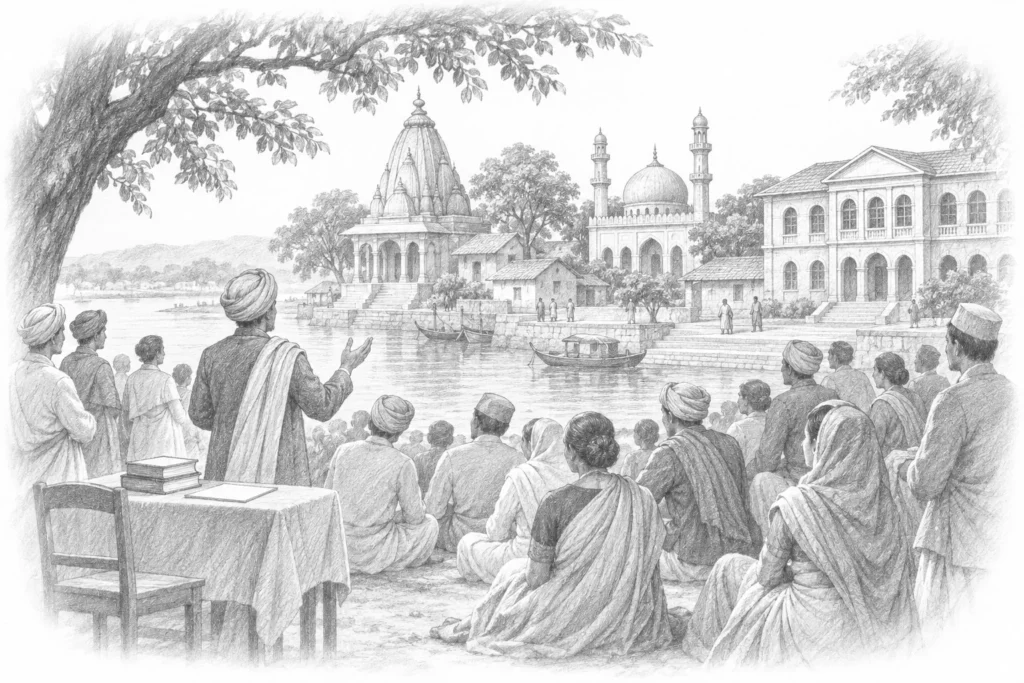
TTHE nineteenth century was an age of intense questioning in India. Under colonial rule, Western education, the printing press and Christian missionaries challenged Indian society, and Indians responded by re-examining their own religions and customs. Some, the reformers, used reason and conscience to attack sati, child marriage, caste and idolatry and asked the colonial state to change the law. Others, the anti-reformers and revivalists, defended tradition, opposed state interference in religion or sought to restore a purified ancient faith. This chapter studies the major social and religious movements among Hindus, Muslims and other communities, the debate between reform and anti-reform, and how both prepared the ground for Indian nationalism.
2.1 The Context and Features of Reform
The reform movements grew out of the encounter between Indian society and colonial modernity. Several developments created the conditions for them:
- Western education. Thomas Babington Macaulay’s Minute on Education (1835) promoted English education, Wood’s Despatch (1854) planned a system of schools and colleges, and universities were founded at Calcutta, Bombay and Madras in 1857, producing a new educated class.
- Orientalist scholarship. The Asiatic Society of Bengal, founded by William Jones in 1784, studied Sanskrit texts and India’s past, giving Indians a new pride in their classical heritage.
- The printing press. Newspapers, journals and pamphlets in English and Indian languages allowed ideas to spread and debates to take place in public.
- Christian missionaries. Missionaries, such as William Carey at Serampore from 1800, criticised Hindu customs and converted some Indians, provoking both reform and defensive reaction.
- The colonial state. British officials claimed to be civilising India and sometimes legislated on social questions, which made the state a target of both reformers’ appeals and traditionalists’ protests.
- A new middle class. Teachers, lawyers, clerks and journalists, educated in the new institutions, led most of the movements.
Features of the Reform Movements
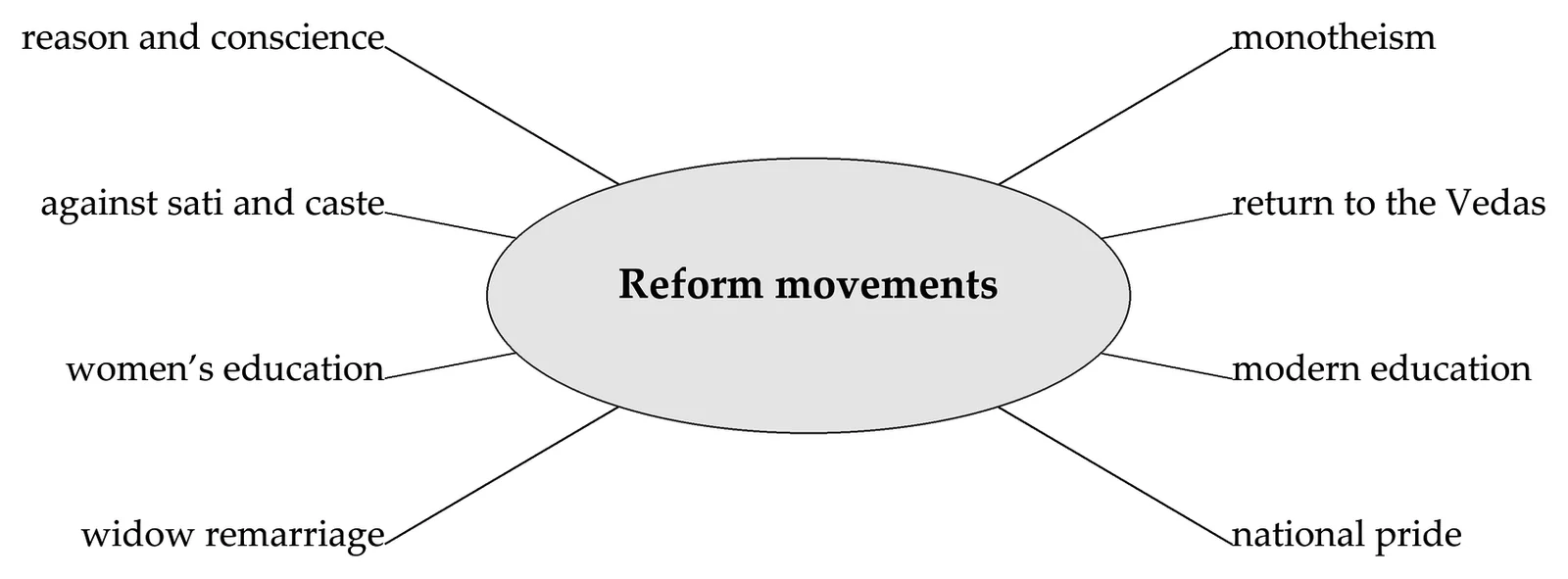
- Rationalism. Reformers judged customs by reason and conscience; Rammohan Roy, in Tuhfat-ul-Muwahhidin (1803–04), criticised superstition and idolatry on rational grounds.
- Religious universalism. Many held that all religions share common truths, and opposed priestly domination, rituals and polytheism.
- Social reform, especially of women’s position. They campaigned against sati, child marriage, purdah and the ill-treatment of widows, and for women’s education and widow remarriage.
- Criticism of caste. Several movements criticised untouchability and the rigidity of caste, though few attacked caste completely.
- Appeal to scripture. Reformers often argued that the true meaning of the Vedas, the Upanishads or the Qur’an supported reform, so reform was presented as a return to pure religion.
- Organisation and the press. They formed associations, ran schools and published journals, creating new forms of public life.
Reform and Anti-Reform: Two Responses
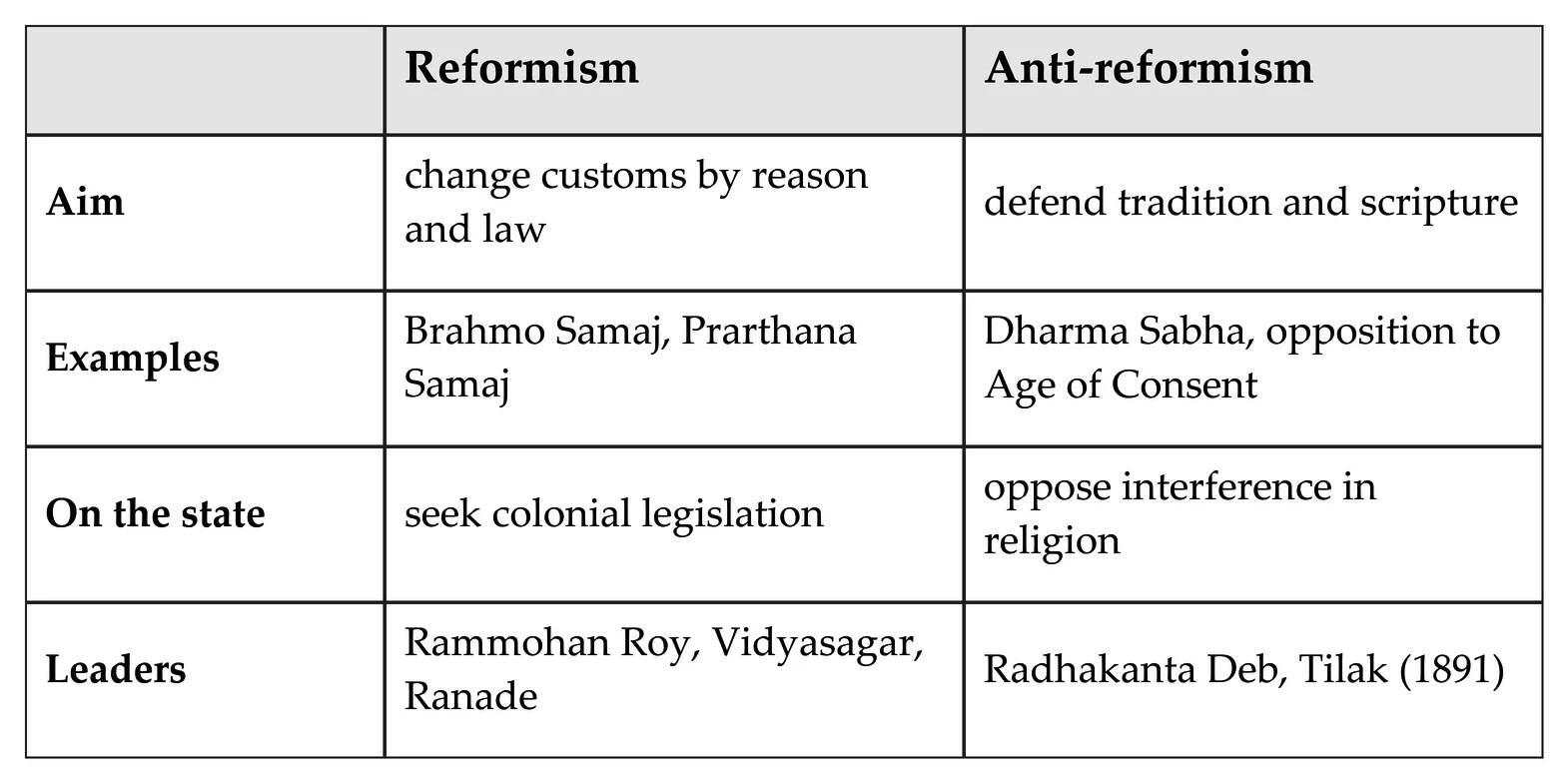
Historians distinguish two broad responses. Reformism sought to change Indian society by reason and, where necessary, by law, often with colonial support. Anti-reformism opposed these changes, either because they violated scripture and custom or because the colonial state had no right to interfere in Indian religion. Between the two lay revivalism, which also sought change but justified it by a return to a glorious ancient past, often combined with criticism of the West. These categories overlap, and the same person could be a reformer on one issue and a traditionalist on another.
2.2 The Major Reform Movements
The Brahmo Samaj
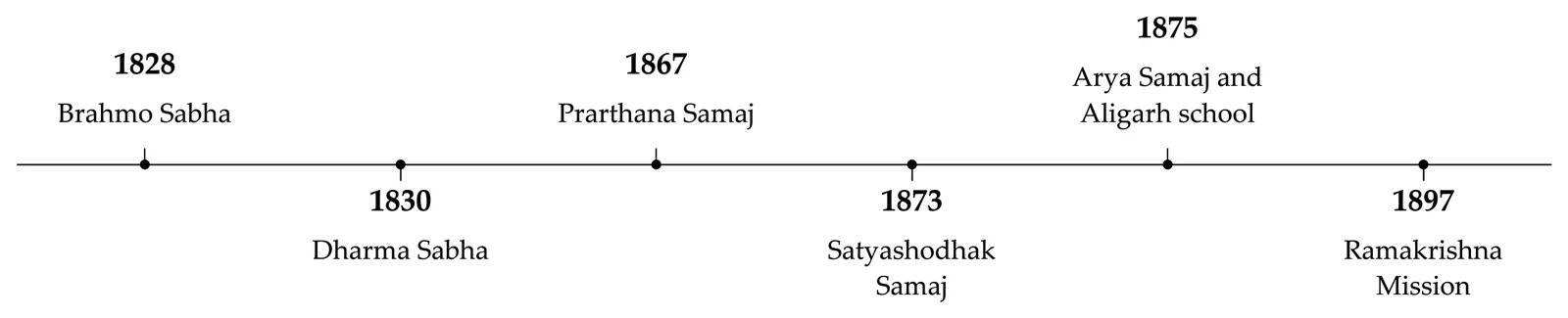
Raja Rammohan Roy (1772–1833), often called the father of modern India, founded the Atmiya Sabha in 1815 and the Brahmo Sabha in 1828, later the Brahmo Samaj, which worshipped one formless God without idols. He campaigned against sati, arguing from the scriptures that it was not obligatory, and supported Bentinck’s ban of 1829; he also favoured English education and women’s property rights. Debendranath Tagore revived the Samaj through the Tattvabodhini Sabha (1839). Keshab Chandra Sen spread it across India, founding the Brahmo Samaj of India in 1866 and pressing for the Native Marriage Act of 1872, which allowed inter-caste marriage and banned child marriage among Brahmos. When Keshab married his under-age daughter to the prince of Cooch Behar in 1878, his followers broke away to form the Sadharan Brahmo Samaj.
Reformers in Bengal and Western India
- Young Bengal. Henry Louis Vivian Derozio, a teacher at Hindu College in Calcutta (founded 1817), encouraged his students to question all authority; they attacked orthodoxy in radical ways.
- Ishwar Chandra Vidyasagar. A Sanskrit scholar, he used scriptures to argue for widow remarriage and led the campaign for the Hindu Widows’ Remarriage Act of 1856; he also promoted girls’ schools, including the Bethune School (1849).
- Prarthana Samaj. Founded in Bombay in 1867 by Atmaram Pandurang, with M.G. Ranade and R.G. Bhandarkar as leading members, it promoted theism, inter-caste dining, widow remarriage and women’s education.
- The Indian National Social Conference. Ranade founded it in 1887 to discuss social reform alongside the Indian National Congress.
- Behramji Malabari. A Parsi journalist, he campaigned against child marriage, leading to the Age of Consent Act of 1891.
- Parsi and Sikh reform. The Rahnumai Mazdayasnan Sabha (1851), with Dadabhai Naoroji among its founders, reformed Parsi customs, and the Singh Sabha movement (1873) sought to purify Sikh practice and spread education.
Movements among the Lower Castes
Reform also came from below. Jyotirao Phule founded the Satyashodhak Samaj in 1873 and, in Gulamgiri (1873), described caste as a form of slavery imposed by Brahmins; with his wife Savitribai Phule he opened schools for girls and lower castes from 1848. These movements challenged Brahmanical authority more radically than upper-caste reformers did, and they are studied further in Chapter 4.
Reform among Muslims
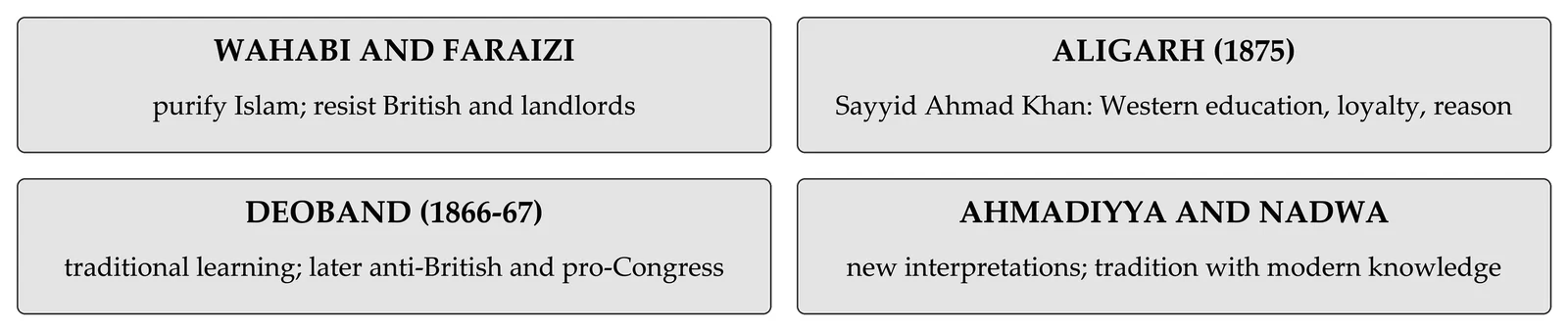
- Revivalist movements. The movement of Sayyid Ahmad of Rae Bareli, called Wahabi by the British, and the Faraizi movement of Haji Shariatullah in Bengal sought to purify Islam of un-Islamic practices and resisted British and Sikh rule.
- Aligarh. Sayyid Ahmad Khan (1817–98) believed that Muslims must accept modern Western education and loyalty to the British. He founded the Scientific Society (1864), the journal Tahzib-ul-Akhlaq and the Muhammadan Anglo-Oriental College at Aligarh (1875), which became Aligarh Muslim University in 1920.
- Deoband. Founded in 1866–67 by Muhammad Qasim Nanautavi and Rashid Ahmad Gangohi, the Dar-ul-Uloom at Deoband trained ulama in traditional Islamic learning, opposed Western influence and, unlike Aligarh, later supported the Congress.
- Other trends. The Ahmadiyya movement (1889) of Mirza Ghulam Ahmad and the Nadwat-ul-Ulama (1894) at Lucknow sought to reconcile tradition and modern knowledge in different ways.
2.3 Anti-Reformism, Revivalism and Their Legacy
Anti-Reform Movements
Every major reform met organised opposition. When sati was banned in 1829, Radhakanta Deb and other orthodox Hindus in Calcutta formed the Dharma Sabha (1830) and appealed to the Privy Council in London, which upheld the ban in 1832. Thousands signed petitions against the Widow Remarriage Act of 1856. The fiercest controversy came over the Age of Consent Bill of 1891, introduced after the death of an eleven-year-old girl, Phulmoni, at the hands of her husband in 1889–90. Bal Gangadhar Tilak opposed it in his newspaper Kesari, arguing that a foreign government had no right to interfere in Hindu religion and that reform must come from within society. Anti-reformism therefore combined the defence of custom with resistance to colonial authority.
Revivalism
- The Arya Samaj. Dayananda Saraswati (1824–83) founded the Arya Samaj in Bombay in 1875 and wrote Satyarth Prakash (1875). He rejected idolatry, polytheism, caste by birth and child marriage, but did so by calling for a return to the Vedas as the source of all truth. The Samaj promoted education through the Dayanand Anglo-Vedic school at Lahore (1886) and the Gurukul at Kangri (1902), and began shuddhi, a ritual to reconvert those who had left Hinduism.
- The Ramakrishna Mission. Inspired by the mystic Ramakrishna Paramahamsa, Swami Vivekananda founded the Ramakrishna Mission in 1897, combining Vedanta with social service and national pride after his famous address at Chicago in 1893.
- The Theosophical Society. Founded in New York in 1875 by Helena Blavatsky and Henry Olcott and based at Adyar from 1882, it praised Hinduism and Buddhism; Annie Besant later joined Indian politics.
- Cow protection. Gaurakshini Sabhas spread in north India from the 1880s, mobilising Hindus around a religious symbol and sometimes leading to communal riots.
Historians on Reform and Anti-Reform
Historians have debated the meaning of these movements. Charles Heimsath, in Indian Nationalism and Hindu Social Reform (1964), traced how social reform became linked to nationalism. Kenneth Jones, in Socio-Religious Reform Movements in British India (1989), distinguished transitional movements, which had little contact with colonial culture, from acculturative ones led by the English-educated. Some historians spoke of a Bengal Renaissance, but Sumit Sarkar questioned how far Rammohan Roy really broke with the past. Feminist historians showed that women were often the object rather than the subject of reform: Lata Mani, in Contentious Traditions (1998), argued that the debate on sati was conducted by men about scripture, with little attention to widows themselves, and Tanika Sarkar, in Hindu Wife, Hindu Nation (2001), showed how the Age of Consent controversy made women’s bodies a symbol of the nation.
The Legacy of Reform and Anti-Reform
Both reform and anti-reform contributed to the rise of nationalism. Reformers created an educated public, voluntary associations and a spirit of rational inquiry, and they gave Indians confidence that their society could change. Revivalists such as Dayananda and Vivekananda gave Indians pride in their own civilisation against colonial contempt. Anti-reformers such as Tilak turned the defence of tradition into resistance against foreign rule. At the same time, religious revivalism among both Hindus and Muslims sharpened community identities, which later contributed to communal politics. The nineteenth-century debates thus shaped both the strengths and the tensions of the national movement.
2.4 Important Questions
- Question 1 Discuss the major social and religious reform movements in nineteenth-century India.
- Question 2 Distinguish between reformist and anti-reformist trends in nineteenth-century India.
- Question 3 Discuss the reform movements among Muslims in nineteenth-century India, with reference to the Aligarh and Deoband movements.
- Question 4 Examine the relationship between the nineteenth-century reform movements and the rise of Indian nationalism.
DU asks the same idea in different words. So learn one broad answer for each question below; the same answer works for every question joined by OR.
Important Question 1
Discuss the major social and religious reform movements in nineteenth-century India.
OR
Examine the nature and significance of the socio-religious reform movements in colonial India.
OR
Did the reform movements of the nineteenth century lead to an Indian Renaissance? Discuss.
Model Answer
“Arise, awake, and stop not till the goal is reached.”
— Swami Vivekananda, lectures of the 1890s, drawing on the Katha Upanishad
Introduction. The nineteenth century saw a wave of social and religious reform movements in India. Educated Indians, influenced by Western education, the press and Christian criticism, re-examined their religions and customs. Movements such as the Brahmo Samaj, the Prarthana Samaj, the Arya Samaj, the Aligarh movement and the Satyashodhak Samaj sought to remove social evils and purify religion. Together they transformed Indian society and prepared the ground for nationalism.
1. The Colonial Context
Reform grew out of the colonial encounter. Macaulay’s Minute of 1835 and Wood’s Despatch of 1854 spread English education, universities were founded in 1857, the printing press created a reading public and missionaries criticised Indian customs. A new middle class of teachers, lawyers and journalists emerged and led the movements.
2. Main Features
The movements shared certain features: rationalism, which judged customs by reason; religious universalism, opposing idolatry and priestly control; concern for women, against sati and child marriage and for education and widow remarriage; criticism of caste; and the formation of associations, schools and journals to spread their ideas.
3. Rammohan Roy and the Brahmo Samaj
Rammohan Roy founded the Brahmo Sabha in 1828 to worship one formless God. He campaigned against sati, using the scriptures to show it was not required, and supported its abolition in 1829. He also favoured English education and women’s property rights, earning the title of father of modern India.
4. Later Brahmo Leaders
Debendranath Tagore revived the Samaj through the Tattvabodhini Sabha in 1839, and Keshab Chandra Sen spread it across India, securing the Native Marriage Act of 1872, which permitted inter-caste marriage among Brahmos. Divisions led to the Sadharan Brahmo Samaj in 1878.
5. Vidyasagar and Widow Remarriage
Ishwar Chandra Vidyasagar, a Sanskrit scholar, used the scriptures to argue that widows could remarry and led the campaign for the Hindu Widows’ Remarriage Act of 1856. He also promoted girls’ education, showing how reform could be justified from within tradition.
6. The Prarthana Samaj and Ranade
In western India, the Prarthana Samaj (1867), led by M.G. Ranade and R.G. Bhandarkar, promoted theism, widow remarriage, inter-caste dining and women’s education. Ranade founded the Indian National Social Conference in 1887 to link social reform with the new national movement.
7. The Arya Samaj
Dayananda Saraswati founded the Arya Samaj in 1875 and wrote Satyarth Prakash. He rejected idolatry, caste by birth and child marriage but called for a return to the Vedas. The Samaj built a network of schools and colleges and started shuddhi to reconvert those who had left Hinduism, combining reform with revivalism.
8. Vivekananda and the Ramakrishna Mission
Swami Vivekananda, after his address at the World’s Parliament of Religions in Chicago in 1893, founded the Ramakrishna Mission in 1897. He combined Vedanta with social service, attacked untouchability and called on Indians to regain self-confidence, inspiring a generation of nationalists.
9. Reform among Muslims
Sayyid Ahmad Khan’s Aligarh movement promoted Western education and founded the Muhammadan Anglo-Oriental College in 1875, while the Deoband school (1866–67) preserved traditional Islamic learning. Earlier, the Wahabi and Faraizi movements sought to purify Islam. These movements shaped modern Muslim identity in India.
10. Lower-Caste Movements
Jyotirao Phule’s Satyashodhak Samaj (1873) and his book Gulamgiri attacked caste as slavery imposed by Brahmins, and with Savitribai Phule he opened schools for girls and lower castes. These movements challenged Brahmanical authority more radically than upper-caste reformers.
11. The Question of a Renaissance
Some historians described these changes as an Indian or Bengal Renaissance, comparing them with the European revival of learning. Others, such as Sumit Sarkar, argued that the movements were limited to a small urban elite, depended on colonial support and did not break decisively with the past, so the term is misleading.
12. Limitations
The movements were largely led by upper-caste, urban, English-educated men; they reached few peasants and workers; women were often objects rather than leaders of reform; and some revivalist trends sharpened religious differences, contributing to later communal tensions.
13. Contribution to Nationalism
The movements created an educated public, new associations and a spirit of inquiry, and gave Indians pride in their culture and confidence in their ability to change their society. Many leaders of the national movement, from Ranade to Gokhale and Tilak, came out of this world of reform debates.
14. Evaluation
The reform movements were a creative response to colonial modernity. They removed some social evils and transformed ideas about religion, women and caste, but their reach was limited and their legacy mixed, contributing to both nationalism and religious identity politics.
Conclusion. Thus, the nineteenth-century reform movements, from the Brahmo Samaj and Prarthana Samaj to the Arya Samaj, the Ramakrishna Mission, Aligarh, Deoband and the Satyashodhak Samaj, used reason, scripture and organisation to reform Indian society. Whether or not they amounted to a Renaissance, they laid the social and intellectual foundations of Indian nationalism, while revealing the limits of elite-led reform.
Important Question 2
Distinguish between reformist and anti-reformist trends in nineteenth-century India.
OR
Discuss the debate between reform and anti-reform with reference to sati, widow remarriage and the Age of Consent Act.
OR
Examine the nature of revivalist movements in nineteenth-century India.
Model Answer
“The practice of suttee, or of burning or burying alive the widows of Hindoos, is hereby declared illegal, and punishable by the criminal courts.”
— Bengal Regulation XVII of 1829, Section II
Introduction. Nineteenth-century India saw a sharp contest between reformers and anti-reformers. Reformers used reason, scripture and colonial legislation to change customs relating to women, caste and religion. Anti-reformers defended custom and scripture and opposed foreign interference in religion. Revivalists sought change through a return to an idealised ancient past. The debates over sati, widow remarriage and the age of consent show how these trends clashed.
1. Meaning of Reformism
Reformism was the effort to change Indian society through reason, conscience and law. Reformers such as Rammohan Roy, Vidyasagar and Ranade believed that customs which caused suffering, especially to women, must be abolished, and they were willing to seek the help of the colonial state to do so.
2. Meaning of Anti-Reformism
Anti-reformism opposed these changes. Orthodox leaders argued that customs were sanctioned by scripture and tradition and that a foreign, Christian government had no right to interfere in Hindu religion. Anti-reformism thus combined religious conservatism with resistance to colonial authority.
3. Meaning of Revivalism
Revivalism stood between the two. Revivalists such as Dayananda Saraswati accepted the need for change but justified it by a return to the Vedas and a glorious ancient past, rejecting later accretions and Western models. Revivalism often combined reform with assertive religious and cultural pride.
4. The Sati Debate
Rammohan Roy argued from the scriptures that sati was not obligatory and campaigned for its abolition, which Bentinck enacted through Regulation XVII of 1829. Orthodox Hindus led by Radhakanta Deb formed the Dharma Sabha in 1830 and appealed to the Privy Council, which upheld the ban in 1832.
5. The Widow Remarriage Debate
Vidyasagar used Parashara’s smriti to argue that widows could remarry, and the Hindu Widows’ Remarriage Act was passed in 1856. Orthodox opponents collected thousands of signatures against it, and in practice few widow remarriages took place, showing the strength of social resistance.
6. The Age of Consent Controversy
After the death of the child bride Phulmoni in 1889–90, the government introduced a bill raising the age of consent from ten to twelve. Reformers such as Behramji Malabari supported it, but Tilak opposed it in Kesari, arguing that reform should come from within society, not from a foreign government. The Act was passed in 1891.
7. Arguments of the Reformers
Reformers argued that cruel customs violated reason and humanity, that the true scriptures did not require them and that the state had a duty to protect the weak. They stressed women’s suffering and the need for education and moral progress.
8. Arguments of the Anti-Reformers
Anti-reformers argued that religion and custom were sacred, that the British had promised in the Queen’s Proclamation of 1858 not to interfere in religion, and that reform imposed by foreigners humiliated Indians. Some, like Tilak, were not opposed to reform as such but to colonial legislation.
9. The Arya Samaj as Revivalism
The Arya Samaj attacked idolatry, caste by birth and child marriage, but in the name of the Vedas rather than Western reason. Its shuddhi campaign and opposition to Christian and Muslim proselytisation gave it a combative character, and it became influential in Punjab and north India.
10. Revivalism among Muslims
Among Muslims, the Wahabi and Faraizi movements and later the Deoband school sought to purify Islam and resist Western influence, while Sayyid Ahmad Khan’s Aligarh movement represented a reformist acceptance of modern education. The contrast mirrors the reform and revival trends among Hindus.
11. The Role of Women
Feminist historians note that women were often the object of debate rather than participants. Lata Mani argued that the sati debate focused on scripture, not on widows’ experience, and Tanika Sarkar showed that the Age of Consent controversy turned the Hindu wife into a symbol of the nation.
12. Overlaps between the Trends
The boundaries were not fixed. Reformers often relied on scripture, revivalists supported some reforms and anti-reformers sometimes supported education. Tilak opposed the Age of Consent Act but did not defend child marriage as such, showing how politics and religion were intertwined.
13. Impact on Nationalism
Reformism created a liberal, rational tradition that shaped the Moderates of the Congress, while anti-reformism and revivalism fed the assertive nationalism of the Extremists. Revivalism also strengthened religious identities, which later contributed to communal politics.
14. Evaluation
The contest between reform and anti-reform was not simply between progress and reaction; it was also a debate over who had the right to change Indian society, Indians or the colonial state. Both trends contributed to the making of Indian nationalism.
Conclusion. Thus, reformists such as Rammohan Roy, Vidyasagar and Ranade sought to change customs through reason and law, anti-reformists such as Radhakanta Deb and Tilak resisted colonial interference in religion, and revivalists such as Dayananda sought change through the ancient past. The debates over sati, widow remarriage and the age of consent show how social questions became political, shaping Indian nationalism.
Important Question 3
Discuss the reform movements among Muslims in nineteenth-century India, with reference to the Aligarh and Deoband movements.
OR
Examine the contribution of Sayyid Ahmad Khan to the modernisation of Indian Muslims.
OR
Compare the Aligarh and Deoband movements.
Model Answer
“He taught man that which he knew not.”
— The Qur’an, 96:5, the motto of the Muhammadan Anglo-Oriental College, Aligarh
Introduction. The nineteenth century was a difficult period for Indian Muslims. The decline of Mughal power, the loss of political authority, the British suspicion of Muslims after 1857 and their slow entry into Western education left many feeling backward. In response, several movements arose, some seeking to purify Islam and resist the West, others to modernise Muslims through Western education. The Aligarh and Deoband movements represent these two directions.
1. The Situation of Muslims
After 1857, the British blamed Muslims for the revolt and excluded many from employment. W.W. Hunter’s The Indian Musalmans (1871) described their economic and educational backwardness. Muslim elites felt that they had lost power to the British and to Hindus who had taken up English education earlier.
2. The Wahabi and Faraizi Movements
Earlier in the century, the movement of Sayyid Ahmad of Rae Bareli, called Wahabi by the British, sought to purify Islam and fought against the Sikhs and British, while the Faraizi movement of Haji Shariatullah in Bengal combined religious purification with resistance to landlords and indigo planters.
3. Sayyid Ahmad Khan
Sayyid Ahmad Khan (1817–98), a judicial officer under the British, concluded after 1857 that Muslims must accept Western education and remain loyal to the British. He wrote on the causes of the revolt to explain Muslim grievances and argued that Islam was compatible with reason and science.
4. Institutions of the Aligarh Movement
He founded the Scientific Society in 1864 to translate Western works, the journal Tahzib-ul-Akhlaq to promote social reform and the Muhammadan Anglo-Oriental College at Aligarh in 1875, modelled on Oxford and Cambridge. The college became Aligarh Muslim University in 1920 and trained generations of Muslim leaders.
5. Religious Ideas of Aligarh
Sayyid Ahmad Khan interpreted the Qur’an rationally, arguing that the word of God could not contradict the work of God, i.e. nature. He criticised purdah, polygamy and blind imitation of tradition, though he moved cautiously on women’s education to avoid offending orthodox opinion.
6. Political Ideas of Aligarh
Sayyid Ahmad Khan opposed the Indian National Congress, arguing that in a system of majority rule Muslims, as a minority, would be dominated. He urged Muslims to stay away from agitation and rely on British goodwill, an attitude that later influenced Muslim separatist politics.
7. The Deoband Movement
The Dar-ul-Uloom at Deoband was founded in 1866–67 by Muhammad Qasim Nanautavi and Rashid Ahmad Gangohi. It aimed to preserve traditional Islamic learning, train ulama and strengthen religious practice, rejecting Western education and government grants.
8. Deoband and Politics
Unlike Aligarh, Deoband was hostile to British rule. Its scholars supported the Congress, and leaders such as Maulana Mahmud Hasan were involved in anti-British activities; later its ulama formed the Jamiat Ulama-i-Hind (1919), which opposed the partition of India.
9. Comparing Aligarh and Deoband
Aligarh sought modern Western education, loyalty to the British and rational interpretation of Islam; Deoband sought traditional religious education, independence from the colonial state and orthodox practice. Aligarh produced a Westernised Muslim elite, Deoband a network of religious scholars and seminaries.
10. Other Movements
The Ahmadiyya movement, founded by Mirza Ghulam Ahmad in 1889, offered a new interpretation of Islam, and the Nadwat-ul-Ulama, founded at Lucknow in 1894, tried to combine traditional and modern learning. Together these movements show the diversity of Muslim responses.
11. Impact on Muslim Identity
These movements created a modern sense of Muslim community, through schools, newspapers and associations. They strengthened religious identity and, in the case of Aligarh, a political sense of Muslims as a separate interest group, which shaped later demands for separate electorates.
12. Relationship with Nationalism
The relationship was complex. Aligarh’s loyalism kept many educated Muslims away from the Congress, while Deoband’s ulama supported it. In the twentieth century, Aligarh graduates were prominent both in the Muslim League and among nationalist Muslims.
13. Criticisms
Critics argue that the Aligarh movement benefited mainly the Muslim upper classes and encouraged separatism, while Deoband’s traditionalism limited social reform, especially for women. Both movements left the Muslim masses largely untouched.
14. Evaluation
The Aligarh and Deoband movements represented two creative responses to colonial rule, modernisation and religious preservation, and together they shaped the education, identity and politics of Indian Muslims.
Conclusion. Thus, nineteenth-century Muslim reform ranged from the purifying Wahabi and Faraizi movements to Sayyid Ahmad Khan’s modernising Aligarh movement and the traditionalist Deoband school. Aligarh promoted Western education and loyalty, Deoband religious learning and opposition to colonial rule, and both helped create a modern Muslim identity that shaped Indian politics in the twentieth century.
Important Question 4
Examine the relationship between the nineteenth-century reform movements and the rise of Indian nationalism.
OR
How did the social and religious reform movements prepare the ground for the national movement?
OR
Discuss the contribution of the reform movements to political awakening in India.
Model Answer
“Vande Mataram – Mother, I bow to thee.”
— Bankim Chandra Chattopadhyay, Anandamath (1882)
Introduction. The national movement did not appear suddenly with the founding of the Indian National Congress in 1885. It grew out of decades of social and religious debate in which Indians questioned their own society and the colonial order. The reform movements created new ideas, institutions and leaders, and the reaction against them produced a strong sense of cultural pride. Both prepared the ground for nationalism.
1. A New Educated Class
The reform movements were led by the new educated middle class, which also led early nationalism. Through schools, colleges and associations, they created a public of readers and speakers who could discuss questions of common interest across regions.
2. Rational and Critical Thinking
Reformers taught Indians to question authority, whether of priests or of custom. The same critical attitude was later turned against colonial rule, as educated Indians began to question the justice of foreign government and its economic effects.
3. Public Associations and the Press
Organisations such as the Brahmo Samaj and Arya Samaj and journals such as Tattvabodhini Patrika and Tahzib-ul-Akhlaq created habits of organisation, debate and petitioning. These became the methods of early political associations, such as the British Indian Association (1851) and the Poona Sarvajanik Sabha (1870).

4. Pride in Indian Civilisation
Revivalists such as Dayananda and Vivekananda, and Orientalist scholarship on India’s classical past, gave Indians pride in their civilisation against colonial claims of superiority. This pride became an important emotional foundation of nationalism.
5. Ideas of Unity
Reformers spoke of Indians as a people with a shared heritage and future, beyond caste and region. Bankim Chandra’s Anandamath (1882), with its song Vande Mataram, imagined the motherland as a goddess, giving nationalism a powerful symbol.
6. Social Reform and Political Reform
Leaders such as Ranade believed that social and political reform must go together, and the Indian National Social Conference met alongside the Congress from 1887. Others, like Tilak, argued that political freedom must come first, and the debate shaped the early Congress.
7. Anti-Reformism and Resistance
Opposition to colonial legislation on social questions, as in the Age of Consent controversy of 1891, became a form of resistance to foreign rule. Tilak used such issues and festivals such as the Ganapati festival (1893) and the Shivaji festival (1895) to mobilise people politically.
8. Reform and the Moderates
The liberal, rational tradition of the reformers shaped the Moderates of the Congress, such as Ranade, Gokhale and Pherozeshah Mehta, who believed in constitutional methods, gradual progress and cooperation with British liberals.
9. Revivalism and the Extremists
Revivalist pride shaped the Extremists, such as Tilak, Bipin Chandra Pal and Aurobindo Ghosh, who used religious symbols and appealed to India’s past to mobilise mass support during the Swadeshi movement of 1905.
10. Lower-Caste Movements and the Nation
Phule and other lower-caste reformers questioned whether the nation imagined by upper-caste leaders included them, raising issues of social justice that later shaped Ambedkar’s politics and the debates of the Constituent Assembly.
11. Muslim Movements and Nationalism
The Aligarh movement’s loyalism and fear of majority rule kept many educated Muslims away from the Congress, while Deoband supported it. These different responses foreshadowed the complex relationship between Muslim politics and Indian nationalism.
12. Women and the Nation
The reform debates made the position of women a central national question. Nationalists increasingly saw educated, virtuous women as symbols of national strength, which opened some space for women’s participation while also limiting it to approved roles.
13. The Darker Legacy
Religious revivalism also sharpened community boundaries. Cow protection movements, shuddhi and competing religious campaigns contributed to Hindu–Muslim tensions, which later grew into communal politics and influenced the partition of India.
14. Evaluation
The reform movements were the seedbed of Indian nationalism, providing its leaders, methods, ideas and symbols, but they also left a legacy of divisions along lines of religion and caste that the national movement never fully overcame.
Conclusion. Thus, the nineteenth-century reform movements prepared the ground for nationalism by creating an educated public, associations, a critical spirit and pride in Indian civilisation. Reformism shaped the Moderates and revivalism the Extremists, while anti-reform resistance became a form of opposition to colonial rule. Yet the same movements sharpened religious and caste identities, leaving both strengths and tensions in Indian nationalism.
Short Notes
(a) Dharma Sabha
An association of orthodox Hindus founded in Calcutta in 1830 under Radhakanta Deb to oppose the ban on sati; it appealed to the Privy Council, which upheld the ban in 1832.
(b) Satyarth Prakash
The book written by Dayananda Saraswati in 1875 that set out the ideas of the Arya Samaj, rejecting idolatry and caste by birth and calling for a return to the Vedas.
(c) Muhammadan Anglo-Oriental College
The college founded by Sayyid Ahmad Khan at Aligarh in 1875 to give Muslims modern Western education; it became Aligarh Muslim University in 1920.
More notes: GE-3 Nationalism in India
These notes are prepared by PADHO TO AISE for study help. They are not an official publication.