
Semester I DSC-3 Colonialism and Nationalism in India
Unit III · 23 min read · Updated 24 Nov 2026
As per the University of Delhi (DU) BA (Hons) Political Science syllabus
Contents
- 3.1 The Revolt of 1857
- Causes
- Course and Consequences
- The Many Histories of 1857
- Features of the Revolt
- 3.2 Social and Religious Reform Movements
- Limitations of the Reform Movements
- 3.3 The Debate on an Indian Renaissance
- 3.4 Education and the Rise of the New Middle Class
- 3.5 Important Questions
- Do you think social and religious reform movements led to a Renaissance in India? Comment.
- Discuss the nature of the revolt of 1857 with reference to its causes and interpretations.
- Write a short note on the rise of the middle class in colonial India.
- Short Notes
उठो, जागो और तब तक मत रुको जब तक लक्ष्य प्राप्त न हो जाए।
Arise, awake, and stop not till the goal is reached.
— Swami Vivekananda, after the Katha Upanishad
INDIAN SOCIETY responded to colonial rule in two broad ways in the nineteenth century. One was resistance: armed rebellion, most powerfully in the great revolt of 1857. The other was reform: a movement led by educated Indians to reform religion and society through reason, education and new ideas, which some have called the ‘Indian Renaissance’. Both responses were shaped by colonial rule, and both prepared the ground for nationalism. In this chapter we study the revolt of 1857 and its many histories, the major social and religious reform movements and the debate on whether they amounted to a renaissance, and the rise of English education and the new middle class, which went on to found the Indian National Congress.
3.1 The Revolt of 1857
The revolt of 1857 was the largest challenge to British rule in the nineteenth century. It began as a mutiny of the sepoys of the Bengal Army but spread to large parts of northern and central India, drawing in peasants, artisans, landlords and dispossessed rulers.
Causes
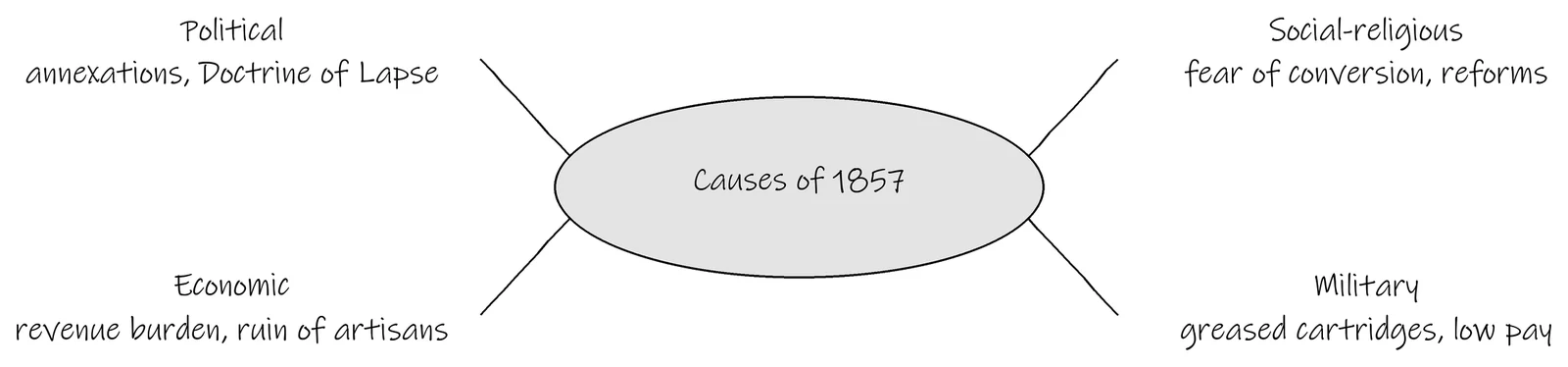
The causes were many and connected (Figure 3.2):
- Political. Lord Dalhousie’s Doctrine of Lapse annexed states whose rulers died without a natural heir, such as Satara (1848), Jhansi (1853) and Nagpur (1854), and Awadh was annexed in 1856 on the charge of misgovernment; the Mughal emperor was told that his successors would lose the title.
- Economic. Heavy land revenue, the loss of land by peasants and talukdars, and the ruin of artisans by British goods created widespread discontent.
- Social and religious. Reforms such as the abolition of sati (1829) and the Widow Remarriage Act (1856), and the activity of missionaries, created a fear that the British intended to destroy Indian religions.
- Military. Sepoys resented low pay, racial discrimination, service overseas (General Service Enlistment Act, 1856) and, finally, the new Enfield rifle, whose cartridges were rumoured to be greased with cow and pig fat.
Course and Consequences
From Meerut the sepoys marched to Delhi on 11 May and proclaimed the aged Bahadur Shah Zafar emperor. The revolt spread to Kanpur (Nana Sahib and Tantia Tope), Lucknow (Begum Hazrat Mahal), Jhansi (Rani Lakshmibai), Bihar (Kunwar Singh) and many rural areas. By 1858 it had been brutally suppressed. Its consequences were far-reaching: Company rule ended in 1858; the army was reorganised to increase British troops and recruit from ‘loyal’ groups; the British promised non-interference in religion and allied with princes and landlords; and the policy of divide and rule became sharper.
The Many Histories of 1857
Sekhar Bandyopadhyay, in ‘Eighteen-Fifty-Seven and Its Many Histories’ (2008), shows that the revolt has been interpreted in many ways, each reflecting its writer’s politics:
- A sepoy mutiny. British officials and early historians such as John Kaye presented it as a mutiny of discontented soldiers.
- A national war of independence. V.D. Savarkar (1909) called it the first Indian war of independence, inspiring later revolutionaries.
- A feudal reaction. R.C. Majumdar argued that it was ‘neither the first, nor national, nor a war of independence’, but a reaction of dispossessed princes and landlords.
- A popular and peasant revolt. Marx, writing about it in 1857, already saw it as more than a mutiny; later historians such as Eric Stokes (The Peasant Armed, 1986) and Rudrangshu Mukherjee showed the deep involvement of peasants and the countryside.
The balanced view is that 1857 was more than a mutiny but not yet a modern national movement: a broad, popular anti-colonial uprising with many local leaders and grievances, but without a common programme.
Features of the Revolt
- Military origin, popular spread. It began among the sepoys of the Bengal Army, many of them peasants from Awadh, so their grievances were linked with those of rural society.
- Hindu–Muslim unity. Rebels of both communities fought together under the Mughal emperor, a fact later stressed by nationalists.
- Restoration of old authority. Rebels proclaimed Bahadur Shah Zafar and local rulers, which shows a desire to restore pre-British political order.
- Rural participation. In Awadh and western UP, peasants and talukdars attacked revenue offices, moneylenders and records, as Eric Stokes and Rudrangshu Mukherjee showed.
- Lack of a common programme. Different groups fought for different aims, and there was no plan for a new political order.
- Regional limits. The south, the Punjab, Bengal and most princely states remained largely quiet.
3.2 Social and Religious Reform Movements
While 1857 was a revolt against colonial rule, the reform movements were an attempt by educated Indians to answer the challenge of the West by reforming their own society. A.P. Sen, in ‘The Idea of Social Reform and its Critique among Hindus of Nineteenth Century India’ (2007), shows that reformers were divided between those who wanted rational reform and those who defended or revived tradition (Figure 3.3).
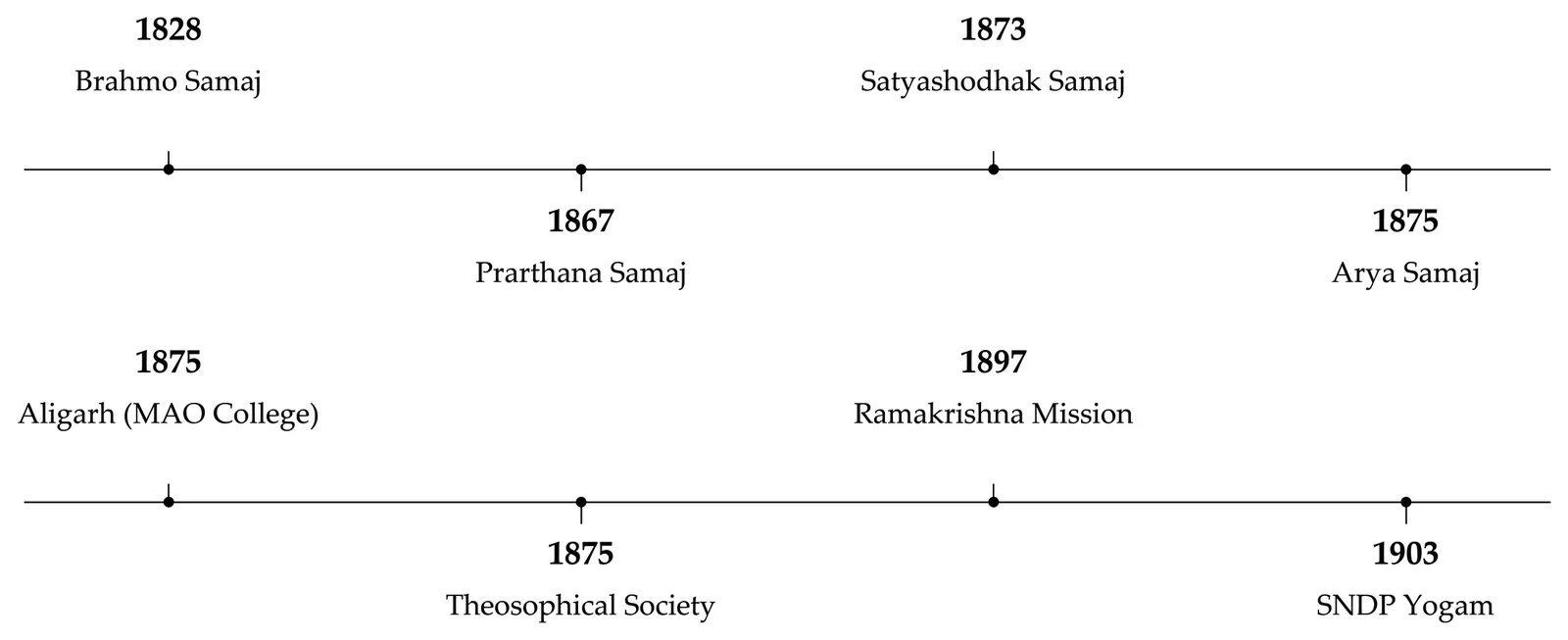
- Raja Rammohan Roy and the Brahmo Samaj (1828). Rammohan Roy, often called the father of modern India, attacked idolatry and sati, supported women’s rights and English education, and founded the Brahmo Samaj to worship one God; his campaign helped Bentinck abolish sati in 1829.
- Young Bengal. The students of Henry Derozio at Hindu College, Calcutta, in the 1820s and 1830s, challenged orthodoxy in the name of reason and freedom.
- Ishwar Chandra Vidyasagar. A Sanskrit scholar who used the shastras themselves to argue for widow remarriage, leading to the Hindu Widows’ Remarriage Act of 1856, and who promoted girls’ education.
- Prarthana Samaj (1867). Founded in Bombay; M.G. Ranade made it a centre of social reform, including the education of women and widow remarriage.
- Arya Samaj (1875). Founded by Swami Dayananda Saraswati, author of Satyarth Prakash, with the call ‘Back to the Vedas’; it rejected idolatry, ritualism and caste by birth, but also launched shuddhi (reconversion), which later increased religious tension.
- Theosophical Society. Founded in New York in 1875 by Madame Blavatsky and Colonel Olcott and moved to Adyar (Madras) in 1882; under Annie Besant it praised Indian spiritual traditions.
- Ramakrishna Mission (1897). Founded by Swami Vivekananda, who spoke at the Parliament of Religions in Chicago in 1893; it joined Vedanta with social service.
- The Aligarh Movement. Sir Syed Ahmad Khan founded the Muhammadan Anglo-Oriental College at Aligarh in 1875 (later Aligarh Muslim University) to spread modern education among Muslims.
- Anti-caste reform. Jyotirao Phule’s Satyashodhak Samaj (1873) in Maharashtra and Sree Narayana Guru’s SNDP Yogam (1903) in Kerala challenged Brahmanical dominance (Chapter 5).
Other movements included the Deoband seminary (1867), the Singh Sabha (1873) among Sikhs and the Ahmadiyya movement. Conservative critics such as Radhakanta Deb’s Dharma Sabha (1830) opposed reform, and later nationalists such as Tilak opposed the Age of Consent Bill of 1891, arguing that a foreign government had no right to legislate on Hindu society.
Limitations of the Reform Movements
- Narrow social base: the leaders and followers were mostly upper-caste, urban and English-educated; peasants and the lower castes were hardly touched, except by Phule and Narayana Guru.
- Dependence on the colonial state: reformers relied on British legislation, which allowed critics to call reform a foreign imposition.
- Revivalism and communal tendencies: the claim to restore a ‘golden age’ and campaigns such as shuddhi and cow protection sharpened religious boundaries.
- Limited change in practice: laws such as the Widow Remarriage Act (1856) were rarely used, and caste and gender hierarchies remained strong.
3.3 The Debate on an Indian Renaissance
The reform movements, especially in Bengal, are often called the Indian (or Bengal) Renaissance, by comparison with the European Renaissance. Supporters of this view point to the spirit of rationalism, humanism and individualism; the questioning of superstition and caste; the campaigns for women’s rights; the growth of education, the press and modern literature (Bankim Chandra, Tagore); and the revival of pride in India’s past. Critics, especially from the 1970s, such as Sumit Sarkar and Barun De, argued that the term is misleading: the movement was confined to a small upper-caste, urban, English-educated elite; it depended on the colonial state for its reforms; it had a strong revivalist side; it did not touch the peasantry; and, unlike Europe, it took place under foreign rule and without economic transformation. The balanced view is that the nineteenth century saw a genuine intellectual awakening, but a limited and contradictory one.
3.4 Education and the Rise of the New Middle Class
Colonial educational policy was decided in the Orientalist–Anglicist controversy. The Orientalists wanted to support Sanskrit and Persian learning; the Anglicists, led by Macaulay, wanted English education. Macaulay’s Minute of 2 February 1835 won, and Bentinck’s English Education Act (1835) made English the medium of higher education. Wood’s Despatch (1854), often called the Magna Carta of English education in India, proposed a graded system of schools and led to the founding of the universities of Calcutta, Bombay and Madras in 1857 (Figure 3.4).
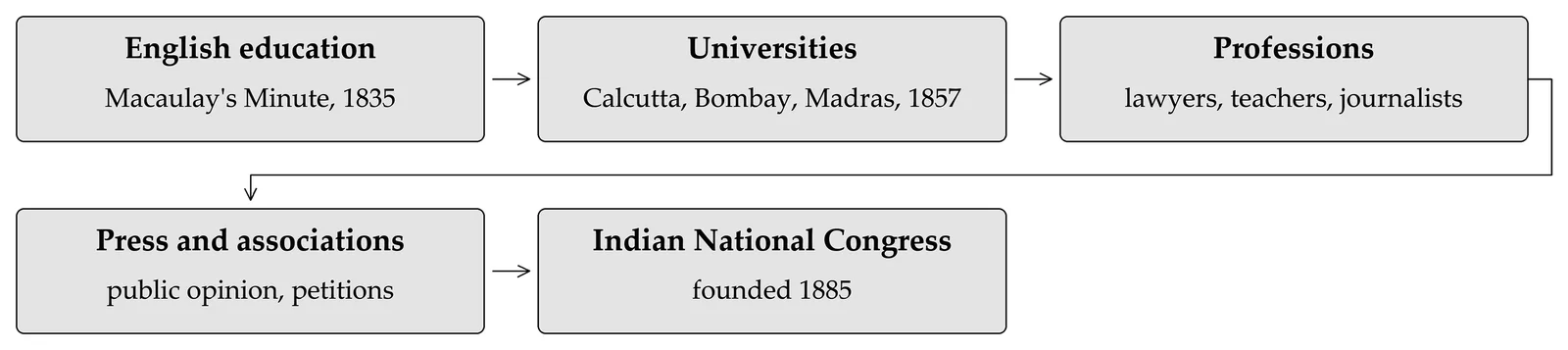
English education produced a new middle class of lawyers, teachers, doctors, journalists and government clerks, described by B.B. Misra in The Indian Middle Classes (1961). Its features and role were these:
- Modern outlook. Exposure to Western liberal ideas of liberty, equality and representative government.
- Social reform. It led the reform movements and campaigns for women’s education.
- Press. It founded newspapers such as the Amrita Bazar Patrika (1868), The Hindu (1878) and Kesari (1881), creating public opinion.
- Associations. It formed political associations: the British Indian Association (1851), the Poona Sarvajanik Sabha (1870), the Indian Association (1876), the Madras Mahajan Sabha (1884) and the Bombay Presidency Association (1885).
- Economic critique. Thinkers such as Naoroji, Ranade and R.C. Dutt developed the critique of colonial economic policy.
- Founding of the Congress. In December 1885 seventy-two delegates met in Bombay under W.C. Bonnerjee to found the Indian National Congress.
Its limitations were that it was small, urban, largely upper-caste and Hindu in composition, and for a long time loyal to British rule; colonial officials mocked it as a ‘microscopic minority’. Yet this class became the leadership of Indian nationalism.
3.5 Important Questions
- Question 1 Do you think social and religious reform movements led to a Renaissance in India? Comment.
- Question 2 Discuss the nature of the revolt of 1857 with reference to its causes and interpretations.
- Question 3 Write a short note on the rise of the middle class in colonial India.
DU asks the same idea in different words. So learn one broad answer for each question below; the same answer works for every question joined by OR.
Important Question 1
Do you think social and religious reform movements led to a Renaissance in India? Comment.
OR
Discuss the major social and religious reform movements of nineteenth-century India.
OR
Examine the nature and limitations of the nineteenth-century reform movements.
Model Answer
“Arise, awake, and stop not till the goal is reached.”
— Swami Vivekananda
Introduction. In the nineteenth century, educated Indians responded to colonial rule and to the challenge of Western ideas by trying to reform their religion and society through reason, education and new institutions. This awakening, which began in Bengal and spread across India, has often been called the Indian or Bengal Renaissance, by comparison with the European Renaissance. Whether the term is justified is one of the important debates of modern Indian history.
1. Background
Colonial rule brought English education, the printing press, newspapers, Christian missionaries and Western ideas of reason, individual rights and social equality. Missionaries and officials attacked Indian religion and customs, such as sati, child marriage, the condition of widows, idolatry and caste. Educated Indians responded in two ways: some sought to reform their society in the light of reason, while others defended or revived tradition. A.P. Sen shows that this tension between reform and its critique ran through the whole century. These forces created a new public sphere of debate in Calcutta, Bombay and Madras.
2. The Major Movements
Raja Rammohan Roy founded the Brahmo Samaj (1828), attacked idolatry and sati, and supported English education and women’s rights; his campaign helped Bentinck abolish sati (1829). Ishwar Chandra Vidyasagar used the shastras to argue for widow remarriage, leading to the Hindu Widows’ Remarriage Act (1856). The Prarthana Samaj (1867), with M.G. Ranade, promoted women’s education and social reform in western India. Swami Dayananda Saraswati founded the Arya Samaj (1875) with the call ‘Back to the Vedas’, rejecting idolatry and caste by birth. Swami Vivekananda founded the Ramakrishna Mission (1897), joining Vedanta with social service. Sir Syed Ahmad Khan founded the Muhammadan Anglo-Oriental College at Aligarh (1875) to bring modern education to Muslims. Jyotirao Phule (Satyashodhak Samaj, 1873) and Sree Narayana Guru (SNDP Yogam, 1903) challenged caste from below.
3. Common Features
- Rationalism: customs were judged by reason and social utility rather than blind tradition.
- Religious universalism and reform: attacks on idolatry, ritualism and priestly domination, and a search for a purified faith.
- Women’s question: campaigns against sati and child marriage, and for widow remarriage and female education.
- Critique of caste: in varying degrees, from Brahmo and Arya criticism to Phule’s radical rejection.
- Education and the press: schools, colleges and newspapers spread new ideas.
- Pride in India’s heritage: reformers often claimed to restore an original purity of Indian religion.
4. Women and Reform
Ishwar Chandra Vidyasagar campaigned for widow remarriage, legalised in 1856, and for girls’ education, while Pandita Ramabai and Savitribai Phule showed women as reformers in their own right.
5. Arguments for a Renaissance
As in Renaissance Europe, nineteenth-century India saw a revival of learning, a spirit of enquiry and humanism, the questioning of religious authority, the rise of the individual, and a flowering of literature and thought, from Bankim Chandra and Michael Madhusudan Dutt to Tagore. New social attitudes towards women and caste emerged, and the reformers created the intellectual foundations of nationalism and of modern Indian political thought.
6. Reform from Below
Movements led by Phule, Narayana Guru and others challenged caste from below, showing that the awakening was not only an upper-caste affair.
7. Arguments against a Renaissance
Historians such as Sumit Sarkar and Barun De argued that the term exaggerates the change. The movements were confined to a small upper-caste, urban, English-educated elite and hardly touched the peasantry; they relied on the colonial state for legislation; many had a revivalist side, and some, such as shuddhi and cow protection, later sharpened communal divisions; they took place without the economic transformation that accompanied the European Renaissance; and they were shaped by colonial ideas of Indian ‘backwardness’. Conservative bodies such as the Dharma Sabha (1830) opposed reform, and later nationalists such as Tilak opposed the Age of Consent Act (1891), arguing that a foreign government had no right to legislate on Hindu society. Others note that the reforms touched mainly upper-caste urban groups and often accepted colonial views of Indian society.
8. Evaluation
The term ‘Renaissance’ is useful if it is understood as an intellectual and cultural awakening rather than a total social transformation. The reform movements changed attitudes towards religion, women and caste, created modern institutions, and produced the generation that founded the national movement, but their reach was limited by class, caste and colonial dependence.
Conclusion. Thus, the social and religious reform movements produced a genuine but limited renaissance: an awakening of reason and social conscience among the educated few, which became the seedbed of Indian nationalism and of later movements for social justice.
Important Question 2
Discuss the nature of the revolt of 1857 with reference to its causes and interpretations.
OR
Was the revolt of 1857 a sepoy mutiny or a war of independence?
OR
Discuss the causes and consequences of the revolt of 1857.
Model Answer
“It was neither the first, nor national, nor a war of independence.”
— R.C. Majumdar on the revolt of 1857
Introduction. The revolt of 1857 was the most serious challenge to British rule in the nineteenth century. It began as a mutiny of the sepoys of the Bengal Army at Meerut on 10 May 1857, but it spread across northern and central India and drew in dispossessed rulers, landlords, peasants and artisans. Its nature has been debated ever since.
1. Political Causes
Lord Dalhousie’s Doctrine of Lapse annexed states whose rulers died without natural heirs, such as Satara (1848), Jhansi (1853) and Nagpur (1854), and Awadh was annexed in 1856 on the charge of misgovernment. The pension of Nana Sahib, the adopted son of the last Peshwa, was stopped, and the Mughal emperor was told that his successors would lose the imperial title. Satara (1848), Jhansi (1853) and Nagpur (1854) were annexed under the doctrine, and Awadh in 1856 on grounds of misgovernment.
2. Economic Causes
Heavy land revenue drove peasants into debt and land loss; in Awadh, talukdars lost estates under the summary settlement of 1856; artisans were ruined by British goods; and the end of princely courts left many soldiers, officials and craftsmen without livelihood. Artisans ruined by British imports and soldiers whose allowances were cut also had grievances.
3. Social, Religious and Military Causes
Reforms such as the abolition of sati and the Widow Remarriage Act (1856), and missionary activity, created fears of forced conversion. Sepoys resented low pay, racial discrimination, the loss of allowances and the General Service Enlistment Act (1856), which required overseas service. The immediate cause was the new Enfield rifle, whose cartridges were rumoured to be greased with cow and pig fat, offending both Hindus and Muslims. The greased cartridges of the Enfield rifle, rumoured to be smeared with cow and pig fat, became the immediate spark at Barrackpore and Meerut.
4. Course and Leaders
From Meerut the rebels reached Delhi on 11 May and proclaimed the aged Bahadur Shah Zafar emperor. The revolt spread to Kanpur under Nana Sahib and Tantia Tope, Lucknow under Begum Hazrat Mahal, Jhansi under Rani Lakshmibai, Bihar under Kunwar Singh, and to many rural areas of Awadh and Rohilkhand. By the middle of 1858 it had been suppressed with great brutality. Rani Lakshmibai of Jhansi, Nana Saheb and Tantia Tope at Kanpur, Begum Hazrat Mahal at Lucknow and Kunwar Singh in Bihar led the revolt in different regions.
5. Popular Participation
In many areas peasants, artisans and tribal groups joined the revolt, attacking moneylenders, records and police stations, which shows that it was more than a mutiny of soldiers.
6. Hindu–Muslim Unity
Hindus and Muslims fought together under Bahadur Shah Zafar’s symbolic leadership, which the British later tried to undermine through divide-and-rule policies.
7. Women in the Revolt
Women such as Rani Lakshmibai, Begum Hazrat Mahal and Jhalkari Bai became symbols of resistance, and nationalists later celebrated their memory.
8. Causes of Failure
The revolt was limited largely to the north; many princes, such as the Nizam and Scindia, and most educated Indians stayed loyal; the rebels lacked a common programme, unified leadership and modern arms; and the British controlled communications and resources. The rebels lacked a common programme and modern weapons, while the British controlled communications through the telegraph.
9. Consequences
Company rule ended with the Government of India Act (1858) and Queen Victoria’s Proclamation; the army was reorganised to increase British troops and recruit from ‘loyal’ groups; annexation was abandoned and princes became allies; and the British turned more cautious about social reform and more committed to divide and rule. The army was reorganised to increase the proportion of European soldiers and to separate Indian troops by caste and region. The policy of annexation was abandoned and princes were assured of their thrones.
10. Interpretations
British officials and writers such as John Kaye called it a sepoy mutiny. V.D. Savarkar (1909) called it the first war of Indian independence. R.C. Majumdar saw it as a feudal reaction of dispossessed princes and landlords, ‘neither the first, nor national, nor a war of independence’. S.N. Sen, in the official centenary history (1957), saw it as beginning as a mutiny and becoming a political revolt. Historians such as Eric Stokes (The Peasant Armed, 1986) and Rudrangshu Mukherjee showed the deep involvement of peasants and rural society. Sekhar Bandyopadhyay emphasises its ‘many histories’: a mosaic of local revolts with different grievances. Marxists saw it as a national and peasant revolt, while R.C. Majumdar and S.N. Sen argued that it was neither simply a mutiny nor fully a war of independence. Savarkar called it the First War of Indian Independence, and the centenary of 1957 made this view widely accepted in India.
11. Evaluation
The revolt of 1857 was more than a mutiny but less than a fully national war of independence: it combined military, feudal, peasant and religious grievances. Its suppression changed the character of British rule and, in memory, inspired later nationalists.
Conclusion. Thus, 1857 was more than a mutiny but less than a modern national movement. It was a broad anti-colonial uprising of many groups, and its memory inspired later nationalists.
Important Question 3
Write a short note on the rise of the middle class in colonial India.
OR
Discuss the role of English education in colonial India.
OR
Examine the role of the new middle class in the rise of nationalism.
Model Answer
“A class of persons Indian in blood and colour, but English in taste, in opinions, in morals and in intellect.”
— Thomas Macaulay, Minute on Education (1835)
Introduction. The new middle class of English-educated professionals was a product of colonial education and administration. Though created to serve colonial rule, it became the leader of social reform and of early Indian nationalism.
1. Origins
In the Orientalist–Anglicist controversy, Macaulay’s Minute and the English Education Act (1835) made English the medium of higher education. Wood’s Despatch (1854) proposed a graded system of education, and the universities of Calcutta, Bombay and Madras were founded in 1857. Colonial administration, law courts, trade and the press created jobs for educated Indians. B.B. Misra, in The Indian Middle Classes (1961), traced the growth of this class. Universities were founded at Calcutta, Bombay and Madras in 1857, and English-educated graduates found jobs in government, law, teaching and journalism. The Charter Act of 1813 had first set aside funds for education.
2. Economic Basis
Unlike the European bourgeoisie, the Indian middle class rested less on industry and trade than on education and the professions, which is why B.B. Misra, in The Indian Middle Classes (1961), saw it as a class created largely by colonial education and administration.
3. Composition
It consisted of lawyers, teachers, doctors, journalists, government clerks and small merchants, concentrated in the presidency towns and drawn largely from upper castes such as Bengali bhadralok, Chitpavan Brahmins and Tamil Brahmins. Most came from upper castes and from regions such as Bengal, Bombay and Madras where colonial institutions were strongest. Groups such as the Bengali bhadralok and the Chitpavan Brahmins of Maharashtra were prominent.
4. Newspapers and the Public Sphere
The middle class created an English and vernacular press, associations and public meetings, forming a public sphere in which colonial policies could be criticised; newspapers such as The Hindu (1878) and Kesari (1881) were landmarks.
5. Role in Reform and Nationalism
It led the social reform movements; founded newspapers such as Amrita Bazar Patrika (1868), The Hindu (1878) and Kesari (1881); formed political associations such as the Poona Sarvajanik Sabha (1870), the Indian Association (1876) and the Madras Mahajan Sabha (1884); developed the economic critique of colonialism; and founded the Indian National Congress in 1885. Leaders such as Surendranath Banerjea, Gokhale and Tilak came from this class, and the Indian National Congress (1885) was largely its creation.
6. Associations before the Congress
Bodies such as the British Indian Association (1851), the Poona Sarvajanik Sabha (1870), the Indian Association (1876) and the Madras Mahajan Sabha (1884) trained the middle class in organised politics before the founding of the Congress.
7. Women of the Middle Class
Middle-class women such as Pandita Ramabai, Kamini Roy and Sarojini Naidu entered education, writing and public life, and the ‘new woman’ became a subject of public debate.
8. A Class of Contradictions
The middle class was both a product of colonialism and its critic: it admired Western liberal ideas while demanding that Britain apply them to India, a contradiction that shaped early moderate politics.
9. Middle Class and Caste
Because English education was most accessible to upper castes, the new middle class reproduced caste privilege, which anti-caste leaders such as Phule criticised.
10. The Middle Class and Language
The middle class also shaped modern Indian languages and literatures, standardising Bengali, Marathi, Hindi and Tamil prose through novels, journals and textbooks, which helped regional and national identities grow.
11. Moderate Politics
The early Congress leaders, drawn from this class, used petitions, speeches and the press to demand Indian representation in councils and the civil service, reflecting their faith in constitutional methods.
12. Limitations
It was small, urban, largely upper-caste and for a long time loyal to British rule; it was distant from peasants and workers until the Swadeshi and Gandhian movements widened the base of nationalism. Its leadership of nationalism became truly mass-based only when Gandhi linked it with peasants and workers.
13. The Middle Class after Independence
After 1947 the middle class expanded through public employment, education and, after 1991, economic liberalisation, and it remains influential in Indian politics and public opinion.
14. Evaluation
The rise of the middle class was a decisive development of colonial India: it produced the leaders, ideas and organisations of reform and nationalism, though its narrow base meant that independence required the mobilisation of wider social groups.
Conclusion. Thus, the middle class, though created by colonial education, turned the liberal ideas it learnt against colonial rule and became the first leadership of Indian nationalism.
Short Notes
(a) Raja Rammohan Roy and the Brahmo Samaj
Rammohan Roy (1772–1833), often called the father of modern India, studied Sanskrit, Persian, Arabic and English and wrote against idolatry, polytheism and priestly domination. He founded the Atmiya Sabha (1815) and the Brahmo Sabha in 1828 (later the Brahmo Samaj) for the worship of one formless God. He campaigned against sati, which Bentinck abolished in 1829, supported women’s property rights and English education, and defended freedom of the press. After him, Debendranath Tagore and Keshab Chandra Sen led the movement, which split in 1866 and again in 1878.
(b) The Arya Samaj
Founded by Swami Dayananda Saraswati in Bombay in 1875, with its main centre later in Lahore, the Arya Samaj called people ‘back to the Vedas’, which it regarded as the only infallible authority. In Satyarth Prakash (1875) Dayananda rejected idolatry, ritualism, child marriage and caste by birth, and supported widow remarriage and women’s education. The Samaj founded the Dayanand Anglo-Vedic (DAV) schools (1886) and spread nationalist pride, but its shuddhi (reconversion) campaign increased tensions with Muslims and Christians.
(c) Wood’s Despatch (1854)
Sent by Charles Wood, President of the Board of Control, it is often called the Magna Carta of English education in India. It recommended a graded system from vernacular primary schools to universities, grants-in-aid to private schools, education of women, teacher training and departments of education in each province. It led to the founding of the universities of Calcutta, Bombay and Madras in 1857.
More notes: DSC-3 Colonialism and Nationalism in India
These notes are prepared by PADHO TO AISE for study help. They are not an official University of Delhi publication.