
Semester VIII DSE-16 Environment
Unit 2 · 24 min read · Updated 24 Nov 2026
As per the University of Delhi (DU) BA (Hons) Political Science syllabus
Contents
- 2.1 The Gender and Environment Debate
- Origins of Ecofeminism
- Features of Shiva’s Ecofeminism
- Agarwal’s Feminist Environmentalism
- Women in Environmental Movements and Policy
- 2.2 The Commons
- Hardin’s Tragedy of the Commons
- Ostrom’s Design Principles
- The Commons in India
- Open Access and Groundwater
- 2.3 The Global Commons
- Features of the Global Commons
- Treaties Governing the Global Commons
- New Challenges
- 2.4 Important Questions
- What is ecofeminism? Discuss Vandana Shiva’s views on women and ecology.
- Discuss the gender and environment debate with reference to Bina Agarwal.
- Discuss the tragedy of the commons and Ostrom’s response.
- What are the global commons? Discuss the problems of governing them.
- Short Notes
साझा संसाधनों में स्वतंत्रता सबके लिए विनाश लाती है।
Freedom in a commons brings ruin to all.
— Garrett Hardin, The Tragedy of the Commons (1968)
TWO perspectives have reshaped environmental thinking. The gender and environment debate asks how women and nature are related and how environmental change affects women. Vandana Shiva’s ecofeminism sees a special bond between women and nature, while Bina Agarwal grounds women’s relationship with the environment in work, property and power. The debate on the commons asks whether shared resources, from village pastures to the oceans and the atmosphere, are doomed to overuse, as Garrett Hardin argued, or can be managed by communities, as Elinor Ostrom showed. This chapter explains both perspectives.
2.1 The Gender and Environment Debate
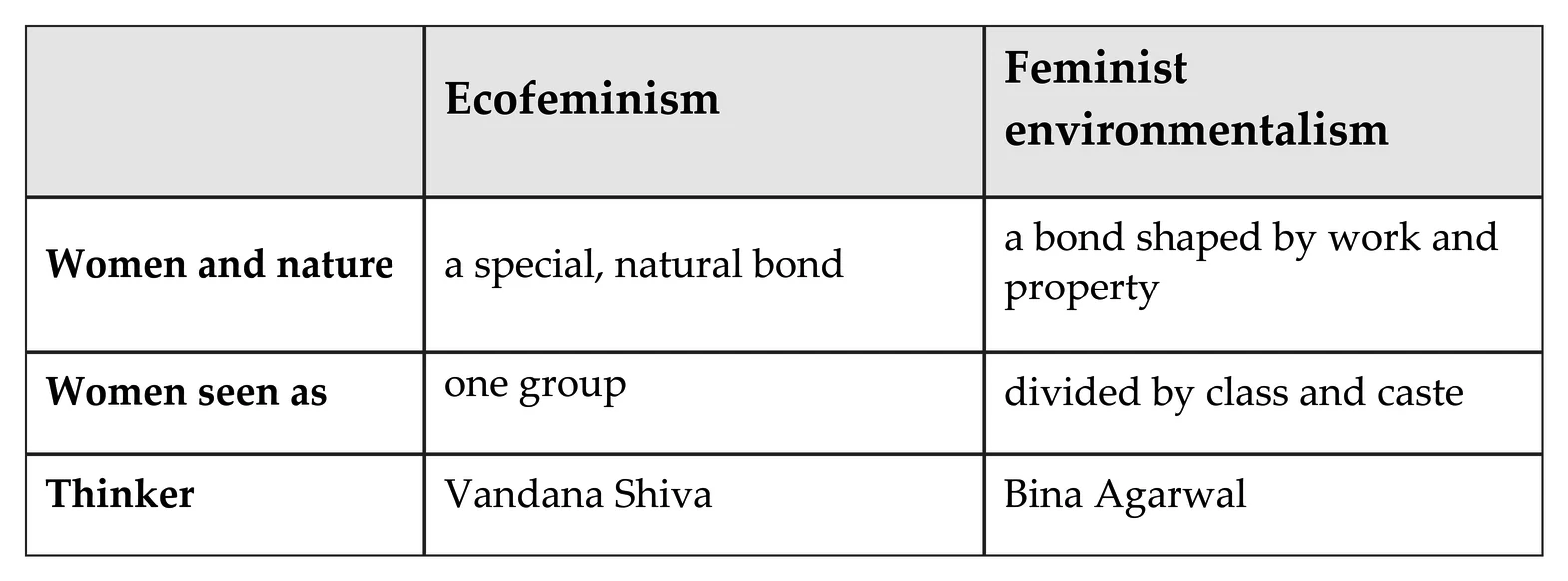
Ecofeminism links the domination of women with the domination of nature. Vandana Shiva argues that Western development is a patriarchal maldevelopment that destroys both, and that rural women are guardians of nature. Bina Agarwal criticises this view and proposes feminist environmentalism, which explains women’s relationship with nature through the gender division of labour, property and power.
Origins of Ecofeminism
The French writer Françoise d’Eaubonne coined the term ecofeminism in 1974. Carolyn Merchant, in The Death of Nature (1980), argued that the scientific revolution of the sixteenth and seventeenth centuries replaced an older image of nature as a living, nurturing mother with a mechanical view that justified its exploitation, and that this change coincided with the subordination of women. Karen Warren described a logic of domination in Western thought, which ranks men above women and culture above nature and uses this ranking to justify control. Vandana Shiva, in Staying Alive (1988), developed an Indian version, drawing on the idea of prakriti, nature as the active feminine principle, and later wrote Ecofeminism (1993) with the German sociologist Maria Mies.
Features of Shiva’s Ecofeminism
- Maldevelopment. Western development, imposed through colonialism and modern science, is a patriarchal project that treats nature and women as passive and productive only when exploited.
- The feminine principle. Prakriti is the living force of nature, and women, especially rural women, are its guardians through their daily work in food, water and fuel.
- Critique of monocultures. In Monocultures of the Mind (1993), Shiva argued that scientific forestry and the Green Revolution replaced diverse local systems with uniform crops and plantations, destroying biodiversity and local knowledge.
- Seeds and biopiracy. Through the organisation Navdanya, founded in 1987, Shiva campaigns for farmers’ seeds and against patents on life forms.
- Women as activists. She points to Chipko and other movements in which women defended forests and water as proof of women’s special relationship with nature.
Agarwal’s Feminist Environmentalism
Bina Agarwal, in The Gender and Environment Debate: Lessons from India (1992), criticised ecofeminism for treating women as a single category, ignoring differences of class, caste and race, and for locating women’s closeness to nature in biology or ideology rather than in material conditions. She argued that women’s concern for the environment arises from the gender division of labour: women collect fuel, fodder and water and so are directly affected by deforestation and the loss of commons. Her alternative, feminist environmentalism, calls for changing both the distribution of property and power and the way resources are managed. In A Field of One’s Own (1994), she showed that land rights for women are central to their welfare and bargaining power.
Women in Environmental Movements and Policy
Women have played leading roles in environmental struggles: Gaura Devi in Chipko in 1974, women in the Appiko movement of Karnataka in 1983, Medha Patkar in the Narmada movement and Mayilamma in the campaign against the Coca-Cola plant at Plachimada in Kerala from 2002. In Kenya, Wangari Maathai founded the Green Belt Movement in 1977, which planted millions of trees, and won the Nobel Peace Prize in 2004. Development thinking moved from Women in Development, inspired by Ester Boserup’s Woman’s Role in Economic Development (1970), to Gender and Development, which examines power relations. In India, rules for joint forest management committees and joint titles under the Forest Rights Act of 2006 seek to include women in resource governance.
2.2 The Commons
A commons is a resource shared by a group, such as a pasture, forest, fishery or groundwater. Garrett Hardin argued that individuals using a commons freely will overuse it, causing a tragedy. Elinor Ostrom showed that many communities have managed commons sustainably for centuries through their own rules, and identified design principles for success.
Hardin’s Tragedy of the Commons
Garrett Hardin’s essay The Tragedy of the Commons, published in Science in 1968, borrowed an example from the English economist William Forster Lloyd, who wrote in 1833. Imagine a pasture open to all herders: each herder gains the full benefit of adding one more animal but shares the cost of overgrazing with everyone, so each keeps adding animals until the pasture is ruined. Hardin’s main concern was population growth, and he concluded that freedom in a commons brings ruin to all. He proposed either privatisation or state regulation, which he called mutual coercion mutually agreed upon.
Ostrom’s Design Principles
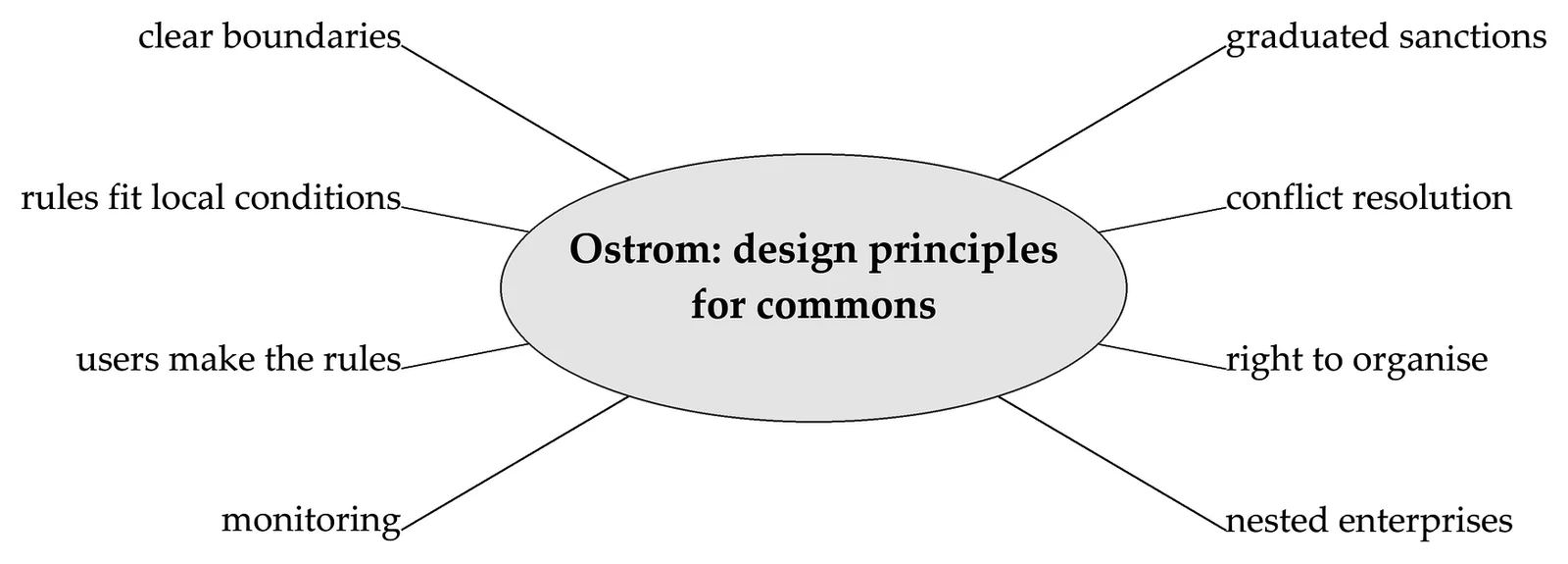
Elinor Ostrom, in Governing the Commons (1990), studied long-enduring commons such as Swiss alpine meadows, Japanese village forests, Spanish irrigation systems governed by water tribunals and irrigation societies in the Philippines. She found that successful communities shared eight design principles. In 2009 she became the first woman to win the Nobel Prize in Economics.
- Clear boundaries of the resource and of those entitled to use it.
- Rules suited to local conditions, linking benefits with contributions.
- Collective-choice arrangements that let users take part in making rules.
- Monitoring by people accountable to the users.
- Graduated sanctions for those who break the rules.
- Cheap and quick conflict resolution.
- Recognition by the state of the community’s right to organise.
- Nested enterprises, with larger systems organised in layers.
The Commons in India
Common lands and resources have been vital to rural India. N.S. Jodha’s study of dry regions, published in 1986, showed that common property resources such as village pastures, forests and ponds provided a large part of the fuel, fodder and income of poor households, and that these commons were shrinking through privatisation and encroachment. Traditional institutions include the kuhls (irrigation channels) of Himachal Pradesh, the phad irrigation system of Maharashtra, the eris (tanks) of Tamil Nadu and the orans (sacred groves) of Rajasthan. In Jagpal Singh v. State of Punjab (2011), the Supreme Court ordered state governments to remove illegal encroachments on village common lands.
Open Access and Groundwater
Critics note that Hardin confused a commons governed by a community with open access, where there are no rules at all; S.V. Ciriacy-Wantrup and Richard Bishop made this distinction in 1975. Groundwater in India is a clear example of open access becoming a tragedy: land owners can pump unlimited water from their own wells, and India is the world’s largest user of groundwater. Falling water tables in Punjab, Haryana and Rajasthan show the danger. The Atal Bhujal Yojana of 2019 seeks community-led management of groundwater in water-stressed areas, applying Ostrom’s ideas.
2.3 The Global Commons
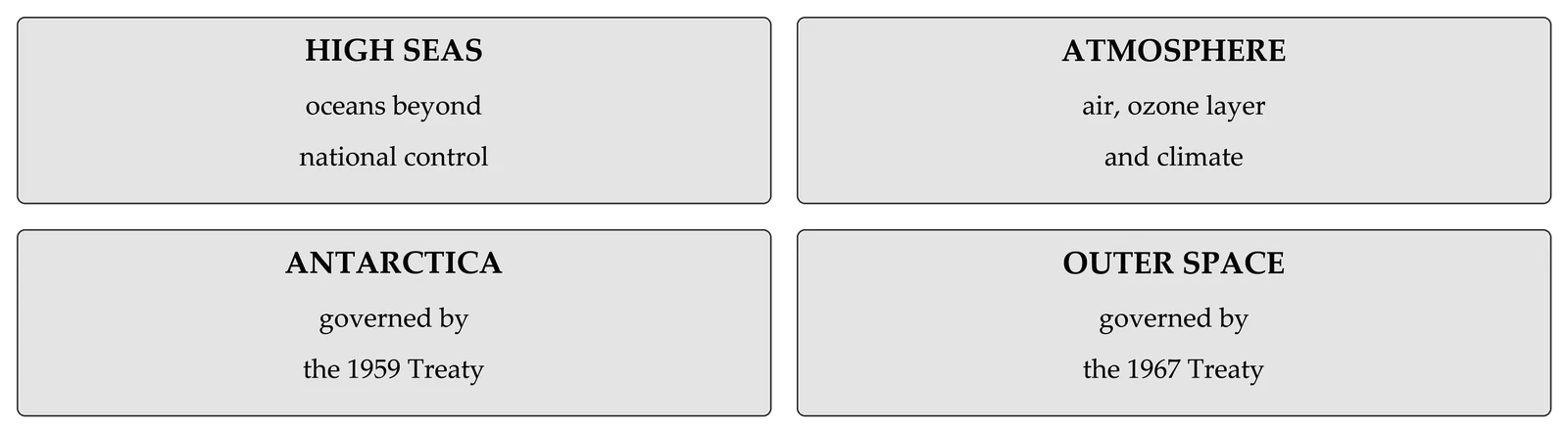
The global commons are areas and resources beyond national jurisdiction: the high seas, the atmosphere, Antarctica and outer space. They are governed by international treaties, but they face the same dangers of overuse and free-riding as local commons, as climate change and overfishing show.
Features of the Global Commons
- Beyond national jurisdiction. The high seas, the deep seabed, Antarctica, outer space and the atmosphere are not owned by any state.
- Common heritage of mankind. In a speech to the UN on 1 November 1967, Malta’s ambassador Arvid Pardo proposed that the seabed be treated as the common heritage of mankind, to be used peacefully and for the benefit of all.
- Free-riding. Because no one can be excluded, states are tempted to benefit without paying; Scott Barrett, in Environment and Statecraft (2003), studied how treaties can overcome this.
- Unequal capacity. Only rich and technologically advanced states can exploit the deep seabed or outer space, raising questions of fairness.
Treaties Governing the Global Commons
- The oceans. The UN Convention on the Law of the Sea of 1982 created 200-nautical-mile exclusive economic zones and the International Seabed Authority; the Agreement on Marine Biodiversity of Areas beyond National Jurisdiction, adopted in 2023, aims to protect life on the high seas.
- Antarctica. The Antarctic Treaty of 1959 reserved the continent for peaceful scientific research and froze territorial claims, and the Madrid Protocol of 1991 banned mining; India joined in 1983, runs the Maitri and Bharati stations and passed the Indian Antarctic Act in 2022.
- Outer space. The Outer Space Treaty of 1967 declared space the province of all mankind and banned nuclear weapons in orbit; the Moon Agreement of 1979 attracted few parties, and India signed the US-led Artemis Accords in 2023.
- The atmosphere. The ozone and climate regimes treat the atmosphere as a shared resource requiring cooperation.
New Challenges
The global commons face growing pressure. Overfishing has depleted many fish stocks on the high seas. Space debris from satellites and anti-satellite tests threatens orbits; the American scientist Donald Kessler warned in 1978 of a chain reaction of collisions, and India’s anti-satellite test, Mission Shakti, in 2019 added to debates on space security. Interest in deep-sea mining of minerals for batteries raises fears for fragile ecosystems. Some scholars also describe cyberspace as a new global commons, though states increasingly claim sovereignty over it. These challenges show that the global commons need stronger institutions based on equity and science.
2.4 Important Questions
- Question 1 What is ecofeminism? Discuss Vandana Shiva’s views on women and ecology.
- Question 2 Discuss the gender and environment debate with reference to Bina Agarwal.
- Question 3 Discuss the tragedy of the commons and Ostrom’s response.
- Question 4 What are the global commons? Discuss the problems of governing them.
DU asks the same idea in different words. So learn one broad answer for each question below; the same answer works for every question joined by OR.
Important Question 1
What is ecofeminism? Discuss Vandana Shiva’s views on women and ecology.
OR
Examine the relationship between women and nature in ecofeminist thought.
OR
Discuss Shiva’s critique of development as maldevelopment.
Model Answer
“The violence to nature, which seems intrinsic to the dominant development model, is also associated with violence to women who depend on nature for drawing sustenance for themselves, their families, their societies.”
— Vandana Shiva, Staying Alive (1988)
Introduction. Ecofeminism is a body of thought that links the oppression of women with the exploitation of nature. It emerged in the 1970s and 1980s from feminist and environmental movements. In India, Vandana Shiva’s Staying Alive (1988) became one of the most influential ecofeminist works, drawing on the experience of rural women and movements such as Chipko.
1. Meaning
Ecofeminism holds that the domination of women and the domination of nature are connected, arising from the same patriarchal worldview, and that ending one requires ending the other.
2. Origin of the Term
The term ecofeminism was coined by the French writer Françoise d’Eaubonne in 1974. It grew in the West through writers such as Carolyn Merchant and Ynestra King and in India through Vandana Shiva.

3. Merchant’s Death of Nature
Carolyn Merchant, in The Death of Nature (1980), argued that the scientific revolution replaced an organic view of nature as a living mother with a mechanical view of nature as dead matter to be controlled, a change that also justified control over women.
4. The Logic of Domination
Karen Warren described a logic of domination in Western thought, which divides reality into hierarchical pairs, such as man and woman, culture and nature, reason and emotion, and treats the second as inferior and available for use.
5. Shiva’s Feminine Principle
Vandana Shiva draws on the Indian idea of Prakriti, nature as an active, creative feminine force. She argues that this feminine principle sustains life and that respecting it is the basis of ecological survival.
6. Maldevelopment
Shiva calls Western development maldevelopment, because it is based on reductionist science and profit, destroys diversity and sustainability, and marginalises women and nature as unproductive.
7. Women as Guardians
Shiva argues that rural women in the Third World are producers of sustenance and holders of ecological knowledge about forests, seeds and water, and are therefore the natural leaders of ecological struggles.
8. Chipko
Shiva points to the Chipko movement, in which women such as Gaura Devi of Reni village in 1974 hugged trees to stop logging, as an example of women defending the forest as a source of life.
9. Critique of the Green Revolution
Shiva criticised the Green Revolution for replacing diverse traditional crops with chemical-intensive monocultures, harming soil, water and women’s knowledge, and founded Navdanya in 1987 to conserve seeds.
10. Monocultures of the Mind
In Monocultures of the Mind (1993), Shiva argued that dominant knowledge systems erase local knowledge, just as monoculture plantations erase biological diversity.
11. Spiritual and Social Ecofeminism
Some ecofeminists stress a spiritual bond between women and nature, while social ecofeminists stress the social and economic structures that link the oppression of women and nature.
12. Criticisms
Critics argue that ecofeminism is essentialist, treating women as naturally closer to nature; that it romanticises traditional societies; and that it ignores differences of class, caste and region among women.
13. Agarwal’s Critique
Bina Agarwal argues that Shiva treats Indian women as a single category and locates the women–nature link in ideology rather than in material conditions such as labour and property rights.
14. Influence
Despite criticism, ecofeminism drew attention to women’s role in environmental movements, the gendered impact of development and the value of local knowledge.
15. Seeds and Biopiracy
Shiva campaigned against patents on seeds and traditional knowledge, which she called biopiracy. India successfully challenged patents on turmeric and neem in the 1990s, and Shiva argued that women farmers, as keepers of seeds, defend biodiversity against corporate control of agriculture.
16. Ecofeminism and Development Policy
Ecofeminist ideas influenced development debates in the 1980s and 1990s, encouraging agencies to see women as environmental managers and to involve them in projects on forestry, water and energy. Critics warned that this sometimes added to women’s unpaid work, as when programmes relied on women’s labour without giving them land rights or decision-making power.
17. Evaluation
Ecofeminism powerfully links the domination of women and nature, though its claims about a natural bond are contested.
Conclusion. Thus, ecofeminism links the oppression of women with the exploitation of nature, as Merchant and Warren show. Vandana Shiva sees Western development as maldevelopment that destroys the feminine principle, and rural women, as in Chipko, as guardians of nature, though Agarwal and others criticise her essentialism.
Important Question 2
Discuss the gender and environment debate with reference to Bina Agarwal.
OR
Distinguish between ecofeminism and feminist environmentalism.
OR
How does environmental degradation affect women in India?
Model Answer
“In the course of history, there comes a time when humanity is called to shift to a new level of consciousness, to reach a higher moral ground.”
— Wangari Maathai, Nobel Peace Prize Lecture (2004)
Introduction. The relationship between women and the environment has been debated by feminists and environmentalists. Ecofeminists such as Vandana Shiva see a special connection between women and nature. Bina Agarwal, in her influential 1992 article, criticised this view and developed feminist environmentalism, which grounds women’s relationship with nature in their material reality. This debate has shaped policy on gender, environment and development.
1. The Debate
The gender and environment debate asks whether women have a special relationship with nature, how environmental degradation affects women, and what role women should play in environmental management.
2. Agarwal’s Critique of Ecofeminism
Bina Agarwal argues that ecofeminism treats women as a single category, ignoring class, caste and race; locates the women–nature link in ideology or biology; and neglects the material sources of women’s relationship with the environment.
3. Critique of Shiva
Agarwal argues that Shiva blames colonialism and Western science for environmental decline while ignoring local inequalities of caste, class and gender in pre-colonial India, and romanticises the position of women in traditional society.
4. Feminist Environmentalism
Agarwal proposes feminist environmentalism, which holds that women’s relationship with nature is shaped by the gender division of labour, property and power, varying across classes and regions.
5. Women’s Work
In rural India, women do much of the work of collecting fuel, fodder and water. When forests and commons are degraded, women must walk farther and spend more time, harming their health, nutrition and income.
6. Decline of the Commons
Agarwal links environmental degradation with the decline of common property resources through privatisation and state control, which hurts poor women most, since they depend heavily on commons. N.S. Jodha documented this decline in the 1980s.
7. Property Rights
Agarwal stresses that women’s lack of land rights limits their control over resources and their voice in decisions, so land rights for women are central to both gender equality and environmental management.
8. Women in Movements
Women have played major roles in Chipko, Appiko and the Narmada Bachao Andolan, not because of a mystical bond with nature but because environmental destruction threatens their livelihoods and families.
9. Exclusion from Institutions
Agarwal’s later research showed that women were often excluded from forest protection committees under Joint Forest Management, even when they did most forest-related work, and that their presence improved forest outcomes.
10. Zelezny on Gender Differences
Lynnette Zelezny and colleagues found that women tend to report stronger environmental attitudes and behaviour than men, which they explain through socialisation into caring and cooperative roles rather than biology.
11. Buckingham-Hatfield
Susan Buckingham-Hatfield shows that gender shapes environmental experience and policy in both North and South, and calls for women’s participation in environmental decision-making.
12. Women, Environment and Development
International policy recognised women’s role through Agenda 21 at the Rio Earth Summit of 1992, which included a chapter on women and sustainable development.
13. Maathai’s Example
Wangari Maathai founded the Green Belt Movement in Kenya in 1977, mobilising women to plant trees, and won the Nobel Peace Prize in 2004, showing women’s leadership in environmental action.
14. Policy Implications
The debate suggests that environmental policy must address women’s rights to land and resources, reduce their work burden and include them in decision-making.
15. Evaluation
Agarwal’s feminist environmentalism grounds the gender and environment link in material conditions, offering a more nuanced view than ecofeminism.
Conclusion. Thus, the gender and environment debate contrasts Shiva’s ecofeminism with Agarwal’s feminist environmentalism, which roots women’s relationship with nature in labour, property and power. Degradation and the decline of commons hurt poor women most, Zelezny shows gender differences in attitudes, and women’s rights and participation are central to environmental policy.
Important Question 3
Discuss the tragedy of the commons and Ostrom’s response.
OR
Can communities manage common resources sustainably? Discuss.
OR
Examine Ostrom’s design principles for governing the commons.
Model Answer
“What is common to the greatest number has the least care bestowed upon it.”
— Aristotle, Politics, Book II
Introduction. Common resources, such as pastures, forests, fisheries and groundwater, are shared by many users. Garrett Hardin’s famous 1968 essay argued that such commons are doomed to overuse. Elinor Ostrom, who won the Nobel Prize in Economics in 2009, showed through studies across the world that communities can govern commons successfully. The debate has shaped environmental policy.
1. Meaning of Commons
A commons, or common-pool resource, is a resource from which it is difficult to exclude users and whose use by one person reduces what is available to others, such as fish in a lake or grass in a pasture.
2. Hardin’s Parable
Hardin described a pasture open to all herders. Each herder gains the full benefit of adding an animal but shares the cost of overgrazing with others, so each keeps adding animals until the pasture is ruined.
3. Hardin’s Solutions
Hardin argued that the tragedy could be avoided only by privatisation or by government control, which he called mutual coercion mutually agreed upon. He was especially concerned with population growth.
4. Influence of Hardin
Hardin’s essay influenced policies that nationalised forests and fisheries or privatised common lands, often ignoring the rights and practices of local communities.
5. Ostrom’s Challenge
Elinor Ostrom, in Governing the Commons (1990), argued that Hardin’s model applies to open-access resources with no rules, but that many real commons are governed by community institutions that prevent overuse.
6. Case Studies
Ostrom studied Swiss Alpine meadows, Japanese mountain forests, Spanish irrigation systems and Philippine irrigation societies, which had been managed sustainably by local communities for centuries.
7. Design Principles
Ostrom identified principles of successful commons: clear boundaries, rules suited to local conditions, users’ participation in making rules, monitoring, graduated sanctions, conflict resolution, recognition of the right to organise and nested levels of governance.
8. Beyond State and Market
Ostrom showed that there is a third way between state control and privatisation: self-governance by users, which can be more effective because users have local knowledge and a stake in the resource.
9. Frischmann and Colleagues
Brett Frischmann, Alain Marciano and Giordano Ramello, reviewing Hardin’s essay after fifty years, show that it was often misread, and that Hardin himself later accepted that his title should have referred to the unmanaged commons.
10. Hardiman on the Dangs
David Hardiman’s study of the Dangs in Gujarat shows how the colonial state took control of forests from Bhil chiefs between 1820 and 1940, turning community commons into state property and provoking resistance, a struggle over power in the forest.
11. Commons in India
India has many traditions of managing commons, such as van panchayats in Uttarakhand, community forests in the North-east and village tanks in the south. Joint Forest Management from 1990 and the Forest Rights Act of 2006 recognised community roles.
12. Decline of the Commons
Commons in India have declined through privatisation, encroachment and state control, harming the poor who depend on them most.
13. Limits of Community Management
Community management can fail when groups are large, unequal or divided, or when markets and states disrupt local institutions. Local elites may also capture the benefits.
14. Lessons for Policy
Ostrom’s work suggests that governments should support and recognise community institutions rather than replace them, and design policies at multiple levels.
15. Groundwater as a Commons
Groundwater in India shows the tragedy of the commons at work. Because landowners can pump freely and electricity for farms is often cheap or free, water tables have fallen sharply in Punjab, Haryana and Rajasthan. Community water budgeting, as in parts of Andhra Pradesh, shows how Ostrom’s principles can help farmers manage aquifers together.
16. Evaluation
Ostrom’s research refuted the idea that the tragedy of the commons is inevitable, showing the potential of community self-governance.
Conclusion. Thus, Hardin argued that freedom in a commons brings ruin and that only state control or privatisation can prevent it. Ostrom showed that communities can govern commons through design principles, and Frischmann and colleagues clarify that Hardin described unmanaged commons. Hardiman’s Dangs and India’s van panchayats show the politics of commons.
Important Question 4
What are the global commons? Discuss the problems of governing them.
OR
Examine the idea of the common heritage of mankind.
OR
Discuss the governance of the high seas, Antarctica, outer space and the atmosphere.
Model Answer
“The Area and its resources are the common heritage of mankind.”
— UN Convention on the Law of the Sea, Article 136 (1982)
Introduction. Some areas and resources lie beyond the jurisdiction of any state and are shared by all humanity. These global commons include the high seas, the deep seabed, the atmosphere, Antarctica and outer space. They are governed by international treaties, but like local commons they face the risk of overuse, pollution and conflict, as the tragedy of the commons predicts.
1. Meaning
The global commons are areas and resources outside national jurisdiction that all states may use, such as the high seas and the atmosphere, or that are held in trust for humanity.
2. Common Heritage of Mankind
In 1967, Arvid Pardo of Malta proposed at the UN that the deep seabed should be the common heritage of mankind, managed for the benefit of all and not appropriated by any state. This idea entered the Law of the Sea Convention of 1982.
3. The High Seas
The high seas, beyond national exclusive economic zones, are open to all. Overfishing and pollution threaten marine life, and a new agreement on biodiversity beyond national jurisdiction, adopted in 2023, aims to create marine protected areas.
4. The Deep Seabed
The International Seabed Authority regulates mining of the deep seabed. Debates continue over whether mining of minerals needed for batteries should be allowed, given the risks to fragile ecosystems.
5. Antarctica
The Antarctic Treaty of 1959 set aside Antarctica for peaceful and scientific purposes and froze territorial claims. The Madrid Protocol of 1991 banned mining. India has research stations there and passed the Indian Antarctic Act in 2022.
6. Outer Space
The Outer Space Treaty of 1967 declared that outer space is not subject to national appropriation and must be used for peaceful purposes, but growing satellite numbers and space debris pose new problems.
7. The Atmosphere
The atmosphere is a global commons used as a sink for pollutants. The Montreal Protocol of 1987 protected the ozone layer, while climate agreements seek to limit greenhouse gas emissions.
8. Free-Riding
Global commons suffer from free-riding, as each state benefits from others’ restraint while avoiding its own costs, making cooperation difficult without enforcement.
9. No World Government
Unlike local commons, global commons have no single authority to make and enforce rules. Governance depends on treaties, which states may refuse to join or comply with.
10. North–South Equity
Developing countries argue that rich countries have used the global commons, especially the atmosphere, more than their share, and should bear more of the cost of protecting them.
11. Ostrom’s Lessons
Ostrom’s principles suggest that global commons need polycentric governance, with action at local, national and international levels, monitoring and fair rules that participants accept.
12. Successes
The Montreal Protocol, which led to the recovery of the ozone layer, and the Antarctic Treaty show that global commons can be governed successfully when interests align and rules are clear.
13. New Commons
Scholars debate whether cyberspace, genetic resources and the global climate system should also be treated as global commons.
14. India’s View
India supports the common heritage principle and equitable access to the global commons, while stressing the historical responsibility of developed countries for their degradation.
15. The Arctic
Melting ice is opening the Arctic to shipping, fishing and oil and gas exploration. Unlike Antarctica, much of the Arctic falls under the jurisdiction of coastal states, but the central Arctic Ocean is high seas. The Arctic Council, in which India is an observer since 2013, coordinates cooperation, though rivalry among powers is growing.
16. Space Debris
Thousands of satellites and pieces of debris now orbit the earth, and collisions could make some orbits unusable. Anti-satellite tests, including those by China in 2007 and India in 2019, added debris and raised calls for rules to protect outer space as a sustainable commons for all.
17. Evaluation
The global commons are vital for all humanity but difficult to govern, requiring cooperation, equity and effective international institutions.
Conclusion. Thus, the global commons, the high seas, deep seabed, Antarctica, outer space and the atmosphere, lie beyond national jurisdiction. Treaties such as UNCLOS, the Antarctic and Outer Space Treaties and the Montreal Protocol govern them, but free-riding, lack of authority and North–South inequity make their protection difficult.
Short Notes
(a) Maldevelopment
Vandana Shiva’s term for Western development, which she argues destroys nature and marginalises women through reductionist science and profit.
(b) Feminist environmentalism
Bina Agarwal’s approach linking women’s relationship with nature to the gender division of labour, property and power.
(c) Common heritage of mankind
The principle, proposed by Arvid Pardo in 1967 and adopted in UNCLOS, that resources such as the deep seabed belong to all humanity.
(d) Common-pool resource
Ostrom’s term for a resource, such as a fishery or pasture, from which it is hard to exclude users and whose use by one reduces what remains for others.
More notes: DSE-16 Environment
These notes are prepared by PADHO TO AISE for study help. They are not an official University of Delhi publication.