
Semester VII DSE-11 Research Methods in Politics
Unit III · 19 min read · Updated 24 Nov 2026
As per the University of Delhi (DU) BA (Hons) Political Science syllabus
Contents
- 3.1 Empirical Methods
- 3.2 Discourse Analysis
- 3.3 History of Ideas
- 3.4 Ethnography
- 3.5 Important Questions
- Discuss the empirical method in the study of politics and its application.
- Discuss discourse analysis as a method of political research.
- Discuss the history of ideas as a method of studying politics, with reference to Quentin Skinner.
- Discuss ethnography as a method in the study of politics.
- Short Notes
सरलता खोजो, और उस पर संदेह भी करो।
Seek simplicity and distrust it.
— Alfred North Whitehead, The Concept of Nature (1920)
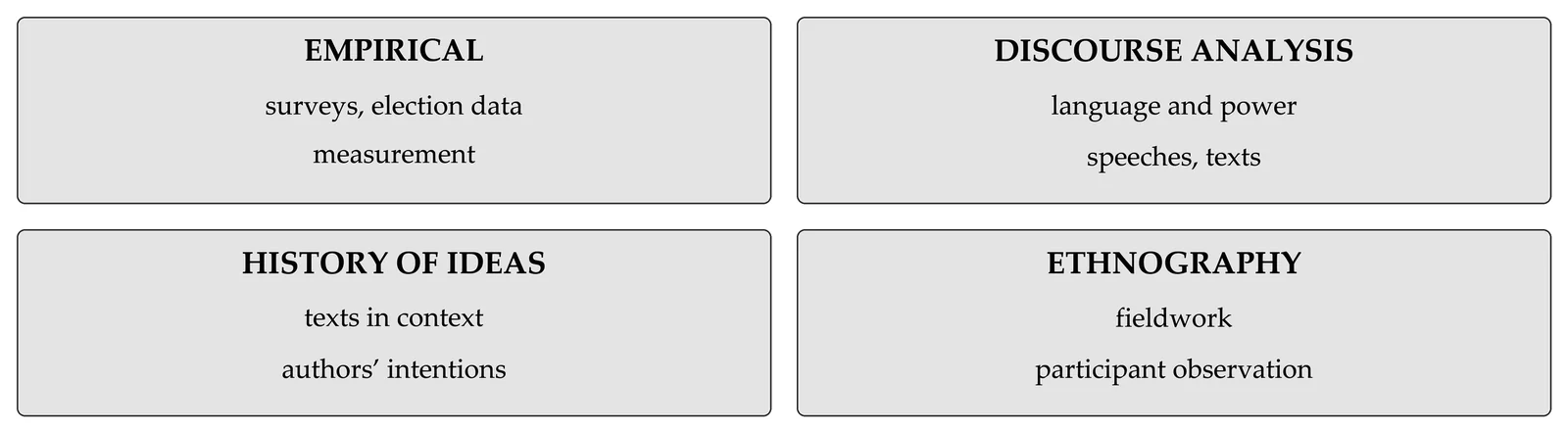
POLITICAL scientists use different methods to study different kinds of questions. Empirical methods, such as surveys and election data, measure and test patterns. Discourse analysis examines how language shapes political meanings and power. The history of ideas studies political texts in their historical context. Ethnography immerses the researcher in the everyday life of a community to understand politics from within. This chapter explains these four methods and their application, drawing on Sanjay Kumar and Praveen Rai, Francesca Jensenius and Gilles Verniers, James Gee, Quentin Skinner, Terence Ball, Sheldon Pollock, Yogendra Yadav and Satendra Kumar.
3.1 Empirical Methods
Empirical research studies politics through systematic observation and measurement. Surveys of voters, such as the National Election Studies conducted by Lokniti-CSDS, reveal patterns of voting and opinion; Sanjay Kumar and Praveen Rai explain how voting behaviour is measured in India. Large-scale data, such as the Indian election data compiled by Jensenius and Verniers, allows the study of trends over decades. Datta and Vaid show how survey research can combine quantitative and qualitative approaches.
3.2 Discourse Analysis
Discourse analysis studies language in use: how speeches, texts, media and conversations construct meanings, identities and power. James Gee explains that language is used not just to say things but to do things and to be certain kinds of people. Michel Foucault showed how discourses shape what can be known and said. Halperin and Heath describe textual analysis, and Phadnis and Kashyap analyse how Indian Prime Ministers invoke historical personalities in their speeches.
3.3 History of Ideas
The history of ideas studies political thought in its historical context. Quentin Skinner argued that to understand a text we must recover what its author was doing in writing it, by studying the debates and conventions of the time. Terence Ball, Felix Gilbert and Sheldon Pollock discuss the aims and methods of intellectual history, Pollock asking how Indian intellectual history can be written.

3.4 Ethnography
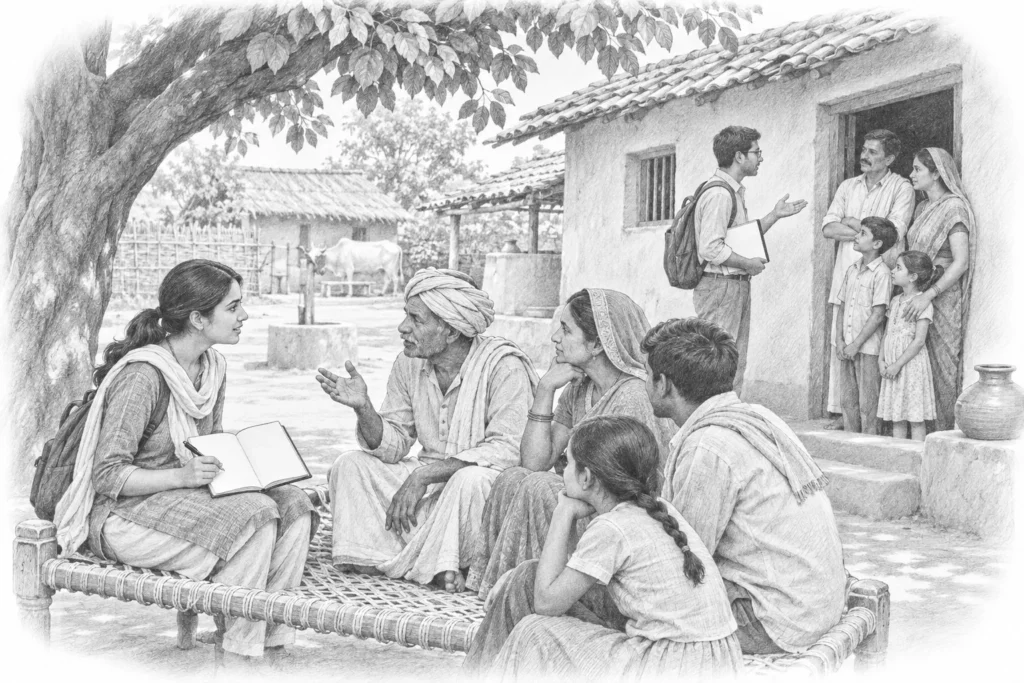
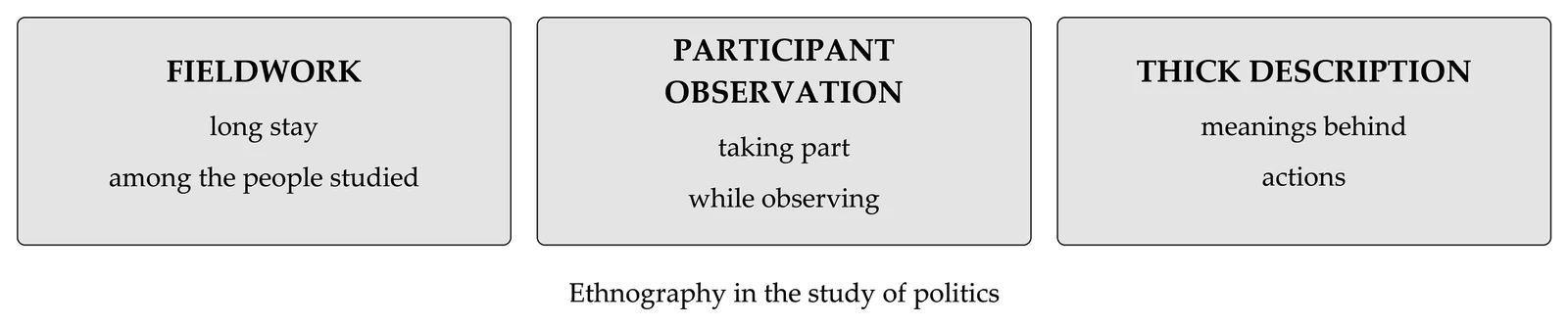
Ethnography involves long-term fieldwork in which the researcher lives among the people studied, practising participant observation and producing thick description of their meanings and practices. In political science, it reveals everyday politics that surveys may miss. Yogendra Yadav reflects on the role of fieldwork in election studies, and Satendra Kumar argues for the promise of ethnography in studying Indian politics.
3.5 Important Questions
- Question 1 Discuss the empirical method in the study of politics and its application.
- Question 2 Discuss discourse analysis as a method of political research.
- Question 3 Discuss the history of ideas as a method of studying politics, with reference to Quentin Skinner.
- Question 4 Discuss ethnography as a method in the study of politics.
DU asks the same idea in different words. So learn one broad answer for each question below; the same answer works for every question joined by OR.
Important Question 1
Discuss the empirical method in the study of politics and its application.
OR
Examine the use of survey research in the study of voting behaviour in India.
OR
How has large-scale data changed the study of Indian politics?
Model Answer
“The perverse and unorthodox argument of this little book is that voters are not fools.”
— V.O. Key Jr., The Responsible Electorate (1966)
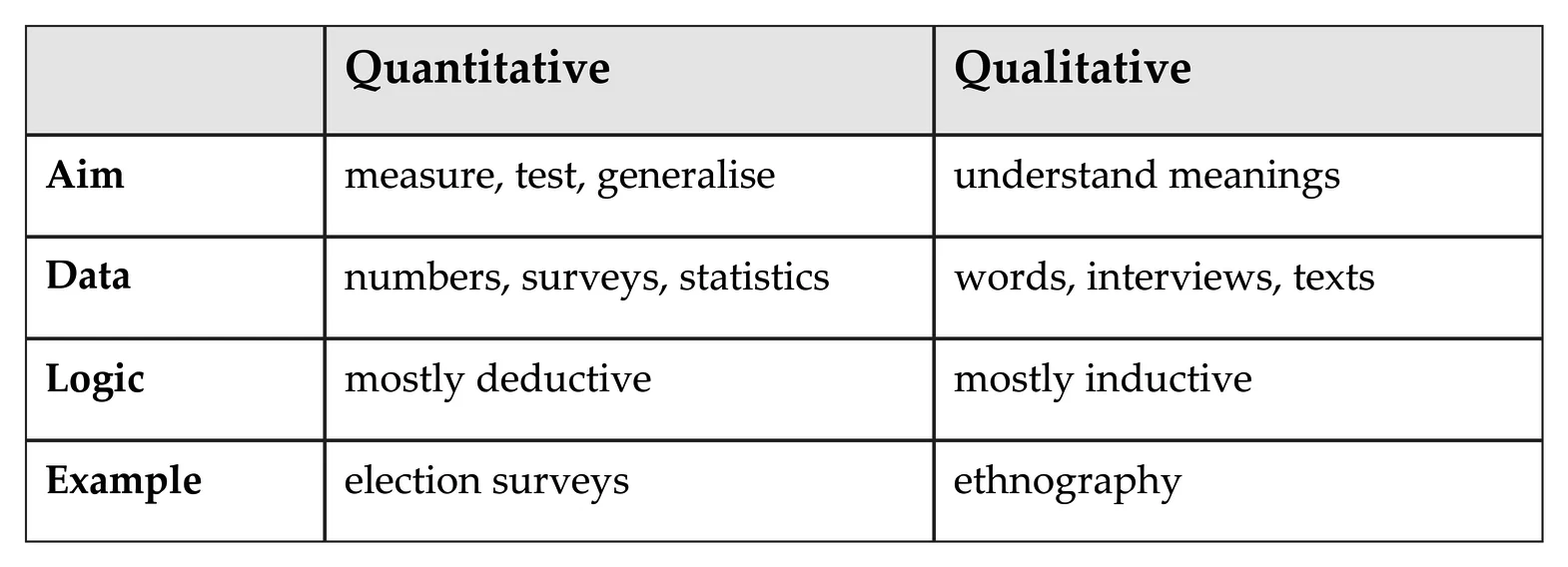
Introduction. The empirical method studies politics through systematic observation, measurement and testing of evidence. It seeks to describe patterns and explain them by testing hypotheses against data. In India, empirical research has been especially important in the study of elections and voting behaviour, and new large-scale datasets have opened new possibilities.
1. Meaning of the Empirical Method
Empirical research relies on evidence gathered through observation and experience rather than pure reasoning. It aims to produce findings that others can check and replicate.
2. Roots in Behaviouralism
The behavioural movement of the 1950s and 1960s made empirical methods central to political science, studying voting, attitudes and participation through surveys and statistics.
3. Survey Research
Surveys ask a sample of people a set of questions to learn about the opinions and behaviour of a larger population. They require careful sampling, well-designed questionnaires and trained interviewers.
4. Election Studies in India
The Centre for the Study of Developing Societies pioneered election surveys in India, and its Lokniti programme has conducted National Election Studies for national elections, producing detailed data on how Indians vote and why.
5. Kumar and Rai on Measuring Voting
Sanjay Kumar and Praveen Rai explain the methods of studying voting behaviour in India, including sampling across a diverse country, translating questionnaires into many languages and asking sensitive questions about caste and religion reliably.
6. Exit Polls and Opinion Polls
Pre-poll and exit polls attempt to predict election outcomes. Their record in India is mixed, because of sampling difficulties, the conversion of vote shares into seats and respondents’ reluctance to reveal their choices.
7. Datta and Vaid on Survey Research
Datta and Vaid argue that survey research should mind the gap between quantitative and qualitative approaches, using open-ended questions, pilot interviews and contextual knowledge to make surveys more meaningful.
8. Large-Scale Election Data
Francesca Jensenius and Gilles Verniers describe a large dataset of Indian election results from 1961 to the present, compiled at the Trivedi Centre for Political Data, which allows researchers to study candidates, parties, turnout and representation over many decades.
9. Studying Constitutions Empirically
Ummareddy and Alam studied constitutional preambles across countries to ask what preambles do, comparing the intentions expressed in them with the reality of how states function, an example of empirical research on constitutional texts.
10. Statistical Analysis
Empirical researchers use statistics to describe data and test relationships, through measures such as correlation and regression. Correlation, however, does not prove causation.
11. Experiments
Field and natural experiments allow researchers to test causal effects, such as the impact of reserved seats for women on local policies, by comparing similar groups exposed to different conditions.
12. Strengths
Empirical methods allow precise description, generalisation from samples and systematic testing of theories, making political claims open to evidence.
13. Limitations
Empirical research may miss meanings and context, measures may be imperfect and data may be biased. Reliance on numbers can oversimplify complex political realities.
14. Ethics
Survey research requires informed consent, confidentiality of respondents and care in asking sensitive questions, especially in contexts of conflict or caste tension.
15. Panel Surveys and Change
Single surveys capture opinion at one moment, but panel surveys interview the same people repeatedly, showing how individuals change their views and votes over time. Such designs help separate real change from differences between samples, though keeping the same respondents over years is difficult and costly.
16. Evaluation
The empirical method has transformed the study of Indian politics, especially elections, and is most powerful when combined with contextual understanding.
Conclusion. Thus, the empirical method studies politics through systematic observation and measurement. Surveys, explained by Kumar and Rai, and large-scale datasets, described by Jensenius and Verniers, have transformed the study of Indian elections, while Datta and Vaid show the value of combining quantitative and qualitative approaches.
Important Question 2
Discuss discourse analysis as a method of political research.
OR
Examine James Gee’s approach to discourse analysis.
OR
How can textual analysis be applied to the study of political speeches?
Model Answer
“Practices that systematically form the objects of which they speak.”
— Michel Foucault, The Archaeology of Knowledge (1969), on discourses
Introduction. Politics is conducted largely through language: speeches, manifestos, laws, debates, media reports and social media posts. Discourse analysis studies how language constructs political meanings, identities and power. It draws on linguistics, philosophy and social theory, and has become an important method in political research.
1. Meaning of Discourse
Discourse refers to language in use in social contexts, and more broadly to systems of meaning that shape how we understand the world. Political discourse defines problems, identities and possible actions.
2. Gee’s Approach
James Gee, in An Introduction to Discourse Analysis, argues that language is used not only to say things but to do things, such as persuading or promising, and to be things, enacting identities such as a leader or a citizen.
3. Gee’s Building Tasks
Gee identifies seven building tasks through which language constructs reality: significance, practices, identities, relationships, politics, connections and sign systems and knowledge. Analysing these shows how a text builds a particular view of the world.
4. Foucault on Discourse and Power
Michel Foucault argued that discourses are linked to power: they define what counts as knowledge, who can speak with authority and what is normal or deviant, shaping institutions such as prisons and clinics.
5. Critical Discourse Analysis
Norman Fairclough, in Language and Power (1989), developed critical discourse analysis, which studies texts at three levels: the text itself, the practices of producing and receiving it, and the wider social practices and power relations it reflects.
6. Halperin and Heath on Textual Analysis
Halperin and Heath distinguish content analysis, which counts words, themes or categories in texts, from discourse analysis, which interprets how meanings are constructed. Both are forms of textual analysis.
7. Content Analysis
Content analysis codes texts into categories, such as themes in party manifestos or news coverage, and counts their frequency, allowing systematic comparison across many texts.
8. Phadnis and Kashyap on Prime Ministers’ Speeches
Phadnis and Kashyap analyse speeches by Indian Prime Ministers to show how they invoke historical personalities such as national leaders, using the past to build legitimacy and convey political messages.
9. Framing
Framing refers to how issues are presented to emphasise certain aspects and suggest certain interpretations, such as presenting migration as a security threat or as an economic opportunity.
10. Securitisation
Scholars of the Copenhagen School, such as Barry Buzan and Ole Wæver, showed how political leaders turn issues into security threats through speech acts, justifying extraordinary measures.
11. Applications
Discourse analysis is used to study nationalism, populism, development discourse, gender and caste representations in media and the language of laws and courts.
12. Computational Text Analysis
New computational methods allow researchers to analyse very large collections of texts, such as parliamentary debates or social media posts, identifying themes and changes over time.
13. Strengths
Discourse analysis reveals how power works through language, how identities are constructed and how political ideas are made persuasive.
14. Limitations
Critics argue that discourse analysis can be subjective, depending on the researcher’s interpretation, and that selecting texts may bias findings.
15. Doing Discourse Analysis
A discourse analysis usually begins by selecting a clear set of texts, such as election speeches or parliamentary debates on a bill. The researcher then reads them closely, identifies key themes, metaphors and categories, asks whose voices are present or silent, and relates the language to the political context and power relations in which it was produced. Transparency about these steps makes the analysis more credible.
16. Evaluation
Discourse analysis is a valuable method for understanding the role of language in politics, especially when combined with careful selection and transparent interpretation.
Conclusion. Thus, discourse analysis studies how language constructs political meanings, identities and power. Gee shows that language is used to say, do and be, Foucault and Fairclough link discourse to power, and Halperin and Heath describe textual analysis, applied by Phadnis and Kashyap to Prime Ministers’ speeches.
Important Question 3
Discuss the history of ideas as a method of studying politics, with reference to Quentin Skinner.
OR
Examine Skinner’s critique of textualism and contextualism.
OR
Is there an Indian intellectual history? Discuss with reference to Sheldon Pollock.
Model Answer
“No agent can eventually be said to have meant or done something which he could never be brought to accept as a correct description of what he had meant or done.”
— Quentin Skinner, ‘Meaning and Understanding in the History of Ideas’ (1969)
Introduction. The history of ideas studies how political thought has developed over time, through the reading of classic and lesser-known texts. A central debate concerns how such texts should be read: as timeless contributions to perennial questions, or as historical actions in particular contexts. Quentin Skinner’s essay of 1969 transformed this debate and founded the Cambridge School of intellectual history.
1. Meaning
The history of ideas, or intellectual history, examines political concepts, arguments and texts, asking what thinkers meant, why they wrote and how ideas changed over time.
2. Textualism
Textualist approaches read classic texts as self-sufficient, addressing perennial questions about justice, power and freedom. Leo Strauss read texts closely for hidden meanings, and Arthur Lovejoy traced unit ideas across centuries.
3. Social Contextualism
Other scholars explained ideas by their social and economic context. C.B. Macpherson, in The Political Theory of Possessive Individualism (1962), read Hobbes and Locke as expressing the values of emerging market society.
4. Skinner’s Critique
Skinner argued that both approaches mislead. Textualism produces mythologies: the mythology of doctrines, which attributes ready-made doctrines to authors; of coherence, which imposes unity on their works; and of prolepsis, which reads texts in light of later events.
5. Against Pure Context
Skinner also argued that social context alone cannot explain a text, because knowing the causes of a text is not the same as understanding what its author meant to do.
6. Texts as Actions
Drawing on J.L. Austin’s theory of speech acts, Skinner argued that writing a text is an action. To understand it, we must recover what the author was doing, such as attacking, defending or redefining a position, in relation to the debates of the time.
7. Linguistic Context
Skinner emphasised the linguistic context: the conventions, vocabularies and arguments available to an author. Only by knowing these can we see what was original or conventional in a text.
8. The Cambridge School
Skinner, J.G.A. Pocock and Peter Laslett formed the Cambridge School. Laslett redated Locke’s Two Treatises, and Pocock studied political languages such as republicanism.
9. Gilbert on Intellectual History
Felix Gilbert, in ‘Intellectual History: Its Aims and Methods’ (1971), examined how intellectual history differs from the history of philosophy by placing ideas within their wider historical setting.
10. Ball on Conceptual Change
Terence Ball, in Reappraising Political Theory (1995), argued for a critical conceptual history that studies how political concepts change through argument, showing that political theory is historically situated.
11. Pollock on Indian Intellectual History
Sheldon Pollock asks whether there is an Indian intellectual history. He argues that the history of Indian thought, especially in Sanskrit traditions, has often been treated as timeless, and calls for historical methods that recognise change and debate in Indian ideas.
12. Application to Indian Thought
Contextual methods help read thinkers such as Kautilya, whose Arthashastra was rediscovered and published in the early twentieth century, or Gandhi and Ambedkar, in relation to the debates of their time.
13. Criticisms of Skinner
Critics argue that Skinner’s method can become antiquarian, making past texts irrelevant to present concerns, and that authors’ intentions are hard to recover.
14. Relevance
Skinner replied that studying the past can free us from assuming that our concepts are natural, showing alternative ways of thinking about politics.
15. Comparative Political Theory
Recent scholars have developed comparative political theory, which studies political ideas from many civilisations, including Indian, Chinese and Islamic traditions, alongside Western thought. Historical and contextual methods help avoid treating non-Western ideas either as exotic curiosities or as mere versions of Western concepts, allowing genuine dialogue between traditions.
16. Evaluation
The history of ideas, especially Skinner’s contextual method, has made political theory more historically careful, while debates continue about its relevance.
Conclusion. Thus, the history of ideas studies political thought in its historical development. Skinner criticised textualist mythologies and pure social contextualism, arguing that texts are actions whose meaning depends on authors’ intentions and linguistic contexts. Ball, Gilbert and Pollock extend this method, Pollock asking how Indian intellectual history can be written.
Important Question 4
Discuss ethnography as a method in the study of politics.
OR
What is the promise of ethnography for the study of Indian politics?
OR
Examine the role of fieldwork in election studies, with reference to Yogendra Yadav.
Model Answer
“Believing, with Max Weber, that man is an animal suspended in webs of significance he himself has spun, I take culture to be those webs, and the analysis of it to be therefore not an experimental science in search of law but an interpretive one in search of meaning.”
— Clifford Geertz, The Interpretation of Cultures (1973)
Introduction. Ethnography is a method in which the researcher spends long periods among the people studied, observing and participating in their lives to understand their meanings and practices. Originating in anthropology, it has become increasingly important in political science, revealing how politics is experienced in everyday life in ways that surveys and statistics may miss.
1. Meaning
Ethnography literally means writing about people. It involves fieldwork, participant observation, informal interviews and detailed field notes, producing rich descriptions of a community’s life.
2. Origins in Anthropology
Bronisław Malinowski’s fieldwork in the Trobriand Islands, described in Argonauts of the Western Pacific (1922), established long-term participant observation as the core method of anthropology.
3. Participant Observation
In participant observation, the researcher takes part in the daily life of the people studied while observing it, gaining insight into practices and meanings that outsiders might misunderstand.
4. Thick Description
Clifford Geertz argued that ethnography should provide thick description, interpreting the meanings behind actions, such as distinguishing a wink from a twitch, rather than simply recording behaviour.
5. Halperin and Heath on Ethnography
Halperin and Heath discuss ethnography in political research: gaining access to the field, choosing a role as observer or participant, keeping field notes and handling ethical issues of consent and confidentiality.
6. Political Ethnography
James Scott’s Weapons of the Weak (1985), based on fieldwork in a Malaysian village, showed how peasants resist domination through everyday forms such as foot-dragging and gossip, a form of politics invisible to surveys.
7. Yadav on Fieldwork
Yogendra Yadav reflects on what work fieldwork does in the study of elections. He argues that fieldwork is not just data collection but a way of learning, which shapes the researcher’s questions and helps interpret survey findings.
8. Kumar on the Promise of Ethnography
Satendra Kumar argues that ethnography offers great promise for studying Indian politics, revealing how caste, class, patronage and power operate in everyday life and how people understand politics in their own terms.
9. Ethnographies of Elections
Mukulika Banerjee, in Why India Votes? (2014), used ethnography to show that many Indians see voting as a meaningful act of citizenship and dignity, not just a calculation of benefits.
10. Indian Traditions of Fieldwork
M.N. Srinivas’s fieldwork in the village of Rampura, described in The Remembered Village (1976), gave rise to concepts such as the dominant caste, which influenced the study of Indian politics.
11. Steps in Ethnography
Ethnography involves choosing a site, gaining access and trust, observing and participating over time, recording field notes, analysing patterns and writing an account that conveys meanings.
12. Ethics
Ethnographers must obtain consent, protect informants’ identities, avoid harm and reflect on the power relationship between researcher and community, especially in sensitive political settings.
13. Strengths
Ethnography provides deep understanding of meanings, processes and everyday politics, generates new concepts and can explain findings that surveys cannot.
14. Limitations
Ethnography is time-consuming, its findings are difficult to generalise and they may be influenced by the researcher’s presence and interpretation.
15. Combining Ethnography with Other Methods
Many political scientists now combine ethnography with surveys or statistical data. Fieldwork can suggest hypotheses that are then tested with survey data, or explain puzzling patterns found in election results, while quantitative data can show how far ethnographic findings from one place apply more widely.
16. Insiders and Outsiders
Ethnographers may be outsiders who must win the trust of a community, or insiders who share its language, caste or region. Outsiders may notice what locals take for granted, while insiders gain easier access and deeper understanding but may overlook familiar patterns. Reflecting on one’s position helps the ethnographer interpret what is seen and heard more carefully.
17. Evaluation
Ethnography enriches political science by revealing politics from below, and is most powerful when combined with other methods.
Conclusion. Thus, ethnography uses long-term fieldwork and participant observation to produce thick descriptions of political life. As Yadav and Satendra Kumar argue, it reveals everyday politics, meanings and power relations that surveys may miss, making it a valuable method for studying Indian politics despite limits of generalisation.
Short Notes
(a) Thick description
Clifford Geertz’s term, borrowed from Gilbert Ryle, for ethnographic writing that interprets the meanings of actions within their cultural context, rather than merely describing behaviour.
(b) Cambridge School
A group of historians of political thought, including Quentin Skinner, J.G.A. Pocock and Peter Laslett, who argued that texts must be read in their historical and linguistic contexts to recover their authors’ intentions.
(c) Content analysis
A method of analysing texts by coding them into categories and counting the frequency of words, themes or ideas, allowing systematic comparison across many documents.
(d) Participant observation
A research method in which the researcher takes part in the daily activities of the people studied while systematically observing them, gaining an insider’s understanding of their practices and meanings. It is the core method of ethnography.
More notes: DSE-11 Research Methods in Politics
These notes are prepared by PADHO TO AISE for study help. They are not an official University of Delhi publication.