
Semester VII DSE-5 Contemporary Debates in Indian Politics
Unit II · 21 min read · Updated 24 Nov 2026
As per the University of Delhi (DU) BA (Hons) Political Science syllabus
Contents
- 2.1 Land–Market Relations
- 2.2 Labour Markets and Flexibility
- 2.3 Labour and Urban Space
- 2.4 Important Questions
- Discuss the changing relationship between land and the market in India.
- Discuss the debate on labour market flexibility and labour reforms in India.
- Discuss the relationship between labour, the urban poor and urban space in contemporary India.
- Discuss the rise of the gig economy in India and its implications for workers.
- Short Notes
पुरुष और स्त्री सभी नागरिकों को समान रूप से जीविका के पर्याप्त साधन प्राप्त करने का अधिकार हो।
That the citizens, men and women equally, have the right to an adequate means of livelihood.
— Constitution of India, Article 39(a)
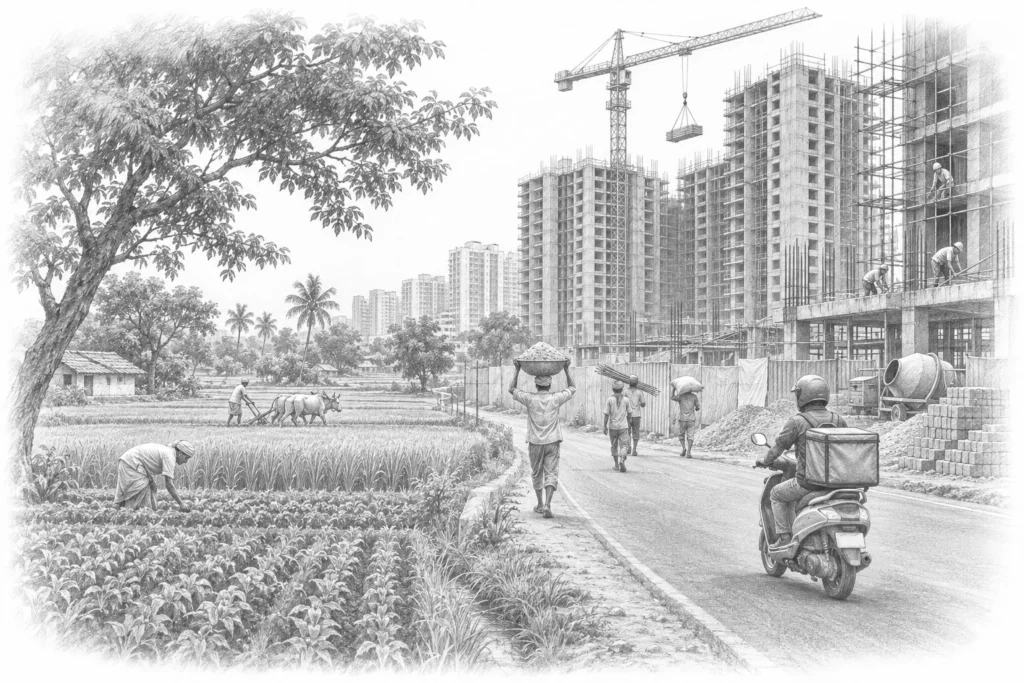
LAND and labour are the two foundations of livelihood for most Indians, and both are being transformed by the market. Since liberalisation, land has become a valuable commodity sought for industry, infrastructure and real estate, producing conflicts over acquisition, displacement and dispossession. At the same time, the labour market has become more flexible and informal, and cities have been restructured in ways that push the labouring poor to the margins, while new forms of work have emerged in the gig economy. This chapter draws on A.N. Sharma, Geeta Kingdon and Jeemol Unni, Leela Fernandes, and studies of gig and domestic work.
2.1 Land–Market Relations
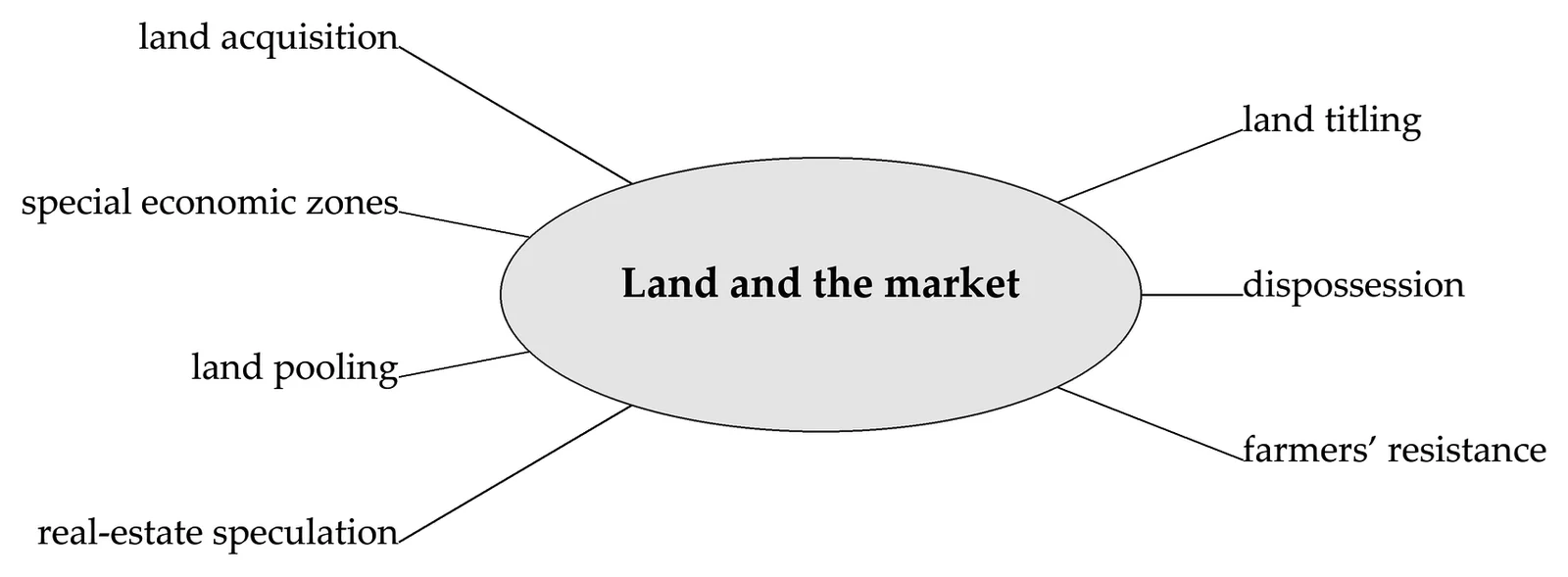
For most Indians, land is a source of livelihood, security and identity. For investors and governments, it is an asset needed for factories, highways, mines and cities. After liberalisation, states competed for private investment and acquired land for companies and Special Economic Zones, often by force. Scholars describe this as accumulation by dispossession, the transfer of land and commons from farmers and tribals to capital. Resistance at Singur and Nandigram led to the Act of 2013, which requires consent, social impact assessment and higher compensation. Rising land prices have also created active land markets in which some gain and many lose.
2.2 Labour Markets and Flexibility
India’s labour market is segmented: a small organised sector with legal protection and a vast informal sector without it. Employers and some economists argue that labour laws make hiring rigid. A.N. Sharma replies that the market is already highly flexible in practice through informal and contract work, so reforms should focus on social security. Geeta Kingdon and Jeemol Unni show how education shapes women’s participation and earnings. The four labour codes, which came into force in 2025, sought to combine flexibility with wider social security.

2.3 Labour and Urban Space
Cities depend on the labour of construction workers, vendors, domestic workers and delivery riders, yet these workers are often treated as encroachers. Leela Fernandes describes a politics of forgetting, in which the new middle class and the state reshape urban space for a world-class city, removing slums and vendors from view. Meanwhile, digital platforms have created gig work for migrants and women in delivery, transport and domestic services, offering flexibility but little security.

2.4 Important Questions
- Question 1 Discuss the changing relationship between land and the market in India.
- Question 2 Discuss the debate on labour market flexibility and labour reforms in India.
- Question 3 Discuss the relationship between labour, the urban poor and urban space in contemporary India.
- Question 4 Discuss the rise of the gig economy in India and its implications for workers.
DU asks the same idea in different words. So learn one broad answer for each question below; the same answer works for every question joined by OR.
Important Question 1
Discuss the changing relationship between land and the market in India.
OR
How has the market rearticulated the relationship between land, displacement and dispossession?
OR
Examine the politics of land acquisition in India since liberalisation.
Model Answer
“No person shall be deprived of his property save by authority of law.”
— Constitution of India, Article 300A
Introduction. Land in India is not only an economic asset but also a source of livelihood, security and identity for millions of farmers and tribals. Since liberalisation, the market has transformed the meaning and use of land. Land has become a commodity sought by industry, infrastructure and real estate, and the state has often acted to transfer it from cultivators to capital, producing new forms of displacement and dispossession.
1. Land in India
Most Indian farmers own small plots; about 86 per cent of holdings are small or marginal. Land is a state subject, and land records are often outdated and disputed. For tribal communities, forests and commons are central to livelihood and culture. Any change in the use of land therefore has deep social consequences.
2. Acquisition by the Developmental State
After Independence, the state acquired land under the colonial Act of 1894 for dams, steel plants, mines and public enterprises, in the name of public purpose. Compensation was low and resettlement poor. The scholar Walter Fernandes estimated that about 60 million people were displaced or affected between 1947 and 2004, many of them tribals.
3. Liberalisation and Land
After 1991, demand for land grew for private industry, infrastructure, mining, information technology parks and real estate. State governments competed to attract investment by offering cheap land, and increasingly acquired land on behalf of private companies rather than for public enterprises.
4. Special Economic Zones
The SEZ Act of 2005 offered tax concessions and relaxed regulations to zones built by private developers. Hundreds were approved within a few years, many on agricultural land near cities. Critics argued that many SEZs were real-estate projects in disguise, and protests forced several states to cancel or scale them down.
5. Accumulation by Dispossession
The geographer David Harvey uses the term accumulation by dispossession for the way capital grows by taking over land, resources and commons from people. Michael Levien argues that the Indian state moved from dispossessing people for public development to dispossessing them for private capital and real estate, acting as a land broker.
6. Singur and Nandigram
In Singur, land acquired in 2006 for a car factory led to farmers’ protests, and the company moved to Gujarat in 2008; the Supreme Court later quashed the acquisition. In Nandigram, police firing during protests against a proposed chemical hub killed 14 people in 2007. These events made land a central political issue.
7. The Act of 2013
The Right to Fair Compensation and Transparency in Land Acquisition, Rehabilitation and Resettlement Act, 2013, requires the consent of 80 per cent of affected families for private projects and 70 per cent for public-private projects, a social impact assessment, higher compensation and rehabilitation for those who lose livelihoods.
8. Attempts at Dilution
In 2014–15, the Union government issued ordinances to exempt several categories of projects from consent and social impact assessment. After opposition and farmers’ protests, the ordinance lapsed. Several states then amended the law for their own projects to make acquisition easier.
9. Land Markets and Speculation
Land prices have risen sharply near cities, highways and industrial corridors. Land has become a financial asset, bought and sold by brokers and developers for speculation. Some farmers gain large sums, while others sell under pressure or are left out of the gains.
10. Land Pooling and New Models
Some projects use land pooling, in which owners give land to the state and receive developed plots in return, as in the new capital of Andhra Pradesh at Amaravati. In Pune, farmers pooled land to build Magarpatta City as shareholders. Such models offer alternatives but can still exclude tenants and labourers.
11. Titling and Leasing
Governments are digitising land records and issuing property cards, as under the SVAMITVA scheme of 2020, and NITI Aayog has proposed a Model Agricultural Land Leasing Act. These reforms aim to make land markets work more smoothly by clarifying ownership.
12. Winners and Losers
Landowners near growing cities often benefit from rising prices, but tenants, agricultural labourers, women without titles, and Dalits and tribals who depend on commons lose their livelihoods without compensation. The market therefore deepens existing inequalities.
13. Resistance
People have resisted dispossession through movements such as the Narmada Bachao Andolan and the struggle at Niyamgiri, where gram sabhas rejected mining in 2013. Increasingly, farmers also bargain for higher compensation and a share in development rather than refusing outright.
14. Evaluation
The market has turned land into a commodity and the state into a facilitator of its transfer to capital. Laws such as the 2013 Act have improved protection, but dispossession and unequal gains remain central issues.
Conclusion. Thus, the relationship between land and the market in India has shifted from state acquisition for public projects to acquisition and speculation for private capital. As the idea of accumulation by dispossession suggests, this has displaced farmers and tribals, provoked resistance at Singur and Nandigram, and produced new laws and new inequalities.
Important Question 2
Discuss the debate on labour market flexibility and labour reforms in India.
OR
Examine A.N. Sharma’s argument about flexibility, employment and labour market reforms in India.
OR
What are the main features and problems of the Indian labour market?
Model Answer
“The State shall make provision for securing just and humane conditions of work and for maternity relief.”
— Constitution of India, Article 42
Introduction. The labour market is where workers sell their labour and employers hire it. In India, this market is deeply divided between a small protected formal sector and a vast informal one. A long debate concerns whether labour laws make the market too rigid and discourage employment, or whether the real problem is the absence of protection for most workers. A.N. Sharma and others have examined this question.
1. Features of the Labour Market
About nine out of ten Indian workers are informal. Around half are self-employed, many as small farmers or traders, and a large share work as casual labourers. Agriculture still employs about 45 per cent of workers. Productivity and wages are low for most, and women’s participation has historically been low.
2. A Segmented Market
T.C.A. Anant and his co-authors describe India’s labour market as segmented. A small formal segment offers regular wages, social security and legal protection, while the informal segment offers insecure, low-paid work. Movement between segments is limited, and the economy has not created enough good jobs to absorb workers leaving agriculture.
3. The Rigidity Argument
Many employers and economists argue that labour laws are too rigid. The Industrial Disputes Act required firms with 100 or more workers to seek government permission for lay-offs and closures. Timothy Besley and Robin Burgess argued in 2004 that states with pro-worker amendments had lower manufacturing output and employment.
4. Sharma: Flexibility Already Exists
A.N. Sharma argues that the Indian labour market is already highly flexible in practice. Most workers are informal, and even in the formal sector employers use contract labour, casual workers and weak enforcement to avoid regulations. Labour laws, he suggests, are not the main obstacle to employment, and reform should focus on extending security and standards to all workers.
5. Contract Labour
The share of contract workers in organised manufacturing rose to more than a third of the workforce by the 2010s. Contract workers do the same work as permanent workers for lower pay and without job security, showing how flexibility has been achieved without changing the law.
6. Jobless Growth
High economic growth after liberalisation created relatively few formal jobs, a pattern called jobless growth. Capital-intensive manufacturing and skill-intensive services such as information technology could not absorb the large number of low-skilled workers leaving agriculture.
7. Education and Women’s Work
Geeta Kingdon and Jeemol Unni show that education raises women’s earnings, but its effect on women’s participation in paid work is U-shaped: women with middle or secondary education are less likely to work than both illiterate women and graduates. Women also face wage discrimination and limited access to suitable jobs.
8. Women’s Participation
Women’s labour force participation fell through the 2000s and 2010s, reaching about 23 per cent in 2017–18 according to the Periodic Labour Force Survey. It rose to about 42 per cent by 2023–24, but mostly through self-employment and unpaid work in family farms rather than regular jobs.
9. State-Level Reforms
Some states amended labour laws themselves. In 2014, Rajasthan raised the threshold for government permission for lay-offs from 100 to 300 workers and made union registration harder. Other states followed, but evidence on whether such changes increased employment is mixed.
10. The Labour Codes
The four labour codes consolidated 29 central laws and came into force in November 2025. The Industrial Relations Code raised the lay-off threshold to 300 workers, allowed fixed-term employment and required notice for strikes, while the Social Security Code extended coverage to gig and platform workers.
11. The Unions’ Response
Central trade unions opposed the codes, arguing that they weaken job security and the right to strike, and organised nationwide strikes. Supporters argue that simplifying many laws will encourage formal hiring.
12. Flexicurity
Some scholars propose flexicurity, a combination of flexibility for employers with security for workers through unemployment insurance, social security and retraining, as in Denmark. For India, this would mean a universal social security floor that covers informal workers.
13. Skills and Unemployment
Educated youth face high unemployment because of a mismatch between education and available jobs. Programmes such as Skill India, launched in 2015, aim to improve employability, but the creation of good jobs remains the central challenge.
14. Evaluation
The debate on flexibility often ignores that most Indian workers already lack protection. As Sharma argues, the main problem is not rigidity but insecurity, and reforms must combine flexibility with social protection.
Conclusion. Thus, India’s labour market is segmented, with a small protected formal sector and a vast informal one. Employers argue that labour laws are rigid, but A.N. Sharma shows that the market is already flexible through informal and contract work. The labour codes seek to combine flexibility with wider social security, but decent work remains elusive.
Important Question 3
Discuss the relationship between labour, the urban poor and urban space in contemporary India.
OR
Examine Leela Fernandes’s idea of the politics of forgetting with reference to urban space in India.
OR
How has the restructuring of cities affected the labouring poor in India?
Model Answer
“All citizens shall have the right to practise any profession, or to carry on any occupation, trade or business.”
— Constitution of India, Article 19(1)(g)
Introduction. India’s cities are growing rapidly and depend on the labour of migrants, vendors, construction workers and domestic workers. Yet the urban poor are often treated as encroachers in the very spaces they help build. Since liberalisation, efforts to create world-class cities have reshaped urban space in favour of the middle class and capital, a process Leela Fernandes describes as a politics of forgetting.
1. Urbanisation in India
The Census of 2011 found that about 31 per cent of Indians lived in urban areas, and about 6.5 crore people lived in slums. Cities generate a large share of national income and attract migrants from rural areas, but housing and services have not kept pace with growth.
2. The Labouring Poor
Cities rely on informal workers: construction labourers, street vendors, domestic workers, rickshaw pullers, waste pickers and delivery riders. Most live in slums or informal settlements close to their work, because they cannot afford formal housing.
3. The World-Class City
Since the 2000s, governments have sought to build world-class cities to attract investment, through programmes such as the Jawaharlal Nehru National Urban Renewal Mission (2005) and the Smart Cities Mission (2015). Such visions emphasise infrastructure, malls and gated housing rather than the needs of the poor.
4. Fernandes: The Politics of Forgetting
Leela Fernandes argues that the new middle class, as the ideal consumer-citizen of liberalised India, has shaped urban politics. Its vision of the city forgets the poor, workers and migrants, who become invisible in the image of a modern nation. The state and the middle class together restructure urban space according to this vision.
5. Spatial Purification
This politics appears as spatial purification: slum demolitions, eviction of street vendors and beautification drives, often before major events such as the Commonwealth Games of 2010. The demolition of settlements along the Yamuna in Delhi in 2004 displaced tens of thousands of people.
6. Middle-Class Activism and the Courts
Resident Welfare Associations and public interest litigation on cleanliness and pollution have often supported evictions. In the Almitra Patel case (2000), the Supreme Court likened resettling slum dwellers on public land to rewarding a pickpocket, reflecting a judicial shift against the urban poor.
7. Legal Protection
Earlier, in Olga Tellis (1985), the Supreme Court held that the right to livelihood is part of the right to life. The Street Vendors Act of 2014 protects vendors’ livelihoods, and in Ajay Maken (2019) the Delhi High Court recognised a right to adequate housing for slum dwellers facing eviction.
8. Housing and Resettlement
Evicted families are often resettled in colonies on the edges of cities, far from their workplaces, which increases travel costs and reduces earnings. Schemes such as the Pradhan Mantri Awas Yojana–Urban (2015) promise housing, but the poorest and migrants often remain excluded.
9. Migrants in the City
Migrant workers face exclusion from housing, welfare and political voice. The COVID-19 lockdown of 2020, when millions walked home after losing work and shelter, exposed how little the city had recognised their presence.
10. Real Estate and Redevelopment
Rising land values have made slum land valuable for redevelopment. Projects such as the redevelopment of Dharavi in Mumbai, awarded to a private group in 2022–23, promise housing for residents but also raise fears of displacement of those deemed ineligible.
11. The Right to the City
The French thinker Henri Lefebvre coined the idea of the right to the city in 1968, the right of inhabitants to shape urban space. Movements of vendors, homeless people and slum dwellers use this idea to claim a place in the city.
12. Organising the Urban Poor
Organisations such as the National Association of Street Vendors of India, domestic workers’ unions and housing rights groups have campaigned for legal recognition, vending zones and in-situ upgrading of slums.
13. Inclusive Planning
Inclusive urban planning would provide rental housing near workplaces, recognise vending zones, upgrade slums in place and give the urban poor a voice in decisions. Without this, the world-class city remains a city for some.
14. Evaluation
The restructuring of urban space reveals the class politics of liberalisation. As Fernandes shows, the middle-class vision of the city erases the labouring poor on whom the city depends.
Conclusion. Thus, India’s cities depend on informal labour but often exclude the urban poor through demolitions, evictions and resettlement far from work. Leela Fernandes calls this a politics of forgetting, shaped by the new middle class and the state. Legal protections and movements for the right to the city seek to make urban space more inclusive.
Important Question 4
Discuss the rise of the gig economy in India and its implications for workers.
OR
Examine the situation of migrant and domestic workers in India’s gig economy.
OR
What are the opportunities and challenges of the gig economy in India?
Model Answer
“That there is equal pay for equal work for both men and women.”
— Constitution of India, Article 39(d)
Introduction. The gig economy refers to short-term, task-based work arranged through digital platforms, such as food delivery, ride-hailing, home services and online freelancing. It has grown rapidly in Indian cities, offering new opportunities but also new forms of insecurity. Scholars such as Roy and Shrivastava, and Tandon and Rathi, examine its promise and problems, especially for migrants and women in domestic work.
1. Meaning of Gig Work
Gig workers perform individual tasks, or gigs, and are paid per task rather than receiving a regular wage. Platform workers find work through apps run by companies called aggregators. Some gig work is location-based, such as delivery and transport, while other work is web-based, such as design and translation.
2. Growth of the Gig Economy
NITI Aayog estimated that India had about 77 lakh gig workers in 2020–21 and that the number could reach 2.35 crore by 2029–30. Growth has been driven by smartphones, cheap data, urban demand and the large supply of young workers seeking jobs.
3. Opportunities
Roy and Shrivastava note that gig work offers flexible hours, low barriers to entry, extra income for students and workers, and opportunities for women who need flexibility. It also gives consumers convenience and creates new markets for services.
4. Workers or Partners
Platforms describe workers as independent partners rather than employees. As a result, gig workers are usually not covered by minimum wages, paid leave, provident fund or protection against dismissal, and bear the costs of vehicles, fuel and phones themselves.
5. Algorithmic Control
Although gig workers are called independent, their work is closely controlled by algorithms that assign tasks, set pay, monitor speed and rate performance. Workers can be deactivated without explanation or a hearing, and incentives push them to work long hours.
6. Insecurity and Safety
Earnings are volatile and often fall when platforms change incentive schemes. Delivery workers face road accidents, heat and pressure for speed, especially with promises of very fast delivery. Few have health or accident insurance.
7. Domestic Work in India
Millions of Indians, mostly women and many of them migrants from Jharkhand, Odisha, Chhattisgarh and West Bengal, work as domestic workers in cities. Many are Dalit or Adivasi. They are excluded from most labour laws, and India has not ratified the ILO’s Domestic Workers Convention of 2011.
8. Tandon and Rathi: Platforms and Domestic Work
Tandon and Rathi show how platforms now bring domestic and care work, such as cleaning and beauty services, onto apps. Platforms standardise prices and offer training, but they reproduce hierarchies of gender, caste and migration and shift risks to workers. Migration sustains these urban labour markets.
9. Women in the Gig Economy
Gig work offers some women flexible earnings, but they face safety concerns, harassment and gender stereotypes about suitable work. Women remain concentrated in beauty and care services, while delivery and transport remain male-dominated.
10. Legal Recognition
The Code on Social Security, 2020, defines gig and platform workers and provides for social security schemes funded partly by aggregators, who may contribute 1 to 2 per cent of their turnover. Rajasthan passed a law for platform workers in 2023, and the Union budget of 2025–26 extended health insurance to registered gig workers.
11. Organising Gig Workers
Gig workers have formed unions, such as the Indian Federation of App-based Transport Workers, and organised strikes against pay cuts. Organising is difficult because workers are dispersed and can be easily replaced, but collective action is growing.
12. Policy Options
Scholars propose minimum earnings per hour, transparency about how algorithms set pay and deactivation, grievance redress, social security and the right to organise. Such measures would make gig work a path to decent work rather than a trap of insecurity.
13. Migrants and Platform Labour
Much platform work in Indian cities is done by young migrants from poorer states, who take up delivery and transport jobs because they offer quick entry without contacts or qualifications. Platforms depend on this steady supply of migrant labour, while migrants, lacking local networks and documents, are least able to bargain for better terms or claim welfare in the city.
14. Global Debates on Platform Work
Other countries have debated whether platform workers are employees. In 2021, the United Kingdom’s Supreme Court held in the Uber case that drivers were workers entitled to minimum wages and holiday pay, and in 2024 the European Union adopted a directive presuming an employment relationship where platforms control work. These debates influence demands in India.
15. Evaluation
The gig economy reflects both the promise of technology and the persistence of informality. It offers flexibility and income but often reproduces insecurity, especially for migrants and women.
Conclusion. Thus, India’s gig economy has grown rapidly, offering flexible work to young people, migrants and women. But as Roy and Shrivastava and Tandon and Rathi show, gig and domestic workers face algorithmic control, insecurity and the absence of labour protection. Legal recognition and collective organisation are beginning to address these challenges.
Short Notes
(a) Olga Tellis case (1985)
A Supreme Court judgment concerning pavement dwellers in Bombay, which held that the right to life under Article 21 includes the right to livelihood. Evictions must follow fair procedure, though the Court did not prevent the demolitions.
(b) Street Vendors Act, 2014
The Street Vendors (Protection of Livelihood and Regulation of Street Vending) Act, which protects the livelihood of vendors, provides for vending certificates and town vending committees with vendor representatives, and limits arbitrary eviction.
(c) Accumulation by dispossession
A term coined by the geographer David Harvey for the way capital grows by taking over land, natural resources and public assets from people, through privatisation, enclosure of commons and land acquisition. It is used to explain land conflicts in India.
More notes: DSE-5 Contemporary Debates in Indian Politics
These notes are prepared by PADHO TO AISE for study help. They are not an official University of Delhi publication.