
Semester IV MDSE-2b India's National Security
Unit II · 25 min read · Updated 24 Nov 2026
As per the University of Delhi (DU) BA (Hons) Political Science syllabus
Contents
- 2.1 Textual Traditions: Ramayana and Mahabharata
- Rajagopalan: Grand Strategic Thought in the Epics
- Narlikar and Narlikar: Bargaining Lessons
- Cautions
- Strategic Ideas in Other Classical Texts
- 2.2 Kautilya
- Key Ideas of the Arthashastra
- Mitra: Kautilya and Indian Strategic Culture
- Kautilya Today
- Discovery and Debate on the Arthashastra
- 2.3 Non-Textual Conceptualizations: Swaraj and Martial Culture
- Anand: Maratha Statecraft and the Ajnapatra
- Vivekanandan: The Mughal Strategic Discourse
- Martial Culture
- Swaraj as a Strategic Idea
- Other Regional Military Traditions
- 2.4 Important Questions
- Discuss the strategic thought in the Ramayana and the Mahabharata.
- Explain Kautilya’s mandala theory and his six measures of foreign policy.
- Discuss the relevance of Kautilya for India’s strategic culture.
- Discuss the non-textual sources of India’s strategic thinking with reference to Maratha and Mughal statecraft.
- Short Notes
जो राजा विजिगीषु के राज्य की सीमा पर कहीं भी स्थित है, वह शत्रु कहलाता है।
The king who is situated anywhere immediately on the circumference of the conqueror’s territory is termed the enemy.
— Kautilya, Arthashastra, Book VI (tr. R. Shamasastry)
IIS there an Indian tradition of strategic thinking? The American analyst George Tanham famously suggested in 1992 that Indian elites had not thought systematically about strategy. Indian scholars reply that India has a rich heritage of strategic ideas, in its epics, the Ramayana and Mahabharata, in Kautilya’s Arthashastra, and in the statecraft of later kingdoms such as the Marathas and Mughals. This chapter examines these textual traditions, the strategic thought of Kautilya, and non-textual conceptualizations such as swaraj and martial culture, which form the intellectual foundations of India’s strategic thinking.

2.1 Textual Traditions: Ramayana and Mahabharata
The Ramayana and the Mahabharata are not only religious and literary texts; they also contain extensive reflections on kingship, war, diplomacy and statecraft. They have shaped how generations of Indians think about power, duty and conflict.
Rajagopalan: Grand Strategic Thought in the Epics
Swarna Rajagopalan, in Grand Strategic Thought in the Ramayana and Mahabharata (in Kanti Bajpai, Saira Basit and V. Krishnappa, eds., India’s Grand Strategy, 2014), shows that the epics contain a coherent body of strategic thought. Both treat the protection of the kingdom and the people as the king’s first duty, and the maintenance of dharma, the moral and social order, as the ultimate goal of statecraft. They discuss the importance of counsel and good advisers, intelligence and spies, alliances, diplomacy and war as a last resort when negotiation fails.
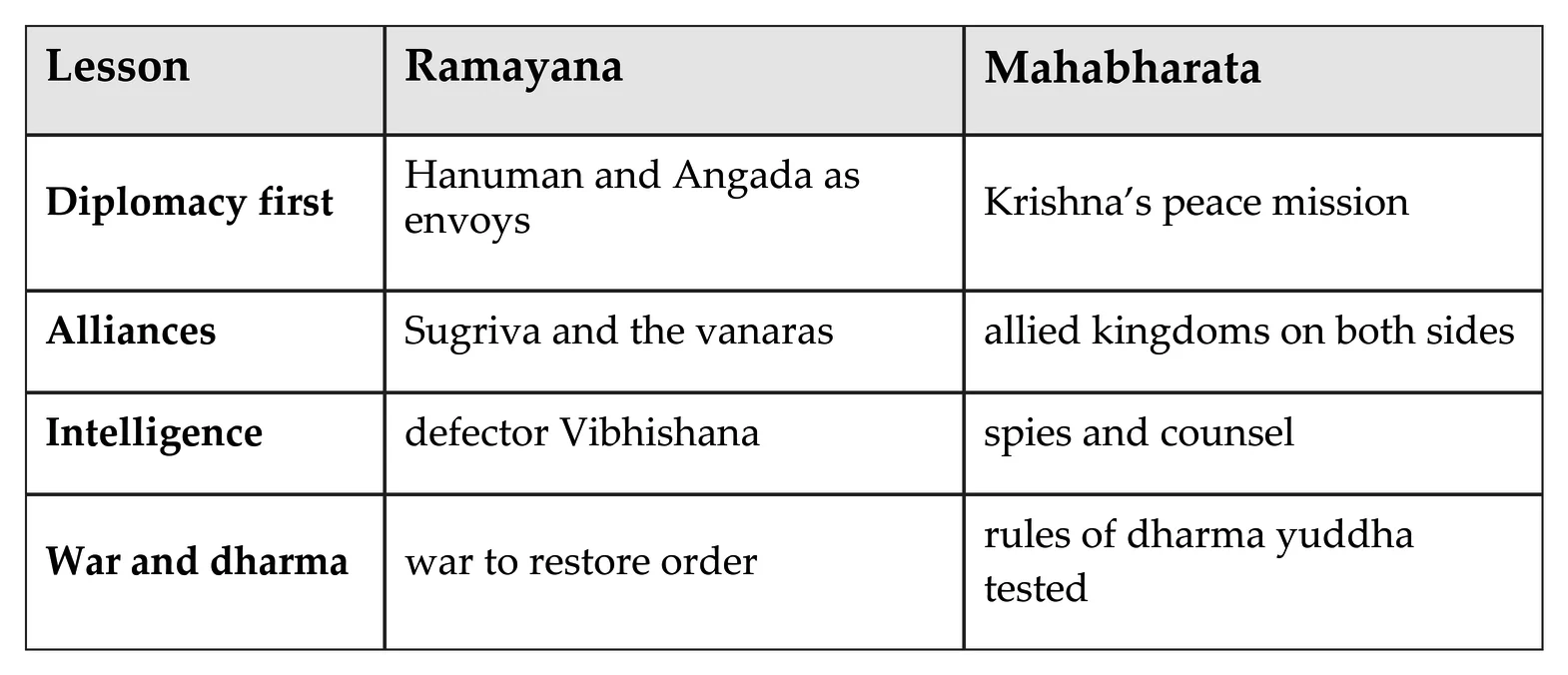
- Ramayana. Rama tries to recover Sita through diplomacy, sending Hanuman and Angada as envoys before war; he forms an alliance with Sugriva and the vanaras and accepts the defector Vibhishana, showing the value of alliances and intelligence from the enemy camp.
- Mahabharata. The Pandavas send Krishna as an envoy to the Kauravas to avoid war, offering to accept just five villages; when this fails, war becomes unavoidable. The epic explores the dilemmas of war, the rules of dharma yuddha (righteous war), the use of deception, and the terrible costs of conflict.
- Bhagavad Gita. Krishna’s counsel to Arjuna stresses doing one’s duty without attachment to results; for a warrior, fighting a righteous war is a duty.
- Shanti Parva. Bhishma’s teachings on the battlefield discuss rajadharma, the duties of the king, the use of danda (force) and the importance of protecting subjects.
Narlikar and Narlikar: Bargaining Lessons
Amrita Narlikar and Aruna Narlikar, in Bargaining with a Rising India: Lessons from the Mahabharata (2014), argue that India’s negotiating behaviour in international forums such as the WTO reflects patterns found in the Mahabharata: a preference for hard bargaining, a heroic refusal to compromise on matters of principle, moral framing of positions and a willingness to accept deadlock rather than an unjust deal. They suggest that understanding these cultural roots can help others negotiate with India, and that India could also learn from the epic’s more flexible strategies.
Cautions
Sharad Patil, in Myth and Reality of Ramayana and Mahabharata (1976), offers a Marxist reading, cautioning that the epics reflect the social conflicts of their times, including caste and class, and should not be treated as timeless guides. Scholars also warn against selective use of the epics to justify contemporary policies or to claim a single Hindu strategic culture, given India’s diverse traditions.
Strategic Ideas in Other Classical Texts
- Shanti Parva of the Mahabharata contains Bhishma’s long teaching on rajadharma, the duties of kings, including counsel, alliances and the use of punishment.
- Kamandaka’s Nitisara, a later digest of Kautilyan ideas, restates the mandala and the six measures in verse.
- The Panchatantra teaches statecraft to princes through animal fables about friendship, deceit and alliances.
- Ashoka’s Rock Edict XIII records his remorse after the Kalinga war and his turn to conquest by dhamma, a model of restraint.
- The Thirukkural devotes its second book, Porul, to statecraft, ministers, forts and armies.
2.2 Kautilya
Kautilya, also called Chanakya or Vishnugupta, is traditionally regarded as the adviser of Chandragupta Maurya (fourth century BCE) and the author of the Arthashastra, a treatise on statecraft, economy, law, diplomacy and war. The text was rediscovered by R. Shamasastry in 1905. Max Weber called it a classic expression of radical realism, compared with which Machiavelli’s Prince is harmless.
Key Ideas of the Arthashastra
- Saptanga theory. The state has seven elements: the king (swami), ministers (amatya), territory and people (janapada), fortified city (durga), treasury (kosha), army (danda) and ally (mitra).
- Matsya nyaya. Without the king’s rod (danda), the strong would devour the weak, as big fish eat small fish; order requires the king’s power.
- Mandala theory. The conqueror (vijigishu) is surrounded by circles of states: the immediate neighbour is a natural enemy (ari), the state beyond it a natural friend (mitra), followed by the enemy’s friend and so on, with a middle king (madhyama) and a neutral king (udasina) able to influence the whole circle.
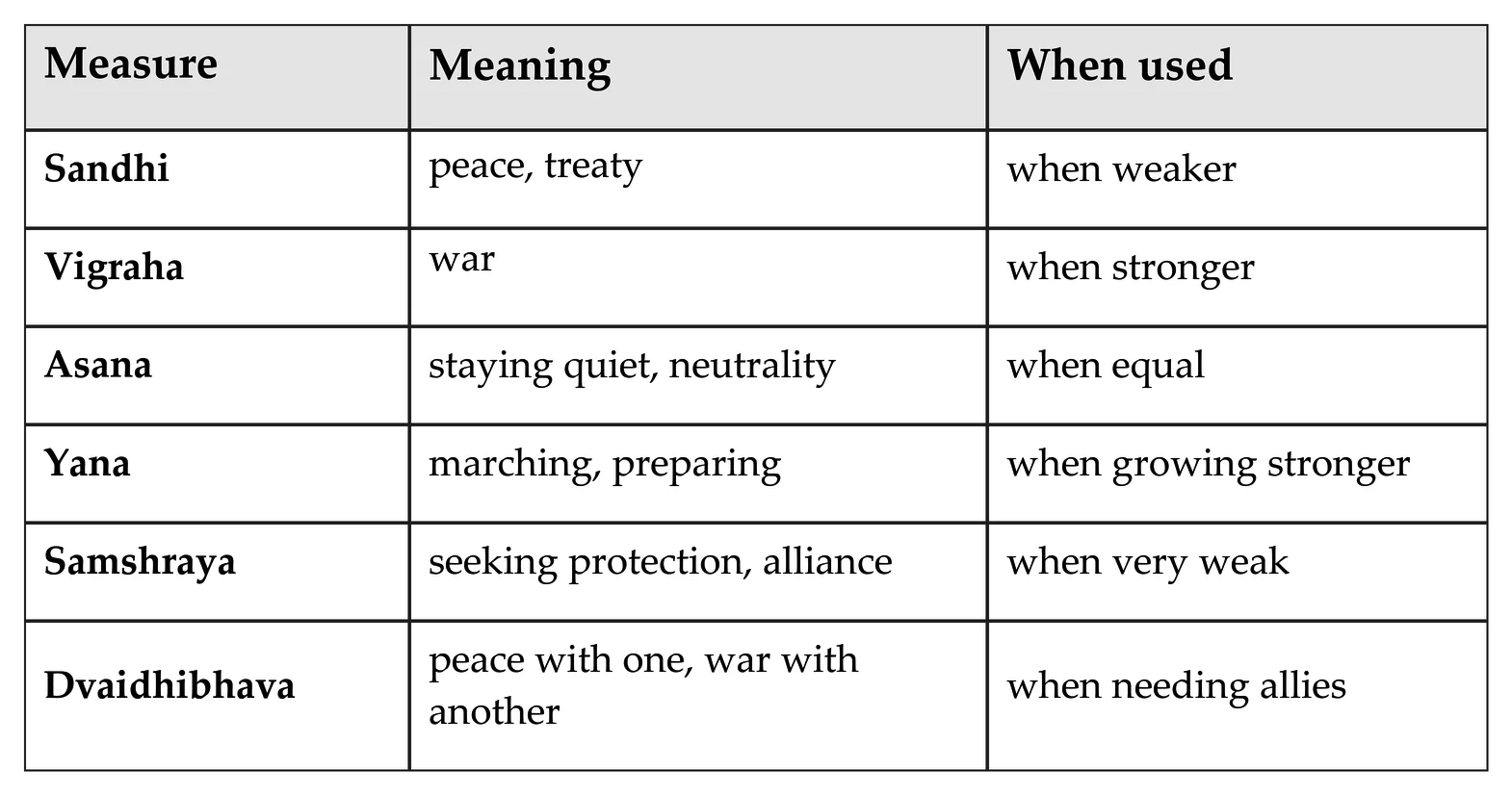
- Six measures (shadgunya). Foreign policy uses six measures: sandhi (peace or treaty), vigraha (war), asana (staying quiet or neutrality), yana (marching or preparing to attack), samshraya (seeking protection or alliance) and dvaidhibhava (double policy, peace with one and war with another), chosen according to relative strength.
- Four upayas. The means of dealing with others are sama (conciliation), dana (gifts), bheda (sowing dissension) and danda (force), with force as the last resort.
- Espionage. The Arthashastra describes an elaborate system of spies and secret agents to gather intelligence and influence enemies.
- Welfare of subjects. The king’s happiness lies in the happiness of his subjects; strategy serves the security and prosperity of the people.
Mitra: Kautilya and Indian Strategic Culture
Subrata K. Mitra, in Kautilya and the Strategic Culture of India (in Subrata Mitra and Michael Liebig, eds., Kautilya’s Arthashastra: An Intellectual Portrait, 2016), argues that Kautilyan ideas form an important layer of India’s strategic culture, often re-used in contemporary policy discourse. India’s combination of realism and restraint, its emphasis on intelligence and diplomacy, its balancing among powers and its pursuit of strategic autonomy echo the Arthashastra’s logic of choosing among the six measures according to circumstances. Rashed Uz Zaman (2006) similarly argued that Kautilya remains a key source of Indian strategic culture, and George Modelski (1964) analysed the Arthashastra’s mandala as an early theory of the international system and balance of power.
Kautilya Today
Indian analysts and institutions, such as the Institute for Defence Studies and Analyses, have revived interest in Kautilya to develop an indigenous vocabulary of strategy. Critics caution that ancient texts written for small kingdoms cannot be directly applied to a modern democratic state, and that emphasising Kautilyan realism may neglect other Indian traditions such as Ashokan restraint and Gandhian non-violence.
Discovery and Debate on the Arthashastra
The Arthashastra was largely unknown in modern times until R. Shamasastry identified a manuscript in Mysore in 1905, published the text in 1909 and an English translation in 1915. R. P. Kangle later produced the standard critical edition and translation (1960–65). Scholars debate its date and authorship: Thomas Trautmann (1971) used statistical analysis of style to argue that it was compiled by several hands, and Patrick Olivelle (2013) places its composition in the early centuries CE rather than the Mauryan period. Max Weber, in Politics as a Vocation (1919), famously said that compared with the Arthashastra, Machiavelli’s The Prince was harmless, a remark that shows how hard-headed Kautilya’s realism appeared to Western readers.
2.3 Non-Textual Conceptualizations: Swaraj and Martial Culture
India’s strategic thinking is not derived only from classical texts. The practices and ideas of later states and communities, such as the Marathas, Mughals, Rajputs and Sikhs, also contributed concepts of sovereignty, legitimacy, warfare and statecraft.
Anand: Maratha Statecraft and the Ajnapatra
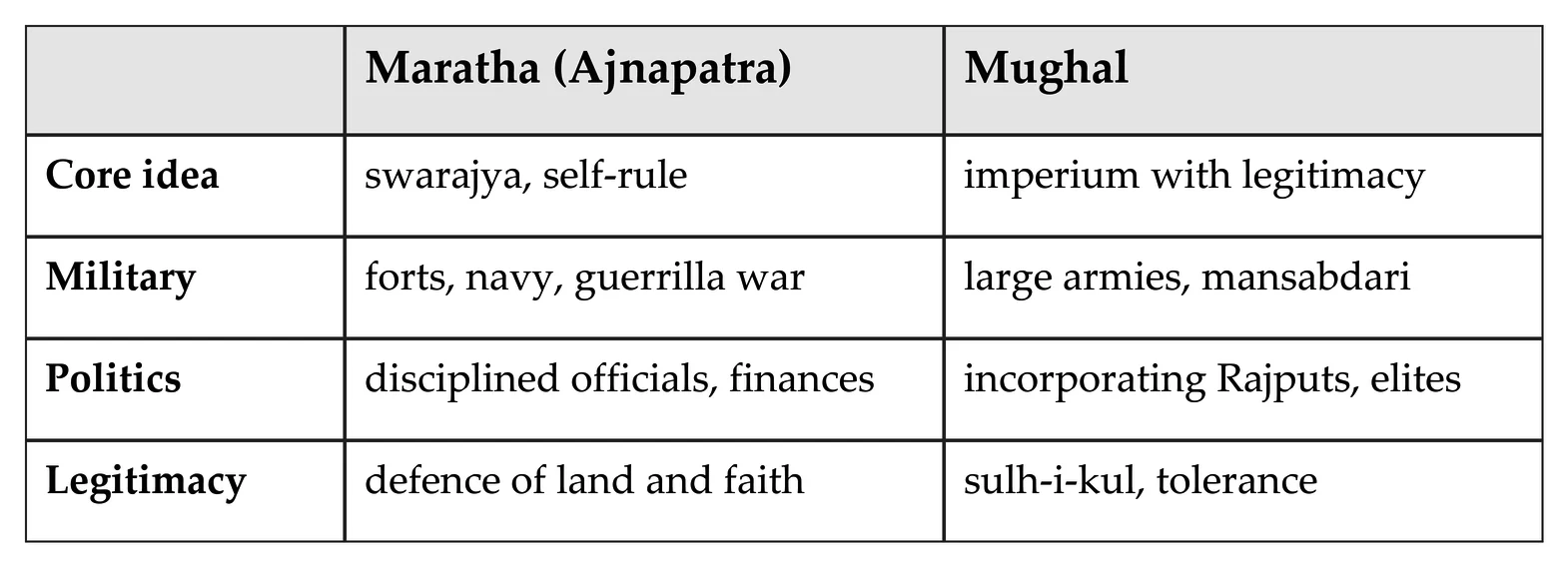
Arpita Anand, in A Regional Intervention in the Debate on India’s Strategic Culture: Maratha Statecraft in Ajnapatra (2021), argues that debates on Indian strategic culture have focused too much on Kautilya and national-level elites, neglecting regional traditions. The Ajnapatra (c. 1716), written by Ramchandrapant Amatya, a minister of the Maratha state, sets out principles of governance and defence drawn from the experience of Shivaji’s swarajya: the importance of forts as the foundation of the kingdom, the need for a navy to protect the coast, careful management of finances, loyalty and discipline of officials, and flexible military tactics such as ganimi kava (guerrilla warfare). Anand shows that the Maratha idea of swarajya, self-rule asserted against powerful empires, offers an indigenous concept linking sovereignty, security and legitimacy.
Vivekanandan: The Mughal Strategic Discourse
Jayashree Vivekanandan, in Strategy, Legitimacy and the Imperium: Framing the Mughal Strategic Discourse (2014), shows that the Mughal empire developed a grand strategy that combined military power with legitimacy. Under Akbar, the empire incorporated regional elites, especially Rajput rulers, through alliances, marriage and the mansabdari system, and pursued sulh-i-kul (universal peace or tolerance) to win acceptance among diverse subjects. Military force was used to expand and hold the empire, but its durability depended on legitimacy and incorporation rather than force alone.
Martial Culture
- Rajput traditions. Codes of honour, valour and loyalty, sometimes at the cost of strategic flexibility.
- Sikh Khalsa. Founded by Guru Gobind Singh in 1699, it combined spiritual commitment with martial discipline, and Ranjit Singh built a modern army in the early nineteenth century.
- Maratha guerrilla warfare. Mobility, surprise and the use of hill forts against larger armies.
- Colonial martial races. The British recruited soldiers from groups they labelled martial races, a policy that shaped the composition of the Indian Army and is criticised today.
Swaraj as a Strategic Idea
The idea of swaraj, from Shivaji’s swarajya to the freedom movement and Gandhi’s self-rule, links security with autonomy and self-reliance. It underlies India’s commitment to strategic autonomy and its reluctance to depend on any single power, connecting historical traditions with contemporary policy.
Other Regional Military Traditions
- Ahom resistance. Lachit Borphukan defeated a Mughal fleet at the Battle of Saraighat on the Brahmaputra in 1671, using river warfare and terrain.
- Mysore. Hyder Ali and Tipu Sultan used iron-cased rockets against the British in the Anglo-Mysore wars of the late eighteenth century.
- The Sikh kingdom. Maharaja Ranjit Singh, who took Lahore in 1799, built a modern army trained partly by European officers.
- Lesson. These traditions show adaptation of technology and terrain, supporting the view that India’s strategic heritage is plural and practical.
2.4 Important Questions
- Question 1 Discuss the strategic thought in the Ramayana and the Mahabharata.
- Question 2 Explain Kautilya’s mandala theory and his six measures of foreign policy.
- Question 3 Discuss the relevance of Kautilya for India’s strategic culture.
- Question 4 Discuss the non-textual sources of India’s strategic thinking with reference to Maratha and Mughal statecraft.
DU asks the same idea in different words. So learn one broad answer for each question below; the same answer works for every question joined by OR.
Important Question 1
Discuss the strategic thought in the Ramayana and the Mahabharata.
OR
Examine Swarna Rajagopalan’s analysis of grand strategic thought in the Indian epics.
OR
Discuss the lessons of the Indian epics for strategy and negotiation.
Model Answer
“For a warrior, nothing is higher than a war against evil.”
— Bhagavad Gita 2.31 (tr. Eknath Easwaran)
Introduction. India’s epics, the Ramayana and the Mahabharata, contain rich reflections on kingship, war, diplomacy and statecraft. Swarna Rajagopalan shows that they offer a coherent grand strategic thought centred on dharma, while Amrita and Aruna Narlikar find in the Mahabharata patterns of Indian negotiating behaviour. These texts form part of the intellectual foundations of Indian strategic thinking.
1. The Epics as Strategic Texts
Beyond their religious and literary meaning, the epics discuss how kings should protect their kingdoms, choose allies, gather intelligence and decide on war and peace, making them sources of strategic thought.
2. Dharma as Goal
Rajagopalan shows that the maintenance of dharma, the moral and social order, is the ultimate goal of statecraft in both epics, and power is legitimate only when it serves dharma.
3. Protection of the People
Both epics treat protection of the kingdom and its people as the king’s first duty, linking security with legitimate rule.
4. Counsel and Advisers
The epics stress the importance of wise counsel; kings who ignore good advice, like Ravana and Duryodhana, bring ruin on themselves.
5. Diplomacy before War
Rama sends Hanuman and Angada as envoys, and the Pandavas send Krishna to seek peace, showing that war is to be a last resort after diplomacy fails.
6. Alliances
Rama’s alliance with Sugriva and the vanaras shows the value of alliances, built on mutual benefit and trust, in overcoming a powerful adversary.
7. Intelligence and Defectors
Rama’s acceptance of Vibhishana, Ravana’s brother, shows the value of intelligence and defectors from the enemy camp.
8. Rules of War
The Mahabharata describes rules of dharma yuddha, righteous war, such as not attacking the unarmed, while also showing how these rules were broken under pressure.
9. Moral Dilemmas
The epic explores the dilemmas of war, including the use of deception, as in the killing of Drona, raising enduring questions about ends and means.
10. The Gita’s Counsel
Krishna’s counsel to Arjuna stresses performing one’s duty without attachment to results, and treats a righteous war as a warrior’s duty.
11. Bhishma’s Teachings
In the Shanti Parva, Bhishma teaches rajadharma, the duties of kings, including the use of danda and the protection of subjects.
12. Narlikar and Narlikar
The Narlikars argue that India’s negotiation style in forums like the WTO reflects Mahabharata patterns of hard bargaining and moral framing.
13. Lessons for Negotiation
They suggest India could learn from the epic’s more flexible strategies, such as Krishna’s pragmatic diplomacy, to achieve better outcomes.
14. Sharad Patil’s Caution
Sharad Patil’s Marxist reading cautions that the epics reflect the social conflicts of their time and should not be treated as timeless guides.
15. Selective Use
Scholars warn against selective use of the epics to justify contemporary policies or to claim a single Hindu strategic culture.
16. Krishna as Strategist
Krishna appears in the Mahabharata as a master strategist who combines diplomacy, alliance-building and, when necessary, deception to secure victory for the side of dharma. His conduct raises the question whether righteous ends can justify unconventional means, a question central to strategy in every age.
17. The Epics and Modern Discourse
Indian leaders and commentators often refer to the epics, using phrases such as Lakshman rekha for red lines or invoking the Mahabharata to discuss just war, showing how these texts continue to shape the language of strategy and security in India.
18. Evaluation
The epics offer valuable insights into the ethics and practice of strategy, but must be read critically and in their historical context.
Conclusion. Thus, the Ramayana and Mahabharata, as Rajagopalan shows, contain a grand strategic thought centred on dharma, counsel, diplomacy, alliances, intelligence and war as a last resort, while the Narlikars find in them roots of India’s negotiating style. The Gita’s teaching that for a warrior nothing is higher than a war against evil shows their moral framing of conflict.
Important Question 2
Explain Kautilya’s mandala theory and his six measures of foreign policy.
OR
Discuss Kautilya’s contribution to the theory of international relations.
OR
Examine the Arthashastra as a text of realist statecraft.
Model Answer
“Agreement with pledges is peace; offensive operation is war; indifference is neutrality; making preparations is marching; seeking the protection of another is alliance; and making peace with one and waging war with another is termed a double policy.”
— Kautilya, Arthashastra, Book VII (tr. R. Shamasastry)
Introduction. Kautilya’s Arthashastra is one of the world’s earliest systematic treatises on statecraft and foreign policy. Written, according to tradition, by the adviser of Chandragupta Maurya, it offers a realist theory of inter-state relations through the mandala theory and the six measures of foreign policy, which scholars such as George Modelski have compared to modern theories of the balance of power.
1. Kautilya and the Arthashastra
Kautilya, also known as Chanakya, is traditionally regarded as the author of the Arthashastra, rediscovered by R. Shamasastry in 1905 and published in 1909.
2. Realist Outlook
The Arthashastra treats inter-state relations as a struggle for power and security, in which the king must calculate relative strength and act accordingly.
3. The Vijigishu
At the centre of the mandala is the vijigishu, the would-be conqueror, whose aim is to expand power and security.
4. Enemy and Friend
The immediate neighbour is a natural enemy, since it shares a border and competes for resources, while the state beyond it is a natural friend, sharing an interest against the common enemy.
5. The Wider Circle
Beyond these lie the enemy’s friend, the friend’s friend and so on, forming circles of alternating enemies and friends.
6. Middle and Neutral Kings
The madhyama, or middle king, can help or resist both conqueror and enemy, while the udasina, or neutral king, is powerful enough to influence the whole circle.
7. Sandhi
Sandhi, peace or treaty, is adopted when a king is weaker than his enemy or when peace serves his interests better than war.
8. Vigraha
Vigraha, war, is chosen when a king is stronger and can gain by fighting, though Kautilya prefers victory with minimum cost.
9. Asana and Yana
Asana means staying quiet or neutral when neither side gains by action, while yana means marching or preparing to attack when strength grows.
10. Samshraya and Dvaidhibhava
Samshraya means seeking the protection of a stronger power, and dvaidhibhava means a double policy, making peace with one state while waging war on another.
11. Choice by Circumstance
Kautilya stresses that the choice among the six measures depends on relative strength, aiming always to move from decline towards stability and growth.
12. Four Upayas
The four means of sama, dana, bheda and danda, conciliation, gifts, dissension and force, guide dealings with others, with force as the last resort.
13. Espionage
The Arthashastra describes an elaborate system of spies to gather intelligence, sow dissension among enemies and protect the state.
14. Modelski’s Analysis
George Modelski (1964) analysed the mandala as an early theory of the international system, comparable to modern ideas of the balance of power.
15. Comparison with Machiavelli
Max Weber called the Arthashastra more radically realist than Machiavelli’s Prince, though Kautilya also stressed the welfare of subjects.
16. Kautilya on Weak and Strong States
Kautilya advised a weak king to seek peace or the protection of a stronger power and to build strength quietly, while a strong king could march against a weakened enemy. This shows a dynamic, situation-based approach rather than fixed rules.
17. Kautilya and Economic Power
The Arthashastra gives great importance to the treasury, trade, agriculture and mines, treating economic strength as the basis of military power, an idea echoed in modern thinking about comprehensive national power.
18. Mandala in Modern Practice
Analysts often apply the mandala to South Asia: Pakistan as the hostile neighbour, Afghanistan and Iran beyond it as potential partners, and China as the enemy’s friend. Though simplified, this reading shows why the mandala remains a popular lens for India’s neighbourhood policy.
19. Evaluation
Kautilya’s mandala and six measures offer a sophisticated realist framework that remains useful for thinking about regional politics and alliances.
Conclusion. Thus, Kautilya’s mandala theory describes circles of natural enemies and friends around the conqueror, and his six measures, peace, war, neutrality, marching, alliance and double policy, are chosen according to relative strength. This realist framework, compared by Modelski and Weber to modern and Machiavellian thought, is a key foundation of Indian strategic thinking.
Important Question 3
Discuss the relevance of Kautilya for India’s strategic culture.
OR
Examine Subrata Mitra’s argument on Kautilya and the strategic culture of India.
OR
Examine the relevance of Kautilya to India’s foreign policy today.
Model Answer
“Truly radical Machiavellianism, in the popular sense of that word, is classically expressed in Indian literature in the Arthashastra of Kautilya; compared to it, Machiavelli’s The Prince is harmless.”
— Max Weber, Politics as a Vocation (1919)
Introduction. Strategic culture refers to the enduring beliefs, values and habits that shape how a state thinks about security and the use of force. Subrata Mitra argues that Kautilyan ideas form an important layer of India’s strategic culture, re-used in contemporary policy discourse. Others caution against over-emphasising an ancient text in understanding a modern democracy.
1. Meaning of Strategic Culture
Strategic culture is the set of shared beliefs and habits about security, threats and the use of force that shapes a state’s choices across time.
2. Tanham’s Challenge
George Tanham argued in 1992 that Indian elites had not thought systematically about strategy, a claim that provoked scholars to examine India’s strategic traditions.
3. Mitra’s Argument
Subrata Mitra argues that Kautilyan ideas form an important layer of India’s strategic culture and are re-used in contemporary discourse on security and diplomacy.
4. Realism and Restraint
India’s combination of realism and restraint echoes Kautilya’s preference for achieving goals through the least costly means, with force as a last resort.
5. Balancing among Powers
India’s balancing among great powers, such as the United States, Russia and China, resembles the Kautilyan logic of choosing among the six measures according to circumstances.
6. Strategic Autonomy
India’s pursuit of strategic autonomy, avoiding dependence on any single power, reflects Kautilya’s emphasis on preserving the king’s freedom of action.
7. The Mandala and the Neighbourhood
Some analysts apply the mandala to South Asia, seeing Pakistan as a neighbour-enemy and states beyond it, such as Afghanistan, as potential friends.
8. Intelligence and Diplomacy
Kautilya’s emphasis on intelligence and diplomacy resonates with India’s reliance on diplomacy and intelligence in managing its neighbourhood.
9. Zaman’s View
Rashed Uz Zaman argued in 2006 that Kautilya remains a key source of Indian strategic culture, despite the long gap between ancient and modern India.
10. Revival in Policy Circles
Institutions such as the Institute for Defence Studies and Analyses have revived interest in Kautilya to build an indigenous vocabulary of strategy.
11. Weber’s Comparison
Max Weber’s remark that the Arthashastra is more radically realist than Machiavelli highlights the hard-headed realism of Indian classical thought.
12. Welfare and Legitimacy
Kautilya also stressed that the king’s happiness lies in his subjects’ happiness, linking strategy with good governance and legitimacy.
13. Limits of Application
Critics caution that a text written for small kingdoms cannot be directly applied to a modern democratic state in a globalised world.
14. Other Traditions
Emphasising Kautilya may neglect other Indian traditions such as Ashokan restraint, Buddhist ethics and Gandhian non-violence, which also shape India’s outlook.
15. Nehru and Kautilya
Even Nehru admired Kautilya’s realism in The Discovery of India, while pursuing a foreign policy based on non-alignment and peace, showing that traditions combine.
16. Kautilya and Non-Alignment
Some scholars read non-alignment as a modern form of Kautilyan asana, staying neutral among great powers to preserve freedom of action, while multi-alignment today resembles dvaidhibhava, cooperating with different powers on different issues.
17. Kautilya in Indian Diplomacy
Indian diplomats and leaders, including recent foreign ministers, have referred to Kautilya in speeches and writings, and books such as Shyam Saran’s How India Sees the World (2017) begin with him, showing his symbolic place in India’s strategic self-image.
18. Evaluation
Kautilya is an important, though not exclusive, source of India’s strategic culture, best understood alongside other traditions.
Conclusion. Thus, Mitra and Zaman argue that Kautilyan realism, balancing, intelligence and strategic autonomy form a lasting layer of India’s strategic culture, answering Tanham’s doubts. Weber’s comparison shows the Arthashastra’s radical realism, but it must be read alongside other Indian traditions of restraint.
Important Question 4
Discuss the non-textual sources of India’s strategic thinking with reference to Maratha and Mughal statecraft.
OR
Examine the idea of swarajya and martial culture in India’s strategic traditions.
OR
Discuss Arpita Anand’s analysis of Maratha statecraft in the Ajnapatra.
Model Answer
“This seal of Shivaji, son of Shahaji, will grow like the first crescent of the moon, will be honoured by the world, and shines for the welfare of all.”
— Royal seal of Shivaji (Sanskrit inscription, tr.)
Introduction. India’s strategic thinking draws not only on classical texts such as the epics and the Arthashastra but also on the practices of later states and communities. Arpita Anand highlights Maratha statecraft and the idea of swarajya, while Jayashree Vivekanandan examines the Mughal strategic discourse of legitimacy and incorporation. Martial traditions of various communities also shaped Indian ideas of war and security.
1. Beyond Texts
Strategic culture is shaped by practices, institutions and experiences as well as texts, so the history of Indian states offers important sources.
2. Anand’s Regional Intervention
Arpita Anand argues that debates on Indian strategic culture focus too much on Kautilya and national elites, neglecting regional traditions such as the Maratha.
3. The Ajnapatra
The Ajnapatra, written around 1716 by Ramchandrapant Amatya, sets out principles of Maratha governance and defence drawn from Shivaji’s experience.
4. Forts
The Ajnapatra describes forts as the foundation of the kingdom, and Shivaji built and held a network of hill forts that allowed a smaller power to resist large empires.
5. Navy
Shivaji built a navy to protect the Konkan coast against the Siddis, Portuguese and English, an early recognition of maritime security.
6. Guerrilla Warfare
The Marathas used ganimi kava, guerrilla tactics of mobility and surprise, to defeat larger Mughal armies, showing strategic adaptation to circumstances.
7. Swarajya
Shivaji’s idea of swarajya, self-rule asserted against powerful empires, links sovereignty, security and legitimacy, and became a symbol of Indian self-assertion.
8. Governance and Finance
The Ajnapatra stresses careful financial management and the discipline and loyalty of officials as foundations of security.
9. Vivekanandan on the Mughals
Jayashree Vivekanandan shows that the Mughal empire’s grand strategy combined military power with legitimacy and incorporation of diverse elites.
10. Incorporation of Elites
Akbar incorporated Rajput rulers and other elites through alliances, marriage and the mansabdari system, turning potential rivals into partners.
11. Sulh-i-Kul
Akbar’s policy of sulh-i-kul, universal peace or tolerance, sought acceptance among diverse subjects, showing that legitimacy was a strategic resource.
12. Rajput Martial Traditions
Rajput codes of honour and valour shaped ideas of warfare, though sometimes at the cost of strategic flexibility against more pragmatic opponents.
13. The Sikh Khalsa
The Khalsa, founded by Guru Gobind Singh in 1699, combined spiritual commitment with martial discipline, and Ranjit Singh built a modern army in Punjab.
14. Colonial Martial Races
The British labelled certain groups martial races for recruitment, a policy that shaped the Indian Army and is criticised today as divisive.
15. Legacy for Today
Ideas of swaraj, forts and navies, legitimacy and incorporation continue to inform debates on strategic autonomy, maritime security and national integration.
16. Maritime Traditions
Beyond the Marathas, the Chola empire of south India projected naval power across the Bay of Bengal to South-East Asia in the eleventh century, showing an older maritime dimension of Indian strategic history that is often forgotten.
17. Regional Diversity
Anand’s argument suggests that India’s strategic culture is plural, shaped by regional experiences in the north-west frontier, the Deccan, the coasts and the north-east, rather than a single national tradition.
18. Evaluation
Non-textual traditions enrich our understanding of Indian strategic culture, showing its diversity beyond classical texts.
Conclusion. Thus, Anand shows that Maratha statecraft in the Ajnapatra, with its forts, navy, guerrilla warfare and swarajya, and Vivekanandan shows that Mughal strategy of legitimacy and incorporation, are important non-textual sources of Indian strategic thought. Shivaji’s seal, promising growth for the welfare of all, captures the link between power and legitimacy.
Short Notes
(a) Mandala theory
Kautilya’s theory that a conqueror is surrounded by circles of states in which the immediate neighbour is a natural enemy and the state beyond it a natural friend.
(b) Shadgunya
Kautilya’s six measures of foreign policy: peace, war, neutrality, marching, alliance and double policy, chosen according to relative strength.
(c) Ajnapatra
A Maratha treatise on statecraft written around 1716 by Ramchandrapant Amatya, stressing forts, navy, finances and disciplined administration.
(d) Dharma yuddha
The idea of righteous war found in the Mahabharata, with rules such as not attacking the unarmed, the fleeing or those who surrender. The epic also shows these rules being broken, raising lasting questions about just means and just ends in war, debates that continue in modern discussions of just war and restraint.
More notes: MDSE-2b India's National Security
These notes are prepared by PADHO TO AISE for study help. They are not an official University of Delhi publication.