
Semester IV DSC-12 Global Politics
Unit IV · 24 min read · Updated 24 Nov 2026
As per the University of Delhi (DU) BA (Hons) Political Science syllabus
Contents
- 4.1 Social Movements and Globalisation
- 4.2 Environment Movements
- 4.3 Women’s Movements
- 4.4 Peace Movements
- 4.5 Global Civil Society and its Limits
- 4.6 Important Questions
- What are global social movements? Discuss their relationship with globalisation.
- Discuss the role of environment movements in global politics with suitable examples.
- Trace the development of women’s movements at the global level.
- Discuss the role of peace movements in global politics.
- Short Notes
एक दूसरी दुनिया संभव है।
Another world is possible.
— World Social Forum, Porto Alegre (2001)
GLOBAL politics is not made only by states, corporations and international organisations. Ordinary people organised in social movements have changed the world: they won the vote for women, forced governments to protect forests and rivers, pressed for bans on landmines and nuclear weapons, and challenged the injustices of globalisation. With cheaper travel, the internet and global media, movements increasingly cross borders, forming networks of activists that pressure states and international institutions. This unit studies the nature of global social movements and three of the most important: environment movements, women’s movements and peace movements.
4.1 Social Movements and Globalisation
A social movement is a sustained, collective effort by people outside formal political institutions to bring about or resist social and political change. Movements combine networks of individuals and organisations, a shared identity, and protest and other forms of action. Theorists distinguish old social movements, such as labour movements focused on class and material interests, from new social movements that emerged from the 1960s, such as environmental, women’s, peace and gay rights movements, which focus on identity, culture and quality of life and are decentralised and often led by educated middle classes.
Global or transnational social movements connect activists across borders. John Guidry and his co-authors (2000) argue that globalisation creates a transnational public sphere in which movements frame issues in global terms, use international norms and institutions, and link local struggles to global audiences. Margaret Keck and Kathryn Sikkink described transnational advocacy networks and the boomerang pattern, in which local activists blocked by their own state appeal to foreign allies, who pressure that state from outside.
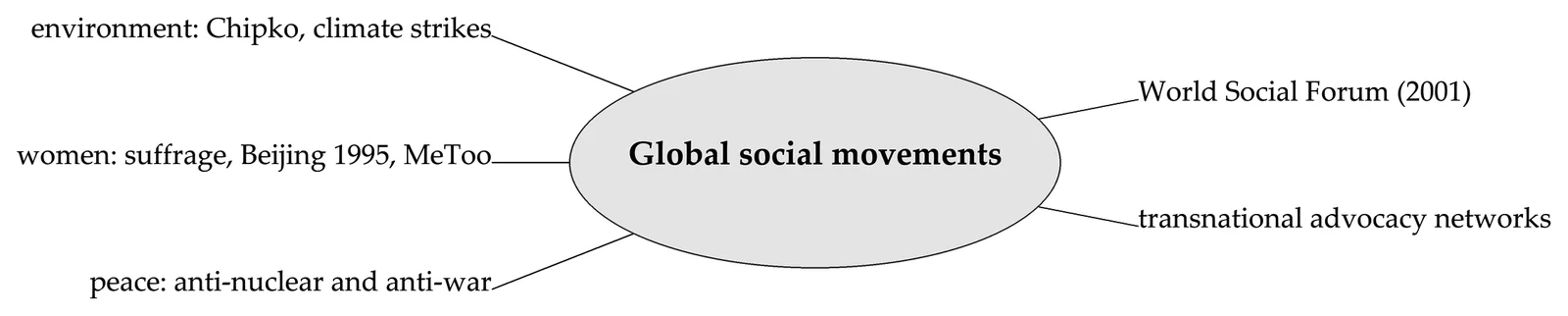
Cristina Flesher Fominaya (2014) traces the global justice movement: the Zapatista uprising in Mexico on 1 January 1994, the day NAFTA came into force; Peoples’ Global Action (1998), which Hermann Maiba describes as a grassroots, horizontal network coordinating global days of action; the ‘Battle of Seattle’ against the WTO in 1999; and the World Social Forum (2001) with its slogan ‘another world is possible’. A new wave in 2011 included the Arab Spring, Spain’s Indignados and Occupy Wall Street, whose slogan was ‘we are the 99 per cent’. Catherine Eschle and Neil Stammers (2004) warn against equating movements with professional international NGOs (INGOs) such as Amnesty International or Greenpeace: movements are broader, more fluid processes of collective action that may challenge power more radically.
4.2 Environment Movements
- Origins: Rachel Carson’s Silent Spring (1962) exposed the dangers of pesticides; the first Earth Day (1970) mobilised millions in the USA; Greenpeace (1971) and Friends of the Earth (1969) became global environmental organisations.
- Chipko (1973): villagers, especially women such as Gaura Devi, hugged trees in the Garhwal Himalayas to stop commercial felling; leaders included Chandi Prasad Bhatt and Sunderlal Bahuguna. It led to a ban on green felling in the Himalayan forests of Uttar Pradesh.
- Narmada Bachao Andolan (1985): led by Medha Patkar and Baba Amte, it opposed large dams that displaced tribal people and farmers, and influenced the World Bank’s withdrawal from the Sardar Sarovar project in 1993.
- Green Belt Movement (1977): founded by Wangari Maathai in Kenya, it mobilised women to plant tens of millions of trees; Maathai won the Nobel Peace Prize in 2004.
- Environmental justice: movements in the USA and elsewhere showed that pollution falls most heavily on poor and minority communities; Ramachandra Guha and Joan Martinez-Alier called struggles of the poor over land, water and forests the environmentalism of the poor.
- Climate movement: Fridays for Future, started by Greta Thunberg in 2018, Extinction Rebellion (2018) and indigenous struggles such as Standing Rock (2016) demand urgent climate action and climate justice.
4.3 Women’s Movements
Women’s movements seek equality, rights and freedom from discrimination and violence. Historians describe successive waves:
- First wave (mid-nineteenth to early twentieth century): the struggle for suffrage, property rights and education, beginning with the Seneca Falls Convention (1848) in the USA; New Zealand granted women the vote in 1893.
- Second wave (1960s–1980s): campaigns on reproductive rights, equal pay, domestic violence and sexuality, with the slogan ‘the personal is political’; Betty Friedan’s The Feminine Mystique (1963) was influential.
- Third wave (1990s): emphasis on diversity and intersectionality, a term coined by Kimberlé Crenshaw (1989), and critiques by women of colour and Global South feminists such as Chandra Talpade Mohanty.
- Fourth wave (2010s): digital activism, as in the #MeToo movement, which spread globally in 2017.
Women’s movements became transnational through the UN: International Women’s Year (1975) and the Mexico City conference, the UN Decade for Women (1976–85), the Convention on the Elimination of All Forms of Discrimination against Women (CEDAW, 1979), and the Beijing Conference (1995), whose Platform for Action identified twelve critical areas of concern. UN Security Council Resolution 1325 (2000) recognised women’s role in peace and security. Networks such as DAWN (Development Alternatives with Women for a New Era), founded in Bangalore in 1984, brought Southern perspectives. Sarifa Moola (2004) observes that activism has shifted from mass movements to NGOs and new actors, raising concerns about NGO-isation. In India, campaigns against dowry and custodial rape in the 1970s and 1980s, the Vishaka judgment (1997) and protests after the Delhi gang rape of 2012 changed laws and public debate.
4.4 Peace Movements
- Early peace societies in the nineteenth century promoted arbitration and disarmament.
- Anti-nuclear movement: the Russell–Einstein Manifesto (1955) warned of nuclear war; the Pugwash Conferences (1957) brought scientists together; Britain’s Campaign for Nuclear Disarmament (1958) organised mass marches; protests contributed to the Partial Test Ban Treaty (1963).
- Anti-war movements: mass protests against the Vietnam War in the 1960s–70s, and global demonstrations against the Iraq war on 15 February 2003 involving millions of people in hundreds of cities.
- 1980s: the nuclear freeze campaign in the USA, European Nuclear Disarmament and the Greenham Common women’s peace camp in Britain (1981–2000) opposed new missiles.
- Campaigns for treaties: the International Campaign to Ban Landmines won the Nobel Peace Prize in 1997 after the Ottawa Treaty; the International Campaign to Abolish Nuclear Weapons (ICAN) won it in 2017 after the Treaty on the Prohibition of Nuclear Weapons; Japan’s Nihon Hidankyo, an organisation of atomic bomb survivors, won it in 2024.
- Gandhian influence and South Asia: Gandhi’s non-violence inspired peace activists worldwide, and groups such as the Pakistan-India People’s Forum for Peace and Democracy (1994) promote people-to-people dialogue.
4.5 Global Civil Society and its Limits
Many scholars speak of an emerging global civil society of movements, NGOs and networks that holds states and corporations accountable. Gordon Laxer and Sandra Halperin (2003) point to its limits: it is dominated by well-funded Northern NGOs; its members are unequal in resources and voice; it lacks democratic accountability; and nation-states remain the main sites where rights are won and enforced. Eschle and Stammers similarly caution that INGOs may become professionalised and depoliticised. Yet global movements have changed norms, shaped treaties and given voice to marginalised people.
4.6 Important Questions
- Question 1 What are global social movements? Discuss their relationship with globalisation.
- Question 2 Discuss the role of environment movements in global politics with suitable examples.
- Question 3 Trace the development of women’s movements at the global level.
- Question 4 Discuss the role of peace movements in global politics.
DU asks the same idea in different words. So learn one broad answer for each question below; the same answer works for every question joined by OR.
Important Question 1
What are global social movements? Discuss their relationship with globalisation.
OR
Discuss the rise of the global justice movement and the World Social Forum.
OR
Distinguish between social movements and INGOs. What are the limits of global civil society?
Model Answer
“We want a world in which many worlds fit.”
— Zapatista National Liberation Army, Fourth Declaration of the Lacandon Jungle (1996)
Introduction. Social movements have always shaped politics, but globalisation has given them new forms. Activists now connect across borders, target international institutions and multinational corporations, and frame local struggles in global terms. Global social movements have become important actors in global politics, challenging the power of states and markets and promoting new norms.
1. Meaning of Social Movements
A social movement is a sustained collective effort by people, mostly outside formal institutions, to promote or resist change. It involves networks of individuals and organisations, a shared collective identity, a sense of grievance and opponents, and repertoires of action such as protests, petitions, boycotts and civil disobedience. Movements differ from political parties, which seek office, and from interest groups, which lobby within institutions.
2. Old and New Social Movements
Old social movements, especially the labour movement, focused on class and material interests and were organised through unions and parties. New social movements, analysed by Alain Touraine, Alberto Melucci and Claus Offe, emerged from the 1960s around issues of environment, gender, peace, sexuality and human rights. They emphasise identity, culture and autonomy, are decentralised and networked, and are often led by educated middle classes. Critics note that the distinction is not absolute: labour movements also raised cultural issues, and many new movements also address material inequality.
3. Globalisation and Movements
Guidry and his co-authors argue that globalisation creates opportunities for movements by building a transnational public sphere. Cheaper travel, the internet and global media allow activists to share information and coordinate, international norms and institutions provide targets and resources, and global problems such as climate change require global responses. Globalisation also creates grievances, such as inequality and job losses, that fuel protest.
4. Transnational Advocacy Networks
Margaret Keck and Kathryn Sikkink showed that transnational advocacy networks of activists, NGOs, journalists and sympathetic officials influence states through information, symbolic politics, leverage and accountability. In the boomerang pattern, local activists whose government ignores them appeal to international allies, who pressure the government from outside, as in human rights and environmental campaigns.
5. The Global Justice Movement
Fominaya traces the global justice or alter-globalisation movement, which opposed neo-liberal globalisation. The Zapatista uprising in Chiapas on 1 January 1994 inspired activists worldwide, and Peoples’ Global Action (1998) coordinated grassroots global days of action. The protests against the WTO in Seattle in 1999, followed by protests in Prague, Genoa and elsewhere, made the movement visible.
6. The World Social Forum
The World Social Forum, first held in Porto Alegre in 2001 as an alternative to the World Economic Forum in Davos, brought together movements, NGOs and activists under the slogan another world is possible. It was an open space for discussion rather than a decision-making body, and it was held in Mumbai in 2004, showing the participation of the Global South.
7. The 2011 Wave
After the 2008 financial crisis, a new wave of protest included the Arab Spring, which toppled rulers in Tunisia and Egypt; the Indignados in Spain, who occupied public squares from 15 May 2011; and Occupy Wall Street from September 2011, with its slogan we are the 99 per cent. Fominaya notes their use of social media, occupation of public spaces and horizontal, leaderless organisation.
8. Movements and INGOs
Eschle and Stammers warn against equating social movements with INGOs such as Amnesty International, Greenpeace and Oxfam. INGOs are formal, professional organisations that often work within institutions, while movements are broader, more fluid processes of collective action that may challenge power structures more radically. Conflating the two may depoliticise global activism.
9. Limits of Global Civil Society
Laxer and Halperin identify limits of global civil society: it is dominated by Northern organisations with greater resources; it lacks democratic accountability; it is internally unequal; and the nation-state remains the main arena in which rights are secured. Maiba’s study of Peoples’ Global Action shows the efforts of grassroots movements to resist such hierarchies through horizontal organisation.
10. Achievements
Global movements have shaped norms and treaties, such as the ban on landmines, climate agreements and women’s rights conventions; exposed corporate and state abuses; and given voice to marginalised peoples. They remind us that global politics is shaped from below as well as from above.
Conclusion. Thus, global social movements are networks of collective action that cross borders and challenge states and markets. Globalisation has both created their grievances and enabled their organisation, though inequalities within global civil society limit their democratic potential.
Important Question 2
Discuss the role of environment movements in global politics with suitable examples.
OR
Examine the Chipko and Narmada Bachao Andolan as environmental movements.
OR
What is the environmentalism of the poor? Discuss.
Model Answer
“What do the forests bear? Soil, water and pure air.”
— Slogan of the Chipko movement
Introduction. Environment movements have been among the most influential social movements of the past six decades. They have raised awareness of pollution, deforestation, biodiversity loss and climate change, pressured governments and corporations, and helped create international environmental agreements. They range from mass movements of villagers defending forests to global campaigns of young people demanding climate action.
1. Origins of Environmentalism
Modern environmentalism grew in the 1960s. Rachel Carson’s Silent Spring (1962) showed how pesticides poisoned wildlife and humans, and the first Earth Day in 1970 mobilised about twenty million Americans. These events led to new environmental laws and agencies and to the Stockholm Conference of 1972. Images of the Earth from space, such as the Earthrise photograph taken from Apollo 8 in 1968, encouraged a sense of a single fragile planet.
2. Global Environmental Organisations
Organisations such as Friends of the Earth (1969) and Greenpeace (1971), founded to protest nuclear testing, became global campaigners on whaling, nuclear power, toxic waste and climate. They use direct action, media campaigns and lobbying at international conferences, and they monitor the implementation of environmental agreements. Their participation as observers in UN climate negotiations allows them to publicise national positions and hold governments to their promises.
3. The Chipko Movement
In 1973 villagers in the Garhwal Himalayas began to hug trees to prevent their felling by contractors. In 1974 Gaura Devi led the women of Reni village to protect their forest. Leaders such as Chandi Prasad Bhatt and Sunderlal Bahuguna spread the movement, which led to a fifteen-year ban on green felling in the Himalayan forests of Uttar Pradesh in 1980. Chipko became a global symbol of grassroots and women’s environmentalism.
4. The Narmada Bachao Andolan
From 1985 the Narmada Bachao Andolan, led by Medha Patkar and Baba Amte, opposed the Sardar Sarovar and other dams on the Narmada, which displaced large numbers of tribal people and farmers. It linked environmental destruction to the injustice of development, and its international campaign contributed to an independent review and the World Bank’s withdrawal from the project in 1993.
5. The Green Belt Movement
Wangari Maathai founded the Green Belt Movement in Kenya in 1977, mobilising rural women to plant trees to combat deforestation, soil erosion and poverty. The movement also campaigned for democracy and women’s rights, and Maathai became the first African woman to win the Nobel Peace Prize in 2004.
6. Environmentalism of the Poor
Ramachandra Guha and Joan Martinez-Alier distinguish the environmentalism of the rich, focused on wilderness and quality of life, from the environmentalism of the poor, in which communities defend their access to forests, water, land and fisheries for survival. Movements such as Chipko, Narmada and struggles against mining in tribal areas show that environmental issues are also issues of justice and livelihood.
7. Environmental Justice
In the USA, the environmental justice movement of the 1980s showed that toxic waste and pollution were concentrated in poor and minority communities. Globally, activists have opposed the dumping of hazardous waste in developing countries, contributing to the Basel Convention (1989), and have linked environmental harm to race, class and colonial histories.
8. The Climate Movement
Climate activism has grown rapidly. Fridays for Future, started by Greta Thunberg’s school strike in 2018, mobilised millions of young people worldwide, and Extinction Rebellion used civil disobedience. Indigenous movements, such as the protests at Standing Rock (2016) against an oil pipeline, and campaigns for divestment from fossil fuels, demand climate justice.
9. Impact
Environment movements have changed public opinion, produced environmental laws and agencies, influenced international agreements such as the Montreal Protocol and the Paris Agreement, and forced corporations to adopt environmental standards. They have also shifted ideas of development towards sustainability and the rights of affected communities. In India, environmental movements contributed to laws such as the Forest Rights Act (2006) and to the creation of the National Green Tribunal (2010).
10. Limits
Critics note divisions between Northern and Southern environmentalists over priorities, the co-optation of green ideas by corporations through greenwashing, and the repression of activists, many of whom are killed each year defending land and forests. Movements often win local battles but struggle against powerful economic interests.
Conclusion. Thus, environment movements, from Chipko to Fridays for Future, have made the environment a central issue of global politics. By linking ecology with justice and livelihood, they have reshaped the meaning of development, though they face continuing resistance from powerful interests.
Important Question 3
Trace the development of women’s movements at the global level.
OR
Discuss the role of the UN in the growth of a transnational women’s movement.
OR
Examine the contribution of women’s movements to global politics with reference to India.
Model Answer
“Human rights are women’s rights, and women’s rights are human rights, once and for all.”
— Hillary Rodham Clinton, Fourth World Conference on Women, Beijing (1995)
Introduction. Women’s movements have transformed societies by challenging discrimination, demanding political rights and exposing violence against women. Beginning as national struggles for the vote, they became a transnational movement that used international institutions to establish women’s rights as human rights. Their history shows both the power and the diversity of global social movements.
1. Meaning
Women’s movements are collective efforts by women and their allies to achieve gender equality and end discrimination, exploitation and violence. They include liberal feminists seeking equal rights, socialist feminists linking gender to class, radical feminists challenging patriarchy, and Black, Dalit and post-colonial feminists highlighting differences among women. These different strands sometimes disagree, but together they have broadened the meaning of equality from formal rights to social, economic and cultural transformation.
2. The First Wave
The first wave, from the mid-nineteenth century, focused on suffrage, property rights and education. The Seneca Falls Convention (1848) in the USA demanded equal rights, and suffrage movements in Britain used both peaceful campaigns and militant tactics. New Zealand granted women the vote in 1893, Britain fully in 1928 and India with universal adult suffrage in 1950.
3. The Second Wave
From the 1960s, the second wave addressed inequality in the family, workplace and sexuality, with the slogan the personal is political. Campaigns focused on reproductive rights, equal pay, domestic violence and rape. Betty Friedan’s The Feminine Mystique (1963) criticised the confinement of women to domestic roles, and Simone de Beauvoir’s The Second Sex (1949) was a major influence. In many countries this period also saw the first women’s studies programmes and shelters for survivors of domestic violence.
4. The Third and Fourth Waves
The third wave of the 1990s emphasised diversity, with Kimberlé Crenshaw’s concept of intersectionality showing how gender interacts with race and class. Chandra Talpade Mohanty criticised Western feminists for portraying Third World women as passive victims. The fourth wave uses digital media, as in the #MeToo movement, which spread across the world in 2017, including India.
5. The UN and Transnational Feminism
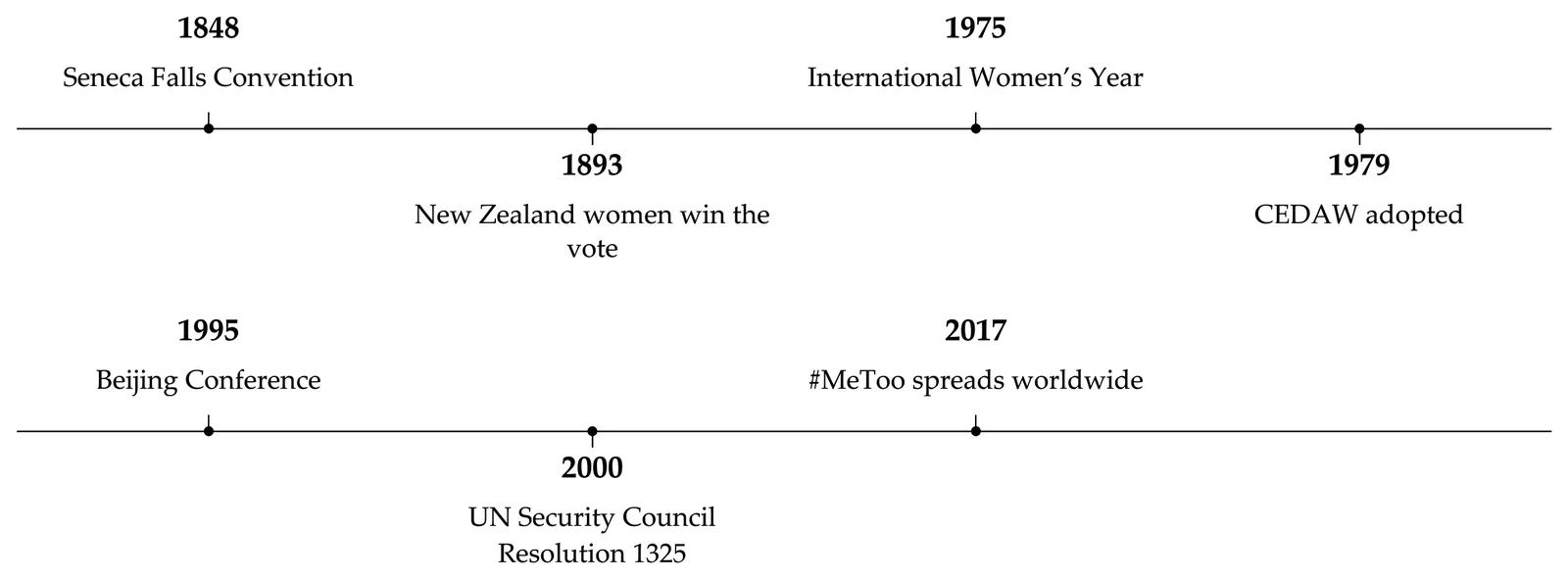
The UN gave women’s movements a global platform. International Women’s Year (1975) and the first World Conference on Women in Mexico City were followed by the UN Decade for Women (1976–85) and conferences in Copenhagen (1980) and Nairobi (1985). The Convention on the Elimination of All Forms of Discrimination against Women (CEDAW, 1979) became the international bill of rights for women. These conferences allowed activists from different countries to meet, share strategies and build networks, and NGO forums held alongside them grew larger with each conference.
6. The Beijing Conference
The Fourth World Conference on Women in Beijing (1995) adopted the Beijing Declaration and Platform for Action, identifying twelve critical areas of concern, including poverty, education, health, violence, armed conflict, economy, power and decision-making, and the girl child. It promoted gender mainstreaming and declared women’s rights to be human rights. Thousands of NGOs attended a parallel forum.
7. Women, Peace and Security
UN Security Council Resolution 1325 (2000) recognised the impact of conflict on women and the importance of women’s participation in peace processes. Women’s groups have campaigned against sexual violence in war, leading to its recognition as a war crime and crime against humanity by international tribunals. Women’s participation in peace negotiations remains low, though studies suggest that agreements are more durable when women are involved.
8. Southern Voices
Networks such as DAWN, founded in Bangalore in 1984, linked gender to development, debt and globalisation from a Southern perspective. Sarifa Moola notes that activism has shifted from mass movements towards NGOs and new actors, raising concerns about NGO-isation, as professional organisations dependent on donors may lose radical edge and connection with grassroots women.
9. Women’s Movements in India
In India, the women’s movement grew in the 1970s with campaigns against dowry deaths and custodial rape, after the Mathura case. It influenced laws on dowry, domestic violence (2005) and sexual harassment, following the Vishaka judgment (1997). Protests after the Delhi gang rape of December 2012 led to stronger rape laws in 2013, and the Women’s Reservation Act (2023) responded to long-standing demands.
10. Evaluation
Women’s movements have achieved suffrage, legal equality and global recognition of women’s rights, but inequality in pay, political representation and safety persists, and backlash against gender equality has grown in some countries. The diversity of women’s experiences means that the movement is plural, not a single voice. The UN’s Sustainable Development Goal 5 (2015) on gender equality reflects the continuing influence of the global women’s movement.
Conclusion. Thus, women’s movements have grown from national suffrage campaigns into a transnational movement that, with the help of the UN, established women’s rights as human rights. Their continuing struggles show the importance of social movements in shaping global norms.
Important Question 4
Discuss the role of peace movements in global politics.
OR
Examine the contribution of anti-nuclear movements to disarmament.
OR
How have peace movements influenced international treaties?
Model Answer
“Remember your humanity, and forget the rest.”
— Russell–Einstein Manifesto (1955)
Introduction. Peace movements seek to prevent war, reduce armaments and promote the peaceful resolution of conflicts. They have campaigned against particular wars, against nuclear weapons and against militarism in general. Although they have rarely stopped wars directly, they have shaped public opinion, influenced arms control treaties and helped create new norms against weapons that cause indiscriminate harm.
1. Meaning
Peace movements are networks of individuals and organisations that oppose war and militarism and promote disarmament, non-violence and conflict resolution. They include pacifists who reject all war, campaigners against specific wars or weapons, and advocates of international law and institutions. Peace activists also distinguish negative peace, the absence of war, from positive peace, the presence of justice and conditions that remove the causes of violence, as Johan Galtung argued.
2. Early Peace Movements
Peace societies emerged in Britain and the USA after the Napoleonic Wars, promoting arbitration and international law. Before 1914, peace congresses and socialist internationalism opposed militarism, and the Hague Conferences of 1899 and 1907 adopted rules of war. The horrors of the First World War strengthened pacifism and support for the League of Nations. Bertha von Suttner’s novel Lay Down Your Arms (1889) became a bestseller, and she later won the Nobel Peace Prize in 1905.
3. The Anti-nuclear Movement
The atomic bombings of Hiroshima and Nagasaki in 1945 created a new kind of peace movement. The Russell–Einstein Manifesto (1955) warned that nuclear war could end humanity, and the Pugwash Conferences (1957) brought scientists together for dialogue. Britain’s Campaign for Nuclear Disarmament (1958) organised the Aldermaston marches, and worldwide protests against nuclear testing contributed to the Partial Test Ban Treaty (1963).
4. Anti-war Movements
Mass protests against the Vietnam War in the USA and around the world in the 1960s and 1970s influenced public opinion and contributed to American withdrawal. On 15 February 2003, millions of people in hundreds of cities demonstrated against the planned invasion of Iraq, one of the largest coordinated protests in history, though it did not prevent the war. The Vietnam protests also linked peace with civil rights, as Martin Luther King Jr. spoke out against the war in 1967.
5. The 1980s Movements
In the 1980s, the deployment of new nuclear missiles in Europe provoked massive protests. The nuclear freeze campaign in the USA drew around a million people to a rally in New York in 1982, and European Nuclear Disarmament linked activists across the Cold War divide. The Greenham Common women’s peace camp (1981–2000) became a symbol of feminist anti-militarism. These movements contributed to the climate that produced the INF Treaty (1987).
6. Campaigns for Humanitarian Disarmament
The International Campaign to Ban Landmines, a coalition of NGOs, worked with sympathetic states such as Canada to produce the Ottawa Treaty (1997), winning the Nobel Peace Prize. The International Campaign to Abolish Nuclear Weapons (ICAN) helped achieve the Treaty on the Prohibition of Nuclear Weapons (2017) and won the Nobel Peace Prize that year.
7. Survivors and Memory
Atomic bomb survivors, the hibakusha, have testified for decades about the human consequences of nuclear weapons. Their organisation Nihon Hidankyo received the Nobel Peace Prize in 2024, recognising the role of memory and testimony in sustaining the taboo against the use of nuclear weapons.
8. Gandhian and Feminist Influences
Gandhi’s philosophy of non-violence inspired peace and civil rights activists such as Martin Luther King Jr. Feminist peace activists, such as Women in Black and the Greenham women, linked militarism to patriarchy and emphasised care and human security. In South Asia, groups such as the Pakistan-India People’s Forum for Peace and Democracy promote dialogue across hostile borders.
9. Impact
Peace movements have shaped norms against nuclear testing, landmines and cluster munitions, influenced arms control treaties, kept the memory of nuclear devastation alive and pressured governments to justify wars. Scholars of the nuclear taboo, such as Nina Tannenwald, credit public opinion and activism with strengthening the norm against nuclear use.
10. Limits
Peace movements have often failed to stop wars, as in Iraq in 2003, and their influence declines when governments frame conflicts as matters of national security. They can be accused of naivety or partisanship, and nuclear-armed states have refused to join the nuclear ban treaty. Yet they remain an essential voice for disarmament and humanity in global politics.
Conclusion. Thus, peace movements, from anti-nuclear campaigns to humanitarian disarmament coalitions, have shaped public opinion and international treaties. Though they rarely stop wars directly, they have strengthened norms against weapons of indiscriminate harm and kept alive the ideal of a peaceful world.
Short Notes
(a) Boomerang pattern
A concept of Margaret Keck and Kathryn Sikkink (1998). When domestic activists are blocked by their own government, they reach out to international allies, such as NGOs, foreign governments or international organisations, who then put pressure on that government from outside. It explains how transnational advocacy networks influence states.
(b) World Social Forum
An annual gathering of social movements, NGOs and activists first held in Porto Alegre, Brazil, in 2001 as an alternative to the World Economic Forum at Davos. Under the slogan another world is possible, it provides an open space for debating alternatives to neo-liberal globalisation. It met in Mumbai in 2004.
(c) CEDAW
The Convention on the Elimination of All Forms of Discrimination against Women, adopted by the UN General Assembly in 1979 and often called an international bill of rights for women. It defines discrimination against women and obliges states to eliminate it in political, economic, social and family life. India ratified it in 1993.
More notes: DSC-12 Global Politics
These notes are prepared by PADHO TO AISE for study help. They are not an official University of Delhi publication.