
Semester VIII MDSE-13 Environment
Unit 3 · 22 min read · Updated 24 Nov 2026
As per the University of Delhi (DU) BA (Hons) Political Science syllabus
Contents
- 3.1 From Stockholm to the SDGs
- Milestones from Stockholm to Rio+20
- Planetary Boundaries
- 3.2 Ozone and Climate Agreements
- How the Ozone Problem Was Discovered and Solved
- Kyoto’s Flexible Mechanisms
- Key Articles of the Paris Agreement
- 3.3 Biodiversity, Wetlands, Wildlife and Solar Energy
- Protocols and Targets under the CBD
- Wetlands and Wildlife Treaties
- The International Solar Alliance in Detail
- 3.4 Important Questions
- Discuss the Earth Summit and the idea of sustainable development leading to the SDGs.
- Discuss the Montreal Protocol and the Kigali Amendment.
- Compare the Kyoto Protocol and the Paris Agreement.
- Discuss the Convention on Biological Diversity, the Ramsar Convention, CITES and the International Solar Alliance.
- Short Notes
मनुष्य सतत विकास की चिंताओं के केंद्र में हैं। उन्हें प्रकृति के साथ सामंजस्य में स्वस्थ और उत्पादक जीवन का अधिकार है।
Human beings are at the centre of concerns for sustainable development. They are entitled to a healthy and productive life in harmony with nature.
— Rio Declaration on Environment and Development, Principle 1 (1992)
GLOBAL environmental problems, such as climate change, ozone depletion, loss of biodiversity and destruction of wetlands, cannot be solved by any one country. Since the Stockholm conference of 1972, states have negotiated a series of international agreements. This chapter examines the Earth Summit and the Sustainable Development Goals, the Montreal Protocol and its Kigali Amendment, the Kyoto Protocol and the Paris Agreement, the Convention on Biological Diversity, the Ramsar Convention and CITES, and the International Solar Alliance, drawing on Shridath Ramphal, Graciela Chichilnisky, Ashish Kothari, Christoph Böhringer and Joanna Caytas.

3.1 From Stockholm to the SDGs
The idea of sustainable development, popularised by the Brundtland Report of 1987, became the central principle of global environmental policy at the Rio Earth Summit of 1992. In 2015, the UN adopted seventeen Sustainable Development Goals for 2030, combining poverty reduction, equality and environmental protection.
Milestones from Stockholm to Rio+20
- 1972 → The UN Conference on the Human Environment at Stockholm (5 to 16 June) created the UN Environment Programme in Nairobi; 5 June became World Environment Day, and Indira Gandhi argued that poverty and need were themselves among the greatest polluters.
- 1987 → The World Commission on Environment and Development, chaired by Gro Harlem Brundtland, published Our Common Future, defining sustainable development as meeting present needs without compromising the ability of future generations to meet theirs.
- 1992 → The Rio Earth Summit adopted the Rio Declaration with twenty-seven principles, Agenda 21 and the Forest Principles, and opened the climate and biodiversity conventions for signature.
- 2002 → The World Summit on Sustainable Development at Johannesburg focused on implementation and partnerships.
- 2012 → The Rio+20 conference, in its outcome document The Future We Want, launched the process for the Sustainable Development Goals.
Planetary Boundaries
In 2009, Johan Rockström and colleagues proposed nine planetary boundaries, such as climate change, biodiversity loss, nitrogen and phosphorus flows, land-system change, freshwater use, ocean acidification and ozone depletion, within which humanity can operate safely. An update in 2023 concluded that six of the nine boundaries had already been crossed. The framework adds scientific urgency to sustainable development, and Kate Raworth’s idea of doughnut economics (2017) combines it with a social foundation of basic needs, so that development should stay above the floor of human needs and below the ceiling of planetary limits.
3.2 Ozone and Climate Agreements
The Montreal Protocol of 1987 phased out chemicals that destroy the ozone layer and is widely seen as the most successful environmental treaty; its Kigali Amendment of 2016 targets HFCs, which warm the climate. Climate change has proved harder: the Kyoto Protocol of 1997 bound only developed countries, while the Paris Agreement of 2015 relies on national pledges by all.

How the Ozone Problem Was Discovered and Solved
In 1974, Mario Molina and F. Sherwood Rowland warned that chlorofluorocarbons (CFCs), used in refrigerators, aerosols and foams, could destroy stratospheric ozone, which shields the earth from ultraviolet radiation; they shared the Nobel Prize in Chemistry in 1995 with Paul Crutzen. In 1985, scientists of the British Antarctic Survey, Joseph Farman, Brian Gardiner and Jonathan Shanklin, reported a dramatic seasonal ozone hole over Antarctica. The same year the Vienna Convention set a framework, and the Montreal Protocol of 1987 set binding cuts, tightened by amendments in London (1990), Copenhagen (1992) and later. In 2009 it became the first UN treaty ratified by every member state. Scientific assessments in 2023 projected that the ozone layer would recover to 1980 levels by around the 2060s over Antarctica.
Kyoto’s Flexible Mechanisms
- Emissions trading. Developed countries with surplus allowances could sell them to others.
- Joint implementation. Developed countries could earn credits for projects that reduced emissions in other developed countries or economies in transition.
- The Clean Development Mechanism. Developed countries could earn credits for projects in developing countries; India became one of the largest hosts of such projects.
Key Articles of the Paris Agreement
- Article 2 sets the goal of holding warming well below 2°C and pursuing efforts to limit it to 1.5°C.
- Article 4 requires every party to prepare nationally determined contributions every five years, each more ambitious than the last.
- Article 6 allows cooperation through carbon markets, whose rules were agreed at Glasgow in 2021 and completed at Baku in 2024.
- Article 8 recognises loss and damage from climate impacts.
- Articles 13 and 14 create an enhanced transparency framework and a global stocktake every five years.
The Intergovernmental Panel on Climate Change, created in 1988, provides the science behind the negotiations; its Sixth Assessment Report (2021 to 2023) found that human influence has unequivocally warmed the planet. In 2024, global average temperatures exceeded 1.5°C above pre-industrial levels for a full calendar year for the first time, showing how difficult the Paris goals have become.
3.3 Biodiversity, Wetlands, Wildlife and Solar Energy
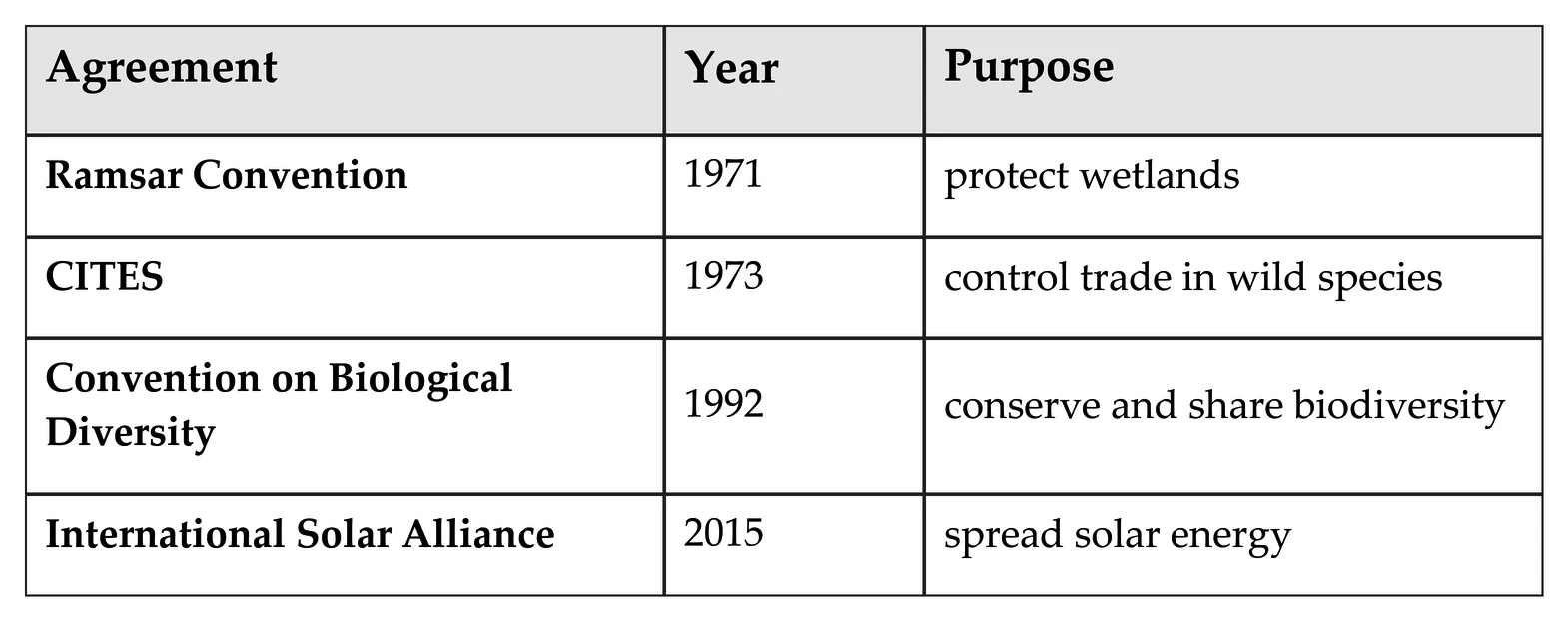
The Convention on Biological Diversity of 1992 aims at conservation, sustainable use and fair sharing of benefits. The Ramsar Convention of 1971 protects wetlands, and CITES of 1973 controls international trade in endangered species. The International Solar Alliance, launched by India and France in 2015, promotes solar energy among sunshine countries.
Protocols and Targets under the CBD
- Cartagena Protocol (2000). It regulates the movement of living modified organisms across borders on the basis of precaution.
- Nagoya Protocol (2010). It requires fair and equitable sharing of benefits from the use of genetic resources and traditional knowledge, with prior informed consent.
- Aichi Targets (2010). Twenty targets for 2011 to 2020 were agreed at Nagoya, but the fifth Global Biodiversity Outlook of 2020 found that none had been fully met.
- Kunming-Montreal Framework (2022). Twenty-three targets for 2030 include protecting thirty per cent of land and sea areas, known as 30 by 30.
- India’s role. India hosted the eleventh Conference of the Parties at Hyderabad in 2012 and implements the Convention through the Biological Diversity Act of 2002; the United States has never ratified the Convention.
Wetlands and Wildlife Treaties
The Ramsar Convention was signed at Ramsar in Iran on 2 February 1971, now World Wetlands Day, and lists wetlands of international importance; the Montreux Record lists sites under threat. India joined in 1982 with Chilika Lake and Keoladeo National Park as its first sites, now has more than eighty Ramsar sites and protects wetlands under the Wetlands (Conservation and Management) Rules of 2017. CITES, signed at Washington on 3 March 1973, now World Wildlife Day, regulates trade through three appendices: Appendix I bans commercial trade in the most endangered species, Appendix II controls trade through permits, and Appendix III lists species protected by individual countries. India joined in 1976. The Convention on Migratory Species of 1979 protects migratory animals, and India hosted its thirteenth conference at Gandhinagar in 2020.
The International Solar Alliance in Detail
Prime Minister Narendra Modi and French President François Hollande launched the International Solar Alliance on 30 November 2015 at the Paris climate conference. Its framework agreement entered into force in December 2017, making it the first treaty-based international organisation headquartered in India, at Gurugram. Membership was opened to all UN members in 2020. The Alliance aims to mobilise a trillion dollars of investment in solar energy by 2030, supports projects in Africa and small island states, and promotes the idea of One Sun One World One Grid, connecting solar power across regions. It reflects India’s ambition to lead on clean energy while linking climate action with development and energy access.
3.4 Important Questions
- Question 1 Discuss the Earth Summit and the idea of sustainable development leading to the SDGs.
- Question 2 Discuss the Montreal Protocol and the Kigali Amendment.
- Question 3 Compare the Kyoto Protocol and the Paris Agreement.
- Question 4 Discuss the Convention on Biological Diversity, the Ramsar Convention, CITES and the International Solar Alliance.
DU asks the same idea in different words. So learn one broad answer for each question below; the same answer works for every question joined by OR.
Important Question 1
Discuss the Earth Summit and the idea of sustainable development leading to the SDGs.
OR
What is sustainable development? Discuss its evolution.
OR
Examine the Sustainable Development Goals with reference to India.
Model Answer
“Sustainable development is development that meets the needs of the present without compromising the ability of future generations to meet their own needs.”
— World Commission on Environment and Development, Our Common Future (1987)
Introduction. Sustainable development is the idea that economic and social development must respect environmental limits so that future generations can also meet their needs. It emerged from debates in the 1970s and 1980s, became the theme of the Rio Earth Summit of 1992 and now guides the UN’s Sustainable Development Goals for 2030.
1. Stockholm, 1972
The UN Conference on the Human Environment at Stockholm in 1972 was the first global conference on the environment. It created the UN Environment Programme, and developing countries insisted that poverty and development must be considered together with environmental protection.
2. The Brundtland Report
The World Commission on Environment and Development, chaired by Gro Harlem Brundtland, published Our Common Future in 1987, defining sustainable development as meeting present needs without compromising the needs of future generations.
3. Ramphal on Environment and Development
Shridath Ramphal, a member of the commission, argued in 1987 that environmental degradation and poverty were linked, and that the debt burden and unfair trade forced poor countries to over-exploit their resources, so global economic reform was needed.
4. The Rio Earth Summit
The UN Conference on Environment and Development at Rio de Janeiro in June 1992 adopted the Rio Declaration with 27 principles, Agenda 21, a plan of action, and Forest Principles, and opened the conventions on climate change and biodiversity for signature.
5. Rio Principles
The Rio Declaration included principles such as common but differentiated responsibilities, the precautionary principle, the polluter pays principle and public participation, which shaped later environmental law.
6. Chichilnisky’s Definition
Graciela Chichilnisky defined sustainable development formally as development that avoids both a dictatorship of the present, which ignores the future, and a dictatorship of the future, which sacrifices present needs.
7. From Rio to Rio+20
The Johannesburg summit of 2002 reviewed progress, and the Rio+20 conference of 2012, in its document The Future We Want, launched the process of creating Sustainable Development Goals.
8. The MDGs
The eight Millennium Development Goals of 2000 focused on poverty, education, health and gender in developing countries until 2015, but gave limited attention to the environment.
9. The SDGs
In September 2015, the UN adopted the 2030 Agenda with seventeen Sustainable Development Goals and 169 targets, applying to all countries and covering poverty, hunger, health, education, gender, water, energy, climate, oceans, land and peace.
10. Integrated Approach
The SDGs recognise that economic, social and environmental goals are interconnected, so progress on one depends on others, as in the link between clean energy, health and climate.
11. India and the SDGs
NITI Aayog coordinates India’s SDG efforts and publishes an SDG India Index ranking states. Schemes on sanitation, clean cooking fuel, renewable energy and financial inclusion are linked to SDG targets.
12. Kothari’s Critique
Ashish Kothari argues that the growth-centred model of development in India is ecologically unsustainable and proposes alternatives such as radical ecological democracy, in which communities have greater control over resources and decisions.
13. Sathaye and Colleagues
Jayant Sathaye, P.R. Shukla and N.H. Ravindranath argue that climate policy and sustainable development in India must be integrated, so that development choices also reduce emissions and vulnerability.
14. Criticisms
Critics say that sustainable development is vague and allows continued growth, that the SDGs are too many and not binding, and that progress has been slowed by conflicts, the pandemic and lack of finance.
15. Evaluation
Sustainable development has become the guiding idea of global environmental policy, but its implementation remains uneven.
Conclusion. Thus, from Stockholm in 1972 and the Brundtland Report of 1987 to the Rio Earth Summit of 1992 and the SDGs of 2015, sustainable development has become central to global policy. Ramphal linked it with poverty and global inequality, Chichilnisky defined it formally, and Kothari calls for deeper ecological democracy in India.
Important Question 2
Discuss the Montreal Protocol and the Kigali Amendment.
OR
Why is the Montreal Protocol regarded as the most successful environmental agreement?
OR
Examine India’s role in the ozone regime.
Model Answer
“Perhaps the single most successful international agreement to date has been the Montreal Protocol.”
— Kofi Annan, UN Secretary-General
Introduction. The ozone layer in the stratosphere protects life on earth from harmful ultraviolet radiation. In the 1970s and 1980s, scientists discovered that chemicals such as chlorofluorocarbons (CFCs) were destroying it. The international response, the Vienna Convention of 1985 and the Montreal Protocol of 1987, is widely seen as the most successful environmental agreement, and the Kigali Amendment of 2016 extended it to climate protection.
1. The Ozone Problem
In 1974, Mario Molina and Sherwood Rowland showed that CFCs, used in refrigerators, air conditioners and sprays, could destroy stratospheric ozone. In 1985, British scientists reported a large ozone hole over Antarctica.
2. The Vienna Convention
The Vienna Convention for the Protection of the Ozone Layer of 1985 was a framework agreement for cooperation on research and monitoring, without binding controls.
3. The Montreal Protocol
The Montreal Protocol, signed on 16 September 1987, set timetables to phase out the production and use of ozone-depleting substances. The date is now observed as World Ozone Day.
4. Strengthening the Protocol
The protocol was strengthened by amendments in London (1990), Copenhagen (1992) and later, which advanced phase-out dates and added new substances as scientific knowledge improved.
5. Differentiated Responsibilities
Developing countries received a grace period of ten years to phase out ozone-depleting substances, recognising their lower historical responsibility and need for development.
6. The Multilateral Fund
The London Amendment of 1990 created a Multilateral Fund, financed by developed countries, to help developing countries meet the costs of phasing out. India joined the protocol in 1992 after this fund was created.
7. Universal Ratification
In 2009, the Montreal Protocol became the first treaty in UN history to be ratified by every country, showing broad agreement on the need to protect the ozone layer.
8. Results
Production of ozone-depleting substances has fallen by about 99 per cent, and scientists expect the ozone layer to recover to 1980 levels around the middle of this century, with the Antarctic recovering later.
9. Reasons for Success
The protocol succeeded because of clear scientific evidence, available substitutes, the support of industry, flexible amendments, financial help for developing countries and trade restrictions on non-parties.
10. The HFC Problem
Hydrofluorocarbons (HFCs), introduced as substitutes for CFCs, do not harm the ozone layer but are powerful greenhouse gases, thousands of times more potent than carbon dioxide.
11. The Kigali Amendment
The Kigali Amendment, adopted in October 2016, commits countries to phase down HFCs by about 80 to 85 per cent by the late 2040s, which could avoid up to 0.4°C of global warming by 2100.
12. India’s Commitments
India ratified the Kigali Amendment in 2021. It will freeze HFC use in 2028 and reduce it by 85 per cent by 2047, and it promotes climate-friendly cooling through its India Cooling Action Plan of 2019.
13. Lessons for Climate Change
The ozone regime shows that global environmental cooperation is possible, though climate change is harder because fossil fuels are central to all economies and substitutes are costly.
14. Challenges
Challenges include illegal production and trade of banned chemicals, as shown by unexpected emissions of CFC-11 detected in 2018, and ensuring a smooth transition to safe alternatives.
15. Science and Diplomacy
The ozone regime shows how science can guide diplomacy. Regular scientific assessments by experts reported to the parties, and the treaty was designed to be adjusted as evidence grew. Molina, Rowland and Paul Crutzen received the Nobel Prize in Chemistry in 1995 for their work, showing how research shaped global policy.
16. Health and Climate Benefits
Protecting the ozone layer has prevented millions of cases of skin cancer and cataracts. Because many ozone-depleting substances are also greenhouse gases, the protocol has also slowed climate change, avoiding more warming than the Kyoto Protocol achieved, which shows how one treaty can serve several environmental goals.
17. Evaluation
The Montreal Protocol is a model of successful environmental governance, and the Kigali Amendment links ozone protection with climate action.
Conclusion. Thus, the Montreal Protocol of 1987, built on the Vienna Convention, phased out ozone-depleting substances through firm timetables, differentiated responsibilities and the Multilateral Fund, achieving universal ratification in 2009. The Kigali Amendment of 2016 extended it to HFCs, and India’s commitments show its role in this success.
Important Question 3
Compare the Kyoto Protocol and the Paris Agreement.
OR
Examine the achievements and limitations of the Kyoto Protocol.
OR
Is the Paris Agreement a step forward in global climate governance? Discuss.
Model Answer
“Holding the increase in the global average temperature to well below 2°C above pre-industrial levels and pursuing efforts to limit the temperature increase to 1.5°C above pre-industrial levels.”
— Paris Agreement, Article 2 (2015)
Introduction. Climate change is the most serious global environmental problem. Under the UN Framework Convention on Climate Change of 1992, states negotiated the Kyoto Protocol of 1997 and the Paris Agreement of 2015. The two agreements reflect very different approaches to sharing responsibility, as Christoph Böhringer and Carsten Vogt, and Joanna Caytas, discuss.
1. The UNFCCC
The UNFCCC of 1992 set the goal of stabilising greenhouse gas concentrations at a level that prevents dangerous interference with the climate, and divided countries into developed (Annex I) and developing.
2. The Kyoto Protocol
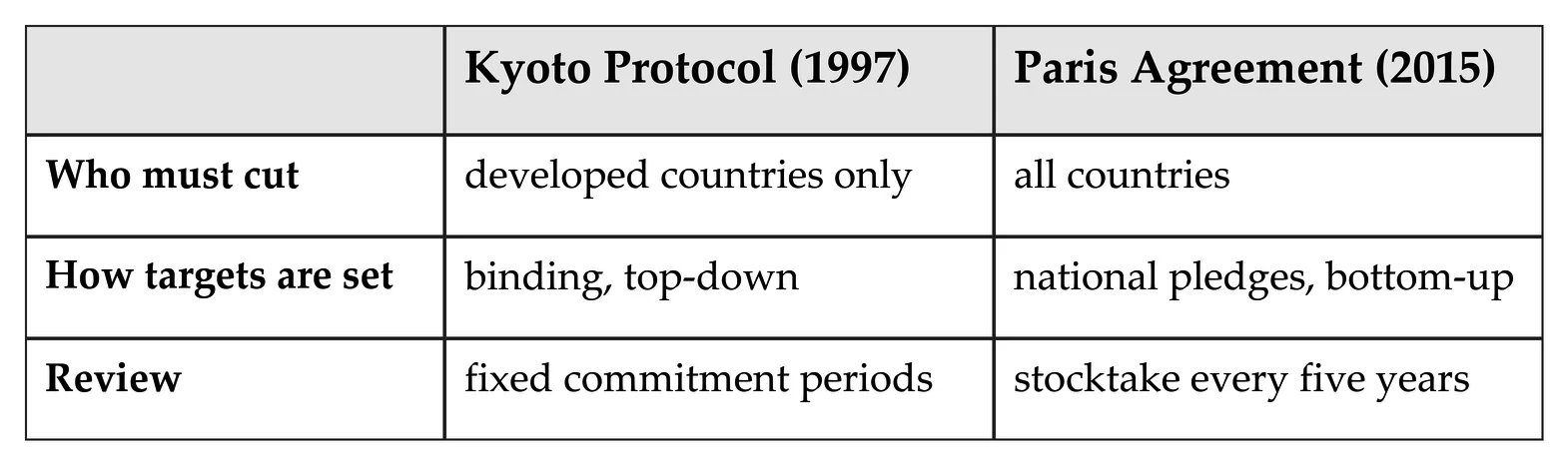
The Kyoto Protocol, adopted in December 1997 and in force from 2005, set legally binding targets for developed countries to reduce emissions by an average of about five per cent below 1990 levels in 2008–2012.
3. Flexible Mechanisms
Kyoto created market mechanisms: emissions trading among developed countries, Joint Implementation and the Clean Development Mechanism, through which developed countries could earn credits from projects in developing countries such as India.
4. Weaknesses of Kyoto
The United States never ratified Kyoto, Canada withdrew in 2011, and developing countries, including large emitters such as China and India, had no targets, so Kyoto covered a shrinking share of global emissions.
5. Böhringer and Vogt
Christoph Böhringer and Carsten Vogt found that after the US withdrawal and concessions on forest sinks and surplus allowances, Kyoto’s economic costs and environmental effects were both small, making it largely symbolic.
6. From Copenhagen to Paris
The Copenhagen conference of 2009 failed to agree a successor, but it produced pledges from major economies. Negotiators then moved towards an agreement in which all countries would take part.
7. The Paris Agreement
The Paris Agreement, adopted in December 2015 and in force from 2016, aims to keep warming well below 2°C and to pursue efforts to limit it to 1.5°C, with all countries submitting nationally determined contributions.
8. How Paris Works
Paris relies on a bottom-up approach: countries set their own targets, report on progress under a transparency framework and increase ambition over time through a global stocktake every five years, the first in 2023.
9. Finance and Loss
Paris also addresses adaptation, finance from developed to developing countries and loss and damage from climate impacts, though the amounts provided have fallen short of needs.
10. Caytas’s Critique
Joanna Caytas describes the Paris negotiations as one step forward and two steps back: Paris achieved universal participation, but its targets are not binding and current pledges are insufficient to meet its temperature goals.
11. India’s Contributions
India pledged in 2015 to reduce the emission intensity of its economy and expand non-fossil power capacity, updated in 2022 to a 45 per cent cut in emission intensity from 2005 levels and 50 per cent non-fossil capacity by 2030, with net zero by 2070.
12. Equity
Paris retains common but differentiated responsibilities in the light of national circumstances, but developing countries argue that developed countries have not done enough to cut emissions or provide finance.
13. US Participation
The United States withdrew from Paris under President Trump, rejoined in 2021 and announced another withdrawal in 2025, showing the agreement’s vulnerability to domestic politics.
14. Comparison
Kyoto was legally binding but narrow; Paris is universal but relies on voluntary pledges. Kyoto drew a sharp line between developed and developing countries, while Paris asks all to act.
15. Carbon Markets
Both agreements use carbon markets. Kyoto’s Clean Development Mechanism supported thousands of projects in developing countries, with India among the largest hosts, though critics questioned whether many projects truly reduced emissions. Article 6 of the Paris Agreement, whose rules were completed between 2021 and 2024, provides for new forms of international carbon trading.
16. Evaluation
Paris is a step forward in participation and flexibility, but its success depends on raising ambition and delivering finance.
Conclusion. Thus, Kyoto set binding targets for developed countries only and, as Böhringer and Vogt show, had limited effect after US withdrawal. Paris brought all countries into a bottom-up system of national pledges and stocktakes, a step forward in participation but, as Caytas argues, weak in ambition and enforcement.
Important Question 4
Discuss the Convention on Biological Diversity, the Ramsar Convention, CITES and the International Solar Alliance.
OR
Examine international efforts to protect biodiversity, wetlands and wildlife.
OR
Discuss India’s role in the International Solar Alliance.
Model Answer
“Being convinced that wetlands constitute a resource of great economic, cultural, scientific, and recreational value, the loss of which would be irreparable.”
— Ramsar Convention on Wetlands, Preamble (1971)
Introduction. Alongside climate and ozone agreements, a range of international instruments protect biodiversity, wetlands and wildlife, and promote clean energy. The Convention on Biological Diversity, the Ramsar Convention and CITES are key conservation treaties, while the International Solar Alliance, led by India, promotes solar energy. Together they show the variety of global environmental governance.
1. The Convention on Biological Diversity
The CBD was opened for signature at the Rio Earth Summit in 1992 and came into force in 1993. Its three objectives are conservation of biodiversity, sustainable use of its components and fair and equitable sharing of benefits from genetic resources.
2. Protocols under the CBD
The Cartagena Protocol of 2000 regulates the safe movement of living modified organisms, and the Nagoya Protocol of 2010 sets rules on access to genetic resources and sharing of benefits with the countries and communities that provide them.
3. Global Biodiversity Targets
The Aichi Targets of 2010 were largely missed. The Kunming-Montreal Global Biodiversity Framework of 2022 set new targets, including protecting 30 per cent of land and seas by 2030.
4. India and the CBD
India passed the Biological Diversity Act of 2002 to implement the CBD, with a National Biodiversity Authority and local committees, and hosted the CBD’s eleventh conference in Hyderabad in 2012.
5. The Ramsar Convention
The Ramsar Convention, signed at Ramsar in Iran on 2 February 1971, protects wetlands of international importance and promotes their wise use. The date is observed as World Wetlands Day.
6. India’s Ramsar Sites
India joined the convention in 1982, and Chilika Lake and Keoladeo National Park were its first listed sites. India now has more than eighty Ramsar sites, among the largest numbers in Asia.
7. CITES
The Convention on International Trade in Endangered Species of Wild Fauna and Flora, signed in Washington in 1973 and in force from 1975, regulates international trade in wild animals and plants through a permit system.
8. CITES Appendices
Species in Appendix I, such as tigers, are threatened with extinction and commercial trade is banned; Appendix II species are regulated to prevent overexploitation; and Appendix III lists species protected by particular countries.
9. India and CITES
India joined CITES in 1976 and enforces it through the Wild Life (Protection) Act and the Wildlife Crime Control Bureau, combating trade in tiger parts, ivory, pangolins and other species.
10. The International Solar Alliance
The International Solar Alliance was launched by India and France at the Paris climate conference in November 2015. Its framework agreement came into force in 2017, and it has its headquarters in Gurugram, India.
11. Aims of the ISA
The ISA aims to promote solar energy in countries rich in sunshine, mobilise investment, reduce costs and support technology and training. India has also promoted the idea of One Sun, One World, One Grid to connect solar power across regions.
12. Significance of the ISA
The ISA is the first international organisation headquartered in India and reflects India’s leadership in climate diplomacy and its own large expansion of solar power.
13. Weaknesses
Biodiversity and wildlife treaties suffer from weak enforcement, lack of funds and conflicts with development. The United States is not a party to the CBD, and illegal wildlife trade remains large.
14. Interlinkages
Biodiversity, wetlands and climate are interconnected: wetlands store carbon, forests support species, and clean energy reduces pressure on ecosystems, so treaties must work together.
15. Traditional Knowledge
India has protected traditional knowledge from misuse through its Traditional Knowledge Digital Library, created in 2001, which records Ayurvedic and other remedies so that patent offices can reject claims based on them. This supports the CBD’s principle that communities should benefit from the use of their knowledge and resources.
16. Evaluation
These agreements show the range of global environmental governance, from conservation to clean energy, and India’s growing role in it.
Conclusion. Thus, the CBD of 1992, with its Cartagena and Nagoya protocols and the 2022 framework, protects biodiversity; the Ramsar Convention protects wetlands, with more than eighty sites in India; CITES regulates wildlife trade; and the International Solar Alliance, launched by India and France in 2015, promotes solar energy and India’s climate leadership.
Short Notes
(a) Agenda 21
The action plan for sustainable development adopted at the Rio Earth Summit in 1992, covering social, economic and environmental issues.
(b) Kigali Amendment
The 2016 amendment to the Montreal Protocol committing countries to phase down HFCs, powerful greenhouse gases.
(c) Nationally determined contributions
Climate pledges set by each country under the Paris Agreement, to be updated and strengthened every five years.
(d) CITES Appendix I
The list of species threatened with extinction, such as tigers, in which international commercial trade is banned under CITES.
More notes: MDSE-13 Environment
These notes are prepared by PADHO TO AISE for study help. They are not an official University of Delhi publication.