
Semester IV MDSE-2a Gandhi and the Contemporary World
Unit III · 22 min read · Updated 24 Nov 2026
As per the University of Delhi (DU) BA (Hons) Political Science syllabus
Contents
- 3.1 Gandhi’s Critique of Modern Civilization
- What Is Modern Civilization
- Targets of Gandhi’s Critique
- True Civilization
- Parekh: The Critique of Modernity
- 3.2 Alternative Modernity
- Features of Gandhi’s Alternative
- Scholarly Views
- The Nehru-Gandhi Debate
- 3.3 Critique of Development and Alternative Development
- Gandhi’s Critique of Development
- Gandhian Economic Ideas
- Ishii: An Origin of Alternative Development
- Influence on Alternative Development
- Criticism
- 3.4 Important Questions
- Examine Gandhi’s critique of modern civilization in Hind Swaraj.
- Discuss whether Gandhi offered an alternative modernity.
- Discuss Gandhi’s critique of industrial development and machinery.
- Discuss how Gandhi’s ideas contributed to alternative and sustainable development.
- Short Notes
सभ्यता आचरण की वह रीति है जो मनुष्य को कर्तव्य का मार्ग दिखाती है।
Civilization is that mode of conduct which points out to man the path of duty.
— M.K. Gandhi, Hind Swaraj (1909)
IIN 1909, while sailing from London to South Africa, Gandhi wrote Hind Swaraj, a fierce critique of modern Western civilization. He argued that the real enemy of India was not only British rule but the civilization that the British represented: industrialism, materialism, the worship of machines and the centralised state. Instead, he offered an alternative idea of civilization based on duty, morality, self-restraint and village self-reliance. This chapter examines Gandhi’s conception of modern civilization and alternative modernity, and his critique of development, which anticipated later ideas of alternative and sustainable development.
3.1 Gandhi’s Critique of Modern Civilization
Hind Swaraj (Indian Home Rule) is written as a dialogue between a Reader, representing the young, often impatient nationalists, and an Editor, representing Gandhi. The Reader wants to drive the British out and make India strong like the West. The Editor argues that this would mean having English rule without the Englishman. India’s real problem, he says, is that it has been seduced by modern civilization.
What Is Modern Civilization
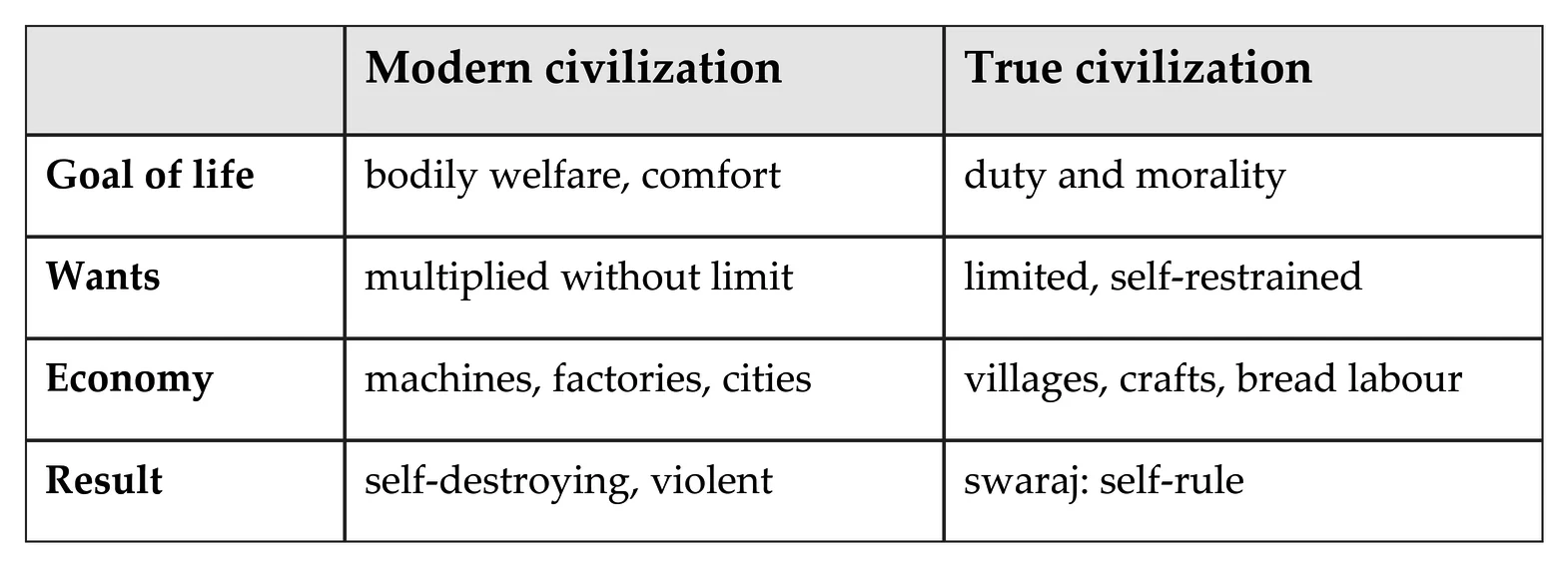
Gandhi argued that modern civilization makes bodily welfare the object of life. It measures progress by material comfort, speed and the multiplication of wants: better houses, clothes, machines and means of travel. It takes no note of morality or religion. He wrote that this civilization is such that one has only to be patient and it will be self-destroyed. He called it a disease, and argued that the English themselves were its victims.
Targets of Gandhi’s Critique
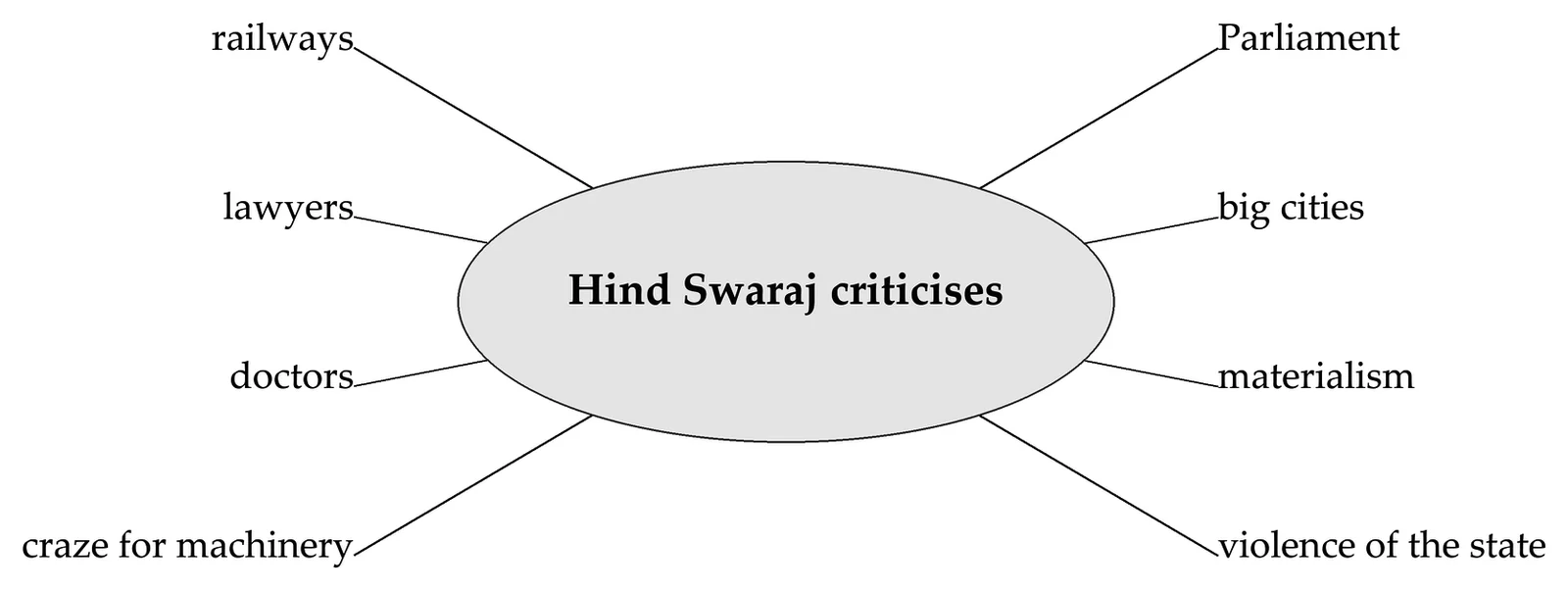
- Railways. They spread plague and famine, encouraged the export of grain, and brought evil to holy places by increasing speed without increasing goodness.
- Lawyers. They profit from quarrels, prolong disputes and helped the British consolidate rule by depending on British courts.
- Doctors. Modern medicine treats symptoms and encourages indulgence, rather than self-control and simple living; Gandhi preferred nature cure.
- Machinery. Machines concentrate wealth, replace human labour and create unemployment and dependence; Gandhi famously objected to the craze for machinery, not machinery as such.
- Parliament. He criticised the British Parliament as a talking shop controlled by parties and ministers, not a true expression of the people’s will.
- Cities and industrialism. Large cities and factories exploit villages and destroy the bonds of community.
- Violence. Modern civilization depends on violence, both in industrial exploitation and in the military power of the state.
True Civilization
Against modern civilization, Gandhi defined true civilization as that mode of conduct which points out to man the path of duty. Performance of duty and observance of morality are convertible terms; to observe morality is to attain mastery over the mind and passions. He argued that ancient Indian civilization, with its villages, simple crafts and moral restraint, had understood this, though he also criticised its failings, such as untouchability and child marriage. For Gandhi, civilization meant moral self-rule, not material accumulation.
Parekh: The Critique of Modernity
Bhikhu Parekh, in The Critique of Modernity (in Gandhi: A Brief Insight, 1997), explains that Gandhi’s critique targeted the core features of modernity: its rationalism, which placed reason above morality and intuition; its individualism, which encouraged self-interest; its materialism and consumerism; its industrialism and technology, which dehumanised labour; its centralised state, which concentrated coercive power; and its violence, against nature, colonised peoples and the poor. Parekh notes that Gandhi was not simply anti-modern: he used modern technologies such as the printing press, praised the Singer sewing machine and accepted many modern ideas of rights and equality. His aim was to subordinate technology and the economy to moral and human ends.
3.2 Alternative Modernity
Many scholars argue that Gandhi offered not a rejection of modernity but an alternative modernity, a different way of being modern that drew on Indian traditions and on dissenting Western thinkers such as Ruskin, Tolstoy, Thoreau and Carpenter.
Features of Gandhi’s Alternative
- Moral self-rule. Swaraj begins with self-control and moral discipline of the individual.
- Village republics. Society should be organised in self-reliant, self-governing villages rather than large cities and centralised states.
- Limited wants. Happiness lies in limiting wants, not multiplying them; non-possession (aparigraha) is a virtue.
- Bread labour. Everyone should do some physical labour, an idea Gandhi took from Tolstoy and the Russian writer Bondaref.
- Appropriate technology. Machines are acceptable if they lighten labour without displacing workers or concentrating wealth.
- Religion and politics. Politics must be guided by ethics, understood through equal respect for all religions rather than sectarianism.
Scholarly Views
Lloyd and Susanne Rudolph, in The Modernity of Tradition (1967), argued that Gandhi used traditional symbols and practices to mobilise Indians for modern political goals, showing that tradition and modernity are not simply opposed. Partha Chatterjee, in Nationalist Thought and the Colonial World (1986), described Gandhi’s thought as a critique of post-Enlightenment civil society, standing outside the thematic of nationalism even as it mobilised the peasantry for the nationalist movement. Ashis Nandy saw Gandhi as a critic of the colonial mind and of the violence of modernity, who offered a way of resisting colonialism without imitating the colonisers.
The Nehru-Gandhi Debate
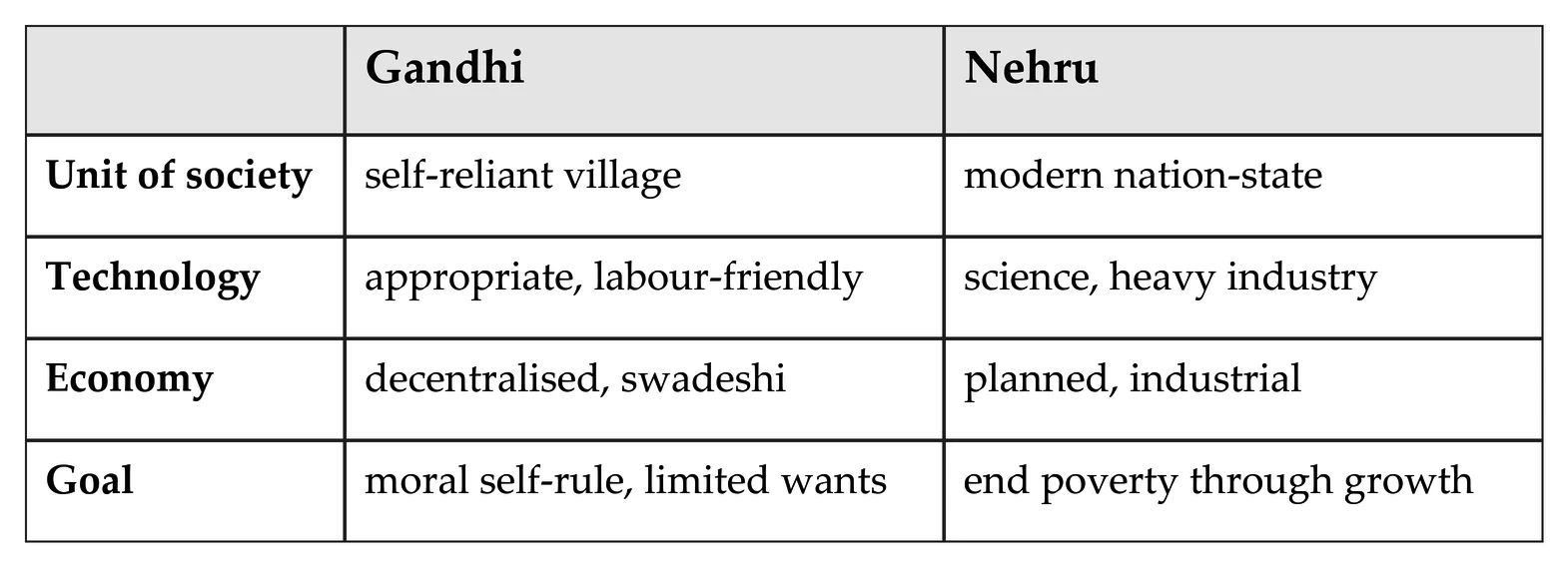
In October 1945, Gandhi wrote to Jawaharlal Nehru that he still believed in the vision of Hind Swaraj and that India would have to live in villages rather than towns, in huts rather than palaces. Nehru replied that he found it unreal and that India needed modern science, industry and planning to remove poverty. After independence, India largely followed Nehru’s path of industrialisation, but some Gandhian ideas entered the Directive Principles, such as Article 40 on village panchayats and Article 43 on cottage industries, and institutions such as the Khadi and Village Industries Commission (1956).
3.3 Critique of Development and Alternative Development
Gandhi’s Critique of Development
Gandhi questioned the model of development that equates progress with industrial growth, urbanisation and rising consumption. He argued that large-scale industrialism exploits villages and the poor, concentrates wealth and power in a few hands, creates unemployment by replacing human labour with machines, destroys crafts and communities, and leads to imperialism, since industrial nations need markets and raw materials abroad. He feared that if India industrialised on the Western pattern, it would strip the world bare like locusts. He insisted that economics and ethics cannot be separated: economics that hurts the moral well-being of individuals or nations is immoral.
Gandhian Economic Ideas
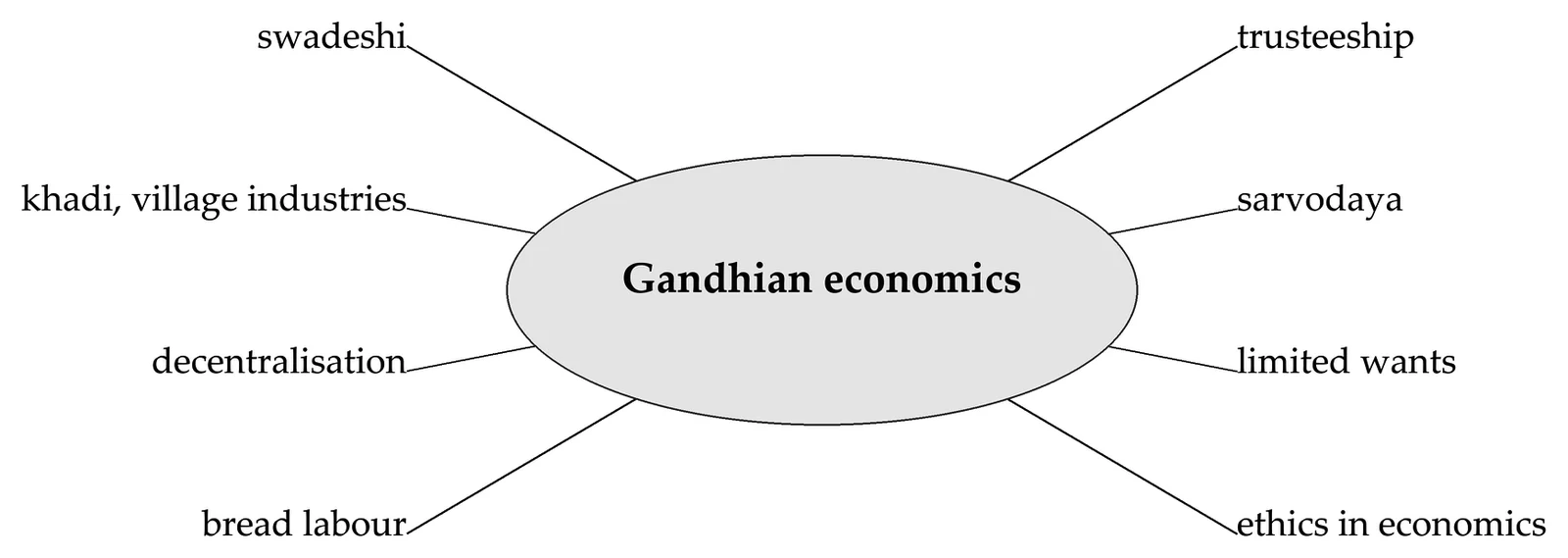
- Swadeshi. Using goods produced in one’s neighbourhood, supporting local producers and self-reliance.
- Khadi and village industries. Hand-spinning and weaving and village crafts to provide work and income in villages.
- Decentralisation. Production by small units close to consumers, avoiding concentration of economic power.
- Bread labour. Every person should earn their bread through physical labour.
- Trusteeship. The wealthy should hold their wealth in trust for society, using it for the common good rather than personal luxury.
- Sarvodaya. The welfare of all, beginning with the last person, inspired by Ruskin’s Unto This Last.
- Limited wants. Simple living and voluntary restraint of consumption.
Ishii: An Origin of Alternative Development
Kazuya Ishii, in The Socio-economic Thoughts of Mahatma Gandhi: As an Origin of Alternative Development (2001), argues that Gandhi’s ideas anticipated many later critiques of mainstream development. Gandhi’s emphasis on meeting basic needs, self-reliance, employment for all, decentralisation, appropriate technology, people’s participation, ecological sustainability and the moral purpose of economic life prefigured the alternative development approaches of the 1970s onwards, such as the basic needs approach, human development and sustainable development. Ishii shows that Gandhi’s thought was not merely nostalgic but offered a coherent alternative to growth-centred development.
Influence on Alternative Development
- J.C. Kumarappa. His Economy of Permanence (1945) developed Gandhian economics, contrasting transient economies of exploitation with permanent economies in harmony with nature.
- E.F. Schumacher. Small Is Beautiful (1973) drew on Gandhi to argue for human-scale, appropriate technology; he recalled Gandhi’s idea of production by the masses rather than mass production.
- Environmental movements. Movements such as Chipko (1973) and thinkers such as Vandana Shiva drew on Gandhian ideas of ecological and community-based development.
- Sustainable development and degrowth. Critics of unlimited growth find in Gandhi an early voice for limits to consumption and harmony with nature.
Criticism
Critics argue that Gandhi’s vision romanticised the village, ignoring caste oppression and poverty in rural India, as Ambedkar pointed out when he called the village a den of ignorance. Economists question whether khadi and cottage industries can provide prosperity for a large population, and Nehru believed that only industrialisation could end poverty. Supporters respond that Gandhi’s aim was not to reject all technology but to make the economy serve human and moral ends.
3.4 Important Questions
- Question 1 Examine Gandhi’s critique of modern civilization in Hind Swaraj.
- Question 2 Discuss whether Gandhi offered an alternative modernity.
- Question 3 Discuss Gandhi’s critique of industrial development and machinery.
- Question 4 Discuss how Gandhi’s ideas contributed to alternative and sustainable development.
DU asks the same idea in different words. So learn one broad answer for each question below; the same answer works for every question joined by OR.
Important Question 1
Examine Gandhi’s critique of modern civilization in Hind Swaraj.
OR
Discuss Gandhi’s distinction between modern civilization and true civilization.
OR
Examine Bhikhu Parekh’s account of Gandhi’s critique of modernity.
Model Answer
“This civilization is such that one has only to be patient and it will be self-destroyed.”
— M.K. Gandhi, Hind Swaraj (1909)
Introduction. Hind Swaraj, written in 1909, is Gandhi’s most important work of political theory. In it, he argued that the real enemy of India was modern Western civilization, which made bodily welfare the goal of life and ignored morality. He offered instead a vision of true civilization based on duty, self-restraint and village self-reliance. Bhikhu Parekh’s analysis shows the depth of this critique of modernity.
1. The Dialogue Form
Hind Swaraj is a dialogue between a Reader, representing impatient young nationalists, and an Editor, representing Gandhi. The form allows Gandhi to answer the arguments of those who wanted to drive out the British by force and imitate the West.
2. English Rule without the Englishman
Gandhi argued that driving out the British while keeping their civilization would mean English rule without the Englishman. Real swaraj required rejecting the civilization the British represented.
3. Bodily Welfare as Goal
Modern civilization, Gandhi argued, makes bodily welfare the object of life, measuring progress by material comfort, speed and the multiplication of wants, and takes no note of morality or religion.
4. Self-Destructive Civilization
He described modern civilization as a disease and wrote that it would destroy itself if one was patient, since a civilization based on endless desires cannot be sustained.
5. Railways
Gandhi argued that railways spread plague and famine, increased the export of grain and brought evil to holy places, since they increased speed without increasing goodness.
6. Lawyers and Doctors
Lawyers profited from quarrels and strengthened British rule through the courts, while doctors encouraged indulgence by treating symptoms rather than promoting self-control.
7. Machinery
Gandhi criticised the craze for machinery, which concentrates wealth, replaces labour and creates unemployment, though he accepted machines that lighten labour without displacing workers.
8. Parliament and the State
He criticised the British Parliament as dominated by parties and ministers and saw the modern state as concentrated coercive power.
9. True Civilization
True civilization is that mode of conduct which points out the path of duty; observing morality means mastering the mind and passions, not multiplying wants.
10. Indian Civilization
Gandhi admired the self-reliant villages and moral restraint of ancient Indian civilization, while criticising its defects such as untouchability and child marriage.
11. Parekh on Rationalism and Individualism
Parekh shows that Gandhi criticised modern rationalism for placing reason above morality, and individualism for encouraging self-interest over community and duty.
12. Parekh on Materialism and Industrialism
Gandhi criticised materialism and consumerism, and industrialism that dehumanised labour and exploited villages and colonised peoples.
13. Parekh on Violence
Modern civilization, Gandhi argued, rests on violence against nature, the poor and colonised peoples, and on the coercive power of the state.
14. Not Simply Anti-Modern
Parekh notes that Gandhi used modern technologies such as the printing press, accepted the sewing machine and embraced modern ideas of equality, so his aim was to subordinate technology to moral ends.
15. Criticism
Critics, including Nehru, found Hind Swaraj unrealistic and romantic, ignoring the benefits of science, medicine and industry for the poor.
16. Swaraj as Self-Rule
In Hind Swaraj, Gandhi defined swaraj as self-rule in the deepest sense: it is swaraj when we learn to rule ourselves. Political independence was only one part; true swaraj required control over one’s desires and freedom from the values of modern civilization.
17. Reception of Hind Swaraj
The book was banned by the Bombay government in 1910 and later admired by writers such as Romain Rolland. Even Gandhi’s colleagues found it extreme, but he never disowned it, telling Nehru in 1945 that he still stood by its vision.
18. Evaluation
Hind Swaraj remains a powerful critique of materialism and violence, raising questions about the purpose of progress that are increasingly relevant in an age of ecological crisis.
Conclusion. Thus, in Hind Swaraj Gandhi criticised modern civilization for making bodily welfare its goal and predicted that it would destroy itself, targeting railways, lawyers, doctors, machinery and the state. Against it he set true civilization as the path of duty, and Parekh shows that his critique of modernity sought to subordinate technology to moral ends.
Important Question 2
Discuss whether Gandhi offered an alternative modernity.
OR
Examine the debate between Gandhi and Nehru on modernity and development.
OR
Discuss scholarly interpretations of Gandhi’s relationship with modernity.
Model Answer
“I am convinced that if India is to attain true freedom and through India the world also, then sooner or later the fact must be recognized that people will have to live in villages, not in towns; in huts, not in palaces.”
— M.K. Gandhi, letter to Jawaharlal Nehru (5 October 1945)
Introduction. Gandhi’s critique of modern civilization has often been seen as a rejection of modernity. But many scholars argue that he offered an alternative modernity, a different way of being modern rooted in Indian traditions and in dissenting Western thought. The debate between Gandhi and Nehru in 1945 shows the contrast between this alternative and the path of industrial modernity that India adopted.
1. Beyond Tradition and Modernity
Gandhi did not simply defend tradition; he criticised untouchability and child marriage while rejecting modern materialism. He sought a third path combining moral traditions with reformed social practices.
2. Western Influences
Gandhi drew on dissenting Western thinkers such as Ruskin, Tolstoy, Thoreau and Edward Carpenter, who themselves criticised industrial civilization, so his alternative was not purely Indian.
3. Moral Self-Rule
At the heart of Gandhi’s alternative was swaraj as moral self-rule: individuals governing themselves through discipline, which would make extensive state coercion unnecessary.
4. Village Republics
Gandhi envisaged society as self-reliant, self-governing villages connected in widening circles, rather than a pyramid of centralised power.
5. Limited Wants
He argued that happiness lies in limiting wants, and practised non-possession, contrasting with the modern multiplication of desires.
6. Appropriate Technology
Gandhi accepted technology that lightened labour without displacing workers, such as the sewing machine, showing that his alternative was not anti-technology as such.
7. The Rudolphs
Lloyd and Susanne Rudolph argued in The Modernity of Tradition (1967) that Gandhi used traditional symbols for modern political ends, showing that tradition and modernity can combine.
8. Partha Chatterjee
Chatterjee described Gandhi’s thought as a critique of post-Enlightenment civil society, standing outside nationalist thought while mobilising peasants for the national movement.
9. Ashis Nandy
Ashis Nandy saw Gandhi as resisting colonialism without imitating the colonisers, offering a critique of the violence and hyper-masculinity of modern colonial culture.
10. Gandhi’s 1945 Letter
In October 1945, Gandhi wrote to Nehru that India would have to live in villages, not towns, in huts, not palaces, if it was to attain true freedom.
11. Nehru’s Reply
Nehru replied that he found this unreal and that India needed science, industry and planning to remove poverty, though he respected Gandhi’s moral concerns.
12. India’s Choice
After independence, India followed Nehru’s path of planned industrialisation, with large dams and heavy industry described as temples of modern India.
13. Gandhian Traces
Gandhian ideas survived in Article 40 on panchayats, Article 43 on cottage industries, the Khadi and Village Industries Commission (1956) and later the 73rd Amendment.
14. Criticism
Critics argue that Gandhi’s alternative romanticised villages, ignored caste hierarchy and could not meet the needs of a growing population.
15. Contemporary Relevance
Ecological crisis, inequality and the search for sustainable lifestyles have revived interest in Gandhi’s alternative vision of modernity.
16. Gandhi and Tagore
Rabindranath Tagore shared Gandhi’s critique of materialism but disagreed with the burning of foreign cloth and the cult of the charkha, valuing reason, science and openness to the world. Their debate in the 1920s shows different Indian responses to modernity.
17. Ecological Modernity
Some scholars see in Gandhi an ecological modernity that values science and rights but rejects unlimited consumption, an idea that has gained relevance in debates on climate change and sustainable living.
18. Evaluation
Gandhi is best understood as offering an alternative modernity that subordinates economy and technology to ethics, rather than as simply rejecting the modern world.
Conclusion. Thus, Gandhi offered an alternative modernity based on moral self-rule, village republics, limited wants and appropriate technology, as scholars such as the Rudolphs, Chatterjee and Nandy show. His 1945 letter insisting that India live in villages, not towns, contrasted with Nehru’s industrial path, yet his vision remains a resource for critics of modern development.
Important Question 3
Discuss Gandhi’s critique of industrial development and machinery.
OR
Gandhi objected to the craze for machinery, not machinery as such. Discuss.
OR
Examine Gandhi’s views on the relationship between economics and ethics.
Model Answer
“What I object to, is the craze for machinery, not machinery as such.”
— M.K. Gandhi, Young India (13 November 1924)
Introduction. Gandhi was one of the earliest and most influential critics of industrial development as the path of progress. He argued that large-scale industrialism exploits villages, concentrates wealth, displaces labour and leads to imperialism. Yet he was not opposed to all machines; he objected to the craze for machinery that served profit rather than human welfare, and insisted that economics be guided by ethics.
1. Development as Industrial Growth
Mainstream development equated progress with industrialisation, urbanisation and rising consumption, a model that Gandhi questioned at its root.
2. Exploitation of Villages
Gandhi argued that cities and industries exploit villages, drawing away their resources and labour and destroying village crafts and communities.
3. Concentration of Wealth
Large-scale industry concentrates wealth and power in a few hands, creating inequality and making the many dependent on the few.
4. Displacement of Labour
Machines that replace human labour create unemployment in a country like India with abundant labour, so Gandhi opposed labour-saving machinery that threw people out of work.
5. The Craze for Machinery
Gandhi clarified in 1924 that he objected to the craze for machinery, not machinery as such, accepting machines that lighten labour and serve all.
6. The Sewing Machine
He praised the Singer sewing machine as one of the few useful inventions, showing that his test was whether a machine served human welfare without exploitation.
7. Industrialism and Imperialism
Gandhi argued that industrial nations need markets and raw materials abroad, so industrialism leads to imperialism and war, as Britain’s rule over India showed.
8. Ecological Limits
He warned that if India industrialised on the Western pattern, it would strip the world bare like locusts, anticipating concerns about ecological limits.
9. Economics and Ethics
Gandhi insisted that economics and ethics cannot be separated; economics that hurts the moral well-being of individuals or nations is immoral.
10. Swadeshi and Khadi
He promoted swadeshi, khadi and village industries to provide work and dignity in villages and to build self-reliance.
11. Decentralisation
Gandhi favoured decentralised production by small units close to consumers, avoiding concentration of economic power.
12. Trusteeship
He proposed that the wealthy hold their wealth in trust for society, using it for the common good, as an alternative to both capitalism and violent class struggle.
13. Bread Labour
Gandhi argued that everyone should do some physical labour, restoring the dignity of manual work and reducing exploitation.
14. Nehru’s Response
Nehru believed that only industrialisation could end poverty and strengthen India, and India’s planning followed his path.
15. Criticism
Economists question whether cottage industries can provide prosperity for a large population, and Ambedkar criticised the idealisation of villages marked by caste oppression.
16. Gandhi on Large Dams and Cities
Though Gandhi died before India’s big dams were built, Gandhian activists later criticised large projects that displaced villagers, as in the Narmada movement, applying his concern for the poorest to modern development.
17. Khadi as Symbol and Economy
Khadi was both an economic programme to provide village employment and a political symbol of swadeshi and self-reliance. Spinning daily was meant to unite rich and poor in bread labour and to free India from dependence on foreign cloth.
18. Evaluation
Gandhi’s critique raised enduring questions about who benefits from development and at what human and ecological cost.
Conclusion. Thus, Gandhi criticised industrial development for exploiting villages, concentrating wealth, displacing labour and leading to imperialism, while insisting that economics be ethical. As he said, he objected to the craze for machinery, not machinery as such, favouring swadeshi, decentralisation and trusteeship as alternatives.
Important Question 4
Discuss how Gandhi’s ideas contributed to alternative and sustainable development.
OR
Discuss Ishii’s view of Gandhi as an origin of alternative development.
OR
Examine the relevance of Gandhian economics today.
Model Answer
“Economics that hurt the moral well-being of an individual or a nation are immoral and, therefore, sinful.”
— M.K. Gandhi, Young India (13 October 1921)
Introduction. Since the 1970s, critics of growth-centred development have proposed alternatives emphasising basic needs, human development, participation and sustainability. Kazuya Ishii argues that Gandhi’s socio-economic thought was an origin of these alternative development approaches. Thinkers from J.C. Kumarappa to E.F. Schumacher and contemporary environmentalists have drawn on Gandhi.
1. Mainstream Development
Mainstream development after 1945 focused on economic growth, industrialisation and modernisation, often neglecting poverty, inequality and the environment.
2. Alternative Development
From the 1970s, alternative development approaches emphasised basic needs, self-reliance, participation, appropriate technology and sustainability.

3. Ishii’s Argument
Ishii argues that Gandhi’s ideas anticipated these approaches, offering a coherent alternative to growth-centred development rather than mere nostalgia.
4. Basic Needs
Gandhi’s concern for the food, clothing, shelter and work of the poorest anticipated the basic needs approach adopted by the ILO in 1976.
5. Self-Reliance
Swadeshi and village self-reliance anticipated later emphasis on local and national self-reliance in development.
6. Employment for All
Gandhi’s insistence on work for all and his opposition to labour-displacing machinery anticipated employment-oriented development strategies.
7. Decentralisation and Participation
His vision of self-governing villages anticipated participatory development and democratic decentralisation through panchayats.
8. Appropriate Technology
Gandhi’s acceptance of technology that serves people without displacing them anticipated the appropriate technology movement.
9. Ecological Sustainability
His idea of limited wants and harmony with nature anticipated sustainable development and critiques of unlimited consumption.
10. Kumarappa’s Economy of Permanence
J.C. Kumarappa developed Gandhian economics in Economy of Permanence (1945), contrasting exploitative economies with permanent economies in harmony with nature.
11. Schumacher
E.F. Schumacher’s Small Is Beautiful (1973) drew on Gandhi to argue for human-scale technology and production by the masses rather than mass production.
12. Environmental Movements
Chipko and other movements, and thinkers such as Vandana Shiva, drew on Gandhian ideas of community-based and ecological development.
13. Ethics in Economics
Gandhi’s insistence that economics be moral resonates with debates on ethical business, corporate responsibility and the purpose of growth.
14. Trusteeship Today
The idea of trusteeship has been linked with corporate social responsibility and philanthropy, though critics argue it underestimates structural inequality.
15. Limits
Critics note that Gandhian economics may not generate enough growth to end mass poverty, and that its village ideal overlooked caste and gender hierarchy.
16. Sarvodaya and the Last Person
Gandhi’s talisman asked policy-makers to recall the face of the poorest person and ask whether a step would help him, a principle that anticipates the focus of human development on the most deprived.
17. Gandhian Ideas in Policy
Rural employment schemes, self-help groups, support for khadi and village industries and decentralised planning through panchayats reflect Gandhian ideas, though within a largely growth-oriented model of development.
18. Evaluation
Gandhi’s ideas offer valuable principles for alternative and sustainable development, though they must be adapted to contemporary conditions.
Conclusion. Thus, as Ishii argues, Gandhi was an origin of alternative development, anticipating basic needs, self-reliance, participation, appropriate technology and sustainability, ideas developed by Kumarappa, Schumacher and environmental movements. His insistence that economics hurting moral well-being is immoral remains a challenge to growth-centred development.
Short Notes
(a) Hind Swaraj
Gandhi’s book of 1909, written as a dialogue, which criticised modern Western civilization and set out his idea of swaraj as moral self-rule and village self-reliance.
(b) Trusteeship
Gandhi’s idea that the wealthy should hold their property in trust for society and use it for the common good, as an alternative to both capitalism and class struggle.
(c) Economy of Permanence
J.C. Kumarappa’s book of 1945 developing Gandhian economics, which contrasted transient, exploitative economies with permanent economies in harmony with nature.
More notes: MDSE-2a Gandhi and the Contemporary World
These notes are prepared by PADHO TO AISE for study help. They are not an official University of Delhi publication.