

Generic Electives (GE) GE-2 Introduction to the Indian Constitution
Unit III · 26 min read · Updated 27 Nov 2026
As per the University of Delhi (DU) Generic Elective (GE) syllabus offered by the Department of Political Science
Contents
- 3.1 Meaning, Features and Types of Fundamental Rights
- Features of Fundamental Rights
- The Six Groups of Fundamental Rights
- The Expanding Meaning of Article 21
- 3.2 Constitutional Debates on Fundamental Rights
- Main Issues in the Debates
- Ambedkar on Fundamental Rights
- 3.3 Constitutional Remedies and Limitations
- Constitutional Remedies
- Limitations on Fundamental Rights
- The Emergency and ADM Jabalpur
- 3.4 Important Questions
- Discuss the nature and significance of Fundamental Rights in the Indian Constitution.
- Discuss the debates in the Constituent Assembly on Fundamental Rights.
- Discuss the right to constitutional remedies and the writs under the Indian Constitution.
- Examine the limitations on Fundamental Rights in the Indian Constitution.
- Short Notes
यह संविधान की आत्मा और उसका हृदय है।
It is the very soul of the Constitution and the very heart of it.
— B.R. Ambedkar, on Article 32, Constituent Assembly (9 December 1948)
FFUNDAMENTAL Rights are the basic rights of the individual that the Constitution guarantees and the courts enforce. Part III of the Constitution, Articles 12 to 35, has been called the Magna Carta of India because it protects citizens against the abuse of state power and against some forms of social oppression. This chapter studies the meaning, features and types of Fundamental Rights, the debates in the Constituent Assembly that shaped them, the constitutional remedies that make them real, and the limitations that the Constitution places on them.
3.1 Meaning, Features and Types of Fundamental Rights
Rights are claims of individuals that are recognised by society and protected by the state. Fundamental Rights are those rights which are considered essential for the full development of the individual and are written into the Constitution, so that ordinary laws cannot take them away and courts can enforce them. The idea has a long history, from the English Magna Carta (1215) and Bill of Rights (1689) to the American Bill of Rights (1791) and the French Declaration of the Rights of Man and of the Citizen (1789). In India, the demand for guaranteed rights appeared in the Constitution of India Bill of 1895, the Commonwealth of India Bill of 1925 promoted by Annie Besant, the Nehru Report of 1928 and the Karachi Resolution of 1931, which combined civil liberties with economic and social rights.
Features of Fundamental Rights
- Justiciable. They are enforceable in courts; a person whose rights are violated can approach the Supreme Court under Article 32 or a High Court under Article 226.
- Protection against the State. Article 12 defines the State broadly to include the Union and state governments and legislatures, local authorities and other authorities, which courts have held to include public sector bodies.
- Judicial review. Article 13 declares void any law that takes away or abridges Fundamental Rights, making the courts guardians of rights.
- Some for citizens, some for all persons. Rights under Articles 15, 16, 19, 29 and 30 belong only to citizens, while rights such as equality before law (Article 14) and life and personal liberty (Article 21) are available to all persons, including foreigners.
- Some against private persons. Articles 15(2), 17, 23 and 24 apply against private individuals, prohibiting discrimination in public places, untouchability, forced labour and child labour in hazardous work.
- Not absolute. They are subject to reasonable restrictions in the interest of public order, morality, security and other grounds.
- Negative and positive. Some prohibit the state from doing something, such as discrimination, while others require it to act, such as providing free education.
- Suspension in emergency. Most rights can be suspended during a national emergency, except Articles 20 and 21 since the 44th Amendment of 1978.
- Amendable but protected. Parliament can amend them, but not so as to destroy the basic structure of the Constitution.
The Six Groups of Fundamental Rights
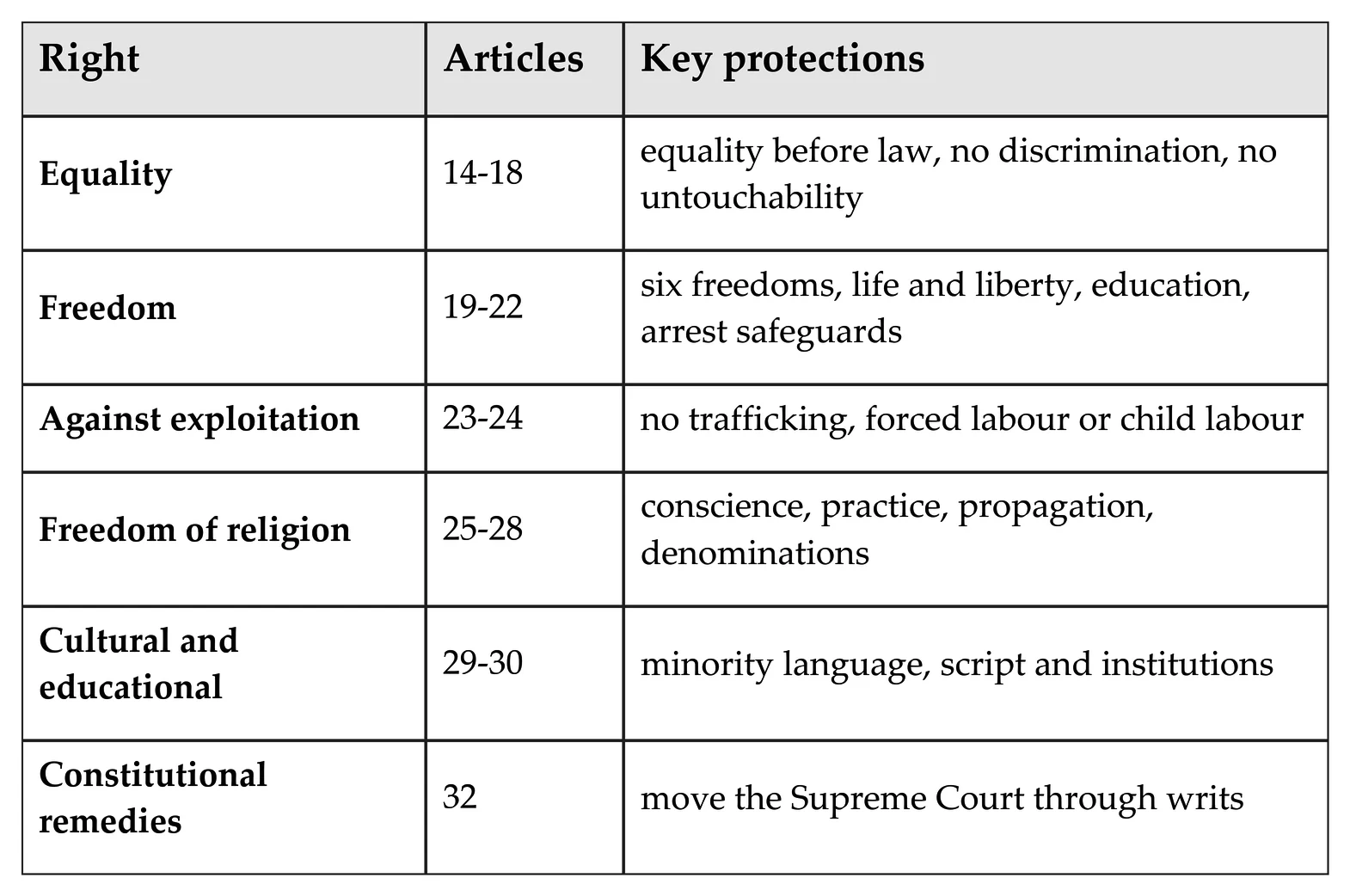
- Right to Equality (Articles 14–18). Equality before law and equal protection of the laws (Article 14); prohibition of discrimination on grounds of religion, race, caste, sex or place of birth (Article 15); equality of opportunity in public employment (Article 16), with provisions for reservations; abolition of untouchability (Article 17); and abolition of titles (Article 18).
- Right to Freedom (Articles 19–22). Article 19 guarantees six freedoms: speech and expression, peaceful assembly, association, movement, residence and profession; Article 20 protects against retrospective criminal laws, double jeopardy and self-incrimination; Article 21 protects life and personal liberty; Article 21A guarantees free and compulsory education for children aged six to fourteen; and Article 22 gives safeguards against arbitrary arrest and regulates preventive detention.
- Right against Exploitation (Articles 23–24). It prohibits human trafficking, begar (forced labour) and the employment of children below fourteen in factories, mines and hazardous work.
- Right to Freedom of Religion (Articles 25–28). It guarantees freedom of conscience and the right to profess, practise and propagate religion, the freedom of religious denominations to manage their affairs, freedom from taxes for promoting any religion, and freedom from compulsory religious instruction in state institutions.
- Cultural and Educational Rights (Articles 29–30). They protect the language, script and culture of minorities and the right of religious and linguistic minorities to establish and administer educational institutions.
- Right to Constitutional Remedies (Article 32). It guarantees the right to move the Supreme Court for the enforcement of Fundamental Rights through writs.
The original Constitution also contained a right to property (Articles 19(1)(f) and 31), which caused repeated conflict over land reform. The 44th Amendment of 1978 removed it from Part III and made it a legal right under Article 300A.
The Expanding Meaning of Article 21
Article 21, which says that no person shall be deprived of life or personal liberty except according to procedure established by law, has become the most dynamic right. In A.K. Gopalan (1950), the Court read it narrowly, accepting any procedure laid down by law. In Maneka Gandhi (1978), it held that the procedure must be just, fair and reasonable and that Articles 14, 19 and 21 are linked, a combination often called the golden triangle. Since then, the Court has read into Article 21 the rights to livelihood, shelter, health, a clean environment, speedy trial, legal aid, dignity and, in Puttaswamy (2017), privacy.

3.2 Constitutional Debates on Fundamental Rights
Fundamental Rights were among the most debated subjects in the Constituent Assembly. An Advisory Committee on Fundamental Rights, Minorities and Tribal and Excluded Areas, chaired by Sardar Vallabhbhai Patel, and its Sub-Committee on Fundamental Rights, chaired by J.B. Kripalani, prepared the drafts. Members such as K.M. Munshi, B.R. Ambedkar and Alladi Krishnaswami Ayyar submitted draft lists of rights, and the constitutional adviser B.N. Rau advised on foreign models.
Main Issues in the Debates
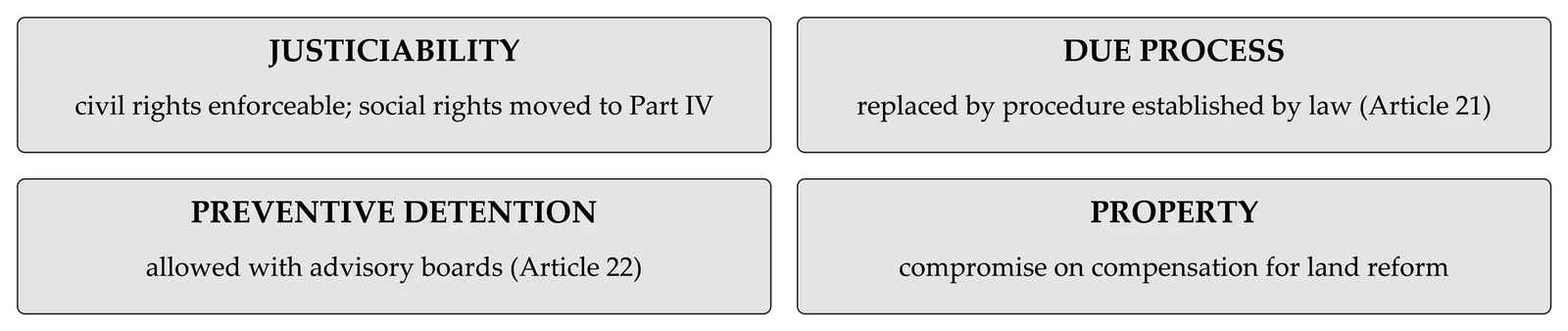
- Justiciable and non-justiciable rights. Members agreed that civil and political rights should be enforceable, but economic and social rights, such as the right to work, could not be enforced by courts in a poor country, so they were placed separately as Directive Principles in Part IV.
- Due process or procedure established by law. The early drafts used the American phrase due process of law, but B.N. Rau, after meeting the American judge Felix Frankfurter in 1947, warned that it allowed courts to strike down social legislation. The Assembly adopted procedure established by law, borrowed from the Japanese Constitution of 1946, though members such as Thakurdas Bhargava strongly criticised the change.
- Preventive detention. Article 22, allowing detention without trial, was fiercely criticised as a denial of liberty; Ambedkar defended it as necessary in the disturbed conditions after Partition, while adding safeguards such as advisory boards.
- Restrictions on freedoms. Critics such as Somnath Lahiri complained that the rights were framed from the point of view of a police constable, because every freedom was hedged with restrictions.
- Property and compensation. Debates on Article 31 reflected the conflict between protecting property and allowing zamindari abolition, resolved by a compromise that limited judicial review of compensation for land reform.
- Minorities. The Assembly abolished separate electorates but protected minorities through cultural and educational rights and freedom of religion, including the right to propagate religion, which was debated at length.
- Untouchability. Article 17 abolishing untouchability was adopted amid cheers, reflecting the influence of the anti-caste movement and Ambedkar.
Ambedkar on Fundamental Rights
Ambedkar believed that rights must be protected by law and by remedies. He described Article 32, which gives the right to move the Supreme Court, as the very soul and heart of the Constitution, because a right without a remedy is meaningless. He also warned that rights depend on the social conscience of society, since rights protected by law alone could be undermined by social prejudice.
3.3 Constitutional Remedies and Limitations
Constitutional Remedies
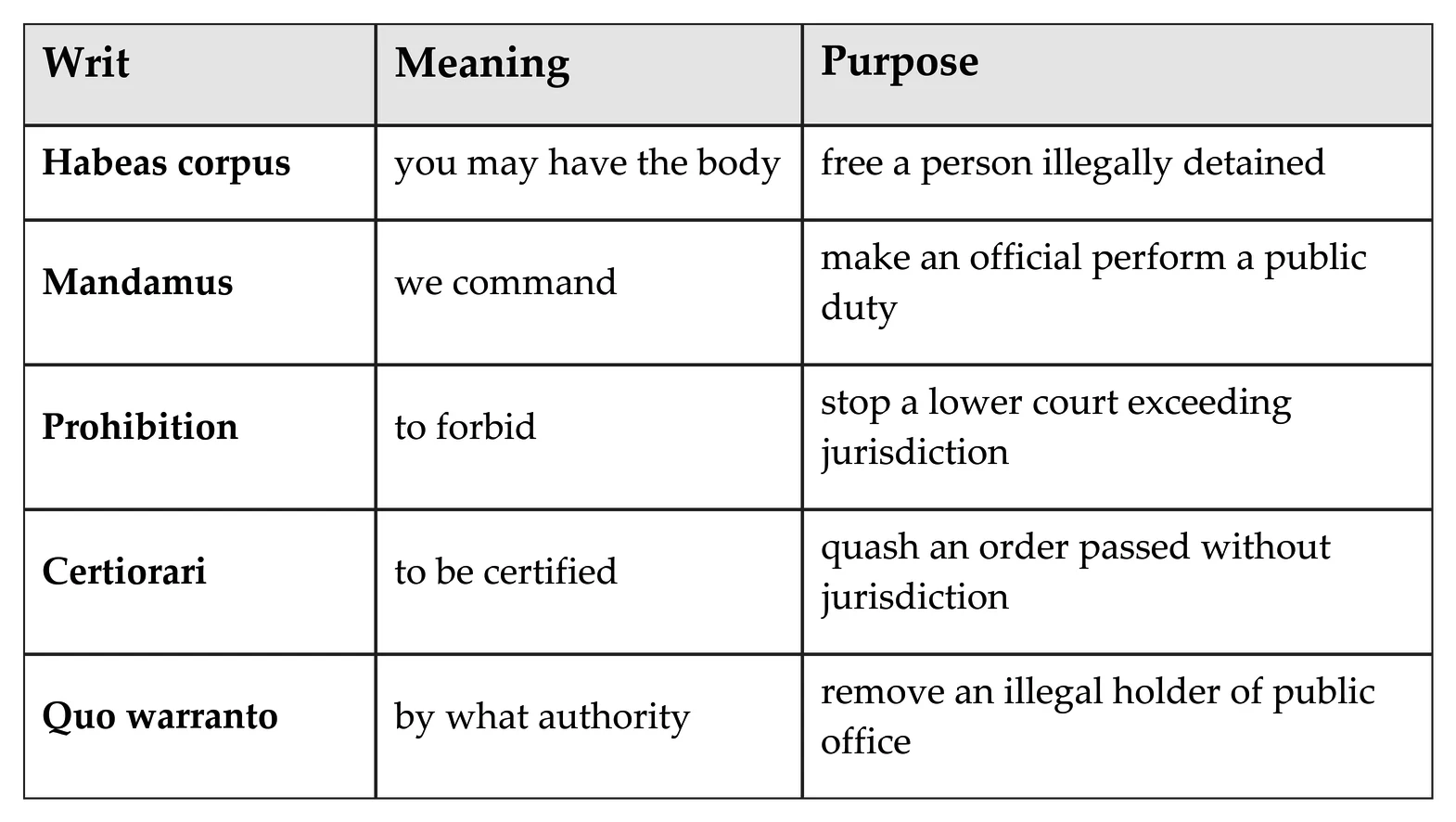
Article 32 guarantees the right to move the Supreme Court for the enforcement of Fundamental Rights, and it is itself a Fundamental Right. Article 226 gives High Courts the power to issue writs for the enforcement of Fundamental Rights and for any other purpose, so their writ jurisdiction is wider. The courts can issue five kinds of writs:
- Habeas corpus, meaning you may have the body, orders a person who has detained another to produce him before the court so that the legality of the detention can be examined.
- Mandamus, meaning we command, orders a public official or body to perform a public duty that it has failed to perform.
- Prohibition is issued by a higher court to a lower court or tribunal to stop it from exceeding its jurisdiction in a pending case.
- Certiorari is issued by a higher court to quash an order already passed by a lower court or tribunal without jurisdiction or in violation of natural justice.
- Quo warranto, meaning by what authority, asks a person holding a public office to show by what right he holds it, preventing illegal occupation of public office.
From the late 1970s, the Supreme Court expanded access to these remedies through public interest litigation, allowing public-spirited persons to approach the courts on behalf of those unable to do so, and even treating letters as petitions. This made constitutional remedies available to prisoners, bonded labourers and the poor.
Limitations on Fundamental Rights
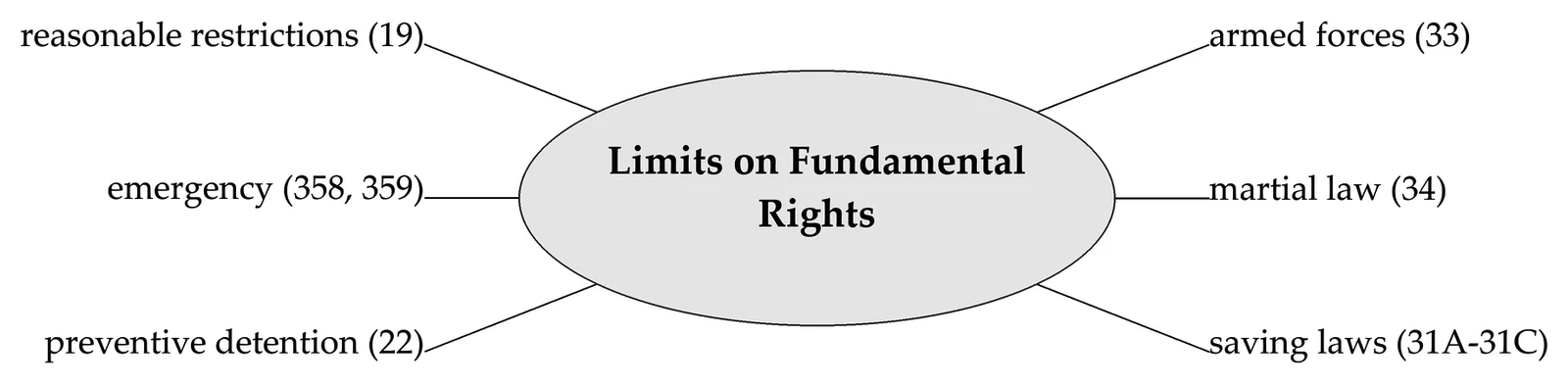
- Reasonable restrictions. Article 19(2) to (6) permits restrictions on the six freedoms on grounds such as the sovereignty and integrity of India, the security of the state, friendly relations with foreign states, public order, decency or morality, contempt of court, defamation and incitement to an offence.
- Emergency. During a national emergency, Article 358 suspends the freedoms of Article 19 when the emergency is declared on grounds of war or external aggression, and Article 359 allows the President to suspend the enforcement of other rights, except Articles 20 and 21.
- Armed forces and martial law. Article 33 allows Parliament to restrict the rights of the armed forces and police, and Article 34 restricts rights in areas under martial law.
- Saving of laws. Articles 31A, 31B and 31C protect certain laws, such as land reform laws and laws placed in the Ninth Schedule, from challenge on the ground of violating some Fundamental Rights, though since 2007 Ninth Schedule laws can be tested against the basic structure.
- Preventive detention. Article 22 permits detention without trial for up to three months, extendable with the approval of an advisory board, under laws such as the National Security Act of 1980.
The Emergency and ADM Jabalpur
The danger of these limitations was seen during the Emergency of 1975–77. In ADM Jabalpur v. Shivkant Shukla (1976), the Supreme Court held by four to one that during the emergency no one could approach the courts for habeas corpus to challenge illegal detention. Justice H.R. Khanna dissented, arguing that the right to life and liberty did not depend on the Constitution alone. The 44th Amendment of 1978 made Articles 20 and 21 non-suspendable, and in Puttaswamy (2017) the Supreme Court declared that ADM Jabalpur had been wrongly decided.
3.4 Important Questions
- Question 1 Discuss the nature and significance of Fundamental Rights in the Indian Constitution.
- Question 2 Discuss the debates in the Constituent Assembly on Fundamental Rights.
- Question 3 Discuss the right to constitutional remedies and the writs under the Indian Constitution.
- Question 4 Examine the limitations on Fundamental Rights in the Indian Constitution.
DU asks the same idea in different words. So learn one broad answer for each question below; the same answer works for every question joined by OR.
Important Question 1
Discuss the nature and significance of Fundamental Rights in the Indian Constitution.
OR
Explain the main features and types of Fundamental Rights in India.
OR
Fundamental Rights are the Magna Carta of India. Discuss.
Model Answer
“The State shall not make any law which takes away or abridges the rights conferred by this Part and any law made in contravention of this clause shall, to the extent of the contravention, be void.”
— Constitution of India, Article 13(2)
Introduction. Fundamental Rights are the basic rights guaranteed by Part III of the Constitution of India, Articles 12 to 35. They protect individuals against arbitrary state action and some forms of social oppression, and they can be enforced in courts. Because they protect liberty, equality and dignity, they are often called the Magna Carta of India.
1. Meaning of Fundamental Rights
Fundamental Rights are rights considered essential for the full development of the individual. Unlike ordinary legal rights, they are written into the Constitution, cannot be taken away by ordinary law and are protected by the courts through judicial review.
2. Historical Background
The demand for guaranteed rights grew during the freedom struggle, from the Constitution of India Bill of 1895 and the Commonwealth of India Bill of 1925 to the Nehru Report of 1928 and the Karachi Resolution of 1931. The experience of colonial repression made Indians value written guarantees of liberty.
3. Justiciability
Fundamental Rights are justiciable. Article 32 allows any person to approach the Supreme Court directly, and Article 226 allows approach to High Courts, for their enforcement through writs. This distinguishes them from Directive Principles, which are not enforceable.
4. Protection against the State
Article 12 defines the State broadly to include governments, legislatures, local authorities and other authorities, and Article 13 makes void any law that violates Fundamental Rights, making the judiciary their guardian.
5. Right to Equality
Articles 14 to 18 guarantee equality before law, prohibit discrimination on grounds of religion, race, caste, sex or place of birth, ensure equal opportunity in public employment with provision for reservations, abolish untouchability and abolish titles.
6. Right to Freedom
Articles 19 to 22 guarantee six freedoms, protection in respect of conviction for offences, the right to life and personal liberty, the right to education and safeguards against arbitrary arrest. Article 21 has been expanded to include dignity, livelihood, health and privacy.
7. Rights against Exploitation and to Religion
Articles 23 and 24 prohibit trafficking, forced labour and hazardous child labour, while Articles 25 to 28 guarantee freedom of conscience and religion and the right of denominations to manage their affairs, reflecting India’s secular character.
8. Minority and Remedial Rights
Articles 29 and 30 protect the culture of minorities and their right to run educational institutions, and Article 32 guarantees the right to constitutional remedies, which Ambedkar called the heart and soul of the Constitution.
9. Rights of Citizens and Persons
Some rights, such as those in Articles 15, 16, 19, 29 and 30, are available only to citizens, while others, such as Articles 14 and 21, protect all persons, including foreigners, showing a universal commitment to human dignity.
10. Not Absolute
Fundamental Rights are subject to reasonable restrictions in the interest of public order, security, morality and other grounds, and most can be suspended during an emergency, except Articles 20 and 21 since 1978.
11. Significance for Democracy
Fundamental Rights protect the freedoms of speech, association and assembly without which democracy cannot work. They allow citizens to criticise the government, form parties and take part in public life.
12. Significance for Social Justice
By abolishing untouchability, prohibiting discrimination, permitting reservations and banning forced labour, Fundamental Rights promote social justice and protect weaker sections against social oppression, not only against the state.
13. Criticisms
Critics argue that the rights carry too many restrictions, that preventive detention undermines liberty, that economic and social rights were left out, and that the language of some provisions is complex for ordinary citizens.
14. Evaluation
Despite their limitations, Fundamental Rights have been expanded by judicial interpretation and remain the foundation of liberty and equality in India, protecting citizens against arbitrary power.
Conclusion. Thus, Fundamental Rights in Part III guarantee equality, freedom, protection against exploitation, freedom of religion, minority rights and constitutional remedies. Justiciable but not absolute, they protect individuals against the state and social oppression, sustain democracy and promote social justice, which is why they are called the Magna Carta of India.
Important Question 2
Discuss the debates in the Constituent Assembly on Fundamental Rights.
OR
Why did the Constituent Assembly adopt ‘procedure established by law’ instead of ‘due process of law’ in Article 21?
OR
Examine the controversies over preventive detention and the restrictions on freedoms in the Constituent Assembly.
Model Answer
“No person shall be deprived of his life or personal liberty except according to procedure established by law.”
— Constitution of India, Article 21
Introduction. Fundamental Rights were among the most carefully debated parts of the Constitution. The Constituent Assembly had to balance individual liberty with the needs of a new state facing Partition, communal violence, poverty and the demand for social reform. The debates shaped the form of Part III and explain many of its features and limitations.
1. The Committees
The Advisory Committee on Fundamental Rights, Minorities and Tribal and Excluded Areas, chaired by Sardar Patel, and its Sub-Committee on Fundamental Rights, chaired by J.B. Kripalani, prepared the drafts, drawing on proposals by K.M. Munshi, Ambedkar and Alladi Krishnaswami Ayyar, with B.N. Rau as constitutional adviser.
2. Justiciable and Non-Justiciable Rights
Members debated whether social and economic rights should be enforceable. The Assembly decided that civil and political rights would be justiciable, while economic and social goals, such as the right to work and adequate livelihood, would be placed in the non-justiciable Directive Principles because the state lacked resources to guarantee them immediately.
3. Due Process of Law
Early drafts used the American phrase due process of law, which allows courts to examine whether laws are fair. B.N. Rau, after meeting the American judge Felix Frankfurter in 1947, warned that it had been used to strike down social legislation in the United States.
4. Procedure Established by Law
The Assembly adopted the phrase procedure established by law from the Japanese Constitution of 1946, so courts would only check whether a valid law had been followed. Thakurdas Bhargava and others criticised this as weakening liberty, and in 1949 Ambedkar added Article 22 safeguards as a partial response.
5. Later Judicial Change
In A.K. Gopalan (1950), the Court followed the narrow meaning, but in Maneka Gandhi (1978) it held that the procedure must be just, fair and reasonable, effectively bringing due process back into Indian law.
6. Preventive Detention
Article 22, allowing detention without trial, was one of the most controversial provisions. Critics saw it as a colonial practice inconsistent with liberty. Ambedkar defended it as necessary in the disturbed conditions after Partition, while providing safeguards such as advisory boards and limits on the period of detention.
7. Restrictions on Freedoms
Many members complained that every freedom in Article 19 was hedged with restrictions. Somnath Lahiri remarked that the rights seemed framed from the point of view of a police constable. Supporters replied that rights must be balanced with public order and security in a new and fragile state.
8. The Right to Property
The right to property and compensation in Article 31 was debated at length. Nehru wanted land reform without heavy compensation, while others wanted protection of property. A compromise limited judicial review of compensation for zamindari abolition, but conflict continued after 1950.
9. Minority Rights
The Assembly abolished separate electorates but guaranteed freedom of religion, including the right to propagate religion, and cultural and educational rights for minorities. These provisions reflected the aim of building trust among minorities after Partition.
10. Abolition of Untouchability
Article 17, abolishing untouchability and making its practice an offence, was adopted with enthusiasm, reflecting the influence of Ambedkar and the anti-caste movement and the commitment to social equality.
11. Constitutional Remedies
Ambedkar insisted that rights need remedies and described Article 32 as the heart and soul of the Constitution. The Assembly gave citizens the right to approach the Supreme Court directly for the enforcement of their rights.
12. Rights against Private Actors
The Assembly made some rights applicable against private persons, such as the prohibition of untouchability, forced labour and discrimination in access to public places, recognising that oppression in India often came from society, not only from the state.
13. Assessment of the Debates
The debates reveal a balance between liberal ideals of individual freedom and the concerns of a new state about security, social reform and national unity. This balance explains why Indian rights are extensive but subject to restrictions.
14. Evaluation
The Constituent Assembly debates produced a carefully balanced set of rights, whose weaknesses, such as preventive detention and the narrow phrasing of Article 21, have been partly corrected by later judicial interpretation and amendments.
Conclusion. Thus, the Constituent Assembly debated justiciability, due process, preventive detention, restrictions, property and minority rights, producing a Part III that combines strong guarantees with significant limitations. Choices such as procedure established by law reflected the needs of a new state, while later courts expanded rights in the spirit of the founders’ commitment to liberty and equality.
Important Question 3
Discuss the right to constitutional remedies and the writs under the Indian Constitution.
OR
Why did Ambedkar call Article 32 the heart and soul of the Constitution?
OR
Explain the writ jurisdiction of the Supreme Court and High Courts.
Model Answer
“The right to move the Supreme Court by appropriate proceedings for the enforcement of the rights conferred by this Part is guaranteed.”
— Constitution of India, Article 32(1)
Introduction. A right is meaningful only if there is a remedy when it is violated. The Constitution of India therefore guarantees the right to constitutional remedies in Article 32, allowing any person to approach the Supreme Court for the enforcement of Fundamental Rights, and gives High Courts similar powers under Article 226. These remedies are provided mainly through five writs, and they have been expanded by public interest litigation.
1. Meaning of Constitutional Remedies
Constitutional remedies are the legal means by which Fundamental Rights are enforced. Article 32 makes the right to approach the Supreme Court itself a Fundamental Right, so that the rights in Part III cannot remain mere promises.
2. Ambedkar’s View
On 9 December 1948, Ambedkar told the Constituent Assembly that Article 32 was the very soul and heart of the Constitution, because without it all other rights would be useless. He believed that the courts must be able to provide effective remedies against the violation of rights.
3. Article 32 and Article 226
Under Article 32, the Supreme Court can issue directions, orders or writs for the enforcement of Fundamental Rights. Under Article 226, High Courts can issue writs for Fundamental Rights and for any other purpose, so their writ jurisdiction is wider, though the Supreme Court’s is a Fundamental Right.
4. Habeas Corpus
Habeas corpus, meaning you may have the body, requires a person or authority that has detained someone to produce him before the court and justify the detention. It is the most important protection of personal liberty against illegal detention.
5. Mandamus
Mandamus, meaning we command, orders a public official, body or lower court to perform a public duty it has failed to perform. It cannot be issued against the President, Governors or private individuals.
6. Prohibition
Prohibition is issued by a higher court to a lower court or tribunal to stop proceedings that exceed its jurisdiction. It is preventive, issued while a case is still pending.
7. Certiorari
Certiorari is issued by a higher court to quash an order already passed by a lower court or tribunal that acted without jurisdiction, in excess of jurisdiction or in violation of natural justice. It is corrective, applied after a decision.
8. Quo Warranto
Quo warranto, meaning by what authority, asks a person holding a public office to show by what right he holds it. If the person is not legally entitled, the court can remove him, preventing illegal occupation of public offices.
9. Public Interest Litigation
From the late 1970s, judges such as P.N. Bhagwati and V.R. Krishna Iyer relaxed the rule that only the affected person can approach the court, allowing public-spirited persons to seek remedies for the poor and treating letters as petitions, as in cases on undertrial prisoners and bonded labour.
10. New Remedies
The Supreme Court has developed new remedies, such as compensation for violation of the right to life in Rudul Sah (1983) and Nilabati Behera (1993), and continuing mandamus, under which it monitors the implementation of its orders over time.
11. Suspension during Emergency
During a national emergency, the President can suspend the right to move the courts for the enforcement of certain rights under Article 359. In ADM Jabalpur (1976), the Court refused habeas corpus, but the 44th Amendment protected Articles 20 and 21 from suspension.
12. Limits of Remedies
Remedies are limited by delays, costs, the backlog of cases and the difficulty that poor citizens face in approaching courts. Legal aid under Article 39A and the Legal Services Authorities Act of 1987 seek to address this problem.
13. Significance
Constitutional remedies make the judiciary the protector of rights, give citizens a direct path to justice and ensure that the state remains bound by the Constitution. They have allowed the expansion of rights through judicial interpretation.
14. Evaluation
Article 32 and the writs have made Fundamental Rights real in Indian life, and public interest litigation has extended them to the poor, though delays and costs remain obstacles.
Conclusion. Thus, the right to constitutional remedies under Articles 32 and 226 allows citizens to enforce their rights through the writs of habeas corpus, mandamus, prohibition, certiorari and quo warranto. Expanded by public interest litigation and new remedies, it justifies Ambedkar’s description of Article 32 as the heart and soul of the Constitution.
Important Question 4
Examine the limitations on Fundamental Rights in the Indian Constitution.
OR
Are Fundamental Rights absolute? Discuss with reference to reasonable restrictions and emergency provisions.
OR
Discuss the suspension of Fundamental Rights during an emergency with reference to the ADM Jabalpur case.
Model Answer
“Without such sanctity of life and liberty, the distinction between a lawless society and one governed by laws would cease to have any meaning.”
— Justice H.R. Khanna, dissent in ADM Jabalpur v. Shivkant Shukla (1976)
Introduction. Fundamental Rights in India are not absolute. The Constitution balances individual liberty with the interests of society and the state by allowing reasonable restrictions, suspension during emergencies and special limitations for the armed forces, martial law and certain laws. These limitations protect public order and national security but can also be misused, as the Emergency of 1975–77 showed.
1. Why Rights Are Limited
No right can be unlimited in a society, because the rights of one person must be balanced with the rights of others and the needs of the community. The Constituent Assembly, facing Partition and violence, believed that the state needed powers to maintain order and unity.
2. Reasonable Restrictions on Freedoms
Article 19(2) to (6) allows restrictions on the six freedoms on grounds such as sovereignty and integrity, security of the state, friendly relations with foreign states, public order, decency or morality, contempt of court, defamation and incitement to an offence, as well as in the interests of the general public and Scheduled Tribes.
3. Test of Reasonableness
Courts decide whether a restriction is reasonable by examining its purpose, the nature of the right and the proportionality of the restriction. In Shreya Singhal (2015), the Court struck down Section 66A of the IT Act as an unreasonable restriction on speech.
4. Emergency: Article 358
When a national emergency is declared on grounds of war or external aggression, Article 358 automatically suspends the freedoms of Article 19, allowing the state to make laws that would otherwise violate them.
5. Emergency: Article 359
Article 359 allows the President to suspend the right to move the courts for the enforcement of other Fundamental Rights during an emergency. Since the 44th Amendment of 1978, the rights in Articles 20 and 21 cannot be suspended.
6. ADM Jabalpur
During the Emergency, in ADM Jabalpur v. Shivkant Shukla (1976), the Supreme Court held by four to one that detainees could not seek habeas corpus. Justice H.R. Khanna’s lone dissent defended the right to life and liberty, and in 2017 the Court declared the majority view wrong.
7. Preventive Detention
Article 22 permits preventive detention, i.e. detention to prevent a person from committing a crime, without trial. Laws such as the National Security Act of 1980 use this power, with safeguards such as advisory boards, but critics say it is often misused against political opponents.
8. Armed Forces and Martial Law
Article 33 allows Parliament to restrict the Fundamental Rights of members of the armed forces, police and intelligence services to ensure discipline, and Article 34 restricts rights in areas under martial law.
9. Saving of Laws
Articles 31A, 31B and 31C protect certain laws, such as land reform laws and laws giving effect to some Directive Principles, from challenge on grounds of violating Articles 14 and 19. Laws in the Ninth Schedule were protected, but since I.R. Coelho (2007) they can be tested against the basic structure.
10. Amendment of Rights
Parliament can amend Fundamental Rights by constitutional amendment, as it did with the right to property in 1978, but the basic structure doctrine prevents it from destroying their core.
11. Judicial Protection against Misuse
Courts have tried to prevent misuse of these limitations by requiring that restrictions be reasonable and proportionate, as in Puttaswamy (2017) and Anuradha Bhasin (2020) on internet shutdowns.
12. Criticisms
Critics argue that the wide grounds of restriction, preventive detention laws and emergency powers allow governments to curb dissent, and that Fundamental Rights in India are given with one hand and taken away with the other.
13. Defence of Limitations
Defenders argue that limitations are necessary to protect security, public order and the rights of others in a diverse and sometimes violent society, and that judicial review and the 44th Amendment provide safeguards.
14. Evaluation
The limitations on Fundamental Rights reflect a balance between liberty and order. The experience of the Emergency shows that this balance depends on vigilant courts, a free press and active citizens.
Conclusion. Thus, Fundamental Rights are limited by reasonable restrictions, emergency provisions, preventive detention, special rules for the armed forces and martial law, and saving clauses. The Emergency and ADM Jabalpur showed the dangers of these limitations, which the 44th Amendment and later judgments have sought to control, confirming that rights are not absolute but must not be destroyed.
Short Notes
(a) Habeas corpus
A writ requiring a person or authority that has detained someone to produce him before the court so that the legality of the detention can be examined; it protects personal liberty.
(b) Golden triangle
The term for Articles 14, 19 and 21 taken together, which the Supreme Court in Maneka Gandhi (1978) held must be read together so that any law affecting liberty is just, fair and reasonable.
(c) Article 300A
The article inserted by the 44th Amendment of 1978 which says that no person shall be deprived of property save by authority of law, making property a legal right rather than a Fundamental Right.
More notes: GE-2 Introduction to the Indian Constitution
These notes are prepared by PADHO TO AISE for study help. They are not an official publication.