
Semester VIII DSE-17 Ethics, Politics and Governance
Unit IV · 23 min read · Updated 24 Nov 2026
As per the University of Delhi (DU) BA (Hons) Political Science syllabus
Contents
- 4.1 Technology and Neutrality
- Is Technology Neutral
- Algorithmic Bias in Practice
- Surveillance and Privacy
- 4.2 Technology and Autonomy
- Collingridge’s Dilemma and Its Responses
- Threats to Autonomy
- Regulating Technology to Protect Autonomy
- 4.3 Transhumanism and Responsible Technology
- The Transhumanist Project
- Critics of Enhancement
- Principles of Responsible AI
- Designing Technology with Values
- 4.4 Important Questions
- Is technology neutral? Discuss with reference to AI, big data and digital surveillance.
- Discuss the relationship between technology and autonomy.
- What is transhumanism? Discuss its ethical implications.
- Discuss the principles of ethical conduct of technology and responsible AI.
- Short Notes
प्रौद्योगिकी न अच्छी है, न बुरी; और न ही वह तटस्थ है।
Technology is neither good nor bad; nor is it neutral.
— Melvin Kranzberg, Kranzberg’s First Law (1986)
NEW technologies such as artificial intelligence, big data analytics, the Internet of Things and digital surveillance are changing how we live, work and are governed. They promise efficiency and new possibilities, but they also raise ethical questions about bias, privacy, control and even what it means to be human. This chapter examines whether technology is neutral, how it affects human autonomy, the debate on transhumanism and the principles of ethical conduct in technology, drawing on Lance Strate, Catherine Stinson, Audley Genus and Andy Stirling, Elaine Graham, Virginia Dignum and S. Matthew Liao.

4.1 Technology and Neutrality
Many people think technology is a neutral tool whose effects depend only on how it is used. Critics such as Lance Strate argue that technology is never neutral, because it embodies values and changes social relations. Catherine Stinson shows that algorithms reflect the choices of their designers and the data they use, so AI, big data, the Internet of Things and digital surveillance can reproduce bias and power.
Is Technology Neutral
The neutrality thesis holds that technology is merely a tool, like a knife that can be used for cooking or killing. Critics reject this. Melvin Kranzberg’s first law (1986) states that technology is neither good nor bad, nor is it neutral. Langdon Winner, in Do Artifacts Have Politics (1980), gave the example of low overpasses on the parkways to Long Island beaches, which, he argued, were designed to keep out buses that carried poor and Black residents. Marshall McLuhan, in Understanding Media (1964), declared that the medium is the message, and Neil Postman, in Technopoly (1992), warned of a culture that surrenders to technology. Lance Strate, in the tradition of media ecology, shows that technologies reshape how we think, communicate and relate to one another.
Algorithmic Bias in Practice
- Criminal justice. In 2016, the news organisation ProPublica reported that COMPAS, software used in US courts to predict reoffending, wrongly labelled Black defendants as high risk far more often than white defendants.
- Hiring. Amazon scrapped an experimental recruiting tool in 2018 after it learned from past data to downgrade applications that mentioned women.
- Facial recognition. Joy Buolamwini and Timnit Gebru’s Gender Shades study (2018) found that commercial systems had much higher error rates for darker-skinned women than for lighter-skinned men.
- Welfare. Virginia Eubanks, in Automating Inequality (2018), and Cathy O’Neil, in Weapons of Math Destruction (2016), showed how automated systems can punish the poor.
- Search. Safiya Noble, in Algorithms of Oppression (2018), showed how search engines reproduced racist and sexist stereotypes.
Surveillance and Privacy
Shoshana Zuboff, in The Age of Surveillance Capitalism (2019), argues that technology companies extract data about human behaviour, predict and shape it and sell these predictions, creating a new form of power. States also use digital surveillance. In India, reports in 2021 that the Pegasus spyware had targeted journalists, activists and politicians led the Supreme Court to appoint a technical committee, overseen by a retired judge, to investigate. The Puttaswamy judgment of 2017 recognised privacy as a fundamental right, and the Digital Personal Data Protection Act of 2023 regulates the processing of personal data, though critics argue that it gives the government broad exemptions.
4.2 Technology and Autonomy
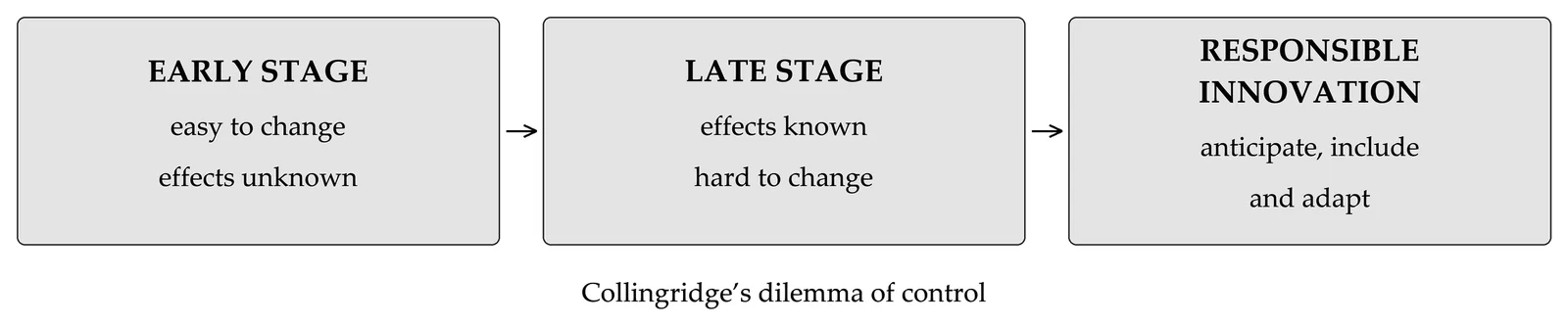
New technologies can expand human freedom but also threaten autonomy, through manipulation of choices by algorithms, dark patterns and targeted messages. David Collingridge’s dilemma of control explains why technologies are hard to govern: their effects are unknown when they are easy to change and hard to change once known.
Collingridge’s Dilemma and Its Responses
David Collingridge, in The Social Control of Technology (1980), stated a dilemma of control: when a technology is new, it is easy to change but its effects are unknown; when its effects become clear, it is so embedded in society that change is costly and difficult. The car, nuclear power and social media all illustrate the problem. Collingridge did not counsel despair. He argued that decision-makers should keep options open by preferring technologies that are flexible, reversible and easy to monitor, avoid early commitment to large, inflexible systems and build in ways to correct mistakes. Later approaches such as anticipatory governance and responsible research and innovation try to involve the public and assess impacts early.
Threats to Autonomy
- Nudges. Richard Thaler and Cass Sunstein, in Nudge (2008), proposed changing the choice architecture to steer people towards better choices while preserving freedom; critics worry that nudges can become manipulation.
- Dark patterns. The designer Harry Brignull coined the term in 2010 for interface tricks, such as hidden costs and hard-to-cancel subscriptions; India’s Central Consumer Protection Authority issued guidelines banning thirteen dark patterns in 2023.
- The attention economy. Tim Wu, in The Attention Merchants (2016), traced how media businesses capture and sell attention, and platforms design endless feeds to maximise engagement.
- Automated decisions. Article 22 of the European Union’s General Data Protection Regulation (2018) gives people the right not to be subject to decisions based solely on automated processing with significant effects.
- Children. Concern about the effect of social media on young people led Australia to legislate in 2024 a minimum age of sixteen for social media accounts.
Regulating Technology to Protect Autonomy
The European Union’s Artificial Intelligence Act of 2024 takes a risk-based approach: it bans uses of unacceptable risk, such as social scoring by governments and manipulative techniques, imposes strict duties on high-risk systems used in areas such as hiring, credit and policing, and requires transparency for systems such as chatbots and deepfakes. Ronald Sandler, in his work on the ethics of emerging technologies, argues that ethical evaluation must consider not only the technology itself but also the social and institutional context in which it is introduced, which is why autonomy must be protected collectively, through democratic regulation, as well as individually.
4.3 Transhumanism and Responsible Technology
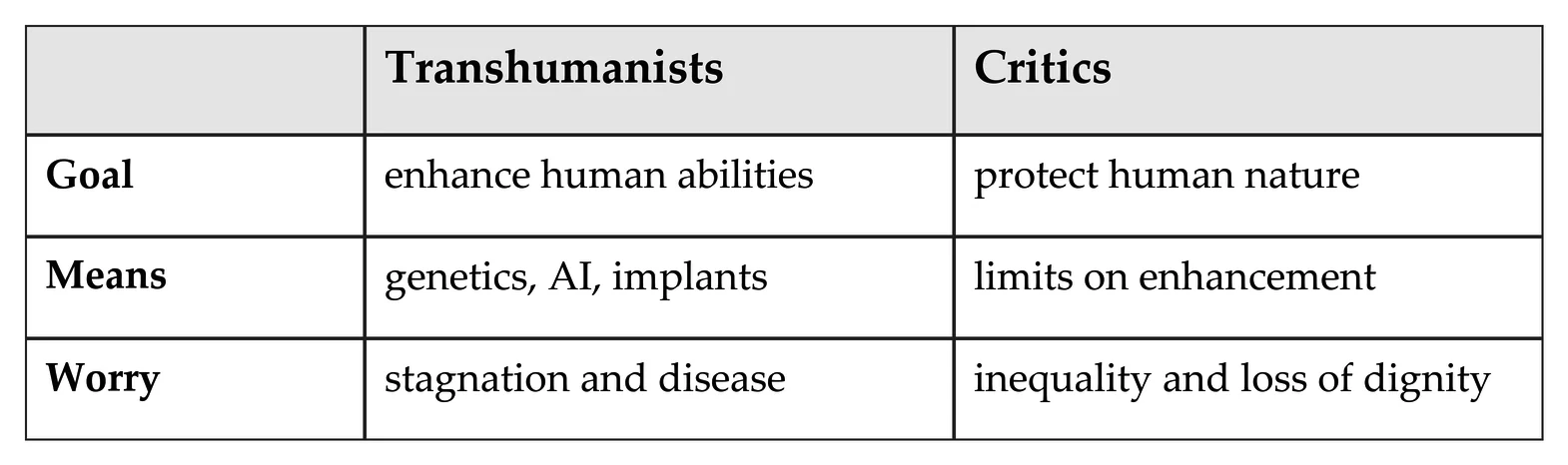
Transhumanism seeks to use technology to enhance human abilities and overcome ageing and death, while critics warn of inequality and loss of human dignity. Responsible technology requires principles such as accountability, responsibility and transparency, which Virginia Dignum proposes for artificial intelligence.

The Transhumanist Project
The biologist Julian Huxley used the word transhumanism in 1957 for the idea that humanity can transcend itself through science. The World Transhumanist Association was founded in 1998 by Nick Bostrom and David Pearce, and Bostrom defended human enhancement in In Defense of Posthuman Dignity (2005). Ray Kurzweil, in The Singularity Is Near (2005), predicted that by about 2045 artificial intelligence would surpass human intelligence and merge with it. Recent developments make these debates practical: the gene-editing tool CRISPR-Cas9, developed in 2012 by Jennifer Doudna and Emmanuelle Charpentier, who won the Nobel Prize in 2020, allows precise changes to DNA, and brain-computer interfaces were implanted in human patients from 2024.
Critics of Enhancement
- Fukuyama. Francis Fukuyama, in Our Posthuman Future (2002), warned that altering human nature threatens the basis of human rights and equality, and in 2004 called transhumanism the world’s most dangerous idea.
- Habermas. Jürgen Habermas, in The Future of Human Nature (2003), argued that genetic design of children would undermine their sense of being the authors of their own lives.
- Sandel. Michael Sandel, in The Case against Perfection (2007), argued that the drive to mastery erodes humility, gratitude for the gifted character of life and solidarity with the less fortunate.
- Inequality. Enhancements available only to the rich could create biological as well as economic divisions.
- Safety and consent. In 2018, the Chinese scientist He Jiankui announced the birth of gene-edited babies, provoking worldwide condemnation, and was later imprisoned.
Principles of Responsible AI
Virginia Dignum, in Responsible Artificial Intelligence (2019), proposes the ART principles: accountability, meaning that systems must be able to explain and justify their decisions and that humans remain answerable; responsibility, meaning that people involved in designing and using AI accept their role and the systems’ links with human values; and transparency, meaning that the data, algorithms and decision processes can be inspected. International frameworks include the OECD AI Principles of 2019, the UNESCO Recommendation on the Ethics of Artificial Intelligence of 2021 and the Bletchley Declaration of 2023. India published a National Strategy for Artificial Intelligence in 2018 and Principles for Responsible AI in 2021, launched the IndiaAI Mission in 2024, co-chaired the AI Action Summit in Paris in 2025 and hosted the next summit in New Delhi in 2026.
Designing Technology with Values
Batya Friedman developed value sensitive design in the 1990s, an approach that builds values such as privacy, fairness and human welfare into technology from the start rather than adding them later. The German philosopher Hans Jonas, in The Imperative of Responsibility (1979), argued that modern technology gives humans unprecedented power over the future, so ethics must consider long-term consequences and act with caution when the stakes are high. Responsible technology thus requires ethics in design, democratic oversight, attention to the vulnerable and humility about what we do not know.
4.4 Important Questions
- Question 1 Is technology neutral? Discuss with reference to AI, big data and digital surveillance.
- Question 2 Discuss the relationship between technology and autonomy.
- Question 3 What is transhumanism? Discuss its ethical implications.
- Question 4 Discuss the principles of ethical conduct of technology and responsible AI.
DU asks the same idea in different words. So learn one broad answer for each question below; the same answer works for every question joined by OR.
Important Question 1
Is technology neutral? Discuss with reference to AI, big data and digital surveillance.
OR
Examine the ethical issues raised by algorithms and big data.
OR
Discuss the ethics of digital surveillance.
Model Answer
“Privacy is the constitutional core of human dignity.”
— Justice D.Y. Chandrachud, Justice K.S. Puttaswamy v. Union of India (2017)
Introduction. A common view holds that technology is merely a tool, neither good nor bad, and that only its use matters. Many philosophers and scholars reject this view, arguing that technologies embody values and reshape society. The question has become urgent with artificial intelligence, big data analytics, the Internet of Things and digital surveillance, which shape decisions about people’s lives.
1. The Neutrality Thesis
The neutrality thesis holds that technology is a value-free instrument that can be used for good or bad purposes, as a knife can be used to cook or to kill. Responsibility lies only with users.
2. Kranzberg’s Law
Melvin Kranzberg argued that technology is neither good nor bad, nor is it neutral: its effects depend on context, but it always shapes society in particular ways.
3. Strate’s Argument
Lance Strate argues that if something is neutral, it is not technology, because every technology changes our environment, our relationships and our ways of thinking. Following Marshall McLuhan, he stresses that the medium itself shapes the message.
4. Algorithms Are Not Neutral
Catherine Stinson shows that algorithms reflect the choices of their designers, such as what to optimise and which data to use. Even technical decisions carry ethical consequences for fairness and harm.
5. Bias in Data
AI systems learn from data that may reflect past discrimination. A recruitment tool developed by Amazon was scrapped in 2018 after it was found to downgrade applications from women, because it learned from past hiring patterns.
6. Discrimination from Missing Data
Betsy Anne Williams, Catherine Brooks and Yotam Shmargad show that algorithms can discriminate based on data they lack, since removing sensitive attributes such as race or caste may allow other variables to act as proxies and hide bias.
7. Big Data
Big data analytics allows governments and companies to predict behaviour from vast amounts of data, raising concerns about privacy, consent and the use of predictions to make decisions about credit, jobs and policing.
8. Internet of Things
The Internet of Things connects devices such as phones, meters, cars and home appliances, collecting continuous data about daily life, which can improve services but also enable surveillance.
9. Digital Surveillance
States use digital technologies to monitor citizens, as revealed by Edward Snowden in 2013 and by reports in 2021 that Pegasus spyware was used against journalists and activists in several countries, including India.
10. Surveillance Capitalism
Shoshana Zuboff argues that technology companies practise surveillance capitalism, collecting personal data to predict and influence behaviour for profit.
11. Privacy in India
In Puttaswamy (2017), the Supreme Court recognised privacy as a fundamental right, linked with dignity and autonomy. The Digital Personal Data Protection Act of 2023 regulates the processing of personal data, though critics note broad exemptions for government.
12. Facial Recognition
Facial recognition systems used by police can misidentify people, especially from some groups, and enable mass surveillance of public spaces, raising concerns about rights and accountability.
13. Value-Sensitive Design
Value-sensitive design argues that ethical values such as privacy, fairness and autonomy should be built into technologies from the start, not added after harm occurs.
14. Benefits
These technologies also bring benefits, such as better health diagnosis, efficient services and disaster warning, so the goal is not to reject them but to govern them ethically.
15. Predictive Policing
Predictive policing tools use past crime data to forecast where crimes will occur or who may offend. A 2016 investigation of the COMPAS risk tool in the United States found that it wrongly labelled Black defendants as high risk more often than white defendants. Because past data reflect biased policing, such tools can reinforce discrimination.
16. Evaluation
Technology is not neutral: its design, data and use carry values and power, so ethics must shape technology from the beginning.
Conclusion. Thus, Kranzberg and Strate show that technology is not neutral, Stinson that algorithms embody choices and Williams and colleagues that missing data can hide discrimination. Big data, the Internet of Things and digital surveillance threaten privacy, recognised in Puttaswamy, so values must be built into technology’s design and governance.
Important Question 2
Discuss the relationship between technology and autonomy.
OR
Explain Collingridge’s dilemma of control.
OR
How do new technologies manipulate human choice?
Model Answer
“When change is easy, the need for it cannot be foreseen; when the need for change is apparent, change has become expensive, difficult and time consuming.”
— David Collingridge, The Social Control of Technology (1980)
Introduction. Autonomy, the capacity to govern oneself and make one’s own choices, is a central value of modern ethics and democracy. New technologies can expand autonomy by giving people information and options, but they can also undermine it by manipulating choices and escaping social control. David Collingridge’s dilemma of control and debates on manipulation help us understand these challenges.
1. Meaning of Autonomy
Autonomy means self-governance: acting according to one’s own reasons and values rather than being controlled by others. Kant saw autonomy as the basis of human dignity.
2. Technology Expands Autonomy
Technologies such as the internet, mobile phones and assistive devices can expand autonomy by giving access to information, communication and services, especially for people with disabilities.
3. Collingridge’s Dilemma
David Collingridge argued in 1980 that technologies face a dilemma of control: in their early stages they are easy to change but their effects are unknown, while by the time their effects are known they are entrenched and hard to change.
4. Examples
Social media and fossil fuel technologies illustrate the dilemma: their harmful effects became clear only after they were deeply embedded in economies and societies.
5. Collingridge’s Response
Collingridge proposed keeping technologies flexible, reversible and open to correction, avoiding early commitment to a single path.
6. Genus and Stirling
Audley Genus and Andy Stirling revisit Collingridge to argue for responsible and accountable innovation, which involves anticipating impacts, including diverse voices, reflecting on values and responding to concerns as technologies develop.
7. Manipulation of Choice
Digital platforms design interfaces and algorithms to influence what people see and choose, exploiting psychological biases to increase engagement, purchases or political support.
8. Nudges and Manipulation
Richard Thaler and Cass Sunstein proposed nudges, small design changes that steer choices while preserving freedom. Critics argue that hidden nudges can become manipulation when they bypass people’s reasoning.
9. Dark Patterns
Dark patterns are deceptive designs, such as hidden charges or difficult cancellation, that trick users. India’s Central Consumer Protection Authority issued guidelines against dark patterns in 2023.
10. Political Targeting
The Cambridge Analytica scandal of 2018 showed how personal data can be used to target voters with tailored messages, raising fears that democratic choice can be manipulated.
11. Automated Decisions
When algorithms decide on loans, jobs or welfare benefits, people may lose control over decisions affecting them and may not understand or challenge them, which threatens autonomy.
12. Sandler on Emerging Technologies
Ronald Sandler’s collection on ethics and emerging technologies shows that technologies raise questions not only about risks but also about power, justice and the kind of lives they encourage.
13. Protecting Autonomy
Protecting autonomy requires transparency about how systems work, the right to explanation and human review, data protection, and design that respects users’ choices.
14. Collective Autonomy
Autonomy is also collective: democratic societies must be able to decide how technologies are developed and used, rather than leaving such choices to companies or experts alone.
15. The Attention Economy
Many digital services are free because they earn money from advertising, so they compete for users’ attention. Features such as endless scrolling, notifications and autoplay are designed to keep people engaged, which critics argue undermines self-control and wellbeing, especially among young people.
16. Children and Technology
Children are especially vulnerable to manipulation and data collection. India’s Digital Personal Data Protection Act of 2023 requires verifiable parental consent for processing children’s data and bars tracking and targeted advertising directed at them, reflecting concern for the autonomy of young users.
17. Evaluation
New technologies both expand and threaten autonomy, and Collingridge’s dilemma shows the need for flexible, anticipatory and democratic governance.
Conclusion. Thus, technology can expand autonomy but also manipulate choice through algorithms, dark patterns and political targeting. Collingridge’s dilemma shows that technologies are hard to control once entrenched, and Genus and Stirling call for responsible innovation that anticipates impacts and includes citizens.
Important Question 3
What is transhumanism? Discuss its ethical implications.
OR
Examine the arguments for and against human enhancement.
OR
Discuss Graham’s critique of transhumanism.
Model Answer
“We need a name for this new belief. Perhaps transhumanism will serve: man remaining man, but transcending himself, by realizing new possibilities of and for his human nature.”
— Julian Huxley, Transhumanism (1957)
Introduction. Transhumanism is a movement that seeks to use science and technology to enhance human physical, intellectual and emotional abilities and to overcome ageing and even death. It raises profound ethical questions about human nature, equality and dignity. Supporters see it as the next step in human progress, while critics such as Elaine Graham, Francis Fukuyama and Michael Sandel warn of its dangers.
1. Meaning
Transhumanism holds that humans can and should use technology to go beyond their current biological limits, becoming healthier, smarter, longer-lived and perhaps eventually posthuman.
2. Origin
The biologist Julian Huxley coined the term in 1957, describing humanity transcending itself by realising new possibilities of human nature. The modern movement grew from the 1980s and 1990s.
3. Technologies of Enhancement
Transhumanists look to genetic engineering, brain-computer interfaces, artificial intelligence, nanotechnology, drugs that enhance cognition and techniques to extend life.
4. Recent Developments
Gene-editing tools such as CRISPR, developed from 2012, and experiments with brain implants have brought enhancement closer to reality. In 2018, a Chinese scientist created gene-edited babies, causing worldwide condemnation.
5. Arguments For
Supporters such as Nick Bostrom argue that enhancement can reduce suffering, disease and death, and that it continues the long human practice of improving ourselves through education and medicine.
6. The Singularity
Ray Kurzweil predicted a technological singularity around 2045, when machine intelligence would surpass human intelligence and humans might merge with technology.
7. Graham’s Critique
Elaine Graham, in ‘Nietzsche Gets a Modem’ (2002), argues that transhumanism draws on Nietzsche’s idea of the overman and on a quasi-religious faith in technology as sublime, promising transcendence while ignoring human embodiment and vulnerability.
8. Fukuyama’s Warning
Francis Fukuyama called transhumanism one of the world’s most dangerous ideas, arguing that altering human nature could undermine the equal dignity on which human rights rest.
9. Habermas on Genetic Enhancement
Jürgen Habermas argued that genetically designing children could undermine their autonomy, since they would be shaped by their parents’ choices rather than by chance.
10. Sandel’s Case against Perfection
Michael Sandel argued that the drive to perfect ourselves expresses a desire for mastery that ignores the giftedness of life and could erode humility, responsibility and solidarity.
11. Inequality
Critics fear that enhancement would be available mainly to the rich, creating a biological divide between enhanced and unenhanced people and deepening inequality.
12. Therapy and Enhancement
Many ethicists distinguish therapy, which restores normal health, from enhancement, which goes beyond it, and argue that therapy is acceptable while enhancement needs careful limits, though the line is hard to draw.
13. Regulation
Many countries restrict germline genetic editing, and international bodies call for oversight of human enhancement research to protect safety and dignity.
14. Indian Perspectives
Indian ethical traditions, which value balance and the acceptance of human limits, may be sceptical of transhumanist ambitions, though India is also investing in biotechnology and AI.
15. Human Enhancement in Sport and Work
Debates on enhancement already arise in sport, where performance-enhancing drugs are banned, and at work, where some use drugs to improve concentration. These cases show the difficulty of drawing lines between acceptable improvement and unfair advantage, and the pressure enhancement may place on others to keep up.
16. Mind Uploading
Some transhumanists imagine uploading the human mind into computers to achieve a kind of digital immortality. Critics question whether a copy of a mind would be the same person and argue that such ideas reflect the disembodied view of human life that Elaine Graham criticises.
17. Evaluation
Transhumanism raises deep questions about what it means to be human, requiring public debate about the goals and limits of enhancement.
Conclusion. Thus, transhumanism, named by Huxley in 1957, seeks to transcend human limits through technology, as Bostrom and Kurzweil hope. Graham criticises its quasi-religious faith in technology, Fukuyama, Habermas and Sandel warn of threats to dignity, autonomy and humility, and inequality remains a serious concern.
Important Question 4
Discuss the principles of ethical conduct of technology and responsible AI.
OR
Examine Dignum’s idea of responsible artificial intelligence.
OR
How should emerging technologies be governed ethically?
Model Answer
“A robot may not injure a human being or, through inaction, allow a human being to come to harm.”
— Isaac Asimov, First Law of Robotics, Runaround (1942)
Introduction. As technologies such as artificial intelligence become more powerful, societies need principles to guide their development and use. Ethical conduct of technology involves designers, companies, governments and users. Virginia Dignum’s idea of responsible AI, S. Matthew Liao’s work on the ethics of AI and the human rights approach of Ben Wagner and his co-editors offer frameworks for this task.
1. Why Ethics in Technology
Technologies affect millions of people, often in ways their creators did not intend. Ethics helps ensure that technologies serve human well-being, respect rights and avoid harm.
2. Asimov’s Laws
Isaac Asimov’s fictional laws of robotics, beginning with the rule that a robot may not harm a human, were early attempts to imagine ethical rules for machines.
3. Dignum on Responsible AI
Virginia Dignum argues that responsible AI rests on accountability, the duty to explain and justify AI decisions; responsibility, keeping humans in charge of AI; and transparency, making AI systems understandable.
4. Ethics in, by and for Design
Dignum distinguishes ethics in design, assessing the ethical impact of AI; ethics by design, building ethical reasoning into systems; and ethics for designers, codes of conduct for those who build AI.
5. Liao on the Ethics of AI
S. Matthew Liao’s volume on the ethics of AI examines questions such as bias, responsibility for decisions made by machines, the moral status of AI and the effects of AI on work and society.
6. Human Rights Approach
Ben Wagner, Matthias Kettemann and Kilian Vieth argue that human rights law provides a framework for governing digital technologies, protecting privacy, free expression, equality and due process.
7. International Principles
The OECD adopted AI principles in 2019, and UNESCO adopted a Recommendation on the Ethics of Artificial Intelligence in 2021, calling for human rights, fairness, transparency, accountability and environmental sustainability.
8. The EU AI Act
The European Union’s Artificial Intelligence Act of 2024 uses a risk-based approach, banning some uses such as social scoring, strictly regulating high-risk uses and setting transparency rules for others.
9. India’s Approach
NITI Aayog’s Responsible AI for All strategy of 2021 set principles of safety, equality, inclusivity, privacy, transparency and accountability, and India launched the IndiaAI Mission in 2024.
10. Professional Codes
Professional bodies such as the Association for Computing Machinery and the IEEE have codes of ethics requiring engineers to avoid harm, respect privacy and be honest about the limits of their systems.
11. Impact Assessments
Algorithmic impact assessments and audits can identify risks of bias and harm before systems are deployed, especially in areas such as policing, welfare and hiring.
12. Lethal Autonomous Weapons
The development of weapons that can select and attack targets without human control has led to calls for an international ban, since delegating life-and-death decisions to machines raises grave ethical concerns.
13. AI Safety
Governments met at Bletchley Park in 2023 to discuss risks from advanced AI, and India joined the declaration calling for international cooperation on AI safety.
14. Challenges
Challenges include the speed of technological change, the power of large companies, differences among countries and the difficulty of enforcing principles in practice.
15. Explainability
Many AI systems, especially deep learning models, work as black boxes whose decisions are hard to explain. Explainable AI seeks methods to show why a system reached a decision, which is important when AI affects loans, jobs, health or justice, so that people can understand and challenge outcomes.
16. Generative AI
Generative AI tools that produce text, images and video raise new concerns about misinformation, deepfakes, copyright and the replacement of creative work. Governments and companies are developing labelling of AI-generated content and safeguards against misuse, while debating how to share the benefits fairly.
17. Evaluation
Ethical conduct of technology requires principles, laws, professional codes and public participation, so that technology serves humanity.
Conclusion. Thus, ethical conduct of technology requires responsible AI based on Dignum’s accountability, responsibility and transparency, Liao’s analysis of AI’s ethical questions and a human rights framework. The OECD and UNESCO principles, the EU AI Act and India’s Responsible AI strategy show growing efforts to govern technology ethically.
Short Notes
(a) Dilemma of control
Collingridge’s idea that technologies are easy to change when their effects are unknown and hard to change once their effects are known.
(b) Dark patterns
Deceptive design features in websites and apps that trick users into choices they did not intend, regulated in India by guidelines of 2023.
(c) Transhumanism
The movement, named by Julian Huxley in 1957, that seeks to enhance human abilities and overcome biological limits through technology.
More notes: DSE-17 Ethics, Politics and Governance
These notes are prepared by PADHO TO AISE for study help. They are not an official University of Delhi publication.