
Semester IV MDSC-4A Comparative Government and Politics
Unit III · 24 min read · Updated 24 Nov 2026
As per the University of Delhi (DU) BA (Hons) Political Science syllabus
Contents
- 3.1 Meaning, Elements and Procedures
- 3.2 Majoritarian Systems: First Past the Post and its Variants
- 3.3 Proportional Representation
- 3.4 Mixed Representation
- 3.5 Effects of Electoral Systems and the Indian Debate
- 3.6 Important Questions
- What is an electoral system? Critically examine the First Past the Post system.
- Explain the system of Proportional Representation. Compare it with the First Past the Post system.
- What are mixed electoral systems? Discuss their features and effects.
- Discuss the political consequences of electoral systems with reference to Duverger’s law.
- Short Notes
साधारण बहुमत वाली एकल मतदान प्रणाली दो-दलीय व्यवस्था को बढ़ावा देती है।
The simple-majority single-ballot system favours the two-party system.
— Maurice Duverger, Political Parties (1951)
ELECTIONS are the heart of representative democracy, but the same votes can produce very different results depending on the rules used to count them. A party that wins forty per cent of the votes may win a majority of seats under one system and only forty per cent of seats under another. The electoral system, the set of rules that converts votes into seats, therefore shapes which parties survive, whether governments are single-party or coalitions, how well minorities and women are represented and how accountable representatives are. This unit studies the definition and procedures of electoral systems and the three main types: First Past the Post, Proportional Representation and Mixed Representation.
3.1 Meaning, Elements and Procedures
An electoral system is the set of rules by which voters express their preferences and by which those votes are translated into seats in a legislature or into the choice of an executive. Andrew Heywood notes that elections perform several functions: recruiting politicians, forming governments, providing representation, influencing policy, educating voters, building legitimacy and, critics add, strengthening elites by channelling discontent. W.M. Downs stresses that electoral systems are among the most manipulable institutions, since those in power can redesign them to their advantage.
Elements of an electoral system
- District magnitude: the number of representatives elected from each constituency; single-member districts elect one, multi-member districts several. Larger magnitudes produce more proportional results.
- Ballot structure: whether voters choose a single candidate, a party list, or rank candidates in order of preference.
- Electoral formula: the rule for allocating seats, such as plurality, majority, or proportional formulas like d’Hondt, Sainte-Laguë and quotas.
- Threshold: the minimum share of votes needed to win seats, such as 5 per cent in Germany.
- Assembly size and tiers: the number of seats and whether there are one or more levels of allocation.
Electoral procedures
Electoral procedures include delimitation of constituencies, preparation of electoral rolls, nomination of candidates, regulation of campaigns and finance, polling, counting and the declaration of results. Independent electoral management bodies, such as the Election Commission of India under Article 324, are essential for free and fair elections. Downs adds that rules on candidate selection, reserved seats and quotas, and voting methods also affect outcomes.
3.2 Majoritarian Systems: First Past the Post and its Variants
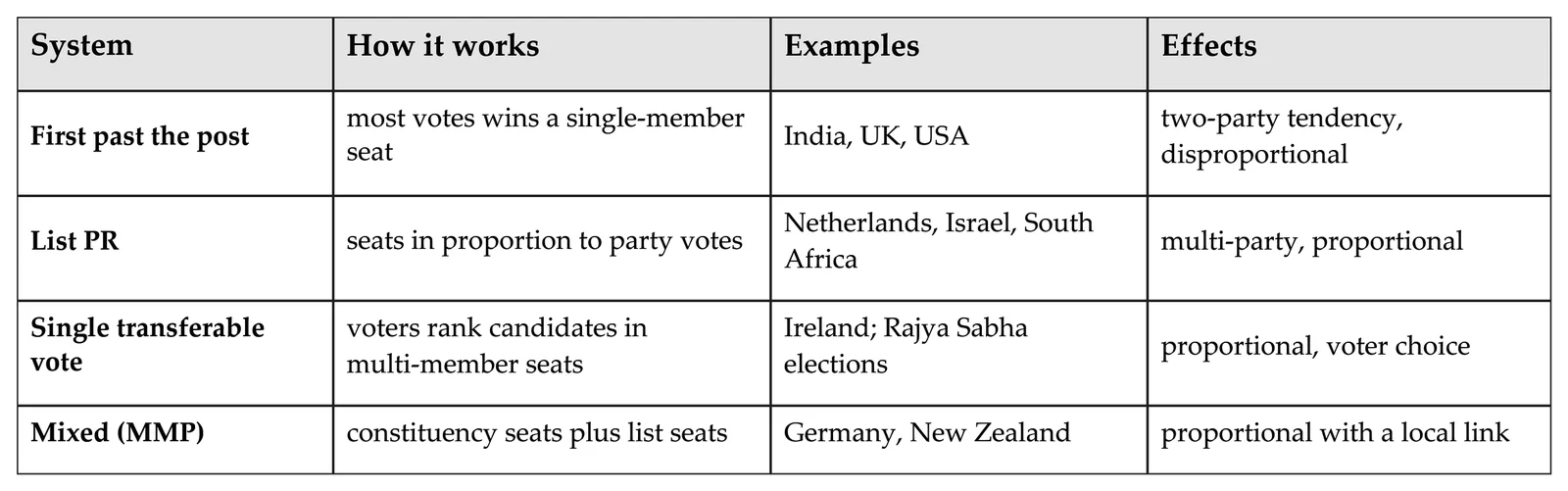
First Past the Post (FPTP), also called single-member plurality, divides the country into single-member constituencies; the candidate with the most votes wins, even without a majority. It is used for the UK House of Commons, the US House of Representatives, Canada and India’s Lok Sabha and state assemblies. Variants include the two-round system (France), in which a second round is held between leading candidates if no one wins a majority, and the alternative vote (Australian House of Representatives), in which voters rank candidates and the lowest are eliminated until one has a majority.
- Merits: simplicity; a clear link between a representative and a constituency; strong, stable single-party governments; clear accountability, since voters can remove a government; exclusion of extremist parties.
- Demerits: disproportional results, as winners gain far more seats than their vote share; ‘wasted votes’ for losing candidates; under-representation of small parties whose support is spread out; ‘manufactured majorities’; incentives for tactical voting; and in diverse societies, possible exclusion of minorities.
- Examples: in 2019 the BJP won about 37 per cent of the vote but 303 of 543 Lok Sabha seats; in the 2024 UK election Reform UK won about 14 per cent of votes but only five seats.
3.3 Proportional Representation
Proportional Representation (PR) aims to give parties a share of seats roughly equal to their share of votes. It uses multi-member constituencies. Its main forms are:
- List PR: parties present lists of candidates and win seats in proportion to their votes. In closed lists (Israel, South Africa, Spain) the party decides the order; in open lists (Finland, Brazil) voters can influence which candidates are elected. Seats are allocated by formulas such as d’Hondt or Sainte-Laguë, and thresholds exclude very small parties.
- Single Transferable Vote (STV): used in Ireland, Malta and the Australian Senate, and in India for the Rajya Sabha and the election of the President. Voters rank candidates; any candidate reaching the quota is elected, and surplus votes and votes of eliminated candidates are transferred according to preferences.
Merits: fairness and proportionality; fewer wasted votes; representation of small parties and minorities; more women elected through party lists; coalition governments that represent a majority of voters and encourage consensus. Demerits: fragmentation and many small parties; unstable coalitions; disproportionate power for small kingmaker parties; weaker link between representatives and constituents in list systems; and less clear accountability, since coalitions are formed after elections, as in Israel’s frequent elections or Italy’s many governments.
3.4 Mixed Representation
Mixed electoral systems combine a single-member district tier with a proportional list tier. In Mixed Member Proportional (MMP) systems, used in Germany and New Zealand, voters cast two votes, one for a constituency candidate and one for a party list; list seats compensate for disproportional results in the constituencies, so the overall outcome is proportional. In parallel or mixed-member majoritarian systems, used in Japan since 1994 and at times in Russia, the two tiers are counted separately, so the result is less proportional.
Robert Moser and Ethan Scheiner (2004) argue that mixed systems allow a controlled comparison: because the two tiers operate in the same country at the same time, their different effects can be isolated. They found that the single-member tier encourages two-candidate competition in established democracies with institutionalised parties, but much less so in new democracies with weak party systems, such as Russia or Ukraine, where many candidates still compete. They also note contamination effects: parties run candidates in districts to boost their list vote, so the two tiers influence each other. Electoral system effects therefore depend on context.
3.5 Effects of Electoral Systems and the Indian Debate
- Duverger’s law: plurality systems tend to produce two-party systems, through a mechanical effect (third parties win few seats) and a psychological effect (voters desert them); PR tends to produce multi-party systems. India, with many parties under FPTP, shows that regional concentration of support can override this tendency.
- Majoritarian and consensus democracy: Arend Lijphart linked FPTP to majoritarian democracy with single-party cabinets and PR to consensus democracy with coalitions and power sharing.
- Trade-offs: Downs and A. Evans show that no system maximises all values; designers must balance proportionality, accountability, government stability, local representation, simplicity and inclusion.
- Indian debate: India chose FPTP for its simplicity and familiarity, with reserved constituencies for Scheduled Castes and Tribes. Critics point to disproportional results and the election of candidates with minority support; the Law Commission’s 170th Report (1999) suggested experimenting with a partial list system. Supporters argue that FPTP has produced stable governments and that PR could encourage fragmentation along caste and religious lines.
3.6 Important Questions
- Question 1 What is an electoral system? Critically examine the First Past the Post system.
- Question 2 Explain the system of Proportional Representation. Compare it with the First Past the Post system.
- Question 3 What are mixed electoral systems? Discuss their features and effects.
- Question 4 Discuss the political consequences of electoral systems with reference to Duverger’s law.
DU asks the same idea in different words. So learn one broad answer for each question below; the same answer works for every question joined by OR.
Important Question 1
What is an electoral system? Critically examine the First Past the Post system.
OR
Discuss the merits and demerits of majoritarian electoral systems.
OR
Should India replace the First Past the Post system? Give reasons.
Model Answer
“The elections to the House of the People and to the Legislative Assembly of every State shall be on the basis of adult suffrage.”
— Article 326, Constitution of India
Introduction. An electoral system is the set of rules that converts votes cast in an election into seats won by parties and candidates. Among the many systems in use, First Past the Post is the oldest and one of the most widespread, used in the United Kingdom, the United States, Canada and India. It is praised for simplicity and stability but criticised for producing unfair and disproportional results.
1. Meaning of Electoral System
Electoral systems include rules on district magnitude, ballot structure, electoral formula and thresholds. They determine how voters express choices and how these choices are counted. Because they shape the number of parties, the type of government and the quality of representation, Giovanni Sartori called electoral systems the most specific manipulative instrument of politics.
2. Functions of Elections
Heywood identifies the functions of elections as recruiting politicians, making governments, providing representation, influencing policy, educating voters, building legitimacy and strengthening elites. Different electoral systems emphasise different functions: FPTP prioritises clear government formation and accountability, while PR prioritises representation.
3. How FPTP Works
The country is divided into single-member constituencies of roughly equal population. Voters cast one vote for a candidate, and the candidate with the largest number of votes wins, even without an absolute majority. The party winning the most constituencies usually forms the government. In India, the Lok Sabha’s 543 seats and all state assemblies are filled this way. Constituency boundaries are periodically redrawn by an independent Delimitation Commission so that constituencies have roughly similar populations, though the number of Lok Sabha seats allotted to each state has been frozen on the basis of the 1971 Census.
4. Variants of Majoritarian Systems
Other majoritarian systems require a majority rather than a plurality. The two-round or second ballot system in France holds a run-off between leading candidates. The alternative vote, used for the Australian House of Representatives, lets voters rank candidates and redistributes votes of eliminated candidates until one has more than half.
5. Merits: Simplicity and Representation
FPTP is easy for voters to understand and quick to count. It creates a clear link between each constituency and its representative, who is accountable to local voters and can take up their grievances. Independent candidates can contest and sometimes win.
6. Merits: Stable and Accountable Government
By rewarding the largest party with a bonus of seats, FPTP usually produces single-party majority governments that can implement their programmes. Voters can clearly identify who is responsible and remove a government at the next election. FPTP also tends to exclude extremist parties with scattered support.
7. Demerits: Disproportionality
FPTP often produces seat shares very different from vote shares. In 2019 the BJP won about 37 per cent of the vote but 303 of 543 Lok Sabha seats, and in the 2024 UK election Labour won about 34 per cent of votes but 411 of 650 seats, while Reform UK won about 14 per cent but only five seats. Governments can thus enjoy large majorities with minority support.
8. Demerits: Wasted Votes and Tactical Voting
Votes cast for losing candidates and surplus votes for winners are wasted, so many voters have no influence on the outcome. In multi-candidate contests a candidate can win with a small share of votes, sometimes under thirty per cent. Voters may vote tactically for a less preferred candidate to stop another, distorting their true preferences. Small shifts in votes can also produce huge swings in seats, making outcomes volatile.
9. Demerits: Minorities, Women and Small Parties
Small parties with support spread across the country are under-represented, and minorities who are not geographically concentrated may find it hard to win seats. Single-member districts also tend to elect fewer women, since parties choose the candidate they think most likely to win. India addresses some of these concerns with reserved constituencies for Scheduled Castes and Tribes and the Women’s Reservation Act, 2023.
10. The Indian Debate
The Constituent Assembly chose FPTP for its simplicity in a largely illiterate electorate. Critics argue that it exaggerates majorities and allows candidates to win with minority support, and the Law Commission’s 170th Report (1999) suggested experimenting with a partial list system. Defenders argue that FPTP has produced stable governments and encouraged parties to build broad social coalitions.
Conclusion. Thus, First Past the Post is simple, provides local representation and usually produces stable, accountable governments, but at the cost of proportionality, wasted votes and under-representation of small parties and minorities. Whether it should be reformed depends on how a society weighs stability against fairness.
Important Question 2
Explain the system of Proportional Representation. Compare it with the First Past the Post system.
OR
Discuss list PR and the single transferable vote with their merits and demerits.
OR
‘Proportional Representation produces fair but unstable governments.’ Discuss.
Model Answer
“In a really equal democracy, every or any section would be represented, not disproportionately, but proportionately.”
— John Stuart Mill, Considerations on Representative Government (1861)
Introduction. Proportional Representation is based on the principle that a legislature should mirror the distribution of votes among parties. It was developed in the nineteenth century by thinkers such as Thomas Hare and John Stuart Mill, who were concerned that majoritarian systems silenced minorities. Today most European democracies and many others use some form of PR.
1. Meaning and Principle
Under PR, parties win seats in proportion to their share of votes, so a party with thirty per cent of votes receives roughly thirty per cent of seats. PR requires multi-member constituencies, which may be regions or the whole country. The larger the district magnitude, the more proportional the outcome. Its supporters regard it as the only system that treats every vote as equal, since each vote contributes to a party’s share of seats wherever it is cast.
2. List PR
In list systems each party presents a list of candidates, and voters choose a party or, in some systems, candidates within the list. Seats are distributed by formulas such as d’Hondt, which slightly favours larger parties, or Sainte-Laguë, which is more favourable to smaller parties. Israel and the Netherlands use the whole country as a single constituency, while Spain uses provinces.
3. Closed and Open Lists
In closed lists, used in Israel, South Africa and Spain, the party fixes the order of candidates and voters cannot change it, which strengthens party control. In open lists, used in Finland and Brazil, voters can choose individual candidates, which increases voter choice but encourages competition within parties.
4. Thresholds
Many list systems set a legal threshold to prevent extreme fragmentation, such as 5 per cent in Germany or 3.25 per cent in Israel. Thresholds exclude very small parties but can also waste a substantial share of votes if many parties fall just below them.
5. Single Transferable Vote
STV, advocated by Thomas Hare and Mill, is used in Ireland, Malta and the Australian Senate, and in India for the Rajya Sabha, state legislative councils and the President’s election. Voters rank candidates in multi-member constituencies. A candidate who reaches the quota is elected, and surplus votes are transferred to the next preferences; the lowest candidates are eliminated and their votes transferred until all seats are filled. STV combines proportionality with choice among candidates.
6. Merits of PR
PR is fair, since seats reflect votes, and few votes are wasted. It allows small parties and minorities to be represented and encourages parties to nominate diverse candidates, which is why PR countries generally elect more women. Coalition governments formed under PR usually represent a majority of voters and encourage compromise and consensus.
7. Demerits of PR
Critics argue that PR leads to fragmentation, with many parties and unstable coalitions, as in Italy, which had dozens of governments after 1945, or Israel, which held five elections between 2019 and 2022. Small parties may become kingmakers with influence out of proportion to their votes. List systems weaken the link between representatives and local voters, and coalition deals made after elections reduce accountability.
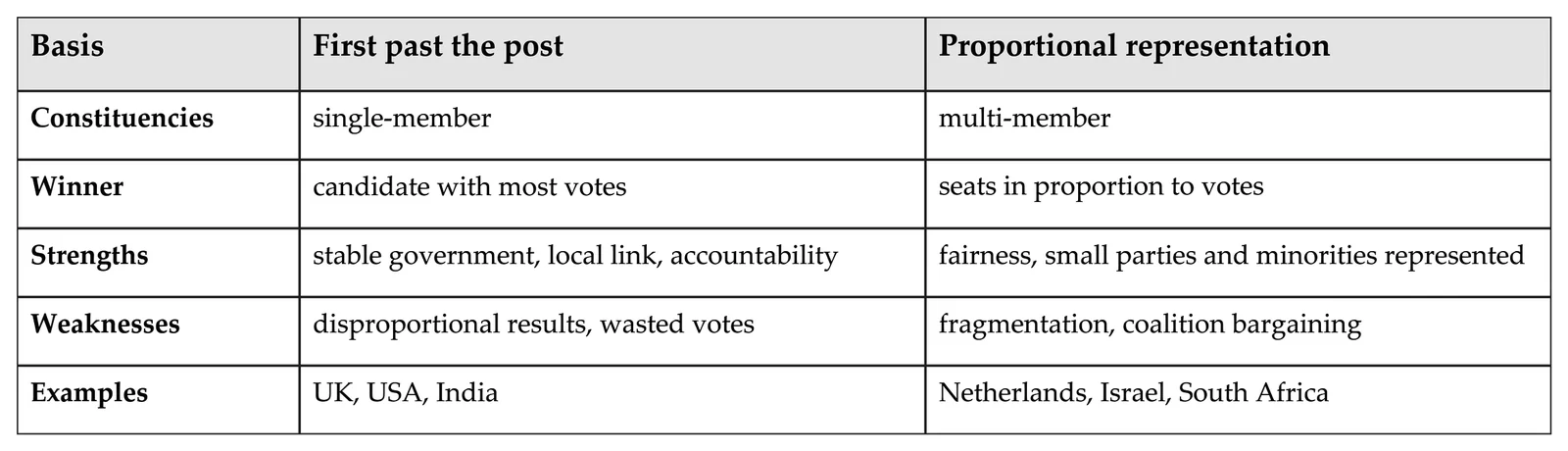
8. Comparison: Proportionality versus Stability
FPTP sacrifices proportionality for stable, accountable single-party government, while PR sacrifices some stability and clarity for fair representation. Arend Lijphart associated FPTP with majoritarian democracy and PR with consensus democracy, and found that consensus democracies perform at least as well on economic management and better on representation and equality.
9. Comparison: Representation and Accountability
FPTP gives each voter a local representative but leaves many voters unrepresented by a party they support. PR gives voters a party voice but, in list systems, weakens local ties. FPTP allows voters to remove governments directly, while PR governments are formed through bargaining among parties after the election.
10. PR in Practice
The Netherlands, with a single national constituency and a very low threshold, regularly has more than a dozen parties in parliament and long coalition negotiations. Germany and the Nordic countries, by contrast, combine PR with stable coalitions and strong parties. South Africa’s closed-list PR helped the ANC build an inclusive post-apartheid parliament, though critics say it made members more loyal to party leaders than to voters. These cases show that the effects of PR depend on thresholds, district size and political culture.
11. Choosing a System
A. Evans and W.M. Downs stress that the choice depends on a country’s social structure and political goals. Divided societies may prefer PR to include minorities, as South Africa did in 1994, while countries seeking decisive government may prefer majoritarian rules. Many countries have adopted mixed systems to combine the advantages of both.
Conclusion. Thus, Proportional Representation ensures fairness and inclusion but may produce fragmented and unstable governments, while First Past the Post produces decisive government at the cost of fairness. Each system reflects different democratic values, and the best choice depends on context.
Important Question 3
What are mixed electoral systems? Discuss their features and effects.
OR
Examine Moser and Scheiner’s analysis of mixed electoral systems.
OR
Is Mixed Member Proportional representation the best of both worlds? Discuss.
Model Answer
“The electoral system is the most fundamental element of representative democracy.”
— Arend Lijphart, Electoral Systems and Party Systems (1994)
Introduction. Since the 1990s mixed electoral systems have become increasingly popular. They combine single-member constituencies elected by plurality or majority with seats allocated by proportional representation, seeking to balance local representation and stable government with fairness. Countries such as Germany, New Zealand, Japan, Mexico and several post-communist states have adopted them.
1. Meaning
A mixed electoral system uses two different formulas in the same election to elect members of a single legislature: one tier of single-member districts and one tier of party-list PR. Voters usually cast two votes, one for a local candidate and one for a party, though some systems use a single vote counted in both tiers. Mixed systems became especially popular in the 1990s, when many new democracies and reforming countries searched for a compromise between majoritarian and proportional traditions.
2. Mixed Member Proportional
In MMP systems, the list tier compensates for disproportionality in the district tier. Seats are first allocated to parties according to their list votes; constituency winners take their seats, and list seats are added until each party’s total is proportional. Germany’s Bundestag, with a 5 per cent threshold, and New Zealand’s Parliament since 1996 are the main examples.
3. Parallel Systems
In parallel or mixed-member majoritarian systems, the two tiers are counted independently, without compensation. Japan has used such a system since 1994, combining single-member districts with regional PR lists. Because the district tier usually rewards large parties, parallel systems are less proportional than MMP.
4. Why Countries Adopt Mixed Systems
Mixed systems are often adopted as compromises during electoral reform. New Zealand moved to MMP after voters became dissatisfied with FPTP results that gave majorities to parties with minority support. Italy and Japan adopted mixed systems in the early 1990s to reduce fragmentation and corruption, and post-communist states such as Russia and Ukraine experimented with them during democratisation.
5. Advantages
Supporters see mixed systems as the best of both worlds: every voter has a local representative, while overall results, especially under MMP, are proportional. Voters can split their votes between a local candidate and a different party, and small parties can win list seats without dominating government formation.
6. Disadvantages
Critics note that mixed systems create two classes of representatives, constituency members and list members, with different roles and legitimacy. They are more complex for voters. MMP can produce overhang seats when a party wins more constituencies than its proportional share, enlarging the legislature, a problem Germany addressed through reforms. Parallel systems may still produce disproportional results. Parties may also exploit the rules, for example by creating decoy lists to win extra compensatory seats, as happened in Italy and Albania.
7. Controlled Comparison
Robert Moser and Ethan Scheiner argue that mixed systems offer a natural experiment. Since both tiers operate in the same country, with the same voters, parties and social cleavages, differences between them can be attributed to the electoral rules. This allows researchers to test theories such as Duverger’s law more precisely than cross-national comparisons.
8. Findings on Party Systems
Moser and Scheiner found that the single-member tier reduces the number of parties and encourages two-candidate competition in established democracies with institutionalised parties, such as Germany and Japan. In new democracies with weak, poorly institutionalised parties, such as Russia and Ukraine, single-member districts did not reduce fragmentation, and many independents and small parties won. Electoral rules therefore have conditional effects.
9. Contamination Effects
The two tiers influence each other. Parties nominate candidates in single-member districts even where they cannot win, because a local candidate increases their list vote, so districts in mixed systems often have more candidates than in pure FPTP systems. Voters also split tickets strategically. These contamination effects mean that mixed systems are not simply two separate systems added together.
10. Evaluation
Mixed systems have become a popular compromise, and MMP in particular combines proportionality with local representation. But their effects depend on party institutionalisation, social cleavages and the details of design, such as thresholds and compensation rules. They show that institutions shape behaviour, but always within a political context.
Conclusion. Thus, mixed electoral systems combine the local link of single-member districts with the fairness of proportional representation. Moser and Scheiner show that their effects vary with context, making them both a useful compromise and a valuable tool for comparative research.
Important Question 4
Discuss the political consequences of electoral systems with reference to Duverger’s law.
OR
How do electoral systems affect party systems, government formation and representation?
OR
‘Electoral systems are the most manipulable instrument of politics.’ Discuss.
Model Answer
“The simple-majority single-ballot system favours the two-party system.”
— Maurice Duverger, Political Parties (1951)
Introduction. Electoral systems do not merely count votes; they shape the entire political system. They influence the number of parties, the formation and stability of governments, the representation of social groups, the behaviour of voters and politicians, and even the management of conflict in divided societies. The study of these consequences, beginning with Maurice Duverger, is a central theme of comparative politics.
1. Duverger’s Law
Duverger argued that the simple-majority single-ballot system favours a two-party system, while proportional representation and two-round majority systems favour multi-party systems. The first statement is called Duverger’s law and the second Duverger’s hypothesis. Britain and the USA, with plurality rules and two dominant parties, seemed to confirm the law. Duverger presented this as close to a true sociological law, though later scholars treated it as a strong tendency rather than a fixed rule.
2. Mechanical and Psychological Effects
Duverger identified two mechanisms. The mechanical effect is that third parties with scattered support win far fewer seats than their vote share. The psychological effect is that voters, knowing this, desert small parties to avoid wasting their votes, and politicians and donors avoid them, further reducing their support.
3. Exceptions and Refinements
Duverger’s law is a tendency, not an iron rule. Canada and India have many parties despite FPTP, because parties with regionally concentrated support can win seats. Gary Cox and others argue that the law operates mainly at the constituency level, producing two main candidates in each district, while different pairs of parties may compete in different regions, as in India.
4. Effects on Government Formation
Plurality systems often manufacture single-party majorities, producing decisive governments. PR systems usually produce coalition governments, which require negotiation and compromise. Lijphart linked these patterns to majoritarian and consensus models of democracy.
5. Effects on Stability and Accountability
Majoritarian systems allow voters to identify and remove governments clearly, enhancing accountability. PR systems can produce unstable coalitions, though many, such as those in Germany and Scandinavia, have been very stable. Downs notes that stability depends also on party discipline and political culture, not only on electoral rules.
6. Effects on Representation
PR systems tend to produce legislatures that reflect the diversity of votes and society, including more women and minorities, as in the Nordic countries. FPTP systems often under-represent women and dispersed minorities, unless reserved seats or quotas are used. Rwanda’s list PR with quotas has produced one of the highest shares of women legislators in the world.

7. Effects on Parties and Candidates
Closed-list PR strengthens party leaders who control the list order, while open lists, STV and single-member districts encourage candidates to build personal followings, which may increase constituency service but also clientelism. Electoral systems also shape campaign strategies, such as targeting swing constituencies under FPTP.
8. Electoral Systems in Divided Societies
Lijphart recommended PR and power sharing for divided societies, to include all major groups. Donald Horowitz preferred systems such as the alternative vote that encourage candidates to seek votes across ethnic lines. South Africa adopted list PR in 1994 to ensure inclusion after apartheid, while India uses reserved constituencies within FPTP.
9. Manipulation and Reform
Because electoral systems shape outcomes, they are often manipulated through gerrymandering of boundaries, malapportionment and changes in rules to benefit those in power. Sartori called them the most specific manipulative instrument of politics. Reforms in New Zealand, Italy and Japan show that dissatisfaction with outcomes can lead to change, while the UK’s 2011 referendum rejected the alternative vote.
10. Effects on Voters and Turnout
Electoral systems also influence citizens’ behaviour. Comparative studies suggest that turnout tends to be somewhat higher under PR, because fewer votes are wasted and voters feel their choices count. Under FPTP, voters in safe seats may feel their vote makes little difference, and many vote tactically rather than sincerely. The type of system also shapes how voters evaluate governments, since single-party majorities are easier to reward or punish than coalitions.
11. The Indian Case
India’s FPTP system has produced both dominance by one party, the Congress system until 1967, and fragmented coalition politics after 1989, showing that social cleavages and regional parties shape outcomes as much as rules. It has given large seat bonuses to winning parties, while reserved constituencies have ensured representation of Scheduled Castes and Tribes.
Conclusion. Thus, electoral systems have profound political consequences for party systems, government formation and representation. Duverger’s law captures an important tendency, but its effects are conditioned by social structure, geography and party organisation, so electoral rules must be studied in context.
Short Notes
(a) d’Hondt method
A highest-averages formula for allocating seats in list PR systems, named after the Belgian lawyer Victor d’Hondt. Each party’s votes are divided successively by 1, 2, 3 and so on, and seats are awarded to the highest quotients. It slightly favours larger parties, and is used in Spain, Portugal and elections to the European Parliament in many countries.
(b) Wasted votes
Votes that do not contribute to electing a candidate: votes for losing candidates and, in some definitions, surplus votes for winners beyond what they needed. FPTP produces many wasted votes, which is a major criticism of it, while PR and STV minimise them.
(c) Gerrymandering
The deliberate drawing of constituency boundaries to benefit a party or group, named after Governor Elbridge Gerry of Massachusetts, who approved a salamander-shaped district in 1812. It works by packing opponents into a few districts or cracking them across many. Independent delimitation bodies, such as India’s Delimitation Commission, aim to prevent it.
More notes: MDSC-4A Comparative Government and Politics
These notes are prepared by PADHO TO AISE for study help. They are not an official University of Delhi publication.