
Generic Electives (GE) GE-6 Western Political Philosophy
Unit II · 28 min read · Updated 27 Nov 2026
As per the University of Delhi (DU) Generic Elective (GE) syllabus offered by the Department of Political Science
Contents
- 3.1 Machiavelli and His Times
- Features of Machiavelli’s Political Thought
- 3.2 Statecraft and Advice to the Prince
- 3.3 Virtù, Vice and Fortuna
- Power and the Economy of Violence
- 3.4 Political Ethics, Religion and Morality
- 3.5 Republicanism
- Interpretations of Machiavelli
- 3.6 Important Questions
- What is Machiavelli’s advice to the prince and his idea of statecraft?
- ‘Machiavelli separated politics from ethics.’ Discuss with reference to his views on political ethics, religion and morality.
- Discuss Machiavelli’s republicanism with reference to the Discourses on Livy.
- Discuss Machiavelli’s concepts of virtù and fortuna.
- Short Notes
जो राजकुमार अपनी सत्ता बनाए रखना चाहता है, उसे यह सीखना होगा कि अच्छा न होना कैसे संभव है, और आवश्यकता के अनुसार इसका उपयोग करना या न करना।
It is necessary to a prince, if he wants to maintain himself, to learn to be able not to be good, and to use this and not use it according to necessity.
— Niccolò Machiavelli, The Prince, Chapter 15 (trans. Mansfield)
NICCOLÒ Machiavelli (1469–1527) stands between the ancient and the modern worlds, which is why the syllabus calls him an interlude. A diplomat of the Florentine republic who lost his post when the Medici returned to power in 1512, he was imprisoned and tortured, and then in exile wrote The Prince (1513) and the Discourses on Livy. Italy was divided among warring states and overrun by French and Spanish armies. Machiavelli broke with the classical and Christian tradition by describing politics as it is rather than as it ought to be. This chapter studies his ideas on vice and virtue, power, political ethics, religion and morality, statecraft and republicanism.
3.1 Machiavelli and His Times
Machiavelli lived in Renaissance Florence, a city of wealth, art and humanist learning, but also of faction and instability. Italy was divided into rival states, Florence, Venice, Milan, Naples and the Papal States, and from 1494 French, Spanish and imperial armies invaded and fought over it. As a diplomat, Machiavelli observed rulers such as Cesare Borgia, the King of France and the Pope, and saw how weak and divided Italian states, relying on unreliable mercenaries, were humiliated by stronger powers.
When the Medici returned in 1512, the republic fell and Machiavelli was dismissed, accused of conspiracy, imprisoned and tortured. In retirement on his farm he wrote The Prince, dedicated to Lorenzo de’ Medici, partly to win back favour, and the Discourses on Livy, a study of the Roman republic. Quentin Skinner shows that The Prince belonged to the humanist genre of advice books for princes, but it subverted that genre by rejecting the conventional advice that princes should always be virtuous in the Christian sense.
Features of Machiavelli’s Political Thought
- Realism. In Chapter 15 of The Prince (written 1513), Machiavelli said he would follow the effectual truth of things (verità effettuale) rather than imagined republics, a break with medieval writing on the ideal ruler.
- A pessimistic view of human nature. In Chapter 17 he described people as ungrateful, fickle, deceitful, cowardly and greedy, so a ruler cannot rely on their goodness.
- Power as the central concern. Politics is about acquiring, keeping and expanding the state (lo stato); success is measured by the security and glory of the state.
- Separation of politics from Christian ethics. The ruler must be judged by political results, not by private morality; this is often described as a double standard of morality.
- Religion as a political tool. In the Discourses, he praised Roman religion for making citizens obedient and brave, and criticised the Church for keeping Italy divided.
- Patriotism and Italian unity. The last chapter of The Prince calls for a new prince to free Italy from the foreign barbarians, reflecting the invasions that began in 1494.
- Citizen armies. He preferred a militia of citizens to mercenaries, a theme developed in The Art of War (1521).
3.2 Statecraft and Advice to the Prince
The Prince is a handbook of statecraft for a new prince who must acquire and keep power. Machiavelli declared his intention to write about the effective truth of things rather than imagined republics, for how one lives is so far from how one ought to live that a prince who does what ought to be done rather than what is done brings about his own ruin. His advice can be summarised in several principles.
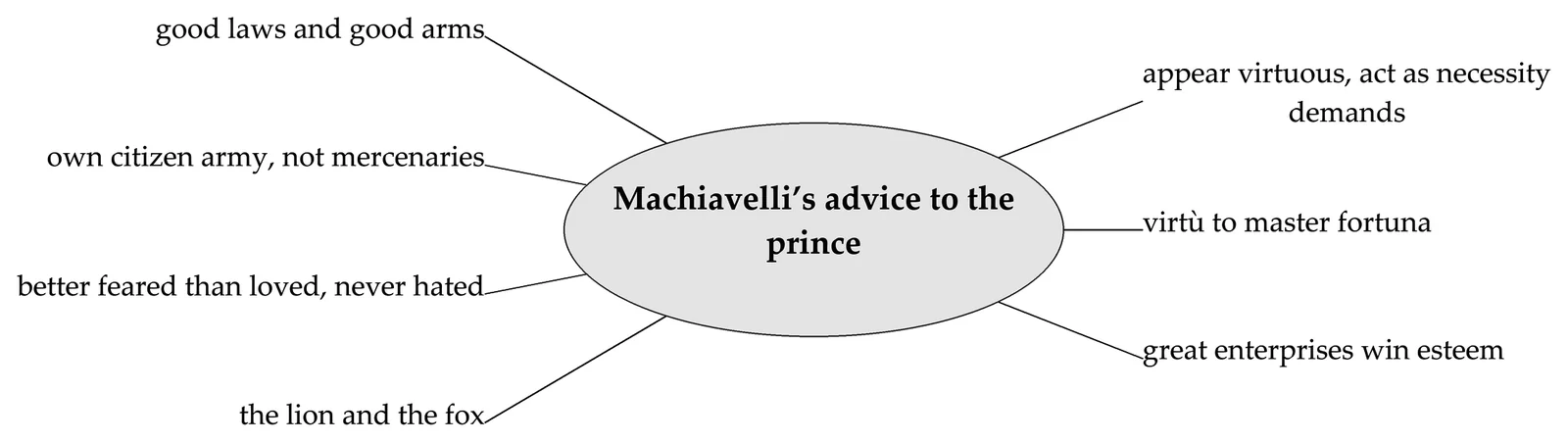
- Good laws and good arms: the foundations of all states are good laws and good arms, and there cannot be good laws without good arms (Chapter 12). Mercenaries are useless and dangerous; a prince needs his own citizen army.
- Learning not to be good: a prince must learn to be able not to be good and to use this according to necessity (Chapter 15).
- Feared rather than loved: if he cannot be both, it is safer to be feared than loved, because people are ungrateful and fickle; but he must avoid being hated, which he can do by leaving alone the property and women of his subjects (Chapter 17).
- The lion and the fox: a prince must combine the force of the lion with the cunning of the fox, and need not keep his word when it harms him (Chapter 18).
- Appearance: he should appear merciful, faithful, humane, honest and religious, for everyone sees what he appears to be, few touch what he is.
- Esteem and great enterprises: a prince wins reputation by great undertakings, decisive alliances and rewarding talent (Chapter 21).
- Liberation of Italy: the final chapter calls for a prince to unite Italy and free it from the barbarians.
3.3 Virtù, Vice and Fortuna
Virtù is Machiavelli’s key concept. It does not mean Christian virtue but the qualities that enable a ruler to maintain his state and achieve great things: energy, courage, skill, foresight and the willingness to do whatever necessity demands. Opposed to virtù is fortuna, chance or circumstance, which Machiavelli compared to a raging river that floods the plain unless dikes are built in advance. Fortune, he said, is the arbiter of perhaps half our actions, leaving the other half to us. In a notorious passage he compared fortune to a woman who yields to the bold, an image criticised by feminists such as Hanna Pitkin.

Machiavelli’s treatment of vice is equally striking. Qualities praised by moralists, such as generosity and mercy, may ruin a state, while apparent vices, such as parsimony and cruelty well used, may preserve it. He distinguished cruelty well used, applied once, swiftly and for security, from cruelty badly used, which grows over time. The test of an action is its effect on the stability and greatness of the state.
Power and the Economy of Violence
Machiavelli did not praise cruelty for its own sake. In Chapter 8 of The Prince, discussing Agathocles of Syracuse, he distinguished cruelty well used, done once, at a stroke, out of necessity and then turned to the subjects’ benefit, from cruelty badly used, which grows over time. In Chapter 7, he described how Cesare Borgia pacified the Romagna through the harsh minister Remirro de Orco and then had Remirro publicly executed, satisfying and stunning the people at once. Scholars call this Machiavelli’s economy of violence: violence should be limited, calculated and directed to establishing order, because a ruler who is too merciful allows disorder that causes greater suffering.
3.4 Political Ethics, Religion and Morality
Machiavelli is often said to have separated politics from ethics. The Italian philosopher Benedetto Croce argued that he discovered the autonomy of politics, a sphere with its own laws beyond good and evil. Isaiah Berlin, in ‘The Originality of Machiavelli’ (1972), argued instead that Machiavelli did not separate politics from morality but contrasted two moralities: the Christian ethic of humility, mercy and salvation, and the pagan or civic ethic of courage, glory and the strength of the state. Since these are incompatible, a ruler must choose, and Machiavelli chose the civic ethic. Berlin saw this as an early recognition of value pluralism.

On religion, Machiavelli valued it as a source of social cohesion, discipline and obedience. In the Discourses he praised the Roman religion, which inspired citizens to fight and keep oaths, and he urged rulers to maintain the religious foundations of the state. But he criticised Christianity as practised in his time for glorifying humble and contemplative men rather than active citizens, making the world weak, and he blamed the Church for keeping Italy divided, being too weak to unite it yet strong enough to prevent anyone else from doing so. His view of religion was thus instrumental: religion matters for its political effects.
3.5 Republicanism
In the Discourses on Livy, Machiavelli appears as a republican. He admired the Roman republic as the best model of a free state and argued that republics are more stable and successful than principalities over time, because they can draw on the varied talents of many citizens. Rome had a mixed constitution of consuls, Senate and tribunes. Strikingly, he argued that the conflicts between the nobles and the plebs, far from being harmful, produced laws favourable to liberty.

Machiavelli believed that the people are better guardians of liberty than the nobles, since the nobles wish to dominate while the people only wish not to be dominated, and that a people is wiser and more constant than a prince. A free republic depends on civic virtue, citizens’ willingness to put the common good before private interest, on a citizen militia and on good laws. Republics decline through corruption and must periodically return to their first principles. Skinner and J.G.A. Pocock see Machiavelli as a key figure in the tradition of civic republicanism, which influenced the English and American revolutions.
Interpretations of Machiavelli
- Teacher of evil. Leo Strauss, in Thoughts on Machiavelli (1958), called him a teacher of evil who deliberately broke with classical and Christian morality.
- A pluralist. Isaiah Berlin, in The Originality of Machiavelli (1972), argued that Machiavelli recognised two incompatible moralities, pagan civic virtue and Christian humility, and chose the former, revealing a pluralism of values.
- A republican humanist. Quentin Skinner, in Machiavelli (1981), placed him in the Renaissance humanist tradition and stressed his republicanism in the Discourses.
- A satirist of tyranny. Rousseau, in The Social Contract (1762), claimed that The Prince was really a book for republicans, exposing the methods of princes.
- The modern Prince. Antonio Gramsci, in his prison notebooks, saw the revolutionary party as a modern Prince that could unite and lead the people.
- Critics. Frederick the Great of Prussia wrote an Anti-Machiavel (1740), and the adjective Machiavellian came to mean cunning and unscrupulous.
3.6 Important Questions
- Question 1 What is Machiavelli’s advice to the prince and his idea of statecraft?
- Question 2 ‘Machiavelli separated politics from ethics.’ Discuss with reference to his views on political ethics, religion and morality.
- Question 3 Discuss Machiavelli’s republicanism with reference to the Discourses on Livy.
- Question 4 Discuss Machiavelli’s concepts of virtù and fortuna.
DU asks the same idea in different words. So learn one broad answer for each question below; the same answer works for every question joined by OR.
Important Question 1
What is Machiavelli’s advice to the prince and his idea of statecraft?
OR
Examine Machiavelli’s concepts of virtù and fortuna.
OR
‘It is better to be feared than loved.’ Discuss with reference to Machiavelli’s The Prince.
Model Answer
“Since a prince is compelled of necessity to know well how to use the beast, he should pick the fox and the lion, because the lion does not defend itself from snares and the fox does not defend itself from wolves.”
— Niccolò Machiavelli, The Prince, Chapter 18 (trans. Mansfield)
Introduction. The Prince, written by Niccolò Machiavelli in 1513 after he lost his post in the Florentine republic, is the most famous work of advice to rulers ever written. Italy was divided, invaded by foreign armies and ruled by weak princes relying on mercenaries. Machiavelli offered a new prince practical lessons on how to acquire, keep and expand power, based on the effective truth of politics rather than moral ideals.
1. Context of The Prince
Machiavelli had served the Florentine republic as a diplomat and seen Cesare Borgia, the French king and the Pope in action. The return of the Medici in 1512 ended his career. The Prince, dedicated to Lorenzo de’ Medici, was partly an attempt to regain favour and partly a call for a strong ruler to unite Italy against the barbarians.
2. A New Approach
Machiavelli declared that he would follow the effective truth of things rather than imagined republics and principalities. Since men are not good, a prince who always acts virtuously among so many who are not will come to ruin. This realism broke with the classical and medieval tradition of advising princes to be just, merciful and pious.
3. Types of Principalities
Machiavelli distinguished hereditary principalities, which are easy to keep, from new principalities, which are hard to hold. New princes acquire power by their own arms and virtù, by fortune and the arms of others, by crime, or by the favour of their fellow citizens. He praised founders such as Moses and Romulus, and noted that armed prophets succeed while unarmed prophets, like Savonarola, fail.
4. Good Laws and Good Arms
The foundations of all states are good laws and good arms, and since there cannot be good laws without good arms, the prince must focus on military power. Mercenaries are disunited, ambitious and disloyal; auxiliaries belonging to another ruler are even more dangerous. A prince should rely on his own citizen army and make war his main study.
5. Learning Not to Be Good
Machiavelli argued that a prince must learn to be able not to be good and to use or not use this ability according to necessity. Some qualities that seem virtuous would ruin him, while others that seem vices bring security and prosperity. Generosity, for example, exhausts the treasury and forces heavy taxes, while parsimony allows the prince to defend the state without burdening the people.
6. Feared or Loved
Machiavelli asked whether it is better to be loved or feared and answered that it is safer to be feared, if one cannot be both. People are ungrateful, fickle and self-interested; love is maintained by obligation, which they break when it suits them, while fear is maintained by the dread of punishment. But the prince must avoid hatred, which comes from seizing his subjects’ property and women.
7. The Lion and the Fox
A prince must know how to fight both by law, which is proper to man, and by force, which is proper to beasts. He should imitate the lion, which frightens wolves, and the fox, which recognises snares. A prudent ruler need not keep his word when doing so would harm him and the reasons for his promise no longer exist, since men are not good and would not keep their word to him.
8. Appearance and Reality
A prince need not have all the conventional virtues but must appear to have them: to seem merciful, faithful, humane, honest and religious. The masses judge by appearances and results, and everyone sees what the prince appears to be, while few know what he really is. What matters is that he conquers and maintains the state; the means will then be judged honourable.
9. Virtù and Fortuna
Success depends on the interplay of virtù and fortuna. Fortune controls about half of our actions, like a flooding river, but a prince with virtù can build dikes in advance. Virtù means energy, boldness, skill and adaptability. Since times change, a prince must adapt his conduct to circumstances, though few can change their nature.
10. Reputation and Esteem
A prince gains esteem by great enterprises, as Ferdinand of Aragon did, by taking clear sides in conflicts rather than remaining neutral, by honouring talent and by encouraging citizens to pursue their trades in security. He should avoid flatterers and choose wise ministers who give honest advice only when asked.
11. The Exhortation to Italy
The final chapter urges a prince to seize the opportunity to liberate Italy from foreign domination, quoting Petrarch on the ancient valour of Italians. This patriotic call suggests that Machiavelli’s ruthless advice served a larger goal: a strong, united and independent Italy.
12. Evaluation
Machiavelli’s advice has been condemned as immoral, giving rise to the term Machiavellian for cunning and unscrupulous conduct. Others see him as the founder of modern political science, who described power realistically, or as a patriot and republican writing for a desperate situation. His statecraft remains relevant to discussions of leadership, power and the ethics of political action.
Conclusion. Thus, Machiavelli advised the prince to rely on good arms, learn when not to be good, prefer fear to love while avoiding hatred, combine the lion and the fox, manage appearances and use virtù to master fortune. His statecraft placed the security and greatness of the state above conventional morality.
Important Question 2
‘Machiavelli separated politics from ethics.’ Discuss with reference to his views on political ethics, religion and morality.
OR
Is Machiavelli the father of modern political science? Give reasons.
OR
Examine Isaiah Berlin’s interpretation of the originality of Machiavelli.
Model Answer
“How one lives is so far from how one should live that he who lets go of what is done for what should be done learns his ruin rather than his preservation.”
— Niccolò Machiavelli, The Prince, Chapter 15 (trans. Mansfield)
Introduction. Machiavelli’s name has become a byword for cunning and immorality in politics. Many interpreters have argued that he separated politics from ethics, treating political action as governed by its own logic of power rather than by moral rules. Others argue that he did not abandon morality but replaced Christian morality with a civic, pagan morality. His views on religion further show how he judged beliefs by their political effects.
1. The Classical and Christian Tradition
Before Machiavelli, political thought from Plato and Aristotle to Aquinas held that politics is part of ethics: the ruler should be just and virtuous, and the purpose of the state is the good life or salvation. Humanist advice books urged princes to cultivate the cardinal and Christian virtues, believing that virtue and success go together.
2. Machiavelli’s Realism
Machiavelli broke with this tradition by insisting on the effective truth of politics. He observed that a ruler who always acts virtuously among bad men will be ruined. Politics must therefore be studied as it is, based on experience and history, rather than as moralists imagine it should be.
3. The Necessity of Vice
Machiavelli argued that a prince must learn not to be good when necessity demands. He may need to break promises, use cruelty, deceive and kill to preserve the state. He distinguished cruelty well used, applied once for security and then turned to the subjects’ benefit, from cruelty badly used, which increases over time.
4. Ends and Means
In judging princes, Machiavelli said, people look to the end: if a prince succeeds in conquering and maintaining the state, his means will always be judged honourable. This has been popularly summarised as the end justifies the means. For Machiavelli, the end was the security, stability and greatness of the state.
5. Croce and the Autonomy of Politics
Benedetto Croce argued that Machiavelli discovered the autonomy of politics: politics is a distinct sphere with its own laws, beyond conventional good and evil. On this view, Machiavelli is the founder of modern political science, studying power scientifically and without moral illusions, as later realists did.
6. Berlin’s Two Moralities
Isaiah Berlin argued that Machiavelli did not separate politics from morality. Rather, he contrasted two incompatible moral systems: the Christian ethic of humility, mercy and otherworldly salvation, and the pagan or civic ethic of courage, vigour, public spirit and glory, the morality of Pericles and the Roman republic. Machiavelli preferred the civic ethic as the basis of strong states.
7. Value Pluralism
For Berlin, Machiavelli’s originality lay in showing that there can be more than one valid system of values and that they may be incompatible, so choices between them are unavoidable and tragic. This undermined the classical and Christian belief in a single harmonious moral order and opened the way to modern pluralism and liberalism.
8. Religion as a Political Instrument
Machiavelli valued religion for its political effects. In the Discourses he praised the religion of ancient Rome, which made citizens obedient, disciplined and willing to fight, and he advised rulers to maintain religious foundations even if they did not believe in them. Religion is a tool of social cohesion and civic virtue.
9. Critique of Christianity and the Church
Machiavelli criticised Christianity as interpreted in his time for glorifying humble and contemplative men and placing the highest good in humility and contempt for worldly things, which made people weak and easy prey for the wicked. He blamed the Church for keeping Italy divided and for setting a bad example through the corruption of the papal court.
10. Skinner’s Interpretation
Quentin Skinner shows that Machiavelli used the humanist vocabulary of virtue but transformed its meaning. For humanists, virtù meant the moral virtues; for Machiavelli it meant whatever qualities a prince needs to maintain his state and win glory, including the willingness to act immorally when necessary.
11. Machiavelli and Modern Political Science
Machiavelli is often called the first modern political thinker because he based his analysis on observation and history, treated the state as a secular entity, focused on power and its acquisition, and freed politics from theology. His realism influenced later thinkers such as Hobbes and modern realist theories of international relations.
12. Evaluation
Whether Machiavelli separated politics from ethics depends on how ethics is understood. He rejected Christian and conventional morality in politics but held a civic morality centred on the common good and the state. His work raises the enduring problem of dirty hands: whether leaders must sometimes do wrong to achieve important public goods.
Conclusion. Thus, Machiavelli broke with the classical and Christian union of politics and morality by insisting on the effective truth of politics and the necessity of vice. Whether seen as discovering the autonomy of politics, as Croce argued, or as choosing civic over Christian morality, as Berlin argued, he transformed political ethics and treated religion as an instrument of the state.
Important Question 3
Discuss Machiavelli’s republicanism with reference to the Discourses on Livy.
OR
How can The Prince and the Discourses be reconciled?
OR
‘The people are better guardians of liberty than the nobles.’ Discuss with reference to Machiavelli.
Model Answer
“Not without cause is the voice of a people likened to that of God.”
— Niccolò Machiavelli, Discourses on Livy, Book I, Chapter 58 (trans. Mansfield and Tarcov)
Introduction. Machiavelli is often remembered only as the author of The Prince, but his longer work, the Discourses on the First Ten Books of Titus Livy, presents him as a passionate republican. Writing at the same time as The Prince, he analysed the history of the Roman republic to discover how free states are founded, preserved and corrupted. Modern scholars see him as a central figure in the tradition of civic republicanism.
1. The Discourses
The Discourses comment on the history of early Rome written by Livy. Machiavelli wished to revive the political wisdom of the ancients, arguing that people admire ancient art and medicine but fail to imitate ancient political virtue. The work covers the founding of states, their internal organisation, expansion and the conduct of leaders.
2. Republics and Principalities
Machiavelli argued that republics are superior to principalities over the long term. A republic can adapt to changing circumstances because it has many citizens of different temperaments, while a prince has only one nature. Republics achieve greater prosperity and power because citizens work for a common good that they share.
3. The Mixed Constitution
Following Polybius, Machiavelli argued that the simple forms of government, monarchy, aristocracy and democracy, tend to degenerate, so the best constitution combines them. Rome had consuls with monarchic power, a Senate representing the nobles and tribunes representing the people, which made it stable and free.
4. The Value of Conflict
Machiavelli made the bold claim that the tumults between the nobles and the plebs were the first cause of Roman liberty. The conflicts produced laws and institutions, such as the tribunes, that protected freedom. Unlike most thinkers, who saw faction as destructive, he saw regulated conflict as a source of vitality.
5. The People as Guardians of Liberty
The nobles have a great desire to dominate, while the people only desire not to be dominated. Therefore the people are better guardians of liberty. Machiavelli also argued that a people is wiser and more constant than a prince, and that the voice of a people is likened to the voice of God.
6. Civic Virtue
A free republic depends on the civic virtue of its citizens: their willingness to put the common good above private interest, to fight for the state and to obey good laws. Religion, education and good laws cultivate civic virtue, and great leaders set examples of it.
7. Citizen Army
As in The Prince, Machiavelli insisted on a citizen army. Rome’s strength lay in citizens who fought for their own republic, unlike the mercenaries of Italian states. Military service was a school of civic virtue and a defence of liberty.
8. Corruption and Renewal
Republics decline through corruption, when citizens prefer private interest and luxury to the common good. Machiavelli argued that republics must periodically return to their first principles, renewing their founding virtue through good laws or the example of virtuous citizens, often after a crisis.
9. Expansion
Machiavelli admired Rome for expanding its power by including allies and granting citizenship, unlike Sparta and Venice, which remained small and fragile. He believed that republics must be prepared to expand to survive in a hostile world.
10. Reconciling The Prince and the Discourses
Scholars debate how the two works relate. Some see The Prince as advice for founding or restoring a state in crisis, when a single ruler is needed, and the Discourses as an account of how a free state is maintained. Others suggest The Prince was a pragmatic bid for employment, while the Discourses express his real republican convictions. Both share a realist method and a commitment to the strength of the state.
11. The Republican Tradition
Quentin Skinner and J.G.A. Pocock place Machiavelli in the tradition of civic republicanism, which values liberty as freedom from domination, active citizenship and civic virtue. In The Machiavellian Moment (1975), Pocock traced how these ideas influenced English republicans and the American founders.
12. Machiavelli and the Republican Tradition
J.G.A. Pocock, in The Machiavellian Moment (1975), showed how Machiavelli’s ideas of civic virtue, citizen armies and the dangers of corruption passed through English republicans such as James Harrington to the founders of the American republic, making him a key figure in the Atlantic republican tradition.
13. Evaluation
Machiavelli’s republicanism shows that he was not merely an adviser to tyrants but a thinker who valued liberty and popular participation. His positive view of conflict and his trust in the people anticipate democratic thought, though his emphasis on expansion and military power reflects the dangerous world of his time.
Conclusion. Thus, in the Discourses Machiavelli defended the republic as the best form of government, based on a mixed constitution, regulated conflict, civic virtue and a citizen army, with the people as the best guardians of liberty. Read together with The Prince, it reveals a thinker devoted to the freedom and strength of the state.
Important Question 4
Discuss Machiavelli’s concepts of virtù and fortuna.
OR
What role does fortune play in politics according to Machiavelli?
OR
Examine the relationship between virtù and fortuna in The Prince.
Model Answer
“Fortune is arbiter of half of our actions, but also that she leaves the other half, or close to it, for us to govern.”
— Niccolò Machiavelli, The Prince (1513), Chapter 25 (trans. Mansfield)
Introduction. Virtù and fortuna are two key concepts in Machiavelli’s political thought. Fortuna is the power of chance and circumstance, while virtù is the human capacity to shape events through boldness, foresight and skill. Machiavelli argued that fortune governs half of human affairs but leaves the other half to human action, so political success depends on the interplay between the two.
1. Meaning of Virtù
Virtù, for Machiavelli, is not Christian virtue but the qualities that enable a ruler to achieve great things: energy, boldness, decisiveness, foresight, practical intelligence and the willingness to do whatever necessity requires. It is the capacity to shape events rather than be shaped by them.
2. Meaning of Fortuna
Fortuna is chance or luck, the unpredictable force of circumstances that can raise or ruin rulers. Machiavelli drew on the Roman image of Fortuna as a goddess who rewards the bold and punishes the timid.
3. Half Our Actions
In Chapter 25 of The Prince, Machiavelli argued that fortune governs about half of human actions but leaves the other half for us to govern. Human beings are not helpless before fate; virtù can prepare for and resist fortune.
4. The River Image
He compared fortune to a violent river that floods the plains in times of storm. Wise rulers build dykes and embankments in calm times, so that when floods come, the damage is limited. Virtù means preparing institutions in advance.
5. Adapting to the Times
Machiavelli argued that rulers succeed when their methods suit the times and fail when times change and they do not adapt. Since people rarely change their nature, success depends on matching one’s character to circumstances.
6. Fortune as a Woman
In a famous and now criticised image, he wrote that fortune is a woman who favours the young and bold rather than the cautious, meaning that impetuous action often succeeds better than hesitation.
7. Cesare Borgia
In Chapter 7, Machiavelli praised Cesare Borgia for showing great virtù in building a state in the Romagna through decisive and sometimes cruel action, though he was ultimately ruined by bad fortune when his father, Pope Alexander VI, died.
8. Agathocles
In Chapter 8, he discussed Agathocles of Syracuse, who rose to power through crime. Machiavelli said that his deeds could not be called virtù, since cruelty and betrayal win power but not glory, showing that virtù is not mere wickedness.
9. Virtù and Necessity
Virtù includes the ability to recognise necessity and to act on it, even against conventional morality. A prince must learn how not to be good and use this according to necessity, combining the force of the lion with the cunning of the fox.
10. Virtù of Founders
Machiavelli most admired founders of states, such as Moses, Cyrus, Romulus and Theseus, whose virtù allowed them to make the most of the opportunity that fortune provided and to establish lasting new orders.
11. Virtù in Republics
In the Discourses on Livy, virtù belongs not only to individuals but also to citizens and institutions. A republic with good laws, arms and civic virtue can adapt better to changing fortune than a single prince.
12. Virtù and Italy
In the final chapter of The Prince, Machiavelli called for a prince with virtù to seize the opportunity offered by Italy’s misfortunes and liberate it from foreign barbarians, linking virtù with patriotism.
13. Interpretations
Scholars such as Quentin Skinner place virtù in the Renaissance humanist tradition of the vir virtutis, the man of true manliness, while Hanna Pitkin, in Fortune Is a Woman (1984), examined its gendered imagery critically.
14. Virtù and Political Leadership
Machiavelli’s idea of virtù has influenced later thinking about leadership. Max Weber’s ideal of a politician who combines passion, responsibility and a sense of proportion echoes the Machiavellian view that leaders must judge circumstances and act decisively, accepting responsibility for consequences rather than relying on good intentions alone.
15. Evaluation
The idea of virtù and fortuna expresses Machiavelli’s belief that human beings can shape their political destiny through energy, foresight and adaptability, while recognising the limits that chance places on all action.
Conclusion. Thus, Machiavelli saw politics as a struggle between virtù and fortuna. Fortune controls half of our actions, but rulers with virtù, energy, foresight, adaptability and the willingness to act on necessity, can prepare for and master it, as founders of states have done. This idea gave political action a new, human-centred dignity in Renaissance thought.
Short Notes
(a) Virtù
Machiavelli’s key concept, meaning the qualities that enable a ruler or a people to maintain the state and achieve greatness: energy, courage, skill, foresight, boldness and the ability to adapt to circumstances, including the willingness to act immorally when necessary. It differs from Christian virtue and is opposed to fortuna, which virtù seeks to master, like dikes built against a flooding river.
(b) Fortuna
Chance or circumstance, which Machiavelli said controls about half of human actions. He compared it to a violent river that can be restrained by dikes built in calm times, and controversially to a woman who yields to the bold. A wise prince prepares for changes of fortune and adapts his conduct, though few can change their nature.
(c) Cesare Borgia
Son of Pope Alexander VI and a ruler in central Italy, whom Machiavelli observed as a diplomat and presented in The Prince as a model of a new prince who acquired power by fortune and the arms of others and tried to secure it by virtù, including ruthless acts such as the execution of his harsh governor Remirro de Orco. He failed only because of his father’s death and his own illness.
More notes: GE-6 Western Political Philosophy
These notes are prepared by PADHO TO AISE for study help. They are not an official publication.