
Semester VII MDSE-6 Themes in Comparative Political Theory
Unit I · 18 min read · Updated 24 Nov 2026
As per the University of Delhi (DU) BA (Hons) Political Science syllabus
Contents
- 1.1 Features of Indian Political Thought
- 1.2 Features of Western Political Thought
- 1.3 Comparative Political Theory
- 1.4 Important Questions
- Discuss the distinctive features of Indian political thought.
- Discuss the distinctive features of Western political thought.
- What is comparative political theory? Why is it important?
- Discuss the nature and study of modern Indian political thought.
- Short Notes
मैं चाहता हूँ कि सभी देशों की संस्कृतियों की हवा मेरे घर में यथासंभव स्वतंत्र रूप से बहे, पर मैं उनमें से किसी के झोंके से उड़ जाने से इनकार करता हूँ।
I want the cultures of all the lands to be blown about my house as freely as possible. But I refuse to be blown off my feet by any.
— M.K. Gandhi, Young India (1 June 1921)
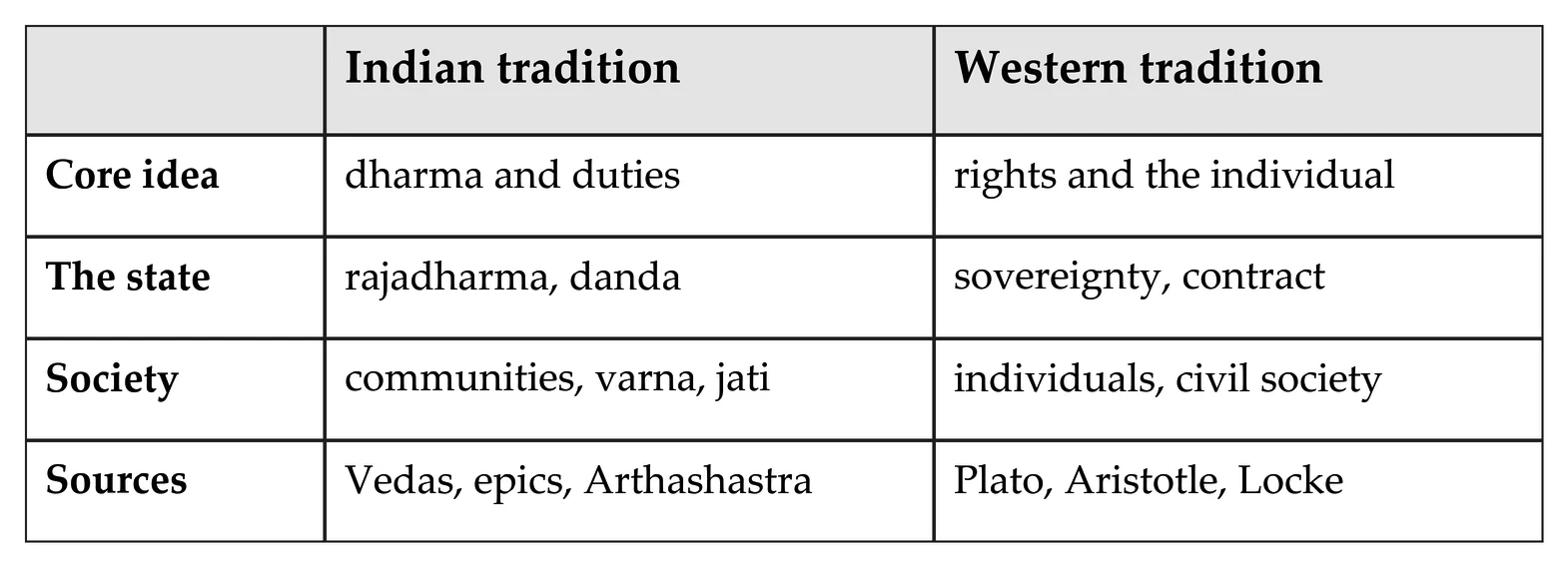
POLITICAL thought has developed in many civilisations, each asking how people should live together, who should rule and what makes power legitimate. The Indian tradition, from the Vedas and the Arthashastra to Gandhi and Ambedkar, centred on dharma, duties and the welfare of the people. The Western tradition, from Plato and Aristotle to Locke and Mill, centred on the polis, citizenship, rights and the limits of the state. Comparative political theory studies these traditions together, not to rank them but to learn from their dialogue. This chapter draws on Fred Dallmayr, Anthony Parel, Thomas Pantham, Tony Burns on Aristotle and Jeremy Waldron on Locke.
1.1 Features of Indian Political Thought
Indian political thought draws on the Vedas, the Dharmashastras, the epics, the Arthashastra and Buddhist and Jain texts. Its central idea is dharma, the moral order that assigns duties to rulers and subjects. The king’s duty, rajadharma, was to protect the people and uphold dharma through danda, punishment. Politics was seen as part of a wider vision of life, alongside wealth, pleasure and liberation. Anthony Parel argues that Indian thought must be studied in its own terms, as Indian political thought, not merely as political ideas that happened to arise in India.
1.2 Features of Western Political Thought
Western political thought began in the Greek polis. Aristotle, as Tony Burns explains, saw the city as natural and aimed at the good life, and classified constitutions by who rules and in whose interest. Later, Roman law, Christian thought and the Renaissance shaped the tradition, and from the seventeenth century, social contract thinkers such as John Locke grounded government in consent and natural rights. Jeremy Waldron shows that Locke’s politics rests on the basic equality of all human beings.
1.3 Comparative Political Theory
Comparative political theory studies political ideas across cultures. Fred Dallmayr argues that it is good for overcoming Eurocentrism and promoting dialogue, in which each tradition learns from the other. Thomas Pantham shows that modern Indian political thought emerged from the encounter with colonial modernity, combining reinterpretation of tradition with critical engagement with Western ideas.

1.4 Important Questions
- Question 1 Discuss the distinctive features of Indian political thought.
- Question 2 Discuss the distinctive features of Western political thought.
- Question 3 What is comparative political theory? Why is it important?
- Question 4 Discuss the nature and study of modern Indian political thought.
DU asks the same idea in different words. So learn one broad answer for each question below; the same answer works for every question joined by OR.
Important Question 1
Discuss the distinctive features of Indian political thought.
OR
Examine Anthony Parel’s argument about the study of Indian political thought.
OR
How does Indian political thought differ from Western political thought?
Model Answer
“Justice, being violated, destroys; justice, being preserved, preserves.”
— Manusmriti 8.15 (trans. G. Bühler)
Introduction. India has a long tradition of political reflection, found in the Vedas, the epics, the law books, the Arthashastra and Buddhist and Jain texts. This tradition developed its own concepts and concerns, which differ in important ways from Western political thought. Anthony Parel argues that it should be studied as a distinct tradition with its own categories rather than through Western lenses alone.
1. Sources
Indian political ideas are found in the Vedas and Upanishads, the Dharmashastras such as the Manusmriti, the Shanti Parva of the Mahabharata, Kautilya’s Arthashastra, Buddhist texts such as the Digha Nikaya and Jain writings, as well as in inscriptions such as Ashoka’s edicts.
2. Dharma
The central concept is dharma, the moral and social order that sustains the world. Rulers and subjects alike are bound by dharma, which defines their duties according to their position and stage of life.
3. Rajadharma and Danda
The ruler’s duty, rajadharma, is to protect the people, uphold dharma and promote welfare. Danda, the power of punishment, is the instrument of order, without which the strong would devour the weak, the condition called matsya nyaya.
4. Duties rather than Rights
Indian thought emphasises duties rather than individual rights. The well-being of subjects is secured through the duties of the king and of each social group, rather than through rights claimed against the state.
5. A Holistic View
Politics is part of a wider vision of human life organised around the four goals, dharma, artha, kama and moksha. Political power serves these goals and is subordinate to dharma.
6. The Organic State
Kautilya’s saptanga theory describes the state as an organism with seven limbs: ruler, ministers, territory, fort, treasury, army and ally. Each must be healthy for the state to flourish.
7. Realism
Alongside its ethical concerns, Indian thought contains a strong realist strand. Kautilya’s Arthashastra analyses power, diplomacy, espionage and war with great practical detail, treating artha, material and political success, as a central goal.
8. Plurality and Debate
Indian thought is plural, including Brahmanical, Buddhist, Jain and materialist traditions that debated kingship, equality and the basis of authority. The Buddhist Aggañña Sutta, for example, describes the first ruler as chosen by the people.
9. Society and the State
In Indian thought, society, organised through families, castes, guilds and villages with their own customs, was largely self-regulating, and the state’s role was to protect this order rather than create it.
10. Hierarchy
Much classical Indian political thought accepted the hierarchy of varna and the subordination of women, which reformers from the Buddha to Ambedkar challenged.
11. Parel: Indian Political Thought
Anthony Parel argues for moving from political thought in India to Indian political thought: recognising that Indian thinkers developed distinct concepts, such as the autonomy of artha and the framework of the purusharthas, which should be studied on their own terms.
12. Modern Indian Thought
Modern Indian thinkers, from Ram Mohan Roy to Gandhi, Nehru, Ambedkar and Lohia, reinterpreted tradition in dialogue with Western ideas of liberty, equality and nationalism, as Thomas Pantham shows.
13. Colonial Misreadings
Colonial scholars often claimed that India lacked political thought and was otherworldly. The rediscovery of the Arthashastra and the work of Indian scholars disproved this view.
14. Ashoka’s Dhamma
Ashoka’s edicts, inscribed on rocks and pillars across the subcontinent in the third century BCE, show another side of Indian political thought. After the Kalinga war, Ashoka promoted dhamma, a moral code of non-violence, tolerance of all sects, respect for elders and care for the welfare of people and animals, presenting the ruler as a moral guide rather than only a wielder of force.
15. Evaluation
Indian political thought offers a distinctive vision centred on dharma, duties, welfare and an organic view of society, with both ethical and realist strands, alongside hierarchies that modern thinkers questioned.
Conclusion. Thus, Indian political thought centres on dharma, rajadharma and danda, emphasises duties over rights and places politics within a holistic view of life, while also including Kautilya’s realism and plural debates. As Parel argues, it should be studied as a distinct tradition with its own concepts.
Important Question 2
Discuss the distinctive features of Western political thought.
OR
Examine the contributions of Aristotle and Locke to Western political thought.
OR
Compare the Western idea of the state with the Indian idea of rajadharma.
Model Answer
“Man is by nature a political animal.”
— Aristotle, Politics
Introduction. Western political thought developed over two and a half thousand years, from ancient Greece through Rome, medieval Christianity, the Renaissance and the modern era. It has centred on questions of citizenship, justice, the best form of government, the basis of political obligation and the rights of individuals. Aristotle and Locke represent two of its most influential moments.
1. The Greek Polis
Western political thought began in the Greek city-state, the polis, a small self-governing community in which citizens participated directly in public affairs. Politics was seen as the highest form of collective life.
2. Aristotle: The Political Animal
Aristotle argued that man is by nature a political animal, who can achieve the good life only within the polis. Tony Burns explains that Aristotle’s politics is teleological: the city exists not merely for life but for the good life.
3. Aristotle’s Classification
Studying 158 constitutions, Aristotle classified governments by the number of rulers and whether they ruled for the common good: monarchy, aristocracy and polity were good forms, while tyranny, oligarchy and democracy were their corruptions. He favoured a mixed constitution, the polity.
4. Rome and Law
Roman thinkers such as Cicero developed ideas of natural law and the republic, and Roman law shaped Western ideas of legal order, property and citizenship.
5. Christianity and the Two Powers
Medieval Christian thinkers, such as Augustine and Aquinas, distinguished spiritual and temporal authority, the church and the state, and debated their relationship, a distinction that later shaped ideas of secularism.
6. Machiavelli and Realism
In the Renaissance, Machiavelli separated politics from conventional morality, studying how power is actually gained and kept, which marked a turn towards realism in Western thought.
7. Sovereignty
Jean Bodin (1576) and Thomas Hobbes (1651) developed the idea of sovereignty, the supreme and undivided authority of the state, which became central to the modern state system.
8. Social Contract
Hobbes, Locke and Rousseau explained political authority through a social contract among free and equal individuals in a state of nature, grounding government in consent rather than divine right or tradition.
9. Locke
John Locke argued that individuals have natural rights to life, liberty and property, that government exists by their consent to protect these rights, and that people may resist a government that violates them.
10. Waldron on Locke
Jeremy Waldron shows that Locke’s politics rests on a principle of basic equality: all human beings, as creatures of God with the capacity for reason, are equal, and no one is naturally subordinate to another.
11. Rights and Liberalism
Western thought developed liberalism, with its emphasis on individual rights, limited government, the rule of law and toleration, which shaped modern constitutions.
12. Critical Traditions
Western thought also produced critiques of liberal capitalism, such as Marxism, socialism, feminism and post-colonial theory, showing its internal diversity.
13. Universalism and Its Critics
Western political thought often presents its concepts as universal. Critics argue that this universalism has sometimes ignored other traditions and justified colonial domination.
14. The Enlightenment
In the eighteenth century, the Enlightenment placed reason, science and individual autonomy at the centre of political thought. Kant urged people to dare to use their own understanding, and thinkers such as Montesquieu and Rousseau proposed new principles of government. Enlightenment ideas of progress, secularism and universal rights shaped the American and French revolutions and modern liberal democracy.
15. Evaluation
Western political thought, from Aristotle to Locke and beyond, centres on citizenship, constitutions, consent and rights, giving the modern world many of its key political ideas.
Conclusion. Thus, Western political thought began with the Greek polis and Aristotle’s view of man as a political animal, developed through Roman law, Christianity and Machiavelli, and found its modern form in social contract theory and Locke’s idea of natural rights and equality, as Burns and Waldron explain.
Important Question 3
What is comparative political theory? Why is it important?
OR
Discuss Fred Dallmayr’s view of what comparative political theory is good for.
OR
Examine the challenges of comparing Indian and Western political thought.
Model Answer
“Oh, East is East, and West is West, and never the twain shall meet.”
— Rudyard Kipling, ‘The Ballad of East and West’ (1889)
Introduction. Comparative political theory studies political ideas from different cultures and traditions in relation to one another. It challenges the assumption, expressed in Kipling’s famous line, that East and West are separate worlds. Scholars such as Fred Dallmayr and Anthony Parel argue that comparing traditions can overcome Eurocentrism and enrich our understanding of politics.
1. Meaning
Comparative political theory examines political concepts and arguments across civilisations, such as Indian, Chinese, Islamic, African and Western traditions, asking how they understand power, justice, community and the good life.
2. Why It Emerged
Globalisation, decolonisation and the growing diversity of societies made it clear that political theory based only on Western texts was too narrow to understand the world.
3. Against Eurocentrism
Comparative political theory challenges Eurocentrism, the assumption that Western ideas are universal and other traditions are merely local or backward. It treats non-Western thought as serious philosophy.
4. Dallmayr: What Is It Good For
Fred Dallmayr argues that comparative political theory promotes cross-cultural dialogue, in which traditions learn from one another. Drawing on Hans-Georg Gadamer’s idea of a fusion of horizons, he sees understanding as a process in which both sides are changed.
5. Parel: Indian Political Thought
Anthony Parel argues that Indian political thought should be studied through its own categories, such as dharma, artha and the purusharthas, rather than by searching for Indian equivalents of Western ideas.
6. Said and Orientalism
Edward Said’s Orientalism (1978) showed how Western scholarship constructed images of the East as irrational and static, serving colonial power. Comparative political theory seeks to avoid such distortions.
7. Methods
Comparative theorists read texts in their historical and cultural contexts, compare concepts carefully and look for both similarities and differences, avoiding forced equivalences.
8. Pitfalls
Comparison can go wrong by imposing Western categories on other traditions, by treating traditions as fixed and uniform, or by romanticising non-Western thought.
9. Comparisons in This Course
This course compares Machiavelli and Kautilya on statecraft, Rousseau and Bankim Chandra Chatterjee on inequality, Mill and Ambedkar on democracy, and Marx and Lohia on socialism.
10. Indian Thinkers as Comparativists
Many modern Indian thinkers were themselves comparativists: Gandhi drew on Ruskin, Tolstoy and Thoreau alongside Indian traditions, and Ambedkar learned from John Dewey while drawing on the Buddha.
11. Contributions
Comparative political theory widens the canon, offers new concepts, such as swaraj or dharma, and helps address global problems that require understanding across cultures.
12. Criticisms
Critics warn that comparative theory may still be dominated by Western scholars and categories, and that defining traditions as Indian or Western can oversimplify their internal diversity.
13. Towards Global Political Theory
Many scholars now speak of global political theory, which studies ideas as they travel and interact across cultures rather than as separate national traditions.
14. Gandhi’s Open Windows
Gandhi expressed the spirit of comparative thought when he wrote that he wanted the cultures of all lands to blow freely through his house, but refused to be blown off his feet by any. Comparative political theory similarly welcomes ideas from every tradition while keeping a critical, rooted perspective.
15. Learning from Many Traditions
Comparative theorists study Confucian ideas of virtuous government, Islamic ideas of justice and consultation, African ideas of community such as ubuntu and Indian ideas of dharma and swaraj alongside Western liberalism. Such comparisons show that questions of good government and justice have been answered in many ways across the world.
16. Evaluation
Comparative political theory shows that East and West can meet in dialogue, enriching political thought and challenging Eurocentrism.
Conclusion. Thus, comparative political theory studies political ideas across traditions. As Dallmayr argues, it is good for overcoming Eurocentrism and fostering dialogue, and as Parel shows, it requires reading Indian thought in its own terms. Contrary to Kipling, East and West can meet in political theory.
Important Question 4
Discuss the nature and study of modern Indian political thought.
OR
Examine Thomas Pantham’s introduction to the study of modern Indian political thought.
OR
How did modern Indian political thought respond to colonialism and Western ideas?
Model Answer
“Where the mind is without fear and the head is held high; Where knowledge is free; Where the world has not been broken up into fragments by narrow domestic walls.”
— Rabindranath Tagore, Gitanjali (1912)
Introduction. Modern Indian political thought emerged from the encounter between Indian traditions and colonial modernity in the nineteenth and twentieth centuries. Indian thinkers reinterpreted their traditions, engaged critically with Western ideas and developed new visions of nation, freedom, equality and justice. Thomas Pantham, in his introduction to Political Thought in Modern India (1986), sets out how this thought should be studied.
1. The Colonial Encounter
British rule brought Western education, law and ideas of liberty and nationalism, along with economic exploitation and cultural domination. Indian thinkers responded by questioning both colonial claims and their own traditions.
2. Pantham’s Approach
Thomas Pantham argues that modern Indian political thought should be studied as a creative response to colonial modernity, not as an imitation of Western thought nor as a simple continuation of ancient tradition. It reinterprets tradition while engaging with modern ideas.
3. Social Reform
Raja Ram Mohan Roy combined liberal ideas with Indian traditions to campaign against sati and for education and freedom of the press, beginning the modern reform movement.
4. Nationalism
Moderate nationalists, such as Dadabhai Naoroji and Gokhale, used liberal arguments to demand rights within the empire, while extremists, such as Tilak and Aurobindo, drew on Indian traditions to demand swaraj.
5. Gandhi
Gandhi offered a radical critique of modern civilisation, proposing swaraj as self-rule, satyagraha as non-violent resistance and a decentralised village-based society.
6. Ambedkar
Ambedkar attacked caste as the central injustice of Indian society, drew on Buddhism and Western democratic thought and helped build a constitutional democracy based on liberty, equality and fraternity.
7. Nehru
Nehru combined liberalism, socialism and nationalism, promoting a secular, democratic and scientific state committed to planned development.
8. Other Currents
Modern Indian thought also includes Hindu nationalism, associated with Savarkar, Muslim thought, such as that of Iqbal and Maulana Azad, and socialist thought, such as that of Lohia and Jayaprakash Narayan.
9. Common Themes
Common themes include the critique of colonialism, the search for an Indian identity, the reform of caste and gender relations, the meaning of swaraj and the relationship between tradition and modernity.
10. Engagement with the West
Indian thinkers neither simply accepted nor rejected Western ideas. They selected, adapted and criticised them, as Gandhi did with Western civilisation and Ambedkar with liberal democracy.
11. Tagore’s Universalism
Rabindranath Tagore warned against narrow nationalism and imagined a world not broken up by narrow domestic walls, combining love of India with universal humanism.
12. Significance for Comparative Theory
Modern Indian political thought shows how ideas travel and are transformed across cultures, making it central to comparative political theory.
13. Relevance
The debates of modern Indian thinkers on nationalism, secularism, caste, democracy and development remain central to contemporary Indian politics.
14. Anti-Caste Thought
Modern Indian thought includes a powerful anti-caste tradition. Jotirao Phule attacked Brahmanical domination in Gulamgiri (1873), E.V. Ramasamy Periyar led the Self-Respect Movement in Tamil Nadu from 1925, and Ambedkar argued for the annihilation of caste. They made social justice a central theme of Indian political thought.
15. Women Thinkers
Women also contributed to modern Indian political thought. Tarabai Shinde criticised patriarchy in Stri Purush Tulana (1882), Pandita Ramabai worked for the rights of widows, and leaders such as Sarojini Naidu and Kamaladevi Chattopadhyay linked women’s freedom to national freedom and social reform.
16. Evaluation
Modern Indian political thought is a rich and creative tradition, shaped by dialogue between Indian and Western ideas, as Pantham shows.
Conclusion. Thus, modern Indian political thought arose from the encounter between Indian traditions and colonial modernity. As Thomas Pantham argues, thinkers such as Ram Mohan Roy, Gandhi, Ambedkar, Nehru and Tagore creatively reinterpreted tradition and engaged critically with Western ideas, producing a distinctive and plural tradition.
Short Notes
(a) Dharma
The central concept of Indian political and moral thought, meaning the moral and social order and the duties appropriate to each person. Rulers and subjects alike are bound by dharma, which the king must protect.
(b) Comparative political theory
The study of political ideas across different cultural traditions, aiming to overcome Eurocentrism and promote dialogue, as argued by Fred Dallmayr.
(c) Matsya nyaya
The law of the fish, an Indian image of anarchy in which the big fish eat the small, used to explain the need for a king and danda to protect the weak.
More notes: MDSE-6 Themes in Comparative Political Theory
These notes are prepared by PADHO TO AISE for study help. They are not an official University of Delhi publication.