
Semester I MDSC-1A Introduction to Political Theory
Unit III · 21 min read · Updated 24 Nov 2026
As per the University of Delhi (DU) BA (Hons) Political Science syllabus
Contents
- 3.1 Protective Discrimination and Principles of Fairness
- Development in India
- Principles of Fairness: The Case For
- The Case Against
- 3.2 The Public vs Private Debate: Feminist Perspective
- The Feminist Critique
- Implications
- 3.3 Censorship and Its Limits
- The Case for Free Speech
- Grounds for Limiting Speech
- Free Speech and Censorship in India
- The Limits of Censorship
- 3.4 Important Questions
- Is protective discrimination consistent with the principles of fairness? Discuss.
- Examine the public–private debate from the feminist perspective.
- What is censorship? Discuss the limits of censorship in a democracy.
- Short Notes
जब तक आप सामाजिक स्वतंत्रता हासिल नहीं करते, क़ानून द्वारा दी गई स्वतंत्रता किसी काम की नहीं।
So long as you do not achieve social liberty, whatever freedom is provided by the law is of no avail to you.
— B.R. Ambedkar
IN CHAPTER 2 we studied liberty, equality, justice and rights one by one. In real political life these concepts often pull in different directions, and people disagree about how to apply them. This chapter studies three such debates prescribed in the syllabus. The first asks whether protective discrimination, such as reservations, is consistent with fairness and equality. The second, from the feminist perspective, asks whether the line between the public and the private spheres protects freedom or hides domination. The third asks how far free speech can be limited, i.e. what the proper limits of censorship are. Each debate puts the concepts of Chapter 2 to work.
3.1 Protective Discrimination and Principles of Fairness
Protective discrimination, also called affirmative action or positive discrimination, means special measures in favour of disadvantaged groups to help them overcome historical and social disadvantage. In India its main form is reservation of seats in education, government jobs and legislatures for Scheduled Castes, Scheduled Tribes and Other Backward Classes. The debate is whether such measures are fair: do they correct injustice, or do they create a new injustice by treating individuals differently on the basis of group identity?
Development in India
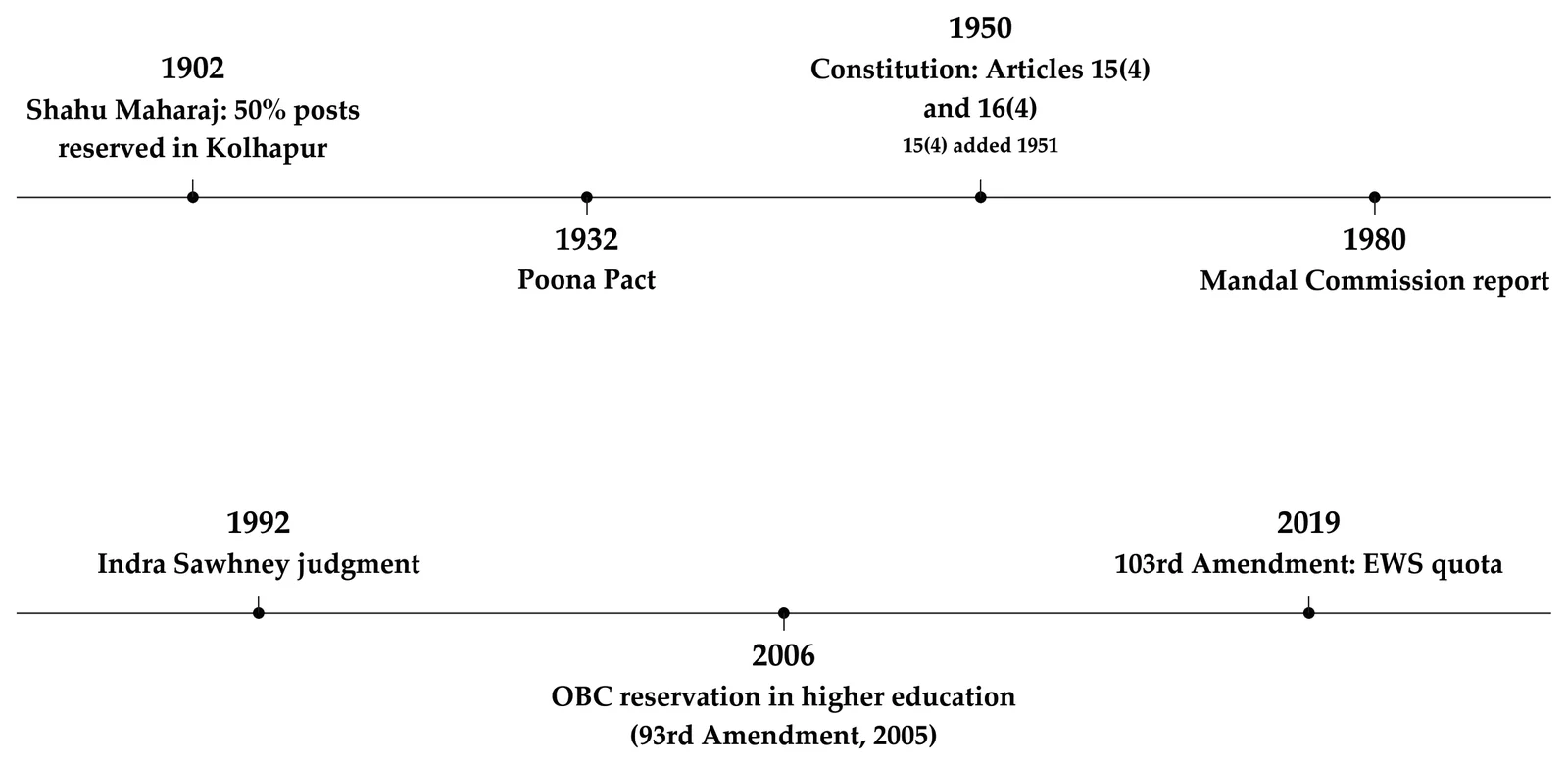
Reservations have a long history (Figure 3.2). Chhatrapati Shahu Maharaj of Kolhapur reserved 50% of posts for backward classes in 1902; the Poona Pact (1932) reserved seats for the depressed classes in legislatures; and the Constitution provided for reservation in jobs (Article 16(4)), in legislatures (Articles 330 and 332) and, after the First Amendment (1951) following State of Madras v. Champakam Dorairajan, in education (Article 15(4)). The Mandal Commission report (1980), implemented in 1990, extended 27% reservation in central jobs to OBCs, which was upheld in Indra Sawhney (1992). The 93rd Amendment (2005) added Article 15(5) for reservation in educational institutions, and the 103rd Amendment (2019) introduced 10% reservation for economically weaker sections.
Principles of Fairness: The Case For
- Compensatory justice. Groups that suffered centuries of exclusion through caste and untouchability deserve compensation; Ambedkar argued that formal equality between unequal groups only preserves inequality.
- Substantive equality and fair opportunity. Rawls’s principle of fair equality of opportunity and the difference principle support measures that benefit the least advantaged. The Supreme Court in State of Kerala v. N.M. Thomas (1976) held that Article 16(4) is a facet of equality, not an exception to it.
- Representation and democracy. Disadvantaged groups need a voice in institutions; a bureaucracy and legislature drawn only from privileged groups lack legitimacy.
- Diversity. Ronald Dworkin, defending affirmative action in American universities, argued that a diverse student body serves the educational and social goals of the institution.
- Breaking the cycle. Education and jobs create role models and lift whole families out of disadvantage.
The Case Against
- Merit and efficiency. Critics argue that selection should depend only on individual merit.
- Benefits go to the better-off. Benefits are often captured by the ‘creamy layer’ within backward groups, which is why the Supreme Court excluded it in Indra Sawhney.
- Perpetuating caste. Reservations may strengthen caste identity and politics instead of reducing them.
- Reverse discrimination. Individuals from non-reserved groups may be treated unfairly for wrongs they did not commit.
- Economic criteria. Some argue that poverty, rather than caste, should be the basis of support, a view partly reflected in the EWS quota.
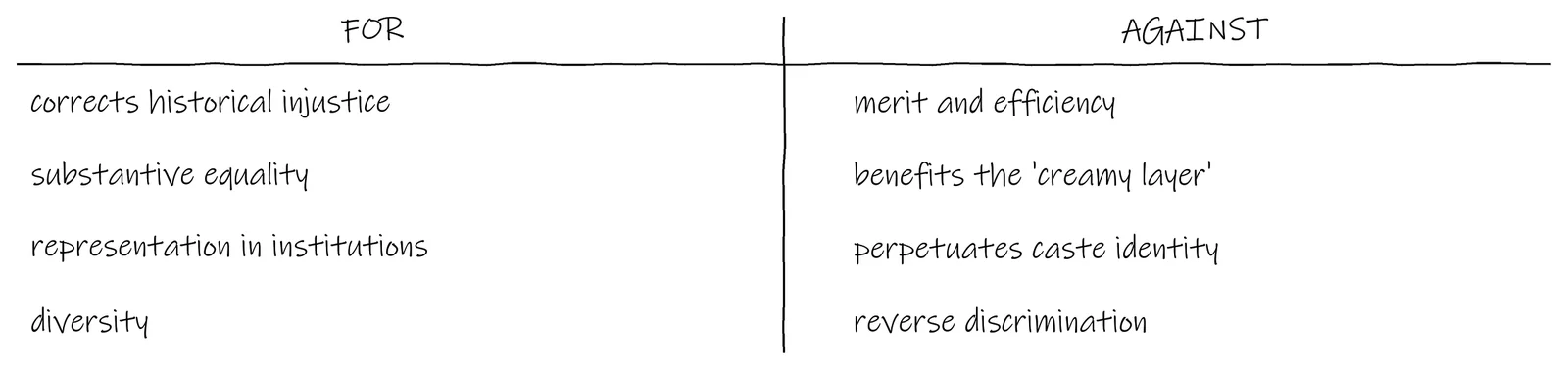
The balanced view, reflected in Indian constitutional law, is that protective discrimination is a legitimate means of achieving substantive equality, but it must be limited (the 50% ceiling), targeted (excluding the creamy layer) and reviewed over time, so that it serves fairness rather than undermining it.
3.2 The Public vs Private Debate: Feminist Perspective
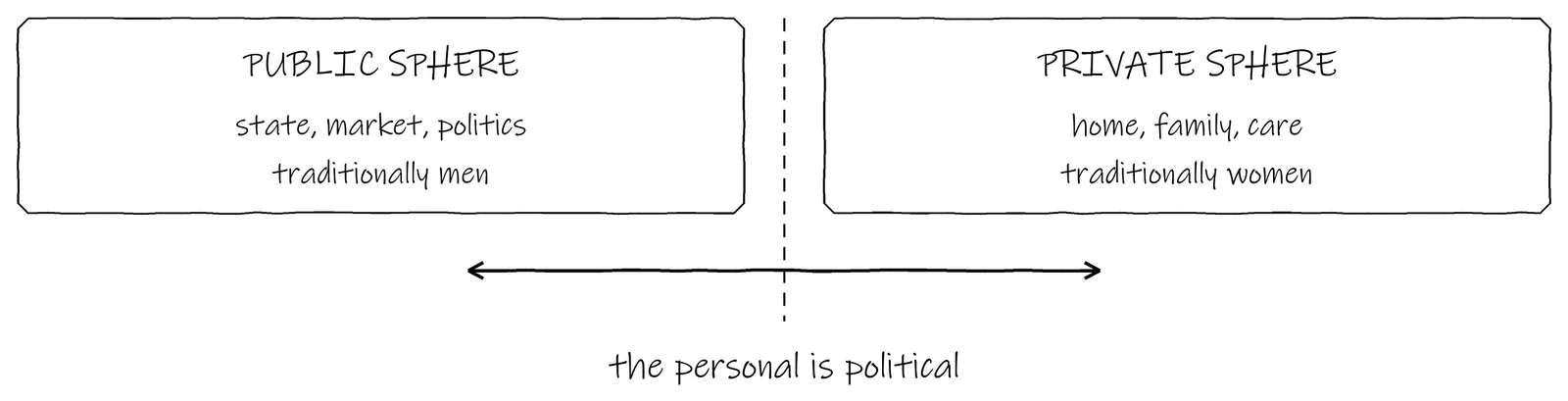
Liberal political theory divides life into two spheres. The public sphere includes the state, the economy and politics, where laws and rights apply. The private sphere includes the family and personal life, which should be protected from state interference. John Locke separated political power from the power of a father over his family, and J.S. Mill protected a private sphere of self-regarding actions. The aim was to protect individual freedom from an intrusive state (Figure 3.4).
The Feminist Critique
Feminists argue that this division is not neutral. Historically, men were placed in the public sphere of work and politics, while women were confined to the private sphere of home and care. Because the family was treated as private, power within it, unpaid domestic labour, domestic violence, marital rape and unequal decision-making, was hidden from political theory and from the law. The slogan ‘the personal is political’, popularised by Carol Hanisch (1969) and the women’s movement, expressed this critique: what happens in personal life is shaped by power and is therefore political.
- Carole Pateman, in The Sexual Contract (1988), argued that the social contract theorists assumed a hidden ‘sexual contract’ that secured men’s power over women.
- Susan Moller Okin, in Justice, Gender, and the Family (1989), insisted that principles of justice must apply within the family, which is the first school of justice.
- Frances Olsen, in ‘The Myth of State Intervention in the Family’ (1985), argued that the idea of ‘non-intervention’ in the family is a myth: the state always shapes the family, through marriage, divorce, property and inheritance laws, so refusing to protect women in the home is itself a political choice that supports the stronger party.
Implications
The critique has changed law and policy. In India, the Protection of Women from Domestic Violence Act (2005), the Dowry Prohibition Act (1961), and laws against sexual harassment at the workplace (the Vishaka guidelines of 1997 and the POSH Act of 2013) brought ‘private’ matters into public law. Debates continue on marital rape and on personal laws. At the same time, many feminists value privacy, for example in reproductive choices, so the aim is not to abolish privacy but to ensure that it does not shield domination.
3.3 Censorship and Its Limits
Censorship means the suppression or control of speech, publications, films, art or other expression by the state or other authorities. It raises one of the oldest debates in political theory: how far should freedom of expression be protected, and when, if ever, may it be restricted?
The Case for Free Speech
John Milton’s Areopagitica (1644) attacked licensing of the press. J.S. Mill, in On Liberty (1859), gave the classic defence: suppressed opinions may be true; even false opinions contain part of the truth; truth that is never challenged becomes ‘dead dogma’; and free discussion develops the human mind. Free speech is also essential for democracy, since citizens need information and the freedom to criticise government.
Grounds for Limiting Speech
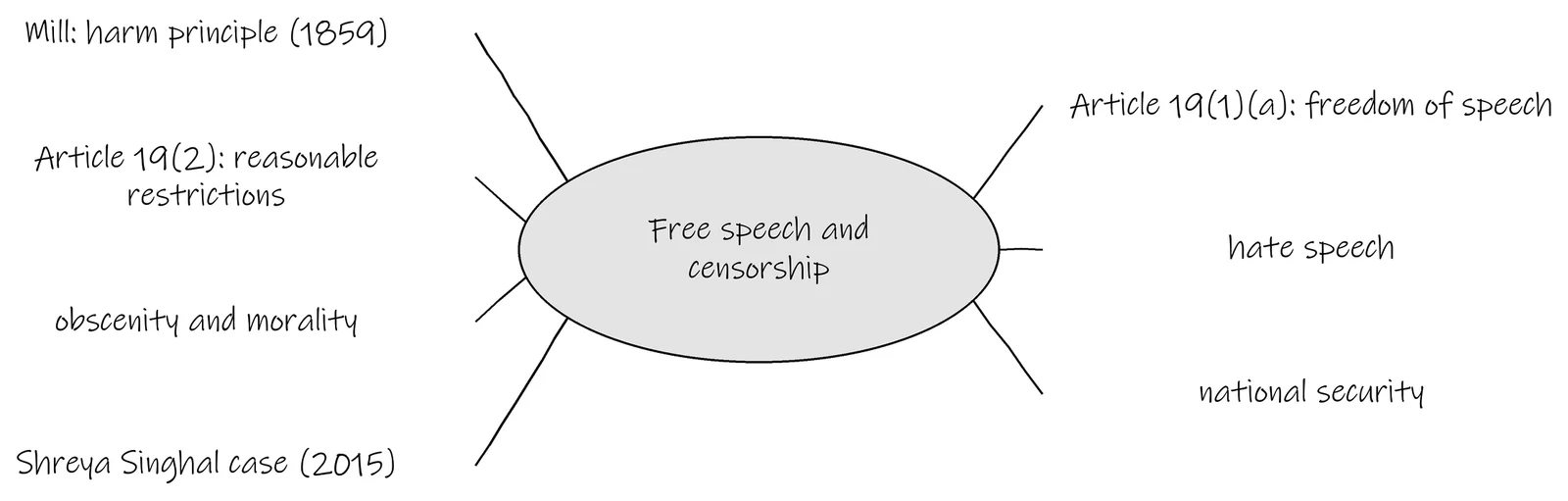
Almost every theorist accepts some limits. Mill himself allowed restriction when speech directly incites harm, giving the example of an angry mob outside a corn-dealer’s house. Common grounds for restriction are incitement to violence, hate speech against groups, defamation, obscenity, national security and public order (Figure 3.5).
Free Speech and Censorship in India
Article 19(1)(a) guarantees freedom of speech and expression, and Article 19(2) allows reasonable restrictions in the interests of the sovereignty and integrity of India, the security of the state, friendly relations with foreign states, public order, decency or morality, contempt of court, defamation and incitement to an offence. Key cases show how the courts draw the line: Romesh Thapar (1950) treated freedom of the press as part of free speech; K.A. Abbas v. Union of India (1970) upheld pre-censorship of films under the Cinematograph Act (1952); Kedar Nath Singh (1962) limited sedition to speech that incites violence; and Shreya Singhal v. Union of India (2015) struck down Section 66A of the IT Act as vague and overbroad. In 2022 the Supreme Court put the colonial sedition law (Section 124A IPC) in abeyance.
The Limits of Censorship
The central question is not whether there should be any limits, but who decides and on what principle. Censorship becomes dangerous when it is used to silence criticism of government, when laws are vague, and when the ‘heckler’s veto’ allows violent groups to suppress speech they dislike. A democratic approach requires that restrictions be narrow, clearly defined by law, proportionate and open to judicial review.
3.4 Important Questions
- Question 1 Is protective discrimination consistent with the principles of fairness? Discuss.
- Question 2 Examine the public–private debate from the feminist perspective.
- Question 3 What is censorship? Discuss the limits of censorship in a democracy.
DU asks the same idea in different words. So learn one broad answer for each question below; the same answer works for every question joined by OR.
Important Question 1
Is protective discrimination consistent with the principles of fairness? Discuss.
OR
Discuss the arguments for and against affirmative action in India.
OR
Write a note on reservations and social justice.
Model Answer
“Equality of opportunity in an unequal society only perpetuates inequality.”
— The argument for affirmative action
Introduction. Protective discrimination, or affirmative action, means special measures for disadvantaged groups, such as reservations in education, jobs and legislatures. The debate is whether such measures fulfil or violate the principle of fairness.
1. Meaning and Constitutional Basis
The Constitution provides for special measures in Articles 15(4), 15(5), 16(4), 46, 330 and 332. The Supreme Court in N.M. Thomas (1976) held that Article 16(4) is a facet of equality, not an exception to it. Articles 15(6) and 16(6), added in 2019, provide for reservation for economically weaker sections.
2. Development of Policy
From Shahu Maharaj (1902) and the Poona Pact (1932) to the Constitution, the Mandal Commission (1980, implemented 1990), Indra Sawhney (1992), the 93rd Amendment (2005) and the EWS quota of the 103rd Amendment (2019), reservation has been extended and refined. The Kalelkar Commission (1955) first studied the backward classes, and the Mandal Commission’s report was implemented in 1990. Reservation in promotions for Scheduled Castes and Scheduled Tribes was restored by the 77th Amendment (1995).
3. Formal versus Substantive Equality
If equality means identical treatment, reservations seem unfair; but if it means equal opportunity in reality, treating unequals equally perpetuates inequality. In N.M. Thomas (1976) the Supreme Court held that reservation is a facet of equality, not an exception to it.
4. Arguments for Protective Discrimination
It provides compensatory justice for historical exclusion; promotes substantive equality and Rawls’s fair equality of opportunity; ensures representation of disadvantaged groups; promotes diversity (Dworkin); and breaks cycles of disadvantage. It also brings historically excluded groups into institutions, which makes those institutions more legitimate.
5. Arguments against Protective Discrimination
Critics cite merit and efficiency, the capture of benefits by the creamy layer, the perpetuation of caste identity, reverse discrimination against individuals, and the claim that economic need rather than caste should be the criterion. Others argue that economic criteria would better target the poor of all castes. Some fear that reservations encourage caste identity in politics.
6. Judicial Balancing
Indra Sawhney upheld OBC reservation but fixed a 50% ceiling, excluded the creamy layer and disallowed reservation in promotions (later restored for SCs and STs by the 77th Amendment, 1995). The EWS quota was upheld in Janhit Abhiyan (2022). In Janhit Abhiyan (2022) the Court upheld the 10 per cent quota for economically weaker sections.
7. Beyond Reservations
Fairness also requires scholarships, coaching, hostels and anti-discrimination laws, so that disadvantaged groups can actually use the opportunities that reservations provide.
8. A Comparative View
The United States used affirmative action in admissions until its Supreme Court restricted race-conscious admissions in 2023, while India’s quotas are written into the Constitution, which shows different ways of pursuing fairness.
9. The Fifty Per Cent Ceiling
Some states, such as Tamil Nadu with 69 per cent, have exceeded the ceiling through constitutional protection, and the EWS quota has raised the question whether the ceiling still applies; the Court’s view is that reservations must remain balanced with the general claim of merit.
10. Evaluation
Protective discrimination is consistent with fairness if fairness means substantive rather than merely formal equality. But it must be targeted at those really disadvantaged and periodically reviewed. Fairness also requires periodic review so that benefits reach those who need them most.
11. Theories of Fairness
John Rawls’s principle of fair equality of opportunity requires that people with similar talents and willingness have similar life chances regardless of their social origin, and his difference principle permits inequalities only if they benefit the least advantaged. Ronald Dworkin argued that affirmative action does not violate anyone’s right, because no one has a right to be judged only by test scores, and institutions may pursue legitimate social goals such as diversity. Dworkin’s idea of ‘treatment as an equal’ supports differential treatment to remove disadvantage.
12. Recent Developments
In State of Punjab v. Davinder Singh (2024), the Supreme Court allowed states to sub-classify Scheduled Castes so that the most backward among them receive a fair share of benefits. Debates continue over the 50% ceiling, the creamy layer for SCs and STs, reservation in the private sector, and caste-based census data. Some judges also suggested a creamy layer for Scheduled Castes, which remains controversial.
Conclusion. Thus, protective discrimination, carefully designed, is not a departure from fairness but a means of achieving it in a society shaped by caste and historical injustice.
Important Question 2
Examine the public–private debate from the feminist perspective.
OR
“The personal is political.” Discuss.
OR
Discuss Frances Olsen’s argument about the myth of state intervention in the family.
Model Answer
“The personal is political.”
— Slogan of the women’s movement, popularised by Carol Hanisch (1969)
Introduction. Liberal theory separates a public sphere of politics and law from a private sphere of family and personal life. Feminists argue that this division hides power and injustice in the family.
1. The Liberal Distinction
Locke separated political power from paternal power, and Mill protected self-regarding actions; the private sphere was meant to protect individual freedom from the state. The private sphere was seen as the realm of family, religion and conscience, where the state should not interfere.
2. The Gendered Division
Men were placed in the public world of work and politics, women in the private world of home and care; unpaid domestic labour was not counted as work, and violence in the home was treated as a private matter. Women’s domestic and care work was unpaid and unrecognised, and their exclusion from public life was justified as natural.
3. ‘The Personal is Political’
Second-wave feminists argued that relations in the family, sexuality and the body are shaped by power and are therefore political. Issues such as domestic violence, marital rape and housework became political issues through this slogan. Kate Millett’s Sexual Politics (1970) argued that relations between the sexes are relations of power.
4. Pateman, Okin and Olsen
Carole Pateman (1988) uncovered the ‘sexual contract’ behind the social contract; Susan Moller Okin (1989) argued that justice must apply within the family; and Frances Olsen (1985) showed that ‘non-intervention’ in the family is a myth, since the state always defines and shapes family relations, and refusing to protect women at home is itself a political choice. Frances Olsen argued that the state’s non-intervention in the family is itself a political choice that protects male power.
5. Care and Work
Feminist economists show that unpaid care work, mostly done by women, sustains the economy, and the ethics of care (Gilligan, Tronto) asks that care be valued as a public concern.
6. Socialist Feminism
Socialist feminists link the private sphere to capitalism, arguing that the family reproduces labour power for capital through women’s unpaid work.
7. Impact on Law
The Domestic Violence Act (2005), the Dowry Prohibition Act (1961), the Vishaka guidelines (1997) and the POSH Act (2013) brought ‘private’ matters into public law. The Sexual Harassment of Women at Workplace Act (2013) followed the Vishaka guidelines. The Protection of Children from Sexual Offences Act (2012) applies the same reasoning to abuse within homes.
8. Public Spaces and Safety
Feminists also argue that women’s limited access to public spaces, because of fear of harassment and violence, restricts their citizenship; the protests after the Delhi gang rape of 2012 brought this issue to the centre of politics.
9. Women in Indian Politics
Women’s low presence in legislatures and their large presence in panchayats after reservation show how public power has been gendered, and the 106th Amendment (2023) seeks to change this.
10. Evaluation
Critics fear excessive state interference in family life; feminists reply that the goal is not to abolish privacy but to ensure that privacy does not protect domination. The aim is not to abolish privacy but to ensure that privacy protects everyone, including women and children.
11. The Liberal Defence of Privacy
Liberals defend the private sphere as a protection against an intrusive state: decisions about religion, family life, sexuality and personal relationships should be free from government control. In Justice K.S. Puttaswamy v. Union of India (2017), the Supreme Court recognised privacy as a fundamental right under Article 21, and in Navtej Singh Johar (2018) it decriminalised consensual same-sex relations, showing how privacy can protect personal freedom. In Puttaswamy (2017) the Supreme Court recognised privacy as a fundamental right, including autonomy over one’s body and choices.
12. Indian Debates
Indian feminists have raised several issues that cross the public–private divide: the exception for marital rape in criminal law, unequal provisions in personal laws on marriage, divorce and inheritance, dowry, and the recognition of unpaid domestic work. These debates show that the boundary between public and private must be drawn in a way that protects both privacy and equality. Debates on marital rape, the Hindu Code Bill and personal laws show how the family has been a site of political contest.
13. Redrawing the Boundary
Many feminists now argue not for abolishing the distinction but for redrawing it: the state should protect individuals from domination inside the family while respecting choices about intimate life.
Conclusion. Thus, the feminist critique has shown that the public–private divide is itself political, and that justice and equality must reach into the home.
Important Question 3
What is censorship? Discuss the limits of censorship in a democracy.
OR
Examine the debate on freedom of speech and its restrictions.
OR
Discuss Mill’s defence of freedom of expression.
Model Answer
“If all mankind minus one were of one opinion, mankind would be no more justified in silencing that one person than he, if he had the power, would be justified in silencing mankind.”
— J.S. Mill, On Liberty (1859)
Introduction. Censorship is the control or suppression of expression by authorities. In a democracy free speech is essential, but most thinkers accept that it has some limits; the debate concerns where those limits lie.
1. The Value of Free Speech
Milton’s Areopagitica (1644) attacked press licensing. Mill argued that silenced opinions may be true, that false opinions contain part of the truth, and that unchallenged truth becomes dead dogma. Free speech also enables democratic criticism of government. Free speech is also essential to democracy, since citizens need information and debate to govern themselves. Article 19 of the Universal Declaration of Human Rights recognises it as a universal right.
2. Forms of Censorship
Censorship may take the form of prior restraint, such as film certification; bans and prosecutions after publication; or informal pressure from governments, mobs and corporations.
3. Grounds for Restriction
Incitement to violence (Mill’s corn-dealer example), hate speech, defamation, obscenity, national security and public order are commonly accepted grounds. Most democracies also restrict speech that threatens national security or the fairness of trials.
4. Censorship in History
Censorship has a long history, from the church’s Index of Prohibited Books to colonial India’s press laws, such as the Vernacular Press Act (1878), used against nationalist newspapers.
5. The Indian Framework
Article 19(1)(a) guarantees free speech; Article 19(2) allows reasonable restrictions. Romesh Thapar (1950), K.A. Abbas (1970), Kedar Nath Singh (1962) and Shreya Singhal (2015) show the courts balancing freedom and restriction; the sedition law was put in abeyance in 2022. Restrictions are allowed in the interests of sovereignty and integrity, security, friendly relations with foreign states, public order, decency or morality, contempt of court, defamation and incitement to an offence.
6. The Emergency Experience
During the Emergency of 1975–77, newspapers were pre-censored and critics jailed, an experience that made free speech a central democratic value in India.
7. Dangers of Censorship
Vague laws, political misuse to silence critics, and the heckler’s veto threaten democracy. Self-censorship, when people stay silent out of fear, is perhaps the most serious danger.
8. Democratic Limits
Restrictions should be narrow, defined by law, proportionate to a real harm, and subject to judicial review. In Shreya Singhal (2015) the Court distinguished discussion and advocacy, which are protected, from incitement, which may be restricted.
9. Film, Press and Internet Censorship
Films in India are certified by the Central Board of Film Certification under the Cinematograph Act, 1952, and K.A. Abbas (1970) upheld pre-censorship of films because of their impact on audiences. The press is protected under Article 19(1)(a), but was censored during the Emergency (1975–77). Today the internet raises new questions about blocking websites, regulating social media and fake news, under the IT Act, 2000 and its rules. Internet shutdowns, frequent in India, raise new questions, and Anuradha Bhasin (2020) required them to be necessary and proportionate.
10. Censorship and Art
Artists and writers in India, such as M.F. Husain and Perumal Murugan, have faced bans, cases and threats; in Perumal Murugan’s case (2016) the Madras High Court urged that the author be allowed to return to what he does best, writing.
11. Hate Speech and Free Speech
Hate speech, which incites hatred or violence against groups on the basis of religion, caste or ethnicity, is restricted by laws such as Sections 153A and 295A of the former Indian Penal Code (now in the Bharatiya Nyaya Sanhita, 2023). The difficulty is to restrict real incitement without suppressing legitimate criticism, satire and dissent. The Supreme Court has directed governments to act against hate speech even without formal complaints.
12. The Principle of Proportionality
Modern courts judge restrictions on speech by proportionality: a restriction must pursue a legitimate aim, be suitable to achieve it, be the least restrictive means available, and balance harm against benefit. In Anuradha Bhasin v. Union of India (2020), concerning internet shutdowns in Jammu and Kashmir, the Supreme Court held that indefinite suspension of the internet is not permissible and that restrictions must be proportionate and subject to review. It must also be the least restrictive measure available.
13. Evaluation
Censorship has a place in a democracy only as a narrow exception: speech should be restricted only where it causes real harm, through clear laws and independent courts. The usual cure for bad speech is more speech, not silence.
Conclusion. Thus, free speech is the lifeblood of democracy. Censorship can be justified only in narrow cases of real harm, and every restriction must itself be limited and accountable.
Short Notes
(a) The Creamy Layer
The term refers to the relatively advanced and well-off members of backward classes. In Indra Sawhney v. Union of India (1992), the Supreme Court held that the creamy layer must be excluded from OBC reservations, so that benefits reach those who are really disadvantaged. An income limit is set by the government and revised from time to time. The principle does not apply to SC and ST reservations in jobs in the same way, though the issue continues to be debated.
(b) Reasonable Restrictions
Article 19(2) of the Constitution allows the state to impose ‘reasonable restrictions’ on freedom of speech in the interests of sovereignty and integrity, security of the state, friendly relations with foreign states, public order, decency or morality, contempt of court, defamation and incitement to an offence. The courts decide whether a restriction is reasonable, i.e. proportionate and not arbitrary.
(c) Hate speech
Speech that attacks or incites hatred against people because of their religion, caste, race, gender or other group identity. Many democracies restrict it to protect equal dignity and public order. In India, provisions of the criminal law punish promoting enmity between groups, and Article 19(2) allows reasonable restrictions on speech in the interest of public order. Critics warn that vague laws can be misused to silence dissent.
More notes: MDSC-1A Introduction to Political Theory
These notes are prepared by PADHO TO AISE for study help. They are not an official University of Delhi publication.