

Semester V MDSC-5A Introduction to International Relations
Unit III · 22 min read · Updated 24 Nov 2026
As per the University of Delhi (DU) BA (Hons) Political Science syllabus
Contents
- 3.1 State and Sovereignty
- 3.2 War and Peace
- 3.3 Human Rights
- 3.4 Global Governance and Climate Change Negotiations
- 3.5 Important Questions
- Discuss the concepts of state and sovereignty in International Relations.
- What are the causes of war? Discuss the pathways to interstate peace.
- Discuss the evolution and significance of human rights in International Relations.
- What is global governance? Discuss climate change negotiations as a problem of global governance.
- Short Notes
संगठन अपने सभी सदस्यों की संप्रभु समानता के सिद्धांत पर आधारित है।
The Organization is based on the principle of the sovereign equality of all its Members.
— Charter of the United Nations, Article 2(1) (1945)
STATES, wars, rights and global problems are the raw material of International Relations. This unit studies four of its central concepts and issues. State and sovereignty explain how the world is divided into independent political units. War and peace ask why states fight and how conflict can be prevented. Human rights ask what every person is owed, whatever the state they live in. Global governance asks how a world without a world government can tackle problems such as climate change. The readings include Navnita Chadha Behera, Christian Reus-Smit, Joseph Grieco and colleagues, Chris Brown, Upendra Baxi, Thomas Weiss, and Anil Agarwal and Sunita Narain.
3.1 State and Sovereignty
A state is a political community with a permanent population, a defined territory, a government and the capacity to enter into relations with other states, as the Montevideo Convention (1933) puts it. Sovereignty means supreme authority within a territory and independence from outside authority. Jean Bodin (1576) and Thomas Hobbes (1651) developed the idea, and the Peace of Westphalia (1648) is often said to have founded the modern system of sovereign states. Christian Reus-Smit shows how this system spread across the world through decolonisation, as empires gave way to independent states.
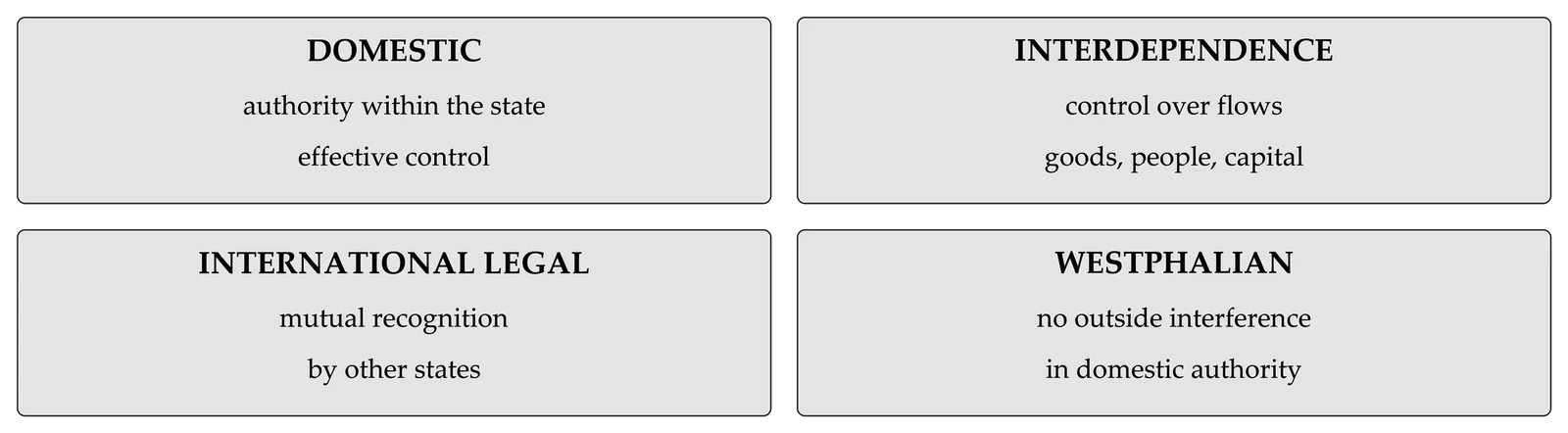
Stephen Krasner distinguished domestic, interdependence, international legal and Westphalian sovereignty, and called sovereignty organised hypocrisy, since powerful states often violate it. Andreas Osiander argues that the Westphalian story is a myth, since the treaties of 1648 did not create sovereign equality. Navnita Chadha Behera, writing from the global South, shows that Westphalian sovereignty was imposed through colonialism and that Asian traditions, such as Kautilya’s mandala, understood power, frontiers and authority differently.
3.2 War and Peace
War is organised, large-scale violence between political groups. Carl von Clausewitz described it as the continuation of policy by other means. Grieco, Ikenberry and Mastanduno explain the causes of war at three levels of analysis: the individual (leaders’ ambitions and misperceptions), the state (regime type, nationalism, domestic politics) and the international system (anarchy, the security dilemma, shifts in the balance of power). Since 1945, wars between states have become rarer, while civil wars, ethnic conflicts and wars involving non-state actors have become more common, a change Mary Kaldor called new wars.
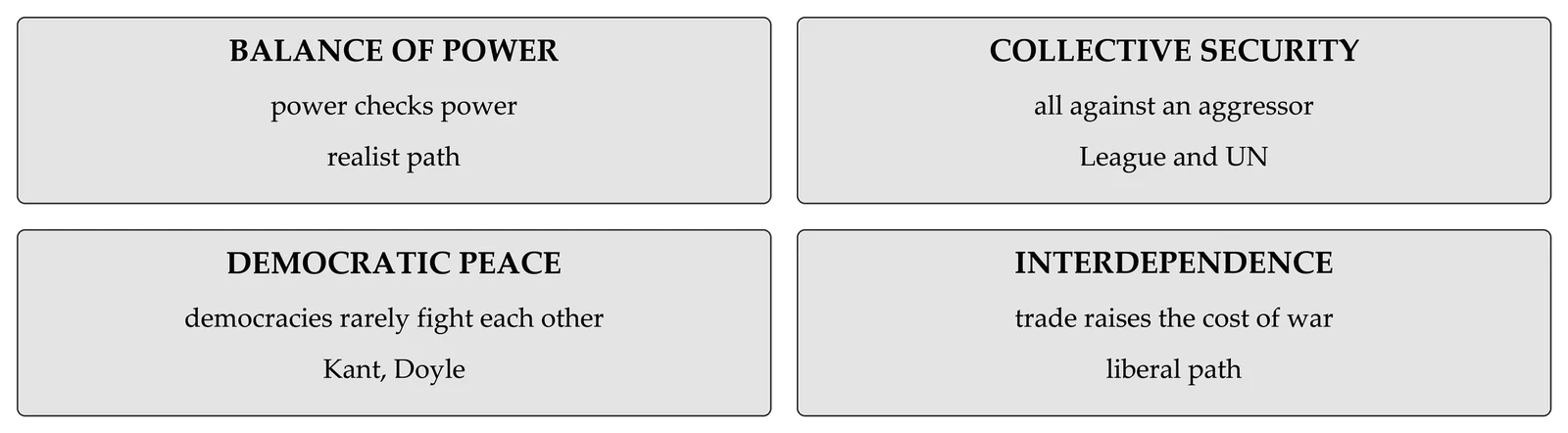
Scholars identify several pathways to peace: the balance of power and deterrence, emphasised by realists; collective security through the League and the United Nations; the democratic peace, the observation that democracies rarely fight one another, rooted in Kant and developed by Michael Doyle; economic interdependence; and international law and institutions. Johan Galtung distinguished negative peace, the absence of war, from positive peace, the absence of structural violence such as poverty and injustice.
3.3 Human Rights
Human rights are rights that every person has simply by being human. After the horrors of the Second World War, the Universal Declaration of Human Rights (1948) set out civil, political, economic, social and cultural rights, and the two International Covenants of 1966 made them binding treaties. The Vienna Declaration (1993) affirmed that all human rights are universal, indivisible and interdependent. Chris Brown notes the tension between human rights and sovereignty, debates between universalism and cultural relativism, such as the Asian values debate, and the weakness of enforcement.

Upendra Baxi, in ‘An Age of Human Rights?’ (2002), questions the celebration of our time as an age of human rights. He distinguishes modern human rights, which in the colonial era excluded slaves, women and colonised peoples, from contemporary human rights, which are inclusive and shaped by the struggles of the violated. He warns that a trade-related, market-friendly human rights paradigm, protecting the rights of global capital, threatens to replace the paradigm of the Universal Declaration.
3.4 Global Governance and Climate Change Negotiations
Global governance refers to the ways in which states, international organisations, NGOs, companies and other actors manage common problems in the absence of a world government. Thomas Weiss traces the idea to the end of the Cold War and to the Commission on Global Governance (1995), and identifies gaps in knowledge, norms, policies, institutions and compliance that limit global problem-solving. Climate change is the clearest test: no state can solve it alone, but each has an incentive to let others bear the costs.

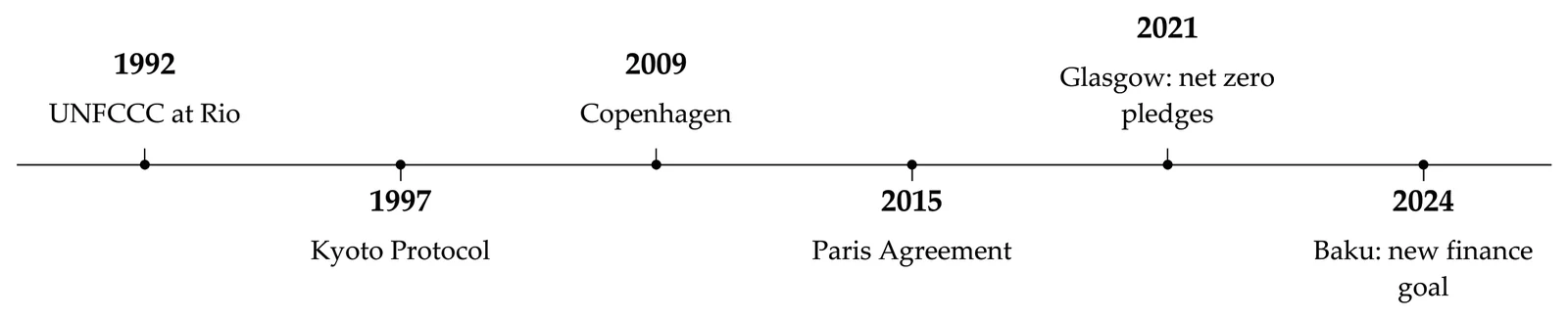
Climate negotiations under the UNFCCC (1992) are based on common but differentiated responsibilities. The Kyoto Protocol (1997) set binding targets only for developed countries; the Paris Agreement (2015) asks all countries to make nationally determined contributions. Anil Agarwal and Sunita Narain, in Global Warming in an Unequal World (1991), attacked a Western report that blamed developing countries, calling it environmental colonialism. They distinguished the survival emissions of the poor from the luxury emissions of the rich and argued for equal per capita rights to the atmosphere.
3.5 Important Questions
- Question 1 Discuss the concepts of state and sovereignty in International Relations.
- Question 2 What are the causes of war? Discuss the pathways to interstate peace.
- Question 3 Discuss the evolution and significance of human rights in International Relations.
- Question 4 What is global governance? Discuss climate change negotiations as a problem of global governance.
DU asks the same idea in different words. So learn one broad answer for each question below; the same answer works for every question joined by OR.
Important Question 1
Discuss the concepts of state and sovereignty in International Relations.
OR
Examine the changing nature of sovereignty in the contemporary world.
OR
Discuss Navnita Chadha Behera’s view of state and sovereignty from the global South.
Model Answer
“Sovereignty is the absolute and perpetual power of a commonwealth.”
— Jean Bodin, Six Books of the Commonwealth (1576)
Introduction. The modern world is divided into nearly two hundred sovereign states, which are the main actors in International Relations. The concepts of state and sovereignty define who has authority in world politics. Yet scholars such as Krasner, Osiander and Behera question the traditional story of sovereignty and show how it has changed and how it looks from the global South.
1. Meaning of the State
The Montevideo Convention of 1933 lists four qualifications of a state: a permanent population, a defined territory, a government and the capacity to enter into relations with other states. Max Weber added that a state successfully claims the monopoly of the legitimate use of force within its territory.
2. Meaning of Sovereignty
Sovereignty means supreme authority. Internally, the sovereign is the final source of law within the territory; externally, the state is independent of any higher authority. Bodin defined it as the absolute and perpetual power of a commonwealth, and Hobbes justified an absolute sovereign as the remedy for the war of all against all.
3. The Westphalian System
The Peace of Westphalia (1648), which ended the Thirty Years’ War, is traditionally seen as the origin of the modern states system, based on territorial sovereignty, non-interference and the equality of states. The UN Charter enshrines these principles in Article 2.
4. Osiander’s Westphalian Myth
Andreas Osiander argues that the Westphalian treaties did not create sovereign equality; they largely confirmed the constitution of the Holy Roman Empire. The myth of Westphalia was constructed later. Sovereignty developed gradually over centuries.
5. Krasner’s Four Sovereignties
Stephen Krasner distinguished domestic sovereignty, effective authority within the state; interdependence sovereignty, control over cross-border flows; international legal sovereignty, mutual recognition; and Westphalian sovereignty, the exclusion of external actors. He called sovereignty organised hypocrisy because powerful states frequently violate these norms.
6. Spread through Decolonisation
Reus-Smit shows that the sovereign state system expanded from Europe to the whole world through the collapse of empires. After 1945, decolonisation created dozens of new states in Asia and Africa, and the UN grew from 51 to 193 members.
7. Behera’s Global South Perspective
Behera argues that for the global South, sovereignty arrived through colonialism. European powers drew borders and imposed the territorial state, often dividing communities, as in the partition of South Asia. Postcolonial states inherited these borders and fiercely defend sovereignty as protection against renewed domination.
8. Non-Western Traditions
Behera points out that pre-colonial Asian polities understood power differently. Kautilya’s mandala imagined circles of kings, and frontiers were zones of overlapping influence rather than fixed lines. Such traditions suggest that Westphalian sovereignty is one historical form, not a universal truth.
9. Quasi-states
Robert Jackson described many postcolonial states as quasi-states, enjoying juridical sovereignty through international recognition but lacking effective empirical control. This explains state weakness and conflict in parts of the world.
10. Challenges to Sovereignty
Sovereignty is challenged by globalisation, which reduces control over flows of money, goods and information; by supranational bodies such as the European Union; by human rights norms and the Responsibility to Protect (2005), which make sovereignty conditional on protecting citizens; and by non-state actors such as terrorist networks.
11. Continuing Importance
Despite these challenges, states remain central. They control armies, make laws, sign treaties and are the members of international organisations. Many states, including India and China, strongly defend sovereignty and non-interference.
12. India and Sovereignty
Having won independence from colonial rule, India placed great value on sovereignty. The Panchsheel agreement with China (1954) listed mutual respect for territorial integrity and sovereignty, non-aggression, non-interference in internal affairs, equality and mutual benefit, and peaceful coexistence. Non-alignment expressed the same desire for autonomy, and India continues to resist outside interference in matters such as Kashmir.
13. Evaluation
State and sovereignty remain the foundation of international politics, but they are historical constructions that have changed over time and look different from different places. A global perspective reveals both their power and their limits.
Conclusion. Thus, the state is a territorial political community, and sovereignty means supreme authority within and independence without. The Westphalian story is partly a myth, sovereignty takes several forms, and, as Behera shows, it was imposed on the global South through colonialism, though it remains central to world politics.
Important Question 2
What are the causes of war? Discuss the pathways to interstate peace.
OR
Examine the causes of war at different levels of analysis.
OR
Discuss the changing nature of war and the conditions of peace.
Model Answer
“War is merely the continuation of policy by other means.”
— Carl von Clausewitz, On War (1832)
Introduction. War has been central to International Relations since the discipline was founded to understand and prevent it. Grieco, Ikenberry and Mastanduno examine why wars occur and the pathways by which states can achieve peace. Scholars also study how the nature of war has changed, from interstate wars to civil wars and new forms of conflict.
1. Meaning of War
War is organised, large-scale violence between political groups, usually states. Clausewitz saw it as a political instrument, the continuation of policy by other means. Hedley Bull defined it as organised violence carried on by political units against each other.
2. Individual Level
At the individual level, wars result from human nature, leaders’ ambitions, misperceptions and psychological biases. Realists such as Morgenthau traced conflict to the human lust for power; others emphasise how leaders misread their opponents, as in the outbreak of the First World War.
3. State Level
At the state level, wars result from the character of states: aggressive regimes, nationalism, militarism, domestic political pressures and the interests of particular groups. Liberals argue that authoritarian states are more war-prone, while Marxists link war to capitalism and imperialism.
4. System Level
At the system level, anarchy permits war because nothing prevents it. The security dilemma, in which one state’s defensive measures threaten others, can produce arms races and war. Power transition theory holds that war is likely when a rising power challenges a declining hegemon.
5. Balance of Power and Deterrence
Realists argue that peace is best preserved by a balance of power, in which no state can dominate, and by deterrence, especially nuclear deterrence, which made a direct war between the superpowers unthinkable during the Cold War.
6. Collective Security
Collective security means that all states agree to act together against any aggressor. The League of Nations failed to achieve it, but the UN Charter forbids the use of force (Article 2(4)) except in self-defence or with Security Council authorisation under Chapter VII.
7. Democratic Peace
Kant’s Perpetual Peace (1795) argued that republics would be peaceful. Michael Doyle (1986) showed that liberal democracies have rarely, if ever, fought each other, because of shared norms, institutional constraints and mutual trust, although they fight non-democracies.
8. Interdependence and Institutions
Liberals argue that trade and investment raise the costs of war, and that international institutions reduce uncertainty, build trust and provide forums for resolving disputes. European integration after 1945 turned former enemies into partners.
9. Positive Peace
Johan Galtung distinguished negative peace, the absence of direct violence, from positive peace, the absence of structural violence such as poverty, discrimination and injustice. Lasting peace requires addressing these deeper causes of conflict.
10. Changing Nature of War
Since 1945 interstate wars have declined, while civil wars, ethnic conflicts and insurgencies have increased. Mary Kaldor called these new wars, fought by states and non-state groups over identity, often targeting civilians. Robert Ayson notes new forms of warfare, including cyber attacks, drones and hybrid war.
11. The Return of Interstate War
Russia’s invasion of Ukraine in February 2022 showed that large-scale interstate war has not disappeared. Rivalries between great powers, territorial disputes and nuclear risks remain serious threats to peace.
12. The Just War Tradition
The just war tradition, developed by Augustine and Thomas Aquinas, asks when war may be fought and how. Its rules for going to war (jus ad bellum) require a just cause, legitimate authority, right intention, last resort and proportionality; its rules in war (jus in bello) require distinguishing combatants from civilians and using proportionate force. The Geneva Conventions of 1949 codify many of these limits.
13. Nuclear Weapons
Nuclear weapons transformed war. Deterrence theorists argue that the fear of mutual destruction kept the Cold War from turning hot. The Non-Proliferation Treaty (1968) sought to limit the spread of such weapons. India, which tested in 1974 and 1998, stayed outside the treaty, calling it discriminatory, and adopted a doctrine of no first use in 2003.
14. Evaluation
No single cause explains war, and no single pathway guarantees peace. Realist, liberal and critical approaches each highlight part of the picture. Combining deterrence, institutions, democracy, interdependence and justice offers the best hope for peace.
Conclusion. Thus, wars arise from causes at the individual, state and system levels, while peace may be pursued through the balance of power, collective security, democracy, interdependence and institutions. As the nature of war changes, the search for both negative and positive peace remains central to IR.
Important Question 3
Discuss the evolution and significance of human rights in International Relations.
OR
Examine the debate between universalism and cultural relativism in human rights.
OR
‘We live in an age of human rights.’ Examine with reference to Upendra Baxi.
Model Answer
“All human rights are universal, indivisible and interdependent and interrelated.”
— Vienna Declaration and Programme of Action (1993)
Introduction. Human rights are rights that belong to every person simply by virtue of being human. Since 1945, they have become a central part of international politics, law and diplomacy. Yet they raise difficult questions about sovereignty, culture and power. Chris Brown and Upendra Baxi offer contrasting perspectives on human rights in world politics.
1. Meaning
Human rights are universal, inalienable and equal. They include civil and political rights, such as freedom of speech and fair trial, and economic, social and cultural rights, such as education, health and work. Karel Vasak described three generations of rights, adding collective rights such as development and a clean environment.
2. Liberal Origins
Brown traces human rights to the natural rights theories of Locke and the revolutionary declarations of America (1776) and France (1789). These rights were, however, limited in practice, excluding slaves, women and colonised peoples.
3. After the Second World War
The Holocaust and wartime atrocities led to the UN Charter’s commitment to human rights and the Universal Declaration of Human Rights, adopted on 10 December 1948. Drafted by a committee chaired by Eleanor Roosevelt, it included contributions from many countries, including India’s Hansa Mehta.
4. The International Regime
The International Covenant on Civil and Political Rights and the International Covenant on Economic, Social and Cultural Rights (1966) made the Declaration’s rights binding. Conventions on racial discrimination, women, torture and children followed, along with the Human Rights Council (2006) and the International Criminal Court (2002).
5. Human Rights and Sovereignty
Human rights challenge sovereignty, since they make a state’s treatment of its own citizens a matter of international concern. The Responsibility to Protect (2005) holds that if a state fails to protect its people from genocide and crimes against humanity, the international community may act. Critics fear selective intervention by powerful states.
6. Universalism and Relativism
Universalists argue that human rights apply everywhere. Cultural relativists argue that rights reflect Western liberal values and must be interpreted in local contexts. In the 1990s, some Asian governments invoked Asian values, emphasising community and order, while critics replied that such claims often protected authoritarian rulers.
7. Brown’s Assessment
Brown argues that the human rights regime is a product of Western liberal thought, that its universality is contested, and that enforcement depends heavily on powerful states. Yet human rights have become a common language of global politics.
8. Baxi’s Question
Upendra Baxi asks whether ours is truly an age of human rights. He notes the proliferation of declarations and institutions, but also the persistence of massive violations, poverty and suffering. Human rights rhetoric often outruns reality.
9. Modern and Contemporary Human Rights
Baxi distinguishes modern human rights, which in the colonial era served to exclude slaves, women and the colonised, from contemporary human rights, after 1948, which are inclusive and shaped by the struggles of the violated themselves. Human rights should be understood from the standpoint of those who suffer.
10. The Market-friendly Paradigm
Baxi warns that a trade-related, market-friendly human rights paradigm, which protects the rights of global capital and corporations, is replacing the paradigm of the Universal Declaration, which centred on human dignity. Globalisation thus threatens the promise of human rights.
11. Human Rights and Foreign Policy
States often use human rights selectively in foreign policy, criticising rivals while ignoring allies. Developing countries emphasise the right to development and economic rights, while Western states often emphasise civil and political rights.
12. NGOs and Advocacy Networks
Non-governmental organisations such as Amnesty International (1961) and Human Rights Watch (1978) document violations and pressure governments. Margaret Keck and Kathryn Sikkink described transnational advocacy networks and a boomerang pattern, in which activists blocked at home appeal to international allies, who then press their government from outside. Such networks have made human rights a matter of global public opinion.
13. Evaluation
Human rights have transformed international politics by limiting what states may do to their citizens and giving voice to the oppressed. Their universality and enforcement remain contested, and as Baxi shows, they must be defended against both state power and market power.
Conclusion. Thus, human rights evolved from liberal natural rights into a global regime after 1945. As Brown shows, they challenge sovereignty and face the universalism–relativism debate, while Baxi questions whether ours is an age of human rights and warns against their capture by market interests.
Important Question 4
What is global governance? Discuss climate change negotiations as a problem of global governance.
OR
Examine the role of equity in climate change negotiations with reference to Agarwal and Narain.
OR
Discuss the evolution of international climate change negotiations and India’s position.
Model Answer
“The Parties should protect the climate system for the benefit of present and future generations of humankind, on the basis of equity and in accordance with their common but differentiated responsibilities and respective capabilities.”
— UN Framework Convention on Climate Change (1992), Article 3(1)
Introduction. Many of today’s problems, such as climate change, pandemics, financial crises and terrorism, cross borders and cannot be solved by any single state. Global governance refers to the collective efforts to manage such problems without a world government. Climate change negotiations are the most important and difficult test of global governance.
1. Meaning of Global Governance
The Commission on Global Governance (1995) described governance as the sum of the many ways individuals and institutions, public and private, manage their common affairs. Global governance includes international organisations, treaties, informal groupings such as the G20, NGOs, companies and networks of experts.
2. Weiss’s Analysis
Thomas Weiss traces the idea of global governance to the end of the Cold War and to work such as Rosenau and Czempiel’s Governance without Government (1992). He argues that global governance suffers from gaps in knowledge, norms, policies, institutions and compliance, which explain why global problems remain unsolved.
3. Climate Change as a Collective Problem
Greenhouse gas emissions from anywhere affect the whole planet. Each state benefits from others cutting emissions while avoiding costs itself, a classic collective action problem. The burden of historical emissions falls mainly on developed countries, while the poorest suffer most from the effects.
4. UNFCCC, 1992
The UN Framework Convention on Climate Change, adopted at the Rio Earth Summit in 1992, aimed to stabilise greenhouse gas concentrations. It established the principle of common but differentiated responsibilities and respective capabilities, recognising that developed countries should take the lead.
5. Kyoto Protocol, 1997
The Kyoto Protocol set binding emission reduction targets for developed countries, listed in Annex I, but none for developing countries. It came into force in 2005, but the United States never ratified it, and its targets had limited effect.
6. Paris Agreement, 2015
The Paris Agreement aims to keep warming well below 2°C and to pursue efforts to limit it to 1.5°C. All countries submit nationally determined contributions, reviewed through a global stocktake every five years. It is universal but relies on voluntary pledges.
7. Recent Negotiations
At Glasgow (2021), countries agreed to phase down unabated coal, and India pledged net zero by 2070. At Sharm el-Sheikh (2022) a fund for loss and damage was agreed. At Dubai (2023) the stocktake called for transitioning away from fossil fuels, and at Baku (2024) a new goal of at least 300 billion dollars a year in climate finance by 2035 was set.
8. Agarwal and Narain’s Critique
In 1991, Anil Agarwal and Sunita Narain of the Centre for Science and Environment criticised a report by the World Resources Institute that blamed developing countries such as India for large shares of emissions from rice fields, cattle and deforestation. They called this environmental colonialism.
9. Survival and Luxury Emissions
Agarwal and Narain distinguished the survival emissions of poor people, from growing food and cooking, from the luxury emissions of the rich, from cars and consumption. They argued that the atmosphere is a global commons to which every person has an equal right, so responsibility should be measured per person.
10. India’s Position
India has consistently emphasised equity, historical responsibility and common but differentiated responsibilities. Its per capita emissions remain far below those of developed countries. Its updated contribution (2022) pledged to reduce the emissions intensity of its economy by 45 per cent from 2005 levels and to obtain half of its electricity capacity from non-fossil sources by 2030.
11. Limits of Global Governance
Climate negotiations show the limits of global governance: pledges fall short of what science requires, finance from rich countries has been inadequate, and major emitters have sometimes withdrawn, as the United States did from the Paris Agreement. Non-state actors, cities and businesses play a growing role.
12. Evaluation
Global governance is essential but fragile. Climate negotiations have produced important agreements and principles, but equity and effectiveness remain in tension. Agarwal and Narain’s insistence on justice remains central to any fair solution.
Conclusion. Thus, global governance is the collective management of common problems without a world government, and climate change is its greatest test. From the UNFCCC to Kyoto and Paris, negotiations have advanced, but as Agarwal and Narain argue, a fair solution must distinguish survival from luxury emissions and respect equity.
Short Notes
(a) Responsibility to Protect
A principle endorsed by the UN World Summit in 2005. Every state has the responsibility to protect its population from genocide, war crimes, ethnic cleansing and crimes against humanity; if it manifestly fails, the international community should act, by force only through the Security Council. It was invoked in Libya in 2011, which made many states wary of it.
(b) Security dilemma
The situation in which measures one state takes to increase its security, such as building arms, make other states feel less secure, leading them to respond in kind. The result can be an arms race and greater insecurity for all, even when no state intends aggression.
(c) Common but differentiated responsibilities
The principle of the UNFCCC (1992) that all states share responsibility for protecting the climate, but developed countries, which caused most historical emissions and have greater capabilities, should take the lead. It underlies the different obligations of developed and developing countries in climate negotiations.
(d) Democratic peace
The proposition that liberal democracies rarely, if ever, go to war with one another. Rooted in Kant’s Perpetual Peace (1795) and developed by Michael Doyle (1986), it is explained by shared norms, institutional constraints and mutual trust. Critics question its definitions and note that democracies fight non-democracies.
More notes: MDSC-5A Introduction to International Relations
These notes are prepared by PADHO TO AISE for study help. They are not an official University of Delhi publication.