
Generic Electives (GE) GE-3 Nationalism in India
Unit V · 25 min read · Updated 27 Nov 2026
As per the University of Delhi (DU) Generic Elective (GE) syllabus offered by the Department of Political Science
Contents
- 5.1 Communalism in Indian Politics
- Causes of Communalism
- Milestones of Communal Politics
- 5.2 The Two-Nation Theory, Partition and Independence
- The Two-Nation Theory
- From Lahore to Partition
- Independence and the Human Cost of Partition
- Explanations of Partition
- 5.3 Integration of the Indian States
- The Process of Integration
- The Difficult Cases
- Results and Later Reorganisation
- 5.4 Important Questions
- Discuss the growth of communalism in Indian politics during the colonial period.
- Examine the two-nation theory and the factors that led to the partition of India.
- Discuss the process of the integration of the princely states into the Indian Union.
- Discuss the circumstances in which India attained independence in 1947.
- Short Notes
बहुत वर्ष पहले हमने नियति से एक वादा किया था, और अब समय आ गया है कि हम अपनी प्रतिज्ञा पूरी करें।
Long years ago we made a tryst with destiny, and now the time comes when we shall redeem our pledge.
— Jawaharlal Nehru, Speech to the Constituent Assembly, 14–15 August 1947
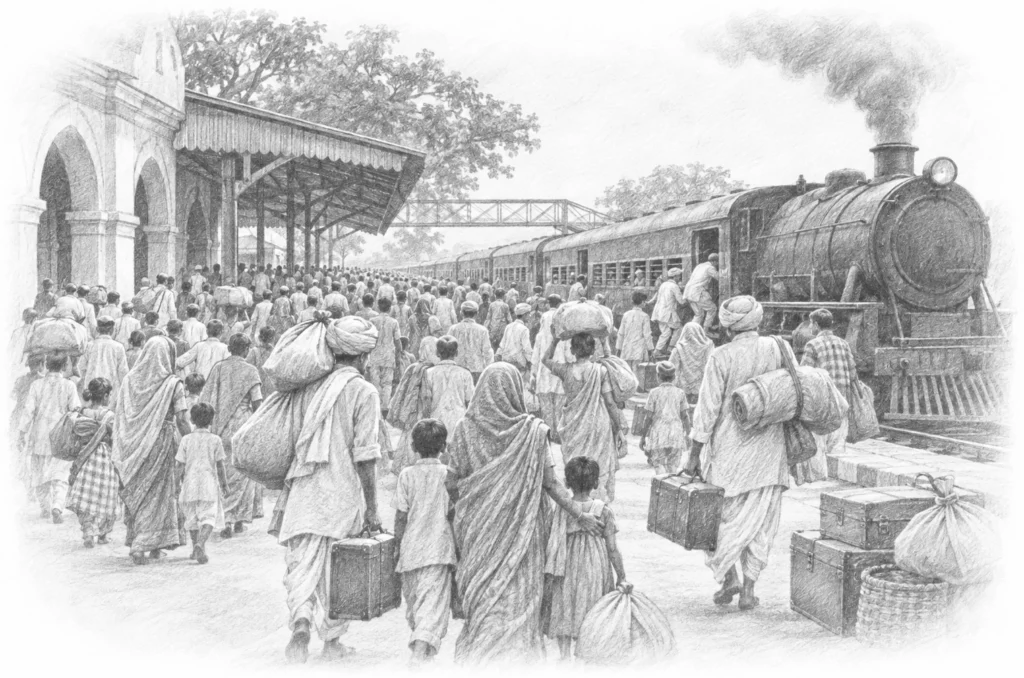
OON 15 August 1947 India became independent, but the same moment saw the country divided into India and Pakistan. Partition uprooted around fifteen million people and cost perhaps half a million to a million lives, and more than five hundred princely states had still to be brought into the new Indian Union. This unit, the last of the paper, studies three linked processes: the growth of communalism in Indian politics and the two-nation theory; the negotiations that led to Partition and independence; and the integration of the princely states, completed largely under Sardar Vallabhbhai Patel and V.P. Menon.

5.1 Communalism in Indian Politics
Communalism is the belief that people who follow the same religion share common social, political and economic interests, different from and opposed to those of followers of other religions. In simple words, it turns religious identity into a political identity. Bipan Chandra, in Communalism in Modern India (1984), described three stages of communal ideology: first, the belief that followers of a religion share secular interests; second, liberal communalism, the belief that the interests of different religious communities are different; and third, extreme communalism, the belief that these interests are hostile and incompatible, so communities cannot live together. Communalism is a modern phenomenon tied to mass politics, not a continuation of medieval religious conflict.

Causes of Communalism
- Colonial policy of divide and rule. The British treated Hindus and Muslims as separate political communities; the partition of Bengal in 1905 and the separate electorates of 1909 encouraged politics along religious lines.
- Census and classification. From 1871, the colonial census counted people by religion and caste, making communities conscious of their numbers and status.
- Uneven development. Muslims in many regions lagged in English education, government jobs and business, and middle-class competition for jobs and seats took communal forms.
- Religious revivalism. Movements such as cow protection, shuddhi, tabligh and tanzim mobilised people around religious symbols and sharpened boundaries.
- Use of religion in mass politics. Nationalist leaders sometimes used religious symbols to mobilise people, while communal organisations claimed to speak for whole communities.
- Communal organisations. The Muslim League (1906), the Hindu Mahasabha (1915) and the Rashtriya Swayamsevak Sangh (1925) gave communal ideas organisational form.
Milestones of Communal Politics
- 1906 → A Muslim deputation led by the Aga Khan met Viceroy Minto at Simla to demand separate electorates, and the Muslim League was founded at Dacca.
- 1909 → The Morley-Minto Reforms introduced separate electorates, which later reforms extended.
- 1916 → In the Lucknow Pact, the Congress and the League agreed on joint demands and accepted separate electorates, a moment of cooperation.
- 1920–22 → The Khilafat and Non-Cooperation movements brought Hindus and Muslims together, but the alliance broke down after 1922, followed by riots in the 1920s.
- 1928–29 → The Nehru Report’s rejection of separate electorates was opposed by many Muslim leaders, and Jinnah put forward his Fourteen Points.
- 1937 → After the provincial elections, the Congress refused to form coalition ministries with the League in Uttar Pradesh, which Jinnah used to argue that Muslims would be dominated under Congress rule.
5.2 The Two-Nation Theory, Partition and Independence
The Two-Nation Theory
The two-nation theory held that Hindus and Muslims were not merely two religious communities but two separate nations, with different religions, cultures, histories, heroes and ways of life, so they could not live together under a single government based on majority rule. Ideas of Muslim distinctiveness were voiced by Sayyid Ahmad Khan in the 1880s, and the poet Muhammad Iqbal, in his presidential address to the Muslim League at Allahabad in 1930, proposed a consolidated Muslim state in north-western India. Choudhry Rahmat Ali coined the name Pakistan in a pamphlet of 1933. M.A. Jinnah gave the theory its fullest political form in his Lahore address of March 1940. On the Hindu side, V.D. Savarkar also spoke of two nations in his Hindu Mahasabha presidential address of 1937.
From Lahore to Partition
- The Lahore Resolution (1940). On 23 March 1940, the Muslim League demanded that areas in which Muslims were a majority, in the north-west and east, should be grouped to form independent states.
- The Cripps Mission (1942). It offered dominion status after the war with the right of provinces to stay out of the Union, which implicitly accepted the possibility of partition; both the Congress and the League rejected it.
- The Quit India Movement (1942). While Congress leaders were in jail, the League strengthened its organisation and influence.
- The C.R. Formula and Gandhi–Jinnah talks (1944). C. Rajagopalachari proposed a plebiscite in Muslim-majority areas after the war; talks between Gandhi and Jinnah failed.
- The Simla Conference (1945). It broke down over the League’s claim to nominate all Muslim members of the Executive Council.
- The elections of 1945–46. The League won almost all Muslim seats, strengthening its claim to speak for Muslims.
- The Cabinet Mission (1946). It proposed a loose federation with groups of provinces, rejecting Pakistan; both parties first accepted it, but disagreement over grouping led the League to withdraw and call for Direct Action Day on 16 August 1946, followed by riots in Calcutta, Noakhali and Bihar.
- The Mountbatten Plan (3 June 1947). Lord Mountbatten announced partition, the division of Punjab and Bengal and the transfer of power; the Indian Independence Act was passed in July 1947.
Independence and the Human Cost of Partition
Pakistan became independent on 14 August and India on 15 August 1947. The boundaries, drawn by a commission under Cyril Radcliffe who had never been to India, were announced only on 17 August, leaving millions uncertain of their fate. About fifteen million people crossed the new borders, and estimates of deaths range from two hundred thousand to two million. Women suffered abduction, rape and forced conversion; the two governments later recovered tens of thousands of abducted women. Historians such as Urvashi Butalia, in The Other Side of Silence (1998), and Gyanendra Pandey, in Remembering Partition (2001), have recovered the experiences of ordinary people. Gandhi spent independence day in riot-torn Calcutta and was assassinated on 30 January 1948.
Explanations of Partition
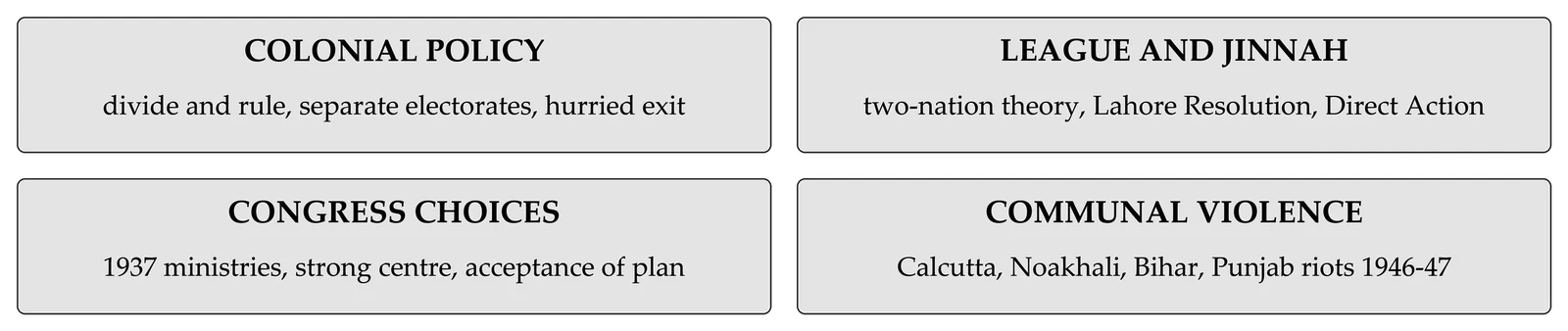
- Colonial policy. Many Indian historians stress British divide and rule, from separate electorates to the hurried transfer of power.
- Jinnah and the League. Others emphasise Jinnah’s leadership and the League’s mobilisation of Muslims around the fear of Hindu domination.
- Congress mistakes. Some point to the Congress’s refusal to share power in 1937, its underestimation of the League and its acceptance of partition to secure a strong central government.
- Jalal’s argument. Ayesha Jalal, in The Sole Spokesman (1985), argued that Jinnah used the Pakistan demand as a bargaining counter to secure parity and safeguards for Muslims within a loose Indian federation, and that partition was not his original aim.
- Communal violence. The riots of 1946–47 made many leaders conclude that partition was the only way to stop further bloodshed.
5.3 Integration of the Indian States
At independence, about 565 princely states, covering two-fifths of the territory and a quarter of the population, were ruled by princes under British paramountcy. The Indian Independence Act ended paramountcy, so in law the states became free to join India or Pakistan or remain independent. Their integration was one of the greatest achievements of the new government.
The Process of Integration
- Leadership. Sardar Vallabhbhai Patel, as Minister of States, and V.P. Menon, the secretary of the States Department, led the process from July 1947.
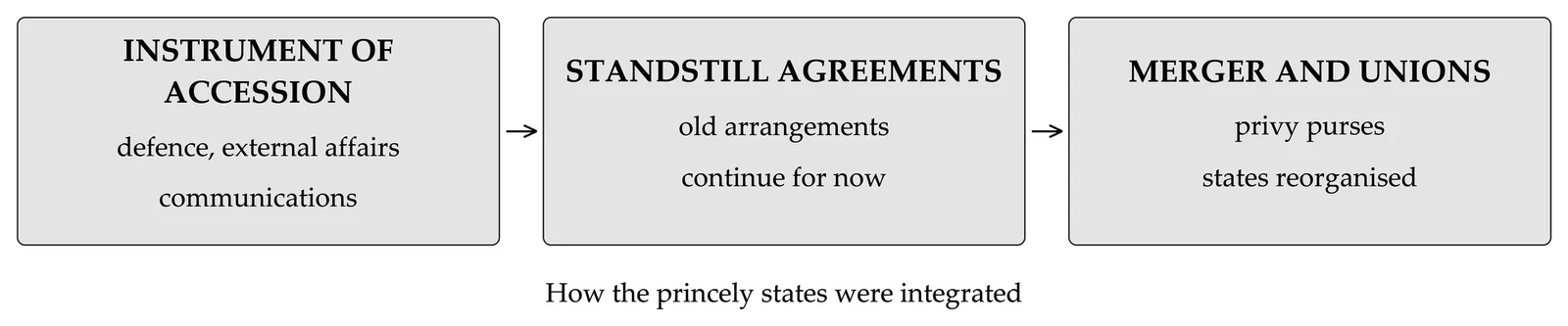
- The Instrument of Accession. Rulers were asked to accede to India on three subjects only, defence, external affairs and communications, while keeping internal autonomy.
- The Standstill Agreement. Existing arrangements on matters such as customs and railways would continue until new ones were made.
- Persuasion and pressure. Patel appealed to the princes’ patriotism, offered them privy purses and privileges, and used popular movements in the states, led by the States’ People’s Conference, to pressure them; by 15 August 1947 almost all states had acceded.
- Merger and unions. In 1948–49, smaller states were merged with neighbouring provinces or grouped into unions such as Saurashtra, Madhya Bharat and the Patiala and East Punjab States Union, and the princes signed agreements of merger.
The Difficult Cases
- Junagadh. Its Muslim ruler acceded to Pakistan though most of his subjects were Hindu and the state was surrounded by Indian territory; after popular protest and Indian action, a plebiscite in February 1948 confirmed accession to India.
- Hyderabad. The Nizam wanted independence, and the Razakars, a militia, attacked opponents while a communist-led peasant struggle grew in Telangana; in September 1948, Indian forces entered in Operation Polo, and the state acceded.
- Jammu and Kashmir. Maharaja Hari Singh delayed his decision, but after tribal raiders from Pakistan invaded in October 1947 he signed the Instrument of Accession on 26 October 1947; Indian troops were sent, and the dispute was taken to the UN.
- Manipur and Tripura. They acceded in 1947 and merged with India in 1949.
Results and Later Reorganisation
Integration created a single political unit out of the patchwork of British provinces and princely states. The Constitution of 1950 classified states into Part A (former provinces), Part B (former princely states and unions) and Part C (chief commissioners’ provinces). The demand for linguistic states, sharpened by the death of Potti Sriramulu after a fast in 1952, led to the creation of Andhra in 1953 and the States Reorganisation Act of 1956, based on the report of the commission chaired by Fazl Ali. The privy purses were abolished by the 26th Amendment in 1971. Historians praise Patel’s statesmanship, while some note the use of force in Hyderabad and the unresolved Kashmir dispute.
5.4 Important Questions
- Question 1 Discuss the growth of communalism in Indian politics during the colonial period.
- Question 2 Examine the two-nation theory and the factors that led to the partition of India.
- Question 3 Discuss the process of the integration of the princely states into the Indian Union.
- Question 4 Discuss the circumstances in which India attained independence in 1947.
DU asks the same idea in different words. So learn one broad answer for each question below; the same answer works for every question joined by OR.
Important Question 1
Discuss the growth of communalism in Indian politics during the colonial period.
OR
What is communalism? Examine the factors responsible for the rise of communal politics in colonial India.
OR
Discuss the role of colonial policy in the growth of communalism in India.
Model Answer
“I am a Musalman and proud of that fact.”
— Maulana Abul Kalam Azad, Congress presidential address, Ramgarh (1940)
Introduction. Communalism is the belief that people who share a religion also share political, economic and social interests opposed to those of other religious groups. In colonial India, communalism grew alongside nationalism and eventually led to the partition of the country. It was a modern phenomenon, shaped by colonial policy, uneven development and mass politics, rather than a simple continuation of age-old religious hostility.
1. Meaning of Communalism
Communalism turns religious identity into a political identity. It assumes that Hindus or Muslims form homogeneous communities with common interests, ignoring differences of class, region, language and caste within them, and presents other communities as rivals or enemies.
2. Bipan Chandra’s Three Stages
Bipan Chandra identified three stages: the belief that co-religionists share secular interests; liberal communalism, which holds that different communities have different interests but can cooperate; and extreme communalism, which holds that their interests are hostile and incompatible. Indian communalism moved towards the extreme stage in the late 1930s and 1940s.
3. A Modern Phenomenon
Historians stress that communalism was modern. It arose with colonial institutions, the census, representative politics, the press and competition for jobs, which encouraged people to think of themselves as members of religious blocs with numbers, rights and grievances.
4. Colonial Divide and Rule
The British often treated Hindus and Muslims as separate communities. The partition of Bengal in 1905, which created a Muslim-majority province, and the separate electorates of 1909 encouraged political organisation along religious lines and gave communal leaders an institutional base.
5. Separate Electorates
Separate electorates, introduced by the Morley-Minto Reforms of 1909 and extended in 1919 and 1935, meant that Muslim candidates were elected only by Muslim voters. This encouraged candidates to appeal to religious identity and made it harder for leaders to build cross-community support.
6. Uneven Economic and Educational Development
In many regions, Muslims entered English education and government service later than Hindus, and middle-class competition for jobs, seats and licences took communal forms. Economic conflicts, such as those between Hindu landlords and Muslim peasants in east Bengal, were sometimes interpreted in religious terms.
7. Religious Revivalism
Nineteenth-century revivalism, cow protection movements, shuddhi and the Muslim tabligh and tanzim campaigns of the 1920s mobilised people around religious symbols and sharpened boundaries between communities, contributing to riots in the 1920s.
8. Communal Organisations
The Muslim League (1906), the Hindu Mahasabha (1915) and the Rashtriya Swayamsevak Sangh (1925) claimed to speak for whole communities. They promoted communal ideologies and opposed the Congress’s claim to represent all Indians.
9. Moments of Unity
Communalism was not inevitable. The Lucknow Pact of 1916 and the Khilafat and Non-Cooperation movements of 1920–22 brought Hindus and Muslims together. The breakdown of this unity after 1922 was followed by riots and growing mistrust.
10. Nationalist Weaknesses
Some nationalist leaders used Hindu religious symbols in mass mobilisation, which alienated many Muslims, and the Congress sometimes compromised with communal elements. Its refusal to form coalition ministries with the League in 1937 deepened Muslim fears of domination.
11. The Late 1930s and 1940s
After 1937, the League under Jinnah adopted extreme communalism, presenting Muslims as a separate nation in danger under a Hindu-majority government. The Lahore Resolution of 1940 and the elections of 1945–46 made communalism the decisive force in politics.
12. Communal Violence
Direct Action Day on 16 August 1946 led to the Great Calcutta Killings, followed by riots in Noakhali, Bihar and Punjab. This violence convinced many leaders that partition was the only way to restore peace.
13. Consequences
Communalism led to the partition of India, mass migration and violence, and left a legacy of mistrust that continues to shape politics in South Asia, as well as the commitment of the Indian Constitution to secularism.
14. Evaluation
Communalism grew from the interaction of colonial policy, social change and political choices. Neither the British nor any single party alone created it, but all contributed, and the national movement could not fully overcome it.
Conclusion. Thus, communalism in colonial India was a modern ideology that turned religion into political identity, encouraged by divide and rule, separate electorates, uneven development, revivalism and communal organisations. It moved from liberal to extreme forms in the 1930s and 1940s and culminated in the tragedy of Partition.
Important Question 2
Examine the two-nation theory and the factors that led to the partition of India.
OR
Discuss the role of the two-nation theory in the partition of India.
OR
Why was India partitioned in 1947? Discuss the different explanations of Partition.
Model Answer
“The Hindus and Muslims belong to two different religious philosophies, social customs, literatures.”
— M.A. Jinnah, presidential address to the Muslim League, Lahore (March 1940)
Introduction. The partition of India in August 1947 created two states, India and Pakistan, and caused one of the largest migrations in human history. It was justified by the two-nation theory, which held that Hindus and Muslims were separate nations. Historians explain Partition through colonial policy, the politics of the Muslim League and the Congress, and the communal violence of 1946–47.
1. Meaning of the Two-Nation Theory
The two-nation theory claimed that Hindus and Muslims were two distinct nations, with different religions, cultures, laws, histories and heroes, so they could not live together under a single government based on majority rule and Muslims needed a separate homeland.
2. Early Ideas
Ideas of Muslim distinctiveness appeared in Sayyid Ahmad Khan’s warnings in the 1880s that majority rule would harm Muslims. In 1930, Muhammad Iqbal proposed a consolidated Muslim state in the north-west, and in 1933 Choudhry Rahmat Ali coined the name Pakistan.
3. Jinnah and the Lahore Resolution
M.A. Jinnah, once called the ambassador of Hindu–Muslim unity, turned to the two-nation theory after 1937. In March 1940 he declared that Hindus and Muslims belonged to two different civilisations, and the League’s Lahore Resolution demanded independent states in Muslim-majority areas.
4. Colonial Policy
British policy of divide and rule, from the partition of Bengal and separate electorates to the recognition of the League as the representative of Muslims, strengthened communal politics. During the Second World War, the British relied on the League while the Congress leaders were in jail.
5. The Congress’s Role
Critics argue that the Congress underestimated the League, refused to share power in 1937 and was unwilling to accept a weak centre. By 1947, leaders such as Nehru and Patel accepted partition to secure a strong, united India in the remaining territory.
6. Failed Negotiations
The Cripps Mission of 1942, the Gandhi–Jinnah talks of 1944, the Simla Conference of 1945 and the Cabinet Mission of 1946 all failed to produce an agreement that both the Congress and the League could accept, mainly over the questions of Pakistan, parity and the powers of the centre.
7. The Cabinet Mission Plan
The Cabinet Mission of 1946 proposed a weak federal centre with groups of provinces, rejecting Pakistan. Both parties initially accepted it, but differences over grouping and Nehru’s statement that the Congress was free to change the plan led the League to withdraw.
8. Direct Action and Violence
The League’s Direct Action Day on 16 August 1946 led to massive riots in Calcutta, followed by violence in Noakhali, Bihar and Punjab. The spread of violence created a sense that partition was the only way to avoid civil war.
9. The Mountbatten Plan
Lord Mountbatten announced on 3 June 1947 that India would be partitioned and Punjab and Bengal divided. The British advanced the date of transfer to August 1947, and the Indian Independence Act was passed in July, leaving little time to prepare.
10. Jalal’s Revisionist View
Ayesha Jalal, in The Sole Spokesman (1985), argued that Jinnah used the Pakistan demand as a bargaining counter to secure parity and safeguards for Muslims within a united India, and that partition resulted from the failure of negotiations rather than from a fixed plan.
11. The Human Cost
About fifteen million people were displaced and hundreds of thousands killed. Women suffered abduction and violence. Historians such as Urvashi Butalia and Gyanendra Pandey have recorded these experiences, showing Partition as a human tragedy, not only a political event.
12. Critique of the Two-Nation Theory
Critics note that Hindus and Muslims shared languages, cultures and histories across regions, that many Muslims, such as Maulana Azad and the Deoband ulama, rejected the theory, and that the later separation of Bangladesh in 1971 showed that religion alone could not hold a nation together.
13. India’s Response
India rejected the two-nation theory by adopting a secular Constitution that guaranteed equal citizenship and freedom of religion to all, and millions of Muslims chose to remain in India.
14. The Division of Punjab and Bengal
When partition became likely, the Congress and the Sikh leaders insisted that if India was divided, Punjab and Bengal must also be divided so that their non-Muslim majority districts remained in India. Jinnah protested that this would give Muslims a truncated and moth-eaten Pakistan, but he accepted the Mountbatten Plan. The division of these two provinces caused the worst violence and the largest migrations of 1947.
15. Evaluation
Partition resulted from a combination of colonial policy, communal ideology, political miscalculation and violence. The two-nation theory provided its justification, but historians debate whether it was inevitable or the result of failed negotiations.
Conclusion. Thus, the two-nation theory, developed from Sayyid Ahmad Khan and Iqbal to Jinnah’s Lahore address of 1940, claimed that Hindus and Muslims were separate nations. Combined with colonial divide and rule, failed negotiations, Congress miscalculations and the violence of 1946–47, it led to Partition in 1947, at an immense human cost.
Important Question 3
Discuss the process of the integration of the princely states into the Indian Union.
OR
Examine the role of Sardar Patel in the integration of Indian states.
OR
Discuss the problems faced in integrating Junagadh, Hyderabad and Kashmir.
Model Answer
“We are at a momentous stage in the history of India. By common endeavour we can raise the country to a new greatness, while lack of unity will expose us to fresh calamities.”
— Sardar Vallabhbhai Patel, statement on the princely states (5 July 1947)
Introduction. At independence, more than five hundred princely states, large and small, ruled by princes under British paramountcy, had to be integrated into the new Indian Union. With the lapse of paramountcy, they were legally free to join India or Pakistan or remain independent. Under Sardar Vallabhbhai Patel and V.P. Menon, almost all were integrated within two years, a remarkable achievement of statecraft.
1. The Princely States
About 565 princely states covered roughly two-fifths of India’s territory and a quarter of its population. They ranged from large states such as Hyderabad, Mysore and Kashmir to tiny estates, and were ruled by princes who accepted British paramountcy in return for internal autonomy.
2. The Lapse of Paramountcy
The Indian Independence Act of 1947 ended British paramountcy, so the states were legally free to decide their future. Some rulers dreamed of independence, which threatened to break India into fragments.
3. Patel and V.P. Menon
Patel became Minister of the new States Department in July 1947, with V.P. Menon as its secretary. Patel appealed to the princes’ patriotism, warning of anarchy if they stood apart, while Menon drafted the legal instruments of integration.
4. The Instrument of Accession
Rulers were asked to accede to India on three subjects only, defence, external affairs and communications, keeping internal autonomy. This limited demand made accession easier to accept, and by 15 August 1947 almost all states had signed.
5. The Standstill Agreement
Alongside accession, standstill agreements kept existing arrangements on matters such as customs, posts and railways in place until new ones were made, ensuring continuity of administration.
6. Popular Movements in the States
The All India States’ People’s Conference and popular movements for democracy in states such as Travancore, Mysore and Orissa put pressure on the princes from below, making resistance to accession difficult.
7. Merger and Democratisation
In 1948–49, smaller states were merged with provinces, and others were grouped into unions such as Saurashtra, Madhya Bharat, Rajasthan and the Patiala and East Punjab States Union. The princes received privy purses and privileges in return for surrendering power.
8. Junagadh
The Nawab of Junagadh acceded to Pakistan although most of his subjects were Hindu and the state was surrounded by Indian territory. After popular protest, the Nawab fled, Indian forces took control and a plebiscite in February 1948 overwhelmingly favoured India.
9. Hyderabad
The Nizam of Hyderabad sought independence, and the Razakars, a militia led by Qasim Razvi, terrorised opponents. After negotiations failed, Indian forces entered the state in September 1948 in Operation Polo, and Hyderabad joined India within days.
10. Jammu and Kashmir
Maharaja Hari Singh delayed his decision until tribal raiders backed by Pakistan invaded in October 1947. He signed the Instrument of Accession on 26 October 1947, Indian troops were flown in, and India took the dispute to the United Nations, where it remains unresolved.
11. Constitutional Integration
The Constitution of 1950 classified states into Parts A, B and C, bringing former princely states into a common constitutional framework. The States Reorganisation Act of 1956 reorganised states on linguistic lines, completing territorial integration.
12. Abolition of Privy Purses
The privy purses and privileges promised to the princes were abolished by the 26th Amendment in 1971, after the Supreme Court had struck down an earlier presidential order, ending the last special status of the former rulers.
13. Assessment of Patel’s Role
Patel is remembered as the Iron Man of India for combining persuasion, generous terms and firmness. Critics note the use of force in Hyderabad and the problems left in Kashmir, but most historians agree that integration prevented the fragmentation of India.
14. Evaluation
The integration of the princely states was a bloodless revolution in most cases, achieved through diplomacy, legal instruments and popular pressure, and it gave India the territorial unity on which its democracy was built.
Conclusion. Thus, under Sardar Patel and V.P. Menon, the princely states were integrated through the Instrument of Accession, standstill agreements, mergers and unions, with firm action in Junagadh and Hyderabad and the accession of Kashmir in 1947. Integration, later completed by constitutional classification and reorganisation, created the territorial unity of independent India.
Important Question 4
Discuss the circumstances in which India attained independence in 1947.
OR
Examine the developments from the Cabinet Mission to the Indian Independence Act of 1947.
OR
Why did the British decide to leave India in 1947? Discuss.
Model Answer
“At the stroke of the midnight hour, when the world sleeps, India will awake to life and freedom.”
— Jawaharlal Nehru, Tryst with Destiny speech (14–15 August 1947)
Introduction. India became independent at midnight on 14–15 August 1947 after nearly two centuries of British rule. Independence came through a combination of the long national struggle, the weakening of Britain after the Second World War and difficult negotiations among the British, the Congress and the Muslim League. It came, however, together with Partition and great violence.
1. The Impact of the Second World War
The war exhausted Britain economically and militarily, and the new Labour government under Clement Attlee, elected in 1945, was more willing to grant independence. The United States also favoured decolonisation.
2. The Quit India Movement
The Quit India Movement of August 1942, though suppressed, showed the depth of popular opposition to British rule and made it clear that India could not be governed indefinitely against the will of its people.
3. The INA Trials and Naval Mutiny
The trials of Indian National Army officers at the Red Fort in 1945–46 aroused nationwide sympathy, and the Royal Indian Navy mutiny of February 1946 in Bombay showed that the loyalty of the armed forces could no longer be relied upon.
4. The Elections of 1945–46
The Congress won most general seats and the League almost all Muslim seats, showing that both had to be part of any settlement and strengthening the League’s claim to speak for Muslims.
5. The Cabinet Mission
The Cabinet Mission of 1946 proposed a three-tier federation with a weak centre and groups of provinces and an interim government. It was an attempt to keep India united, but disagreement over grouping led to its failure.
6. The Interim Government
An interim government headed by Nehru was formed in September 1946, and the League joined it in October, but the two parties could not work together, which paralysed administration.
7. Communal Violence
Direct Action Day in August 1946 and the riots that followed in Calcutta, Noakhali, Bihar and Punjab created an atmosphere of fear and convinced many leaders that a quick settlement was needed.
8. The Attlee Declaration
On 20 February 1947, Prime Minister Attlee announced that Britain would leave India by June 1948 at the latest, and Lord Mountbatten was sent as Viceroy to arrange the transfer of power.
9. The Mountbatten Plan
On 3 June 1947, Mountbatten announced the plan to partition India, divide Punjab and Bengal and transfer power to two dominions. The Congress and the League accepted it, and the date was advanced to August 1947.
10. The Indian Independence Act
The British Parliament passed the Indian Independence Act in July 1947, creating the dominions of India and Pakistan from 15 August, ending paramountcy over the princely states and giving the Constituent Assemblies full sovereign power.
11. The Radcliffe Line
Boundary commissions under Cyril Radcliffe divided Punjab and Bengal in a few weeks, and their awards were announced only after independence, causing confusion and contributing to the violence of the migrations.
12. Freedom and Its Cost
Independence was celebrated with Nehru’s Tryst with Destiny speech, but it came with the displacement of about fifteen million people, massive violence and the assassination of Gandhi in January 1948.
13. Reasons for British Withdrawal
Historians cite the strength of the national movement, the war’s impact on Britain, the unreliability of the armed forces, international pressure and the rising cost of holding India. Imperialist historians stressed British willingness to transfer power, while nationalists stressed Indian struggle.
14. The Constituent Assembly
The Constituent Assembly, elected indirectly by the provincial assemblies under the Cabinet Mission Plan, first met on 9 December 1946, though the Muslim League boycotted it. Under the Indian Independence Act it became a sovereign body for India from 15 August 1947, acting both as the constitution-making body and as the dominion legislature until the Constitution came into force on 26 January 1950.
15. Evaluation
India’s independence was the result of a long struggle combined with a changed international and British situation, but the failure to agree on a united India meant that freedom came with Partition.
Conclusion. Thus, India attained independence on 15 August 1947 because the national movement, the Second World War, the INA trials and naval mutiny made British rule untenable, and because the Cabinet Mission’s failure and communal violence led to the Mountbatten Plan and the Indian Independence Act. Freedom came, but with the tragedy of Partition.
Short Notes
(a) Lahore Resolution
The resolution adopted by the Muslim League on 23 March 1940 demanding that Muslim-majority areas in the north-west and east of India be grouped to form independent states; it is often called the Pakistan Resolution.
(b) Instrument of Accession
The legal document by which princely rulers acceded to India in 1947, surrendering control over defence, external affairs and communications to the Union.
(c) Operation Polo
The Indian military operation of September 1948 that ended the Nizam’s resistance and brought Hyderabad into the Indian Union.
More notes: GE-3 Nationalism in India
These notes are prepared by PADHO TO AISE for study help. They are not an official publication.