

Generic Electives (GE) GE-3 Nationalism in India
Unit I · 31 min read · Updated 27 Nov 2026
As per the University of Delhi (DU) Generic Elective (GE) syllabus offered by the Department of Political Science
Contents
- 1.1 Nationalism and the Ways of Studying It
- General Theories of Nationalism
- Was India a Nation
- Why Approaches Matter
- 1.2 The Imperialist and Nationalist Approaches
- The Imperialist Approach
- The Cambridge School
- The Nationalist Approach
- 1.3 The Marxist and Subaltern Approaches
- The Marxist Approach
- The Subaltern Approach
- Other Perspectives
- 1.4 Important Questions
- Discuss the different approaches to the study of nationalism in India.
- Compare the Nationalist and Imperialist approaches to the study of nationalism in India.
- Discuss the Marxist approach to the study of nationalism in India.
- Discuss the Subaltern approach to the study of nationalism in India. How is it different from other approaches?
- Short Notes
भारतीय राष्ट्रवाद के इतिहास-लेखन पर लंबे समय से अभिजातवाद का प्रभुत्व रहा है – औपनिवेशिक अभिजातवाद और बुर्जुआ-राष्ट्रवादी अभिजातवाद का।
The historiography of Indian nationalism has for a long time been dominated by elitism – colonialist elitism and bourgeois-nationalist elitism.
— Ranajit Guha, On Some Aspects of the Historiography of Colonial India, Subaltern Studies I (1982)
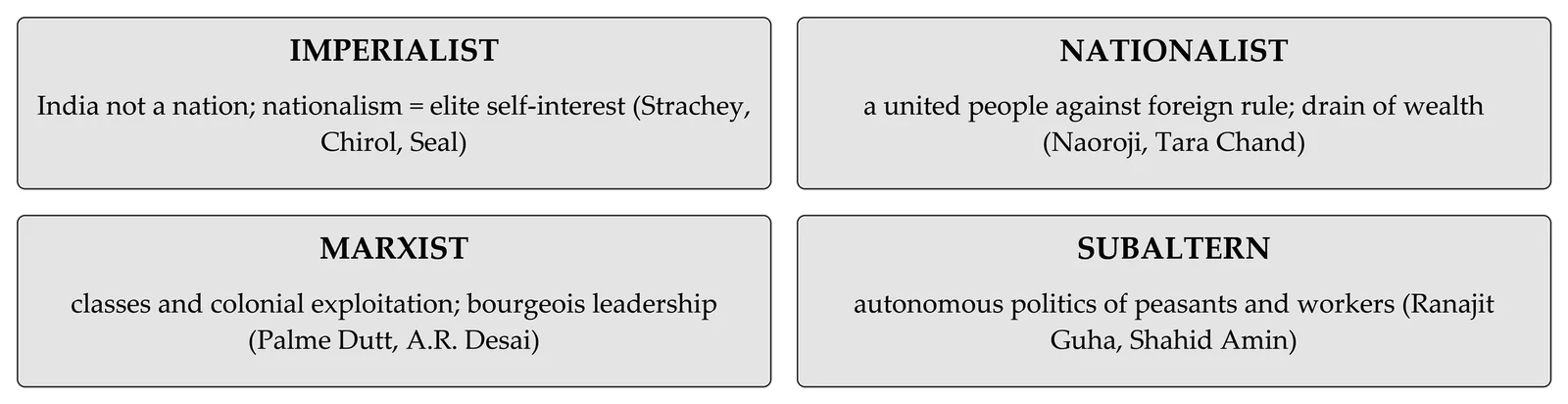
TTHE Indian national movement is one of the greatest mass movements in modern history, but historians have never agreed on what it was. Was India already a nation, awakened by colonial rule, or a collection of peoples brought together by British administration? Was the movement a struggle of the whole people against imperialism, a contest among educated elites for jobs and power, a movement led by the bourgeoisie, or something in which ordinary peasants and workers acted on their own? This chapter studies the four main approaches to these questions, the Nationalist, Imperialist, Marxist and Subaltern, and shows how each shapes our understanding of Indian nationalism.
1.1 Nationalism and the Ways of Studying It
A nation is a large group of people who feel that they belong together because of shared history, culture, territory or political aspirations, and nationalism is the belief that such a nation should have its own state or self-government. In simple words, nationalism is both a feeling of belonging and a political demand. Before we study the Indian debate, it helps to know how scholars explain nationalism in general, because each approach to Indian nationalism draws on one of these explanations.
General Theories of Nationalism
- Primordialism. Some thinkers hold that nations are ancient and natural, rooted in language, religion and kinship; nationalists often see their own nation this way.
- Modernism. Ernest Gellner, in Nations and Nationalism (1983), argued that nationalism arose with industrial society, which needed a common high culture spread through mass education; nations are products of modernity, not its cause.
- Imagined communities. Benedict Anderson, in Imagined Communities (1983), called the nation an imagined political community, since its members will never meet most of their fellow members, and showed how print capitalism, newspapers and novels made such imagining possible.
- Invented traditions. Eric Hobsbawm, in The Invention of Tradition (1983, with Terence Ranger) and Nations and Nationalism since 1780 (1990), showed how ruling groups invent rituals and symbols that make nations appear old.
- Ethno-symbolism. Anthony D. Smith argued that modern nations build on older ethnic communities, myths and memories, taking a middle path between primordialism and modernism.
Was India a Nation
The Indian debate begins with a basic question: was India a nation before British rule? British officials such as John Strachey, in his lectures published as India (1888), insisted that India had never possessed any unity, political, social or religious, and was only a geographical expression held together by British power. Indian nationalists replied that India had an ancient cultural and civilisational unity, and that colonial rule had only awakened it. Surendranath Banerjea called his autobiography A Nation in Making (1925), suggesting that the nation was being built through the struggle itself. Jawaharlal Nehru, in The Discovery of India (1946), described India as an ancient palimpsest on which many layers of culture had been written without erasing the earlier ones, a unity in diversity.
Why Approaches Matter
An approach is a way of looking at the past, i.e. a set of assumptions about who makes history, what drives it and which sources matter. The four approaches to Indian nationalism differ on several key questions:
- Who were the main actors? Colonial rulers, nationalist leaders, classes, or ordinary people acting on their own.
- What drove the movement? Ideals of freedom, self-interest and competition, economic contradictions, or the everyday experience of domination.
- What was the role of the Congress and Gandhi? Leader of the whole nation, a coalition of interests, a bourgeois party, or an elite that both mobilised and restrained the masses.
- What sources should be used? Government records, nationalist speeches and newspapers, economic data, or rumours, folk songs and the records of rebellions.
Students should remember that these approaches are not simply right or wrong. Each one throws light on certain aspects of the national movement and hides others, and the best answers compare them carefully.
1.2 The Imperialist and Nationalist Approaches
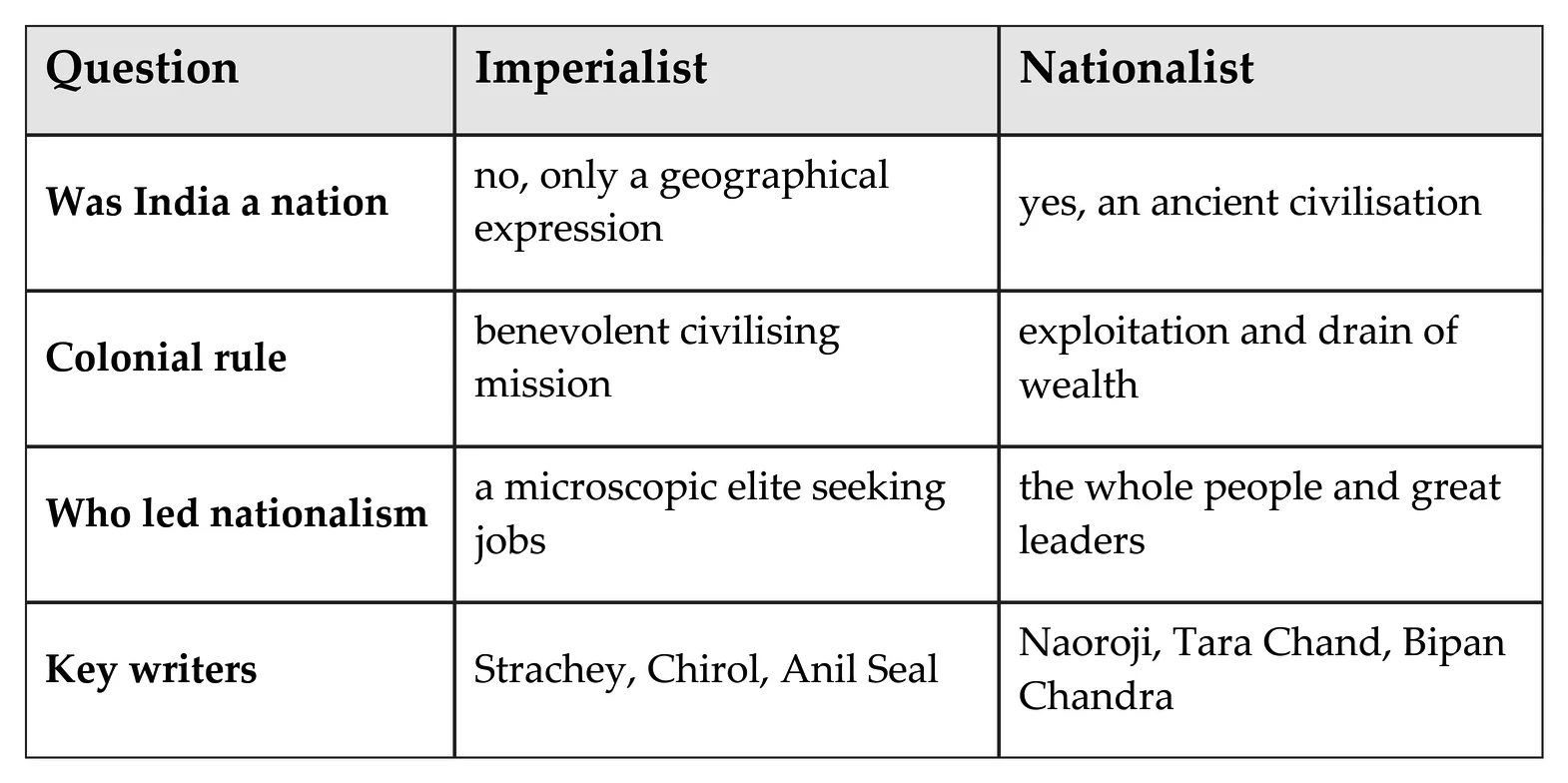
The two earliest approaches developed in direct opposition to each other. The Imperialist or colonialist approach came from British administrators and historians who wanted to justify colonial rule; the Nationalist approach came from Indian leaders and historians who wanted to justify the demand for freedom.
The Imperialist Approach
The imperialist approach, also called the colonialist approach, denied that India was a nation and treated Indian nationalism as the work of a small, selfish minority. Its main features were:
- India not a nation. Writers such as John Strachey (1888) argued that India was a collection of castes, religions and regions with no common identity, so British rule was necessary to hold it together.
- A microscopic minority. Lord Dufferin, the Viceroy, dismissed the Congress soon after its founding as representing only a microscopic minority of educated Indians.
- Benevolent rule. British rule was presented as bringing peace, law, railways and education, a civilising mission that Indians should be grateful for.
- Unrest as sedition. Valentine Chirol, in Indian Unrest (1910), described the rise of extremist nationalism as dangerous agitation stirred up by disloyal Brahmin elites and Hindu revivalism.
- Gradual self-government. Imperial historians such as Reginald Coupland presented constitutional reforms as a gift of gradual self-government granted by the British when Indians were ready.
The Cambridge School
From the late 1960s, a group of historians associated with Cambridge University gave the imperialist approach a more scholarly form. Anil Seal, in The Emergence of Indian Nationalism (1968), argued that nationalism was created by Western-educated elites who competed with one another and with the British for jobs, positions and power. Later work by John Gallagher, Gordon Johnson and Seal, collected in Locality, Province and Nation (1973), argued that politics was driven by local leaders seeking patronage, who formed alliances upward through provincial and national networks as the British extended representative institutions. On this view, nationalism was not a struggle of ideals but a competition of interests, and the Congress was a loose coalition of factions held together by self-interest.
The Nationalist Approach
The nationalist approach saw the freedom struggle as the movement of the whole Indian people, united by a love of freedom, against foreign rule. Its main features were:
- An ancient nation. India had a long civilisational unity, which colonial rule had suppressed and the national movement revived.
- Economic critique of colonialism. Dadabhai Naoroji, in Poverty and Un-British Rule in India (1901), developed the drain theory, arguing that Britain drained India’s wealth, and R.C. Dutt’s Economic History of India (1902–04) showed the ruin of Indian industry and agriculture.
- Heroic leaders. The movement is told through the ideals and sacrifices of leaders such as Tilak, Gandhi and Nehru.
- Unity of the people. All classes, castes and religions are seen as participating in a common struggle, and conflicts within Indian society are given little attention.
- Official histories. After independence, works such as Tara Chand’s History of the Freedom Movement in India (four volumes, 1961–72) and R.C. Majumdar’s History of the Freedom Movement in India (1962–63) presented this view, though Majumdar disagreed with the government’s emphasis.
Later historians, led by Bipan Chandra, combined the nationalist view with insights from Marxism. In India’s Struggle for Independence (1988), written with Mridula Mukherjee, Aditya Mukherjee, K.N. Panikkar and Sucheta Mahajan, they described the national movement as a broad, popular, anti-imperialist movement that included many classes and used a strategy of struggle, truce and struggle, often called a left-nationalist view.
1.3 The Marxist and Subaltern Approaches
The Marxist and Subaltern approaches both criticised the earlier ones for ignoring the masses, but they differed in how they understood the role of ordinary people.
The Marxist Approach
Marxist historians explain history through class and the mode of production. Karl Marx himself wrote on British rule in India in 1853, arguing that Britain had a double mission in India, destroying the old society and laying the material foundations of a modern one. Indian Marxists developed this into a full interpretation of nationalism:
- R. Palme Dutt. In India Today (1940), Dutt argued that the national movement expressed the contradiction between the interests of the Indian people and British imperialism, but that its leadership was in the hands of the Indian bourgeoisie, which compromised with imperialism when mass movements threatened its interests.
- A.R. Desai. In Social Background of Indian Nationalism (1948), Desai traced nationalism to the new social classes created by colonial rule, the bourgeoisie, the middle class, workers and peasants, and divided the movement into phases according to which classes led it.
- Two contradictions. Marxists stress two contradictions: the primary one between colonialism and the Indian people, and a secondary one between exploiting and exploited classes within India.
- Gandhi and the bourgeoisie. Many Marxists argued that Gandhi’s non-violence and the withdrawal of movements such as Non-Cooperation in 1922 served the bourgeoisie by keeping mass action within safe limits.
- Later Marxist history. Sumit Sarkar’s Modern India 1885–1947 (1983) and Bipan Chandra’s Rise and Growth of Economic Nationalism (1966) combined class analysis with detailed study of ideas and movements.
The Subaltern Approach
The word subaltern, i.e. of inferior rank, was used by the Italian Marxist Antonio Gramsci in his prison notebooks for groups excluded from power. In 1982, Ranajit Guha launched the series Subaltern Studies with an essay that criticised colonialist, nationalist and even Marxist historiography for being elitist. The main ideas of the approach are:
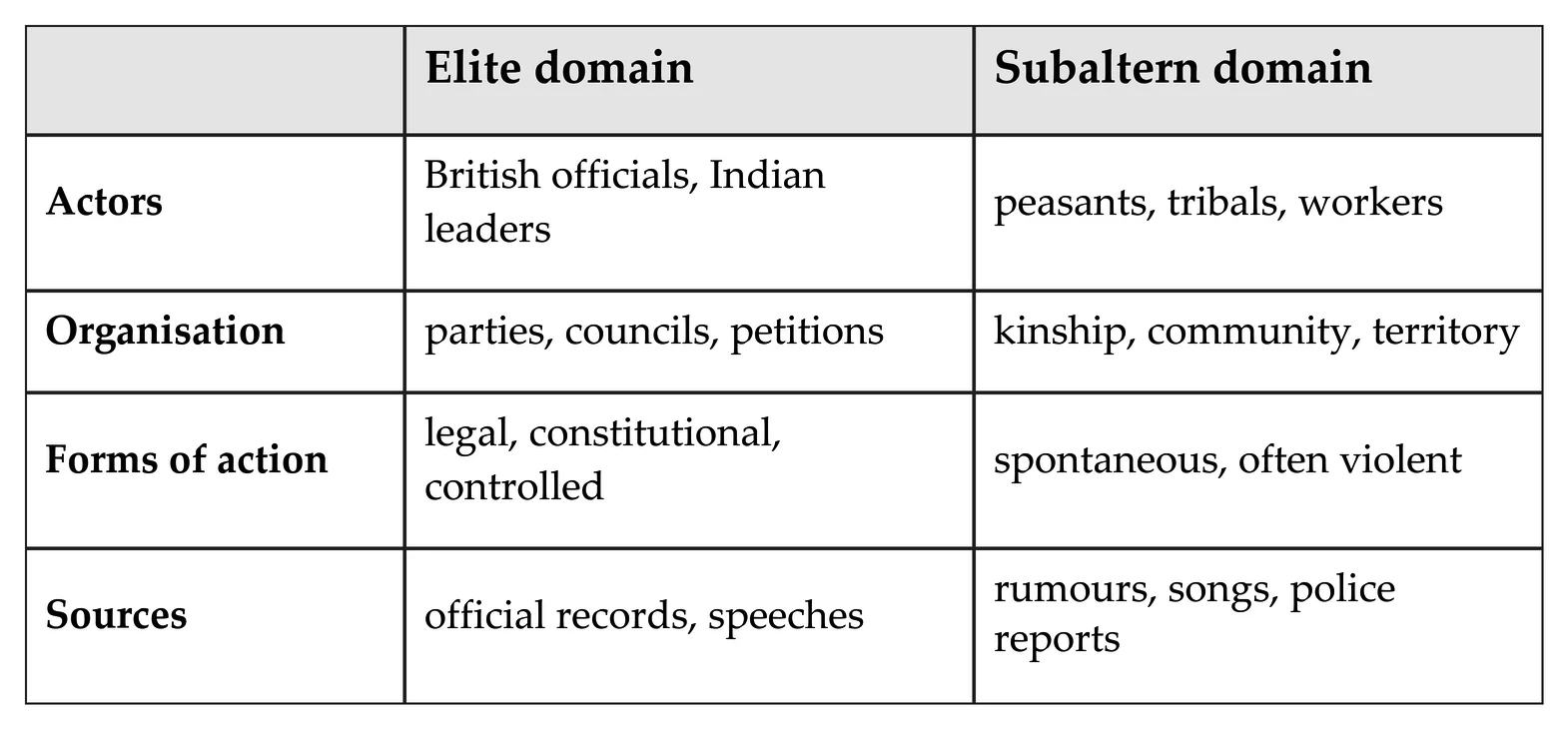
- Elitism of earlier history. Earlier approaches told the story of the national movement as the work of elites, British or Indian, and treated the masses as followers.
- An autonomous domain. Guha argued that the politics of the people, peasants, tribals, workers and the urban poor, formed an autonomous domain with its own forms of mobilisation, based on kinship, community and territory rather than on elite organisation.
- The failure of the nation. Because elites could not fully speak for the people, the Indian bourgeoisie failed to speak for the nation; there was a gap between elite and subaltern politics.
- New sources. Subaltern historians read official records against the grain and used rumours, songs and oral memories; Shahid Amin’s essay Gandhi as Mahatma (1984) showed how peasants in Gorakhpur created their own images of Gandhi.
- Peasant consciousness. Guha’s Elementary Aspects of Peasant Insurgency in Colonial India (1983) studied how rebels understood their own actions.
The approach later took a postcolonial turn. Partha Chatterjee, in Nationalist Thought and the Colonial World: A Derivative Discourse (1986), argued that Indian nationalism challenged colonial rule but accepted the framework of Western modern thought, moving through a moment of departure (Bankim Chandra), a moment of manoeuvre (Gandhi) and a moment of arrival (Nehru). Gayatri Chakravorty Spivak, in Can the Subaltern Speak (1988), questioned whether historians could recover the voice of the most oppressed, especially subaltern women. Critics such as Sumit Sarkar, in his essay The Decline of the Subaltern in Subaltern Studies (1997), argued that the series had moved away from material conditions towards culture and discourse.
Other Perspectives
Besides the four main approaches, feminist historians have shown how women took part in and were shaped by the national movement, and Dalit and anti-caste writers, following B.R. Ambedkar’s What Congress and Gandhi Have Done to the Untouchables (1945), have questioned whether the Congress represented the lower castes. These perspectives remind us that the nation was imagined differently by different groups.
1.4 Important Questions
- Question 1 Discuss the different approaches to the study of nationalism in India.
- Question 2 Compare the Nationalist and Imperialist approaches to the study of nationalism in India.
- Question 3 Discuss the Marxist approach to the study of nationalism in India.
- Question 4 Discuss the Subaltern approach to the study of nationalism in India. How is it different from other approaches?
DU asks the same idea in different words. So learn one broad answer for each question below; the same answer works for every question joined by OR.
Important Question 1
Discuss the different approaches to the study of nationalism in India.
OR
Critically examine the major historiographical approaches to Indian nationalism.
OR
How have historians differed in their understanding of the Indian national movement? Discuss.
Model Answer
“It is an imagined political community – and imagined as both inherently limited and sovereign.”
— Benedict Anderson, Imagined Communities (1983), on the nation
Introduction. Nationalism is the feeling of belonging to a nation and the demand that the nation should govern itself. In India, nationalism grew in opposition to British colonial rule and produced a mass freedom struggle. Historians, however, have interpreted this struggle in different ways. Four main approaches stand out: the Imperialist, the Nationalist, the Marxist and the Subaltern. Each asks who made the national movement and why.
1. Meaning of Nationalism
Nationalism combines a sense of shared identity with a political demand for self-government. Scholars such as Ernest Gellner and Benedict Anderson see nations as modern creations, made possible by industrialisation, mass education and print, while others see them as rooted in older cultural communities. These general debates shape how historians study Indian nationalism and its origins.
2. The Question of India’s Unity
The first issue dividing historians is whether India was a nation before British rule. Colonial writers such as John Strachey in 1888 denied any Indian unity, while nationalists argued that India possessed an ancient civilisational unity. This question determines whether nationalism is seen as an awakening of an old nation or the creation of a new one.
3. The Imperialist Approach
British administrators and historians saw Indian nationalism as the work of a small educated minority, not of a real nation. Lord Dufferin called the Congress a microscopic minority, and Valentine Chirol’s Indian Unrest (1910) presented extremist nationalism as sedition. British rule was described as a benevolent civilising mission that brought order, law and progress.
4. The Cambridge School
From 1968, Anil Seal and other Cambridge historians argued that nationalism arose from competition among Western-educated elites for jobs, patronage and power. Politics moved from locality to province to nation as the British extended representative institutions. On this view, the Congress was a coalition of factions driven by self-interest rather than by ideals.
5. The Nationalist Approach
Nationalist historians presented the freedom struggle as the movement of the whole Indian people against foreign rule. They stressed the economic critique of colonialism, especially Dadabhai Naoroji’s drain theory, the sacrifices of leaders and the unity of all communities. Tara Chand and R.C. Majumdar wrote multi-volume histories of the freedom movement in this spirit after independence.
6. Bipan Chandra’s Synthesis
Bipan Chandra and his colleagues, in India’s Struggle for Independence (1988), described the movement as a broad, popular, multi-class struggle against imperialism. They emphasised Gandhi’s strategy of struggle, truce and struggle and the movement’s commitment to democracy and secularism, combining nationalist and Marxist insights in what is often called a left-nationalist view.
7. The Marxist Approach
Marxist historians explain nationalism through class and economic change. R. Palme Dutt’s India Today (1940) saw the movement as an expression of the conflict between Indian people and imperialism, led by a bourgeoisie that compromised with the British. A.R. Desai’s Social Background of Indian Nationalism (1948) linked each phase of nationalism to the rise of new social classes.
8. The Two Contradictions
Marxists identify a primary contradiction between colonialism and the Indian people and a secondary contradiction between classes within Indian society, such as landlords and peasants or capitalists and workers. The national movement, they argue, mobilised the masses against imperialism but did not resolve the internal contradictions, which is why independence left deep inequalities.
9. The Subaltern Approach
In 1982, Ranajit Guha launched Subaltern Studies, criticising earlier historiography as elitist. He argued that peasants, tribals and workers had an autonomous domain of politics, with their own forms of mobilisation based on community and kinship. The elites could not fully speak for them, so the bourgeoisie failed to speak for the nation.
10. New Methods and Sources
Subaltern historians used rumours, folk songs, oral memories and records of rebellions, reading colonial documents against the grain. Shahid Amin’s essay Gandhi as Mahatma (1984) showed how peasants in Gorakhpur created their own miraculous images of Gandhi, revealing popular understandings of nationalism that differed from those of the Congress leadership.
11. The Postcolonial Turn
Partha Chatterjee argued in 1986 that Indian nationalism, though anti-colonial, remained a derivative discourse that accepted Western ideas of modernity and the state. Gayatri Spivak asked whether the subaltern could speak at all. These works moved the approach from social history towards the study of ideas, culture and power in colonial and postcolonial societies.
12. Feminist and Dalit Perspectives
Feminist historians showed how women participated in and were constrained by the national movement, while Dalit writers, following Ambedkar, questioned whether the Congress represented the untouchables. These perspectives reveal that different groups imagined the nation differently and that the national movement was not equally inclusive of all.
13. Comparing the Approaches
The Imperialist approach sees colonialism as benevolent and nationalism as elite self-interest; the Nationalist sees a united people struggling for freedom; the Marxist sees classes and economic contradictions; and the Subaltern sees an autonomous politics of the people neglected by elites. They differ in their actors, motives and sources, but together give a fuller picture.
14. Evaluation
Each approach has strengths and weaknesses. The Imperialist approach ignores colonial exploitation and the mass character of the movement; the Nationalist approach neglects internal conflicts of caste, class and gender; the Marxist approach can reduce politics to economics; and the Subaltern approach risks romanticising popular action and fragmenting the national story. A balanced view draws on all of them.
Conclusion. Thus, Indian nationalism has been read in four main ways: as elite competition by Imperialist and Cambridge historians, as the united struggle of a people by Nationalist historians, as a class-based anti-imperialist movement by Marxists, and as a story in which ordinary people acted autonomously by Subaltern historians. Studying all four helps students understand both the achievements and the limits of the freedom struggle.
Important Question 2
Compare the Nationalist and Imperialist approaches to the study of nationalism in India.
OR
Critically evaluate the Imperialist (colonialist) approach to Indian nationalism with reference to the Cambridge School.
OR
How did nationalist historians interpret the Indian national movement? Discuss.
Model Answer
“She was like some ancient palimpsest on which layer upon layer of thought and reverie had been inscribed, and yet no succeeding layer had completely hidden or erased what had been written previously.”
— Jawaharlal Nehru, The Discovery of India (1946)
Introduction. The Imperialist and Nationalist approaches were the first two interpretations of Indian nationalism, and they developed in direct opposition. The Imperialist approach, voiced by British officials and later refined by the Cambridge School, sought to justify colonial rule. The Nationalist approach, developed by Indian leaders and historians, sought to justify the demand for freedom. Comparing them shows how history itself became a field of political struggle.
1. Origins of the Imperialist Approach
The Imperialist approach grew out of the writings of British administrators who governed India. They wrote histories that presented British rule as the bringer of order and progress after centuries of disorder. Their views reflected the needs of empire: to show that Indians were not ready for self-government and that British rule was both necessary and beneficial.
2. India Not a Nation
John Strachey, in India (1888), argued that India had never possessed any unity, political, social or religious, and was only a geographical expression. Divided by caste, religion, language and region, Indians could not form a nation, so British rule alone held the country together. Nationalism was therefore artificial, a borrowed idea rather than a genuine popular feeling.
3. Nationalism as Elite Self-Interest
Lord Dufferin dismissed the early Congress as representing a microscopic minority of educated Indians. Valentine Chirol’s Indian Unrest (1910) portrayed extremist nationalism as agitation by disloyal Brahmin elites exploiting religious feeling. In this view, nationalists did not speak for the masses, who were content with the peace and justice of British rule.
4. The Cambridge School
Anil Seal’s The Emergence of Indian Nationalism (1968) argued that Western-educated elites in the presidencies competed for limited jobs and positions, and that nationalism grew out of this competition. Later Cambridge work, Locality, Province and Nation (1973), described politics as networks of patrons and clients linking local leaders to provincial and national politics through the institutions created by the British.
5. Strengths of the Imperialist Approach
The Cambridge School drew attention to the role of local politics, factions, patronage and the effect of colonial institutions on the shape of Indian politics. It corrected the idea that all Indians were united and showed that self-interest played a part in political mobilisation, an insight later used by other historians as well.
6. Weaknesses of the Imperialist Approach
Critics argue that the Imperialist approach ignored colonial exploitation, economic drain and racial discrimination. It reduced a mass movement involving millions to the ambitions of a few, could not explain sacrifices such as imprisonment and death, and treated ideas, idealism and popular participation as unimportant. Tapan Raychaudhuri famously criticised it for reducing the movement to animal politics.
7. Origins of the Nationalist Approach
The Nationalist approach began with nationalist leaders themselves, who wrote to expose colonial exploitation and assert India’s right to freedom. After independence, it became the dominant view in official and academic histories, which celebrated the freedom struggle as the foundation of the new nation.
8. An Ancient Nation Awakened
Nationalist historians argued that India possessed a cultural and civilisational unity going back thousands of years, expressed in pilgrimage, literature and shared values. Nehru described India as an ancient palimpsest, layer upon layer of culture. Colonial rule had suppressed this unity, and the national movement revived it in modern political form.
9. The Economic Critique of Colonialism
Nationalists developed a powerful economic critique. Dadabhai Naoroji’s drain theory argued that Britain drained India’s wealth through home charges, salaries and profits, and R.C. Dutt showed how colonial policy ruined Indian industry and agriculture. This critique gave nationalism a strong basis in the material experience of colonial exploitation.
10. The Movement of the Whole People
Nationalist historians portrayed the movement as uniting all classes, castes and religions under the Congress, led by great leaders such as Tilak, Gandhi and Nehru. Tara Chand’s and R.C. Majumdar’s histories of the freedom movement presented a story of sacrifice and heroism culminating in independence in 1947.
11. Weaknesses of the Nationalist Approach
Critics argue that the Nationalist approach neglected conflicts within Indian society, such as those between landlords and peasants, upper castes and Dalits, and Hindus and Muslims. It focused on leaders rather than ordinary people and sometimes overlooked communal tendencies within the movement, which helped lead to Partition.
12. Bipan Chandra’s Left-Nationalist View
Bipan Chandra and his colleagues refined the Nationalist approach in India’s Struggle for Independence (1988). They accepted that there were internal conflicts but argued that the movement was a broad, popular, anti-imperialist movement, democratic and secular in character, which successfully mobilised millions against colonial rule.
13. Points of Contrast
The two approaches differ on almost every question. The Imperialist sees colonialism as benevolent; the Nationalist sees it as exploitative. The Imperialist sees nationalism as elite self-interest; the Nationalist sees it as a mass movement inspired by ideals. One denies Indian unity; the other affirms it.
14. Evaluation
Both approaches were shaped by politics: one defended empire, the other the nation. The Imperialist approach is weakened by its blindness to exploitation, and the Nationalist approach by its neglect of internal divisions. Later Marxist and Subaltern historians built on the criticism of both, showing the importance of classes and ordinary people.
Conclusion. Thus, the Imperialist approach, from Strachey to the Cambridge School, denied Indian nationhood and saw nationalism as elite competition, while the Nationalist approach, from Naoroji to Bipan Chandra, saw a united people fighting colonial exploitation. Each reveals part of the truth, and comparing them shows that the writing of history was itself part of the struggle over India’s freedom.
Important Question 3
Discuss the Marxist approach to the study of nationalism in India.
OR
Examine the contribution of A.R. Desai and R. Palme Dutt to the Marxist understanding of Indian nationalism.
OR
How did Marxist historians explain the class character of the Indian national movement?
Model Answer
“England has to fulfil a double mission in India: one destructive, the other regenerating – the annihilation of old Asiatic society, and the laying the material foundations of Western society in Asia.”
— Karl Marx, The Future Results of British Rule in India (1853)
Introduction. The Marxist approach explains Indian nationalism through the economic and class structure of colonial society. Drawing on Karl Marx’s method of historical materialism, Marxist historians argue that colonial rule transformed India’s economy and created new social classes, whose interests and conflicts shaped the national movement. They see the movement as genuinely anti-imperialist but led by the bourgeoisie, which limited its radical potential.
1. Marx on British Rule in India
In articles for the New York Daily Tribune in 1853, Marx condemned the brutality of British rule but argued that it was destroying the old village economy and laying the foundations of modern society through railways, private property in land and a unified administration. This idea of a destructive and regenerating mission influenced later Marxist interpretations of colonialism.
2. Historical Materialism
Marxists explain history through the mode of production and class struggle. Changes in the economic base, such as the commercialisation of agriculture and the rise of industry, create new classes and new conflicts. Nationalism, on this view, is an expression of the interests of particular classes in a particular economic situation.
3. R. Palme Dutt’s India Today
R. Palme Dutt, a British communist of Indian descent, argued in India Today (1940) that colonial rule exploited India through trade, finance capital and the drain of wealth. The national movement expressed the people’s opposition to this exploitation, but its leadership belonged to the Indian bourgeoisie, which feared mass revolution and therefore compromised with imperialism at decisive moments.

4. A.R. Desai’s Social Background
A.R. Desai, in Social Background of Indian Nationalism (1948), traced nationalism to the social changes brought by colonialism: a new land system, modern industry, modern education, the press and transport. These changes created new classes, the industrial bourgeoisie, the professional middle class, the working class and commercialised peasants, which gradually entered the national movement.
5. Phases of Nationalism
Desai divided the movement into phases according to its social base. Early nationalism was led by the educated middle class; in the Swadeshi period the lower middle class joined; under Gandhi the movement drew in peasants and the masses; and in the 1930s and 1940s workers and peasants organised separately through trade unions and Kisan Sabhas, pushing the movement leftward.
6. The Two Contradictions
Marxists distinguish the primary contradiction between the Indian people and British imperialism from secondary contradictions between Indian classes, such as landlords and tenants or capitalists and workers. The national movement focused on the first while suppressing the second, which explains why independence left social and economic inequalities largely intact.
7. The Role of the Bourgeoisie
Marxists argue that Indian capitalists supported the Congress because they wanted protection from British competition and a share in political power. Their influence, through figures such as G.D. Birla, encouraged a cautious, constitutional strategy and opposition to radical land reform or socialist policies.
8. Gandhi in Marxist Interpretation
Many Marxists saw Gandhi as a leader who mobilised the masses but kept them under bourgeois control. They pointed to the withdrawal of Non-Cooperation after Chauri Chaura in 1922 and the Gandhi–Irwin Pact of 1931 as moments when mass struggle was halted. Others recognised Gandhi’s unique ability to draw peasants into politics.
9. Peasants and Workers
Marxist historians paid special attention to peasant and working-class movements, such as the Kisan Sabhas, the Tebhaga and Telangana struggles and strikes in Bombay. They argued that these movements represented the radical potential of the masses, which the bourgeois leadership often restrained in the name of national unity.
10. Later Marxist Historians
Bipan Chandra’s Rise and Growth of Economic Nationalism (1966) studied the economic ideas of early nationalists, and Sumit Sarkar’s Modern India 1885–1947 (1983) combined class analysis with attention to culture and popular movements. Irfan Habib and others analysed the colonial economy, showing the depth of deindustrialisation and agrarian distress.
11. Strengths of the Marxist Approach
The Marxist approach drew attention to the economic exploitation of colonialism, the class basis of politics and the role of peasants and workers, correcting both the Imperialist denial of exploitation and the Nationalist neglect of internal conflict. It provided a powerful framework for understanding the social roots of nationalism.
12. Criticisms
Critics argue that the Marxist approach sometimes reduces politics, religion and culture to economic interests, cannot fully explain the role of caste and religion, and treats Gandhi and the Congress too simply as bourgeois. Subaltern historians argued that even Marxists saw the masses through the eyes of elite organisations such as parties and unions.
13. Influence on Other Approaches
The Marxist approach influenced Bipan Chandra’s left-nationalist synthesis and the early Subaltern historians, many of whom began as Marxists. Its emphasis on class and economic structure remains important in studies of colonial India, even as historians add attention to culture, caste and gender.
14. Evaluation
The Marxist approach is valuable for its analysis of colonial exploitation and the class character of nationalism, but it needs to be combined with attention to ideas, identities and popular consciousness to give a complete picture of the national movement.
Conclusion. Thus, Marxist historians such as R. Palme Dutt and A.R. Desai explained Indian nationalism as the product of new classes created by colonialism and as a struggle against imperialist exploitation led by the bourgeoisie. Their approach highlighted the economic roots of nationalism and the radical role of peasants and workers, though critics argue that it underestimates religion, caste and culture.
Important Question 4
Discuss the Subaltern approach to the study of nationalism in India. How is it different from other approaches?
OR
What is Subaltern historiography? Examine its contribution to the study of Indian nationalism.
OR
‘The bourgeoisie failed to speak for the nation.’ Discuss with reference to the Subaltern approach.
Model Answer
“The subaltern cannot speak.”
— Gayatri Chakravorty Spivak, Can the Subaltern Speak? (1988)
Introduction. The Subaltern approach emerged in 1982 with the first volume of Subaltern Studies, edited by Ranajit Guha. It challenged the colonialist, nationalist and Marxist histories of Indian nationalism for being elitist, i.e. for telling history from the point of view of rulers and leaders. Instead, it sought to recover the politics and consciousness of the subaltern classes, peasants, tribals and workers, as agents of history in their own right.
1. Meaning of Subaltern
The term subaltern, meaning of inferior rank, was used by the Italian Marxist Antonio Gramsci in his prison notebooks for social groups excluded from power and dominated by ruling classes. Guha used it for the mass of the people in colonial India, as distinct from the elite, British and Indian, who controlled power.
2. The Critique of Elitism
Guha’s founding essay argued that the historiography of Indian nationalism had been dominated by colonialist elitism and bourgeois-nationalist elitism. Both treated nationalism as the achievement of elites, whether British administrators who granted reforms or Indian leaders who inspired the masses, and neither recognised the independent politics of the people.
3. The Autonomous Domain
Guha argued that alongside the domain of elite politics there existed an autonomous domain of subaltern politics. It was based on kinship, community and territory rather than on formal organisations, and it was more violent and spontaneous than elite politics, as seen in peasant uprisings, riots and tribal rebellions.
4. The Failure of the Bourgeoisie
Because the two domains remained separate, the Indian bourgeoisie could not fully speak for the nation. The Congress mobilised the masses but also disciplined and restrained them, fearing their independent action. Guha described this as the historic failure of the nation to come to its own, which shaped the character of the postcolonial state.
5. Peasant Consciousness
In Elementary Aspects of Peasant Insurgency in Colonial India (1983), Guha analysed the forms of peasant rebellion, such as negation, ambiguity, solidarity and transmission, arguing that peasant rebels had their own consciousness and understanding of power, rather than being blind followers of elite leaders or reacting only to economic hardship.
6. Gandhi as Mahatma
Shahid Amin’s essay Gandhi as Mahatma (1984) examined rumours in Gorakhpur district in 1921, where peasants credited Gandhi with miracles and punished those who disobeyed him. Amin showed that peasants interpreted Gandhi according to their own beliefs and aims, sometimes acting in ways the Congress did not approve, as at Chauri Chaura in 1922.
7. New Sources and Methods
Subaltern historians read colonial records against the grain, using police reports, court records, rumours, songs and oral traditions to recover the voices of people who left few written documents. This methodological innovation influenced historians across the world, especially in Latin America and Africa.
8. Partha Chatterjee’s Contribution
Partha Chatterjee, in Nationalist Thought and the Colonial World (1986), argued that Indian nationalism was a derivative discourse that opposed colonial rule but accepted Western ideas of reason, modernity and the state. He traced its moments of departure, manoeuvre and arrival in Bankim, Gandhi and Nehru.
9. Spivak’s Challenge
Gayatri Spivak, in Can the Subaltern Speak (1988), questioned whether historians could truly recover subaltern voices, since these voices reach us only through elite records and the historian’s own framework. She paid special attention to subaltern women, who were silenced by both colonial and patriarchal power.
10. Difference from the Imperialist Approach
While the Imperialist approach saw Indian politics as elite competition and denied popular nationalism, the Subaltern approach insisted that ordinary people had their own politics and resisted both colonial and Indian elites. It shares the Imperialist scepticism about the Congress’s claims to represent everyone, but for opposite reasons.
11. Difference from the Nationalist Approach
The Nationalist approach presented a united people led by the Congress. The Subaltern approach showed tensions between leaders and masses, arguing that the Congress both mobilised and restrained popular action, and that the nation it created did not fully represent subaltern interests.
12. Difference from the Marxist Approach
Marxists explained popular action through class and economic interests and often viewed the masses through parties and unions. Subaltern historians, though influenced by Marxism, gave greater importance to culture, religion and community in shaping popular consciousness, and rejected the idea that the masses needed a vanguard to become political.
13. Criticisms
Critics argue that the approach romanticised popular violence, exaggerated the separation between elite and subaltern domains and fragmented history into local studies. Sumit Sarkar argued in 1997 that the later shift to culture and discourse abandoned the original concern with material conditions and class.
14. Evaluation
Despite its limits, the Subaltern approach transformed the study of Indian nationalism by bringing ordinary people into the centre of history, introducing new sources and methods and raising questions about power and representation that remain important today.
Conclusion. Thus, the Subaltern approach, launched by Ranajit Guha in 1982, criticised colonialist, nationalist and Marxist histories as elitist and argued that peasants, tribals and workers had an autonomous politics of their own. Through scholars such as Shahid Amin, Partha Chatterjee and Gayatri Spivak, it showed the gap between the nation imagined by elites and the experience of the people, though critics warn against romanticising subaltern action.
Short Notes
(a) Drain theory
Dadabhai Naoroji’s argument, set out in Poverty and Un-British Rule in India (1901), that Britain drained India’s wealth through home charges, salaries, pensions and profits sent to England, causing Indian poverty.
(b) Cambridge School
A group of historians, led by Anil Seal in The Emergence of Indian Nationalism (1968), who explained Indian nationalism as competition among Western-educated elites for jobs, patronage and power.
(c) Subaltern Studies
A series of volumes launched by Ranajit Guha in 1982 that sought to write history from below, recovering the autonomous politics of peasants, tribals and workers in colonial India.
More notes: GE-3 Nationalism in India
These notes are prepared by PADHO TO AISE for study help. They are not an official publication.