
Generic Electives (GE) GE-2 Introduction to the Indian Constitution
Unit I · 24 min read · Updated 27 Nov 2026
As per the University of Delhi (DU) Generic Elective (GE) syllabus offered by the Department of Political Science
Contents
- 1.1 Constitutional Development under British Rule
- The Company Period (1773–1858)
- The Crown Period (1858–1947)
- Influence of the 1935 Act
- 1.2 Indian Demands and the Constituent Assembly
- The Indian Demand for a Constitution
- Composition of the Constituent Assembly
- Working of the Assembly
- 1.3 The Making of the Constitution: Debates and Achievements
- Methods of Decision-Making
- Major Debates
- Ambedkar’s Final Warnings
- Criticisms of the Constituent Assembly
- 1.4 Important Questions
- Trace the constitutional development of India under British rule.
- Discuss the main features of the Government of India Act, 1935 and its influence on the Indian Constitution.
- Discuss the composition and working of the Constituent Assembly of India.
- Discuss the major debates in the Constituent Assembly during the making of the Indian Constitution.
- Short Notes
26 जनवरी 1950 को हम अंतर्विरोधों से भरे जीवन में प्रवेश करने जा रहे हैं।
On the 26th of January 1950, we are going to enter into a life of contradictions.
— B.R. Ambedkar, Speech in the Constituent Assembly (25 November 1949)
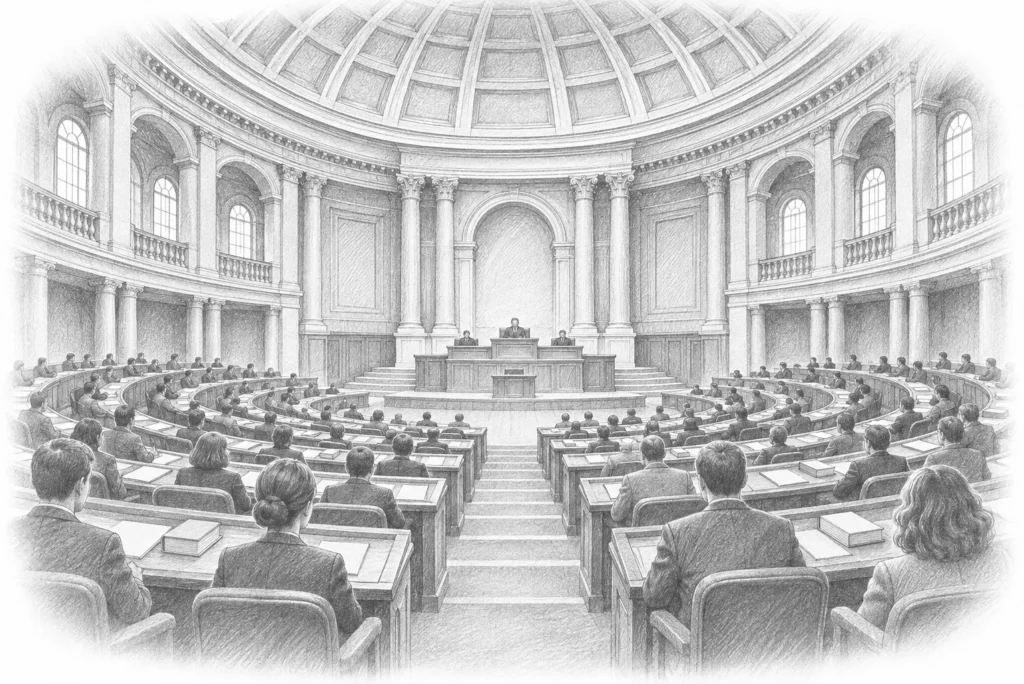
TTHE Constitution of India did not appear from nowhere. It grew out of almost two centuries of colonial constitutional development, from the Regulating Act of 1773 to the Government of India Act of 1935, and out of the Indian national movement’s long demand for self-government and rights. It was finally drafted by the Constituent Assembly, which met from December 1946 to January 1950. This chapter studies the constitutional antecedents, i.e. the earlier laws and demands that shaped the Constitution, and the making of the Constitution by the Constituent Assembly, including its composition, working, major debates and achievements.

1.1 Constitutional Development under British Rule
Constitutional development in colonial India took place through a series of laws passed by the British Parliament. At first, these laws regulated the East India Company; later they created legislatures, introduced the elective principle and gave Indians a limited share in government. British rulers saw these reforms as gradual concessions, while Indian nationalists saw them as inadequate responses to their demand for self-government.
The Company Period (1773–1858)
- Regulating Act, 1773. It made the Governor of Bengal the Governor-General of Bengal, with a council of four, and set up a Supreme Court at Calcutta (1774), the first step towards central administration.
- Pitt’s India Act, 1784. It created a Board of Control in London to supervise the Company’s political affairs, establishing dual control by the Company and the British government.
- Charter Act, 1813. It ended the Company’s trade monopoly in India, except in tea and trade with China, and allowed missionaries to work in India.
- Charter Act, 1833. It made the Governor-General of Bengal the Governor-General of India, centralised legislative power and set up a Law Commission under Macaulay.
- Charter Act, 1853. It separated the legislative and executive functions of the Governor-General’s Council and introduced open competition for the civil services.
The Crown Period (1858–1947)
- Government of India Act, 1858. After the revolt of 1857, power passed from the Company to the Crown; a Secretary of State for India with a council in London controlled Indian administration, and the Governor-General became the Viceroy.
- Indian Councils Act, 1861. It added non-official members, some of them Indians, to the Viceroy’s legislative council and restored legislative powers to Bombay and Madras.
- Indian Councils Act, 1892. It enlarged the councils and allowed indirect election of some members and discussion of the budget.
- Indian Councils Act, 1909 (Morley-Minto Reforms). It enlarged the councils further, introduced elected members and created separate electorates for Muslims, which nationalists saw as divide and rule.
- Government of India Act, 1919 (Montagu-Chelmsford Reforms). Following the Montagu Declaration of 1917, it introduced dyarchy in the provinces, dividing subjects into transferred subjects under Indian ministers and reserved subjects under the Governor, and created a bicameral central legislature with a majority of elected members.
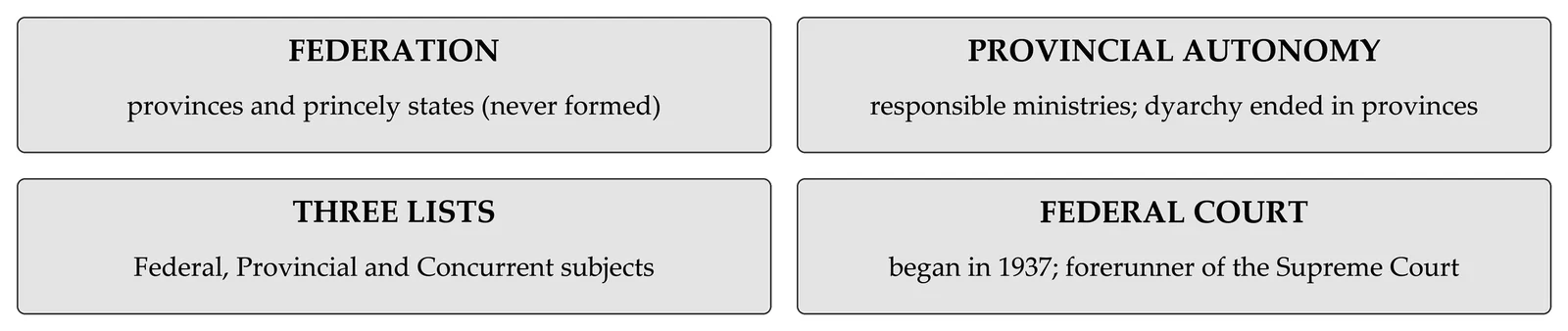
- Government of India Act, 1935. The most detailed colonial constitution, it proposed an all-India federation of provinces and princely states (never implemented), introduced provincial autonomy with responsible governments in the provinces, divided powers into three lists, created a Federal Court (1937) and extended the franchise to about a tenth of the population.
Influence of the 1935 Act
The Government of India Act of 1935 had a great influence on the Constitution of 1950. The federal scheme, the three lists of subjects, the office of Governor, the emergency provisions, the public service commissions and many administrative provisions were taken from it, with changes. Ambedkar admitted in the Constituent Assembly that a good part of the Draft Constitution reproduced the 1935 Act, but argued that there was nothing to be ashamed of in borrowing well-tried provisions. The crucial difference was that the 1950 Constitution was made by Indians, rested on popular sovereignty and guaranteed rights and universal adult franchise.
1.2 Indian Demands and the Constituent Assembly
The Indian Demand for a Constitution
- Constitution of India Bill, 1895. Often associated with the circle of Bal Gangadhar Tilak, it demanded rights such as free speech and equality before law.
- Commonwealth of India Bill, 1925. Promoted by Annie Besant, it proposed dominion status and a bill of rights for India.
- The Nehru Report, 1928. Prepared by a committee headed by Motilal Nehru in response to the all-white Simon Commission, it demanded dominion status, a list of fundamental rights, universal adult suffrage and joint electorates.
- The Karachi Resolution, 1931. Adopted by the Congress, it set out fundamental rights and economic policies, combining civil liberties with social and economic rights.
- The demand for a Constituent Assembly. M.N. Roy first proposed a Constituent Assembly in 1934, the Congress formally demanded one in 1935, and Nehru argued that only an assembly elected by the people could frame India’s constitution.
- British responses. The August Offer of 1940 accepted that Indians should frame their own constitution after the war, and the Cripps Mission of 1942 proposed an elected constitution-making body.
Composition of the Constituent Assembly
The Constituent Assembly was formed under the Cabinet Mission Plan of 1946. Its members were elected indirectly by the members of the provincial legislative assemblies through the single transferable vote, roughly one seat for every million people, with seats divided among Muslims, Sikhs and general members according to population, while representatives of the princely states were nominated. Its planned strength was 389: 292 from the provinces, 4 from the chief commissioners’ provinces and 93 from the princely states. After Partition, its membership fell to 299. The Assembly included leaders of the Congress such as Nehru, Patel, Rajendra Prasad and Maulana Azad, as well as Ambedkar, members of other parties, representatives of minorities and fifteen women, among them Hansa Mehta, Sarojini Naidu, Durgabai Deshmukh and Dakshayani Velayudhan.
Working of the Assembly
- First meeting. It met on 9 December 1946, with Sachchidananda Sinha as temporary chairman; Rajendra Prasad was elected President on 11 December, and the Muslim League boycotted it.
- Objectives Resolution. Nehru moved it on 13 December 1946, and it was adopted on 22 January 1947, setting the aims of the Constitution.
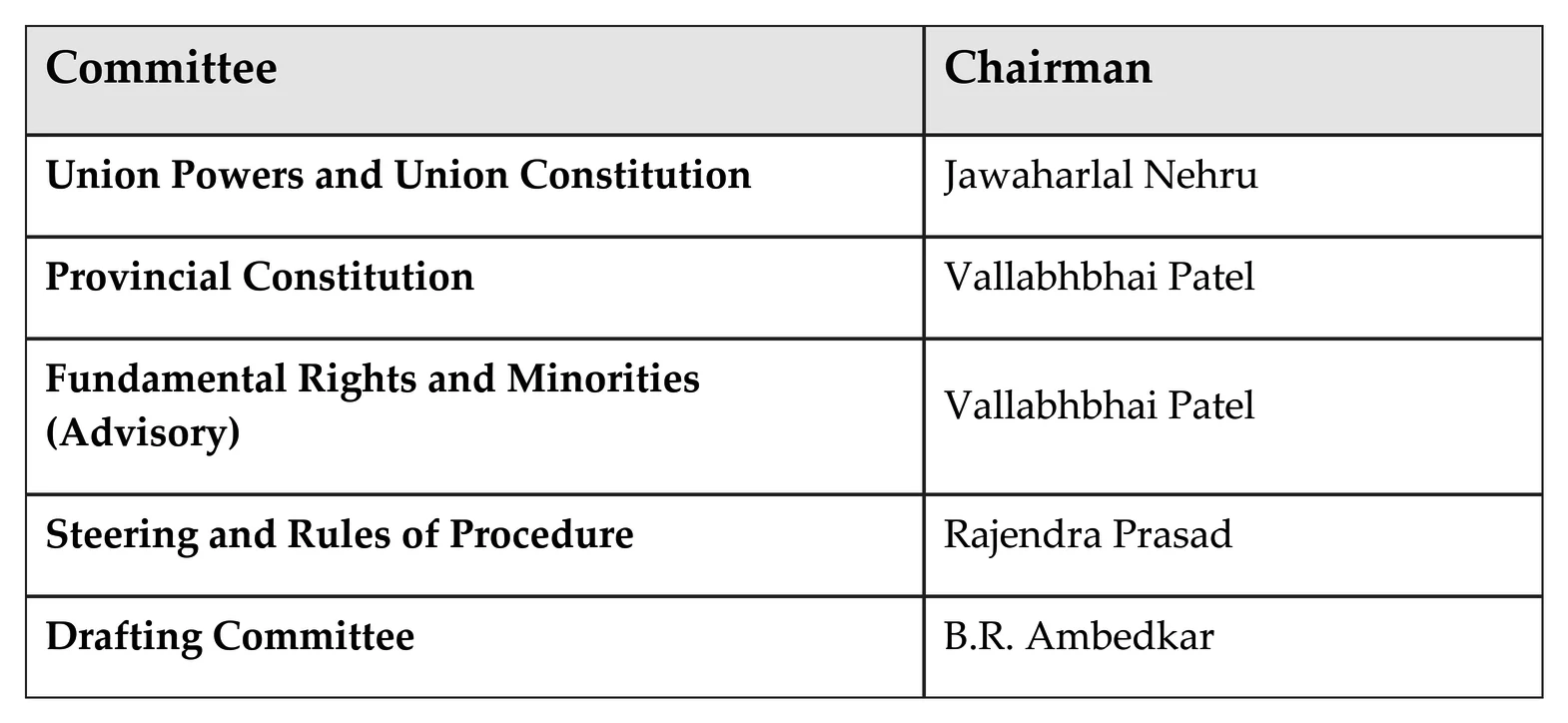
- Committees. Major committees included the Union Powers and Union Constitution Committees under Nehru, the Provincial Constitution Committee and the Advisory Committee on Fundamental Rights and Minorities under Patel, and the Steering and Rules Committees under Prasad.
- The Drafting Committee. Set up on 29 August 1947 with B.R. Ambedkar as chairman, its members included N. Gopalaswami Ayyangar, Alladi Krishnaswami Ayyar, K.M. Munshi, Mohammad Saadulla, N. Madhava Rau and T.T. Krishnamachari.
- The constitutional adviser. B.N. Rau prepared the first draft in October 1947 from the committees’ reports and studied foreign constitutions.
- Readings and adoption. The Draft Constitution was published in February 1948, debated clause by clause and adopted on 26 November 1949; members signed it on 24 January 1950, and it came into force on 26 January 1950, the anniversary of the Purna Swaraj declaration of 1930.
- Time taken. The Assembly took about two years, eleven months and eighteen days, holding eleven sessions over 165 days.
1.3 The Making of the Constitution: Debates and Achievements
Methods of Decision-Making
Granville Austin, in The Indian Constitution: Cornerstone of a Nation (1966), argued that the Assembly made decisions through consensus and accommodation rather than simple majority voting. Leaders sought broad agreement and reconciled conflicting principles, such as federalism with a strong centre, or parliamentary government with an independent judiciary. Austin also noted that the Assembly was dominated by the Congress, which, however, included people of many views.
Major Debates
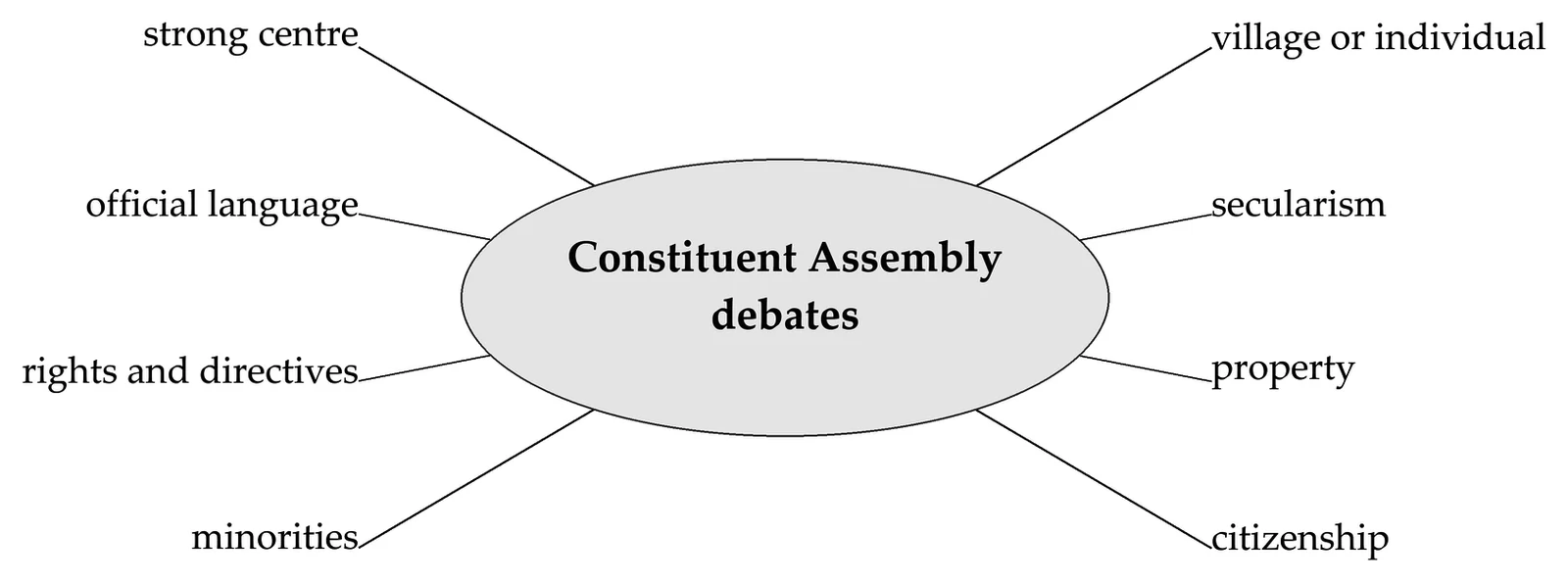
- Federalism. After Partition, members chose a federation with a strong centre to preserve unity, rejecting the weak centre of the Cabinet Mission Plan.
- Language. The Munshi-Ayyangar formula, adopted on 14 September 1949, made Hindi in the Devanagari script the official language of the Union, with English to continue for fifteen years.
- Rights and directives. Members debated which rights should be justiciable, leading to the division between Fundamental Rights and Directive Principles.
- Minorities and reservations. Separate electorates were abolished, but reservations in legislatures were provided for Scheduled Castes and Scheduled Tribes, and minorities received cultural and educational rights.
- The village and the individual. Gandhians wanted the village as the basic unit, but Ambedkar defended the individual as the unit; village panchayats were placed in the Directive Principles.
- Property. The right to property and compensation was debated in the context of zamindari abolition.
- Citizenship. The Assembly debated citizenship for refugees and migrants after Partition, adopting provisions in Articles 5 to 11.
Ambedkar’s Final Warnings
In his speech of 25 November 1949, Ambedkar gave three warnings. First, Indians should hold fast to constitutional methods and abandon methods such as civil disobedience now that constitutional means were available. Second, they should not lay their liberties at the feet of even a great man, since hero-worship in politics leads to dictatorship. Third, they must make political democracy a social democracy, because India was entering a life of contradictions, with equality in politics and inequality in social and economic life.
Criticisms of the Constituent Assembly
- Not directly elected. It was elected indirectly by provincial assemblies chosen on a limited franchise, not by universal adult franchise.
- Congress domination. Austin called it a one-party body in an essentially one-party country.
- Dominated by lawyers. Critics said it was dominated by lawyers and produced a lengthy, legalistic document; Ivor Jennings called the Constitution a lawyer’s paradise.
- Borrowed provisions. It borrowed heavily from the 1935 Act and foreign constitutions.
Defenders reply that the Assembly included members from almost every community, region and ideology, held open and detailed debates, invited public suggestions and produced a Constitution that has endured for more than seventy-five years.
1.4 Important Questions
- Question 1 Trace the constitutional development of India under British rule.
- Question 2 Discuss the main features of the Government of India Act, 1935 and its influence on the Indian Constitution.
- Question 3 Discuss the composition and working of the Constituent Assembly of India.
- Question 4 Discuss the major debates in the Constituent Assembly during the making of the Indian Constitution.
DU asks the same idea in different words. So learn one broad answer for each question below; the same answer works for every question joined by OR.
Important Question 1
Trace the constitutional development of India under British rule.
OR
Discuss the major constitutional antecedents of the Indian Constitution.
OR
Examine the Acts of 1909 and 1919 as stages in India’s constitutional development.
Model Answer
“The gradual development of self-governing institutions with a view to the progressive realisation of responsible government in India as an integral part of the British Empire.”
— The Montagu Declaration (20 August 1917)
Introduction. India’s constitutional development under British rule took place through a series of Acts of the British Parliament, from the Regulating Act of 1773 to the Government of India Act of 1935. These laws first regulated the East India Company, then established Crown rule, created legislatures and gradually admitted Indians to a limited share in government. They shaped many institutions that the Constitution of 1950 later adopted.
1. The Regulating Act, 1773
The Regulating Act was the first attempt by the British Parliament to control the East India Company. It made the Governor of Bengal the Governor-General of Bengal with a council and established a Supreme Court at Calcutta, beginning centralised administration.
2. Pitt’s India Act and the Charter Acts
Pitt’s India Act of 1784 created a Board of Control in London. The Charter Acts of 1813, 1833 and 1853 ended the Company’s trade monopoly, created the post of Governor-General of India, centralised law-making and introduced competition for the civil services.
3. The Government of India Act, 1858
After the revolt of 1857, the Act of 1858 transferred power from the Company to the Crown. A Secretary of State for India, responsible to Parliament, controlled Indian affairs, and the Governor-General became the Viceroy.
4. The Indian Councils Acts of 1861 and 1892
The 1861 Act added non-official members, including some Indians, to the legislative councils, and the 1892 Act enlarged the councils, introduced indirect election and allowed discussion of the budget, though real power remained with officials.
5. The Morley-Minto Reforms, 1909
The Indian Councils Act of 1909 enlarged the councils, increased elected members and introduced separate electorates for Muslims. Nationalists criticised separate electorates as a policy of divide and rule that encouraged communal politics.
6. The Montagu Declaration, 1917
On 20 August 1917, Secretary of State Edwin Montagu declared that British policy aimed at the progressive realisation of responsible government in India as part of the Empire, the first official promise of self-government.
7. The Government of India Act, 1919
The Montagu-Chelmsford Reforms introduced dyarchy in the provinces, with transferred subjects under Indian ministers and reserved subjects under the Governor, and created a bicameral central legislature. Indians found dyarchy unworkable and inadequate.
8. The Simon Commission and Nehru Report
The all-white Simon Commission of 1927 was boycotted by Indians. In response, the Nehru Report of 1928 drafted a constitution for India, demanding dominion status, fundamental rights and universal adult suffrage.
9. The Round Table Conferences and Communal Award
Three Round Table Conferences in London (1930–32) discussed constitutional reform, and the Communal Award of 1932 extended separate electorates, leading to the Poona Pact between Gandhi and Ambedkar.
10. The Government of India Act, 1935
The Act of 1935 proposed an all-India federation, introduced provincial autonomy, divided powers into three lists, created a Federal Court and widened the franchise. Elections under it in 1937 brought Congress ministries to power in most provinces.
11. Indian Demands
Alongside British reforms, Indians demanded their own constitution, through the Commonwealth of India Bill of 1925, the Nehru Report of 1928, the Karachi Resolution of 1931 and the demand for a Constituent Assembly from 1934.
12. Towards Independence
The August Offer of 1940, the Cripps Mission of 1942 and the Cabinet Mission of 1946 accepted that Indians would frame their own constitution, leading to the Constituent Assembly and the Indian Independence Act of 1947.
13. Legacy for the Constitution
The Constitution of 1950 inherited the federal structure, legislative lists, emergency powers, the office of Governor and many administrative provisions from colonial Acts, especially the 1935 Act, while adding popular sovereignty, rights and universal franchise.
14. Evaluation
Colonial constitutional development was limited and designed to preserve British control, but it introduced representative institutions and legal traditions that Indians adapted to build a democratic republic.
Conclusion. Thus, India’s constitutional development under British rule moved from the Regulating Act of 1773 through Crown rule in 1858, the Councils Acts, the Morley-Minto and Montagu-Chelmsford reforms, to the Government of India Act of 1935. Combined with Indian demands for self-government, these antecedents shaped the structure of the Constitution of 1950.
Important Question 2
Discuss the main features of the Government of India Act, 1935 and its influence on the Indian Constitution.
OR
‘The Indian Constitution is largely based on the Government of India Act, 1935.’ Discuss.
OR
Examine the Government of India Act, 1935 as the most important constitutional antecedent of the Constitution.
Model Answer
“There is nothing to be ashamed of in borrowing.”
— B.R. Ambedkar, Constituent Assembly (4 November 1948), on the use of the 1935 Act and other constitutions
Introduction. The Government of India Act of 1935 was the last and most detailed constitutional law passed by the British Parliament for India. With 321 sections and 10 schedules, it introduced provincial autonomy and proposed an all-India federation. Although Indian nationalists rejected it as inadequate, it became the most important source of the Constitution of 1950, which borrowed much of its structure while transforming its spirit.
1. Background
The Act followed the Simon Commission (1927–30), the Round Table Conferences (1930–32) and a White Paper of 1933. It was meant to grant limited self-government while preserving British control over defence, foreign affairs and finance.
2. An All-India Federation
The Act proposed a federation of British provinces and princely states. Since the princes’ accession was voluntary and not enough of them joined, the federation never came into existence, and the centre continued under the 1919 arrangements.
3. Provincial Autonomy
Dyarchy in the provinces was abolished, and provinces received responsible government, with ministers accountable to elected legislatures. Elections in 1937 led to Congress ministries in eight provinces, giving Indians experience of governance.
4. Division of Powers
The Act divided powers into a Federal List, a Provincial List and a Concurrent List, with residuary powers vested in the Governor-General. The Constitution of 1950 adopted the same three lists as the Union, State and Concurrent Lists.
5. Dyarchy at the Centre
At the centre, the Act proposed dyarchy, with defence and foreign affairs reserved to the Governor-General, but this was never implemented because the federation did not come into being.
6. Safeguards and Special Powers
The Governor-General and Governors were given special responsibilities and discretionary powers, such as protecting minorities and maintaining law and order, which allowed them to override ministers. Nationalists criticised these safeguards as limits on self-government.
7. Federal Court and Other Institutions
The Act created a Federal Court, which began work in 1937 and was the forerunner of the Supreme Court, and provided for public service commissions and a Federal Railway Authority; the Reserve Bank of India was set up in 1935 under a separate law.
8. Franchise and Separate Electorates
The franchise was extended to about a tenth of the population, and separate electorates continued for Muslims and other communities, as provided by the Communal Award of 1932 and the Poona Pact.
9. Nationalist Criticism
The Congress rejected the Act because it did not grant dominion status, retained British control and gave the princes and the Governor-General too much power. Nehru described it as a charter of slavery.
10. Influence on the Federal Structure
The Constitution borrowed the federal scheme, the three lists, the emergency provisions, the office of Governor and the structure of the judiciary from the 1935 Act, adapting them to a sovereign republic.
11. Influence on Administration
Many detailed provisions on administration, public services, finance and relations between the centre and provinces were taken almost word for word from the 1935 Act, which explains the length of the Constitution.
12. Ambedkar’s Defence
Answering critics who said the Draft Constitution reproduced the 1935 Act, Ambedkar said on 4 November 1948 that there was nothing to be ashamed of in borrowing, since the fundamental principles of constitutions were common knowledge and had been adapted to Indian needs.
13. Differences in Spirit
Unlike the 1935 Act, the Constitution of 1950 rests on popular sovereignty, guarantees Fundamental Rights, adopts universal adult franchise, abolishes separate electorates and establishes a sovereign republic.
14. Evaluation
The 1935 Act provided the administrative and federal framework of the Constitution, but the Constituent Assembly transformed it into a democratic constitution by adding rights, popular sovereignty and social justice.
Conclusion. Thus, the Government of India Act of 1935 introduced provincial autonomy, proposed a federation, divided powers into three lists and created a Federal Court. Though rejected by nationalists, it shaped much of the structure of the Constitution of 1950, which borrowed its framework while giving it a new democratic spirit.
Important Question 3
Discuss the composition and working of the Constituent Assembly of India.
OR
Was the Constituent Assembly a representative body? Discuss.
OR
Examine the role of the Drafting Committee and B.R. Ambedkar in the making of the Constitution.
Model Answer
“The Constituent Assembly was a one-party body in an essentially one-party country. The Assembly was the Congress and the Congress was India.”
— Granville Austin, The Indian Constitution: Cornerstone of a Nation (1966)
Introduction. The Constitution of India was framed by the Constituent Assembly, which met from December 1946 to January 1950. Formed under the Cabinet Mission Plan, it was elected indirectly by the provincial assemblies. Through committees, debates and the Drafting Committee chaired by B.R. Ambedkar, it produced one of the world’s longest constitutions. Its representativeness and methods have been debated by scholars.
1. The Demand for a Constituent Assembly
The idea of a Constituent Assembly was first proposed by M.N. Roy in 1934 and adopted by the Congress in 1935. The British accepted it in principle in the August Offer of 1940 and the Cripps proposals of 1942.
2. Formation under the Cabinet Mission Plan
Under the Cabinet Mission Plan of 1946, members were elected indirectly by provincial legislators through the single transferable vote, roughly one seat per million people, with seats divided among general, Muslim and Sikh members, while princely states’ representatives were nominated.
3. Composition
The Assembly was planned to have 389 members, 292 from the provinces, 4 from chief commissioners’ provinces and 93 from the princely states. After Partition, its strength fell to 299. It included Congress leaders, Ambedkar, members of other parties, minorities and fifteen women.
4. First Session and the Objectives Resolution
The Assembly first met on 9 December 1946, with the Muslim League boycotting. Rajendra Prasad was elected President, and Nehru moved the Objectives Resolution on 13 December 1946, which set out the goals of the Constitution.
5. The Committees
The Assembly worked through committees: the Union Powers and Union Constitution Committees under Nehru, the Provincial Constitution and Advisory Committees under Patel, and the Steering and Rules Committees under Prasad. Their reports formed the basis of the draft.
6. The Drafting Committee
Set up on 29 August 1947, the Drafting Committee was chaired by Ambedkar, with members including Alladi Krishnaswami Ayyar, N. Gopalaswami Ayyangar and K.M. Munshi. It prepared the Draft Constitution, published in February 1948.
7. Ambedkar’s Role
Ambedkar piloted the Draft Constitution through the Assembly, explaining and defending its provisions, and is called the chief architect of the Constitution. T.T. Krishnamachari noted that much of the work fell on Ambedkar because other members were often absent.
8. B.N. Rau’s Contribution
B.N. Rau, the constitutional adviser, prepared the first draft in October 1947, studied foreign constitutions and consulted jurists abroad, making an important technical contribution.
9. Debate and Adoption
The Draft Constitution was debated clause by clause, with thousands of amendments proposed. It was adopted on 26 November 1949, signed on 24 January 1950 and came into force on 26 January 1950.
10. Consensus and Accommodation
Granville Austin argued that the Assembly decided by consensus and accommodation, seeking broad agreement among different groups and reconciling principles such as federalism and a strong centre.
11. Was It Representative
Critics argue that it was not directly elected, that it was chosen on a limited franchise and that it was dominated by the Congress, which Austin called a one-party body in a one-party country.
12. Defence of Its Representativeness
Defenders note that the Congress was a broad coalition representing many views, that the Assembly included members of various communities, castes, regions and ideologies, and that it invited public suggestions and debated openly.
13. Dual Role after Independence
After 15 August 1947, the Assembly also acted as the dominion Parliament, making ordinary laws in addition to framing the Constitution, until the first elections of 1951–52.
14. Women and Minorities in the Assembly
Fifteen women, including Hansa Mehta, Durgabai Deshmukh, Ammu Swaminathan and Rajkumari Amrit Kaur, sat in the Assembly, and members from Scheduled Castes, minorities and the princely states took part. Their presence shaped debates on equality, reservation and minority rights, even though the Assembly was not directly elected.
15. Evaluation
Despite its limits, the Constituent Assembly produced a Constitution that has endured and commanded legitimacy, reflecting the wisdom and spirit of accommodation of its members.
Conclusion. Thus, the Constituent Assembly, formed under the Cabinet Mission Plan and indirectly elected, worked through committees and the Drafting Committee under Ambedkar to frame the Constitution between 1946 and 1949. Though criticised as Congress-dominated and not directly elected, it worked through consensus and accommodation and produced a Constitution of lasting legitimacy.
Important Question 4
Discuss the major debates in the Constituent Assembly during the making of the Indian Constitution.
OR
Examine the philosophy and main debates of the Constituent Assembly.
OR
Discuss Ambedkar’s warnings in his final speech to the Constituent Assembly.
Model Answer
“If the people who are elected are capable and men of character and integrity, they would be able to make the best even of a defective Constitution.”
— Rajendra Prasad, Constituent Assembly (26 November 1949)
Introduction. The Constituent Assembly was a forum of intense debate in which members of different ideologies, communities and regions discussed the shape of independent India. Key debates concerned federalism, language, rights, minorities, the village, property and citizenship. The outcomes reflected compromise and accommodation, and Ambedkar’s final speech warned about the challenges ahead.
1. The Objectives Resolution
Nehru’s Objectives Resolution of 1946 promised an independent sovereign republic with justice, equality and freedom for all and safeguards for minorities and backward classes. It set the philosophy for later debates.
2. Federalism and a Strong Centre
Before Partition, the Assembly planned a weak centre as in the Cabinet Mission Plan. After Partition and communal violence, members chose a federation with a strong centre to protect unity, with residuary and emergency powers vested in the Union.
3. The Language Question
The question of a national language divided north and south. The Munshi-Ayyangar formula of 14 September 1949 made Hindi in Devanagari the official language of the Union with English continuing for fifteen years, a compromise rather than a final solution.
4. Rights and Directive Principles
Members debated which rights should be enforceable, leading to justiciable Fundamental Rights in Part III and non-justiciable Directive Principles in Part IV. They also debated due process and preventive detention.
5. Minorities and Separate Electorates
After Partition, the Assembly abolished separate electorates for religious minorities, but provided reservations in legislatures for Scheduled Castes and Scheduled Tribes and cultural and educational rights for minorities.
6. The Village and the Individual
Gandhians wanted a constitution based on village republics, but Ambedkar criticised the village as a den of localism and ignorance and defended the individual as the unit. Village panchayats were placed in the Directive Principles.
7. Secularism and Religious Freedom
The Assembly debated whether India should be explicitly secular and whether to include the right to propagate religion. It guaranteed freedom of religion to all and equal treatment by the state, without adopting a state religion.
8. Property and Land Reform
The right to property was debated in the context of zamindari abolition, with Nehru seeking to protect land reform from judicial challenge over compensation, leading to a compromise in Article 31.
9. Citizenship
The Assembly debated citizenship for refugees and migrants after Partition, adopting a framework in Articles 5 to 11 based mainly on birth and domicile, leaving details to Parliament.
10. Parliamentary Government
The Assembly chose parliamentary government on the British model rather than a presidential system, believing that responsibility to the legislature was more important than stability, given India’s experience with British institutions.
11. Ambedkar’s First Warning
In his final speech on 25 November 1949, Ambedkar urged Indians to hold fast to constitutional methods and abandon methods such as civil disobedience, which he called the grammar of anarchy, now that constitutional means were available.
12. Ambedkar’s Second and Third Warnings
He warned against hero-worship in politics, which leads to dictatorship, and said that political democracy must be made a social democracy, since India was entering a life of contradictions with political equality and social inequality.
13. Prasad’s Reflection
Rajendra Prasad, in his closing speech, said that the success of the Constitution would depend on the character of the people who worked it, since capable and honest leaders could make the best even of a defective constitution.
14. Evaluation
The debates show that the Constitution was the result of serious argument and compromise among different visions of India, which helps explain its legitimacy and endurance.
Conclusion. Thus, the Constituent Assembly debated federalism, language, rights, minorities, the village, secularism, property and citizenship, resolving them through consensus and accommodation. Ambedkar’s warnings about constitutional methods, hero-worship and social democracy, and Prasad’s stress on character, remain relevant to the working of the Constitution today.
Short Notes
(a) Dyarchy
The system introduced in the provinces by the Government of India Act of 1919, under which transferred subjects were administered by Indian ministers and reserved subjects by the Governor and his councillors.
(b) Drafting Committee
The committee set up by the Constituent Assembly on 29 August 1947, chaired by B.R. Ambedkar, which prepared the Draft Constitution published in February 1948.
(c) Munshi-Ayyangar formula
The compromise on language adopted on 14 September 1949, making Hindi in the Devanagari script the official language of the Union, with English to continue for official purposes for fifteen years.
More notes: GE-2 Introduction to the Indian Constitution
These notes are prepared by PADHO TO AISE for study help. They are not an official publication.