
Semester VII MDSE-6 Themes in Comparative Political Theory
Unit IV · 18 min read · Updated 24 Nov 2026
As per the University of Delhi (DU) BA (Hons) Political Science syllabus
Contents
- 4.1 Democracy: Mill and Ambedkar
- 4.2 Socialism: Marx and Lohia
- 4.3 Important Questions
- Discuss J.S. Mill’s views on democracy and representative government.
- Discuss B.R. Ambedkar’s views on democracy and compare them with those of J.S. Mill.
- Discuss Karl Marx’s idea of socialism.
- Discuss Ram Manohar Lohia’s idea of socialism and compare it with Marx.
- Short Notes
लोकतंत्र केवल शासन का एक रूप नहीं है। यह मूलतः साथ मिलकर जीने का, साझा अनुभवों का एक तरीका है।
Democracy is not merely a form of Government. It is primarily a mode of associated living, of conjoint communicated experience.
— B.R. Ambedkar, Annihilation of Caste (1936)
DEMOCRACY and socialism are two of the most important ideas of modern politics, and this unit compares Western and Indian thinkers on each. On democracy, J.S. Mill defended representative government as the best form of government, while B.R. Ambedkar insisted that political democracy must rest on social democracy. On socialism, Karl Marx offered a theory of class struggle and revolution, while Ram Manohar Lohia developed an Indian socialism attentive to caste, gender and decentralisation. This chapter draws on Eleanor Zelliot, Rajasekhariah and Jayaraj on Ambedkar, Anand Kumar and Raghavendra Tolpadi on Lohia, and V.P. Varma on Gandhi and Marx.
4.1 Democracy: Mill and Ambedkar
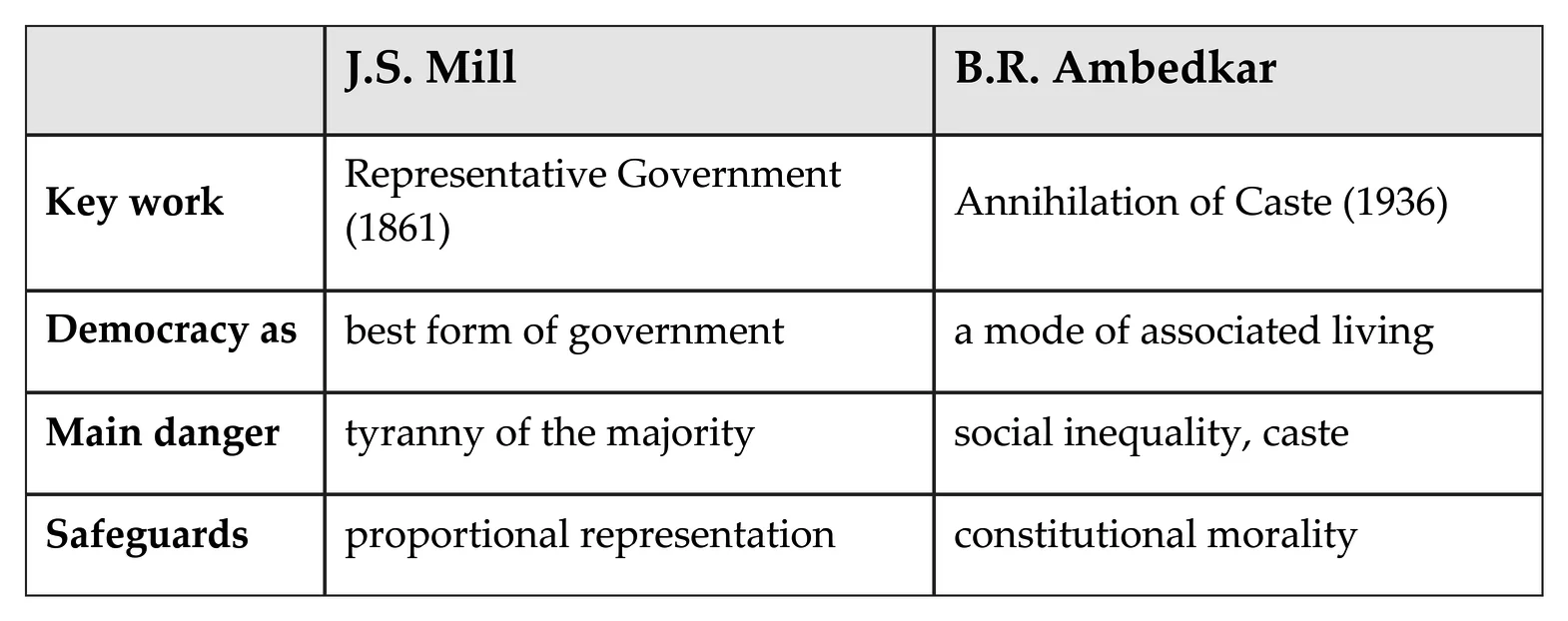
J.S. Mill argued that representative government is the ideally best form of government, because it protects people’s interests and improves their intelligence and character through participation. He feared the tyranny of the majority and proposed proportional representation and plural votes for the educated. B.R. Ambedkar defined democracy as a way of life and a method of bringing revolutionary change without bloodshed. He warned that political democracy cannot last without social democracy, based on liberty, equality and fraternity, which caste denied.
4.2 Socialism: Marx and Lohia
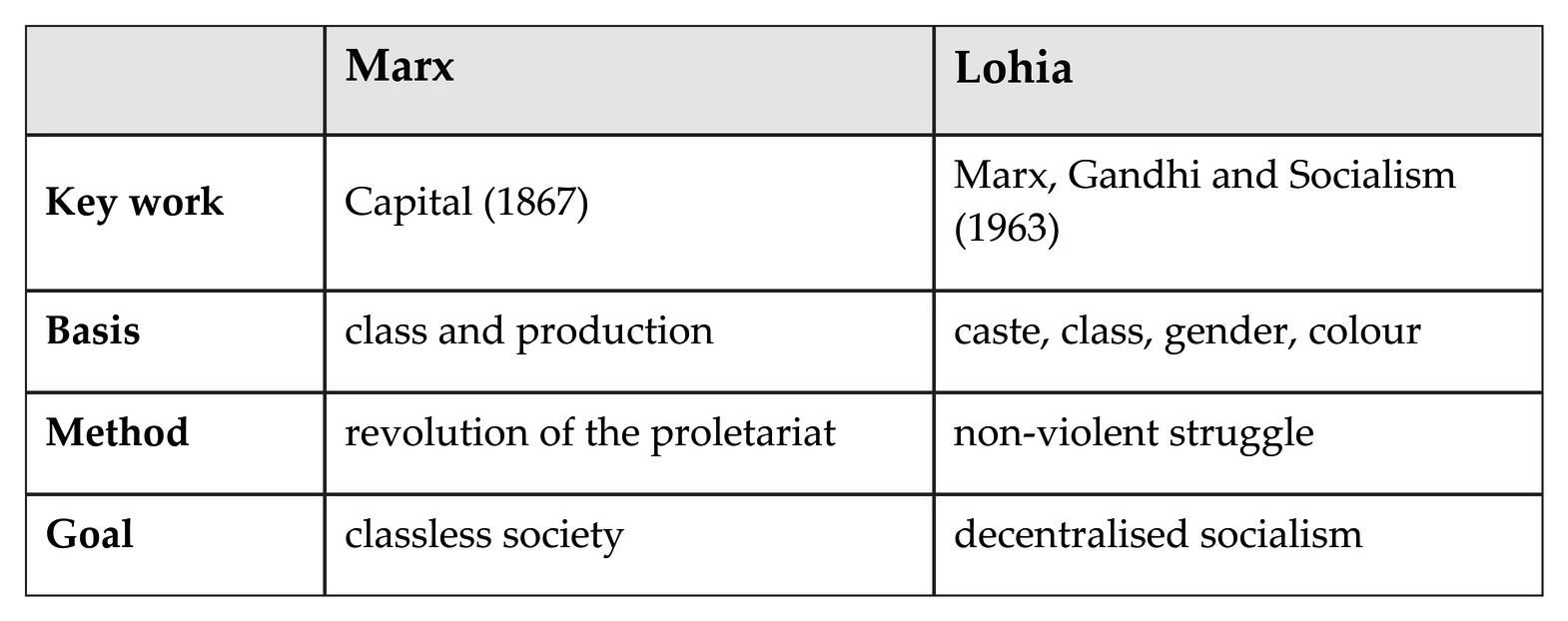
Karl Marx argued that capitalism exploits workers through surplus value and that class struggle would lead to a socialist revolution and eventually a classless communist society. Ram Manohar Lohia criticised Marxism as Eurocentric and centralising, and developed a socialism suited to India: decentralised, non-violent, based on small-scale technology and attentive to the inequalities of caste, gender, language and colour as well as class. His Sapta Kranti, seven revolutions, summed up this vision.
4.3 Important Questions
- Question 1 Discuss J.S. Mill’s views on democracy and representative government.
- Question 2 Discuss B.R. Ambedkar’s views on democracy and compare them with those of J.S. Mill.
- Question 3 Discuss Karl Marx’s idea of socialism.
- Question 4 Discuss Ram Manohar Lohia’s idea of socialism and compare it with Marx.
DU asks the same idea in different words. So learn one broad answer for each question below; the same answer works for every question joined by OR.
Important Question 1
Discuss J.S. Mill’s views on democracy and representative government.
OR
Why did Mill consider representative government the ideally best form of government?
OR
Examine Mill’s concern about the tyranny of the majority.
Model Answer
“The ideally best form of government is that in which the sovereignty, or supreme controlling power in the last resort, is vested in the entire aggregate of the community.”
— J.S. Mill, Considerations on Representative Government (1861)
Introduction. John Stuart Mill (1806–1873) was the leading liberal thinker of nineteenth-century Britain. In On Liberty (1859) and Considerations on Representative Government (1861), he defended democracy as the best form of government while warning of its dangers. His democratic theory combined faith in participation with fear of mass ignorance and majority tyranny.
1. Mill’s Background
Mill was educated by his father James Mill and influenced by Jeremy Bentham’s utilitarianism, which he revised to value higher pleasures and individual development. He also served the East India Company and was a member of Parliament.
2. The Ideally Best Government
Mill argued that the ideally best form of government is one in which sovereignty rests with the whole community, and every citizen has a voice and, at least occasionally, a role in public functions.

3. Two Criteria
Mill judged governments by two criteria: how far they promote the virtue and intelligence of the people, and how well they use the existing good qualities of citizens for public affairs. Representative government does best on both.
4. Participation as Education
Participation in public affairs, through voting, juries and local government, educates citizens, widens their sympathies and makes them active rather than passive. This educative effect is a central argument for democracy.
5. Protecting Interests
Mill also argued that people’s rights and interests are secure only when they can protect them themselves, so excluding groups from political power leads to their neglect.
6. The Tyranny of the Majority
In On Liberty, Mill warned that democracy can produce a tyranny of the majority, not only through laws but through social pressure that crushes individuality. He defended liberty through the harm principle.
7. Dangers of Democracy
Mill feared class legislation, in which a majority of uneducated workers might pass laws in their own narrow interest, and a low level of intelligence in government.
8. Proportional Representation
Mill supported Thomas Hare’s scheme of proportional representation, so that minorities would be represented in proportion to their numbers and the best minds could be elected.
9. Plural Voting
Mill proposed giving additional votes to the educated, so that knowledge would carry weight, though everyone except the illiterate and those dependent on poor relief would have at least one vote.
10. Open Ballot
Mill opposed the secret ballot, arguing that voting is a public trust that should be exercised openly and responsibly, in the public interest.
11. Women’s Suffrage
Mill championed women’s right to vote. As a member of Parliament, he presented a petition for women’s suffrage in 1866 and proposed an amendment in 1867 to give women the vote.
12. The Role of the Assembly
Mill held that a representative assembly should not administer or draft laws in detail, but should watch and control the government, debate public questions and express public opinion.
13. Criticisms
Critics see Mill as elitist, given plural voting, and note that he considered some peoples, including Indians, not yet ready for representative government, justifying colonial rule.
14. Local Government
Mill valued local institutions as schools of citizenship. Through municipal councils, juries and parish offices, ordinary people learn to think about public interests, gain practical experience of government and develop the public spirit on which national democracy depends.
15. Nationality
Mill argued that free institutions work best where the people share a common nationality, language and public opinion, since a divided people cannot easily form the united public opinion that representative government requires. Critics note the difficulty this view poses for diverse societies such as India.
16. Mill and Colonial Rule
In On Liberty, Mill wrote that despotism is a legitimate mode of government in dealing with barbarians, provided the end is their improvement. He applied this to India, which he had served through the East India Company, believing Indians were not yet ready for self-government, a view later criticised as colonial.
17. Evaluation
Mill offered a powerful defence of representative democracy based on participation and liberty, though his fears of the majority led to elitist proposals.
Conclusion. Thus, Mill defended representative government as the ideally best form because it protects interests and develops citizens’ intelligence and virtue through participation. Fearing the tyranny of the majority and class legislation, he proposed proportional representation, plural voting and an open ballot, while championing women’s suffrage.
Important Question 2
Discuss B.R. Ambedkar’s views on democracy and compare them with those of J.S. Mill.
OR
‘Political democracy cannot last unless there lies at the base of it social democracy.’ Discuss.
OR
Examine Ambedkar’s conditions for the successful working of democracy.
Model Answer
“A form and a method of Government whereby revolutionary changes in the economic and social life of the people are brought about without bloodshed.”
— B.R. Ambedkar, on democracy, Poona (1952)
Introduction. B.R. Ambedkar, the architect of the Indian Constitution, developed a distinctive theory of democracy. Influenced by his teacher John Dewey and by the Buddha, he saw democracy not merely as a form of government but as a way of life based on liberty, equality and fraternity. He warned that political democracy would fail in India unless it rested on social democracy, which caste denied.
1. Democracy as a Way of Life
In Annihilation of Caste (1936), Ambedkar wrote that democracy is primarily a mode of associated living, of conjoint communicated experience, drawing on Dewey’s idea that democracy is a form of social life, not just a system of voting.
2. Democracy as Peaceful Revolution
In a lecture in 1952, Ambedkar defined democracy as a form and method of government through which revolutionary changes in the economic and social life of the people are brought about without bloodshed.
3. Social Democracy
In his speech of 25 November 1949, Ambedkar warned that India would have equality in politics but inequality in social and economic life, and that political democracy cannot last unless based on social democracy.
4. Liberty, Equality, Fraternity
Ambedkar said he took liberty, equality and fraternity from the teachings of the Buddha, not from the French Revolution. Fraternity, a sense of common brotherhood, was essential, and caste destroyed it.
5. Conditions for Democracy
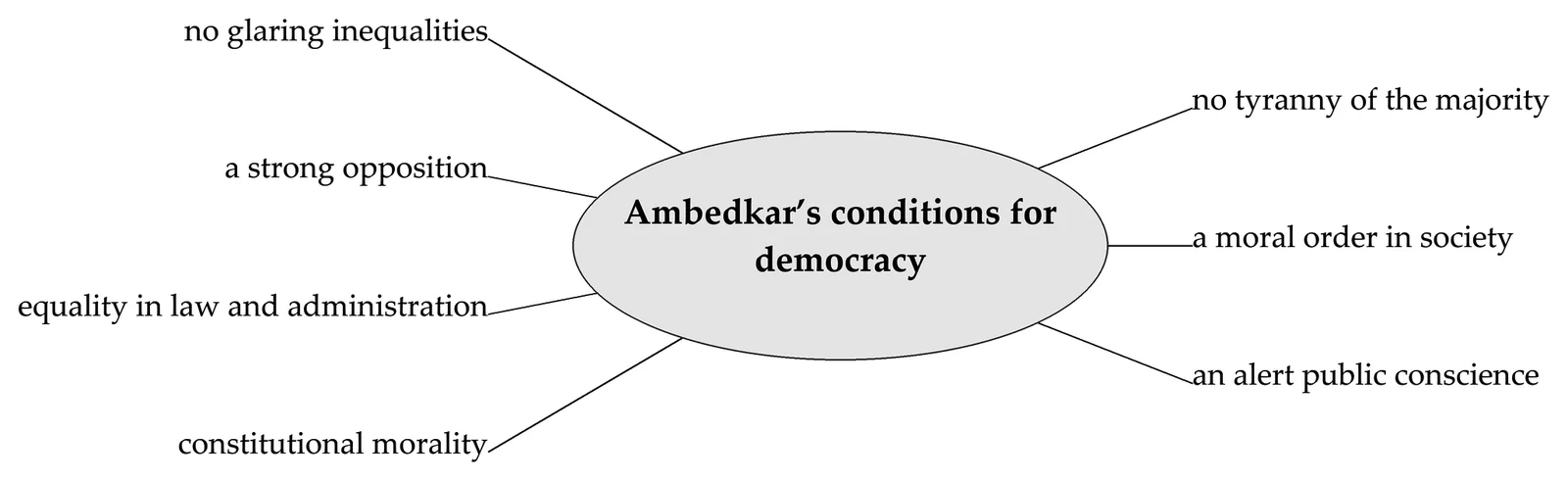
Ambedkar listed conditions for the success of democracy: no glaring inequalities, a strong opposition, equality in law and administration, constitutional morality, no tyranny of the majority over minorities, a moral order in society and an alert public conscience.
6. Constitutional Morality
Ambedkar stressed constitutional morality, respect for constitutional forms and restraint by those in power. He warned that it is not a natural sentiment but must be cultivated.
7. Against the Grammar of Anarchy
After independence, Ambedkar urged Indians to abandon unconstitutional methods such as civil disobedience and satyagraha, which he called the grammar of anarchy, and to use constitutional means.
8. Against Hero-Worship
Ambedkar warned that bhakti, or hero-worship, in politics is a sure road to degradation and eventual dictatorship, urging citizens not to surrender their liberties to great leaders.
9. Safeguards for Minorities
Ambedkar insisted on safeguards for minorities and Scheduled Castes, such as reserved seats and fundamental rights, because a caste majority could otherwise become a permanent communal majority.
10. Zelliot and Rajasekhariah
Eleanor Zelliot shows that Ambedkar combined liberal democracy with social reform and Buddhist ethics. A.M. Rajasekhariah and H. Jayaraj describe his political philosophy as pragmatic, rational and humanist.
11. Mill and Ambedkar: Similarities
Both were liberal democrats who valued individual liberty and feared the tyranny of the majority, and both supported the rights of women and minorities.
12. Mill and Ambedkar: Differences
Mill feared the uneducated masses and proposed plural voting, while Ambedkar insisted on universal adult franchise. Mill focused on political institutions, while Ambedkar focused on social democracy and the injustice of caste.
13. Relevance
Ambedkar’s warnings about social inequality, constitutional morality and hero-worship remain highly relevant to Indian democracy today.
14. Adult Franchise
Ambedkar argued for adult franchise long before independence, including in his evidence before the Southborough Committee in 1919, insisting that the depressed classes must have a direct voice in government. The Constitution he helped draft gave the vote to every adult citizen, rejecting property and education qualifications.
15. Economic Democracy
Ambedkar distinguished political democracy, one person one vote, from economic democracy, which requires the reduction of inequality in wealth. He saw the Directive Principles of State Policy as the Constitution’s commitment to economic democracy, guiding governments towards social and economic justice.
16. Evaluation
Ambedkar deepened democratic theory by insisting that democracy must transform social relations, not just political institutions.
Conclusion. Thus, Ambedkar saw democracy as a way of life and a method of peaceful revolution, resting on liberty, equality and fraternity and requiring social democracy, constitutional morality and safeguards for minorities. Compared with Mill, he shared a liberal concern for liberty but rejected elitism and focused on social inequality and caste.
Important Question 3
Discuss Karl Marx’s idea of socialism.
OR
Examine Marx’s views on class struggle, revolution and communism.
OR
Compare Marx and Gandhi on socialism with reference to V.P. Varma.
Model Answer
“From each according to his ability, to each according to his needs!”
— Karl Marx, Critique of the Gotha Programme (1875)
Introduction. Karl Marx (1818–1883) developed the most influential theory of socialism. He argued that capitalism, though productive, exploits workers and is driven by class conflict, and that it would be replaced through revolution by socialism and finally by a classless communist society. His ideas inspired workers’ movements and revolutions across the world, including in India.
1. Critique of Capitalism
Marx argued that capitalism is based on private ownership of the means of production and wage labour. Workers, owning only their labour power, must sell it to capitalists, who profit from their work.
2. Historical Materialism
Marx held that the economic base shapes politics, law and ideas, and that history moves through modes of production, from slavery and feudalism to capitalism, driven by changes in production and class struggle.

3. Exploitation and Surplus Value
Workers produce more value than they receive in wages. This surplus value is taken by capitalists as profit, which is the source of exploitation. A.L. Harris explains how this analysis underlies Marx’s social philosophy.
4. Alienation
In his early writings, Marx argued that capitalist labour alienates workers from their product, their activity, their human nature and each other. J.R. Stanfield shows how this theory of alienation underlies Marx’s social economics.
5. Class Struggle
The history of all hitherto existing society is the history of class struggles. Under capitalism, the struggle between bourgeoisie and proletariat would intensify as workers become concentrated and organised.
6. Revolution
Marx believed the proletariat would overthrow capitalism through revolution, though he allowed that in some democratic countries workers might succeed through peaceful means.
7. Dictatorship of the Proletariat
After the revolution, a transitional dictatorship of the proletariat would use state power to abolish class rule. Marx saw the Paris Commune of 1871 as an example.
8. Two Phases of Communism
In the Critique of the Gotha Programme (1875), Marx distinguished a lower phase, in which people are rewarded according to work, from a higher phase guided by the principle from each according to ability, to each according to needs.
9. Withering Away of the State
With classes abolished, the state as an instrument of class rule would wither away, as Engels put it, leaving the administration of things.
10. Marx and Democratic Socialism
Jim Cork compared Marx with John Dewey, examining the relationship between socialism and democracy. Democratic socialists, such as Eduard Bernstein, argued for achieving socialism gradually through democratic reforms.
11. Varma on Gandhi and Marx
V.P. Varma compared Gandhi and Marx in 1954. Both cared for the poor and criticised capitalism, but Marx accepted violence, class struggle and centralised industry, while Gandhi insisted on non-violence, trusteeship and decentralised village production.
12. Marxism in Practice
Marxist ideas inspired revolutions in Russia and China and communist parties in India, which governed states such as Kerala and West Bengal through elections.
13. Criticisms
Critics point to the authoritarianism of communist states, the failure of predicted revolutions in advanced countries and the economic problems of central planning.
14. Marx on India
In articles of 1853 on British rule in India, Marx argued that Britain had a double mission in India: destructive, in breaking down the old village economy, and regenerating, in laying the material foundations of a modern society through railways and new forms of production. Indian scholars have debated these views, which reflect both his critique of colonialism and his Eurocentric view of progress.
15. Socialism and Freedom
For Marx, socialism was ultimately about human freedom. Once production was organised collectively and scarcity overcome, people would be free from the compulsion of wage labour and able to develop their many capacities. In The German Ideology, he imagined a society in which a person could hunt in the morning, fish in the afternoon and criticise after dinner without being confined to one occupation.
16. Evaluation
Marx’s socialism offers a powerful critique of capitalist exploitation and a vision of a classless society, though its realisation has been deeply contested.
Conclusion. Thus, Marx’s socialism rests on a critique of capitalist exploitation through surplus value and alienation, a theory of class struggle and revolution, and a vision of communism based on from each according to ability, to each according to needs. Compared with Gandhi, as Varma shows, it accepts violence and centralisation.
Important Question 4
Discuss Ram Manohar Lohia’s idea of socialism and compare it with Marx.
OR
Examine Lohia’s critique of Marxism and his idea of a new socialism.
OR
Discuss Lohia’s views on caste, class and gender.
Model Answer
“Caste is immobile class. Class is mobile caste.”
— Ram Manohar Lohia, The Caste System (1964)
Introduction. Ram Manohar Lohia (1910–1967) was one of India’s most original socialist thinkers and a leader of the Congress Socialist Party and later the Socialist Party. He criticised both capitalism and Soviet communism as products of European civilisation and developed an Indian socialism that combined Marx’s concern for equality with Gandhi’s decentralisation and non-violence, and gave central importance to caste and gender.
1. Lohia’s Life
Lohia studied in Germany, joined the Congress Socialist Party founded in 1934, took part in the Quit India movement and later led socialist parties. He was a fierce critic of the Congress government and an advocate of the backward castes.
2. Critique of Marxism
In Marx, Gandhi and Socialism (1963), Lohia argued that Marxism was Eurocentric, generalising from European history, and that both capitalism and communism rested on large-scale, centralised technology unsuited to poor countries like India.
3. Equidistance
Lohia called for equidistance from both capitalism and communism, seeking a third path suited to Asian and other developing societies.
4. Decentralised Socialism
Lohia proposed a decentralised socialism based on small-unit technology, cottage industries and a four-pillar state, the chaukhamba raj, distributing power among the village, district, province and centre.
5. Caste and Class
Lohia argued that in India caste and class are closely linked: caste is immobile class, and class is mobile caste. Socialism in India must therefore fight caste as well as economic inequality.
6. Sixty Per Cent Reservation
Lohia demanded that sixty per cent of opportunities in public life be reserved for the backward groups: women, Dalits, Adivasis, backward castes and backward sections of minorities.
7. Sapta Kranti
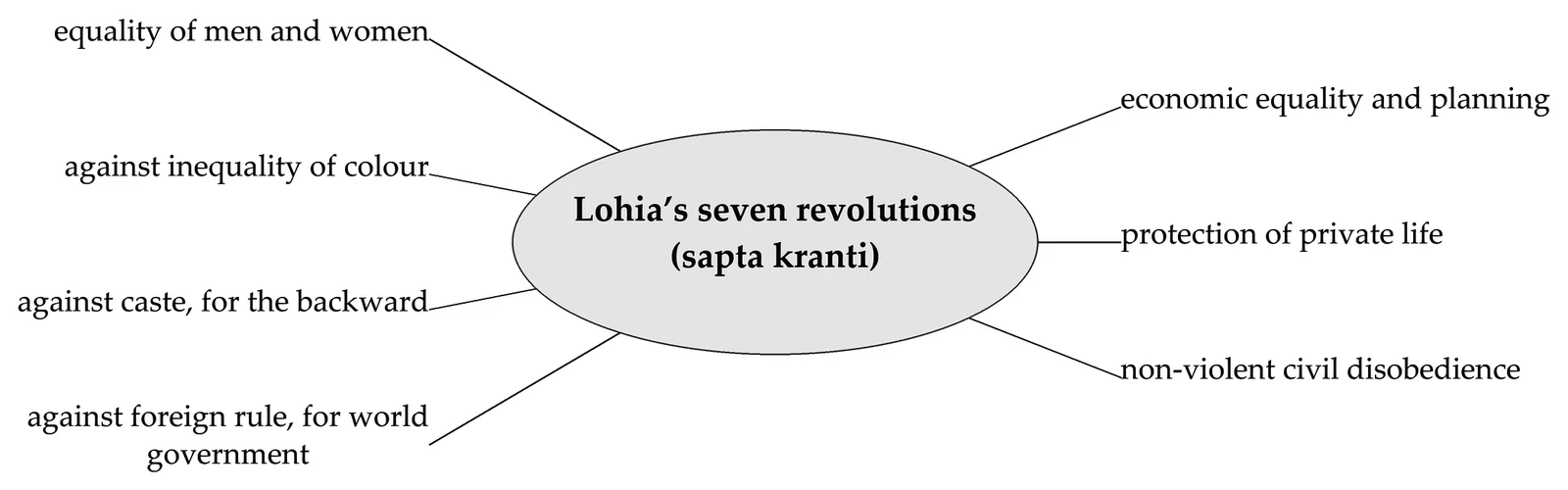
Lohia’s seven revolutions called for equality between men and women, against inequality based on skin colour, against caste, against foreign domination, for economic equality, for privacy and democratic rights, and against weapons in favour of civil disobedience.
8. Gender
Lohia gave great importance to women’s equality, arguing that women were the most oppressed group in Indian society, and linked gender with caste and class.
9. Language
Lohia opposed the dominance of English, which he saw as excluding the masses from power, and campaigned for Indian languages in administration and education.
10. Kumar on Intersectionality
Anand Kumar shows that Lohia’s political sociology anticipated intersectionality, analysing how caste, class, gender and language together shape inequality in India.
11. Tolpadi on Lohia’s Vision
Raghavendra Tolpadi examines the context, discourse and vision of Lohia’s socialism, showing how it grew out of Indian conditions and the struggles of the backward castes.
12. Marx and Lohia Compared
Both sought equality and criticised capitalism. But Marx focused on class and revolution, while Lohia added caste, gender, colour and language, rejected violence and centralisation and favoured decentralised, non-violent change.
13. Influence
Lohia’s ideas influenced the politics of backward castes, the Mandal movement and socialist parties in north India.
14. Criticisms
Critics argue that Lohia’s ideas were not fully systematic, that his opposition to English was impractical and that the parties inspired by him did not always follow his principles.
15. Lohia’s Internationalism
Lohia was an internationalist who called for a world government and a world parliament based on adult franchise, the abolition of discrimination based on colour and race and the reduction of inequality between rich and poor nations. He saw Indian socialism as part of a global struggle for equality.
16. Evaluation
Lohia developed a distinctive Indian socialism that combined equality with decentralisation and recognised multiple forms of inequality.
Conclusion. Thus, Lohia criticised Marxism as Eurocentric and centralising and proposed a decentralised, non-violent socialism suited to India, based on small-scale technology and the chaukhamba raj. Through his Sapta Kranti and his analysis of caste as immobile class, he added caste, gender, colour and language to Marx’s focus on class.
Short Notes
(a) Tyranny of the majority
Mill’s warning that in a democracy the majority may oppress minorities and individuals, not only through laws but through social pressure that suppresses individuality and dissent.
(b) Constitutional morality
Ambedkar’s term, drawn from George Grote, for respect for constitutional forms and restraint by those in power, which he said must be cultivated for democracy to work in India.
(c) Sapta Kranti
Lohia’s seven revolutions: for gender equality, against colour, caste and foreign domination, for economic equality, for privacy and democratic rights, and for civil disobedience against weapons.
More notes: MDSE-6 Themes in Comparative Political Theory
These notes are prepared by PADHO TO AISE for study help. They are not an official University of Delhi publication.