
Semester VII MDSE-6 Themes in Comparative Political Theory
Unit III · 18 min read · Updated 24 Nov 2026
As per the University of Delhi (DU) BA (Hons) Political Science syllabus
Contents
- 3.1 Rousseau on Inequality
- 3.2 Bankim Chandra Chatterjee on Equality
- 3.3 Comparing Rousseau, Bankim and Ambedkar
- 3.4 Important Questions
- Discuss Rousseau’s views on the origin of inequality.
- Discuss Bankim Chandra Chatterjee’s ideas on equality in Samya.
- Compare the views of Rousseau and Bankim Chandra Chatterjee on inequality.
- Discuss B.R. Ambedkar’s critique of caste as graded inequality.
- Short Notes
पहला व्यक्ति जिसने ज़मीन का एक टुकड़ा घेरकर कहा ‘यह मेरा है’ और ऐसे भोले लोग पाए जिन्होंने उस पर विश्वास कर लिया, वही नागरिक समाज का वास्तविक संस्थापक था।
The first man who, having enclosed a piece of ground, bethought himself of saying ‘This is mine’, and found people simple enough to believe him, was the real founder of civil society.
— Jean-Jacques Rousseau, Discourse on the Origin of Inequality (1755)
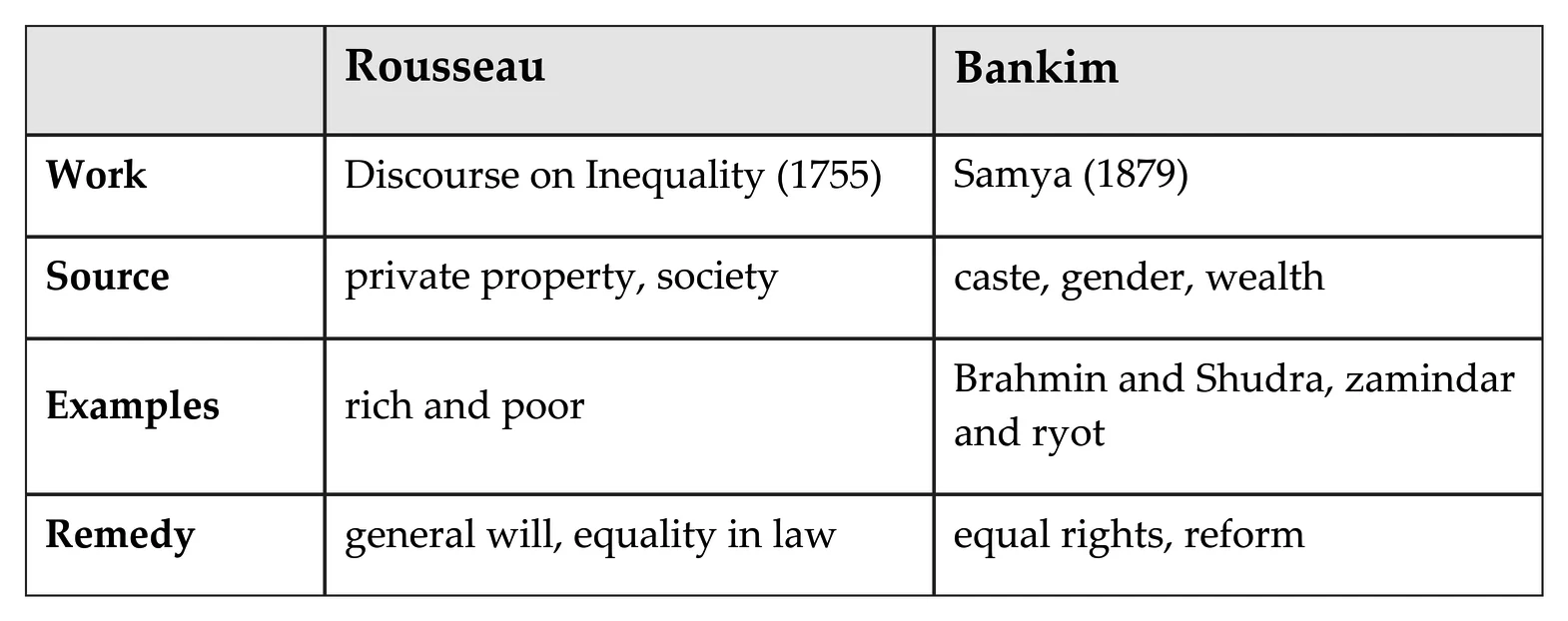
WHY are some people rich and powerful while others are poor and powerless? Two thinkers from very different worlds tried to answer this question. Jean-Jacques Rousseau, in his Discourse on Inequality (1755), argued that inequality is not natural but the product of private property and civilisation. More than a century later, the Bengali writer Bankim Chandra Chatterjee, in his essay Samya (1879), examined the inequalities of caste, gender and wealth in Indian society. The syllabus also asks us to read B.R. Ambedkar, the greatest Indian critic of caste inequality. This chapter compares their ideas, drawing on J.I. Macadam, L. Sorenson, Bibek Debroy’s translation of Samya and Ambedkar’s writings.
3.1 Rousseau on Inequality
Rousseau distinguished natural inequality, differences of age, health and strength, from moral or political inequality, differences of wealth, honour and power created by society. In the state of nature, people were free, independent and roughly equal. Inequality grew with families, agriculture, metallurgy and above all private property, which led the rich to persuade the poor to accept a government that protected their wealth. J.I. Macadam shows how the Discourse prepared the ground for the Social Contract.
3.2 Bankim Chandra Chatterjee on Equality
Bankim Chandra Chatterjee (1838–1894), the novelist who wrote Anandamath and the song Vande Mataram, was also a powerful essayist. In Samya (Equality), influenced by Rousseau, Mill and socialist ideas, he examined three great inequalities in Indian society: between Brahmin and Shudra, between men and women, and between rich and poor, especially zamindars and peasants. He argued that such inequalities were unjust and called for reform.
3.3 Comparing Rousseau, Bankim and Ambedkar
Rousseau and Bankim both distinguished natural from social inequality and traced economic inequality to property. Rousseau sought a remedy in a republic of equal citizens governed by the general will, while Bankim hoped for reform through law and education. Ambedkar went further in analysing caste as graded inequality, a hierarchy that divides workers and denies dignity, and demanded its annihilation.
3.4 Important Questions
- Question 1 Discuss Rousseau’s views on the origin of inequality.
- Question 2 Discuss Bankim Chandra Chatterjee’s ideas on equality in Samya.
- Question 3 Compare the views of Rousseau and Bankim Chandra Chatterjee on inequality.
- Question 4 Discuss B.R. Ambedkar’s critique of caste as graded inequality.
DU asks the same idea in different words. So learn one broad answer for each question below; the same answer works for every question joined by OR.
Important Question 1
Discuss Rousseau’s views on the origin of inequality.
OR
Distinguish between natural and moral inequality in Rousseau’s thought.
OR
How is the Discourse on Inequality related to the Social Contract?
Model Answer
“I conceive that there are two kinds of inequality among the human species; one, which I call natural or physical, … the other, which may be called moral or political inequality.”
— Jean-Jacques Rousseau, Discourse on the Origin of Inequality (1755)
Introduction. In 1753, the Academy of Dijon asked: what is the origin of inequality among men, and is it authorised by natural law? Rousseau’s answer, the Discourse on the Origin of Inequality (1755), argued that inequality is not natural but created by society, especially private property. It is one of the most radical works of political thought and influenced later revolutionary and socialist ideas.
1. Two Kinds of Inequality
Rousseau distinguished natural or physical inequality, differences in age, health, strength and qualities of mind, from moral or political inequality, privileges such as wealth, honour and power that some enjoy at the expense of others, established by convention.
2. The State of Nature
In the state of nature, Rousseau imagined, human beings lived solitary, simple lives, satisfying basic needs. They were free, independent and roughly equal, moved by self-love, amour de soi, and pity for others’ suffering.
3. Perfectibility
What distinguished humans from animals was perfectibility, the capacity to develop and change. This capacity allowed progress but also led humans away from natural freedom into dependence and inequality.
4. The Growth of Society
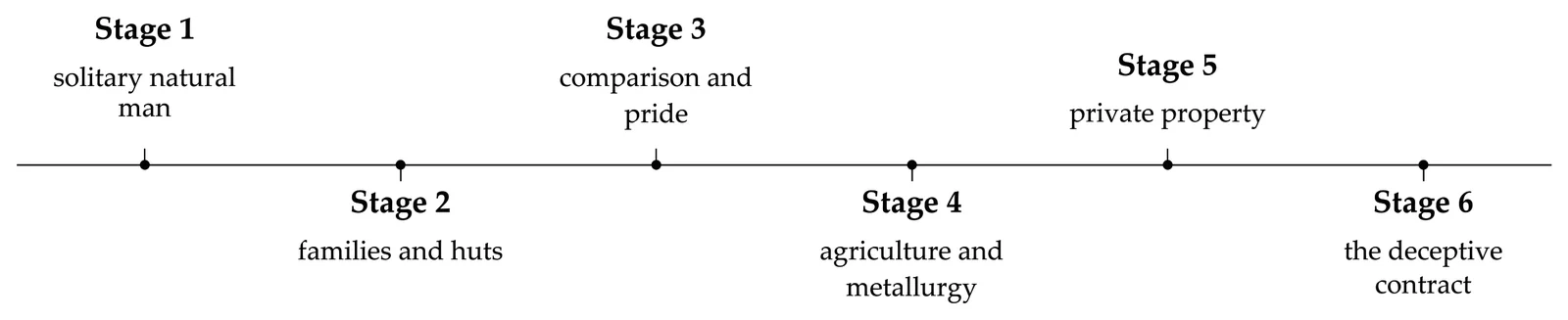
Rousseau traced stages of development: families and huts, settled communities, comparison and pride, and then agriculture and metallurgy, which required cooperation, specialisation and the division of land.
5. Amour-Propre
As people began to compare themselves with others, they developed amour-propre, a self-love based on the desire for esteem. Vanity, envy and competition followed, making inequality a matter of social standing.
6. Private Property
Rousseau declared that the first man who enclosed land, said ‘this is mine’ and found others to believe him was the true founder of civil society. Private property divided people into rich and poor.
7. The Deceptive Contract
The rich, fearing the poor, proposed a social contract to establish laws and government for the protection of all. In reality, this contract secured the property of the rich and made inequality permanent.
8. Despotism
Rousseau argued that inequality culminated in despotism, in which all are equal again, but equal in slavery under an arbitrary ruler.
9. Macadam on the Two Works
J.I. Macadam examines the relationship between the Discourse and the Social Contract (1762). The Discourse diagnoses how a false contract created inequality, while the Social Contract proposes a legitimate contract under which people remain free and equal.
10. Sorenson on Natural Inequality
L. Sorenson examines how Rousseau treated natural inequality, arguing that Rousseau recognised natural differences among people but held that political inequality cannot be justified by them, which supports his demand for political equality.
11. The Remedy
In the Social Contract, Rousseau proposed a republic governed by the general will, with equality before the law and limits on wealth, so that no citizen is rich enough to buy another and none poor enough to be forced to sell himself.
12. Influence
Rousseau’s critique of inequality influenced the French Revolution, socialist thinkers and Marx, and remains a classic account of how social institutions produce inequality.
13. Criticisms
Voltaire mocked Rousseau’s praise of the state of nature, and critics argue that his account is speculative, romanticises primitive life and underestimates the benefits of property and civilisation.
14. Critique of Civilisation
Rousseau’s critique of inequality grew out of his earlier Discourse on the Arts and Sciences (1750), which argued that the progress of the arts and sciences had corrupted morals by encouraging luxury, vanity and the desire to appear rather than to be. For Rousseau, civilisation brought refinement but also dependence, inequality and the loss of natural freedom.
15. Evaluation
Rousseau showed that inequality is a social creation, not a natural fact, making it a central problem for political theory.
Conclusion. Thus, Rousseau distinguished natural inequality from moral or political inequality and argued that the latter arose from society, especially private property and the deceptive contract of the rich. As Macadam shows, the Discourse diagnosed the problem and the Social Contract proposed a remedy through the general will and equality of citizens.
Important Question 2
Discuss Bankim Chandra Chatterjee’s ideas on equality in Samya.
OR
Examine Bankim’s analysis of caste, gender and economic inequality.
OR
What was Bankim’s contribution to Indian political thought?
Model Answer
“The State shall not discriminate against any citizen on grounds only of religion, race, caste, sex, place of birth or any of them.”
— Constitution of India, Article 15(1)
Introduction. Bankim Chandra Chatterjee (1838–1894) is best known as a novelist and the author of Vande Mataram, but he was also an important social thinker. In his essay Samya (Equality), published in 1879, he examined the inequalities of Indian society, influenced by Rousseau, J.S. Mill and contemporary socialist ideas. The essay is one of the earliest Indian discussions of equality as a political principle.
1. Bankim’s Life and Work
Bankim served as a deputy magistrate in British Bengal, edited the journal Bangadarshan from 1872 and wrote novels such as Anandamath (1882). He was a leading figure of the Bengal Renaissance, which reinterpreted Indian tradition in the light of Western ideas.
2. The Essay Samya
In Samya, Bankim argued that inequality exists in all societies, but that much of it is unjust because it is created by society rather than by nature. He drew on Rousseau’s distinction between natural and social inequality and on Mill’s defence of liberty and equality.
3. Caste Inequality
Bankim criticised the inequality between Brahmins and Shudras, in which birth determined status and privilege. He praised figures such as the Buddha and Chaitanya for preaching equality and challenging caste hierarchy.
4. Gender Inequality
Influenced by Mill’s The Subjection of Women, Bankim criticised the subordination of women in Indian society, including their exclusion from education and property, and their unequal treatment in marriage.
5. Economic Inequality
Bankim analysed the inequality between rich and poor, especially between zamindars and ryots, the peasants who worked the land, whose condition he saw as one of exploitation.
6. The Bengal Peasant
In his essay on the Bengal peasant, Bangadesher Krishak, Bankim criticised the Permanent Settlement of 1793, which made zamindars owners of land and left peasants exposed to high rents and oppression, while the country’s wealth benefited only a few.
7. Remedies
Bankim looked to reform, education, changes in law and the spread of ideas of equality rather than revolution. He hoped that society would recognise the injustice of inherited privilege.
8. Debroy’s Translation
Bibek Debroy’s English translation of Samya, published in 2002, made the essay available to a wider audience, highlighting Bankim as an early Indian theorist of equality.
9. Later Turn
In his later years, Bankim turned to a reinterpretation of Hinduism in works such as Krishnacharitra and Dharmatattva, and distanced himself from the radical tone of Samya. His later work influenced cultural nationalism.
10. Bankim and Rousseau
Bankim read Rousseau and shared his view that much inequality is social rather than natural, but applied this idea to Indian institutions, caste, the zamindari system and the position of women.
11. Significance
Samya shows that Indian thinkers engaged creatively with Western ideas of equality and applied them to Indian conditions, linking social reform with political thought.
12. Limitations
Critics note that Bankim wrote from an elite, upper-caste perspective, proposed limited remedies and later moved towards a Hindu revivalism that sat uneasily with his earlier egalitarianism.
13. Relevance
The three inequalities Bankim identified, of caste, gender and wealth, remain central to Indian politics and to debates on social justice.
14. Bankim and Mill
Bankim was a careful reader of J.S. Mill. From Mill’s utilitarianism he took the idea that institutions should be judged by their effects on human happiness, and from The Subjection of Women the argument that the subordination of women rests on custom rather than nature. He applied these liberal arguments to Indian institutions that Mill himself had not examined, such as caste and the zamindari system.
15. Evaluation
Samya is an important early Indian critique of inequality, showing the influence of European ideas transformed by Indian concerns.
Conclusion. Thus, Bankim Chandra Chatterjee, in Samya (1879), examined the inequalities of caste, gender and wealth in Indian society, influenced by Rousseau and Mill. He condemned the privileges of Brahmins, the subordination of women and the exploitation of peasants by zamindars, making an early Indian contribution to the theory of equality.
Important Question 3
Compare the views of Rousseau and Bankim Chandra Chatterjee on inequality.
OR
How did Rousseau’s ideas influence Indian thinking on equality?
OR
Examine the similarities and differences between Rousseau and Bankim on property and inequality.
Model Answer
“No citizen shall ever be wealthy enough to buy another, and none poor enough to be forced to sell himself.”
— Jean-Jacques Rousseau, The Social Contract (1762), Book II
Introduction. Rousseau and Bankim Chandra Chatterjee lived in different centuries and civilisations, yet both wrote powerful critiques of inequality. Rousseau, in eighteenth-century France, traced inequality to private property and civilisation. Bankim, in nineteenth-century colonial Bengal, applied similar ideas to caste, gender and the zamindari system. Comparing them shows how ideas of equality travelled and were transformed.
1. Why Compare
Comparing Rousseau and Bankim illustrates comparative political theory: how a European idea was adopted and adapted by an Indian thinker facing different social structures.
2. Different Contexts
Rousseau wrote in pre-revolutionary France, a society of privileged estates of clergy and nobility. Bankim wrote in colonial Bengal, shaped by caste, the zamindari system created by the Permanent Settlement and British rule.
3. Natural and Social Inequality
Both distinguished natural differences from inequalities created by society, and both argued that the latter, being man-made, could not be justified by nature.
4. Property
Rousseau traced inequality to the origin of private property. Bankim focused on a specific form of property relation, the zamindari system, which concentrated land in the hands of a few and exploited peasants.
5. Hierarchy of Status
Rousseau attacked inequalities of rank and esteem produced by amour-propre. Bankim attacked caste, a hereditary hierarchy of status sanctioned by religion, which had no exact equivalent in Rousseau’s Europe.
6. Gender
Here they differ sharply. Rousseau, in Emile, assigned women a subordinate role, a view criticised by Mary Wollstonecraft. Bankim, influenced by Mill, criticised the subordination of women in Indian society.
7. Remedies
Rousseau sought a radical political solution: a republic governed by the general will, with equal citizens and limits on wealth. Bankim proposed gradual reform through education, law and changes in social attitudes.
8. The Role of the State
For Rousseau, a legitimate state founded on the general will is the means to freedom and equality. Bankim, writing under colonial rule, placed more hope in social reform than in the state.
9. Influence
Bankim read Rousseau, and his essay shows the influence of Rousseau’s distinction between natural and social inequality, combined with Mill’s liberalism and socialist ideas.
10. Legacy
Rousseau’s ideas fed into the French Revolution and later socialism. Bankim’s ideas contributed to Indian social reform and, through his later work, to cultural nationalism.
11. The Ambedkarite Perspective
Ambedkar later offered a deeper critique of caste as graded inequality, going beyond both Rousseau and Bankim in demanding the annihilation of caste.
12. Contemporary Relevance
Inequalities of wealth, caste and gender remain central to politics today, making the questions raised by Rousseau and Bankim still relevant.
13. Limits of the Comparison
Bankim’s essay is shorter and less systematic than Rousseau’s theory, and his later work moved in a different direction, so the comparison must recognise their different scope and purposes.
14. Equality and Freedom
Both thinkers linked equality to freedom. For Rousseau, people who depend on the will of others cannot be free, so equality is the condition of liberty. Bankim similarly saw caste, the subordination of women and the poverty of peasants as forms of servitude that denied people the capacity to live as free and dignified human beings.
15. Equality in the Constitution
Many of the concerns of Rousseau and Bankim are reflected in the Indian Constitution. Article 14 guarantees equality before the law, Articles 15 and 17 prohibit discrimination and abolish untouchability, and the Directive Principles ask the state to reduce inequalities of income and prevent the concentration of wealth.
16. Evaluation
Rousseau and Bankim share a critique of social inequality but differ in context, focus and remedy, showing how ideas are reshaped as they travel.
Conclusion. Thus, Rousseau and Bankim both argued that inequality is social rather than natural and linked it to property. But Bankim applied these ideas to caste, gender and the zamindari system of colonial Bengal, differing from Rousseau on women and proposing reform rather than a new republic.
Important Question 4
Discuss B.R. Ambedkar’s critique of caste as graded inequality.
OR
‘Caste is not merely a division of labour; it is a division of labourers.’ Discuss.
OR
Examine Ambedkar as a thinker of universal human dignity.
Model Answer
“Caste System is not merely division of labour. It is also a division of labourers.”
— B.R. Ambedkar, Annihilation of Caste (1936)
Introduction. B.R. Ambedkar (1891–1956) was the most powerful critic of caste inequality in Indian history. Born into an untouchable caste, he became a scholar, lawyer, social reformer and the chief architect of the Indian Constitution. He analysed caste as a system of graded inequality and demanded its annihilation, making equality the core of his political thought.
1. Ambedkar’s Life
Ambedkar faced untouchability from childhood, yet earned doctorates from Columbia University and the London School of Economics. He led movements for the rights of untouchables, founded political parties and chaired the Drafting Committee of the Constitution.
2. The Origin of Caste
In Castes in India (1916), presented at Columbia University, Ambedkar argued that caste originated in endogamy, marriage within the group, maintained through practices such as sati, enforced widowhood and child marriage, which controlled women.
3. Graded Inequality
Ambedkar described caste as graded inequality: an ascending scale of reverence and a descending scale of contempt. Each caste looks down on those below it, which prevents the oppressed from uniting against the system.
4. Division of Labourers
In Annihilation of Caste (1936), Ambedkar argued that caste is not merely a division of labour but a division of labourers, fixing people in hereditary occupations regardless of ability and ranking them in a hierarchy.
5. Untouchability
Untouchability was the most extreme form of caste inequality, denying basic human dignity. Ambedkar led the Mahad Satyagraha of 1927 for the right to use public water and publicly burned the Manusmriti.
6. Critique of the Shastras
Ambedkar argued that caste was sanctioned by the Hindu scriptures, so reform required rejecting their authority. Without this, he said, caste could not be destroyed.
7. Remedies
Ambedkar proposed inter-caste marriage, rejection of the shastras, education, political safeguards and, finally, conversion. In 1956, he embraced Buddhism with lakhs of followers.
8. Economic Inequality
Ambedkar also addressed economic inequality. In States and Minorities (1947), he proposed state ownership of key industries and agricultural land, a form of state socialism within a constitutional framework.
9. Gender Equality
Ambedkar linked caste to the control of women and, as Law Minister, drafted the Hindu Code Bill to give women rights in marriage, divorce and inheritance.
10. Ambedkar as Vishwa-Manav
Ambedkar is increasingly seen as a Vishwa-Manav, a universal human being, whose struggle for dignity and equality speaks to oppressed people everywhere, not only to Dalits in India.
11. Comparison with Rousseau and Bankim
Like Rousseau and Bankim, Ambedkar saw inequality as social rather than natural, but he identified caste as a unique system of graded inequality and demanded its total annihilation rather than reform.
12. Constitutional Equality
Ambedkar ensured that the Constitution abolished untouchability (Article 17), prohibited discrimination and provided reservations, turning his critique of inequality into constitutional principles.
13. Legacy
Ambedkar’s ideas inspired Dalit movements, social justice politics and debates on equality across the world.
14. Political and Social Democracy
In his speech to the Constituent Assembly on 25 November 1949, Ambedkar warned that India was entering a life of contradictions: equality in politics, with one person one vote, but inequality in social and economic life. He argued that political democracy cannot last unless it rests on social democracy, a way of life based on liberty, equality and fraternity.
15. Evaluation
Ambedkar’s critique of graded inequality is the most profound Indian analysis of social hierarchy, linking caste, gender and economy.
Conclusion. Thus, Ambedkar analysed caste as graded inequality, rooted in endogamy and sanctioned by scripture, and as a division of labourers rather than of labour. Going beyond Rousseau and Bankim, he demanded the annihilation of caste and built equality into the Constitution, making him a universal thinker of human dignity.
Short Notes
(a) Amour-propre
Rousseau’s term for the self-love that depends on comparison with others and the desire for their esteem, which arose in society and produced vanity, envy and inequality.
(b) Samya
Bankim Chandra Chatterjee’s essay on equality (1879), which examined the inequalities of caste, gender and wealth in Indian society under the influence of Rousseau, Mill and socialist ideas.
(c) Graded inequality
Ambedkar’s description of caste as a hierarchy with an ascending scale of reverence and a descending scale of contempt, in which each caste looks down on those below, preventing unity among the oppressed.
More notes: MDSE-6 Themes in Comparative Political Theory
These notes are prepared by PADHO TO AISE for study help. They are not an official University of Delhi publication.