
Semester VII MDSE-6 Themes in Comparative Political Theory
Unit II · 19 min read · Updated 24 Nov 2026
As per the University of Delhi (DU) BA (Hons) Political Science syllabus
Contents
- 2.1 Machiavelli’s Statecraft
- 2.2 Kautilya’s Statecraft
- 2.3 Comparing Machiavelli and Kautilya
- 2.4 Important Questions
- Discuss Machiavelli’s ideas on statecraft.
- Discuss Kautilya’s ideas on statecraft in the Arthashastra.
- Compare the ideas of Machiavelli and Kautilya on statecraft.
- Discuss the theories of kingship in ancient India.
- Short Notes
मुझे कल्पना के बजाय वास्तविक सत्य का अनुसरण करना अधिक उचित लगता है।
It appears to me more appropriate to follow up the real truth of the matter than the imagination of it.
— Niccolò Machiavelli, The Prince (1532), Chapter XV
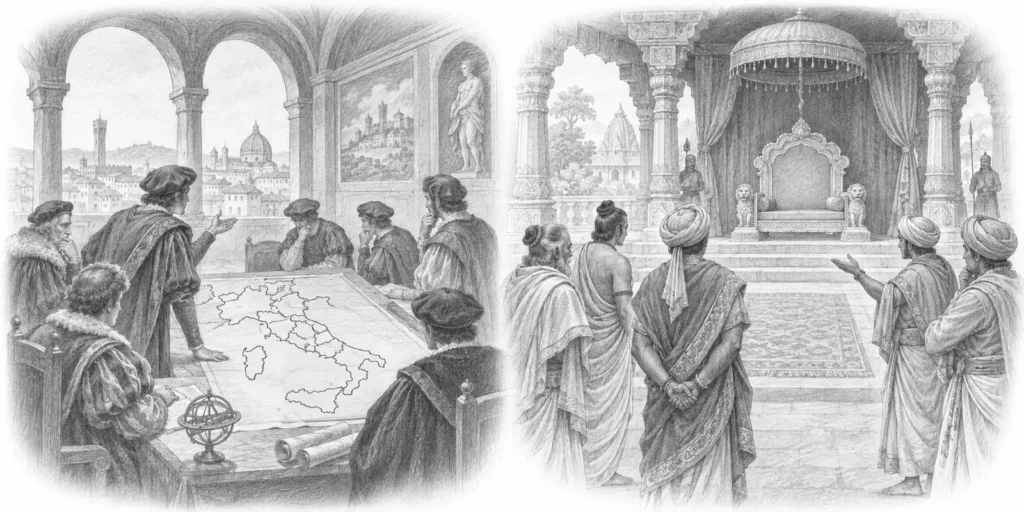
STATECRAFT is the art of governing, gaining and keeping power, and managing relations with other states. Two of the most famous writers on statecraft lived nearly two thousand years apart: Kautilya, the adviser traditionally linked to the Mauryan emperor Chandragupta, whose Arthashastra is a detailed manual of government, and Niccolò Machiavelli, the Florentine diplomat whose The Prince shocked Europe with its frank advice to rulers. Both are seen as founders of political realism. This chapter studies their ideas and compares them, drawing on the original texts, V.R. Mehta’s Foundations of Indian Political Thought and John Spellman’s study of ancient Indian kingship.
2.1 Machiavelli’s Statecraft
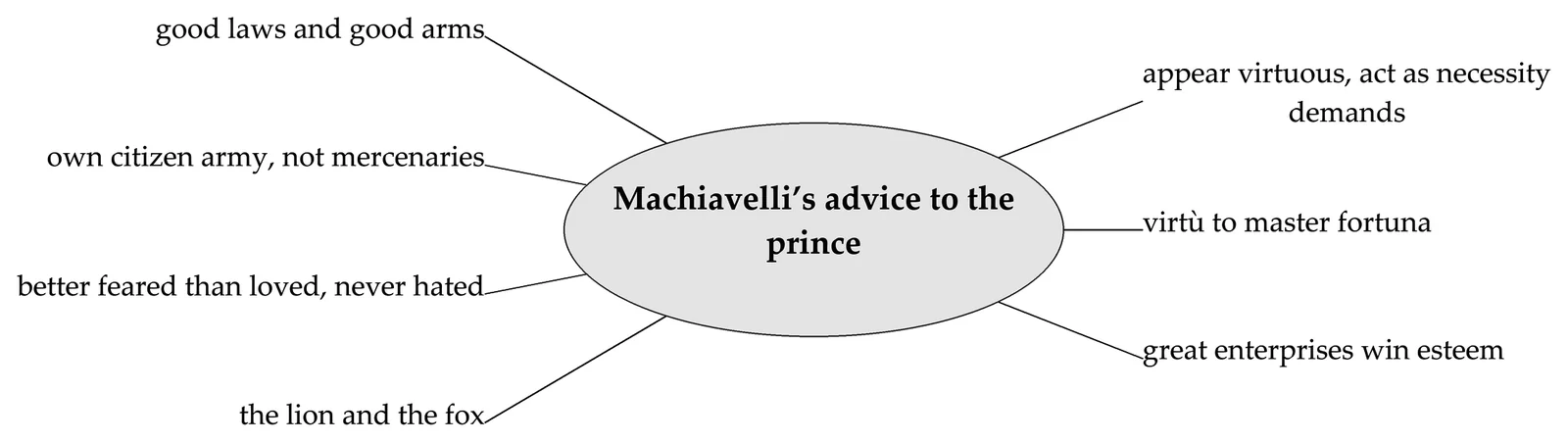
Writing amid the wars and instability of Renaissance Italy, Machiavelli studied how rulers actually gain and keep power. He argued that a prince must be prepared to act against conventional morality when necessary, combining virtù, energy and skill, to master fortuna, chance. It is safer to be feared than loved, and a prince must be both a fox and a lion. His aim was a strong, stable state and, ultimately, the unification of Italy.
2.2 Kautilya’s Statecraft
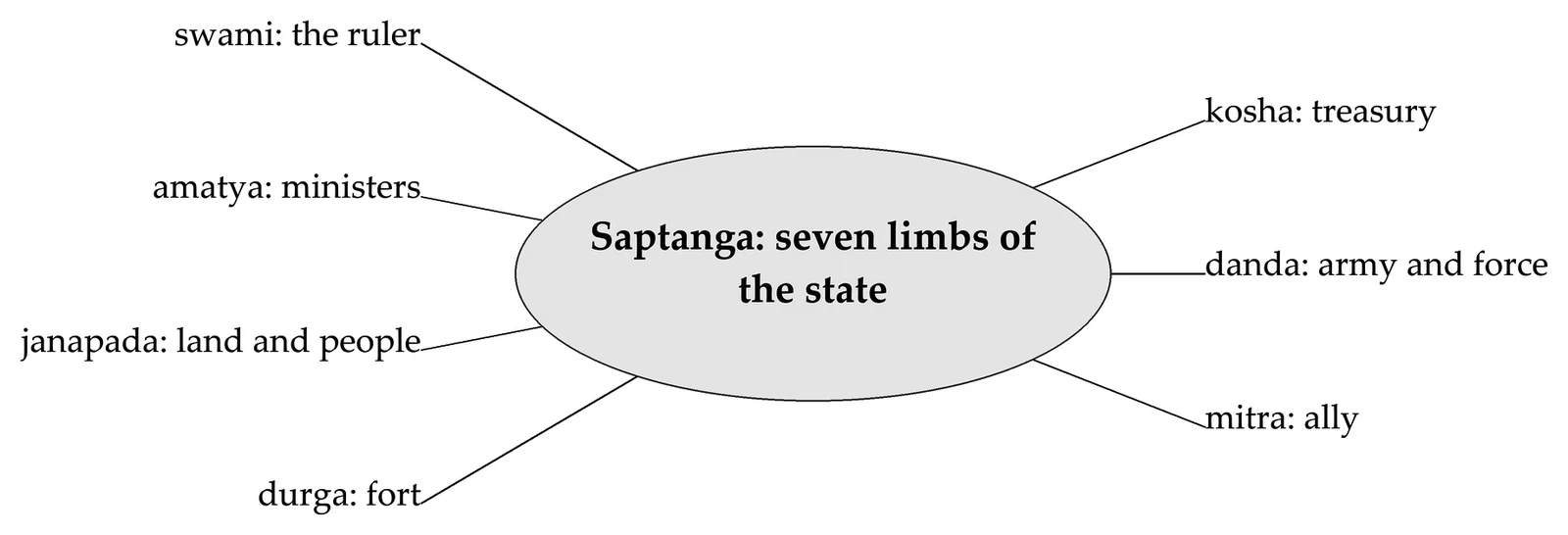
Kautilya’s Arthashastra is a comprehensive treatise on government, covering the king’s training, administration, economy, law, espionage, diplomacy and war. The state has seven elements, the saptanga, and relations with other states follow the mandala of friends and enemies and a six-fold policy. The aim of the state is yogakshema, the security and welfare of the people, and the king’s power, though realist, operates within dharma.
2.3 Comparing Machiavelli and Kautilya
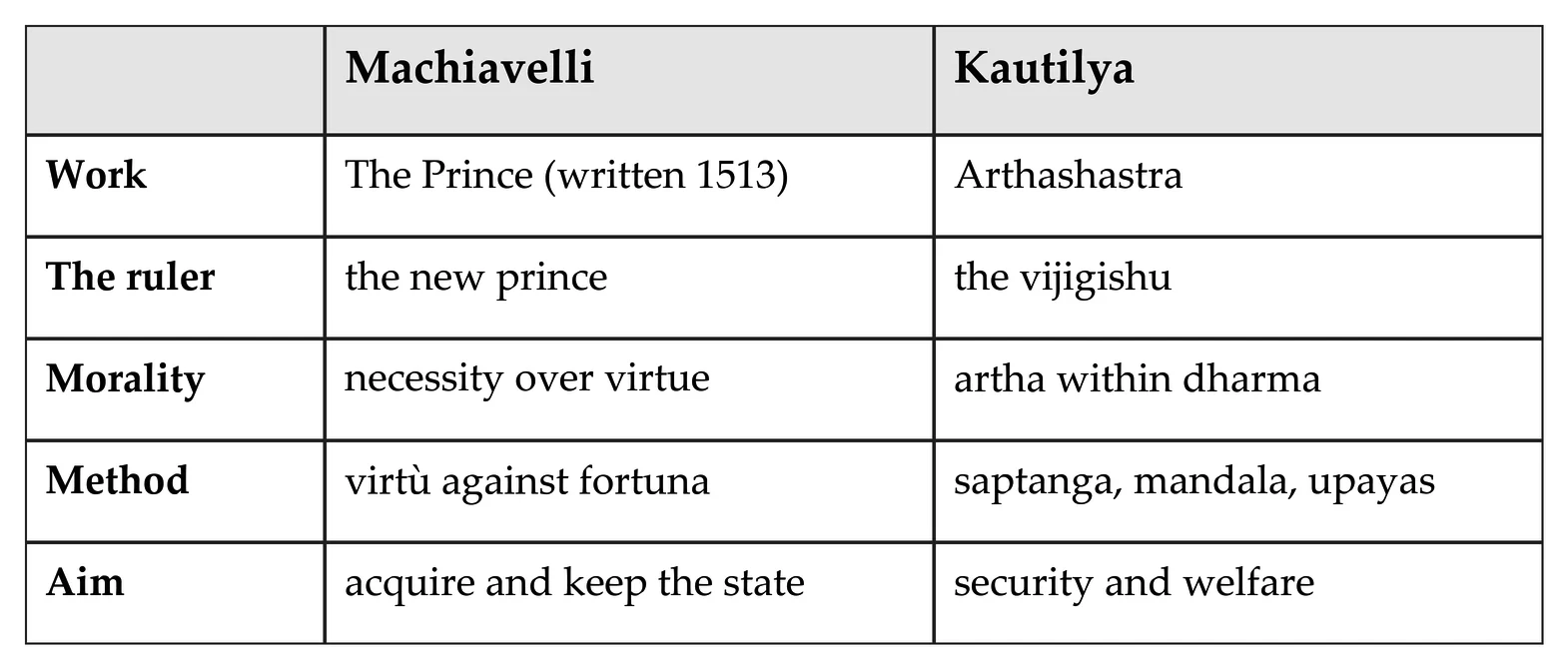
Both thinkers were realists who advised rulers, studied power as it is and accepted deceit and force when necessary. But Kautilya’s work is far more systematic, covering administration and the economy in detail, and places the welfare of subjects and dharma at the centre, while Machiavelli focused on the founding and preservation of the state. Max Weber famously said that compared with the Arthashastra, The Prince is harmless.
2.4 Important Questions
- Question 1 Discuss Machiavelli’s ideas on statecraft.
- Question 2 Discuss Kautilya’s ideas on statecraft in the Arthashastra.
- Question 3 Compare the ideas of Machiavelli and Kautilya on statecraft.
- Question 4 Discuss the theories of kingship in ancient India.
DU asks the same idea in different words. So learn one broad answer for each question below; the same answer works for every question joined by OR.
Important Question 1
Discuss Machiavelli’s ideas on statecraft.
OR
Examine Machiavelli’s views on morality and politics.
OR
Discuss Machiavelli’s concepts of virtù and fortuna.
Model Answer
“It is much safer to be feared than loved, when, of the two, either must be dispensed with.”
— Niccolò Machiavelli, The Prince (1532), Chapter XVII
Introduction. Niccolò Machiavelli (1469–1527) was a Florentine diplomat and political thinker whose The Prince is one of the most famous and controversial works of political theory. Writing amid war and instability in Italy, he gave rulers frank advice on how to gain and keep power, separating politics from conventional morality. He is regarded as a founder of modern political realism.
1. Historical Context
Italy in Machiavelli’s time was divided into rival city-states and invaded by France and Spain from 1494. Machiavelli served the Florentine republic as a diplomat until the Medici returned to power in 1512. Out of office, he wrote The Prince in 1513.
2. Realism
Machiavelli said he would follow the real truth of things rather than imagined republics and principalities. He studied how rulers actually behave, not how they ought to behave, which made his work a turning point in political thought.
3. Human Nature
Machiavelli held a pessimistic view of human nature. People are ungrateful, fickle, deceitful and greedy for gain, and a ruler who assumes they are good will be ruined.
4. Politics and Morality
A prince must learn how not to be good and use this knowledge according to necessity. Conventional virtues such as generosity and mercy can ruin a state, while actions that seem cruel may preserve it.
5. Virtù and Fortuna
Virtù means the energy, skill and boldness of a ruler; fortuna is chance or fortune. Machiavelli compared fortune to a flooding river, which can be controlled by those who build defences in calm times, and held that fortune governs about half of human affairs.
6. Feared or Loved
Machiavelli argued that it is best to be both loved and feared, but if one must choose, it is safer to be feared, because fear is maintained by the threat of punishment. A prince should, however, avoid being hated, especially by not seizing his subjects’ property or women.
7. The Lion and the Fox
A prince must imitate both the lion and the fox: the lion to frighten wolves and the fox to recognise traps. He need not keep his word when it is against his interest, but he must appear merciful, faithful, humane and religious.
8. Appearance and Reputation
Machiavelli stressed that people judge by appearances. A prince must manage his reputation carefully, since the multitude is impressed by what it sees and by outcomes.
9. Arms and the State
The foundations of the state are good laws and good arms, and there cannot be good laws without good arms. Machiavelli condemned mercenary troops and urged rulers to rely on their own citizen armies.
10. The New Prince
Machiavelli focused on the new prince, who must found and secure a state. Such a ruler faces great difficulties and must sometimes use cruelty, but cruelty well used is done all at once and then turned to the benefit of subjects.
11. Republicanism
In his Discourses on Livy, Machiavelli praised republics, in which citizens participate in government and conflict between classes preserves liberty. Many scholars see him as a republican who wrote The Prince for exceptional circumstances.
12. Italian Unification
The last chapter of The Prince calls on a prince to liberate Italy from foreign domination, showing that Machiavelli’s ultimate aim was a strong and united Italy.
13. Interpretations
Machiavelli has been seen as a teacher of evil, a patriot, a republican and a scientist of politics. Rousseau even called The Prince a book for republicans, warning people about tyrants.
14. Religion and the State
In the Discourses, Machiavelli praised the Roman use of religion to unite citizens, encourage obedience to law and inspire courage in war. He valued religion for its political usefulness rather than its truth, and criticised the Church of his time for keeping Italy divided and weak.
15. Reason of State
Machiavelli’s ideas contributed to the later doctrine of reason of state, named by Giovanni Botero in 1589, which holds that the preservation of the state can justify actions that would otherwise be considered wrong. This idea shaped the practice of European statecraft in the following centuries.
16. Evaluation
Machiavelli founded modern political realism by separating politics from conventional morality and studying power as it is. His ideas remain influential and controversial.
Conclusion. Thus, Machiavelli’s statecraft, set out in The Prince, rests on a realist view of human nature and politics. The prince must combine virtù to master fortuna, be feared rather than loved if necessary, act as both lion and fox and rely on good arms, all to found and preserve a strong state.
Important Question 2
Discuss Kautilya’s ideas on statecraft in the Arthashastra.
OR
Examine Kautilya’s theory of the state and administration.
OR
Discuss Kautilya’s views on danda, diplomacy and war.
Model Answer
“That sceptre on which the well-being and progress of the sciences of Anvikshaki, the triple Vedas, and Varta depend is known as Danda.”
— Kautilya, Arthashastra 1.4 (trans. R. Shamasastry)
Introduction. The Arthashastra, attributed to Kautilya, also known as Chanakya or Vishnugupta, the adviser of Chandragupta Maurya, is the most comprehensive ancient Indian treatise on statecraft. It covers the training of the king, administration, the economy, law, espionage, diplomacy and war. It combines hard-headed realism with a commitment to the welfare of the people.
1. The Text
The Arthashastra is divided into fifteen books. A manuscript was discovered by R. Shamasastry in 1905 and published in 1909. Scholars such as Thomas Trautmann argue that the text was compiled and revised over several centuries.
2. The Aim of the State
The state’s aim is yogakshema, the acquisition and protection of welfare. Kautilya wrote that in the happiness of his subjects lies the king’s happiness, making the welfare of the people the purpose of power.
3. The Saptanga Theory
The state consists of seven elements: the king, ministers, territory and people, fort, treasury, army and ally. They are interdependent, like the limbs of a body, and the king must strengthen all of them.
4. The King
The king must be trained in the sciences, control his senses, keep a strict daily routine and be energetic. A disciplined, active king makes his subjects active, while a lazy king ruins the state.
5. Administration
The Arthashastra describes a large bureaucracy of ministers and superintendents in charge of the treasury, mines, trade, agriculture, forests, weights and measures, and more, showing a highly organised state.
6. The Economy
Kautilya saw a strong economy as the basis of power. The state controlled mines, forests and trade, encouraged agriculture, collected taxes and kept a full treasury, since the treasury supports the army.
7. Danda
Danda, punishment, maintains order. Kautilya warned that severe punishment makes the king hated, while mild punishment makes him despised, so punishment must be just and proportionate.
8. Espionage
Kautilya described an extensive network of spies in disguise to watch officials, the public and foreign states, reflecting his realism about human behaviour and threats to the state.
9. The Mandala
In foreign policy, the would-be conqueror is at the centre of a circle of states. The neighbour is a natural enemy and the neighbour’s neighbour a natural friend, and the king must calculate alliances accordingly.
10. The Six-fold Policy
The king chooses among six policies: peace, war, neutrality, marching, seeking alliance and a dual policy, according to his strength relative to others.
11. The Four Means
The four upayas, conciliation, gifts, sowing dissension and force, provide ways of dealing with enemies, with force used only when other means fail.
12. Dharma and Artha
Kautilya gave priority to artha, material well-being and power, as the basis of dharma and kama, but kept the king within the framework of dharma and the welfare of subjects.
13. Mehta and Spellman
V.R. Mehta shows that Kautilya’s realism operated within an Indian view of the state as part of a moral order, while John Spellman places the Arthashastra within the development of ancient Indian ideas of kingship.
14. Law and Justice
Kautilya identified four sources of law: dharma, sacred law; vyavahara, evidence and legal transactions; charitra, custom; and rajashasana, the king’s edicts. Where they conflict, he gave priority to the king’s law, showing the importance he attached to the authority of the state in maintaining order and justice.
15. Corruption and Control
Kautilya was keenly aware of corruption. He listed forty ways in which officials could embezzle revenue and remarked that just as one cannot avoid tasting honey or poison placed on the tongue, an official handling revenue will inevitably taste some of it. He therefore recommended constant inspection, rotation of officials and spies to watch them.
16. Evaluation
The Arthashastra is a remarkably systematic work of statecraft, combining realism about power with a concern for welfare and order.
Conclusion. Thus, Kautilya’s statecraft aims at yogakshema, the welfare and security of the people, through a strong state of seven elements, a disciplined king, an extensive administration and economy, just danda, espionage and a calculated foreign policy based on the mandala and the six-fold policy, all within the framework of dharma.
Important Question 3
Compare the ideas of Machiavelli and Kautilya on statecraft.
OR
‘Compared with the Arthashastra, Machiavelli’s The Prince is harmless.’ Discuss.
OR
Examine the similarities and differences between Kautilya and Machiavelli.
Model Answer
“Truly radical ‘Machiavellianism’ … is classically expressed in the Indian literature in the Arthashastra of Kautilya … compared to it, Machiavelli’s The Prince is harmless.”
— Max Weber, ‘Politics as a Vocation’ (1919)
Introduction. Kautilya and Machiavelli, separated by nearly two thousand years and very different civilisations, are often compared as founders of political realism. Both advised rulers on how to gain and keep power, both accepted deceit and force when necessary, and both studied politics as it is. Yet their aims, methods and scope differ significantly.
1. Why Compare
Comparing them shows that political realism is not only a Western idea, and helps understand how different traditions think about power, morality and the state.
2. Similar Contexts
Both wrote in times of division and conflict: Kautilya amid the rivalry of states before the Mauryan empire, and Machiavelli amid the wars of divided Italy. Both hoped for a strong, unified state.
3. Shared Realism
Both studied power as it actually works, rejecting idealistic illusions. Both accepted that the ruler may use deceit, espionage and force for the good of the state.
4. Human Nature
Both took a cautious view of human nature. Machiavelli saw people as ungrateful and fickle, and Kautilya assumed that officials would steal and that rivals would plot, requiring constant vigilance.
5. Morality and Politics
Machiavelli separated politics from conventional morality. Kautilya also allowed immoral means but placed them within the framework of dharma, so that power served the welfare of subjects.
6. Ends of the State
Machiavelli’s main aims were the security and glory of the state and its founding by a new prince. Kautilya’s aim was yogakshema, the welfare and security of the people, alongside the expansion of the king’s power.
7. The Ruler
Machiavelli’s prince relies on virtù to master fortune. Kautilya’s king relies on training, self-discipline, control of the senses and a strict routine.
8. Scope and System
Kautilya’s work is far more systematic and comprehensive, covering administration, economy, law and foreign policy in detail. The Prince is a short work focused mainly on how to acquire and keep power.
9. Administration and Economy
Kautilya described an elaborate bureaucracy and state control of the economy, while Machiavelli said little about administration or economic policy.
10. Foreign Policy
Kautilya’s mandala and six-fold policy provide a systematic theory of inter-state relations. Machiavelli discussed alliances and warned against neutrality but offered no comparable system.
11. Republicanism
Machiavelli also wrote the Discourses, praising republics and civic participation. Kautilya’s work assumes monarchy, though it discusses republics, or sanghas, as rivals to be divided.
12. Weber’s Verdict
Max Weber argued that Kautilya’s realism was more radical than Machiavelli’s, describing The Prince as harmless by comparison with the Arthashastra’s detailed methods of espionage and manipulation.
13. Limits of the Comparison
Some scholars warn against calling Kautilya the Indian Machiavelli, since this judges Indian thought by a Western standard. Kautilya should be understood in his own context and tradition.
14. Religion and Statecraft
Both thinkers saw religion as politically useful. Machiavelli praised Roman civic religion for uniting citizens, while Kautilya advised the king to use religious festivals, omens and the credulity of people to strengthen the state and weaken enemies, though Kautilya’s king also remained bound by dharma.
15. Relevance Today
Both thinkers are invoked in modern international relations. Machiavelli is seen as a forerunner of realism in Western thought, and Kautilya is increasingly studied as a source of Indian strategic thinking, with scholars and officials referring to the mandala and the six-fold policy when discussing India’s foreign policy.
16. Evaluation
Both are great realists, but Kautilya’s statecraft is more systematic and welfare-oriented, while Machiavelli’s is more concentrated on the founding and survival of the state.
Conclusion. Thus, Machiavelli and Kautilya share a realist approach to power, a cautious view of human nature and acceptance of deceit and force. But Kautilya’s Arthashastra is more systematic, covers administration and economy and places welfare and dharma at the centre, which is why Weber found Machiavelli harmless by comparison.
Important Question 4
Discuss the theories of kingship in ancient India.
OR
Examine John Spellman’s study of kingship in ancient India.
OR
Compare the ancient Indian theory of kingship with Western theories of monarchy.
Model Answer
“‘Chosen by the whole people’ is the meaning of Mahāsammata.”
— Aggañña Sutta, Digha Nikaya 27
Introduction. Kingship was the central political institution of ancient India, and Indian texts developed several theories of its origin, nature, duties and limits. John Spellman’s Political Theory of Ancient India (1964) studies these theories from the earliest times to about 300 CE, and V.R. Mehta places them within the foundations of Indian political thought. They provide the background against which Kautilya’s statecraft should be understood.
1. The Importance of Kingship
Most ancient Indian states were monarchies, and texts from the Vedas to the Arthashastra discussed the king’s origin, powers and duties. Kingship was seen as necessary to protect order and dharma.
2. Spellman’s Study
John Spellman examines how Indian ideas of kingship developed, including theories of the king’s origin, his divinity, his relationship with the Brahmins and the limits on his power, showing that Indian thought contained several competing theories.
3. Vedic Kingship
In the Vedic period, kings were supported by assemblies called the sabha and samiti, and some hymns suggest the people chose the king. Consecration rituals such as the rajasuya gave kingship religious legitimacy.
4. The Divine Theory
The Manusmriti says the Creator made the king from particles of the gods to protect the world. This gave the king great dignity, but it also bound him to rule according to dharma.
5. The Contract Theory
The Shanti Parva of the Mahabharata describes people suffering from anarchy and agreeing to accept a king who would protect them in return for taxes. The Buddhist Aggañña Sutta describes the first ruler, Mahasammata, as chosen by the whole people.
6. The King’s Duties
The king’s duty was to protect his subjects, punish wrongdoers, uphold the dharma of different groups, collect fair taxes and promote welfare.
7. Limits on the King
The king was bound by dharma, the customs of castes, guilds and villages, the advice of ministers and the influence of Brahmins. Some texts suggest that a king who fails to protect his people loses his legitimacy and may be resisted.
8. Kautilya’s King
Kautilya presented the king as the most important element of the state, who must be trained, disciplined and energetic, and whose happiness lies in the happiness of his subjects.
9. Buddhist Ideas of Kingship
Buddhist texts describe the ideal of the chakravartin, the righteous universal ruler who governs by dhamma rather than force, an ideal Ashoka tried to realise.
10. Mehta’s Foundations
V.R. Mehta argues that Indian political thought saw the state as part of a larger moral and cosmic order, with the king as its guardian rather than its master.
11. Comparison with the West
European theories of the divine right of kings, as in Robert Filmer, made the king answerable only to God. Indian theories also sacralised the king but bound him more closely to dharma and the welfare of subjects.
12. Republics as Alternatives
Alongside monarchy, ancient India had republics, or sanghas, governed by assemblies, showing that kingship was not the only political form.
13. Legacy
Indian ideas of the ruler’s duty to protect and serve the people, and of welfare as the aim of the state, influenced later Indian political thought and the ideals of the modern welfare state.
14. Royal Rituals
Great sacrifices such as the rajasuya, a consecration ceremony, and the ashvamedha, the horse sacrifice in which a horse was allowed to roam and the territories it crossed were claimed, displayed the king’s power and legitimacy and linked kingship with the gods and the cosmic order.
15. The King and the Brahmin
Indian texts described a partnership between royal power, kshatra, and priestly authority, brahma. The king relied on the purohita, the royal priest, for ritual and advice, while Brahmins depended on the king for protection. This relationship both legitimised and limited royal power.
16. Evaluation
Ancient Indian theories of kingship combined divine, contractual and functional ideas, binding rulers to dharma and welfare, as Spellman and Mehta show.
Conclusion. Thus, ancient Indian theories of kingship included divine origin, as in the Manusmriti, and contract or election, as in the Shanti Parva and the Aggañña Sutta. As Spellman and Mehta show, the king was bound by dharma and the welfare of his subjects, the framework within which Kautilya’s statecraft developed.
Short Notes
(a) Virtù and fortuna
Machiavelli’s key concepts: virtù is the energy, skill and boldness of a ruler, and fortuna is chance or fortune. A successful prince uses virtù to master fortuna, which Machiavelli compared to a flooding river.
(b) Yogakshema
Kautilya’s term for the aim of the state: the acquisition and protection of the welfare and security of the people.
(c) Mahasammata
In the Buddhist Aggañña Sutta, the first ruler, whose name means the great elect, chosen by the people to maintain order in return for a share of the harvest, an early idea of kingship by consent.
More notes: MDSE-6 Themes in Comparative Political Theory
These notes are prepared by PADHO TO AISE for study help. They are not an official University of Delhi publication.