
Semester VII MDSC-7 Themes in Western Political Philosophy
Unit IV · 21 min read · Updated 24 Nov 2026
As per the University of Delhi (DU) BA (Hons) Political Science syllabus
Contents
- 5.1 Hegel and His Philosophy of Freedom
- 5.2 Ethical Life: The Family
- 5.3 Civil Society
- 5.4 The State
- 5.5 Important Questions
- Explain Hegel’s concept of ethical life with reference to the family, civil society and the state.
- Discuss Hegel’s theory of the state.
- Examine Hegel’s concept of civil society.
- Discuss Hegel’s idea of freedom and his dialectical method.
- Short Notes
जो तर्कसंगत है वह वास्तविक है, और जो वास्तविक है वह तर्कसंगत है।
What is rational is actual and what is actual is rational.
— G.W.F. Hegel, Elements of the Philosophy of Right (1820), Preface
GEORG Wilhelm Friedrich Hegel (1770–1831) was the most ambitious philosopher of German idealism and one of the most influential thinkers of the modern age. He sought to show that history is the progress of the consciousness of freedom, and that freedom is realised not by isolated individuals but in the institutions of a rational community. In the Elements of the Philosophy of Right (1820), he traced the development of freedom from abstract right and morality to ethical life, Sittlichkeit, comprising the family, civil society and the state. Hegel has been read as a liberal, a conservative and even a forerunner of totalitarianism, and his ideas shaped Marx and later political thought. This unit studies his theory of ethical life.

5.1 Hegel and His Philosophy of Freedom
Hegel saw reality as the self-development of spirit (Geist), which comes to know itself through history. History, he argued, is the progress of the consciousness of freedom: in the ancient Orient only one, the ruler, was known to be free; in Greece and Rome some were free; in the modern Germanic world, shaped by Christianity and the Reformation, all are known to be free. His method is dialectical: each stage contains contradictions that are overcome and preserved, sublated, in a higher stage.
The Philosophy of Right develops freedom in three stages. Abstract right is the freedom of persons expressed in property and contract. Morality is the inner freedom of the subject, conscience and intention, which Hegel associated with Kant. Both are one-sided, and they are reconciled in ethical life, the customs and institutions of a community in which individuals find their freedom realised. Hegel criticised Kant’s morality as empty formalism, because duty must be given content by concrete social institutions.
5.2 Ethical Life: The Family
The family is the first, immediate form of ethical life, a unity based on love, in which individuals feel themselves members rather than separate persons. Marriage is not merely a contract but an ethical union freely entered into. The family holds property in common and educates children to become independent persons. When children grow up and parents die, the family dissolves into separate individuals, who enter civil society.

Hegel assigned men to public life in civil society and the state and women to the family, arguing that women were not made for the higher sciences or for government. Feminist critics have challenged this division, which reflects the assumptions of his time.
5.3 Civil Society
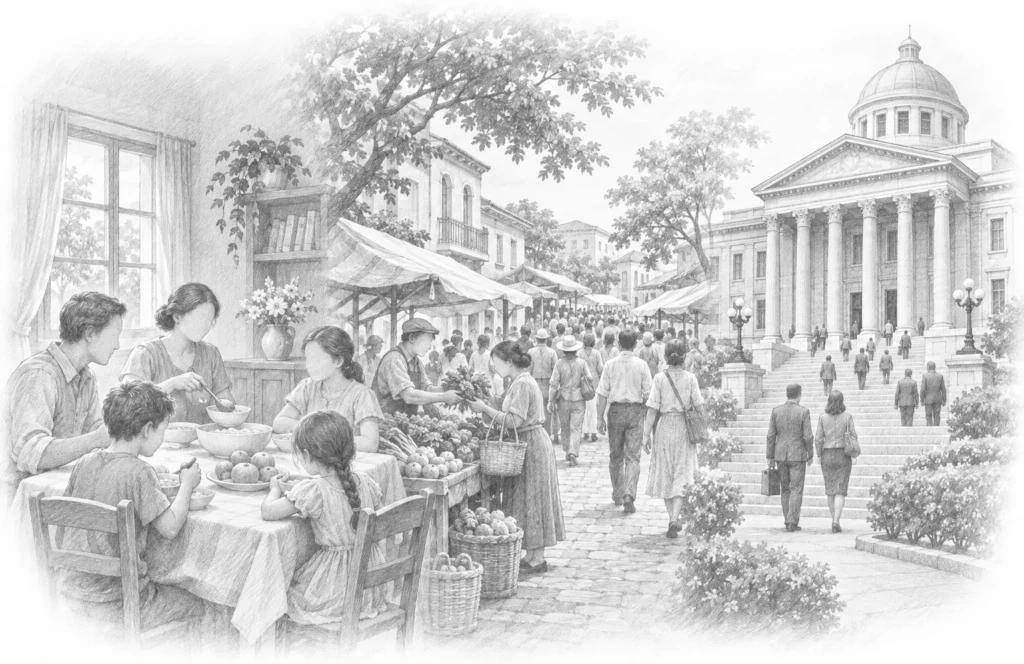
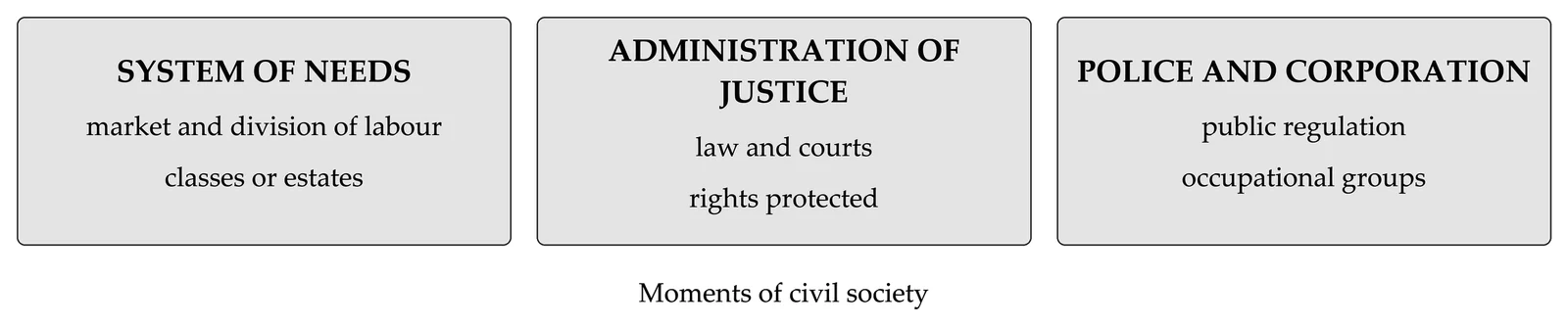
Civil society (bürgerliche Gesellschaft) is the sphere between the family and the state, in which individuals pursue their own particular interests but become dependent on one another. It contains three moments: the system of needs, the market economy with its division of labour and three estates, agricultural, business and the universal estate of civil servants; the administration of justice, which protects property and rights through law and courts; and the police and corporation, which provide public regulation and occupational associations that give members recognition and a sense of community.
Hegel was acutely aware of civil society’s problems. He observed that despite an excess of wealth, civil society is not rich enough to check excessive poverty and the creation of a rabble, and that it is driven to seek markets and colonies abroad. Civil society cannot solve its own contradictions; the state must integrate it.
5.4 The State
The state is the culmination of ethical life, the actuality of the ethical Idea and of concrete freedom, in which the universal interest and individual freedom are reconciled. Hegel’s rational state is a constitutional monarchy with three powers: the crown, which gives the final decision; the executive, staffed by a professional civil service, the universal class; and the legislature, with estates representing the agricultural and business classes. The state is not a mere means to protect property, as in contract theories, but the highest form of community.
Hegel’s claim that what is rational is actual and his praise of the state led Karl Popper to call him an enemy of the open society and a forerunner of totalitarianism. Liberal interpreters such as Shlomo Avineri and Charles Taylor argue that Hegel defended a constitutional state with rule of law, freedom of conscience and representative institutions. Karl Marx, in his critique of 1843, argued that Hegel inverted reality: it is civil society that determines the state, not the reverse.
5.5 Important Questions
- Question 1 Explain Hegel’s concept of ethical life with reference to the family, civil society and the state.
- Question 2 Discuss Hegel’s theory of the state.
- Question 3 Examine Hegel’s concept of civil society.
- Question 4 Discuss Hegel’s idea of freedom and his dialectical method.
DU asks the same idea in different words. So learn one broad answer for each question below; the same answer works for every question joined by OR.
Important Question 1
Explain Hegel’s concept of ethical life with reference to the family, civil society and the state.
OR
What is Sittlichkeit? Discuss its three moments.
OR
Discuss Hegel’s view of the relationship between civil society and the state.
Model Answer
“The state is the actuality of the ethical Idea.”
— G.W.F. Hegel, Elements of the Philosophy of Right (1820), §257
Introduction. Ethical life, or Sittlichkeit, is the central concept of Hegel’s political philosophy. It refers to the customs, institutions and shared ways of life in which individual freedom is realised. Hegel argued that freedom cannot be found in isolated individuals or in abstract moral duty but only in a community of rational institutions: the family, civil society and the state.
1. Freedom as the Theme
Hegel’s Philosophy of Right is a philosophy of freedom. He sought to show how the free will realises itself in the world, through property, moral conscience and finally ethical institutions.
2. Abstract Right and Morality
Abstract right concerns persons as owners of property who make contracts. Morality concerns subjects with inner conscience and intentions. Both are incomplete: abstract right lacks inner meaning, and morality lacks objective content.
3. Meaning of Ethical Life
Ethical life unites the objective order of institutions with the subjective will of individuals. In it, individuals recognise social norms as their own, so that duty and freedom coincide. Hegel drew on the Greek polis but sought a modern form that respects individual freedom.
4. The Family
The family is ethical life in its immediate form, based on love and feeling. Its members are united as parts of a whole rather than as separate persons with competing rights.
5. Marriage and Children
Marriage is an ethical union freely entered into, not merely a contract. The family has common property managed by its head and educates children to become free persons, after which the family dissolves into individuals.
6. Civil Society
Civil society is the sphere of difference, in which individuals pursue particular interests as independent persons but are bound together by mutual dependence through the market, law and associations.
7. The System of Needs
In the system of needs, people work and exchange to satisfy their needs, producing a division of labour and estates: the agricultural, the business and the universal estate of civil servants. Hegel drew on political economists such as Adam Smith.
8. Justice, Police and Corporation
The administration of justice protects property and persons through public law. The police, meaning public authority, regulate markets and provide welfare, while corporations, occupational associations, give members security and recognition.
9. Poverty and the Rabble
Civil society creates great wealth but also great poverty and a rabble that loses its sense of honour and right. Hegel admitted that civil society cannot solve this problem by itself.
10. The State
The state is the highest moment of ethical life, in which the universal interest is consciously pursued and individual freedom is fully realised. It integrates the family and civil society into a rational whole.
11. State and Civil Society
Hegel was among the first to distinguish clearly between civil society and the state. Civil society serves particular interests; the state represents the universal. Contract theorists, he argued, confused the two by making the state a means to protect property.
12. Dialectical Movement
The three moments form a dialectical movement: the unity of the family is broken by the difference of civil society, and both are reconciled in the state, which preserves love and individuality at a higher level.
13. Criticisms
Critics argue that Hegel subordinated the individual to the state, excluded women from public life and idealised the Prussian state. Marx argued that civil society, not the state, is the real foundation of social life.
14. Influence
Hegel’s concept of civil society influenced Marx, Gramsci and modern theories of civil society, while his idea of ethical life influenced communitarians such as Charles Taylor.
15. Evaluation
Hegel’s ethical life offers a rich account of how freedom depends on social institutions. Its emphasis on community and recognition corrects individualist theories, though its view of the state and of women remains controversial.
Conclusion. Thus, Hegel’s ethical life comprises the family, based on love, civil society, the sphere of particular interests and mutual dependence, and the state, the actuality of the ethical Idea, in which universal and particular interests are reconciled and freedom is fully realised.
Important Question 2
Discuss Hegel’s theory of the state.
OR
‘The state is the actuality of concrete freedom.’ Discuss.
OR
Was Hegel a liberal or a forerunner of totalitarianism? Discuss.
Model Answer
“The state is the actuality of concrete freedom.”
— G.W.F. Hegel, Elements of the Philosophy of Right (1820), §260
Introduction. Hegel’s theory of the state is among the most debated in political philosophy. He saw the state not as a necessary evil or a protector of property but as the highest expression of ethical life and freedom. His rational state was a constitutional monarchy with a professional civil service and representative estates. Interpreters disagree whether this made him a liberal, a conservative or a forerunner of totalitarianism.
1. Critique of Contract Theory
Hegel rejected social contract theories, which treat the state as an agreement among individuals to protect their interests. This confuses the state with civil society. The state is not a means but an end in itself, the community in which individuals find their highest freedom.
2. The State as Ethical Idea
The state is the actuality of the ethical Idea, the ethical spirit as substantial will, knowing and thinking itself. It is the realisation of reason and freedom in the world.
3. Concrete Freedom
In the state, individuals pursue their particular interests while consciously recognising and willing the universal interest. Their freedom is concrete because it is realised in institutions, not merely abstract or inner.
4. The Rational Constitution
The rational state has a constitution dividing power among three moments: the crown, the executive and the legislature. Unlike the separation of powers, these powers are organically united.
5. The Crown
The monarch represents the moment of final decision and the unity of the state. In a well-ordered state, the monarch’s role is limited: he dots the i’s, signing decisions prepared by others.
6. The Executive and the Universal Class
The executive, staffed by a professional civil service chosen by merit, applies laws and pursues the universal interest. Hegel called civil servants the universal class, since their interest is the public good.
7. The Legislature and the Estates
The legislature includes an upper house representing the landed estate and a lower house representing the business estate through corporations. Representation is through organised groups rather than individuals.
8. Public Opinion
Hegel valued public opinion and freedom of the press but warned that public opinion contains both truth and error and deserves to be both respected and despised.
9. External Sovereignty and War
The state is sovereign in relation to other states. Hegel argued that war has an ethical value, preserving the health of nations by reminding citizens of the higher value of the state, a view critics find disturbing.
10. The Rational and the Actual
Hegel’s statement that what is rational is actual and what is actual is rational led critics to accuse him of justifying existing institutions. Defenders argue that by actual he meant what realises reason, not whatever exists.
11. The March of God
A famous passage, often translated as saying that the state is the march of God in the world, has been cited as glorifying the state. Scholars argue that it means the existence of the state is part of the divine order of history.
12. Popper’s Critique
Karl Popper, in The Open Society and Its Enemies (1945), attacked Hegel as an apologist of the Prussian state and a forerunner of totalitarianism, who subordinated the individual to the state.
13. Liberal Readings
Shlomo Avineri and Charles Taylor argue that Hegel defended a constitutional state with rule of law, freedom of conscience, property rights and representation, and that he opposed both absolutism and mass democracy.
14. Marx’s Critique
Marx argued that Hegel mystified the state by presenting it as the realisation of reason, when it actually reflects the interests of the dominant class in civil society.
15. Evaluation
Hegel’s theory of the state is a profound attempt to reconcile individual freedom with community. Its ambiguities have allowed both liberal and authoritarian interpretations, but it remains central to understanding the modern state.
Conclusion. Thus, Hegel saw the state as the actuality of the ethical Idea and of concrete freedom, organised as a constitutional monarchy with crown, civil service and estates. Popper saw him as a totalitarian forerunner, while Avineri and Taylor read him as a theorist of the rational constitutional state.
Important Question 3
Examine Hegel’s concept of civil society.
OR
Discuss the system of needs, the administration of justice and the corporation in Hegel.
OR
How did Hegel analyse the problem of poverty in civil society?
Model Answer
“Despite an excess of wealth civil society is not rich enough, i.e. its own resources are insufficient, to check excessive poverty and the creation of a penurious rabble.”
— G.W.F. Hegel, Elements of the Philosophy of Right (1820), §245
Introduction. Hegel was among the first philosophers to analyse civil society as a distinct sphere of modern life, separate from both the family and the state. Drawing on political economy, he described the market economy, its institutions and its contradictions, including poverty. His analysis influenced Marx and modern theories of civil society.
1. Meaning of Civil Society
Civil society is the sphere in which individuals, released from the family, pursue their own needs and interests as independent persons. It is the stage of difference, standing between the unity of the family and the unity of the state.
2. Two Principles
Civil society rests on two principles: the particular person pursuing his own ends, and the universal form that connects persons through mutual dependence, since each can satisfy his needs only through others.
3. The System of Needs
The system of needs is the market economy. Needs multiply and are refined, work is divided, and exchange connects producers. Hegel drew on Adam Smith, Say and Ricardo, admiring how the pursuit of self-interest produces a system of interdependence.
4. The Estates
The division of labour produces three estates: the agricultural estate, close to nature and family; the business estate of craftsmen, manufacturers and traders, which relies on its own work; and the universal estate of civil servants, which serves the public interest.
5. Administration of Justice
The administration of justice makes rights public and secure through written law, courts and public trials, protecting property and persons. Law must be known to all.
6. The Police
The police, in Hegel’s broad sense of public authority, regulate markets, supervise prices and quality, provide public works, education and welfare, and deal with contingencies that individuals cannot manage.
7. The Corporation
Corporations are occupational associations, similar to guilds, that care for their members, train them and give them recognition and honour. They form a second family for members and a bridge between civil society and the state.
8. Poverty
Hegel recognised that civil society produces poverty. When many fall below a certain standard of living, they lose their sense of right and honour and become a rabble, while wealth is concentrated in a few hands.
9. The Rabble
The rabble is not just poverty but the inner disposition of resentment against society. Hegel considered this one of the most disturbing problems of modern society.
10. No Easy Solution
Hegel examined solutions: charity or public support would undermine independence and honour; providing work would increase overproduction. Despite an excess of wealth, civil society is not rich enough to prevent poverty.
11. Colonisation
Civil society is therefore driven beyond its borders to seek markets and to found colonies, exporting its surplus population. This anticipated later theories of imperialism.
12. Civil Society and State
Because civil society cannot solve its own contradictions, it must be integrated into the state, which pursues the universal interest and gives ethical meaning to economic life.
13. Influence on Marx
Marx took over Hegel’s concept of civil society but argued that it is the real foundation of the state, and that its contradictions, especially between capital and labour, can be resolved only by revolution.
14. Later Theories
Gramsci later redefined civil society as the sphere of voluntary associations and culture in which hegemony is built, and contemporary theorists use the term for the space of associations between state and market.
15. Hegel and Political Economy
Hegel was one of the first philosophers to study political economy seriously, reading James Steuart and Adam Smith. He admired the way the market turns self-interest into a system of mutual dependence, which he saw as a rational achievement of the modern world. But unlike the economists, he did not believe the market could regulate itself, and he insisted that ethical institutions must govern economic life.
16. Evaluation
Hegel’s analysis of civil society was remarkably prescient in identifying both the dynamism of the market and its tendency to produce poverty and alienation.
Conclusion. Thus, Hegel’s civil society comprises the system of needs, the administration of justice, and the police and corporation. He saw that it produces both wealth and a penurious rabble that it cannot remedy, so that it must be integrated into the state, an analysis that deeply influenced Marx.
Important Question 4
Discuss Hegel’s idea of freedom and his dialectical method.
OR
How did Hegel criticise Kant’s moral philosophy?
OR
Explain Hegel’s philosophy of history as the progress of the consciousness of freedom.
Model Answer
“The owl of Minerva spreads its wings only with the falling of the dusk.”
— G.W.F. Hegel, Elements of the Philosophy of Right (1820), Preface
Introduction. Hegel’s political philosophy is part of a larger system in which reality is understood as the development of spirit towards self-knowledge and freedom. His dialectical method and his philosophy of history explain how freedom develops through contradiction and conflict. His critique of Kant shows why he located freedom in social institutions rather than individual conscience.
1. Spirit
Hegel understood reality as spirit (Geist), the self-developing activity of reason that comes to know itself through nature, human history and culture.
2. The Dialectic
Dialectic is the movement of thought and reality through contradictions. Each stage reveals its one-sidedness, is negated, and is preserved at a higher level, a process Hegel called sublation (Aufhebung). The formula thesis-antithesis-synthesis is a later simplification.
3. History as Progress of Freedom
Hegel held that world history is the progress of the consciousness of freedom. In the ancient Oriental world, only one person, the despot, was free; in the Greek and Roman world, some were free; in the modern Germanic world, all are known to be free.
4. The Cunning of Reason
Individuals pursue their own passions, but reason uses them to realise its purposes in history. World-historical individuals such as Caesar and Napoleon serve the progress of spirit without knowing it.
5. Freedom as Self-determination
For Hegel, freedom is not mere absence of constraint or arbitrary choice but self-determination: the will willing itself, finding itself at home in the world it inhabits.
6. Abstract Right
The first form of freedom is abstract right: persons express their will in property, exchange it through contract, and violate it through wrong and crime, which punishment restores.
7. Morality
The second form is morality, the freedom of the subject who acts on intention and conscience and seeks the good. This is Kant’s standpoint.
8. Critique of Kant
Hegel argued that Kant’s categorical imperative is an empty formalism: the test of universalisability cannot tell us our concrete duties. Conscience alone can justify anything, even evil, and so needs the content of social institutions.
9. Ethical Life
Freedom is fully realised only in ethical life, the family, civil society and the state, where duties are concrete and the individual finds himself recognised in social institutions.
10. Recognition
In the Phenomenology of Spirit (1807), Hegel’s master-slave dialectic showed that self-consciousness requires recognition by others. Freedom is therefore social, depending on relations of mutual recognition.
11. The Owl of Minerva
Philosophy, Hegel wrote, is its own time apprehended in thoughts. It comes too late to instruct the world how it ought to be; the owl of Minerva spreads its wings only at dusk, understanding a form of life once it has matured.
12. Influence on Marx
Marx adopted Hegel’s dialectical method but turned it upside down, replacing the development of spirit with the development of material production and class struggle.
13. Criticisms
Critics argue that Hegel’s philosophy of history is Eurocentric, treating Asia and Africa as stages left behind, and that his system justifies whatever happens as rational.
14. Relevance
Hegel’s ideas of recognition, social freedom and dialectic remain influential in critical theory, communitarianism and theories of identity, such as those of Charles Taylor and Axel Honneth.
15. Hegel and the French Revolution
Hegel welcomed the French Revolution as a glorious dawn of the principle that the world should be governed by reason and freedom. But in the Phenomenology he criticised its pursuit of absolute freedom, which, rejecting all institutions, ended in the Terror. Freedom, he concluded, must be embodied in rational institutions rather than in abstract principles imposed on society.
16. Left and Right Hegelians
After Hegel’s death in 1831, his followers divided. Right Hegelians stressed his reconciliation with existing religion and the Prussian state. Left or Young Hegelians, including Ludwig Feuerbach, Bruno Bauer and the young Marx, used his dialectic to criticise religion and existing institutions, turning Hegel’s philosophy into a weapon of radical criticism.
17. Evaluation
Hegel transformed the idea of freedom from individual choice to social self-realisation, and his dialectic offered a powerful account of historical change, though his Eurocentrism and apparent justification of the present are serious limitations.
Conclusion. Thus, Hegel saw history as the dialectical progress of the consciousness of freedom, realised through abstract right, morality and ethical life. Criticising Kant’s formalism, he located freedom in institutions of mutual recognition, influencing Marx and later social theory.
Short Notes
(a) Sittlichkeit
Hegel’s term for ethical life, the customs, institutions and shared ways of life of a community in which individuals find their freedom realised. Its three moments are the family, civil society and the state, which overcome the one-sidedness of abstract right and morality.
(b) Civil society
For Hegel, the sphere between family and state in which independent persons pursue their own interests but depend on one another through the market, law and corporations. He showed that it produces both wealth and poverty, and must be integrated by the state.
(c) Universal class
Hegel’s name for the professional civil service, chosen by merit and paid by the state, whose particular interest lies in serving the universal interest of the community. It plays a central role in his rational state.
(d) Owl of Minerva
Hegel’s image, from the Preface to the Philosophy of Right, for the idea that philosophy understands a form of life only when it has matured and begun to decline: the owl of Minerva, symbol of wisdom, flies only at dusk.
More notes: MDSC-7 Themes in Western Political Philosophy
These notes are prepared by PADHO TO AISE for study help. They are not an official University of Delhi publication.